The main category of Forex News.
You can use the search box below to find what you need.
[wd_asp id=1]
The main category of Forex News.
You can use the search box below to find what you need.
[wd_asp id=1]
May 21, 2025 – Written by David Woodsmith
STORY LINK GBP/USD Forecast: Pound Finds Fleeting Gains vs Dollar as UK Inflation Soars
The Pound to US Dollar (GBP/USD) exchange rate struck its strongest level since early 2022 on Wednesday, following the publication of hotter-than-anticipated UK inflation data.
At the time of writing, GBP/USD was trading at approximately $1.3405, Virtually unchanged from Wednesday’s opening levels, but down from a high of $1.3469 briefly struck earlier in the session.
The Pound (GBP) initially jumped on Wednesday morning after the UK’s latest consumer price index revealed inflationary pressures were building more rapidly than forecast.
Figures from the Office for National Statistics (ONS) showed headline inflation climbing to 3.5% in April, a notable jump from the previous reading of 2.6% and higher than the expected 3.3%. Core inflation also surprised to the upside, accelerating from 3.4% to 3.8%.
The initial reaction saw GBP surge across the board as investors speculated that sticky inflation could push the Bank of England (BoE) to adopt a more cautious approach on monetary easing. With rate cut bets being pared back, markets quickly priced in a longer period of elevated interest rates.
However, the Pound’s rally didn’t last. As markets analysed the underlying details, it became clear that much of the inflation increase was driven by volatile components, such sharp rise in road tax and increased air fares over the Easter period.
As a result, economists argued that the data was unlikely to alter the BoE’s overall outlook, with most analysts still expecting the central bank to deliver at least two rate cuts later in the year.
The US Dollar remained on the defensive midweek, unable to recover from the recent wave of selling triggered by deteriorating confidence in the US economy.
Concerns about government borrowing and economic slowdown have been growing, particularly after Moody’s decision to cut the US’s credit rating. The move cast a shadow over the long-term sustainability of US fiscal policy and sparked a fresh rise in Treasury yields.
In addition to debt concerns, trade policy uncertainty and mixed economic indicators have made it difficult for the USD to find firm footing. While hopes for a near-term rate cut from the Federal Reserve have cooled, with analysts fearing this will place even more pressure on the US economy in the coming months.
Looking ahead, the UK’s latest PMI releases are likely to shape the direction of the Pound US Dollar exchange rate on Thursday.
Forecasts suggest continued weakness in the UK’s manufacturing sector may offset gains in services, keeping the private sector’s recovery uneven. If the composite PMI slips further, it could reinforce expectations for BoE rate cuts and weigh on the Pound.
Over in the US, S&P’s latest PMI figures are also due. While not as closely watched as the ISM data, they could still influence USD sentiment. A weaker-than-expected reading may deepen concerns over the health of the US economy and extend downside pressure on the Dollar.

International Money Transfer? Ask our resident FX expert a money transfer question or try John’s new, free, no-obligation personal service! ,where he helps every step of the way,
ensuring you get the best exchange rates on your currency requirements.
TAGS: Pound Dollar Forecasts
Via Metal Miner
The Copper Monthly Metals Index (MMI) retraced to the downside with a 4.23% decline from March to April. Looking at copper prices today, analysts seem to be struggling with ongoing trade policy shifts.
Comex copper prices have experienced wild swings over the past few months. First, they hit a new all-time high in March before plunging in April. By mid-May, they entered into a shaky sideways trend.

Source: MetalMiner Insights
Tariffs continue to drive the market. This month, markets have mostly been reacting to the U.S.’s most recent deals with China and the UK. Both appeared to ease concerns that the broad-based tariffs announced over recent months may prove less extreme than expected, resulting in renewed optimism about the global economy.
While mostly stable, the bias appears increasingly to the downside for Comex copper prices today. This is mainly because tariff deals have yet to fully ease the demand concerns that continue to plague the market.
The International Copper Study Group counts itself among those not particularly concerned about supply. Contrary to previous worries that the copper market was on the verge of growing deficit, the ICSG expects the market to maintain its surplus status in both 2025 and 2026.

The group noted “Uncertainty surrounding international trade policy that is likely to weaken the global economic outlook and negatively impact copper demand, usage growth rates have been revised down compared to the Group’s September 2024 forecasts.” As a result, the surplus expectation more than doubled for 2025. Considering the surplus accumulated during 2024, this will leave the market with a significant cushion as trade policy evolves.
While the raw material market remains tight, global growth prospects remain a concern. The U.S. economy shrank by 0.3% in Q1. Meanwhile, deflation remains a lingering problem for China, which is struggling to lean on domestic demand amid trade barriers in the U.S.
The U.S.-China trade deal may have eased some market concerns about the impact of steep tariffs on the world’s two largest economies. However, uncertainty lingers as the current agreement will expire in 90 days and still leaves a steep 30% tariff on Chinese goods.
Global stocks returned to the upside in May, offering no support for copper prices today. While inventory fluctuations do not boast a strong correlation to copper prices, the rise suggests demand conditions appear relatively stable. Both SHFE and LME inventory levels experienced considerable drawdowns over recent months as material moved to the U.S. amid tariff concerns.

Source: MacroMicro
But while LME stocks continue to decline, SHFE stocks have started to rebound. This, alongside the continued rise in Comex stocks, has added a further drag to bullish expectations for copper prices.
Among the other leading indicators for copper prices, the U.S. dollar index appeared to stabilize, halting declines that pushed the index below its long-term range in previous months.

Source: MetalMiner Insights, Chart & Correlation Analysis Tool
The index, which trades inversely to copper prices, has started to move sideways after regaining some of the losses accumulated in recent months. While it has fallen short of rebounding back to where it stood at the start of the year, the modest increase has seemingly weighed on copper prices over recent weeks.
Investor expectations remain mixed on the future direction of the index. Speculation that the White House might favor a weaker dollar relative to other currencies added considerable weight, particularly after the Trump administration noted the strength of the U.S. dollar has come at the expense of U.S. exports. However, U.S. officials have subsequently clarified that currency policy is not part of ongoing trade negotiations.
Meanwhile, the Federal Reserve has yet to blink with regard to rate cuts. Chairman Jerome Powell has remained reluctant to cut rates since last year, as tariff announcements have risked further inflation pressures in the U.S. While the most recent CPI and negotiations with China could incentivize a softer stance from the Fed, Powell has repeatedly cited “uncertainty” as reason to hold rates steady.
A cut from the Fed would add further pressure on the U.S. dollar, potentially dragging it back below its current range. This could stem further losses for copper prices today, tomorrow, and in the near future. Read MetalMiner’s market outlook and copper price forecast here.
By Nichole Bastin
More Top Reads From Oilprice.com
May 21, 2025 – Written by Ben Hughes
STORY LINK Euro to Dollar Forecast: Danske Hold 12 Month Target of 1.20
The US Dollar has come under renewed pressure on Wednesday and the Euro to Dollar (EUR/USD exchange rate has secured a further strong gain to 2-week highs around 1.1350.
A sustained break above 1.1350 could lead to a challenge on 1.15 while failure could trigger a sharp correction.
MUFG commented; “Any sign of pushing trading partners in Asia (Japan this week) to conducting less or stopping US dollar buying intervention would likely trigger further big moves weaker for the dollar.”
ING sees scope for a dollar recovery; “We think some USD-positive headlines on trade coming from the G7 summit in Canada can put a lid on EUR/USD before the end of the week.” It does not see a near-term move to 1.1500.
Danske Bank maintains a 12-month target of 1.20.
The dollar has been undermined by unease over US fiscal trends and speculation that the US Administration will look for key trading partners to accept stronger currencies which would put wider downward pressure on the US currency.
The Euro has also gained support from evidence of further net capital flows into the Euro area.
G7 Finance Ministers will meet in Banff Canada on Wednesday and Thursday with rumours reverberating across markets.
ING commented; “US Treasury Secretary Scott Bessent is set to hold several bilateral meetings in the coming days. If current speculation proves accurate – and the US is pushing for stronger trading partner currencies – it could not only prompt sharp appreciation in those currencies but also weigh on the dollar more broadly.”
HSBC considers that speculation of currency talk is overblown; “The reports have tried to spin this into a possible precursor to some kind of deal to strengthen the JPY as part of a trade deal with the US. Nothing the finance minister has said would support this thesis.”
Credit Agricole added; “We continue to believe that the US would not explicitly abandon its “strong USD” policy and further think that the US Treasury Secretary Bessent could reiterate that a stable and strong currency is in the US best interest.”
The dollar could also gain net support if trade talks make progress.
ING added; “Incidentally, recent developments suggest that the US administration tends to dial down trade tensions after direct talks with other leaders, and any signs of de-escalation should provide some support for the dollar.”
Markets are also monitoring wider US fundamentals with the US Administration looking to get the Budget Bill passed in the House of Representatives.
MUFG commented; “There are other factors at play too that are reinforcing dollar selling pressure. Investors remain concerned over the fiscal outlook in the US with the Wall Street Journal reporting that a deal on the SALT cap to unify the Republicans has been reached to get the tax cutting bill moving through Congress.”
According to Goldman Sachs; “The U.S. still faces the worst growth-inflation mix of the major economies, and as the fiscal bill makes its way through Congress, eroding U.S. exceptionalism is proving – literally – costly at a time of large funding needs.”
The dollar will struggle if there is evidence of a sustained net asset flows away from the US.
SocGen noted that previous credit-rating downgrades have not had a sustained impact but commented; “the big driver of FX moves at the moment is a loss of attraction in US assets in general. Or, more particularly, a realization that everyone is very overweight something that might be a little riskier than they thought.”
The Euro area recorded the second-largest current account surplus on record for March and there were further net inflows into Euro-Zone capital markets.
MUFG commented; What has also become clear from the flow data on the financial account side of the balance of payments is that the end of negative rates in core Europe has helped to draw in demand for euro-zone fixed income from abroad.
These flows will provide structural Euro support.
International Money Transfer? Ask our resident FX expert a money transfer question or try John’s new, free, no-obligation personal service! ,where he helps every step of the way,
ensuring you get the best exchange rates on your currency requirements.
TAGS: Euro Dollar Forecasts
Silver price (XAG/USD) hits a fresh weekly high to near $33.20 during North American trading hours on Wednesday. The white metal strengthens as the US Dollar (USD) extends its downside on the United States (US) credit rating erosion in the wake of large debt levels and escalated fiscal imbalances.
The US Dollar Index (DXY), which tracks the Greenback’s value against six major currencies, slumps to near 99.50, the lowest level seen in two weeks. Technically, a soft US Dollar makes the Silver price a value bet for investors. Additionally, concerns over US credit erosion improve the safe-haven demand of non-yielding assets, such as Silver.
The table below shows the percentage change of US Dollar (USD) against listed major currencies today. US Dollar was the weakest against the Japanese Yen.
| USD | EUR | GBP | JPY | CAD | AUD | NZD | CHF | |
|---|---|---|---|---|---|---|---|---|
| USD | -0.49% | -0.30% | -0.57% | -0.51% | -0.54% | -0.56% | -0.48% | |
| EUR | 0.49% | 0.19% | -0.11% | -0.04% | -0.02% | -0.07% | 0.01% | |
| GBP | 0.30% | -0.19% | -0.29% | -0.21% | -0.20% | -0.25% | -0.19% | |
| JPY | 0.57% | 0.11% | 0.29% | 0.05% | 0.04% | 0.00% | 0.09% | |
| CAD | 0.51% | 0.04% | 0.21% | -0.05% | -0.03% | -0.04% | 0.02% | |
| AUD | 0.54% | 0.02% | 0.20% | -0.04% | 0.03% | -0.04% | 0.04% | |
| NZD | 0.56% | 0.07% | 0.25% | -0.00% | 0.04% | 0.04% | 0.07% | |
| CHF | 0.48% | -0.01% | 0.19% | -0.09% | -0.02% | -0.04% | -0.07% |
The heat map shows percentage changes of major currencies against each other. The base currency is picked from the left column, while the quote currency is picked from the top row. For example, if you pick the US Dollar from the left column and move along the horizontal line to the Japanese Yen, the percentage change displayed in the box will represent USD (base)/JPY (quote).
On Friday, Moody’s downgraded the US Sovereign Credit rating by one notch to Aa1 from Aaa amid concerns over ballooning debt levels to near $36 trillion. The credit rating firm also warned of debt levels widening further, with US President Donald Trump aiming to pass a new tax-cut bill to fulfil his economic agenda.
However, Republican lawmakers didn’t back the new tax bill in a closed-door meeting on Capitol Hill on Tuesday due to disagreement over higher deductions in state and local tax payments, according to a Republican Representative Mike Lawler, Reuters reported.
Meanwhile, investors keep a close eye on the Russia-Ukraine truce talks in the Vatican City. On Monday, US President Trump confirmed immediate ceasefire talks between Moscow and Kyiv through a post on Truth. Social, but didn’t mention any specific timeframe. Trump expressed confidence that talks would be majorly about ending the war and not a temporary truce. Russia and Ukraine will immediately start negotiations toward a Ceasefire and, more importantly, an END to the War,” Trump said. Signs of progress in the Russia-Ukraine truce talks towards ending the war will be unfavorable for safe-haven assets, such as Silver.
Silver price delivers a breakout of the Descending Triangle formation on a daily timeframe, which results in a strong upside move. The near-term trend of the white metal is bullish as it holds the 20-period Exponential Moving Average (EMA), which trades around $32.65.
The 14-period Relative Strength Index (RSI) oscillates inside the 40.00-60.00 range, indicating a sideways trend. Should a fresh bullish momentum emerge if the RSI breaks above 60.00.
Looking up, the March 28 high of $34.60 will act as key resistance for the metal. On the downside, the April 11 low of $30.90 will be the key support zone.
Silver is a precious metal highly traded among investors. It has been historically used as a store of value and a medium of exchange. Although less popular than Gold, traders may turn to Silver to diversify their investment portfolio, for its intrinsic value or as a potential hedge during high-inflation periods. Investors can buy physical Silver, in coins or in bars, or trade it through vehicles such as Exchange Traded Funds, which track its price on international markets.
Silver prices can move due to a wide range of factors. Geopolitical instability or fears of a deep recession can make Silver price escalate due to its safe-haven status, although to a lesser extent than Gold’s. As a yieldless asset, Silver tends to rise with lower interest rates. Its moves also depend on how the US Dollar (USD) behaves as the asset is priced in dollars (XAG/USD). A strong Dollar tends to keep the price of Silver at bay, whereas a weaker Dollar is likely to propel prices up. Other factors such as investment demand, mining supply – Silver is much more abundant than Gold – and recycling rates can also affect prices.
Silver is widely used in industry, particularly in sectors such as electronics or solar energy, as it has one of the highest electric conductivity of all metals – more than Copper and Gold. A surge in demand can increase prices, while a decline tends to lower them. Dynamics in the US, Chinese and Indian economies can also contribute to price swings: for the US and particularly China, their big industrial sectors use Silver in various processes; in India, consumers’ demand for the precious metal for jewellery also plays a key role in setting prices.
Silver prices tend to follow Gold’s moves. When Gold prices rise, Silver typically follows suit, as their status as safe-haven assets is similar. The Gold/Silver ratio, which shows the number of ounces of Silver needed to equal the value of one ounce of Gold, may help to determine the relative valuation between both metals. Some investors may consider a high ratio as an indicator that Silver is undervalued, or Gold is overvalued. On the contrary, a low ratio might suggest that Gold is undervalued relative to Silver.
May 21, 2025 – Written by David Woodsmith
STORY LINK Pound to Dollar Forecast: GBP Gains on USD Weakness, UK Inflation
A combination of U.S. Dollar weakness and stronger than expected UK inflation triggered a surge in the Pound to Dollar (GBP/USD) exchange rate to 3-year highs just below 1.3470.
The pair, however, was unable to hold the gains and retreated to 1.3410 as the Pound dipped and the dollar recovered from Asian lows.
A sustained break above 1.3445/50 remains key to generating further medium-term gains.
According to UoB; “based on the current momentum, any advance might find the late April high of 1.3445 difficult to break.”
Markets now consider that a June Bank of England rate cut is very unlikely, but the longer-term debate is continuing to rage amid the debate over underlying inflation.
According to the ONS, the headline year-on-year inflation rate posting a stronger than expected surge to 3.5% from 2.6% previously and above consensus forecasts of 3.3%.
The core rate increased to 3.8% from 3.4% and above market expectations of 3.6%.
A key element was the increase in retail energy prices. There was also upward pressure from transport, recreation and culture which was offset by some weakness in clothing and footwear.
The goods inflation rate increased to 1.7% from 0.6% while the services-sector rate jumped to 5.4% from 4.7%.
Following the data, markets were less confident that there would be two further rate cuts this year, but views were mixed.
Luke Bartholomew, deputy chief economist at the fund manager Aberdeen; “we think a quarterly profile of rate cuts remains appropriate, but the chance of the easing cycle speeding up any time soon has fallen.
Goldman Sachs economist James Moberly sees a June cut as being off the agenda, but does not expect further increases in inflation and added; “in fact, we see services inflation falling back below the BoE’s projections later in the year.”
He added; “Given the restrictive policy stance, notable labour market loosening, a likely deceleration in pay growth, and a softer near-term demand outlook, we therefore continue to expect the Bank to accelerate the pace of cuts in the second half.”
In contrast, Berenberg considers that the BoE might not be able to cut rates again this year if services inflation increases further; “That would be evidence that demand is solid enough for companies to pass on increases in their costs, and force the Bank of England to take an extended pause in their cutting cycle until services inflation is on a downward path again.”
The dollar index retreated to 2-week lows before a tentative recovery.
Danske Bank commented; “This seems reflective of the fiscal jitters related to last week’s downgrade from Moody’s and the overly accommodative tax bill now being discussed in Congress.”
ING commented; “Periods of data silence often serve as a useful gauge of the market’s underlying bias in FX. So far this week, the tendency to add to USD short positions has been clear.”
There will be a series of G7 meetings in Canada over the next few days with speculation that the US will push for other countries to strengthen their currencies as part of any trade deals.
ING added; “If current speculation proves accurate – and the US is pushing for stronger trading partner currencies – it could not only prompt sharp appreciation in those currencies but also weigh on the dollar more broadly.”
MUFG added; “any sign of pushing trading partners in Asia (Japan this week) to conducting less or stopping US dollar buying intervention would likely trigger further big moves weaker for the dollar.”
If there are no hints over a preference for a weaker US currency, there could be scope for the dollar to recover ground.
International Money Transfer? Ask our resident FX expert a money transfer question or try John’s new, free, no-obligation personal service! ,where he helps every step of the way,
ensuring you get the best exchange rates on your currency requirements.
TAGS: Pound Dollar Forecasts
The U.S. dollar index (.DXY) slipped to a two-week low following Moody’s downgrade of the U.S. government’s credit rating last Friday. The downgrade cited rising fiscal risk and projected deficit expansion under President Trump’s proposed tax cuts. UBS analysts noted that the downgrade triggered a fresh round of dollar selling, supporting gold by making it more attractive to foreign buyers.
In FX markets, the dollar weakened across the board. It fell to 144.095 yen and dropped 0.7% against the Swiss franc. Traders are now watching U.S.-Japan discussions, which may touch on currency management and volatility. With Treasury Secretary Scott Bessent expected to meet his Japanese counterpart this week, any signal favoring a weaker dollar could give gold bulls more fuel.
Long-end Treasury yields jumped on Wednesday, as the 30-year yield topped 5% and the 10-year yield hit 4.5%, spurred by expectations that the Trump administration’s tax bill could deepen the deficit by up to $5 trillion. According to Deutsche Bank, final outcomes on the tax bill will significantly shape near-term deficit projections.
Bridgewater’s Ray Dalio added to the pessimism, warning that the real risk is not default, but inflation triggered by the Federal Reserve potentially printing money to manage debt service. This sentiment, echoed in the bond market, is driving capital into gold as investors seek a hedge against monetary debasement.
The US dollar has fallen pretty significantly during the early hours on Wednesday against the Japanese yen, which partially is due to the fact that the interest rates in Japan are spiking all of a sudden. In fact, Japanese government bonds have literally had no bids for two days. What this means is eventually the Bank of Japan is going to have to step in and drive yields down.
So, this is a market that I’m looking at very closely because it hasn’t broken yet. But if and when the Japanese come in and start doing yield curve control, that will put the yen on the back foot. In the short term, we have a lot of support right in this general vicinity. So, although I want to get long of this market in the long term, I’m waiting for that momentum candle.
The Australian dollar has rallied a bit during the trading session on Wednesday in the early hours, but it also looks like we are struggling. I think quite frankly, this is a market where money went to die. There’s just nothing here, and we’re stuck in the same range that we have been in for quite some time. If you are a short-term trader, then you like this setup because the 0.6350 level underneath offers massive support, while the 0.65 level above offers massive resistance. As we continue to chop back and forth, again, if you’re a short-term trader, this is your market. If you’re looking for a bigger trade, we have to break out of this consolidation area first.
For a look at all of today’s economic events, check out our economic calendar.
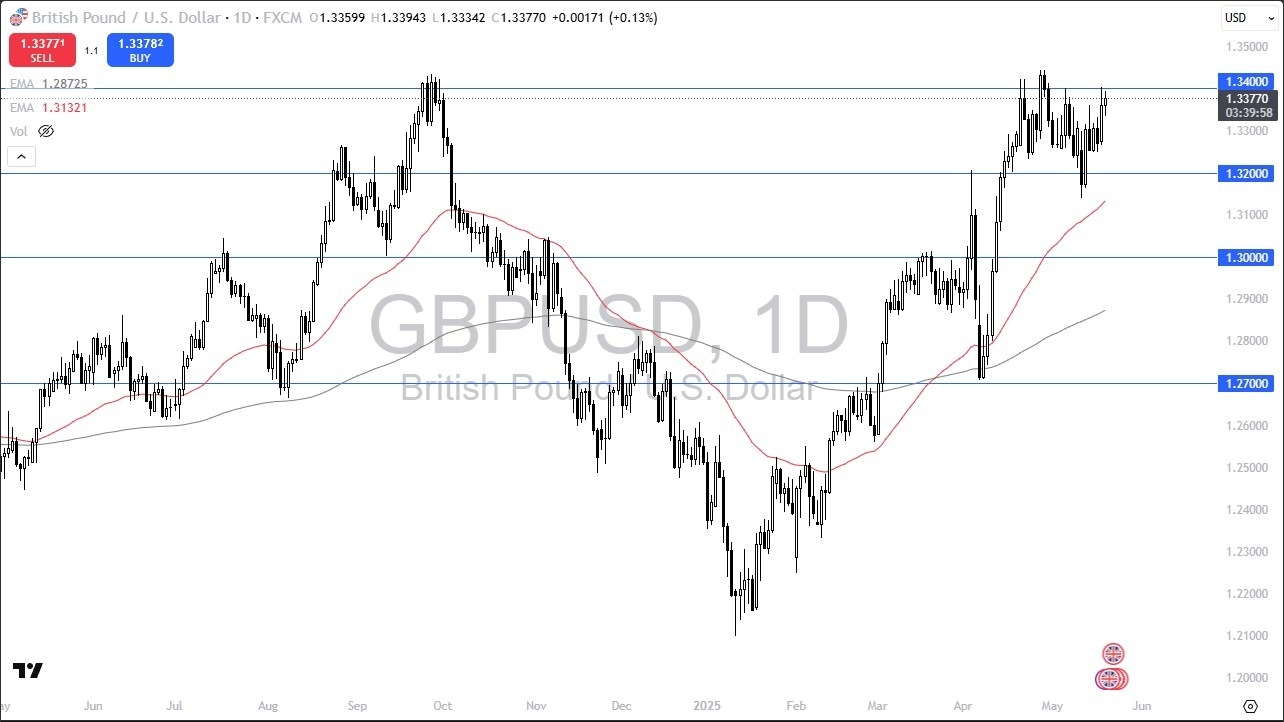
So, I am very interested in it because I do think that if we are going to see the US dollar really start to strengthen, we could see the British pound fail here. We are starting to see US dollar strength against multiple currencies. Although in all fairness, the last major US dollar strengthening push that we had seen, the British pound held its own in relation to other currencies such as the euro or the Canadian dollar, Japanese yen, etc. So, with that being said, it might be more of a slow grind if the short idea does work out.
But keep an eye on the 1.32 level because that’s an area that should be support. And if we break down below there, the 50 day EMA ends up being a target followed by the 1.30 level.

I have no real serious interest in trying to go long of this market until we break above the 1.35 level. Because I think at that point, we start to see a change in attitude. And I think we start to see that the British pound really starts to take off. It’s been a strong move to the upside. But quite frankly, you need to work off some of that fraud. Now the question, of course, is whether or not we are going to be able to find that momentum to the upside, or if we finally fall apart.
Ready to trade our GBP/USD Forex analysis? Here are the best regulated trading platforms UK to choose from.
Christopher Lewis has been trading Forex and has over 20 years experience in financial markets. Chris has been a regular contributor to Daily Forex since the early days of the site. He writes about Forex for several online publications, including FX Empire, Investing.com, and his own site, aptly named The Trader Guy. Chris favours technical analysis methods to identify his trades and likes to trade equity indices and commodities as well as Forex. He favours a longer-term trading style, and his trades often last for days or weeks.
The GBPJPY pair remains affected by the contradiction between the main indicators, delaying the bullish rally, to continue providing sideways trading by its stability near 193.00, as the price remains stable above the main support at 191.20, so the bullish suggestion remains valid, to expect renewing the pressure on the obstacle at 194.60 in order to resume the bullish attack, and 195.30 level represents the next main target for the bullish trading.
The attempt of the moving average 55 to form extra support by its fluctuation near 192.00 makes us keep the bullish suggestion until reaching the mentioned targets.
The expected trading range for today is between 192.45 and 194.00
Trend forecast: Fluctuated within the bullish track.
Do you need help in trading decisions? Do you want to learn how to start trading?
Join Economies.com VIP Club and benefit from over 15 years of market analysis expertise and get:
Special Offer: Subscribe to the Economies.com VIP channel and get also a free subscription to a trusted trading signals channel provided by Best Trading Signal.
EUR/USD preserves its bullish momentum early Wednesday and trades at a fresh two-week-high above 1.1300 after closing the second consecutive day in positive territory on Tuesday. The pair’s near-term technical picture highlights a buildup of bullish momentum.
The table below shows the percentage change of Euro (EUR) against listed major currencies this week. Euro was the strongest against the US Dollar.
| USD | EUR | GBP | JPY | CAD | AUD | NZD | CHF | |
|---|---|---|---|---|---|---|---|---|
| USD | -1.20% | -0.91% | -0.82% | -0.58% | -0.55% | -0.76% | -1.34% | |
| EUR | 1.20% | 0.27% | 0.44% | 0.69% | 0.78% | 0.51% | -0.14% | |
| GBP | 0.91% | -0.27% | -0.15% | 0.42% | 0.51% | 0.24% | -0.41% | |
| JPY | 0.82% | -0.44% | 0.15% | 0.25% | 0.44% | 0.27% | -0.46% | |
| CAD | 0.58% | -0.69% | -0.42% | -0.25% | 0.04% | -0.18% | -0.82% | |
| AUD | 0.55% | -0.78% | -0.51% | -0.44% | -0.04% | -0.27% | -0.90% | |
| NZD | 0.76% | -0.51% | -0.24% | -0.27% | 0.18% | 0.27% | -0.64% | |
| CHF | 1.34% | 0.14% | 0.41% | 0.46% | 0.82% | 0.90% | 0.64% |
The heat map shows percentage changes of major currencies against each other. The base currency is picked from the left column, while the quote currency is picked from the top row. For example, if you pick the Euro from the left column and move along the horizontal line to the US Dollar, the percentage change displayed in the box will represent EUR (base)/USD (quote).
The US Dollar (USD) remained under bearish pressure on Tuesday and helped EUR/USD stretch higher. The lack of progress in US-China trade relations and the political uncertainty in the US seem to be causing the USD to lose interest.
China’s Commerce Ministry said the United States’ measures on China’s advanced chips are “typical of unilateral bullying and protectionism,” adding that the US violates international law by abusing export controls to contain and suppress China. Meanwhile, the Congressional Budget Office (CBO) noted that US President Donald Trump’s tax bill, which are yet to be approved by House Republicans, could add roughly $3.8 trillion to the national debt. Earlier in the week, Moody’s announced that it downgraded the US’ sovereign credit rating to ‘AA1’ from ‘AAA’, citing concerns about the unsustainable deficit.
Meanwhile, European Central Bank Governing Council member Klaas Knot said on Tuesday that the medium-term inflation outlook is too uncertain to say whether the ECB needs to cut key rates again in June.
Investors will pay close attention to political developments in the US and headlines surrounding geopolitics in the second half of the day. If House Republicans pass Trump’s bill, the USD could find some demand with the immediate reaction. However, such a decision could feed into debt fears and make it difficult for the USD to gather strength sustainably. Additionally, a re-escalation of US-China trade tensions could trigger another leg lower in the USD and allow EUR/USD to extend its weekly rally.
EUR/USD climbed above 1.1270, where the 100-period Simple Moving Average (SMA) on the 4-hour chart, the Fibonacci 38.2% retracement of the latest uptrend and the 50-period SMA converge. Additionally, the Relative Strength Index (RSI) indicator climbed above 60, reflecting a buildup of bullish momentum.
On the upside, interim resistance seems to have formed at 1.1340 (static level) before 1.1380 (Fibonacci 23.6% retracement) and 1.1430 (static level). Looking south, supports could be spotted at 1.1270, 1.1200 (static level, round level) and 1.1170 (Fibonacci 50% retracement).
The Euro is the currency for the 19 European Union countries that belong to the Eurozone. It is the second most heavily traded currency in the world behind the US Dollar. In 2022, it accounted for 31% of all foreign exchange transactions, with an average daily turnover of over $2.2 trillion a day.
EUR/USD is the most heavily traded currency pair in the world, accounting for an estimated 30% off all transactions, followed by EUR/JPY (4%), EUR/GBP (3%) and EUR/AUD (2%).
The European Central Bank (ECB) in Frankfurt, Germany, is the reserve bank for the Eurozone. The ECB sets interest rates and manages monetary policy.
The ECB’s primary mandate is to maintain price stability, which means either controlling inflation or stimulating growth. Its primary tool is the raising or lowering of interest rates. Relatively high interest rates – or the expectation of higher rates – will usually benefit the Euro and vice versa.
The ECB Governing Council makes monetary policy decisions at meetings held eight times a year. Decisions are made by heads of the Eurozone national banks and six permanent members, including the President of the ECB, Christine Lagarde.
Eurozone inflation data, measured by the Harmonized Index of Consumer Prices (HICP), is an important econometric for the Euro. If inflation rises more than expected, especially if above the ECB’s 2% target, it obliges the ECB to raise interest rates to bring it back under control.
Relatively high interest rates compared to its counterparts will usually benefit the Euro, as it makes the region more attractive as a place for global investors to park their money.
Data releases gauge the health of the economy and can impact on the Euro. Indicators such as GDP, Manufacturing and Services PMIs, employment, and consumer sentiment surveys can all influence the direction of the single currency.
A strong economy is good for the Euro. Not only does it attract more foreign investment but it may encourage the ECB to put up interest rates, which will directly strengthen the Euro. Otherwise, if economic data is weak, the Euro is likely to fall.
Economic data for the four largest economies in the euro area (Germany, France, Italy and Spain) are especially significant, as they account for 75% of the Eurozone’s economy.
Another significant data release for the Euro is the Trade Balance. This indicator measures the difference between what a country earns from its exports and what it spends on imports over a given period.
If a country produces highly sought after exports then its currency will gain in value purely from the extra demand created from foreign buyers seeking to purchase these goods. Therefore, a positive net Trade Balance strengthens a currency and vice versa for a negative balance.