The main category of Forex News.
You can use the search box below to find what you need.
[wd_asp id=1]
The main category of Forex News.
You can use the search box below to find what you need.
[wd_asp id=1]
Silver prices edged lower on Friday, with losses of over 1%, set to end the week on a negative note amid rising US Treasury yields, which staged a comeback late during the North American session. XAG/USD trades at $32.26 after hitting a daily peak of $32.68 at the time of writing.
XAG/USD consolidated within the 50 and 100-day Simple Moving Averages (SMAs) at $32.73 and $31.88, respectively, over the last five days, with no apparent bias as depicted in the daily chart. The Relative Strength Index (RSI), although bearish, remains flat near the 50-neutral line, flat.
This confirms the grey metal’s lack of direction, but buyers could regain control if they clear a downslope trendline drawn from the March 28–April 25 peaks, which could be broken near $33.00. A breach of the latter will expose $33.50, followed by the $34.00 mark. Once surpassed, the next stop would be the October 30 peak at $34.51.
Conversely, if XAG/USD falls below $32.00, the first support would be the 100-day SMA, followed by the May 15 low of $31.65. Once this level is cleared, the next stop would be the 200-day SMA at $31.23, followed by the $31.00 figure.
Silver is a precious metal highly traded among investors. It has been historically used as a store of value and a medium of exchange. Although less popular than Gold, traders may turn to Silver to diversify their investment portfolio, for its intrinsic value or as a potential hedge during high-inflation periods. Investors can buy physical Silver, in coins or in bars, or trade it through vehicles such as Exchange Traded Funds, which track its price on international markets.
Silver prices can move due to a wide range of factors. Geopolitical instability or fears of a deep recession can make Silver price escalate due to its safe-haven status, although to a lesser extent than Gold’s. As a yieldless asset, Silver tends to rise with lower interest rates. Its moves also depend on how the US Dollar (USD) behaves as the asset is priced in dollars (XAG/USD). A strong Dollar tends to keep the price of Silver at bay, whereas a weaker Dollar is likely to propel prices up. Other factors such as investment demand, mining supply – Silver is much more abundant than Gold – and recycling rates can also affect prices.
Silver is widely used in industry, particularly in sectors such as electronics or solar energy, as it has one of the highest electric conductivity of all metals – more than Copper and Gold. A surge in demand can increase prices, while a decline tends to lower them. Dynamics in the US, Chinese and Indian economies can also contribute to price swings: for the US and particularly China, their big industrial sectors use Silver in various processes; in India, consumers’ demand for the precious metal for jewellery also plays a key role in setting prices.
Silver prices tend to follow Gold’s moves. When Gold prices rise, Silver typically follows suit, as their status as safe-haven assets is similar. The Gold/Silver ratio, which shows the number of ounces of Silver needed to equal the value of one ounce of Gold, may help to determine the relative valuation between both metals. Some investors may consider a high ratio as an indicator that Silver is undervalued, or Gold is overvalued. On the contrary, a low ratio might suggest that Gold is undervalued relative to Silver.
The high for the day at $3.45 essentially tested prior support as resistance as a minor interim higher swing low was at $3.42. Notice that a falling trendline has been added to the chart from the recent peak in March. Along with the 61.8% retracement level, it may provide an additional guide as it previously represented resistance. It is interesting to note that on Monday the trendline and 61.8% level are converged.
In other words, they mark the same price area on Monday. When two or more indicators mark a similar price area, it has the potential to do two things. One, it can act like a magnet pulling price towards it. And second, it marks a potentially more significant price level. Therefore, it increases the chance for a bullish reversal and the potential selling pressure that could be unleashed if it doesn’t hold as support.
A bearish reversal on the weekly chart triggered on Thursday, with the breakdown confirming today with a likely weekly closing price below $3.42. That is another piece of evidence for the bearish side of the outlook. It increases the chance that natural gas will reach the 61.8% level, and that it could go lower. The 78.6% retracement is the next lower price level at $3.07.
On the upside, a decisive rally above today’s high of $3.45 would show strength and indicate that today’s low may have completed the retracement. Or it is just a bounce before a continuation lower. Resistance from Thursday is at $3.50 and it is confirmed by a potential AVWAP resistance level calculated from the March peak.
For a look at all of today’s economic events, check out our economic calendar.
May 16, 2025 – Written by Frank Davies
STORY LINK Pound to Dollar Forecast: Buy the Pullbacks “Below 1.32” say UBS
The Pound to Dollar exchange rate (GBP/USD) failed to hold above 1.3300 on Friday and settled just below this level.
The dollar was resilient despite another soft US data release and increased stagflation fears.
UK data next week will be important for Pound direction.
According to UBS, there is the risk of near-term weakness; “We think renewed pullbacks below 1.32 (1.30-1.32 range) are possible due to the de-escalation of the global tariff situation.
It added; “We like to use such moves to build up some GBPUSD long positions amid long-term USD concerns.”
The University of Michigan consumer confidence index retreated further to 50.8 for May from 52.2 previously and below consensus forecasts of 53.1 with current conditions and expectations components both losing ground.
According to Surveys of Consumers Director Joanne Hsu; “Many survey measures showed some signs of improvement following the temporary reduction of China tariffs, but these initial upticks were too small to alter the overall picture – consumers continue to express somber views about the economy.”
The 1-year inflation expectations also jumped again to 7.3% from 6.5% and the highest reading since April 1981.
This combination will increase US stagflation fears and hurt dollar sentiment.
At this stage, markets are still pricing in less than a 40% chance of a July rate cut.
MUFG commented; “We still see July as quite plausible for a cut but labour market conditions will be key. We maintain that damage has been done from trade policy uncertainty already and while yesterday’s comments highlighted further the Fed’s caution in a new world of potentially frequent supply-side shocks, labour market weakness is still set to unfold which will see the Fed’s caution ease. That remains one of a number of factors that we believe will weaken the dollar further this year.”
Scotiabank noted the run of relatively weak data. It added; “This development does not bode well for the broader USD and may set the stage for renewed medium-term weakness following the countertrend recovery we’ve observed over the past few weeks.”
George Saravelos, head of forex research at Deutsche Bank expects structural vulnerability will undermine the dollar; “The U.S. cannot close its very large current account deficit unless it closes its fiscal deficit too which the U.S. appears unwilling to do.”
Hopes for stronger UK ties with the EU are providing net Pound support.

Matthew Ryan, strategist at global financial services firm Ebury commented; “Market participants will be hoping for a ‘reset’ of sorts in the relationship between Britain and the common bloc in the hope that an accord can be reached that reverses some of the damage done to trade relations.”
He added; “Signs of closer alignment between the UK and EU should be bullish for the pound.”
UBS expects the UK outlook will be crucial; “The CPI print for April and forward-looking activity indicators, such as the flash PMIs for May, will be more important. Solid wage growth could keep inflation on the elevated side, with positive activity spillover effects keeping PMIs stable, despite tariff concerns.”
International Money Transfer? Ask our resident FX expert a money transfer question or try John’s new, free, no-obligation personal service! ,where he helps every step of the way,
ensuring you get the best exchange rates on your currency requirements.
TAGS: Pound Dollar Forecasts
The forex market remains sideways, but the key levels are incredibly appealing. In today’s forecast, I’ll share the levels to watch and scenarios to be aware of for next week.
Watch the video below for key insights on the DXY, EURUSD, GBPUSD, USDJPY, and USDCHF. Don’t forget to scroll down to save the annotated charts before trading next week.
The DXY remained mostly indecisive this week after testing the 101.80 confluence of resistance. The lack of movement made trading the major currency pairs less than exciting.
However, times like this often foreshadow aggressive moves. This week’s sideways movement is the market’s way of coiling before its next big move.
Although we don’t know the direction of the next move, the DXY key levels couldn’t be more straightforward. Key support is 100.20, and the February descending channel provides overhead resistance near 101.30.
For the US dollar to move higher next week, bulls must take out 101.30 and 101.80. A sustained break above these zones on the high time frames would open the door to the 103.40 pivot from March and April.
On the other hand, a sustained break below 100.20 next week would pave the way toward the recent 98.00 low. Notice how the DXY didn’t thoroughly retest the 97.70 level from March 2022. That could become a factor if 100.20 fails next week.
This week, EURUSD traders have been at a stalemate. On one hand, sellers are defending 1.1200, which failed on Monday, and on the other, buyers are protecting 1.1060 support.
As discussed in previous videos, I’m waiting for this week’s close. A weekly close below 1.1200 could signal weakness going into next week.
However, a weekly close above 1.1200 would keep buyers in the game. EURUSD would need to reclaim 1.1200 and 1.1275 to convince me that the uptrend is alive. The bottom line is that euro bulls have work to do.
One note about this week’s close. The EURUSD needs to close convincingly below 1.1200 to confirm a buy-side fakeout. It won’t be enough to see the pair close the week at 1.1200 or a few pips below. It must be convincing.

GBPUSD is another currency pair that has stalled this month. Since climbing above 1.3200 one month ago, the pound has consolidated in a 300-pip range.
It isn’t surprising to see the pair take a breather. The April rally was incredibly aggressive, so profit-taking from buyers is expected. 1.3440 is also significant resistance, so sellers will naturally defend it.
One thing I’m watching as we head into next week is the potential for a bull flag pattern. Given this choppy price action, I’m not yet convinced, but the potential exists.
GBPUSD must break channel resistance near 1.3330/40 to confirm the bull flag. Just above that is the multi-month resistance at 1.3440. A sustained break above that on the high time frames opens the door to 1.3630 and 1.3750.
Key support for GBPUSD is 1.3200. The pair fell below that on May 12th but quickly rebounded. That shows strength from bulls, but they have more work to do.
Lastly, I can’t rule out the potential for a deeper retracement to 1.3050 while below channel resistance. But as mentioned in Thursday’s video, the price action during this pullback favors bulls for now.

USDJPY has been a difficult pair to trade. On the other hand, the yen basket of currencies is an incredibly clean chart on the high time frames. See the video above for details.
If the Japanese yen holds above its March 2020 trend line on the weekly and monthly charts, pairs like USDJPY could suffer. That’s especially true if the DXY breaks below 100.20.
However, if the yen fails to hold above its March 2020 trend line, it would confirm a failed breakout. A fakeout on the high time frames would likely trigger a move in the opposite direction.
That could trigger a rally for USDJPY, but only if the yen index fails to hold support. I discuss this scenario in detail in today’s video (above).

USDCHF is one of the more promising-looking charts for dollar bulls. The pair reclaimed the 0.8330 level I discussed in recent videos. Monday’s rally flipped the 0.8330 area to new support.
However, the 0.8475 lows attracted sellers during Monday’s rally. 0.8475 is the other level I mentioned recently that could be a significant hurdle for USDCHF bulls.
A view of the weekly time frame (see the video above) isn’t as convincing for bulls. USDCHF is trading above the 2023 low, but to turn higher, it must also close above the August and September 2024 lows.
Currently, USDCHF is between 0.8330 and 0.8400, so the stalemate continues. I’m keeping the pair on my radar for now, but this week’s price action has been less than convincing.

Important DisclaimersThe content provided on the website includes general news and publications, our personal analysis and opinions, and contents provided by third parties, which are intended for educational and research purposes only. It does not constitute, and should not be read as, any recommendation or advice to take any action whatsoever, including to make any investment or buy any product. When making any financial decision, you should perform your own due diligence checks, apply your own discretion and consult your competent advisors. The content of the website is not personally directed to you, and we does not take into account your financial situation or needs.The information contained in this website is not necessarily provided in real-time nor is it necessarily accurate. Prices provided herein may be provided by market makers and not by exchanges.Any trading or other financial decision you make shall be at your full responsibility, and you must not rely on any information provided through the website. FX Empire does not provide any warranty regarding any of the information contained in the website, and shall bear no responsibility for any trading losses you might incur as a result of using any information contained in the website.The website may include advertisements and other promotional contents, and FX Empire may receive compensation from third parties in connection with the content. FX Empire does not endorse any third party or recommends using any third party’s services, and does not assume responsibility for your use of any such third party’s website or services.FX Empire and its employees, officers, subsidiaries and associates, are not liable nor shall they be held liable for any loss or damage resulting from your use of the website or reliance on the information provided on this website.Risk DisclaimersThis website includes information about cryptocurrencies, contracts for difference (CFDs) and other financial instruments, and about brokers, exchanges and other entities trading in such instruments. Both cryptocurrencies and CFDs are complex instruments and come with a high risk of losing money. You should carefully consider whether you understand how these instruments work and whether you can afford to take the high risk of losing your money.FX Empire encourages you to perform your own research before making any investment decision, and to avoid investing in any financial instrument which you do not fully understand how it works and what are the risks involved.
GBP/USD stays under modest bearish pressure in the European session on Friday and trades below 1.3300 after posting small gains on Thursday. The pair’s near-term technical picture highlights a lack of buyer interest.
The table below shows the percentage change of British Pound (GBP) against listed major currencies this week. British Pound was the weakest against the US Dollar.
| USD | EUR | GBP | JPY | CAD | AUD | NZD | CHF | |
|---|---|---|---|---|---|---|---|---|
| USD | 0.46% | 0.13% | -0.51% | 0.43% | -0.09% | 0.36% | 0.30% | |
| EUR | -0.46% | -0.20% | -0.41% | 0.46% | 0.07% | 0.39% | 0.32% | |
| GBP | -0.13% | 0.20% | -0.04% | 0.66% | 0.29% | 0.52% | 0.52% | |
| JPY | 0.51% | 0.41% | 0.04% | 0.93% | -0.21% | 0.01% | 0.57% | |
| CAD | -0.43% | -0.46% | -0.66% | -0.93% | -0.26% | -0.06% | -0.14% | |
| AUD | 0.09% | -0.07% | -0.29% | 0.21% | 0.26% | 0.21% | 0.21% | |
| NZD | -0.36% | -0.39% | -0.52% | -0.01% | 0.06% | -0.21% | -0.10% | |
| CHF | -0.30% | -0.32% | -0.52% | -0.57% | 0.14% | -0.21% | 0.10% |
The heat map shows percentage changes of major currencies against each other. The base currency is picked from the left column, while the quote currency is picked from the top row. For example, if you pick the British Pound from the left column and move along the horizontal line to the US Dollar, the percentage change displayed in the box will represent GBP (base)/USD (quote).
The US Dollar (USD) struggled to find demand after mixed macroeconomic data releases on Thursday and helped GBP/USD stays in positive territory in the second half of the day.
The data published by the US Bureau of Labor Statistics showed that the annual producer inflation, as measured by the change in the Producer Price Index, declined to 2.4% in April from 2.7% in March. Meanwhile, Retail Sales increased 0.1% on a monthly basis in April, and US Department of Labor Reported that there were 229,000 weekly Initial Jobless Claims, matching the previous week’s reading and the market expectation.
The University of Michigan will release the Consumer Sentiment Index data for May later in the day. The one-year Consumer Inflation Expectation component of the survey rose for five consecutive months and reached 6.5% in April, compared to 2.6% in November 2024. In case there is a noticeable decline in this data, the immediate reaction could hurt the USD and open the door for a rebound in GBP/USD. On the flip side, another increase could boost the USD, causing the pair to stretch lower heading into the weekend.
The Relative Strength Index (RSI) indicator on the 4-hour chart declines toward 50, reflecting buyers’ hesitancy.
On the upside, the first resistance level is located at 1.3300 (100-period Simple Moving Average (SMA) on the 4-hour chart, 20-day SMA) before 1.3400 (static level) and 1.3450 (end-point of the latest uptrend).
Looking south, supports could be located at 1.3260 (Fibonacci 23.6% retracement) of the latest uptrend, 1.3200 (static level, 200-period SMA) and 1.3160 (Fibonacci 38.2% retracement).
The Pound Sterling (GBP) is the oldest currency in the world (886 AD) and the official currency of the United Kingdom. It is the fourth most traded unit for foreign exchange (FX) in the world, accounting for 12% of all transactions, averaging $630 billion a day, according to 2022 data.
Its key trading pairs are GBP/USD, also known as ‘Cable’, which accounts for 11% of FX, GBP/JPY, or the ‘Dragon’ as it is known by traders (3%), and EUR/GBP (2%). The Pound Sterling is issued by the Bank of England (BoE).
The single most important factor influencing the value of the Pound Sterling is monetary policy decided by the Bank of England. The BoE bases its decisions on whether it has achieved its primary goal of “price stability” – a steady inflation rate of around 2%. Its primary tool for achieving this is the adjustment of interest rates.
When inflation is too high, the BoE will try to rein it in by raising interest rates, making it more expensive for people and businesses to access credit. This is generally positive for GBP, as higher interest rates make the UK a more attractive place for global investors to park their money.
When inflation falls too low it is a sign economic growth is slowing. In this scenario, the BoE will consider lowering interest rates to cheapen credit so businesses will borrow more to invest in growth-generating projects.
Data releases gauge the health of the economy and can impact the value of the Pound Sterling. Indicators such as GDP, Manufacturing and Services PMIs, and employment can all influence the direction of the GBP.
A strong economy is good for Sterling. Not only does it attract more foreign investment but it may encourage the BoE to put up interest rates, which will directly strengthen GBP. Otherwise, if economic data is weak, the Pound Sterling is likely to fall.
Another significant data release for the Pound Sterling is the Trade Balance. This indicator measures the difference between what a country earns from its exports and what it spends on imports over a given period.
If a country produces highly sought-after exports, its currency will benefit purely from the extra demand created from foreign buyers seeking to purchase these goods. Therefore, a positive net Trade Balance strengthens a currency and vice versa for a negative balance.
Silver price (XAG/USD) falls sharply to near $32.30 during European trading hours on Friday. The white metal is down over 1% as investors become increasingly confident about a trade deal between the United States (US) and China.
The White House has signaled that Washington will “conduct a series of negotiations” with Beijing to avoid “escalation in trade tensions”. “We are going into a series of negotiations with China to prevent escalation again,” US Treasury Secretary Scott Bessent said on Thursday.
Trade tensions between the US and China started receding after both nations agreed to lower tariffs by 115% for 90 days. The event forced market experts to revise their global growth projections on the upside.
Theoretically, the demand for safe-haven assets, such as Silver, declines in a calm market mood. However, the demand for Silver as an industrial product has increased, given that China is recognized as the major manufacturing hub of the world. The temporary trade truce between the US and China is expected to allow Chinese firms to return to their prior capacity utilization. Silver as an industrial product is used in various sectors such as Electric Vehicles (EVs), electronics, and mining, etc.
The Silver price is lower despite a significant correction in US bond yields. 10-year US Treasury yields retrace sharply to near 4.40% from their monthly high of 4.55% posted on Thursday after the release of the soft US Producer Price index (PPI) and Retail Sales data for April.
Theoretically, the demand for non-yielding assets, such as the Silver price rises, when yields on interest-bearing assets decline.
Silver price trades in a Descending Triangle formation on a four-hour timeframe. The chart pattern reflects indecisiveness among market participants. The near-term trend of the white metal is uncertain as it wobbles around the 20-period Exponential Moving Average (EMA), which is close to $32.44.
The 14-period Relative Strength Index (RSI) oscillates inside the 40.00-60.00 range, indicating a sideways trend.
Looking up, the March 28 high of $34.60 will act as key resistance for the metal. On the downside, the April 11 low of $30.90 will be the key support zone.
their
Silver is a precious metal highly traded among investors. It has been historically used as a store of value and a medium of exchange. Although less popular than Gold, traders may turn to Silver to diversify their investment portfolio, for its intrinsic value or as a potential hedge during high-inflation periods. Investors can buy physical Silver, in coins or in bars, or trade it through vehicles such as Exchange Traded Funds, which track its price on international markets.
Silver prices can move due to a wide range of factors. Geopolitical instability or fears of a deep recession can make Silver price escalate due to its safe-haven status, although to a lesser extent than Gold’s. As a yieldless asset, Silver tends to rise with lower interest rates. Its moves also depend on how the US Dollar (USD) behaves as the asset is priced in dollars (XAG/USD). A strong Dollar tends to keep the price of Silver at bay, whereas a weaker Dollar is likely to propel prices up. Other factors such as investment demand, mining supply – Silver is much more abundant than Gold – and recycling rates can also affect prices.
Silver is widely used in industry, particularly in sectors such as electronics or solar energy, as it has one of the highest electric conductivity of all metals – more than Copper and Gold. A surge in demand can increase prices, while a decline tends to lower them. Dynamics in the US, Chinese and Indian economies can also contribute to price swings: for the US and particularly China, their big industrial sectors use Silver in various processes; in India, consumers’ demand for the precious metal for jewellery also plays a key role in setting prices.
Silver prices tend to follow Gold’s moves. When Gold prices rise, Silver typically follows suit, as their status as safe-haven assets is similar. The Gold/Silver ratio, which shows the number of ounces of Silver needed to equal the value of one ounce of Gold, may help to determine the relative valuation between both metals. Some investors may consider a high ratio as an indicator that Silver is undervalued, or Gold is overvalued. On the contrary, a low ratio might suggest that Gold is undervalued relative to Silver.
This is a follow-up analysis of our prior report “”, dated 17 April 2025.
Since our last publication, the has staged an initial push down to test the first medium-term support zone of 140.30/140.00, as highlighted (it printed an intraday low of 139.89 on 22 April).
Before the expected relief US dollar bounce took shape, the USD/JPY rallied by 4.4% to hit an intraday high of 145.93 on 2 May.
A setback occurred, causing it to slide towards an intraday low of 142.35 on 6 May.
The initial two weeks of US dollar strength against the Japanese yen have been reinforced by the recently concluded Bank of Japan (BoJ) monetary policy decision meeting last Thursday, 1 May. The BoJ switched into a “dovish hold” stance by keeping its short-term policy unchanged at 0.5% but slashed its current fiscal year growth forecast to 0.5% from 1.1%, citing trade tariff uncertainty.
However, the Japanese yen’s strength against the US dollar was short-lived as the USD/JPY managed to propel higher by 4.4% to hit a high of 148.65 on Monday, 12 May, triggered by a renewed bout of risk-on sentiment over the growing optimism of US-China trade tensions de-escalation.
Fig 1: Japan implied forward short-term interest rate curve as of 15 May 2025 (Source: Macro Micro)
Market expectations for Bank of Japan rate hikes in 2025 have softened compared to three months ago. The forward-implied short-term policy rate, derived from interest rate futures, has shifted lower, now projected at 0.66% by December 2025, down from 0.83% previously. However, this remains slightly above the 0.57% level seen just a month ago (see Fig 1).
However, other factors can support a potential resurgence of Japanese yen strength.

Fig 2: 10-YR & 2-YR yield spreads of US Treasuries/JGBs medium-term trends as of 16 May 2025 (Source: TradingView)
Since 6 January 2025, the and yield spreads of the US Treasury notes over Japanese Government Bonds (JGBs) have continued to narrow (trended downwards) below their respective key medium-term pivotal resistances of 3.60% and 3.84%, respectively.
If their downward trajectory remains intact, the 10-year and 2-year yield spreads of the US Treasury notes over JGBs may see further downside towards 2.47% and 2.90% next, which in turn may trigger further downside pressure on the USD/JPY (see Fig 2).

Fig 3: USD/JPY medium-term trend as of 16 May 2025 (Source: TradingView)
The USD/JPY’s swift intraday rally of 2.1% seen on Monday, 16 May, is the best single-day gain of the USD/JPY since 17 June 2022.
Interestingly, the bullish momentum of the US dollar’s strength was short-lived, and the USD/JPY staged a decline of -2.5% to print an intraday low of 144.92 on Friday, 16 May at the time of writing, which wiped out its initial gains (see Fig 3).
In addition, the price actions of the USD/JPY have reintegrated back below its 50-day moving average and the medium-term descending trendline from its 10 January 2025 swing high, coupled with a bearish momentum condition being flashed out on its daily RSI momentum indicator.
Hence, the rally of 16 May is likely considered a “head fake” failure, a bullish breakout. Watch the 149.00 key medium-term pivotal resistance (also the key 200-day moving average), and a break below the 144.10 key intermediate support may see further weakness on the USD/JPY to retest 140.30/140.00 medium-term support in the first step before exposing the next medium-term supports at 138.90 and 137.10/136.50.
On the other hand, a clearance above 149.00 invalidates the bearish scenario for a recovery towards the next medium-term resistances at 151.30 and 154.50.
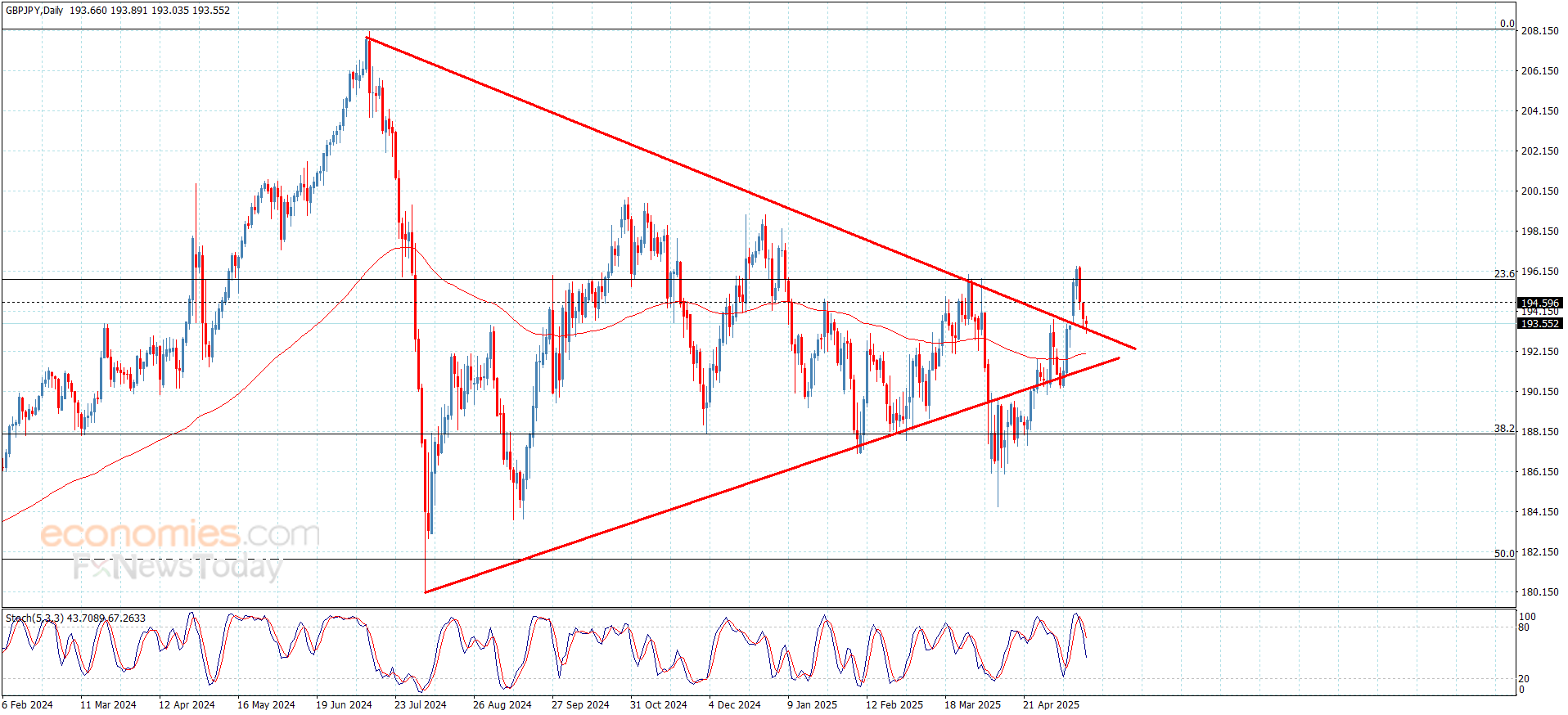
The GBPJPY pair affected by the bearish correctional bias domination, to settle near the support at 193.15, the continuation of the main indicator’s contradiction might force the price to provide new mixed trading, but its stability above the mentioned support will increase the chances for renewing the bullish attempts, which targets 194.55 level, to extend the trading towards the next resistance at 195.70.
In case reaching below the current support, we recommend the neutrality and monitoring the price behavior due to the factors that assist to decrease the negativity, starting from the moving average 55 stability below the current trading and its stability near 192.05, besides the continuation of forming a solid support at 191.40 level, to decrease the chances for renewing the negative attack on the upcoming trading.
The expected trading range for today is between 193.00 and 194.55
Trend forecast: Bullish
Do you need help in trading decisions? Do you want to learn how to start trading?
Join Economies.com VIP Club and benefit from over 15 years of market analysis expertise and get:
Special Offer: Subscribe to the Economies.com VIP channel and get also a free subscription to a trusted trading signals channel provided by Best Trading Signal.
The GBPJPY pair affected by the bearish correctional bias domination, to settle near the support at 193.15, the continuation of the main indicator’s contradiction might force the price to provide new mixed trading, but its stability above the mentioned support will increase the chances for renewing the bullish attempts, which targets 194.55 level, to extend the trading towards the next resistance at 195.70.
In case reaching below the current support, we recommend the neutrality and monitoring the price behavior due to the factors that assist to decrease the negativity, starting from the moving average 55 stability below the current trading and its stability near 192.05, besides the continuation of forming a solid support at 191.40 level, to decrease the chances for renewing the negative attack on the upcoming trading.
The expected trading range for today is between 193.00 and 194.55
Trend forecast: Bullish
Do you need help in trading decisions? Do you want to learn how to start trading?
Join Economies.com VIP Club and benefit from over 15 years of market analysis expertise and get:
Special Offer: Subscribe to the Economies.com VIP channel and get also a free subscription to a trusted trading signals channel provided by Best Trading Signal.