The main category of Forex News.
You can use the search box below to find what you need.
[wd_asp id=1]
The main category of Forex News.
You can use the search box below to find what you need.
[wd_asp id=1]
U.S. crude oil supply will rise more slowly than expected for the rest of 2025 and in 2026 and peak as early as this year, as WTI benchmark prices below $60 per barrel are testing the breakeven point of shale production, energy flows intelligence firm Kpler said on Monday.
Oil prices have slipped by more than 15% since the beginning of April as the market fears recessions from the U.S. tariffs and oversupply from the aggressive production hikes from OPEC+. Prices dipped early on Monday after the OPEC+ group decided on Saturday to raise collective output by 411,000 barrels per day (bpd), nearly triple the volume originally scheduled.
The U.S. benchmark, WTI Crude, was trading at about $57 per barrel—a price point that is below the breakeven levels for many shale wells, especially those outside the prime acreage and hottest spots in the Permian.
With the low oil prices, Kpler has now cut its U.S. crude supply forecast by 120,000 barrels per day (bpd) to 170,000 bpd for the rest of 2025 and into 2026, “as weaker prices threaten to slow shale production.”
“With WTI, the main US benchmark crude, now near breakeven levels for new wells, producers are likely to cut back drilling,” said the analysts at Kpler.
U.S. shale producers are the most reactive to oil price changes and they are typically quick to follow the price trends. Lower margins are prompting caution among the American oil industry, Kpler noted.
The latest OPEC+ move to fight for market share and discipline U.S. shale is putting pressure on U.S. crude output, said Kpler, which now expects America’s crude production to peak in 2025 and gradually decline after that.
Despite steady near-term activity, growth is slowing in the U.S. shale patch, and U.S. crude output is set to peak this year, Kpler noted.
By Charles Kennedy for Oilprice.com
More Top Reads From Oilprice.com
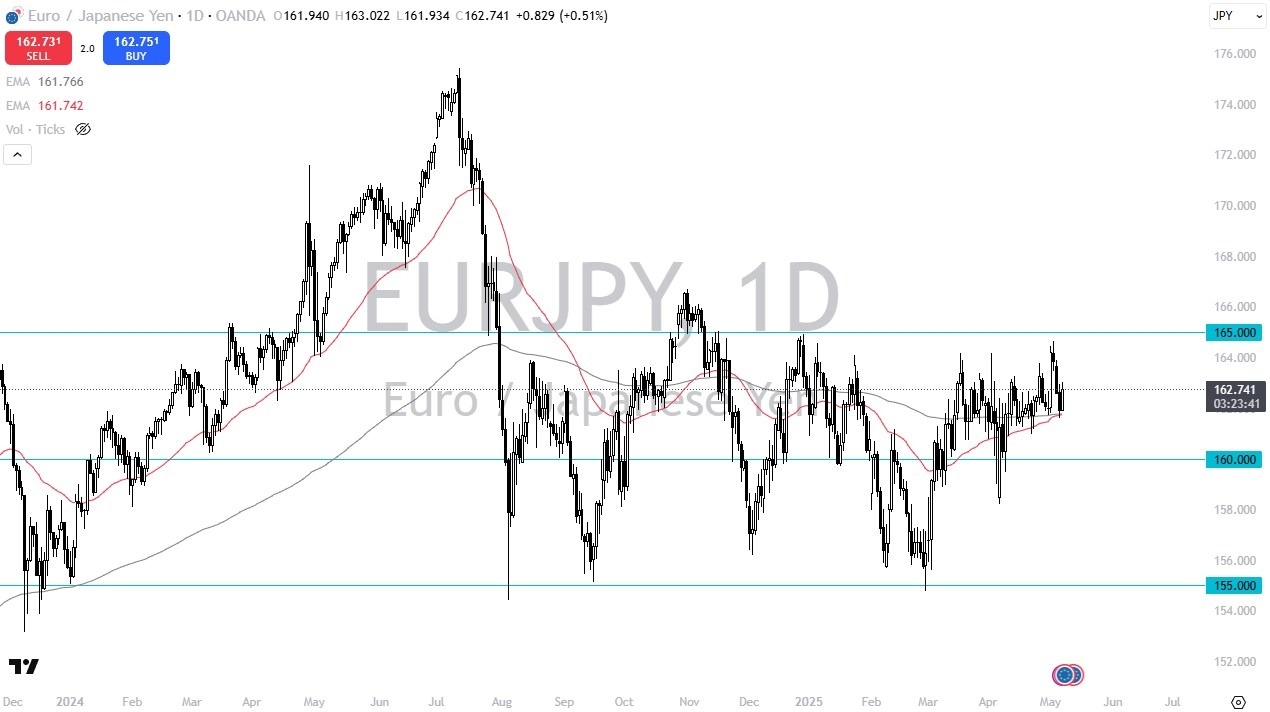
A rally from here probably opens up the possibility of a move towards the 165 yen level, which has been like a pretty significant ceiling here for some time. If we can clear that level, then we have the chance of breaking out. Underneath, if we were to break down below the moving averages, then we could move down to the 160 yen level, which is basically the middle of the overall consolidation.

You’ll notice on the charts that I have the 155 yen level and the 165 yen level drawn out with the 160 yen level right in the middle, you can see where price has flipped there multiple times. The interest rate differential does favor the euro, although not drastically, but at the end of the day, that is something that matters.
Furthermore, I am starting to see the Japanese yen give up some of its grip on other currencies, so that might translate into higher prices here as well. Keep in mind that the Bank of Japan recently flinched when it came time to tighten monetary policy, and it’s difficult to imagine a scenario where traders forget that. I do favor the upside.
Begin trading our daily forecasts and analysis. Here is a list of Forex brokers in Japan to work with.
Forex market experts anticipate a surprise today, Thursday. The Bank of England’s interest rate meeting is widely expected to result in a 25-basis point cut to 4.25%. However, some analysts see a possibility of a more aggressive move. Moreover, what has caught the attention of Bank of England watchers is the unusual number of Monetary Policy Committee (MPC) members scheduled to deliver speeches in the aftermath of the decision.
Typically, the speaker list is distributed over the following weeks. If the British central bank decides to cut the interest rate by 50 basis points, it will need to convey a strong message and narrative for this move. This is because such a cut would come against a backdrop of elevated inflation, pushing the bank further away from its 2.0% target. Therefore, a 50-basis point rate cut would risk its credibility and require policymakers to do some serious “marketing” of the decision.
Regarding currency prices and the British pound, a 50-basis point rate cut would be surprising and would initially lead to a sharp downward adjustment. The pound might soon recover its losses if financial markets perceive the 50-basis point rate cut as a pre-emptive move that reduces the need for further cuts later. This makes the possibility of a rate cut in June plausible and could explain the flurry of messages from MPC speakers in the following days.
More interest rate cuts, at a faster pace, would negatively impact the British pound.
According to some currency experts, “A more dovish update from the Bank of England could cause a setback after the pound’s recent recovery, although the recent dovish repricing would cushion any sterling sell-off if there is a slight change in guidance.” However, economists warn that the bank risks its reputation by trying to boost growth with rate cuts at the expense of its inflation responsibility.
Keep in mind that the British pound still has strong factors, and any pullback could be opportunities for bargain hunters to buy.
For his part, Andrew Sentance, a former member of the Bank of England’s Monetary Policy Committee, believes that now is not the right time to cut interest rates, as he expects inflation to rise to 4-5% in the coming months. Higher national insurance contributions for companies are considered a major driver of costs facing businesses, which are expected to be passed on to consumers. Meanwhile, food prices are expected to start rising again, ending a period of negative food price inflation that recently helped the Bank of England.
On the other hand, the British pound will receive support if the Bank of England continues to signal satisfaction with the pace of its current quarterly interest rate cuts. This comes amid continued declines in financial market volatility, as investors remain optimistic about the prospects for trade deals after “Liberation Day.”
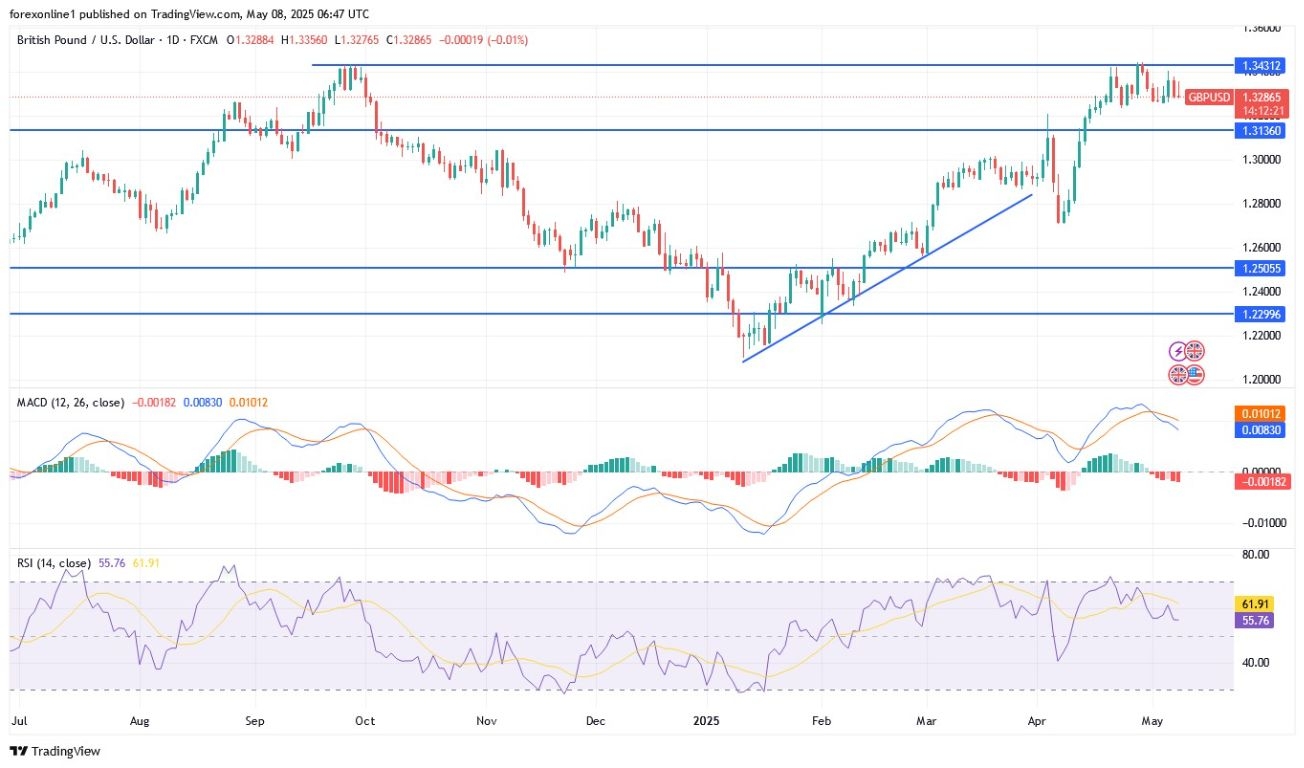
According to the performance on the daily timeframe chart, the GBP/USD trading has remained on its path to a bullish shift, and the 1.3400 resistance will remain a catalyst and confirmation of the bulls’ strong control. According to the 14-day Relative Strength Index (RSI) reading around the 60 level, this confirms the upward shift but has not yet reached the overbought zone, and the MACD indicator for the 12.26 closing is still in the overbought zone. Over this time frame, a break of the upward trend will not occur without the bears moving the currency pair to the vicinity of the support levels of 1.3240 and 1.3180, respectively. Caution is advised, as if the pound does not gain momentum today, the GBP/USD pair may be subject to profit-taking selloffs.
Ready to trade our daily Forex GBP/USD analysis? We’ve made this UK forex brokers list for you to check out.
Wall Street banks are racing this week to slash their oil price forecasts for 2025 and 2026 after OPEC+ threw another curveball at the market this weekend by vowing to continue raising production by more than initially planned.
Commodity strategists and analysts from major U.S. and European investment banks have issued notes with downgraded oil price forecasts for 2025 and 2026 since OPEC+ producers led by Saudi Arabia and Russia agreed on Saturday to raise collective output by 411,000 barrels per day (bpd), nearly triple the volume originally scheduled.
The move follows a similar surge announced for May and signals a sharp reversal from OPEC+ efforts to defend relatively high oil prices.
Saudi Arabia Changes Tack
Saudi Arabia is signaling that it would not tolerate any longer OPEC+ producers regularly busting their quotas while others, such as the Kingdom, stick to their production ceilings per the OPEC+ agreement. Iraq and Kazakhstan have been the OPEC+ members chronically pumping above their quotas, continuously promising to “compensate for previous overproduction,” and continuously failing to do so.
So, OPEC’s top producer and leader of the OPEC+ alliance decided to make it easier for the cheaters to “compensate” and, in the meantime, increase its own production after years of trying to “stabilize the market.” Analysts also say that the Saudis are leading another OPEC+ effort to discipline the U.S. shale industry and force a slowdown in drilling activity and production growth through oil prices lower than the breakevens for new shale wells.
OPEC cited “current healthy oil market fundamentals” to explain its second decision in as many months to bundle three monthly increases into one month, which would result in more than 800,000 bpd of new supply when June ends.
The market appears anything but healthy. Demand may be picking up somewhat due to the lower oil prices, but fears of recessions and muted demand growth due to the U.S. tariff barrage and trade blitzes continue to override oil market sentiment. The small surplus expected later this year has now been revised upwards to more than 1 million bpd of glut at some banks.
Major banks moved to cut their oil price forecasts, seeing a larger-than-expected surplus and weakened oil demand growth.
Banks Take Note
In the case of Goldman Sachs, its commodity strategists slashed their oil price forecast for a third time in one month, following the announcement of another aggressive production hike from OPEC+.
Goldman’s analysts now see Brent Crude prices averaging $60 per barrel this year, down from a previous forecast of $63 a barrel. The average price of the U.S. benchmark, WTI Crude, was now downgraded at Goldman Sachs to $56 for 2025, down from $59 a barrel previously expected.
Next year, Brent is set to average $56 a barrel, down from $58, and WTI is expected at $52, down from $55 per barrel in the previous forecast from mid-April.
“Saturday’s decision increases our confidence that the new baseline size of production increases is likely 0.41mb/d,” Goldman Sachs’ strategists wrote in a note on Sunday.
“The decision likely reflects relatively low inventories and a broader shift to a more long-run equilibrium focused on supporting internal cohesion and on strategically disciplining U.S. shale supply,” the bank’s strategists said.
The Goldman team, led by the head of oil research Daan Struyven, also noted that “Our key conviction remains that high spare capacity and high recession risk skew the risks to oil prices to the downside despite relatively tight spot fundamentals.”
Morgan Stanley also cut its oil price forecasts for the remainder of the year, anticipating a bigger glut. The bank revised down its projection of Brent Crude prices to $62.50 per barrel in the third and fourth quarters of this year, down by $5 per barrel from the previous forecast.
The market glut could reach 1.1 million bpd in the second half of the year, Morgan Stanley reckons. That’s an upward revision of 400,000 bpd from the previous surplus forecast.
“We interpret OPEC+’s communication as an indication that it may unwind its production quota faster altogether,” Morgan Stanley analysts, including Martijn Rats, said in a note carried by Bloomberg.
UK bank Barclays cut its Brent forecast by $4 to $66 per barrel for this year and by $2 to $60 a barrel for next year.
ING also slashed its Brent forecast for the remainder of 2025 – from $68 to $62 per barrel. This leaves the new 2025 average forecast at $65, down from $70 a barrel previously.
“This will change if OPEC+ reverses policy once again or if lower oil prices embolden President Trump to take a more aggressive approach toward several sanctioned oil-producing countries,” said Warren Patterson, Head of Commodities strategy at ING.
“The key to knowing how far the Saudis will take what is starting to look like a price war is the nation’s tolerance for low oil prices over time,” Patterson noted.
By Tsvetana Paraskova for Oilprice.com
More Top Reads From Oilprice.com
Forex traders also closely monitored the progress in US-Japan trade negotiations, with Tokyo striving to reach a bilateral agreement by June. On the economic front, Japan’s April Services PMI was revised upwards, highlighting the strongest increase in new orders in nearly a year. Meanwhile, the Bank of Japan last week kept its benchmark interest rate at 0.5% and lowered its growth and inflation forecasts, indicating that any future interest rate hikes remain unlikely for the time being.
According to currency market trading, the latest developments between China and the United States represent the latest progress in easing global trade tensions, welcomed by global investors who hope these measures will boost economic growth. The Japanese yen, a safe-haven currency, benefited from the escalation of trade tensions following Donald Trump’s announcement of tariffs on “Liberation Day” on April 2, which proved to be more severe than expected.
We still recommend buying the dollar against the Japanese yen at every downward trend without risk and monitoring the factors affecting the currency pair.
As expected, the US Federal Reserve kept its federal funds rate target range unchanged at 4.25%-4.50% for its third consecutive meeting in May 2025, in line with expectations. Officials are adopting a wait-and-see approach amid concerns that President Trump’s tariffs could lead to higher inflation and slower economic growth. At the same time, policymakers noted increasing uncertainty about the economic outlook and rising risks of higher unemployment and inflation. The US central bank also reported that despite the impact of fluctuations in net exports on the data, recent indicators suggest that economic activity continues to expand at a solid pace. The country’s unemployment rate has stabilized at a low level in recent months, and labor market conditions have remained steady. Inflation remains somewhat elevated.
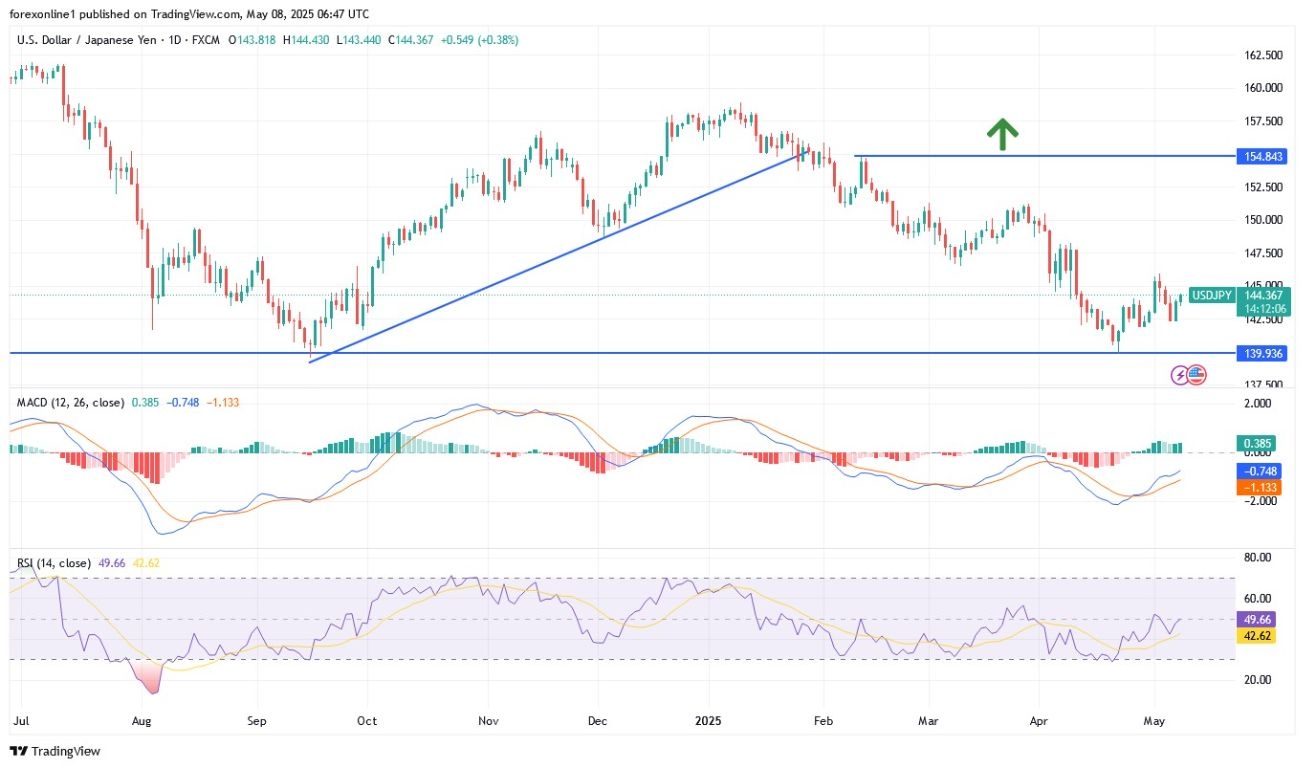
According to the performance on the daily timeframe chart, the USD/JPY currency pair is still in the early stages of forming an upward channel and currently lacks sufficient momentum to confirm the upward shift. This could occur if the bulls succeed in breaking towards the resistance levels of 145.60 and 147.00, respectively. The MACD indicator for the 12.26 closing suggests an upward shift but has not yet reached the overbought zone, giving the bulls opportunities for an upward rebound. At the same time, the Relative Strength Index (RSI) remains below the midline, confirming that the bulls need more stimulus before confirming the bullish shift.
On the negative side, the bullish outlook for the USD/JPY will be affected by the bears moving the currency pair towards the support level of 142.30 and lower. So far, we still prefer the strategy of buying the US dollar against the Japanese Yen from every downward level.
Want to trade our USD/JPY forex analysis and predictions? Here’s a list of forex brokers in Japan to check out.
The (USDJPY) price settled on a rise in its recent intraday trading, supported by its trading above EMA50, and under the dominance of a bullish correctional wave on the short-term basis, alongside the bias line, the pair is preparing to attack the current resistance level at 144.00.
On the other hand, we notice the beginning of negative overlapping signals appearance on the (RSI), after reaching overbought levels, which might decelerate the rise and provide chances for bearish correctional rebounds that the price attempt to use it to offload these overbought conditions and gain the required positive momentum to breach the mentioned resistance.
Do you need help in trading decisions? Do you want to learn how to start trading?
Join Economies.com VIP Club and benefit from over 15 years of market analysis expertise and get:
Special Offer: Subscribe to the Economies.com VIP channel and get also a free subscription to a trusted trading signals channel provided by Best Trading Signal.
EUR/USD came under bearish pressure in the American session on Wednesday and closed the day deep in negative territory. The pair stays on the back foot early Thursday and trades slightly below 1.1300.
The table below shows the percentage change of Euro (EUR) against listed major currencies this week. Euro was the weakest against the US Dollar.
| USD | EUR | GBP | JPY | CAD | AUD | NZD | CHF | |
|---|---|---|---|---|---|---|---|---|
| USD | 0.35% | -0.18% | -0.17% | 0.45% | 0.53% | 0.37% | 0.17% | |
| EUR | -0.35% | -0.25% | -0.26% | 0.36% | 0.44% | 0.29% | 0.08% | |
| GBP | 0.18% | 0.25% | -0.21% | 0.62% | 0.70% | 0.54% | 0.33% | |
| JPY | 0.17% | 0.26% | 0.21% | 0.61% | 0.70% | 0.62% | 0.44% | |
| CAD | -0.45% | -0.36% | -0.62% | -0.61% | -0.21% | -0.08% | -0.28% | |
| AUD | -0.53% | -0.44% | -0.70% | -0.70% | 0.21% | -0.16% | -0.36% | |
| NZD | -0.37% | -0.29% | -0.54% | -0.62% | 0.08% | 0.16% | -0.21% | |
| CHF | -0.17% | -0.08% | -0.33% | -0.44% | 0.28% | 0.36% | 0.21% |
The heat map shows percentage changes of major currencies against each other. The base currency is picked from the left column, while the quote currency is picked from the top row. For example, if you pick the Euro from the left column and move along the horizontal line to the US Dollar, the percentage change displayed in the box will represent EUR (base)/USD (quote).
The Federal Reserve (Fed) announced on Wednesday that it left the policy rate, federal funds rate, unchanged at the range of 4.25%-4.5% following the May meeting, as widely anticipated. In the policy statement, the US central bank acknowledged that the uncertainty surrounding the economic outlook has increased further.
While speaking during the post-meeting press conference, Fed Chairman Jerome Powell noted that near-term inflation expectations have moved up because of tariffs and reiterated that they need to wait before adjusting the policy. According to the CME FedWatch Tool, the probability of a 25 basis points (bps) rate cut in June dropped to 20% from about 30% before the Fed event. As a result, the US Dollar (USD) gathered strength against its rivals in the American session, causing EUR/USD to push lower.
The US economic calendar will feature the weekly Initial Jobless Claims data on Thursday. Additionally, the Bureau of Labor Statistics will publish preliminary Unit Labor Costs data for the first quarter. In case there is a noticeable decline in the number of first-time applications for unemployment benefits, with a reading near 200,000, the USD could continue to outperform its rivals. On the other hand, a print above 250,000 could have the opposite impact on the currency’s valuation. Nevertheless, investors could refrain from betting on a significant weakening of the USD following the hawkish Fed event.
The Relative Strength Index (RSI) indicator on the 4-hour chart stays below 50 and EUR/USD closed the last four 4-hour candles below the 100-period, 50-period and 20-period Simple Moving Averages (SMA), highlighting a bearish tilt in the near-term outlook.
On the downside, 1.1270 (Fibonacci 38.2% retracement of the latest uptrend) aligns as immediate support before 1.1175 (Fibonacci 50% retracement) and 1.1080 (Fibonacci 61.8% retracement). Looking north, resistances could be spotted at 1.1380 (100-period SMA, Fibonacci 23.6% retracement, 1.1430 (static level) and 1.1500 (static level, round level).
The Euro is the currency for the 19 European Union countries that belong to the Eurozone. It is the second most heavily traded currency in the world behind the US Dollar. In 2022, it accounted for 31% of all foreign exchange transactions, with an average daily turnover of over $2.2 trillion a day.
EUR/USD is the most heavily traded currency pair in the world, accounting for an estimated 30% off all transactions, followed by EUR/JPY (4%), EUR/GBP (3%) and EUR/AUD (2%).
The European Central Bank (ECB) in Frankfurt, Germany, is the reserve bank for the Eurozone. The ECB sets interest rates and manages monetary policy.
The ECB’s primary mandate is to maintain price stability, which means either controlling inflation or stimulating growth. Its primary tool is the raising or lowering of interest rates. Relatively high interest rates – or the expectation of higher rates – will usually benefit the Euro and vice versa.
The ECB Governing Council makes monetary policy decisions at meetings held eight times a year. Decisions are made by heads of the Eurozone national banks and six permanent members, including the President of the ECB, Christine Lagarde.
Eurozone inflation data, measured by the Harmonized Index of Consumer Prices (HICP), is an important econometric for the Euro. If inflation rises more than expected, especially if above the ECB’s 2% target, it obliges the ECB to raise interest rates to bring it back under control.
Relatively high interest rates compared to its counterparts will usually benefit the Euro, as it makes the region more attractive as a place for global investors to park their money.
Data releases gauge the health of the economy and can impact on the Euro. Indicators such as GDP, Manufacturing and Services PMIs, employment, and consumer sentiment surveys can all influence the direction of the single currency.
A strong economy is good for the Euro. Not only does it attract more foreign investment but it may encourage the ECB to put up interest rates, which will directly strengthen the Euro. Otherwise, if economic data is weak, the Euro is likely to fall.
Economic data for the four largest economies in the euro area (Germany, France, Italy and Spain) are especially significant, as they account for 75% of the Eurozone’s economy.
Another significant data release for the Euro is the Trade Balance. This indicator measures the difference between what a country earns from its exports and what it spends on imports over a given period.
If a country produces highly sought after exports then its currency will gain in value purely from the extra demand created from foreign buyers seeking to purchase these goods. Therefore, a positive net Trade Balance strengthens a currency and vice versa for a negative balance.
The (USDJPY) price settled on a rise in its recent intraday trading, supported by its trading above EMA50, and under the dominance of a bullish correctional wave on the short-term basis, alongside the bias line, the pair is preparing to attack the current resistance level at 144.00.
On the other hand, we notice the beginning of negative overlapping signals appearance on the (RSI), after reaching overbought levels, which might decelerate the rise and provide chances for bearish correctional rebounds that the price attempt to use it to offload these overbought conditions and gain the required positive momentum to breach the mentioned resistance.
Do you need help in trading decisions? Do you want to learn how to start trading?
Join Economies.com VIP Club and benefit from over 15 years of market analysis expertise and get:
Special Offer: Subscribe to the Economies.com VIP channel and get also a free subscription to a trusted trading signals channel provided by Best Trading Signal.
The GBPJPY pair announced delaying the bearish trading by its stability above the support of the sideways range at 190.75 level, recording some gains by its stability near 191.70, facing the moving average 55.
We expect providing mixed trading, noting that 192.45 level represents an extra barrier that might assist in renewing the negative attempts, to ease the mission of breaking the current support and begin targeting the negative stations that are located near 189.90 and 189.20.
The expected trading range for today is between 191.00 and 192.40
Trend forecast: Sideways
Do you need help in trading decisions? Do you want to learn how to start trading?
Join Economies.com VIP Club and benefit from over 15 years of market analysis expertise and get:
Special Offer: Subscribe to the Economies.com VIP channel and get also a free subscription to a trusted trading signals channel provided by Best Trading Signal.
Silver (XAG/USD) attracts fresh buying during the Asian session on Thursday and reverses a major part of the previous day’s retracement slide from over a one-week high. The white metal climbs to the $33.00 neighborhood in the last hour and seems poised to appreciate further.
From a technical perspective, a descending channel on short-term charts constitutes the formation of a bullish flag against the backdrop of the recent goodish recovery from the $28.45 area, or the year-to-date low touched in April. Moreover, oscillators on daily/hourly charts are holding in positive territory, validating the near-term constructive outlook for the XAG/USD.
However, it will still be prudent to wait for a breakout above the trend-channel hurdle near the $33.20 area before positioning for additional gains. The XAG/USD might then aim to surpass the $33.70 intermediate barrier and reclaim the $34.00 round-figure mark. Some follow-through buying will be seen as a fresh trigger for bulls and pave the way for a further appreciation.
On the flip side, the $32.50-$32.45 area, followed by the overnight swing low, around the $32.25 region, could offer some support to the XAG/USD ahead of the $32.00 mark. The next relevant support is pegged around the $31.60-$31.55 zone, representing the lower end of the aforementioned trend-channel, which, if broken, might shift the near-term bias in favor of bearish traders.
Silver is a precious metal highly traded among investors. It has been historically used as a store of value and a medium of exchange. Although less popular than Gold, traders may turn to Silver to diversify their investment portfolio, for its intrinsic value or as a potential hedge during high-inflation periods. Investors can buy physical Silver, in coins or in bars, or trade it through vehicles such as Exchange Traded Funds, which track its price on international markets.
Silver prices can move due to a wide range of factors. Geopolitical instability or fears of a deep recession can make Silver price escalate due to its safe-haven status, although to a lesser extent than Gold’s. As a yieldless asset, Silver tends to rise with lower interest rates. Its moves also depend on how the US Dollar (USD) behaves as the asset is priced in dollars (XAG/USD). A strong Dollar tends to keep the price of Silver at bay, whereas a weaker Dollar is likely to propel prices up. Other factors such as investment demand, mining supply – Silver is much more abundant than Gold – and recycling rates can also affect prices.
Silver is widely used in industry, particularly in sectors such as electronics or solar energy, as it has one of the highest electric conductivity of all metals – more than Copper and Gold. A surge in demand can increase prices, while a decline tends to lower them. Dynamics in the US, Chinese and Indian economies can also contribute to price swings: for the US and particularly China, their big industrial sectors use Silver in various processes; in India, consumers’ demand for the precious metal for jewellery also plays a key role in setting prices.
Silver prices tend to follow Gold’s moves. When Gold prices rise, Silver typically follows suit, as their status as safe-haven assets is similar. The Gold/Silver ratio, which shows the number of ounces of Silver needed to equal the value of one ounce of Gold, may help to determine the relative valuation between both metals. Some investors may consider a high ratio as an indicator that Silver is undervalued, or Gold is overvalued. On the contrary, a low ratio might suggest that Gold is undervalued relative to Silver.