The main category of Forex News.
You can use the search box below to find what you need.
[wd_asp id=1]
The main category of Forex News.
You can use the search box below to find what you need.
[wd_asp id=1]
Goldman Sachs on Wednesday hiked its quarterly copper price forecast, citing de-escalation in trade tensions and resilient Chinese copper demand that will likely continue to support price in the coming months.
“We upgrade our 2Q/3Q price forecast to $9,330/$9,150/t from $8,620/$8,370 previously,” the bank said in a note.
May 7, 2025 – Written by Frank Davies
STORY LINK Euro to Pound Forecast: EURGBP Dips to 0.85 as BoE Cut Priced in
UK-EU negotiations on trade and other issues is seen as a positive.
The euro may be overvalued as it made strong gains even when the ECB were cutting rates aggressively.
Sterling has managed to make slight gains against the euro in recent weeks as the EUR/GBP exchange rate has faded from above 0.87 in mid-April, back to 0.85 support. This move was partially unwinding the strong gains the euro made in early April when market volatility spiked and it acted as a safe haven. However, there have been other factors driving the move, with positives for the pound and negatives for the euro both playing a part.
The BoE are very likely to cut this week, but this would only take rates in the UK down from 4.5% to 4.25%, considerably higher than the 2.4% offered by the ECB. Importantly, this cut is a measured step towards normalization of rates and is not driven by fears over unemployment or economic weakness. More cuts are likely to follow, but there is no expectation of aggressive cuts in the near-term.
“…Thursday should see the Bank of England cutting rates by 25bp. This is widely expected by consensus and fully priced into the Sonia curve. As discussed in our economist’s preview, we expect an 8-1 vote split (one vote for a 50bp cut) and no changes in forward guidance (future cuts to be “gradual and careful”),” noted ING on Tuesday.
This is a healthy backdrop for the pound, and quite different to the situation in the EU where the ECB is in a hurry to get to neutral rates below 2%.
While there have been concerns abouts cuts to government spending and a slowing economy, the UK has managed to sidestep most of the proposed tariffs from the US and is likely to strike a deal on 10% tariffs, the lowest possible under Trump’s current recommendations. Meanwhile, the UK and EU are negotiating a reset of their post-Brexit relationship, with a key summit scheduled for May 19, 2025. The talks will aim to reduce trade barriers, boost economic growth, and enhance cooperation on security, defence, and other areas, while navigating geopolitical challenges like U.S. tariffs under President Trump. A draft agreement emphasizes a “new strategic partnership” based on “free and open trade” and global economic stability.
This could be positive for the UK economy, but there are a number of potential hurdles. UK Prime Minister Keir Starmer has already set red lines: no return to the single market, customs union, or freedom of movement. However, the EU demands concessions, particularly on fishing and youth mobility, which some EU states like Poland see as non-negotiable. The talks are complicated by simultaneous UK efforts to secure a U.S. trade deal, with concerns that closer EU alignment could provoke U.S. tariffs.
The Euro-Dollar conversion rallied from a 2025 low of 1.01 to a high of 1.15 in a short space of time while EURGBP rallied from 0.82 to above 0.87. Considering this came during an aggressive rate cutting cycle from the ECB, the risk is that the euro has gone too far too fast and is relatively overvalued based on rate differentials.
It’s not as if the backdrop is rosy for the euro – tariffs are likely to weigh on an already fragile and stagnant economy. Indeed, the euro’s rally was not due to improving data and came in the wake of the German election and subsequent spending plans, both from Germany and other member states vowing to boost military spending. This should offer a bump to the economy, but the optimism may have been overdone. EURGBP at 0.85 looks around fair value for now.
International Money Transfer? Ask our resident FX expert a money transfer question or try John’s new, free, no-obligation personal service! ,where he helps every step of the way,
ensuring you get the best exchange rates on your currency requirements.
TAGS: Euro Pound Forecasts
Silver price (XAG/USD) is rallying to near $32.60 during North American trading hours on Monday. The white metal strengthens as the US Dollar (USD) slumps at the start of the week, with the Federal Reserve’s (Fed) monetary policy meeting in focus. Technically, a decline in the US Dollar makes investment in the Silver price an attractive bet for investors.
The US Dollar Index (DXY), which tracks the Greenback’s value against six major currencies, is down almost 0.5% at around 99.50.
According to the CME Fedwatch tool, traders are almost certain that the central bank will leave interest rates steady on Wednesday. The tool also shows that the probability for the Fed to lower borrowing rates in June has dropped to 32% from 66% seen a week ago. Traders have pared Fed dovish bets for the June meeting after the release of the better-than-projected United States (US) Nonfarm Payrolls (NFP) data for April.
Theoretically, a high-interest-rate environment bodes poorly for non-yielding assets, such as Silver.
Meanwhile, diminishing hopes of a US-China trade war resolution in the near term have also supported the Silver price. The demand for safe-haven assets, such as Silver, increases amid heightening geopolitical tensions.
US President Donald Trump said on Sunday that he is not going to speak with Chinese President Xi Jinping this week, but expressed willingness to lower tariffs on China. “At some point, I’m going to lower them, because otherwise, you could never do business with them, and they want to do business very much,” Trump said.
On the economic front, US ISM Services PMI data for April has come in better than expected. The Services PMI expanded at a faster pace to 51.6 from 50.8 in March and estimates of 50.6.
Silver price struggles to revisit an over three-week high around $33.70. The near-term outlook of the white metal has become uncertain as it falls below the 20-day Exponential Moving Average (EMA), which trades around $32.65.
The 14-day Relative Strength Index (RSI) falls below 50.00 after failing to break above 60.00, indicating that investors are not bullish anymore.
Looking up, the March 28 high of $34.60 will act as key resistance for the metal. On the downside, the April 11 low of $30.90 will be the key support zone.
Silver is a precious metal highly traded among investors. It has been historically used as a store of value and a medium of exchange. Although less popular than Gold, traders may turn to Silver to diversify their investment portfolio, for its intrinsic value or as a potential hedge during high-inflation periods. Investors can buy physical Silver, in coins or in bars, or trade it through vehicles such as Exchange Traded Funds, which track its price on international markets.
Silver prices can move due to a wide range of factors. Geopolitical instability or fears of a deep recession can make Silver price escalate due to its safe-haven status, although to a lesser extent than Gold’s. As a yieldless asset, Silver tends to rise with lower interest rates. Its moves also depend on how the US Dollar (USD) behaves as the asset is priced in dollars (XAG/USD). A strong Dollar tends to keep the price of Silver at bay, whereas a weaker Dollar is likely to propel prices up. Other factors such as investment demand, mining supply – Silver is much more abundant than Gold – and recycling rates can also affect prices.
Silver is widely used in industry, particularly in sectors such as electronics or solar energy, as it has one of the highest electric conductivity of all metals – more than Copper and Gold. A surge in demand can increase prices, while a decline tends to lower them. Dynamics in the US, Chinese and Indian economies can also contribute to price swings: for the US and particularly China, their big industrial sectors use Silver in various processes; in India, consumers’ demand for the precious metal for jewellery also plays a key role in setting prices.
Silver prices tend to follow Gold’s moves. When Gold prices rise, Silver typically follows suit, as their status as safe-haven assets is similar. The Gold/Silver ratio, which shows the number of ounces of Silver needed to equal the value of one ounce of Gold, may help to determine the relative valuation between both metals. Some investors may consider a high ratio as an indicator that Silver is undervalued, or Gold is overvalued. On the contrary, a low ratio might suggest that Gold is undervalued relative to Silver.
After posting gains to start the week, GBP/USD edges lower and trades in negative territory below 1.3350 in the European session on Wednesday as investors gear up for the Federal Reserve’s (Fed) monetary policy announcements.
The US Dollar (USD) stays resilient against its peers midweek on improving risk mood. Washington confirmed that United States (US) Treasury Secretary Scott Bessent and chief trade negotiator Jamieson Greer will meet China’s economic tsar He Lifeng in Geneva this Saturday, to kick off official talks with China. Read more…
Pound Sterling (GBP) is likely to trade in a range vs US Dollar (USD), expected to be between 1.3300 and 1.3400. In the longer run, the current price movements are part of a 1.3240/1.3450 range-trading phase, UOB Group’s FX analysts Quek Ser Leang and Peter Chia note.
24-HOUR VIEW: “Our view for GBP to trade with a downward bias yesterday was incorrect, as after dipping to a low of 1.3260, GBP soared, reaching a high of 1.3402. The subsequent pullback from the high amid overbought conditions suggests GBP is likely to trade in a range today, expected to be between 1.3300 and 1.3400.” Read more…
Fake breakout of the consolidation and rejection of the Pitchfork Median Trend line. Read more…
Gold price has come under intense selling pressure early Wednesday, correcting sharply from two-week highs of $3,435. Renewed optimism over the upcoming US-China trade talks and profit-taking ahead of the US Federal Reserve (Fed) policy announcements.
Late Tuesday, the White House announced that US Treasury Secretary Scott Bessent and US Trade Representative (USTR) Jamieson Greer will travel to Geneva, Switzerland, to attend trade talks with Chinese Vice Premier He Lifeng. The trade talks will be held from May 9 to 12 in an effort to de-escalate a trade war between the world’s two biggest economies.
Asian traders hit their desks on Wednesday and reacted positively to this overnight news, reducing the safe-haven flows and the demand for the traditional store of value, the Gold price. The US Dollar (USD) firms up with US-China trade optimism easing concerns over economic growth.
Meanwhile, traders resort to taking profits off the table after the latest Gold price rally, repositioning ahead of the critical Fed verdict and Chairman Jerome Powell’s press conference. As a no-rate-change decision is fully priced in, Powell’s tone during the presser will hold the key to altering markets’ expectations of interest rate cuts this year.
Following robust US labor market data and business PMIs, markets have pared bets for a June rate cut, with Goldman Sachs and Barclays moving their rate calls to July from June.
Powell will likely stick to the Fed’s cautious rhetoric, hinting at a wait-and-see approach amid a lack of clarity on the impact of US tariffs. In case he acknowledges resilience in the economy, it could be read as a hawkish shift in the Fed’s policy stance, which could push back against June rate cut bets and fuel a fresh leg up in the Greenback. As a result, Gold price could extend its correction from two-week highs.
On the other hand, Gold price could witness a fresh upswing if the Fed signals a June rate cut, expressing concerns on the economic outlook.
In the meantime, the Gold price downside could remain cushioned by the escalating geopolitical tensions globally. Israel’s security Cabinet unanimously approved a plan to widen the military offensive in Gaza. Meanwhile, a Kremlin spokesman said Russia will stick to its plans for a unilaterally-imposed ceasefire between 8 and 11 May. Still, he warned that an appropriate response will be given immediately if Ukraine does not also halt the fire.
Pakistan has vowed to a strong retaliation after the Indian armed forces early Wednesday carried out missile attacks on nine terror targets in Pakistan and Pakistan-Occupied Kashmir (PoK), in response to the terror attack in Pahalgam in Jammu & Kashmir.
Gold price faced rejection below the channel support (now resistance), retreating sharply toward the initial support of the $3,350 psychological barrier.
The 21-day Simple Moving Average (SMA) at $3,283 will be the following line of defense for Gold buyers. Deeper declines will challenge the May 2 low of $3,223.
However, the 14-day Relative Strength Index (RSI) holds above the midline near 61.50, suggesting that any dip will likely be bought in.
Gold price must find a firm foothold above the two-week high of $3,435 to take on the upside. The next topside target is at the channel support (now resistance) at $3,494, where the record high will also come into play.
Monetary policy in the US is shaped by the Federal Reserve (Fed). The Fed has two mandates: to achieve price stability and foster full employment. Its primary tool to achieve these goals is by adjusting interest rates.
When prices are rising too quickly and inflation is above the Fed’s 2% target, it raises interest rates, increasing borrowing costs throughout the economy. This results in a stronger US Dollar (USD) as it makes the US a more attractive place for international investors to park their money.
When inflation falls below 2% or the Unemployment Rate is too high, the Fed may lower interest rates to encourage borrowing, which weighs on the Greenback.
The Federal Reserve (Fed) holds eight policy meetings a year, where the Federal Open Market Committee (FOMC) assesses economic conditions and makes monetary policy decisions.
The FOMC is attended by twelve Fed officials – the seven members of the Board of Governors, the president of the Federal Reserve Bank of New York, and four of the remaining eleven regional Reserve Bank presidents, who serve one-year terms on a rotating basis.
In extreme situations, the Federal Reserve may resort to a policy named Quantitative Easing (QE). QE is the process by which the Fed substantially increases the flow of credit in a stuck financial system.
It is a non-standard policy measure used during crises or when inflation is extremely low. It was the Fed’s weapon of choice during the Great Financial Crisis in 2008. It involves the Fed printing more Dollars and using them to buy high grade bonds from financial institutions. QE usually weakens the US Dollar.
Quantitative tightening (QT) is the reverse process of QE, whereby the Federal Reserve stops buying bonds from financial institutions and does not reinvest the principal from the bonds it holds maturing, to purchase new bonds. It is usually positive for the value of the US Dollar.
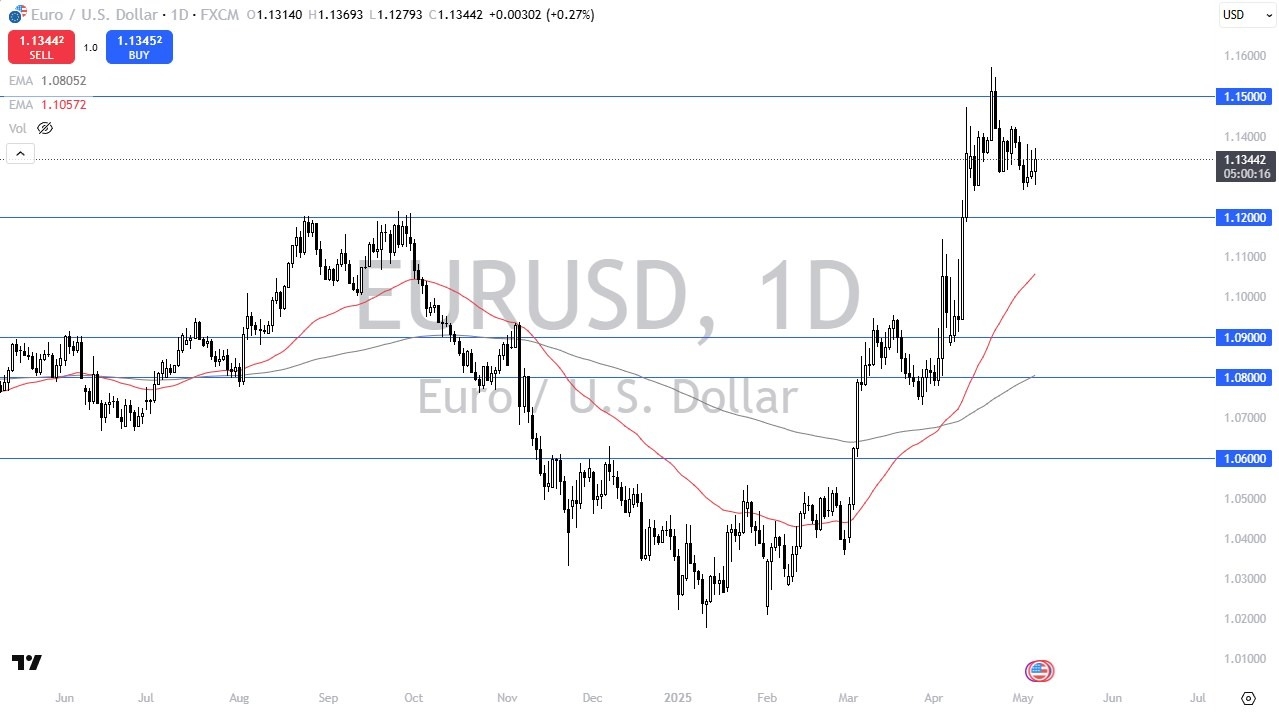
Ultimately, the 1.15 level is an area that you watch from a longer term standpoint. And it’s worth noting that recently over the last week or two, we’ve really seen a bit of hesitation. So I think that once we get through the FOMC and perhaps more importantly, the press conference, we might have a little bit more clarity.
If we break down from here, the 1.12 level is an area that I think a lot of people are going to watch. If we can break down below there, then it’s likely that the market goes searching to the 50 day EMA, all things being equal. This is a market that will continue to be noisy, but I think it’s getting exhausted unless of course, Jerome Powell says something that really rocks the markets.

I think at best you get sideways action. If we can break above that reason high, the market is likely to go looking to the 1.17 level followed by the 1.20 level. The Euro of course does have the benefit of Germany exiting recession while the United States is thought to be going into recession. But one thing that’s worth noting is that the jobs markets are a little stubborn at the moment.
So, we’ll have to see how things play out, all things being equal, it’s neutral. But once we get out of this little, tiny range, then we might have a little bit more in the way of clarity.
Ready to trade our Forex daily analysis and predictions? Here are the best trading platform for beginners to choose from.
The GBPJPY pair provided new negative trading, attempting to break the support of the sideways triangle at 190.85 level, but it bounced again towards 191.10, keeping its stability below the moving average 55.
While providing negative momentum by stochastic approach from 20 level makes us wait for confirming breaking the current support, which allows it to activate the negative attack, which might target 189.90 level reaching the next target at 189.20.
The expected trading range for today is between 189.90 and 191.50
Trend forecast: Bearish
Do you need help in trading decisions? Do you want to learn how to start trading?
Join Economies.com VIP Club and benefit from over 15 years of market analysis expertise and get:
Special Offer: Subscribe to the Economies.com VIP channel and get also a free subscription to a trusted trading signals channel provided by Best Trading Signal.
Copper price reached the initial positive target by reaching $4.7400 level, which forces it to form sideways fluctuated moves, waiting for the extra positive momentum from the main indicators, to confirm renewing the bullish attempts.
Reminding you that the stability of the moving average 55 near the initial support at $4.5400 level supports the attempts of renewing the bullish attempts, which might target $4.8200 level, then attempts to press on the barrier at $4.9000.
The expected trading range for today is between $4.6000 and $4.8100
Trend forecast: Bullish
Do you need help in trading decisions? Do you want to learn how to start trading?
Join Economies.com VIP Club and benefit from over 15 years of market analysis expertise and get:
Special Offer: Subscribe to the Economies.com VIP channel and get also a free subscription to a trusted trading signals channel provided by Best Trading Signal.
Copper price reached the initial positive target by reaching $4.7400 level, which forces it to form sideways fluctuated moves, waiting for the extra positive momentum from the main indicators, to confirm renewing the bullish attempts.
Reminding you that the stability of the moving average 55 near the initial support at $4.5400 level supports the attempts of renewing the bullish attempts, which might target $4.8200 level, then attempts to press on the barrier at $4.9000.
The expected trading range for today is between $4.6000 and $4.8100
Trend forecast: Bullish
Do you need help in trading decisions? Do you want to learn how to start trading?
Join Economies.com VIP Club and benefit from over 15 years of market analysis expertise and get:
Special Offer: Subscribe to the Economies.com VIP channel and get also a free subscription to a trusted trading signals channel provided by Best Trading Signal.
Copper price reached the initial positive target by reaching $4.7400 level, which forces it to form sideways fluctuated moves, waiting for the extra positive momentum from the main indicators, to confirm renewing the bullish attempts.
Reminding you that the stability of the moving average 55 near the initial support at $4.5400 level supports the attempts of renewing the bullish attempts, which might target $4.8200 level, then attempts to press on the barrier at $4.9000.
The expected trading range for today is between $4.6000 and $4.8100
Trend forecast: Bullish
Do you need help in trading decisions? Do you want to learn how to start trading?
Join Economies.com VIP Club and benefit from over 15 years of market analysis expertise and get:
Special Offer: Subscribe to the Economies.com VIP channel and get also a free subscription to a trusted trading signals channel provided by Best Trading Signal.