The main category of Forex News.
You can use the search box below to find what you need.
[wd_asp id=1]
The main category of Forex News.
You can use the search box below to find what you need.
[wd_asp id=1]
May 2, 2025 – Written by Frank Davies
STORY LINK Pound Sterling to Dollar Forecast: GBP to “Remain Firm” vs USD over 2025
The Pound to Dollar (GBP/USD) exchange rate was unable to move above 1.3350 on Thursday and retreated to just below 1.3300 after the round of US data.
The releases were certainly soft, but markets had been braced for even weaker figures which helped trigger dollar short covering.
Scotiabank still considers that the overall tone is one of consolidation; “The trend is bullish, given the sequence of higher highs and higher lows since March. The RSI has softened somewhat, but waning momentum is not enough to violate the bull trend. For now, we highlight the recent range and GBPUSD’s movement roughly bound between the mid-1.32s and mid-1.34s.”
Confidence in the US economy remains fragile and the latest labour market data triggered some alarm. re were some concerns.
Initial jobless claims increased to 241,000 in the latest week from 223,000 previously while continuing claims jumped to 1.92mn from 1.83mn in the previous week and the highest level since November 2021.
There was, however, some relief surrounding the business confidence data.
The ISM manufacturing index edged lower to 48.7 for April from 49.0 previously, but this was above consensus forecasts of 47.9.
The production index hit the lowest level since May 2020, but new orders and employment declined at slightly slower rates for the month.
The monthly jobs report is due on Friday.
According to MUFG; “A much weaker nonfarm payrolls report tomorrow poses the main downside risk for the US dollar‘s recent tentative rebound.”
ING added; “The reduction in dollar risk premium may have a little further to go, but may run into the bearish headwind of US data.”
Scotiabank also notes the importance of data; “The sharp decline seen in the USD so far suggests this may not be a “typical” year for the USD but persistence in the soft USD tone would fit with the outlook for slower growth, lower corporate earnings and continued diversification away from the USD in the next few months.”
UBS does see the risk of a more substantial GBP/USD correction; “We expect the pound to remain firm against the U.S. dollar over the course of the year, though some short-term setbacks may occur following the recent rally.”
UK data was mixed with the PMI manufacturing index remaining in contraction territory while there was a jump in March consumer lending ahead of the Stamp Duty changes.

Rabobank is cautious over the UK growth outlook. A growth agenda is a good thing, but the British government’s history of announcing grand strategies with much fanfare and little follow-through casts a long shadow.
There are strong expectations of a Bank of England rate cut next week and Rabobank noted the potential for more dovish guidance given concerns over the growth outlook.
International Money Transfer? Ask our resident FX expert a money transfer question or try John’s new, free, no-obligation personal service! ,where he helps every step of the way,
ensuring you get the best exchange rates on your currency requirements.
Gold price is nursing weekly losses early Friday, and it is on track to book its worst week in over two months. Gold buyers refuse to give up, anticipating the high-impact US Nonfarm Payrolls (NFP) data due later this Friday for a fresh directional impetus.
Gold price is off the two-week lows of $3,202 set on Thursday, licking its wounds as traders refrain from placing any fresh directional bets heading into the key event risk for Friday – the US labor market report.
The US Dollar (USD) has been on a roll higher this week, thanks to easing trade tensions globally, with the US optimistic about reaching trade deals with its major Asian trading partners, including China.
Risk sentiment received a fresh lift earlier on after the local media reported the Chinese Commerce Ministry as saying that “the US has recently sent messages to China through relevant parties, hoping to start talks with China,”
“China is currently evaluating this,” the Ministry added.
Further, easing US economic growth concerns also underpinned the sentiment around the Greenback, rendering it negative for the USD-denominated Gold price. Data showed on Thursday that the ISM manufacturing PMI fell to 48.7 in April from 49.0 in March, against expectations for a bigger fall to 48.
Early Friday,markets seem to have resorted to their position adjustments in the US Dollar, leading to a pause in its recent uptrend, while the bright metal also draws some support from the Russia-Ukraine geopolitical stand-off.
Attention now turns toward the US NFP data release for the next big action in the Gold price and the King Dollar.
Markets expect the US NFP to show a 130,000 job gain in April, down from a stellar 228,000 job creations reported in March. The Unemployment Rate is set to remain steady at 4.2% in the same period.
If the headline NFP prints a reading below the 100,000 level, it could refuel concerns over the impact of tariffs on ŪS labor market. This narrative could double down on the US Federal Reserve’s (Fed) easing prospects, triggering a fresh US Dollar downside while rescuing the Gold price.
On the other hand, a positive surprise above the 200,000 figure could add extra legs to the Gold price correction, pushing back against expectations of a June interest rate cut and boosting the USD further.
Gold price clings to the critical 21-day Simple Moving Average (SMA) support, now at $3,234, pausing the correction accentuated by the downside break of a three-week-long rising channel on Wednesday.
The 14-day Relative Strength Index (RSI) sits just above the midline near 52.50, having ended its descent.
Therefore, a rebound toward the immediate static support-turned-resistance at $3,260 could be seen if the 21-day SMA holds on a weak US NFP report.
Acceptance above that level will prompt Gold buyers to flex their muscles toward the channel support (now resistance) at $3,405.
Ahead of that, the $3,350 could be a tough nut to crack.
If the US jobs data exceeds expectations by a wide margin, Gold sellers crack the 21-day SMA at $3,234 on a sustained basis, opening doors toward the $3,150 psychological level.
The 50-day SMA at $3,087 will be next on their radars.
The Nonfarm Payrolls release presents the number of new jobs created in the US during the previous month in all non-agricultural businesses; it is released by the US Bureau of Labor Statistics (BLS). The monthly changes in payrolls can be extremely volatile. The number is also subject to strong reviews, which can also trigger volatility in the Forex board. Generally speaking, a high reading is seen as bullish for the US Dollar (USD), while a low reading is seen as bearish, although previous months’ reviews and the Unemployment Rate are as relevant as the headline figure. The market’s reaction, therefore, depends on how the market assesses all the data contained in the BLS report as a whole.
The Gold price (XAU/USD) edges lower to a two-week low near $3,235 during the early Asian session on Friday. The easing of trade tensions between the US and its trading partners has dented the safe-haven demand, weighing on the precious metal.
US President Donald Trump announced potential trade deals with India, South Korea, and Japan, seeking to convert his tariff policy into trade agreements. Furthermore, Chinese state media said late Thursday that the US has reached out toChina to begin trade talks regarding Trump’s 145% tariffs.
The US Dollar (USD) strengthens due to this positive development, which makes gold less attractive to other currency buyers. “Market sees trade tensions de-escalating and is less concerned about the Fed independence, reducing the demand for safe-haven assets for now,” said UBS analyst Giovanni Staunovo.
Following the weaker-than-expected US Q1 Gross Domestic Product (GDP) released on Wednesday, the markets are now pricing higher chances of more Federal Reserve (Fed) rate cuts, although everything hinges on trade deals. This, in turn, might boost the non-yielding Gold price.
The US April employment report will be the highlight later on Friday as it might propel the US Fed to start cutting rates sooner rather than later. If the report shows a weaker outcome, this could weigh on the USD and cap the downside for the USD-denominated commodity price.
Gold has played a key role in human’s history as it has been widely used as a store of value and medium of exchange. Currently, apart from its shine and usage for jewelry, the precious metal is widely seen as a safe-haven asset, meaning that it is considered a good investment during turbulent times. Gold is also widely seen as a hedge against inflation and against depreciating currencies as it doesn’t rely on any specific issuer or government.
Central banks are the biggest Gold holders. In their aim to support their currencies in turbulent times, central banks tend to diversify their reserves and buy Gold to improve the perceived strength of the economy and the currency. High Gold reserves can be a source of trust for a country’s solvency. Central banks added 1,136 tonnes of Gold worth around $70 billion to their reserves in 2022, according to data from the World Gold Council. This is the highest yearly purchase since records began. Central banks from emerging economies such as China, India and Turkey are quickly increasing their Gold reserves.
Gold has an inverse correlation with the US Dollar and US Treasuries, which are both major reserve and safe-haven assets. When the Dollar depreciates, Gold tends to rise, enabling investors and central banks to diversify their assets in turbulent times. Gold is also inversely correlated with risk assets. A rally in the stock market tends to weaken Gold price, while sell-offs in riskier markets tend to favor the precious metal.
The price can move due to a wide range of factors. Geopolitical instability or fears of a deep recession can quickly make Gold price escalate due to its safe-haven status. As a yield-less asset, Gold tends to rise with lower interest rates, while higher cost of money usually weighs down on the yellow metal. Still, most moves depend on how the US Dollar (USD) behaves as the asset is priced in dollars (XAU/USD). A strong Dollar tends to keep the price of Gold controlled, whereas a weaker Dollar is likely to push Gold prices up.
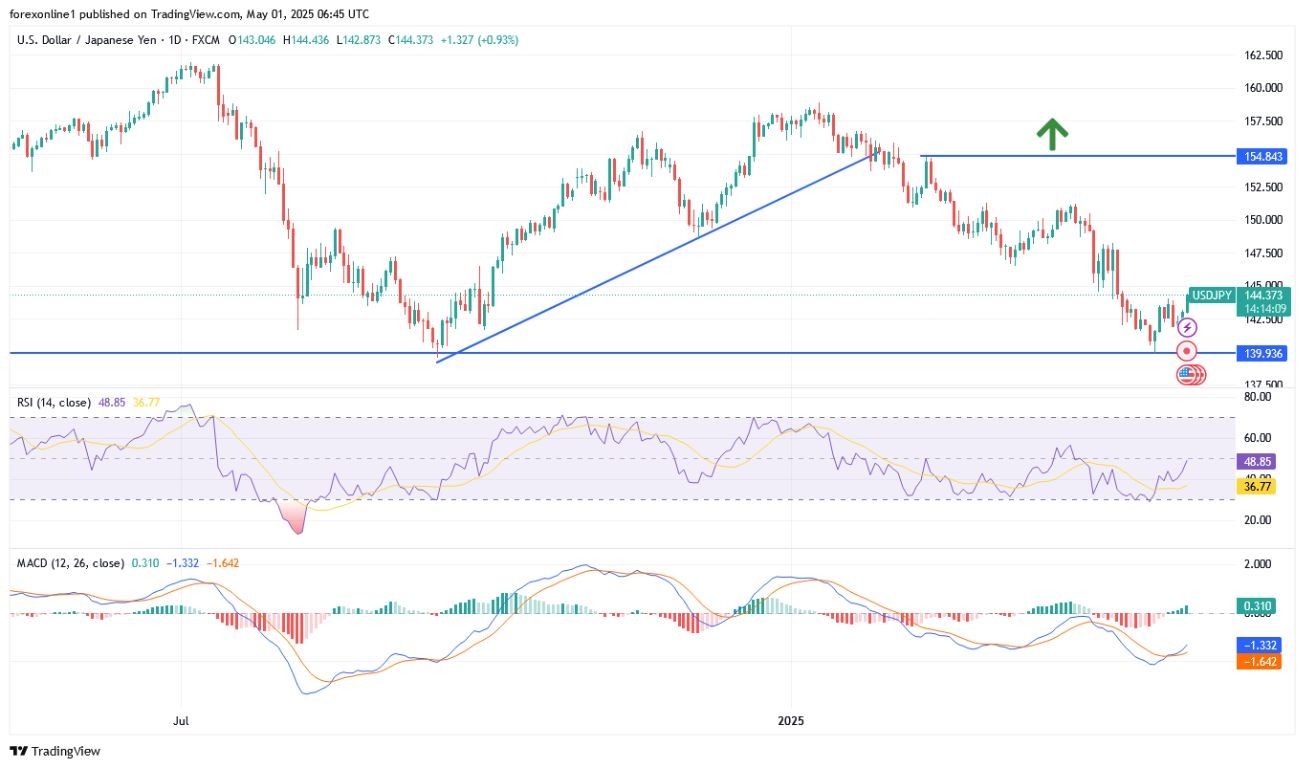
The USD/JPY pair surges almost 0.8% to near 144.80 during European trading hours on Thursday. The pair strengthens as the Japanese Yen (JPY) underperforms across the board, with the Bank of Japan (BoJ) indicating delay in plans of more interest rate hikes.
The table below shows the percentage change of Japanese Yen (JPY) against listed major currencies today. Japanese Yen was the strongest against the Canadian Dollar.
| USD | EUR | GBP | JPY | CAD | AUD | NZD | CHF | |
|---|---|---|---|---|---|---|---|---|
| USD | -0.07% | -0.11% | 0.82% | 0.09% | 0.06% | 0.02% | 0.01% | |
| EUR | 0.07% | -0.04% | 0.92% | 0.13% | 0.13% | 0.09% | 0.07% | |
| GBP | 0.11% | 0.04% | 0.90% | 0.20% | 0.17% | 0.12% | 0.10% | |
| JPY | -0.82% | -0.92% | -0.90% | -0.75% | -0.76% | -0.85% | -0.89% | |
| CAD | -0.09% | -0.13% | -0.20% | 0.75% | -0.03% | -0.07% | -0.10% | |
| AUD | -0.06% | -0.13% | -0.17% | 0.76% | 0.03% | -0.04% | -0.05% | |
| NZD | -0.02% | -0.09% | -0.12% | 0.85% | 0.07% | 0.04% | -0.02% | |
| CHF | -0.01% | -0.07% | -0.10% | 0.89% | 0.10% | 0.05% | 0.02% |
The heat map shows percentage changes of major currencies against each other. The base currency is picked from the left column, while the quote currency is picked from the top row. For example, if you pick the Japanese Yen from the left column and move along the horizontal line to the US Dollar, the percentage change displayed in the box will represent JPY (base)/USD (quote).
Earlier in the day, the BoJ kept interest rates steady at 0.5%, as expected, but expressed that additional tariffs imposed by United States (US) President Donald Trump on April 2 could hit the domestic economy and inflation.
We will enter a period in which both inflation and wage growth will likely slow somewhat. But we expect a positive cycle of rising wages and inflation to continue due to a severe labour shortage,” BoJ Governor Kazuo Ueda said in the press conference, Reuters reported.
Additionally, the BoJ has cut Gross Domestic Product (GDP) forecast for fiscal year ending March 2026 significantly to 0.5% from prior estimates of 1.1%.
Meanwhile, US Dollar (USD) gives up some of its intraday gains ahead of the US final S&P Global and Manufacturing PMI data for April, which will be published in the North American session.
USD/JPY extends its recovery to near the 20-day Exponential Moving Average (EMA), which trades around 144.00. The pair started recovering after attracting bids near the 21-month low around 140.00.
The 14-day Relative Strength Index (RSI) rises into the 40.00-60.00 range, suggesting that the bearish momentum is over. However, the downside bias is intact.
The odds of the pair extending its recovery towards the March 11 low of 146.54 and the April 9 high of 148.28 would increase if it will break above the key resistance of 145.00.
The asset would face downside move towards the 28 July 2023 low of 138.00 and the 14 July 2023 of 137.25 after sliding below the September 16 low of 139.58.
The Bank of Japan (BoJ) announces its interest rate decision after each of the Bank’s eight scheduled annual meetings. Generally, if the BoJ is hawkish about the inflationary outlook of the economy and raises interest rates it is bullish for the Japanese Yen (JPY). Likewise, if the BoJ has a dovish view on the Japanese economy and keeps interest rates unchanged, or cuts them, it is usually bearish for JPY.
Last release:
Thu May 01, 2025 03:02
Frequency:
Irregular
Actual:
0.5%
Consensus:
0.5%
Previous:
0.5%
Source:
Bank of Japan
Ethereum price (ETHUSD) rose in its last intraday trading, settled above the resistance at $1.800, to move in its way to confirm breaching this stubborn resistance, and we are still waiting for a good close above it, while the continuation of the positive support due to its trading above EMA50, with the emergence of the positive signals on the (RSI).
Therefore, our expectations suggest (ETHUSD) price rise in their upcoming trading on the intraday levels, conditioned by its stability above $1,800, to target the next main resistance at $1,900.
The expected trading range for today is between $1,750 support and $1,865 resistance.
Today’s forecast: Bullish
Do you need help in trading decisions? Do you want to learn how to start trading?
Join Economies.com VIP Club and benefit from over 15 years of market analysis expertise and get:
Special Offer: Subscribe to the Economies.com VIP channel and get also a free subscription to a trusted trading signals channel provided by Best Trading Signal.
Today’s decision was clear: The Bank of Japan (BoJ) kept its key short-term interest rate unchanged at 0.5% at its May meeting, maintaining its highest level since 2008 and in line with market expectations. This unanimous decision came amid growing concerns that US President Trump’s tariff measures could weaken both US and global economic growth.

Tokyo is currently negotiating a trade agreement with Washington, which could affect future policy moves. Furthermore, the Japanese board had indicated it would raise interest rates if economic and price forecasts were realized. In its quarterly forecasts, the BoJ lowered its forecast for Japan’s fiscal year 2025 GDP growth to 0.5% from the 1.0% expected in January, citing trade risks and political uncertainty. The growth forecast for 2026 was also lowered to 0.7% from 1.0%. Also, the BoJ cut its core inflation forecast for fiscal year 2025 from 2.7% to 2.2% and expects it to fall further to 1.7% in fiscal year 2026 before rising to 1.9% in fiscal year 2027.
Meanwhile, overall inflation is expected to remain around 2% through the end of the fiscal year ending March 2028.
Dear TradersUp website follower, we still prefer buying the US dollar against the Japanese yen from every downward level, but without risk and distributing trades across several entry levels.
Dear Reader, according to recent trading, the USD/JPY pair appears to be experiencing a notable recovery after reaching its low of 139.85 in April. The USD/JPY pair has achieved a bullish breakout above the 38.2% Fibonacci retracement level at 144.24 and is currently trading at 144.60. The pair’s price shows a clear rebound from its April lows, forming a series of higher lows and higher highs since mid-April. This structure suggests that buyers have regained market momentum after the sharp decline from the 151.34 area seen in previous months.
The Fibonacci retracement levels, drawn from the recent swing high to swing low, represent key reference points. With the price breaking above the 38.2% level (144.24), attention now turns to the 50% retracement level at 145.60, which could be the next resistance target. Above that, the 61.8% Fibonacci level at 146.95 will represent a significant hurdle for bulls. Looking at the moving averages, both are sloping downwards, indicating that the long-term trend remains bearish despite the recent recovery. The price will need to break above these dynamic resistance levels to confirm a more sustainable reversal.
Meanwhile, momentum indicators are showing strong bullish signals. The Stochastic indicator has crossed above the 50 level and is approaching the overbought zone, indicating strong buying pressure. Similarly, the Relative Strength Index (RSI) is trending upward and is currently near 60, reflecting increasing bullish momentum without yet reaching overbought territory. If the USD/JPY pair continues its upward trend, the 50% Fibonacci level will be the next key resistance to watch. Conversely, failure to hold above the 38.2% level could see the pair retest support near the April lows.
Want to trade our USD/JPY forex analysis and predictions? Here’s a list of forex brokers in Japan to check out.
Gold price edged lower on Thursday, trading at fresh two-week highs just above the $3,200 mark. De-escalating global trade tensions backed demand for the US Dollar (USD) despite mixed first-tier figures released in the last two sessions. Stocks also benefited from the better mood, with Wall Street extending Wednesday’s rally.
Most Asian and European markets were closed amid the celebration of Labor Day, but the United States (US) ones worked normally. The country released some mixed data, as Initial Jobless Claims for the week ended April 26 rose by 241K, worse than the 224K anticipated and the previous weekly figure of 223K. The April ISM Manufacturing Purchasing Managers’ Index (PMI), on the contrary, posted 48.7, down from the 49 posted in March, but better than the 48 expected.
Earlier in the day, US President Donald Trump noted progress on talks with some Asian countries, including India and Japan. Regarding China, Trump stated that there’s a “very good” chance of making a deal with China, yet added that any deal with Beijing has to be in US terms. Meanwhile, a Beijing-backed outlet reported on Thursday that United States officials have contacted their Chinese counterparts for talks.
Finally, White House trade advisor Peter Navarro down-talked data, saying, “I got to say just one thing about today’s news, that’s the best negative print I have ever seen in my life,” while saying he likes “where we’re at now.”
The week will end with the release of the US Nonfarm Payrolls (NFP) report. The country is expected to have added 130K new job positions in April, while the Unemployment Rate is foreseen at 4.2%, unchanged from March. Employment-related data ahead of the NFP report, however, hints at a soft reading, which may end up weighing on the USD.
From a technical point of view, the daily chart for XAU/USD shows that the risk skews to the downside. The pair is down for a third consecutive day, piercing a mildly bullish 20 Simple Moving Average (SMA) currently at around $3,232.10. The 100 and 200 SMAs maintain their upward slopes far below the current level, yet technical indicators head firmly south, approaching their midlines from above. Selling interest seems strong, and a break below $3,200 should open the door for a continued slide.
In the near term, and according to the 4-hour chart, the XAU/USD pair is poised to extend its slide. After meeting sellers around a mildly bullish 20 SMA, Gold slid below its 100 SMA, which, anyway, maintains its upward slope. Finally, technical indicators resumed their slides within negative levels, anticipating lower lows ahead.
Support levels: 3,200.00 3,188.30 3,176.40
Resistance levels: 3,232.10 3,245.20 3,261.70
Tariffs are customs duties levied on certain merchandise imports or a category of products. Tariffs are designed to help local producers and manufacturers be more competitive in the market by providing a price advantage over similar goods that can be imported. Tariffs are widely used as tools of protectionism, along with trade barriers and import quotas.
Although tariffs and taxes both generate government revenue to fund public goods and services, they have several distinctions. Tariffs are prepaid at the port of entry, while taxes are paid at the time of purchase. Taxes are imposed on individual taxpayers and businesses, while tariffs are paid by importers.
There are two schools of thought among economists regarding the usage of tariffs. While some argue that tariffs are necessary to protect domestic industries and address trade imbalances, others see them as a harmful tool that could potentially drive prices higher over the long term and lead to a damaging trade war by encouraging tit-for-tat tariffs.
During the run-up to the presidential election in November 2024, Donald Trump made it clear that he intends to use tariffs to support the US economy and American producers. In 2024, Mexico, China and Canada accounted for 42% of total US imports. In this period, Mexico stood out as the top exporter with $466.6 billion, according to the US Census Bureau. Hence, Trump wants to focus on these three nations when imposing tariffs. He also plans to use the revenue generated through tariffs to lower personal income taxes.
Nonetheless, natural gas is in a counter-trend rally within a bearish trend structure. It is rising into multiple potential resistance areas. How it behaves around those price levels should leave clues about what may come next. In general, once the 20-Day line is reclaimed, the 50-Day MA becomes a potential upside target. The 50-Day MA is now at $3.81 and falling. It is a little above potential resistance around an AVWAP level at $3.75, anchored at the top of the trend.
A bullish weekly reversal triggered this week indicating that a higher swing low has been established for the long-term uptrend and showing the buyers in charge. The uptrend can be defined as a rising parallel trend channel. It is interesting to observe that the middle line of the rising channel (dashed) is rapidly being approached for a test as resistance.
There is a weekly high at $3.61 that can be used as a proxy for the line. If that high can be exceeded, the $3.75 AVWAP level and 50-Day MA become the next upside targets, and it would be another sign of strength on the weekly time frame. A daily close above that weekly high would further confirm strength and increase the chance that natural gas could keep rising.
Note that yesterday support was found at the AVWAP line (light blue) from the recent bottom. Therefore, it may identify support in the future. Short-term support is now around the 20-Day MA and today’s low, which was $3.34.
For a look at all of today’s economic events, check out our economic calendar.
Silver price (XAG/USD) recovers a majority of its early losses and returns to near $32.50 during North American trading hours on Thursday. The white metal gained ground after posting a fresh over two-week low around $31.66, earlier in the day, even though the US Dollar (USD) has extended its two-day recovery.
The table below shows the percentage change of US Dollar (USD) against listed major currencies today. US Dollar was the strongest against the Japanese Yen.
| USD | EUR | GBP | JPY | CAD | AUD | NZD | CHF | |
|---|---|---|---|---|---|---|---|---|
| USD | 0.37% | 0.25% | 1.54% | 0.23% | 0.21% | 0.35% | 0.72% | |
| EUR | -0.37% | -0.12% | 1.13% | -0.17% | -0.14% | -0.02% | 0.33% | |
| GBP | -0.25% | 0.12% | 1.26% | -0.02% | -0.03% | 0.10% | 0.46% | |
| JPY | -1.54% | -1.13% | -1.26% | -1.30% | -1.29% | -1.22% | -0.87% | |
| CAD | -0.23% | 0.17% | 0.02% | 1.30% | 0.00% | 0.12% | 0.48% | |
| AUD | -0.21% | 0.14% | 0.03% | 1.29% | -0.00% | 0.12% | 0.50% | |
| NZD | -0.35% | 0.02% | -0.10% | 1.22% | -0.12% | -0.12% | 0.36% | |
| CHF | -0.72% | -0.33% | -0.46% | 0.87% | -0.48% | -0.50% | -0.36% |
The heat map shows percentage changes of major currencies against each other. The base currency is picked from the left column, while the quote currency is picked from the top row. For example, if you pick the US Dollar from the left column and move along the horizontal line to the Japanese Yen, the percentage change displayed in the box will represent USD (base)/JPY (quote).
Technically, a higher US Dollar makes the Silver price an expensive bet for investors.
The US Dollar Index (DXY), which tracks the Greenback’s value against six major currencies, jumps above 100.00. The USD strengthens even though the United States (US) ISM Manufacturing PMI data for April has shown that activities declined at a faster pace. The Manufacturing PMI is down at 48.7 from 49.0 in March but higher than estimates of 48.0.
Meanwhile, ISM Manufacturing Prices Paid, which gauges change in input cost, expanded at a faster pace to 69.8 from 69.4, but missed estimates of 70.3. Accelerating input costs are expected to feed consumer inflation. Such a scenario will limit the Federal Reserve (Fed) from reducing interest rates, which bodes poorly for non-yielding assets, such as Silver.
Earlier in the day, the Silver price fell sharply as investors expected that fears of additional tariffs announced by US President Donald Trump have peaked as Washington is close to announcing a bilateral trades with number of its trading partners soon.
“Initial trade deals are to be announced in weeks, not months,” US Trade Representative Jamieson Greer said at Fox News, Reuters reported.
However, trade uncertainty between the US and China will keep the downside in the Silver price limited.
Silver price struggles to revisit an over three-week high around $33.70. The near-term outlook of the white metal has become uncertain as it falls below the 20-day Exponential Moving Average (EMA), which trades around $32.65.
The 14-day Relative Strength Index (RSI) falls below 50.00 after failing to break above 60.00, indicating that investors are not bullish anymore.
Looking up, the March 28 high of $34.60 will act as key resistance for the metal. On the downside, the April 11 low of $30.90 will be the key support zone.
Silver is a precious metal highly traded among investors. It has been historically used as a store of value and a medium of exchange. Although less popular than Gold, traders may turn to Silver to diversify their investment portfolio, for its intrinsic value or as a potential hedge during high-inflation periods. Investors can buy physical Silver, in coins or in bars, or trade it through vehicles such as Exchange Traded Funds, which track its price on international markets.
Silver prices can move due to a wide range of factors. Geopolitical instability or fears of a deep recession can make Silver price escalate due to its safe-haven status, although to a lesser extent than Gold’s. As a yieldless asset, Silver tends to rise with lower interest rates. Its moves also depend on how the US Dollar (USD) behaves as the asset is priced in dollars (XAG/USD). A strong Dollar tends to keep the price of Silver at bay, whereas a weaker Dollar is likely to propel prices up. Other factors such as investment demand, mining supply – Silver is much more abundant than Gold – and recycling rates can also affect prices.
Silver is widely used in industry, particularly in sectors such as electronics or solar energy, as it has one of the highest electric conductivity of all metals – more than Copper and Gold. A surge in demand can increase prices, while a decline tends to lower them. Dynamics in the US, Chinese and Indian economies can also contribute to price swings: for the US and particularly China, their big industrial sectors use Silver in various processes; in India, consumers’ demand for the precious metal for jewellery also plays a key role in setting prices.
Silver prices tend to follow Gold’s moves. When Gold prices rise, Silver typically follows suit, as their status as safe-haven assets is similar. The Gold/Silver ratio, which shows the number of ounces of Silver needed to equal the value of one ounce of Gold, may help to determine the relative valuation between both metals. Some investors may consider a high ratio as an indicator that Silver is undervalued, or Gold is overvalued. On the contrary, a low ratio might suggest that Gold is undervalued relative to Silver.
Ethereum price (ETHUSD) rose in its last intraday trading, settled above the resistance at $1.800, to move in its way to confirm breaching this stubborn resistance, and we are still waiting for a good close above it, while the continuation of the positive support due to its trading above EMA50, with the emergence of the positive signals on the (RSI).
Therefore, our expectations suggest (ETHUSD) price rise in their upcoming trading on the intraday levels, conditioned by its stability above $1,800, to target the next main resistance at $1,900.
The expected trading range for today is between $1,750 support and $1,865 resistance.
Today’s forecast: Bullish
Do you need help in trading decisions? Do you want to learn how to start trading?
Join Economies.com VIP Club and benefit from over 15 years of market analysis expertise and get:
Special Offer: Subscribe to the Economies.com VIP channel and get also a free subscription to a trusted trading signals channel provided by Best Trading Signal.