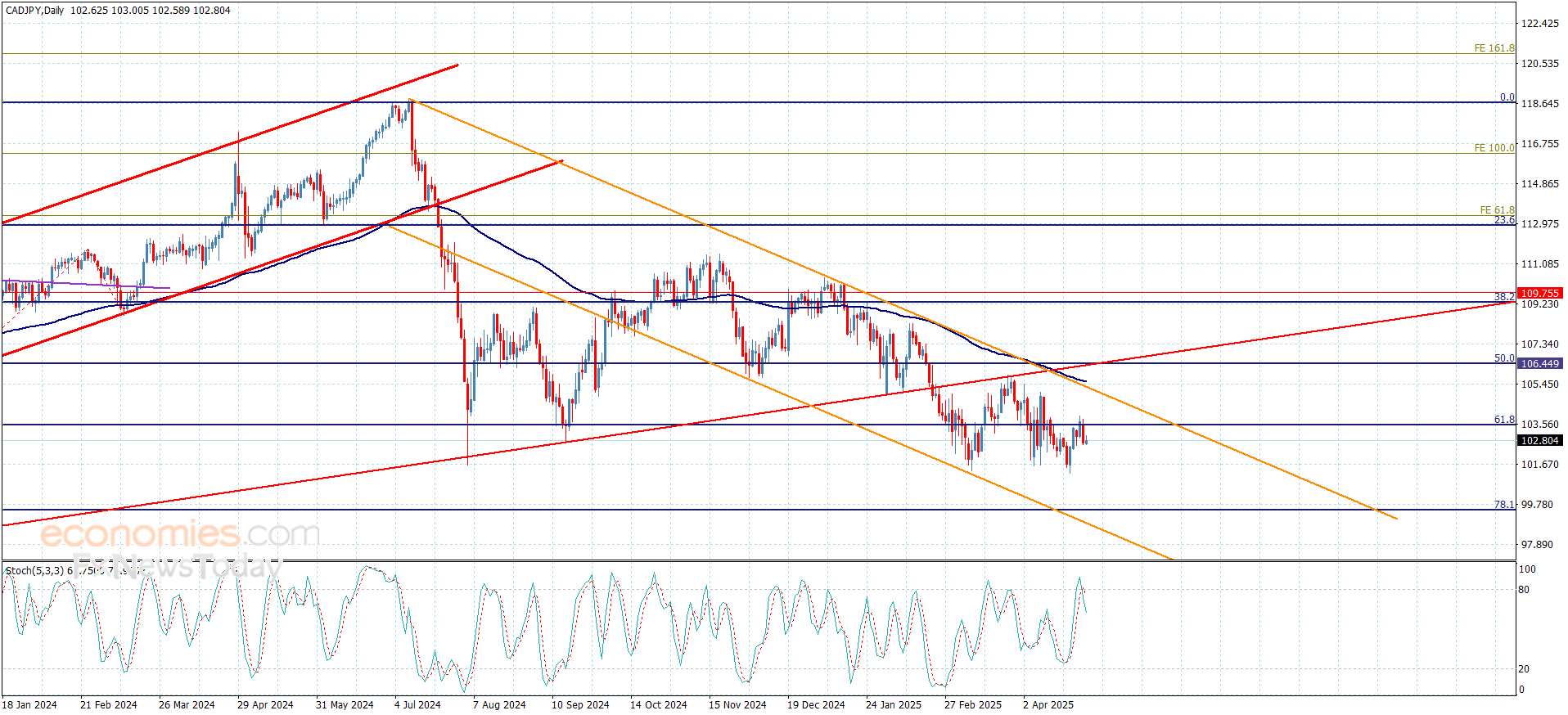
The main category of Forex News.
You can use the search box below to find what you need.
[wd_asp id=1]
The main category of Forex News.
You can use the search box below to find what you need.
[wd_asp id=1]
Copper price continued providing sideways trading, to keep the negative stability below the barrier at $4.9100, which forms a main factor that confirms the suggested bearish scenario, note that gathering the negative momentum is important to begin targeting negative stations that are located near $4.6600 and $4.5600.
Noting that the price rally above the current barrier and holding above it, will confirm the negative attack, which provides chances for recording extra gains by its rally towards $4.9600 and $5.0400.
The expected trading range for today is between $4.6600 and $4.8400
Trend forecast: Bearish
Do you need help in trading decisions? Do you want to learn how to start trading?
Join Economies.com VIP Club and benefit from over 15 years of market analysis expertise and get:
Special Offer: Subscribe to the Economies.com VIP channel and get also a free subscription to a trusted trading signals channel provided by Best Trading Signal.
GBP/USD benefited from the renewed selling pressure surrounding the US Dollar (USD) and advanced to its highest level in over three years above 1.3440 in the Asian session on Tuesday. Although the pair corrects lower in the European morning, the technical outlook suggests that the bullish bias remains intact.
The table below shows the percentage change of British Pound (GBP) against listed major currencies this week. British Pound was the strongest against the US Dollar.
| USD | EUR | GBP | JPY | CAD | AUD | NZD | CHF | |
|---|---|---|---|---|---|---|---|---|
| USD | -0.27% | -0.80% | -0.81% | -0.31% | -0.39% | -0.28% | -0.62% | |
| EUR | 0.27% | -0.59% | -0.57% | -0.05% | -0.21% | -0.02% | -0.37% | |
| GBP | 0.80% | 0.59% | 0.04% | 0.55% | 0.36% | 0.57% | 0.23% | |
| JPY | 0.81% | 0.57% | -0.04% | 0.55% | 0.47% | -0.85% | 0.50% | |
| CAD | 0.31% | 0.05% | -0.55% | -0.55% | -0.20% | 0.03% | -0.30% | |
| AUD | 0.39% | 0.21% | -0.36% | -0.47% | 0.20% | 0.20% | -0.14% | |
| NZD | 0.28% | 0.02% | -0.57% | 0.85% | -0.03% | -0.20% | -0.34% | |
| CHF | 0.62% | 0.37% | -0.23% | -0.50% | 0.30% | 0.14% | 0.34% |
The heat map shows percentage changes of major currencies against each other. The base currency is picked from the left column, while the quote currency is picked from the top row. For example, if you pick the British Pound from the left column and move along the horizontal line to the US Dollar, the percentage change displayed in the box will represent GBP (base)/USD (quote).
The USD weakened against its major rivals in the second half of the day on Monday on growing concerns over an economic downturn. The Federal Reserve Bank of Dallas’ Texas Manufacturing Index slumped to its worst level since May 2020 at -35.8 in April, down from -16.3 in March. Additionally, the uncertainty surrounding the US-China trade relations puts additional weight on the USD’s shoulders.
Early Tuesday, a spokesperson for China’s Commerce Ministry said that the US should stop making threats if they want a resolution and noted that it’s the US that needs to seek dialogue with China on tariffs.
In the second half of the day, the US Department of Labor Statistics will publish JOLTS Job Openings data for March. Investors expect the number of job openings to decline slightly to 7.5 million from 7.56 million in February. A significant negative surprise, with a reading at or below 7 million, could trigger another leg of USD selloff and open the door for additional gains in GBP/USD. On the flip side, a bigger-than-forecast print could support the USD and limit the pair’s upside.
GBP/USD holds comfortably above the 20-period and the 50-period Simple Moving Averages (SMA) on the 4-hour chart and the Relative Strength Index (RSI) indicator stays above 60, reflecting a bullish bias.
On the upside, 1.3480 (mid-point of the ascending regression channel) aligns as the next key resistance level before 1.3500 (static level, round level) and 1.3570 (static level). Looking south, supports could be spotted at 1.3340-1.3330 (20-period SMA, 50-period SMA) and 1.3280 (lower limit of the ascending channel).
The Pound Sterling (GBP) is the oldest currency in the world (886 AD) and the official currency of the United Kingdom. It is the fourth most traded unit for foreign exchange (FX) in the world, accounting for 12% of all transactions, averaging $630 billion a day, according to 2022 data.
Its key trading pairs are GBP/USD, also known as ‘Cable’, which accounts for 11% of FX, GBP/JPY, or the ‘Dragon’ as it is known by traders (3%), and EUR/GBP (2%). The Pound Sterling is issued by the Bank of England (BoE).
The single most important factor influencing the value of the Pound Sterling is monetary policy decided by the Bank of England. The BoE bases its decisions on whether it has achieved its primary goal of “price stability” – a steady inflation rate of around 2%. Its primary tool for achieving this is the adjustment of interest rates.
When inflation is too high, the BoE will try to rein it in by raising interest rates, making it more expensive for people and businesses to access credit. This is generally positive for GBP, as higher interest rates make the UK a more attractive place for global investors to park their money.
When inflation falls too low it is a sign economic growth is slowing. In this scenario, the BoE will consider lowering interest rates to cheapen credit so businesses will borrow more to invest in growth-generating projects.
Data releases gauge the health of the economy and can impact the value of the Pound Sterling. Indicators such as GDP, Manufacturing and Services PMIs, and employment can all influence the direction of the GBP.
A strong economy is good for Sterling. Not only does it attract more foreign investment but it may encourage the BoE to put up interest rates, which will directly strengthen GBP. Otherwise, if economic data is weak, the Pound Sterling is likely to fall.
Another significant data release for the Pound Sterling is the Trade Balance. This indicator measures the difference between what a country earns from its exports and what it spends on imports over a given period.
If a country produces highly sought-after exports, its currency will benefit purely from the extra demand created from foreign buyers seeking to purchase these goods. Therefore, a positive net Trade Balance strengthens a currency and vice versa for a negative balance.
Silver price (XAG/USD) trades higher to near $33.30 during European trading hours on Tuesday. The white metal gains as investors start doubting whether de-escalation in the trade war between the United States (US) and China is underway.
A fresh boost in uncertainty over US-China trade relations has come from comments by US Treasury Secretary Scott Bessent stating that Beijing should be the one to commence trade talks. “I believe that it’s up to China to de-escalate, because they sell five times more to us than we sell to them, Bessent said in an interview on CNBC’s Squawk Box on Monday. However, Bessent indicated that trade discussions with other nations are going well.
Though Bessent’s comments have indicated that the trade war will be majorly between Washington and Beijing, the stand-off is expected to keep global economic tensions heightened. Theoretically, the Silver price performs strongly when fears of global economic turmoil escalate.
Meanwhile, the US Dollar (USD) rises ahead of the US JOLTS Job Openings data for March, which will be published at 14:00 GMT. The US Dollar Index (DXY), which tracks the Greenback’s value against six major currencies, move higher to near 99.30. Investors expect US employers to have posted 7.5 million jobs, marginally lower than 7.56 million seen in February.
This week, investors will pay close attention to a slew of US economic data, including the Nonfarm Payrolls (NFP), which will influence market expectations for the Federal Reserve’s (Fed) monetary policy outlook.
Silver price aims to revisit an over three-week high around $33.70. The near-term outlook of the white metal remains bullish as it holds the 20-day Exponential Moving Average (EMA), which trades around $32.73.
The 14-day Relative Strength Index (RSI) struggles to break above 60.00. A fresh bullish momentum would emerge if the RSI breaks above that level.
Looking up, the March 28 high of $34.60 will act as key resistance for the metal. On the downside, the April 11 low of $30.90 will be the key support zone.
Silver is a precious metal highly traded among investors. It has been historically used as a store of value and a medium of exchange. Although less popular than Gold, traders may turn to Silver to diversify their investment portfolio, for its intrinsic value or as a potential hedge during high-inflation periods. Investors can buy physical Silver, in coins or in bars, or trade it through vehicles such as Exchange Traded Funds, which track its price on international markets.
Silver prices can move due to a wide range of factors. Geopolitical instability or fears of a deep recession can make Silver price escalate due to its safe-haven status, although to a lesser extent than Gold’s. As a yieldless asset, Silver tends to rise with lower interest rates. Its moves also depend on how the US Dollar (USD) behaves as the asset is priced in dollars (XAG/USD). A strong Dollar tends to keep the price of Silver at bay, whereas a weaker Dollar is likely to propel prices up. Other factors such as investment demand, mining supply – Silver is much more abundant than Gold – and recycling rates can also affect prices.
Silver is widely used in industry, particularly in sectors such as electronics or solar energy, as it has one of the highest electric conductivity of all metals – more than Copper and Gold. A surge in demand can increase prices, while a decline tends to lower them. Dynamics in the US, Chinese and Indian economies can also contribute to price swings: for the US and particularly China, their big industrial sectors use Silver in various processes; in India, consumers’ demand for the precious metal for jewellery also plays a key role in setting prices.
Silver prices tend to follow Gold’s moves. When Gold prices rise, Silver typically follows suit, as their status as safe-haven assets is similar. The Gold/Silver ratio, which shows the number of ounces of Silver needed to equal the value of one ounce of Gold, may help to determine the relative valuation between both metals. Some investors may consider a high ratio as an indicator that Silver is undervalued, or Gold is overvalued. On the contrary, a low ratio might suggest that Gold is undervalued relative to Silver.
The USD/JPY price analysis indicates an improvement in risk appetite following Trump’s promise to lower automotive tariffs. At the same time, progress on trade negotiations with countries like India has reduced the risk of a global trade war. However, the dollar remains fragile amid uncertainty over the fate of trade talks between the US and China.
If you are interested in automated forex trading, check our detailed guide-
The US president said he was ready to reduce tariffs on automobiles on Tuesday, slightly easing economic concerns. Trump’s tariff campaign has become less aggressive in recent days as he acknowledges the risk to the economy. Last week, the president criticized the Fed, demanding lower interest rates to support the economy. However, Powell has remained cautious, not giving any clear signals on when the next rate cut will come. This has sobered Trump, leading to his softer stance.
Moreover, negotiations with countries that might suffer reciprocal tariffs are ongoing. On Monday, Scott Bessent said India would be the first to sign a deal with the US. As a result, market participants are optimistic about the global economy.
However, progress with China has stalled with neither country willing to be the first to cut tariffs. The US is waiting for China to start lowering its tariffs before they do the same. Still, the US has admitted that the current tariffs are unsustainable. Therefore, eventually, one side will have to start the process.
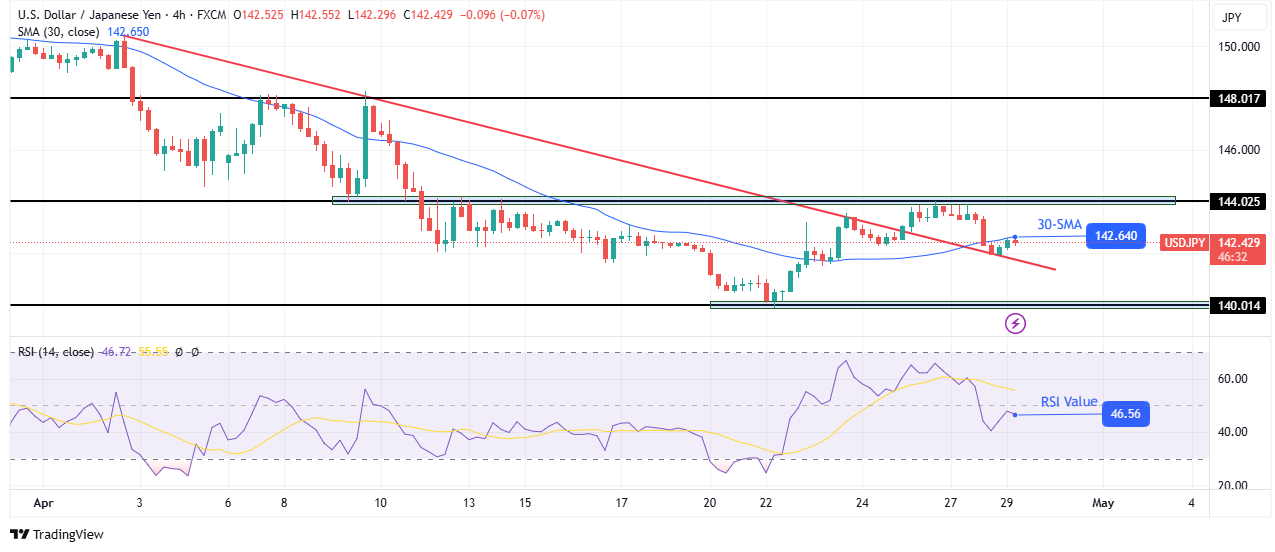
On the technical side, the USD/JPY price has broken above and retested a solid resistance trendline. However, it has returned below the 30-SMA, and the RSI is now under 50. Still, bulls are challenging the SMA resistance.
If you are interested in guaranteed stop-loss forex brokers, check our detailed guide-
USD/JPY has been on a decline since bears took the lead at the top of the chart. The price mostly stayed below the 30-SMA. Moreover, the highs of the downtrend respected a clear resistance trendline. However, things changed after the price reached the 140.01 support level.
Here, bulls became stronger, pushing the price above the 30-SMA and the trendline. Furthermore, the price pulled back to retest the line. From here, bulls must break above the 144.02 resistance to make a higher high and confirm an uptrend. Otherwise, the downtrend will continue.
Looking to trade forex now? Invest at eToro!
67% of retail investor accounts lose money when trading CFDs with this provider. You should consider whether you can afford to take the high risk of losing your money.
Meanwhile, US Treasury Secretary Scott Bessent said trade relations with key partners were “progressing,” reinforcing the risk-on mood in equity markets.
Despite short-term pressure, gold remains underpinned by expectations of a more dovish Federal Reserve. Futures markets now price in a 76% probability of a rate cut by June, with three total cuts expected by year-end, according to CME FedWatch.
Lower rates reduce the opportunity cost of holding metals, providing a buffer against aggressive declines.
Upcoming US economic data—including the JOLTS job openings, core PCE inflation, and April’s Nonfarm Payrolls—may serve as catalysts. Until then, metals are likely to remain sensitive to macro crosscurrents and dollar positioning.
Gold hovers near $3,315, supported by $3,270, as markets await key U.S. data. Silver steadies above $33, but momentum hinges on a breakout above $33.27 to confirm upside.
I think this is a situation where traders are trying to sort out which direction to go. In general, I think we’re working off some of that excess froth that was in the Euro previously due to the massive amount of ridiculous volatility. After all, traders were basically treating the US dollar like it was going to zero.
So now, cooler heads have prevailed, and we are starting to look around the world and trying to determine what happens next. I think you have a situation where we very well could go higher, but I think the best case scenario for those who are bullish on the Euro is that we go sideways for a while. You have to work off some of the momentum. On the other hand, if we get a very risk off type of situation, you could see the US dollar start to strengthen again.

Ironically, higher interest rates don’t seem to matter at the moment, but they will eventually. The Federal Reserve must keep its interest rates high for a while, at least to combat inflation. The Europeans may be heading in that same direction.
We’re still kind of wishy-washy when it comes to the European Central Bank. And I think that’s part of the problem here. So, no clear analysis other than it is a good thing to be in this range between 1.12 underneath and 1.15 above. We certainly have more of a tilt to the upside. So, if you are playing in this little playground here, you’re looking to buy short-term dips for short-term moves.
Ready to trade our EUR/USD daily forecast? Here’s a list of some of the top forex brokers in Europe to check out.
The GBPJPY pair failed to confirm breaching the barrier at 191.55 yesterday, affected by the moving average 55 above it, which forces it to form sideways trading, to be confined between this barrier and the support level at 190.50.
Monitoring the price behavior and waiting for its rally above the barrier, to increase the efficiency of the bullish track, targeting 192.40 level, reaching the next target near 193.15, while reaching below the support will cancel the positive suggestion to force the price suffer several losses, starting at 189.70 and 188.60.
The expected trading range for today is between 190.50 and 191.55
Trend forecast: Sideways
Do you need help in trading decisions? Do you want to learn how to start trading?
Join Economies.com VIP Club and benefit from over 15 years of market analysis expertise and get:
Special Offer: Subscribe to the Economies.com VIP channel and get also a free subscription to a trusted trading signals channel provided by Best Trading Signal.
The GBPJPY pair failed to confirm breaching the barrier at 191.55 yesterday, affected by the moving average 55 above it, which forces it to form sideways trading, to be confined between this barrier and the support level at 190.50.
Monitoring the price behavior and waiting for its rally above the barrier, to increase the efficiency of the bullish track, targeting 192.40 level, reaching the next target near 193.15, while reaching below the support will cancel the positive suggestion to force the price suffer several losses, starting at 189.70 and 188.60.
The expected trading range for today is between 190.50 and 191.55
Trend forecast: Sideways
Do you need help in trading decisions? Do you want to learn how to start trading?
Join Economies.com VIP Club and benefit from over 15 years of market analysis expertise and get:
Special Offer: Subscribe to the Economies.com VIP channel and get also a free subscription to a trusted trading signals channel provided by Best Trading Signal.
Copper price continued providing sideways trading, to keep the negative stability below the barrier at $4.9100, which forms a main factor that confirms the suggested bearish scenario, note that gathering the negative momentum is important to begin targeting negative stations that are located near $4.6600 and $4.5600.
Noting that the price rally above the current barrier and holding above it, will confirm the negative attack, which provides chances for recording extra gains by its rally towards $4.9600 and $5.0400.
The expected trading range for today is between $4.6600 and $4.8400
Trend forecast: Bearish
Do you need help in trading decisions? Do you want to learn how to start trading?
Join Economies.com VIP Club and benefit from over 15 years of market analysis expertise and get:
Special Offer: Subscribe to the Economies.com VIP channel and get also a free subscription to a trusted trading signals channel provided by Best Trading Signal.
The GBPJPY pair failed to confirm breaching the barrier at 191.55 yesterday, affected by the moving average 55 above it, which forces it to form sideways trading, to be confined between this barrier and the support level at 190.50.
Monitoring the price behavior and waiting for its rally above the barrier, to increase the efficiency of the bullish track, targeting 192.40 level, reaching the next target near 193.15, while reaching below the support will cancel the positive suggestion to force the price suffer several losses, starting at 189.70 and 188.60.
The expected trading range for today is between 190.50 and 191.55
Trend forecast: Sideways
Do you need help in trading decisions? Do you want to learn how to start trading?
Join Economies.com VIP Club and benefit from over 15 years of market analysis expertise and get:
Special Offer: Subscribe to the Economies.com VIP channel and get also a free subscription to a trusted trading signals channel provided by Best Trading Signal.