The main category of Forex News.
You can use the search box below to find what you need.
[wd_asp id=1]
The main category of Forex News.
You can use the search box below to find what you need.
[wd_asp id=1]
The Gold price (XAU/USD) loses ground to around $3,335 during the early Asian session on Tuesday. The yellow metal edges lower amid a modest rebound of the US Dollar (USD) and a softening in tensions between the United States and China.
China exempted some US imports from its 125% tariffs on Friday, raising hopes that the trade war between the US and China is nearing an end, although China quickly knocked down US President Donald Trump’s assertion that negotiations between the two countries were underway.
US Treasury Secretary Scott Bessent said on Monday that the US government is in contact with China but that it’s up to Beijing to take the first step in de-escalating the tariff fight with the US due to the imbalance of trade between the two nations. The easing fears of trade tension between the world’s two largest economies reduce demand for traditional safe-haven assets like gold. Additionally, a stronger Greenback added further headwinds for the precious metal.
“Comments last week from the White House have fueled optimism that a US-China trade deal may eventuate, which has caused safe-haven demand for assets such as gold to subside,” said Tim Waterer, Chief Market Analyst at KCM Trade.
On the other hand, rising expectations that the Federal Reserve (Fed) will resume its rate-cutting cycle in the June meeting could lift the non-yielding Gold price. Meanwhile, the Fed remains in blackout mode ahead of its Federal Open Market Committee (FOMC) meeting on May 7.
Traders will keep an eye on the preliminary US Q1 GDP report and April employment data this week, as it might offer some hints about the Fed’s next policy decisions and the US economic outlook. The expectation for April is that the US economy will add 135,000 jobs and the Unemployment Rate will remain at 4.2%. If the reports show a weaker-than-expected outcome, this could drag the Greenback lower and boost the USD-denominated commodity price in the near term.
Gold has played a key role in human’s history as it has been widely used as a store of value and medium of exchange. Currently, apart from its shine and usage for jewelry, the precious metal is widely seen as a safe-haven asset, meaning that it is considered a good investment during turbulent times. Gold is also widely seen as a hedge against inflation and against depreciating currencies as it doesn’t rely on any specific issuer or government.
Central banks are the biggest Gold holders. In their aim to support their currencies in turbulent times, central banks tend to diversify their reserves and buy Gold to improve the perceived strength of the economy and the currency. High Gold reserves can be a source of trust for a country’s solvency. Central banks added 1,136 tonnes of Gold worth around $70 billion to their reserves in 2022, according to data from the World Gold Council. This is the highest yearly purchase since records began. Central banks from emerging economies such as China, India and Turkey are quickly increasing their Gold reserves.
Gold has an inverse correlation with the US Dollar and US Treasuries, which are both major reserve and safe-haven assets. When the Dollar depreciates, Gold tends to rise, enabling investors and central banks to diversify their assets in turbulent times. Gold is also inversely correlated with risk assets. A rally in the stock market tends to weaken Gold price, while sell-offs in riskier markets tend to favor the precious metal.
The price can move due to a wide range of factors. Geopolitical instability or fears of a deep recession can quickly make Gold price escalate due to its safe-haven status. As a yield-less asset, Gold tends to rise with lower interest rates, while higher cost of money usually weighs down on the yellow metal. Still, most moves depend on how the US Dollar (USD) behaves as the asset is priced in dollars (XAU/USD). A strong Dollar tends to keep the price of Gold controlled, whereas a weaker Dollar is likely to push Gold prices up.
Cisco Systems’ stock price extended the gains in latest intraday levels, boosted by positive signals from the Stochastic, however, it reached overbought levels, indicating the weakness of that positive momentum, especially amid the dominance of the downward correctional trend in the short term, with negative pressure due to trading below the 50-day SMA.
Therefore we expect the price to decline and target the support of $52.00, provided the resistance of $58.45 holds on.
Today’s price forecast: Bearish
Do you need help in trading decisions? Do you want to learn how to start trading?
Join Economies.com VIP Club and benefit from over 15 years of market analysis expertise and get:
Special Offer: Subscribe to the Economies.com VIP channel and get also a free subscription to a trusted trading signals channel provided by Best Trading Signal.
April 28, 2025 – Written by Tim Boyer
STORY LINK EUR/USD Outlook: Is Euro to Dollar Rate Forecast to Challenge on 1.15?
The Euro to US Dollar exchange rate (EUR/USD) has consolidated around 1.1350 ahead of a big week for US data.
The dollar has managed to stabilise in global markets, but sentiment remains cautious.
According to ING; “Hard data to determine dollar’s next move.”
It added; “The worst case for EUR/USD is probably 1.1250, should US data surprise on the upside. 1.1500 is the risk, should any of this week’s job releases suggest that tariff uncertainty has already triggered layoffs.”
On a longer-term view, Goldman Sachs has a 12-month target of 1.20.
US data will be watched closely this week, especially jobs-related releases.
According to HSBC; “Some high-frequency US data for April already point to a bleak picture.”
It added; “Given the steep drop in US survey/soft data, we’d be very surprised if it doesn’t spill over into hard data at all.”
Trade talks will also continue to be watched very closely.
Caution is likely to prevail in the short term, especially if Administration rhetoric does not appear to match reality.
Late on Friday, President Trump stated that Chinese President Xi had called, but this was denied with Beijing stating that there had been no trade negotiations.
According to Bank of America; “USD could depreciate faster if trade negotiations fail. De-escalation in the trade war and re-focus on pro-growth policies could help the USD recover, but we would not expect risk premium to fully vanquish any time soon.”
It added; “US trade policies and the surrounding uncertainty are bad for Europe, but worse for the US. We still think risks are we think skewed toward more EUR strength from potential European reforms and the EU pushing for trade deals elsewhere, assuming no EU-US trade escalation.
Nordea maintains a bearish stance; “Trump’s plan to deglobalise the US from the rest of the world presents a significant risk to the economy and financial market that is in danger of hurting investor confidence and trust which would be bad news for the dollar.”

Goldman Sachs notes that the Administration has dialled back tariff rhetoric.
It added; “However, after frequent changes in policy positions, we think it will take some time for investors to be convinced. Just as importantly, even after the exemptions and reversals, planned and actual tariff increases are still very large, and US businesses and consumers may be frozen by the uncertainty, which remains high and is why our economists are still on recession watch.”
Goldman also expects longer-term capital shifts; “We view the evidence that some investors have sold or hedged a portion of their Dollar assets largely as confirmation that they are unlikely to be adding to those positions with the same enthusiasm as before. Historically, these types of changes in investor appetite led to large, persistent changes in exchange rates.”
International Money Transfer? Ask our resident FX expert a money transfer question or try John’s new, free, no-obligation personal service! ,where he helps every step of the way,
ensuring you get the best exchange rates on your currency requirements.
TAGS: Euro Dollar Forecasts
Gold price changed course in the American session on Monday, and trades around $3,330, recovering nicely from an intraday low of $3,268.03. In the absence of relevant macroeconomic data, investors kept focusing on trade developments. Mixed headlines on United States-China trade talks spurred some concerns after a quiet start to the day, as cautious optimism led the Asian and European sessions, weighing on US Dollar (USD) demand.
The White House hinted at trade talks with its Asian counterpart last week, but Beijing stated on Monday that President Xi Jinping has not spoken with his United States (US) counterpart, Donald Trump. Meanwhile, Trump said that there are no red lines that would make him ease tariffs. “It always affects you a little bit,” Trump noted when asked about the potential impact on the USD, stocks, or even economic progress.
At the time being, Wall Street struggles to retain the green, with the Dow Jones Industrial Average (DJIA) being the best performer and the Nasdaq Composite being the worst.
Other than that, investors await first-tier data from major economies scheduled for later this week. Most figures will be released on Wednesday, with growth updates from Germany, the Eurozone (EU), the US and Canada. Meanwhile, Australia, Germany and the EU will post inflation updates. The cherry on the top will be US employment-related data, including different reports ahead of the Nonfarm Payrolls report scheduled for Friday.
The XAU/USD pair trimmed early losses, but so far, it’s unable to recover its bullish stance. The daily chart for the pair shows it is hovering around its opening, while the risk remains skewed to the upside, given that it keeps developing above all bullish moving averages. The same chart shows a strong floor in the $3,260 region, as buyers surged around it in the last four trading days. Finally, technical indicators stand well above their midlines, albeit only the Momentum indicator aims north. The Relative Strength Index (RSI) indicator consolidates around 62, as XAU/USD can not extend gains beyond its recent range’s top in the $3,370/80 region.
The near-term picture is neutral-to-bullish. The 4-hour chart shows XAU/USD is currently battling to overcome a directionless 20 Simple Moving Average (SMA), while the 100 and 200 SMAs keep heading higher, over $100 below the current level. Technical indicators, in the meantime, advance, yet within negative levels and with limited upward strength.
Support levels: 3,314.50 3,301.40 3,288.70
Resistance levels: 3,344.60 3,358.10 3,370.00
Image © Adobe Images
The Pound to Euro exchange rate opened the new week near fortnight highs and could have scope to climb further to around 1.18 in the days ahead, as Roxette sings “Listen to Your Heart,” and Sterling makes a start on a journey that might ultimately see it back around 1.20 over the coming months.
GBP/EUR recovered to multi-week highs around 1.17 last week as EUR/USD receded from some of its best levels since November 2021 and with the latter pair perhaps set to take a further dip into the market’s very own Pool of Bethesda, Sterling may have scope to rise further toward 1.18 up ahead.
“We are also introducing changes in some of our other forecasts. More specifically, we are bringing our EURGBP forecasts marginally higher, reflecting the stronger EUR, without, however, changing our bullish GBP view directionally,” says the research team at Barclays, in a Sunday note.

“We have recommended longs in GBPCHF as a way to capture a further normalisation in the VIX with limited downside risk due to more-active SNB pushback on CHF appreciation,” they add, after lowering their second-quarter GBP/EUR forecast slightly, to 1.19.
The anticipation of an eventual climb toward 1.20 assumes a continued, gradual and orderly decline of the US Dollar that would help to lift EUR/USD to 1.20 over the next three-to-six months, and GBP/USD back to around 1.44.
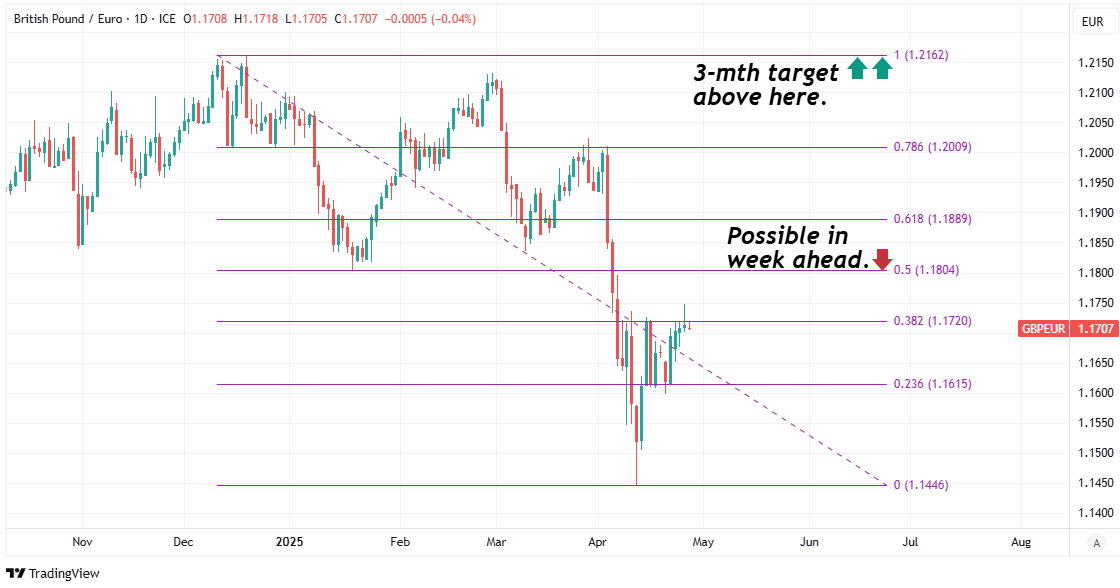
Above: GBP/EUR shown at daily intervals with Fibonacci retracements highlighting possible resistances. Click image for closer inspection.
“Given that some BoE hawks [have talked] of trade dumping as being potentially disinflationary we would be mindful of a graduated uptick in June MPC pricing, from the current 11bps,” ”says Jeremy Stretch European head of FX strategy at CIBC Capital Markets.
“Despite the immediate retail beat we would maintain a cautious EUR/GBP upside bias, only a weekly close below 0.8519 [above 1.1798 in GBP/EUR} would negate looking for a return towards the 21 April high,” he adds in a Friday note to clients.
There is no meaningful data out in the UK or Euro Area this week, however, Sterling showed resilience last week when the S&P Global Composite PMI survey index fell sharply for April, to a level sometimes consistent with recession.
The above is admittedly a wild forecast, and somewhat contrary to popular opinion so in entertaining it, readers might like to just “Listen to your Heart,” as that’s what the biblical covenant says to do.
Above: Roxette, Listen to Your Heart. Source: Youtube.
Meanwhile, the euro was supported by a better-than-expected German Ifo survey suggesting an improvement in confidence among small businesses, and some favourable comments from European Central Bank officials.
“We raise our GBPUSD forecast and now see the pairing edging higher towards 1.39 at the end of our forecast horizon,” strategists at UBS say, in a Friday note.
“With US policy risks persisting and European fundamentals improving, EURUSD is likely to remain supported, with the balance of risks favoring further euro strength,” they add.
The outlook is largely a function of how Sterling and the Euro each trade against the Dollar, which was tipped by the UBS team on Friday to help lift EUR/USD to 1.18, implying they think GBP/EUR will likely trade around 1.1779 over the coming year.
Bonus Song: Florence and the Machine Rabbit Heart. Source: Youtube.
Natural gas futures have now fallen for ten straight sessions, weighed down by mild spring temperatures and sluggish demand typical of the shoulder season.
Production remains stubbornly high, with Lower 48 dry gas output at 104.4 Bcf/day on Friday, up 3.8% year-over-year, according to BNEF. In contrast, Lower 48 gas demand was only 66.8 Bcf/day, down 7% from a year ago.
LNG exports were also lighter, with flows at 15.3 Bcf/day, a 3% week-over-week decline. These supply-demand imbalances continue to erode price support.
The EIA reported an 88 Bcf storage build for the week ending April 18, exceeding expectations of 75 Bcf and topping the five-year average build of 58 Bcf. Total working gas in storage now stands at 1,934 Bcf, 44 Bcf below the five-year average but still within the historical range.
Despite a tighter year-over-year supply picture—storage levels are down 20.2% versus last year—the higher-than-expected injection and ongoing mild weather are keeping pressure on futures.
If the Bank of England remains cautious about interest rate cuts and risk appetite declines, the British pound could benefit. Recently, UK economic data results were mixed on Friday, with stronger-than-expected retail sales data offset by a further decline in consumer confidence. According to the economic calendar data results, retail sales volumes rose by 0.4% for March, compared to the consensus forecast of a 0.3% decline, although the February increase was revised down to 0.7% from the original reading of 1.0%. favourable weather boosted demand for clothing and outdoor product sales, which was partly offset by a fall in supermarket sales.
First-quarter sales rose by 1.6% compared to the final quarter of 2024, the strongest increase since July 2021. According to Forex market trading, the British pound is taking some comfort from this. We wouldn’t overstate it, but it has performed well and was threatening to roll over, and it has received some support from the data, temporarily at least. On another front, doubts remain about the sustainability of spending. The UK GfK consumer confidence index fell to -23 for April from -19 previously, slightly worse than the -21 forecast, its lowest level since November 2023, with all components declining during the month.

The British pound continues to benefit significantly against other major currencies from Britain’s avoidance of US tariffs.
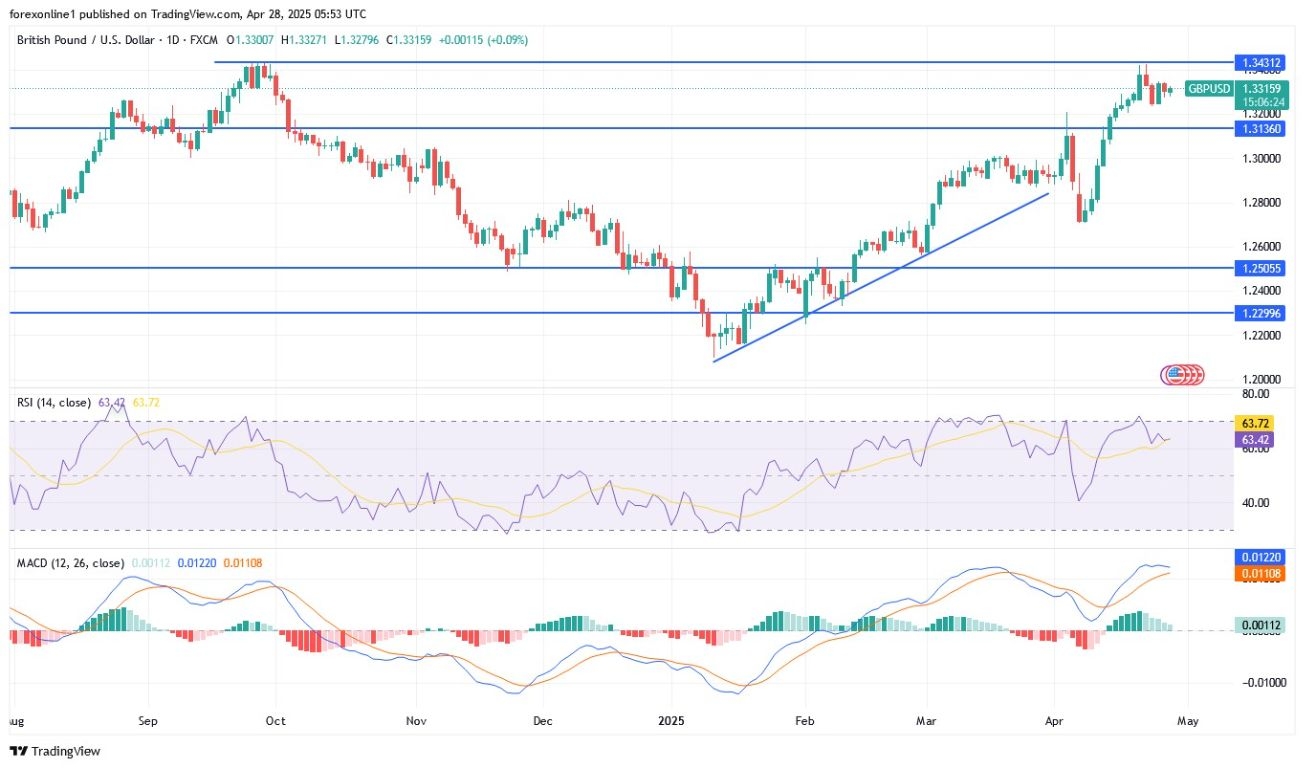
According to trusted trading platforms, the GBP/USD exchange rate rose to test a three-year high of around 1.3430 before retreating slightly. With the recent decline, some currency market experts have lowered their foreign exchange market forecasts, as the dominant theme in the markets has been the increasing political turmoil in the United States, caused by escalating trade tensions, which has led to increased fears of a US recession. In the longer term, structural challenges, such as US political shifts, the trade war, and capital flight from US assets, point to a significant decline in the value of the US dollar.
According to reliable trading platforms, the GBP/USD exchange rate rose to test its highest levels in three years at around 1.3430 before a limited pullback. With the recent decline, some currency market experts lowered their foreign exchange market forecasts, as the dominant theme in the markets was increasing political turmoil in the United States, stemming from escalating trade tensions, leading to growing fears of a US recession. In the longer term, structural challenges, such as US political shifts, the trade war, and capital moving away from US assets, point to a significant decline in the value of the US dollar.
They remain cautious about the UK’s economic outlook, but the sharp decline in the dollar has led to a strong revision in the forecast for the British pound. Accordingly, the GBP/USD pair is now expected to rise to the 1.39 resistance level on a 12-month forecast, from 1.31 previously. The forecasts are driven by a high degree of uncertainty, as investors now face multiple scenarios and forecasts based on how tariff policy develops, all of which hinge on President Trump’s decisions.
Therefore, the easiest option for investors now is to reduce exposure to the US dollar and US assets in general, and reassess when developments allow more certainty about the outlook.
Regarding the British pound, the Bank of England is expected to adhere to a cautious stance; we also believe that the market is pricing in a much larger amount of monetary easing than will actually be implemented, which provides support for the pound as expectations are reassessed. Accordingly, we expect some gains for the pound against a weaker US dollar, but it may struggle to improve significantly against the euro at present.
Ready to trade our GBP/USD Forex analysis? Here are the best regulated trading platforms UK to choose from
Gold prices are hovering near $3,297, defending the rising trendline and major support zone around $3,270, where a triple-bottom structure is forming. The pivot point sits around $3,269, offering critical near-term support. Immediate resistance stands at $3,369, followed by $3,434, and the next key target at $3,500.
A breakdown below $3,270 could open the door toward $3,196 and potentially $3,152. The 50 EMA at $3,323 and the 200 EMA at $3,242 are important trend guides—price action currently dances between them.
A clean bullish reaction above $3,323 would strengthen the short-term outlook, while a failure to hold $3,270 may shift momentum back to sellers.
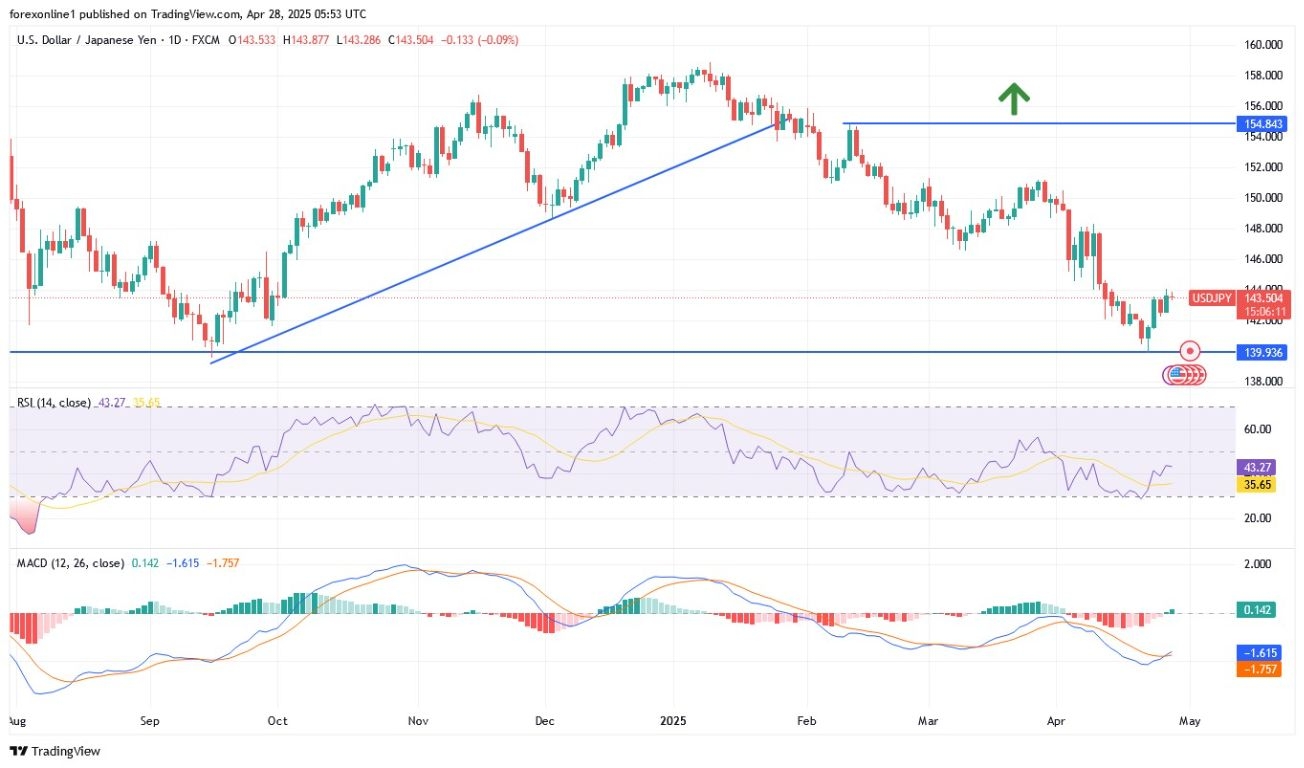
According to Forex market trading, the USD/JPY price continued its upward rebound path as the US dollar’s value rose amid receding global trade tensions. Last week, Japanese Finance Minister Katsunobu Kato and US Treasury Secretary Scott Bessent held a closed-door meeting on the sidelines of the International Monetary Fund and World Bank Spring meetings in Washington. While Kato remained silent on the discussions, he emphasized that Japan and the United States would continue close and constructive dialogue on exchange rates, hinting that currency issues could be part of broader trade negotiations.
Senior Japanese trade negotiator, Hirose Akazawa, is also scheduled to visit Washington this week for a second round of bilateral talks. At the same time, the Bank of Japan is widely expected to keep its interest rate steady at 0.5% this week as it monitors the potential impact of US tariffs on the export-driven Japanese economy.
I still recommend buying the US dollar against the Japanese yen at every downward trend level, but without risk, while monitoring the factors influencing currency rates.
At the end of last week’s trading and in the short term, the USD/JPY pair rebounded from the trendline support level at around 142.48 to trade at around 143.80. The pair is trading within an ascending channel. The USD/JPY pair has now advanced to trade above the 100-hour moving average by a few levels. As a result, the pair is approaching entering overbought levels on the 14-hour RSI. Therefore, bulls will aim to extend the current gains towards the resistance at 144.30 and then to the resistance at 145.00. Conversely, bears will seek to capitalize on renewed profit-taking selling at the support level around 143.20 or lower at the support of 142.50.
In the long term, based on the daily chart, the USD/JPY pair is trading within a descending channel. However, the 14-day RSI has recently rebounded to avoid entering an oversold condition. Therefore, bulls will seek to extend their current rebound towards resistance at 146.00 or higher, reaching resistance at 149.00, respectively. On the other hand, and over the same period of time, bears will seek to take profits at the support level of 141.00 and then at the support level of 139.00, respectively.
Want to trade our USD/JPY forex analysis and predictions? Here’s a list of forex brokers in Japan to check out.
The EURJPY pair provided positive signal on Friday by forming a strong bullish rally, achieving 163.75, which forces it to fluctuate below 163.25 level, due to the contradiction between the main indicators by stochastic exit from the overbought level.
The price might be forced to provide more of the mixed trading, but its success in taking advantage of forming extra support at 162.40 might assist renewing the bullish attempts, to wait for confirming breaching 163.25 to increase the chances for recording new gains by its rally towards 164.20 reaching the next target near 164.90.
The expected trading range for today is between 162.50 and 164.25
Trend forecast: Bullish by confirming the breach
Do you need help in trading decisions? Do you want to learn how to start trading?
Join Economies.com VIP Club and benefit from over 15 years of market analysis expertise and get:
Special Offer: Subscribe to the Economies.com VIP channel and get also a free subscription to a trusted trading signals channel provided by Best Trading Signal.