The main category of Forex News.
You can use the search box below to find what you need.
[wd_asp id=1]
The main category of Forex News.
You can use the search box below to find what you need.
[wd_asp id=1]
The primary drag on prices came from updated weather projections. Atmospheric G2 reported warmer-than-normal conditions across the eastern two-thirds of the U.S. for April 22–26, reducing the need for heating demand. With storage builds now expected to accelerate, traders leaned bearish, even as technical indicators show the market holding above its 200-day moving average at $2.897.
The EIA reported a +16 Bcf injection for the week ended April 11, well below forecasts of +24 Bcf and the five-year average increase of +50 Bcf. While this bullish surprise triggered a round of short covering, it wasn’t enough to change the broader sentiment driven by warming temperatures. As of April 11, U.S. natural gas inventories were 20.9% below year-ago levels and 3.9% below the five-year average.
Lower-48 state dry gas production on Thursday reached 105.6 Bcf/day, up 5.4% year-over-year, while demand stood at 70.1 Bcf/day, up 2.2%. LNG flows to export terminals dropped to 15.5 Bcf/day, down 4.8% from the prior week. Electricity demand, however, remained supportive. The Edison Electric Institute reported a 6.4% year-over-year jump in power generation for the week ending April 12, potentially signaling stronger gas burn from utilities.
The GBP/JPY cross weakens to near 188.45 during the early European session on Monday. The ongoing uncertainty over US President Donald Trump’s trade tariffs continues to weigh on investors’ sentiment, which boosts safe-haven currencies like the Japanese Yen (JPY).
According to the daily chart, the bearish outlook of GBP/JPY remains in play as the cross remains capped below the key 100-day Exponential Moving Average (EMA). The path of least resistance is to the downside, with the 14-day Relative Strength Index standing below the midline near 43.60.
The first downside target for the cross emerges at 187.47, the low of April 17. Extended losses could see a drop to 186.54, the low of April 8. The crucial support level for GBP/JPY is seen in the 185.00-184.95 zone, representing the psychological level and the lower limit of the Bollinger Band.
In the bullish case, the immediate resistance level is located at the 190.00 round mark. Sustained trading above this level could attract some buyers to 191.90, the 100-day EMA. Further north, the next hurdle to watch is 194.20, the high of April 3.
The Japanese Yen (JPY) is one of the world’s most traded currencies. Its value is broadly determined by the performance of the Japanese economy, but more specifically by the Bank of Japan’s policy, the differential between Japanese and US bond yields, or risk sentiment among traders, among other factors.
One of the Bank of Japan’s mandates is currency control, so its moves are key for the Yen. The BoJ has directly intervened in currency markets sometimes, generally to lower the value of the Yen, although it refrains from doing it often due to political concerns of its main trading partners. The BoJ ultra-loose monetary policy between 2013 and 2024 caused the Yen to depreciate against its main currency peers due to an increasing policy divergence between the Bank of Japan and other main central banks. More recently, the gradually unwinding of this ultra-loose policy has given some support to the Yen.
Over the last decade, the BoJ’s stance of sticking to ultra-loose monetary policy has led to a widening policy divergence with other central banks, particularly with the US Federal Reserve. This supported a widening of the differential between the 10-year US and Japanese bonds, which favored the US Dollar against the Japanese Yen. The BoJ decision in 2024 to gradually abandon the ultra-loose policy, coupled with interest-rate cuts in other major central banks, is narrowing this differential.
The Japanese Yen is often seen as a safe-haven investment. This means that in times of market stress, investors are more likely to put their money in the Japanese currency due to its supposed reliability and stability. Turbulent times are likely to strengthen the Yen’s value against other currencies seen as more risky to invest in.
Silver (XAG/USD) attracts some dip-buyers at the start of a new week and touches an intraday high, around the $32.80 region during the Asian session. The white metal, however, remains below the $33.00 mark and a nearly two-week high touched last Thursday, warranting some caution for bullish traders.
From a technical perspective, the XAG/USD now seems to have found acceptance above the 61.8% Fibonacci retracement level of the recent slump from the March swing high to a fresh year-to-date low touched earlier this month. Moreover, oscillators on the daily chart have again started gaining positive traction and support prospects for a further near-term appreciating move.
However, it will still be prudent to wait for a sustained strength beyond the $33.00 mark, or the 78.6% Fibo. level, before placing fresh bullish bets. The XAG/USD might then accelerate the positive momentum towards the $33.20 area, en route to the next relevant hurdle near the $33.50-$33.55 region and the $34.00 neighborhood, or a multi-month peak touched in March.
On the flip side, Friday’s swing low, around the $32.10-$32.05 region, or the 61.8% Fibo. level might continue to act as an immediate support. Any further slide could be seen as a buying opportunity and remain limited near the $31.35-$31.30 area, or the 50% Fibo. level. A convincing break below, however, might prompt technical selling and make the XAG/USD vulnerable.
The subsequent further might then drag the XAG/USD below the $31.00 round-figure mark, towards the $30.55 area, or the 38.2% Fibo. level. The downward trajectory could extend further toward the $30.00 psychological mark en route to the $29.55 region (23.6% Fibo.). The latter should act as a key pivotal point, which if broken might shift the bias in favor of bearish traders.
Silver is a precious metal highly traded among investors. It has been historically used as a store of value and a medium of exchange. Although less popular than Gold, traders may turn to Silver to diversify their investment portfolio, for its intrinsic value or as a potential hedge during high-inflation periods. Investors can buy physical Silver, in coins or in bars, or trade it through vehicles such as Exchange Traded Funds, which track its price on international markets.
Silver prices can move due to a wide range of factors. Geopolitical instability or fears of a deep recession can make Silver price escalate due to its safe-haven status, although to a lesser extent than Gold’s. As a yieldless asset, Silver tends to rise with lower interest rates. Its moves also depend on how the US Dollar (USD) behaves as the asset is priced in dollars (XAG/USD). A strong Dollar tends to keep the price of Silver at bay, whereas a weaker Dollar is likely to propel prices up. Other factors such as investment demand, mining supply – Silver is much more abundant than Gold – and recycling rates can also affect prices.
Silver is widely used in industry, particularly in sectors such as electronics or solar energy, as it has one of the highest electric conductivity of all metals – more than Copper and Gold. A surge in demand can increase prices, while a decline tends to lower them. Dynamics in the US, Chinese and Indian economies can also contribute to price swings: for the US and particularly China, their big industrial sectors use Silver in various processes; in India, consumers’ demand for the precious metal for jewellery also plays a key role in setting prices.
Silver prices tend to follow Gold’s moves. When Gold prices rise, Silver typically follows suit, as their status as safe-haven assets is similar. The Gold/Silver ratio, which shows the number of ounces of Silver needed to equal the value of one ounce of Gold, may help to determine the relative valuation between both metals. Some investors may consider a high ratio as an indicator that Silver is undervalued, or Gold is overvalued. On the contrary, a low ratio might suggest that Gold is undervalued relative to Silver.
The Gold Price (XAU/USD) drifts higher to a fresh record high near $3,375 during the early Asian session on Monday after facing some profit-taking due to the long weekend. Uncertainty about US President Donald Trump’s tariff policies and persistent geopolitical tensions continue to underpin the precious metal.
Investors have rushed to safe-haven assets like Gold due to rising uncertainty about tariffs and their impact on the economy, resulting in a more than 25% increase in the yellow metal prices since January. “The case for adding gold allocations has become more compelling than ever in this environment of escalating tariff uncertainty, weaker growth, higher inflation, geopolitical risks & diversification away from US assets & the US$,” said UBS analysts.
Additionally, central bankers have been adding gold to their portfolios. China, the world’s largest gold consumer, China added gold to its holdings for the fifth consecutive month, boosting its demand for the precious metal as a safe haven asset in the face of mounting global trade and geopolitical tensions.
On the other hand, the Federal Reserve (Fed) Chair Jerome Powell turned hawkish last week, reducing the likelihood of a Fed rate reduction in June. Meanwhile, San Francisco Fed President Mary Daly said on Friday that the US economy is in a good place, though some sectors are slowing down. This, in turn, could lift the Greenback and weigh on the USD-denominated commodity price.
Gold has played a key role in human’s history as it has been widely used as a store of value and medium of exchange. Currently, apart from its shine and usage for jewelry, the precious metal is widely seen as a safe-haven asset, meaning that it is considered a good investment during turbulent times. Gold is also widely seen as a hedge against inflation and against depreciating currencies as it doesn’t rely on any specific issuer or government.
Central banks are the biggest Gold holders. In their aim to support their currencies in turbulent times, central banks tend to diversify their reserves and buy Gold to improve the perceived strength of the economy and the currency. High Gold reserves can be a source of trust for a country’s solvency. Central banks added 1,136 tonnes of Gold worth around $70 billion to their reserves in 2022, according to data from the World Gold Council. This is the highest yearly purchase since records began. Central banks from emerging economies such as China, India and Turkey are quickly increasing their Gold reserves.
Gold has an inverse correlation with the US Dollar and US Treasuries, which are both major reserve and safe-haven assets. When the Dollar depreciates, Gold tends to rise, enabling investors and central banks to diversify their assets in turbulent times. Gold is also inversely correlated with risk assets. A rally in the stock market tends to weaken Gold price, while sell-offs in riskier markets tend to favor the precious metal.
The price can move due to a wide range of factors. Geopolitical instability or fears of a deep recession can quickly make Gold price escalate due to its safe-haven status. As a yield-less asset, Gold tends to rise with lower interest rates, while higher cost of money usually weighs down on the yellow metal. Still, most moves depend on how the US Dollar (USD) behaves as the asset is priced in dollars (XAU/USD). A strong Dollar tends to keep the price of Gold controlled, whereas a weaker Dollar is likely to push Gold prices up.
I wrote on 6th April that the best trades for the week would be:
The overall result was a win of 10.74%, which was 1.07% per asset.
Last week saw a much calmer market as days and even weeks are now passing without any new tariff bombshells, although President Trump hinted that new automobile tariffs at 25% due to begin in early May might be postponed. Negotiations will be ongoing until the 90-day period ends in early July.
The big news last week was the European Central Bank’s rate cut of 0.25%, which was widely expected, and the optimism that inflation is now well on course to settle long-term at about the target level of 2%. The ECB seems to feel quite confident that it has inflation beaten, and ironically this may be boosting the Euro as a new safe-haven currency.
Another major item was lower than expected inflation in both the UK and in Canada, which is adding to the growing “inflation beaten” narrative.
The Bank of Canada held its Overnight Rate at 2.75%.
US Retail Sales data came in a little stronger than expected.
Finally, President Trump has been publicly criticizing Fed Chair Jerome Powell for not cutting rates more quickly, and is publicly musing on studying replacing him, although it is hard to see how this could be executed. President Trump is trying to talk down the Federal Funds Rate.

The coming week has a very light schedule of important releases.
This week’s important data points, in order of likely importance, are:
For the month of April 2025, I made no monthly forecast, as at the start of that month, the Forex market was dull and there were only mixed long-term trends.
As there were no unusually large price movements in Forex currency crosses over the past week, I made no weekly forecast.
The British Pound and the New Zealand Dollar were the strongest major currencies last week, while the Swiss Franc, the US Dollar, and the Euro were the weakest. Volatility decreased markedly last week, with more than 37% of the most important Forex currency pairs and crosses changing in value by more than 1%. Next week will likely see even lower volatility as there is such a light data schedule
You can trade these forecasts in a real or demo Forex brokerage account.

Last week, the US Dollar Index printed a bearish inside bar pattern which closed near the low of its range. The previous week’s low is close by and represents a 3-year low price. These are all bearish signs and we clearly have a strongly bearish long-term trend in the greenback.
It looks likely that US Dollar weakness will continue as there are no real technical or fundamental reasons why this will reverse, and ongoing tariff concerns are likely to keep the Dollar weak. However, it might be that as we approach the tariff negotiation deadline in early July that we start to hear news of trade deals which might boost the Dollar.

The EUR/USD currency pair rose last week to make its highest weekly close in a few years, ending the week not far from the high of its range. However, it is worth noting that the resistance level at $1.1430 has continued to hold, and that the price was unable to make a new high last week.
It is likely worth being long here as this currency pair tends to trend slowly but reliably. With a weak greenback and interest in the Euro as a safe-haven currency, there are good reasons to be long here.
If the price can get established above $1.1430 that will probably be a good long trade entry signal, as there are no key resistance levels above that area for a few hundred pips.

The GBP/USD currency pair rose last week to close very near its high on an unusually large range, well above the previous week’s high. The Pound is the strongest major currency and managed to advance further against the greenback than the Euro did last week, but the price chart below shows the long-term bullish trend is weaker and choppier. However, the short-term bullish momentum is certainly here.
It is likely worth entering long trades here on a short-term basis on bullish breakouts for as long as this short-term momentum persists.
The Pound’s strength is maintained mostly on the back of its relatively large interest rate of 4.50%, which is attracting deposits looking for overnight carry.
Bulls might beware of the area above $1.3380 if it is reached this week.

The USD/JPY currency pair traded lower for yet another consecutive week, reaching a new 6-month low and closing near the bottom of its weekly range.
There is clearly a long-term bearish trend here, and there has also been short-term bearish momentum due mostly to weakness in the US Dollar.
This major currency pair tends to trend with some reliability, so I like to be short here. We might also start to see the Yen really start to strengthen more itself as Japanese wages continue to rise and make rate hikes more of a possibility at the Bank of Japan.
While other currencies are advancing more strongly against the Dollar, few are breaking to new long-term highs, and that is a good reason to be short here.

Gold rose firmly last week to reach yet another new record high not far below the round number at $3,400. The weekly close was a little way off the high, but the bearish retracement here has not been especially deep, so everything still looks essentially bullish as the precious metal advances into blue sky.
Gold can advance during periods of crisis like the one we are in now and this is what seems to be happening as its correlation with the US stock market lessens.
It is worth considering Gold as having standalone merit, as a look at the weekly price chart below shows a very strong long-term bullish trend having been underway for almost 1.5 years. Since the start of 2024, the price of Gold against the USD has increased by more than 55%, which is an impressive amount for any asset, and especially so for a precious metal.
I think it is wise to be long of Gold right now, or to enter a new position once we get a new high daily closing price in New York above $3,343.10.

The S&P 500 Index lost a little ground last week. The big story is the price managing to reclaim some ground after the big selloff a few weeks ago, but bulls ran into the 5,500 area which has acted as strong resistance, and we’ve seen the price fail here and start to turn bearish again.
The price traded in bear market territory (down 20% from the recent peak), and has regained ground, but is still well below the 200-day moving average which is shown in green within the price chart below.
These are all bearish signs, although shorting US equity indices is very risky and probably not advisable to anyone except a very experienced trader.
I believe there is going to be more turbulence in the stock market over the coming months as we approach the 90-day tariff deadline in early July, so I am happy to be out of stocks for now.

I see the best trades this week as:
Ready to trade our Weekly Forex forecast? Check out our list of the best Forex brokers.
April 20, 2025 – Written by Frank Davies
STORY LINK Pound to Dollar Forecast: GBPUSD Bullish to 1.34 for Buyers
After an initial retreat, Commerzbank expects the Pound to Dollar exchange rate (GBP/USD) gains to 1.39 by Q2 2026 as the dollar loses traction.
ING sees scope for near-term GBP/USD gains, but expects slight losses to 1.30 on a 12-month view as European currencies fail to hold gains.
US equities struggled during the week, but there was a net easing of volatility and overall risks premiums edged lower which helped cushion risk appetite.
With a more benign environment and a fragile dollar, GBP/USD strengthened to 6-month highs just below 1.3300 before stabilising.
Even with more benign conditions, uncertainty remains extremely high.
SocGen commented; “Both trade uncertainty and FX volatility peaked on 9 April, coinciding with heightened tensions in global trade dynamics. This moment could mark a critical juncture in the trade war, potentially signalling either a pause or the peak of the trade risk premium.”
US retail sales data held firm for March, but there were significant earning signs in the latest business confidence readings with expectations of weaker activity and higher inflation.
High-frequency economic indicators will continue to scrutinised very closely.
SocGen commented; “The current de-coupling between rates and FX makes sense in the context of huge foreign exposure to US asset at a time of turbulence but the key question is still the US economy is going to slow as much and as fast as the market thinks.”
If the economy holds firm, the dollar could gain renewed support, but evidence of a slide in activity would be damaging.
UBS commented; “Looking ahead, Wednesday’s release of the first global purchasing managers’ index (PMI) data since recent tariff announcements will be pivotal. A relatively weaker US PMI versus the rest of the world could reignite the USD downtrend.”
Fed Chair Powell reiterated that he was in no rush to adjust interest rates, while stating that the tariff impact is likely to be larger than expected with weaker activity and higher inflation.
MUFG commented; “That to us does not sound like a central bank that will be rushing to cut rates and there remains an increasing risk that the Fed could delay for longer than the markets expect to cut rates.”
President Trump maintained calls for lower interest rates and criticised Powell very strongly and effectively called for him to resign.

The Administration’s currency policy will also be a key element.
According to Commerzbank; “In the coming months, the dollar should recover somewhat, as markets are pricing in Fed rate cuts too early.”
It expects GBP/USD will dip bank below 1.30 this quarter.
It added; “But if it becomes clear later in the year that Donald Trump does not want the appreciation of the dollar to partially offset the effects of his tariff increases, he is likely to publicly put the Fed under pressure. In this environment, investors are likely to increasingly doubt that the Fed will act decisively, which would weigh on the dollar.”
Danske Bank commented; “Tariff shocks, stagflation fears, consumer and business uncertainty and tightening financial conditions all challenge the long-standing narrative for US exceptionalism.”
It added; “The usual macro drivers are no longer behaving as expected, reinforcing our view that the USD is losing its traditional anchors.”
According to Scotiabank; “A weaker USD seems to be a likely outcome of US trade policy—either indirectly in the longer run as the US capital account surplus runs down alongside the reduction in the US trade deficit or more directly as the US seeks a more competitive currency arrangement against its major trading partners.”
The dollar will be much more vulnerable if there is a wider loss of confidence.
Scotiabank added; “There may be early signs of shift in perception as to the reserve currency status of the U.S. dollar and an associated decline in the perceived safety of American government debt.”
ING added; “We do think FX reserve managers will be cutting the dollar shares in their FX reserves this year. As one of the big five reserve currencies, sterling does benefit from the dollar diversification trade.
It added; “GBP/USD is also very much driven by EUR/USD trends – where fiscal stimulus will be helping in Europe too.”
Following the latest UK labour-market and inflation data, markets remained convinced that there will be a Bank of England rate cut in May.
The UK data will also be monitored very closely given the fiscal and monetary policy implications.
ING commented; “Domestically, we’re waiting on the UK data to show whether unemployment is rising or inflation is falling. We think the market is right to forecast three more Bank of England cuts this year, starting in May.”
International Money Transfer? Ask our resident FX expert a money transfer question or try John’s new, free, no-obligation personal service! ,where he helps every step of the way,
ensuring you get the best exchange rates on your currency requirements.
April 20, 2025 – Written by David Woodsmith
STORY LINK Euro to Dollar Forecast: Further EUR Upside to Upper 1.16s?
Currency forecasters at Deutsche Bank expect long-term Euro to Dollar exchange rate (EUR/USD) gains to 1.25 at the end of 2027 and note the risk that gains could come quicker.
EURUSD was held below 3-year highs of 1.1470 during the week, but found strong buying below 1.1300.
EUR/USD remains well above levels that would be justified on rate differentials alone amid a loss of dollar confidence.
MUFG commented; “If those rate spreads were to reassert themselves in influencing FX, then the dollar would likely recover. It would imply EUR/USD breaking back below the 1.1000-level.”
It added; “However, we doubt that is going to happen at this juncture and it would take something more meaningful from President Trump in terms of backtracking on trade policy for the dollar to recover on a more sustained basis.”
Standard Chartered sees scope for a retreat to 1.08 this quarter; “We are of the view that the US Dollar index (DXY) is likely to rebound modestly higher from current levels.”
According to Standard Chartered; “We see the recent US Dollar weakness as a reaction to worries that US policy is likely to result in lower demand for US assets. However, a refocus on growth-positive factors, such as tax cuts and deregulation, is likely to help reduce these concerns.”
It added; “We also find it interesting that, despite several days of downward pressure, the DXY index has not yet firmly broken below 99, suggesting its post-2021 100-110 range remains intact.”
US retail sales data held firm for March, but there were significant warning signs in the latest business confidence readings with expectations of weaker activity and higher inflation.
Fed Chair Powell reiterated that he was in no rush to adjust interest rates, while stating that the tariff impact is likely to be larger than expected with weaker activity and higher inflation.
President Trump criticised Powell strongly and effectively called for him to resign.
The ECB cut interest rates by a further 25 basis points with the deposit rate at 2.25% and warnings over the Euro-Zone growth outlook were reinforced by commentary from Bank President Lagarde.
According to MUFG; “Lagarde clearly did not want to entertain for any amount of time the potential for inflation to move higher. The focus was very much on negative growth concerns which reinforces the prospect of more rate cuts ahead.”
It now sees a risk that rates will be cut to 1.50%.
According to Deutsche, fair value for EUR/USD is in the 1.25-1.30 range which will act as an anchor for the pair amid geo-political uncertainty.
It also sees the risk of sustained global diversification away from the US dollar amid political uncertainty, trade concerns and weaker growth.
Deutsche Bank considers the potential risk of substantial capital flows out of US markets.
The bank notes foreigners own $7 trillion of American fixed income and $18 trillion of American equities. For example, European portfolio holdings of US equities have risen from 5% to 20% since 2010 and that unhedged FX exposure to US assets is very high.
A substantial reallocation of assets would involve heavy dollar selling.
The bank did note that a dovish ECB policy would curb Euro gains.
UBS considers that the Euro is vulnerable to a deeper correction; “We regard the euro’s recent move as an overextension and suggest waiting for short-term setbacks before engaging in EUR longs. Once the ECB halts its easing cycle, and the Fed resumes its rate cuts, we believe conditions will be ripe for the EURUSD to move higher in the latter part of the year.”
After being bullish for the past year, HSBC is notably less confident in the dollar; “US policy uncertainty is high and is weighing on the US Dollar Index (DXY) via risk aversion. There are questions about its structural properties. After considering the US current account position, fiscal risks and holdings of US securities, we think that the structural discussion around the USD is louder, and the tail risk is higher.
It added; “Putting these together tells us that the DXY will likely be in a softer position over the coming quarters.”
Citi forecasts the euro hitting highs around $1.20 in the next six to 12 months, before the dollar could start to make a comeback.
International Money Transfer? Ask our resident FX expert a money transfer question or try John’s new, free, no-obligation personal service! ,where he helps every step of the way,
ensuring you get the best exchange rates on your currency requirements.
April 20, 2025 – Written by Frank Davies
STORY LINK Pound to Dollar Forecast: GBPUSD Bullish to 1.34 for Buyers
After an initial retreat, Commerzbank expects the Pound to Dollar exchange rate (GBP/USD) gains to 1.39 by Q2 2026 as the dollar loses traction.
ING sees scope for near-term GBP/USD gains, but expects slight losses to 1.30 on a 12-month view as European currencies fail to hold gains.
US equities struggled during the week, but there was a net easing of volatility and overall risks premiums edged lower which helped cushion risk appetite.
With a more benign environment and a fragile dollar, GBP/USD strengthened to 6-month highs just below 1.3300 before stabilising.
Even with more benign conditions, uncertainty remains extremely high.
SocGen commented; “Both trade uncertainty and FX volatility peaked on 9 April, coinciding with heightened tensions in global trade dynamics. This moment could mark a critical juncture in the trade war, potentially signalling either a pause or the peak of the trade risk premium.”
US retail sales data held firm for March, but there were significant earning signs in the latest business confidence readings with expectations of weaker activity and higher inflation.
High-frequency economic indicators will continue to scrutinised very closely.
SocGen commented; “The current de-coupling between rates and FX makes sense in the context of huge foreign exposure to US asset at a time of turbulence but the key question is still the US economy is going to slow as much and as fast as the market thinks.”
If the economy holds firm, the dollar could gain renewed support, but evidence of a slide in activity would be damaging.
UBS commented; “Looking ahead, Wednesday’s release of the first global purchasing managers’ index (PMI) data since recent tariff announcements will be pivotal. A relatively weaker US PMI versus the rest of the world could reignite the USD downtrend.”
Fed Chair Powell reiterated that he was in no rush to adjust interest rates, while stating that the tariff impact is likely to be larger than expected with weaker activity and higher inflation.
MUFG commented; “That to us does not sound like a central bank that will be rushing to cut rates and there remains an increasing risk that the Fed could delay for longer than the markets expect to cut rates.”
President Trump maintained calls for lower interest rates and criticised Powell very strongly and effectively called for him to resign.
The Administration’s currency policy will also be a key element.
According to Commerzbank; “In the coming months, the dollar should recover somewhat, as markets are pricing in Fed rate cuts too early.”
It expects GBP/USD will dip bank below 1.30 this quarter.
It added; “But if it becomes clear later in the year that Donald Trump does not want the appreciation of the dollar to partially offset the effects of his tariff increases, he is likely to publicly put the Fed under pressure. In this environment, investors are likely to increasingly doubt that the Fed will act decisively, which would weigh on the dollar.”
Danske Bank commented; “Tariff shocks, stagflation fears, consumer and business uncertainty and tightening financial conditions all challenge the long-standing narrative for US exceptionalism.”
It added; “The usual macro drivers are no longer behaving as expected, reinforcing our view that the USD is losing its traditional anchors.”
According to Scotiabank; “A weaker USD seems to be a likely outcome of US trade policy—either indirectly in the longer run as the US capital account surplus runs down alongside the reduction in the US trade deficit or more directly as the US seeks a more competitive currency arrangement against its major trading partners.”
The dollar will be much more vulnerable if there is a wider loss of confidence.
Scotiabank added; “There may be early signs of shift in perception as to the reserve currency status of the U.S. dollar and an associated decline in the perceived safety of American government debt.”
ING added; “We do think FX reserve managers will be cutting the dollar shares in their FX reserves this year. As one of the big five reserve currencies, sterling does benefit from the dollar diversification trade.
It added; “GBP/USD is also very much driven by EUR/USD trends – where fiscal stimulus will be helping in Europe too.”
Following the latest UK labour-market and inflation data, markets remained convinced that there will be a Bank of England rate cut in May.
The UK data will also be monitored very closely given the fiscal and monetary policy implications.
ING commented; “Domestically, we’re waiting on the UK data to show whether unemployment is rising or inflation is falling. We think the market is right to forecast three more Bank of England cuts this year, starting in May.”
International Money Transfer? Ask our resident FX expert a money transfer question or try John’s new, free, no-obligation personal service! ,where he helps every step of the way,
ensuring you get the best exchange rates on your currency requirements.
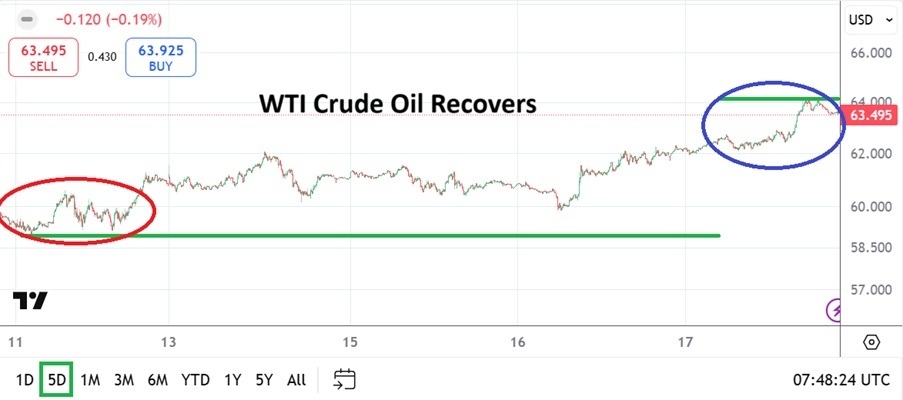
The current price in WTI Crude Oil is certainly within the lower part of its long-term track record. Any prices below the 66.000 USD level can be thought to be rather low in the commodity. Before the onslaught of selling which erupted in the first week of April due to concerns about Trump tariff policies, WTI Crude Oil was flirting with nearly 72.000 USD per barrel.
Day traders need to remain cautious in WTI Crude Oil and all commodities in the coming days, there is still a lot of dynamic influence large players could cause. Looking for higher prices in WTI Crude Oil which are not overly ambitious may feel correct, but speculators should keep their targets realistic and watch the broad markets like equity indices as a barometer. If prices climb above 64.000 USD early this week and sustain higher values this would be a sign large players are still focusing on further price recovery.
The current price of WTI Crude Oil is certainly within the lowest aspects of its long-term range. A look at six month and one year charts show that anything below the $66.000 level looks relatively cheap.
WTI Crude Oil has been hit with volatility because it is one of the key commodities in the global economy. If tariff implications continue to be debated without clarity for solutions, large traders may remain nervous. However, the ability of the commodity to ebb higher on Wednesday and Thursday of last week before the long holiday weekend may indicate traders were a bit less nervous.
Day traders should watch the first handful of hours in WTI Crude Oil as it begins to trade this week to gauge behavioral sentiment. The broad markets and the energy sector remain in fragile price ranges. Although some recovery of value was demonstrated last week, conditions are not abundantly optimistic. A wagering environment may continue to hold the power in the coming days as a tendency for optimistic outlooks fights with potential calls of retaliatory actions by some nations being confronted by U.S tariffs.
Ready to trade our weekly forecast? We’ve shortlisted the best Forex Oil trading brokers in the industry for you.
The high for the week was a successful test of resistance at the 200% projection of a rising ABCD pattern that began from the August 2018 lows. It was also in the region of $3,335, which is the 261.8% extension for the bearish correction that began from the 2011 peak. Both price levels are derived from long-term patterns. So far, the targets seem to be recognized by the market. But given the sustained signs of strength, the quickening uptrend may continue.
Gold has benefited from rising global uncertainty and it may continue to do so. Therefore, a decisive advance above this week’s high of $3,358, has gold next targeting the $3,383 price zone as that is the 127.2% projection for a rising ABCD pattern (purple) that began from the February swing low (A). Then, a little higher is the projection for a recent small bull pennant pattern that triggered on Wednesday at $3,454. The 161.8% projection for the rising ABCD pattern is then at $3,498.
Although the rising angle of ascent in the price of gold is a sign of strong and growing demand, it also indicates that the trend may be extended with the risk of a correction increasing. The top of two rising trend channels were broken recently. Subsequently, a pullback to test support around the prior trend high of $3,246 and near potential support of a top channel line, would be normal and retain the near-term bullish outlook for gold. However, a decline below Tuesday’s low of $3,208 could lead to a deeper pullback.
For a look at all of today’s economic events, check out our economic calendar.