The main category of Forex News.
You can use the search box below to find what you need.
[wd_asp id=1]
The main category of Forex News.
You can use the search box below to find what you need.
[wd_asp id=1]
Thursday’s high completed a 200% extended target for a large rising ABCD pattern that begins from the August 2018 swing low. That target is joined by the 261.8% extended retracement of the multi-year bearish correction that began from the August 2011 peak at $3,355. Therefore, a decline below $3,284 is a sign of weakness and could lead to a deeper pullback to test prior resistance as support.
Key initial price levels start with the prior high of $3,246 along with Wednesday’s low of $3,239. Then, there is the inside day from Tuesday with a low of $3,208. A bull breakout of that day led to the sharp bullish upside continuation run on Wednesday. Therefore, it may hold significance on the way down as well, if it is approached.
This week’s upside continuation in the price of gold followed a long bullish engulfing pattern that was completed last week. It showed aggressive buying and a continuation of the long-term bull trend. Moreover, the strong advance triggered breakouts of two rising parallel trend channels, further indicating that demand was increasing. The top line of the blue channel should also be watched for signs of support during a deeper pullback, if it occurs.
An initial target from a rising ABCD pattern has not yet been reached and it therefore identifies the next higher potential target at $3,3,83. Higher up is the 161.8% extended target for a larger rising ABCD pattern (not shown). Then, a little higher is $3,454. That price area is the estimated target for a small bull flag defined by the two narrow range days of consolidation from Monday and Tuesday. An intraday chart (not shown) provides a clearer view of the bull flag pattern.
For a look at all of today’s economic events, check out our economic calendar.
Platinum price kept its positive stability above the moving average 55, to notice it attempted to enter the minor bullish channel’s levels again by hitting $972.60 level, which forced it to provide some of the sideways trading range, due to Stochastic reach to the overbought level.
Note that the continuation of the formation of extra support at $950.00 level will represent an important factor to confirm the continuation of the positivity, which makes us wait to gather the required extra positive momentum to motivate the bullish rally, until reaching the main targets at $981.00 and $994.00.
The expected trading range for today is between 985.00 and 1040.00
Trend forecast: Bullish
Do you need help in trading decisions? Do you want to learn how to start trading?
Join Economies.com VIP Club and benefit from over 15 years of market analysis expertise and get:
Special Offer: Subscribe to the Economies.com VIP channel and get also a free subscription to a trusted trading signals channel provided by Best Trading Signal.
Given the sharp five-day decline to a low of $55.23 that ended last week, there is a strong case to be made for a sharp countertrend rally as well. Crude oil fell by $17.25 or 23.8% following the April 2 high of $72.49, measured to last week’s low and the low of the bearish correction. It has been consolidating off that bottom until the upside breakout that triggered today. Certainly, there can still be some backing and filling within this week’s price range of $60.40 to $64.72, before an advance might continue.
But this week will end with a higher weekly high and higher weekly low, a sign that buyers are stepping in more aggressively than they have recently. Furthermore, today’s bullish advance follows a bullish outside day from Wednesday, another bullish sign. Traders and investors will likely see short-term weakness as an opportunity given the new bullish signals in crude oil.
The first key upside target zone is from the confluence of several indicators from $65.40 to $65.89. Prior lows and now potential support are at $65.40 to $65.65, while the 20-Day MA, now at $65.72, and the 61.8% Fibonacci retracement at $65.89 complete the price range. A little higher is the initial 100% target from a rising ABCD pattern (not shown) that completes at $67.08. Subsequently, there is the 78.6% Fibonacci retracement at $68.79, which is joined by the 127.2% extended target for the ABCD pattern at $69.31.
For a look at all of today’s economic events, check out our economic calendar.
Gold price retreated further from its record high on Thursday, trading as low as $3,284.10 early in the American session. The US Dollar (USD) maintained its bearish bias against all major rivals throughout the day, with XAU/USD easing on the back of profit-taking. The pair, however, bounced from the mentioned low and regained the $3,300 mark ahead of the long Easter weekend.
It was quite a busy day, despite limited reactions across the FX board. On the one hand, the European Central Bank (ECB) announced its monetary policy decision. As widely anticipated, ECB officials trimmed the three benchmark interest rates by 25 basis points (bps) each. Officials refrained from giving clear hints on what’s next for monetary policy, yet highlighted the risks related to the trade war while noting uncertainty remains high.
On the other hand, United States (US) President Donald Trump jumped into social media and took aim at Federal Reserve (Fed) Chairman Jerome Powell, complaining he is moving too slow on interest rate cuts while stating that his “termination cannot come fast enough.”
Trump’s words came as an answer to Powell’s speech on Wednesday, warning of the potential consequences of the Trump administration’s trade war, while reiterating that the central bank plans to hold interest rates steady for now.
On a positive note, the White House welcomed talks with Mexico and Canada regarding a trade deal, albeit no specific details were offered.
Other than that, Wall Street trades mixed, with the Dow Jones Industrial Average (DJIA) sharply down but the Nasdaq and the S&P 500 holding on to modest gains.
The daily chart for the XAU/USD pair shows it posted a higher high and a higher low, maintaining the bullish trend alive despite the intraday slide. At the same time, technical indicators eased from extreme readings, but remain in overbought territory. Finally, the pair trades above all its moving averages, with a bullish 20 Simple Moving Average (SMA) currently at $3,114.60.
Support levels:3,317.20 3,305.65 3,292.80
Resistance levels 3,335.00 3,350.00 3,375.00
The US dollar has recovered slightly against the Japanese yen during the early hours. But quite frankly, I think you have to look at this through the prism of a market that is just simply oversold, much like the euro has been overbought. And I think the bounce makes a certain amount of sense. Over the longer term, I anticipate that you have to pay close attention to the 142 yen level because if we break significantly below there, then it’s likely that we would see the market drop to the 140 yen level.
The 145 yen level above, I think, is an area that a lot of people will be watching as it is a large round psychologically significant figure and an area that has been important a couple of times in the past. Anything above there, the dollar probably catches a serious bid.
The Australian dollar is overbought against the US dollar and is threatening the 0.64 level, an area that has been a major resistance barrier multiple times in the past and is also backed up by the 200-day EMA. So, I do think you have a scenario where traders are going to be looking at this as a potential short opportunity or maybe just an overbought extension that needs to at least grind away some of this excess froth.
As we head towards Good Friday, momentum will probably drop, liquidity will almost certainly drop. So therefore, I don’t necessarily think that we have a huge buying opportunity. However, if we get a daily close well above the 0.64 level, you have to think that the trend has changed from a longer term standpoint.
For a look at all of today’s economic events, check out our economic calendar.
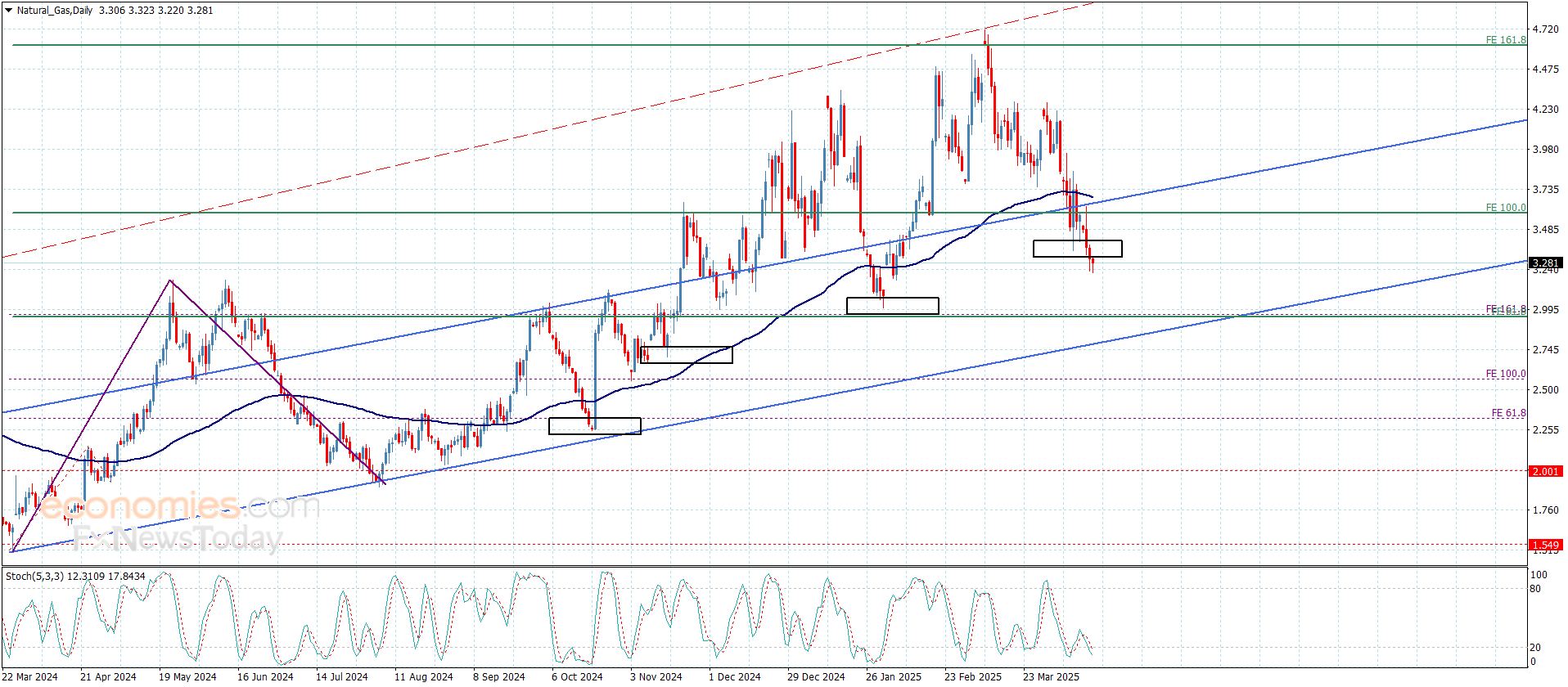
The U.S. Energy Information Administration (EIA) increased its Henry Hub natural gas spot price forecast for 2025 and 2026 in its latest short term energy outlook (STEO), which was released on April 10.
According to its April STEO, the EIA now sees the Henry Hub spot price averaging $4.27 per million British thermal units (MMBtu) in 2025 and $4.60 per MMBtu in 2026. In its previous STEO, which was released in March, the EIA saw the Henry Hub spot price averaging $4.19 per MMBtu in 2025 and $4.47 per MMBtu in 2026.
The EIA projected in its April STEO that the Henry Hub spot price will come in at $3.93 per MMBtu in the second quarter of 2025, $4.34 per MMBtu in the third quarter, $4.68 per MMBtu in the fourth quarter, $4.93 per MMBtu in the first quarter of next year, $4.18 per MMBtu in the second quarter, $4.61 per MMBtu in the third quarter, and $4.66 per MMBtu in the fourth quarter.
The EIA highlighted in its latest STEO that the Henry Hub spot price averaged $4.15 per MMBtu in the first quarter of 2025 and $2.19 per MMBtu overall in 2024.
In its March STEO, the EIA projected that the Henry Hub spot price would average $3.88 per MMBtu in the second quarter of this year, $4.30 per MMBtu in the third quarter, $4.49 per MMBtu in the fourth quarter, $4.66 per MMBtu in the first quarter of 2026, $4.13 per MMBtu in the second quarter, $4.50 per MMBtu in the third quarter, and $4.60 per MMBtu in the fourth quarter of next year.
The EIA’s March STEO projected that the Henry Hub spot price would average $4.11 per MMBtu in the first quarter of 2025. This STEO also highlighted that the commodity came in at $2.19 per MMBtu overall in 2024.
“A colder than normal January and February this winter heating season resulted in more natural gas than average being withdrawn from natural gas storage,” the EIA said in its latest STEO.
“We estimate more than 1,600 billion cubic feet (Bcf) of natural gas was withdrawn in the first quarter of 2025 (1Q25), or 21 percent more than the five-year (2019 – 2024) average,” it added.
“At the end of March, which marks the end of the U.S. natural gas storage withdrawal season (November – March), we estimate that U.S. working natural gas in underground storage totaled just over 1,800 Bcf, or four percent less than the five-year average,” it continued.
The EIA highlighted in the STEO that it expects higher natural gas prices this year compared with 2024, which it said “will encourage producers in the Appalachia and Haynesville regions to increase production”.
“Dry natural gas production averages about 105 Bcfpd in 2Q25 in our forecast, nearly three Bcfpd more than the same period in 2024,” the EIA noted in its April STEO.
“The U.S. benchmark Henry Hub price averages more than $3.90 per MMBtu in 2Q25 in our forecast, almost 90 percent higher compared with 2Q24. We expect the Henry Hub price to average about $4.30 per MMBtu in 2025 and nearly $4.60 per MMBtu in 2026,” it added.
“We expect natural gas injections into storage to be higher than average early in the natural gas injection season (April – October),” it continued.
The EIA went on to reveal, however, that it expects injections to fall below the five-year average “beginning in midsummer when natural gas use in the electric power sector picks up”.
“We forecast U.S. natural gas inventories will end the injection season on October 31 with three percent less natural gas in storage than the five-year average, with about 3,660 Bcf in storage,” it added.
A research note sent to Rigzone by the JPM Commodities Research team on April 12 showed that J.P. Morgan expected the average U.S. natural gas Henry Hub price to average $3.80 per MMBtu in 2025 and $3.31 per MMBtu in 2026.
J.P. Morgan saw the commodity coming in at $3.90 per MMBtu in the second quarter of this year, $4.00 in the third quarter, $3.75 per MMBtu in the fourth quarter, $3.50 per MMBtu in the first quarter of next year, $3.00 in the second quarter, $3.25 per MMBtu in the third quarter, and $3.50 per MMBtu in the fourth quarter, the report highlighted.
A BMI report sent to Rigzone by the Fitch Group on April 11 showed that BMI expected the front month natural gas Henry Hub price to average $3.40 per MMBtu this year and $3.80 per MMBtu next year.
A Standard Chartered Bank report sent to Rigzone by Standard Chartered Bank Commodities Research Head Paul Horsnell on April 8 showed that Standard Chartered expected the NYMEX basis Henry Hub nearby future U.S. natural gas price to average $3.35 per MMBtu in 2025 and $3.30 per MMBtu in 2026.
Standard Chartered Bank saw the commodity averaging $3.50 per MMBtu across the second and third quarters of this year, $3.20 per MMBtu across the fourth quarter of 2025 and first quarter of 2026, $3.70 per MMBtu in the second quarter of 2026, and $3.50 per MMBtu in the third quarter of next year, according to the report.
To contact the author, email andreas.exarheas@rigzone.com
April 17, 2025 – Written by Frank Davies
STORY LINK Pound Sterling to Euro Forecast: ECB Upside, “EUR Looking Overvalued vs USD, GBP, JPY”
After finding support close to 1.1600, the Pound to Euro exchange rate strengthened to just above 1.1660 GBPEUR after the ECB expressed concerns surrounding the Euro-Zone growth outlook, although the Euro pulled away from initial lows.
Commerzbank commented; “given the factors that argue against a hawkish surprise, the risks are likely to be skewed towards a weaker euro.”
ING expects solid GBP/EUR exchange rate selling on any gains to 1.1765.
The ECB cut interest rates by 25 basis points at the latest policy meeting, in line with consensus forecasts, with the deposit rate cut to 2.25%
The central bank expressed greater reservations surrounding the outlook.
According to the statement; “The euro area economy has been building up some resilience against global shocks, but the outlook for growth has deteriorated owing to rising trade tensions. Increased uncertainty is likely to reduce confidence among households and firms, and the adverse and volatile market response to the trade tensions is likely to have a tightening impact on financing conditions.”
Bank President Lagarde stated that the economic outlook is clouded by exceptional uncertainty and that downside risks to the growth outlook have increased.
Markets are now expecting three further rate cuts this year which curbed Euro support.
Credit Agricole commented; “the ECB could further take into account the prospect for aggressive fiscal stimulus that could boost the bank’s long-term growth outlook for the Eurozone. While this could keep the EUR supported in the near term, we also note that our short-term fair value models are signalling that the EUR is looking quite overvalued vs the USD, GBP and JPY.”
UBS also notes the potential for a Euro correction; “markets have already priced in part of the fiscal boost over the last six weeks, so we see more downside than upside risk in next week’s sentiment numbers. After the euro’s recent rally, we expect next week’s data to prompt a consolidation rather than a renewed push higher.”
There were no significant UK developments during the day.
SocGen head of corporate research FX and rates Kenneth Broux commented on the outlook; “The backdrop for the UK and for sterling really is not too bad. As long as we don’t have another leg of risk-off and another spike in gilt yields, sterling should continue to do quite well.”
UBS considers that GBP/EUR fundamentals are mixed; “With its export mix vastly focused on services, the UK should fare better than others in the new goods-tariffed world. However, the GBP’s high-beta nature and trade dependency on the Eurozone would still suffer in a trade war scenario.”
It added; “Furthermore, the UK does not have the benefit of a fiscal bazooka plan like Germany, and we do not believe it will have the means to do so anytime soon.”

The bank is still broadly positive on the Pound; “Nevertheless, we still believe that GBP positives can shine through in the short run.”
International Money Transfer? Ask our resident FX expert a money transfer question or try John’s new, free, no-obligation personal service! ,where he helps every step of the way,
ensuring you get the best exchange rates on your currency requirements.
The GBPJPY pair activated the negative attack in yesterday’s trading, achieving the initial negative target by hitting 187.55 level, then it rebounded to settle above 38.2%Fibonacci correction level at 188.00, to gather the required negative momentum to confirm the continuation of the bearish trend in the upcoming trading.
In general, the bearish scenario would remain valid if the trading settled below the main resistance at 189.90, as confirming breaking 188.00 level makes us expect targeting new negative stations, and 186.50 level represents the next target for the negative trading, while the attempt of breaching the mentioned resistance will cancel the bearish suggestion in the near trading, as there is a chance for achieving some gains by the price rally towards 190.50 initially.
The expected trading range for today is between 186.50 and 189.20
Trend forecast: Bearish
Do you need help in trading decisions? Do you want to learn how to start trading?
Join Economies.com VIP Club and benefit from over 15 years of market analysis expertise and get:
Special Offer: Subscribe to the Economies.com VIP channel and get also a free subscription to a trusted trading signals channel provided by Best Trading Signal.
April 17, 2025 – Written by David Woodsmith
STORY LINK GBP/USD Forecast: Pound Looks to be Overbought Against Dollar
After hitting 6-month highs close to 1.3300, the Pound to Dollar exchange rate dipped to test 1.3200 before rebounding to 1.3240.
US equities posted sharp losses on Wednesday before a tentative rebound in futures on Thursday.
Scotiabank noted that the Pound is looking overbought but added; “We look to near-term resistance around 1.33, and beyond that, the September high around 1.34. Near-term support is expected between 1.3220 and 1.32.”
Although the dollar has managed to crawl away from 3-year lows, underlying confidence remains weak with the currency undermined by a fresh slide in US equities with the S&P 500 index sliding 2.2% on Wednesday. The currency index (DXY) was held below 100.
After Wednesday’s European close, Fed Chair Powell stated that the Administration had been more aggressive than expected in imposing tariffs.
He warned that the economy was liable to be weaker and inflation higher which would complicate the task in setting policy.
According to Powell; “We may find ourselves in the challenging scenario in which our dual-mandate goals are in tension. If that were to occur, we would consider how far the economy is from each goal, and the potentially different time horizons over which those respective gaps would be anticipated to close.”
His rhetoric was more hawkish than comments from Governor Waller earlier in the week.
Powell again considered that the central bank needed to be patient and there was no case for making any quick judgement on interest rates.
ING commented; “In normal market conditions, Powell’s hawkishness would have triggered a positive USD response. But the greenback is still responding to the narrative of relative US assets underperformance and growth concerns, which are arguably being compounded by a hawkish Fed.”
ING added; “Despite plenty of indications that the dollar is oversold and undervalued, we don’t see a catalyst for a respite today. Should US equities underperform again, DXY should extend its drop below 99.0.
Citi played down the risk of a big structural move away from the dollar; “We do not think this is a proper de-dollarisation and see no real risk to the USD reserve currency status.”
It did, however, add; “However, the world is overweight U.S. assets. Ultimately this ‘sell America’ flow could severely weigh on the USD this year.”
Confidence surrounding trade talks will also be a key element.
On Wednesday, there were some reports that China was open to talks with the US, but there were important conditions and overnight the foreign ministry stated that China will pay no attention if the United States continues to play the “tariff numbers game.”
Charu Chanana, chief investment strategist at Saxo, said markets are detecting signs of hope in US-Japan trade talks.
She added; “When the bar is low, even talks about talks can lift markets as investors rotate from fear to hope.”
International Money Transfer? Ask our resident FX expert a money transfer question or try John’s new, free, no-obligation personal service! ,where he helps every step of the way,
ensuring you get the best exchange rates on your currency requirements.
TAGS: Pound Dollar Forecasts
Silver price (XAG/USD) falls sharply to near $32.50 in Thursday’s European session after failing to extend a 10-day rally above the key resistance of $33.00. The white metal corrects as the US Dollar (USD) strives to gain ground near its recent lows. The US Dollar Index (DXY), which tracks the Greenback’s value against six major currencies, attracts some bids near its three-year low of 99.00.
The USD Index rebounds slightly as decent progress in negotiations on a trade deal between the United States (US) and Japan has eased some uncertainty over the domestic economic outlook. “A Great Honour to have just met with the Japanese Delegation on Trade. Big Progress!” US President Donald Trump wrote in a post on Truth.Social platform on Wednesday.
This appears to be a meaningful sign that Trump wants favorable bilateral trades over hefty reciprocal tariff policies. More positive outcomes of trade negotiations by Washington with other trading partners will be favorable for the US Dollar. Such a scenario will diminish the global economic uncertainty, which would lead to a decline in demand for safe-haven assets, such as Silver.
Additionally, slight hawkish commentary from Federal Reserve (Fed) Chair Jerome Powell on the monetary policy outlook has also forced traders to book profits in the Silver price. On Wednesday, Powell said in a speech at the Economic Club of Chicago that the Fed seeks more clarity on the economic outlook before making any policy adjustments. Fed’s support for a restrictive monetary policy stance bodes poorly for non-yielding assets, such as Silver.
Meanwhile, the escalated trade war between China and the US will keep the downside in the Silver price limited. Beijing has shown a willingness for trade talks with Washington, but with respect and mutual understanding.
Silver price holds above the 20-day Exponential Moving Average (EMA) near $32.28, suggesting that the near-term outlook is bullish. The white metal aims to revisit the October 22 high of $34.87.
The 14-day Relative Strength Index (RSI) delivers a V-shape recovery after turning oversold below 30.00. The momentum oscillator is expected to find resistance near 60.00.
A fresh upside would appear in the counter if the Silver price breaks above the April 16 high of $33.12. The move will unlock targets of the October 22 high of $34.87 and an over-decade high of $35.50.
On the flip side, a downside move by the Silver price below the April 14 low of $31.74 will expose it to the April 11 low of $30.90, followed by the psychological level of $30.00
Silver is a precious metal highly traded among investors. It has been historically used as a store of value and a medium of exchange. Although less popular than Gold, traders may turn to Silver to diversify their investment portfolio, for its intrinsic value or as a potential hedge during high-inflation periods. Investors can buy physical Silver, in coins or in bars, or trade it through vehicles such as Exchange Traded Funds, which track its price on international markets.
Silver prices can move due to a wide range of factors. Geopolitical instability or fears of a deep recession can make Silver price escalate due to its safe-haven status, although to a lesser extent than Gold’s. As a yieldless asset, Silver tends to rise with lower interest rates. Its moves also depend on how the US Dollar (USD) behaves as the asset is priced in dollars (XAG/USD). A strong Dollar tends to keep the price of Silver at bay, whereas a weaker Dollar is likely to propel prices up. Other factors such as investment demand, mining supply – Silver is much more abundant than Gold – and recycling rates can also affect prices.
Silver is widely used in industry, particularly in sectors such as electronics or solar energy, as it has one of the highest electric conductivity of all metals – more than Copper and Gold. A surge in demand can increase prices, while a decline tends to lower them. Dynamics in the US, Chinese and Indian economies can also contribute to price swings: for the US and particularly China, their big industrial sectors use Silver in various processes; in India, consumers’ demand for the precious metal for jewellery also plays a key role in setting prices.
Silver prices tend to follow Gold’s moves. When Gold prices rise, Silver typically follows suit, as their status as safe-haven assets is similar. The Gold/Silver ratio, which shows the number of ounces of Silver needed to equal the value of one ounce of Gold, may help to determine the relative valuation between both metals. Some investors may consider a high ratio as an indicator that Silver is undervalued, or Gold is overvalued. On the contrary, a low ratio might suggest that Gold is undervalued relative to Silver.
The