The main category of Forex News.
You can use the search box below to find what you need.
[wd_asp id=1]
The main category of Forex News.
You can use the search box below to find what you need.
[wd_asp id=1]
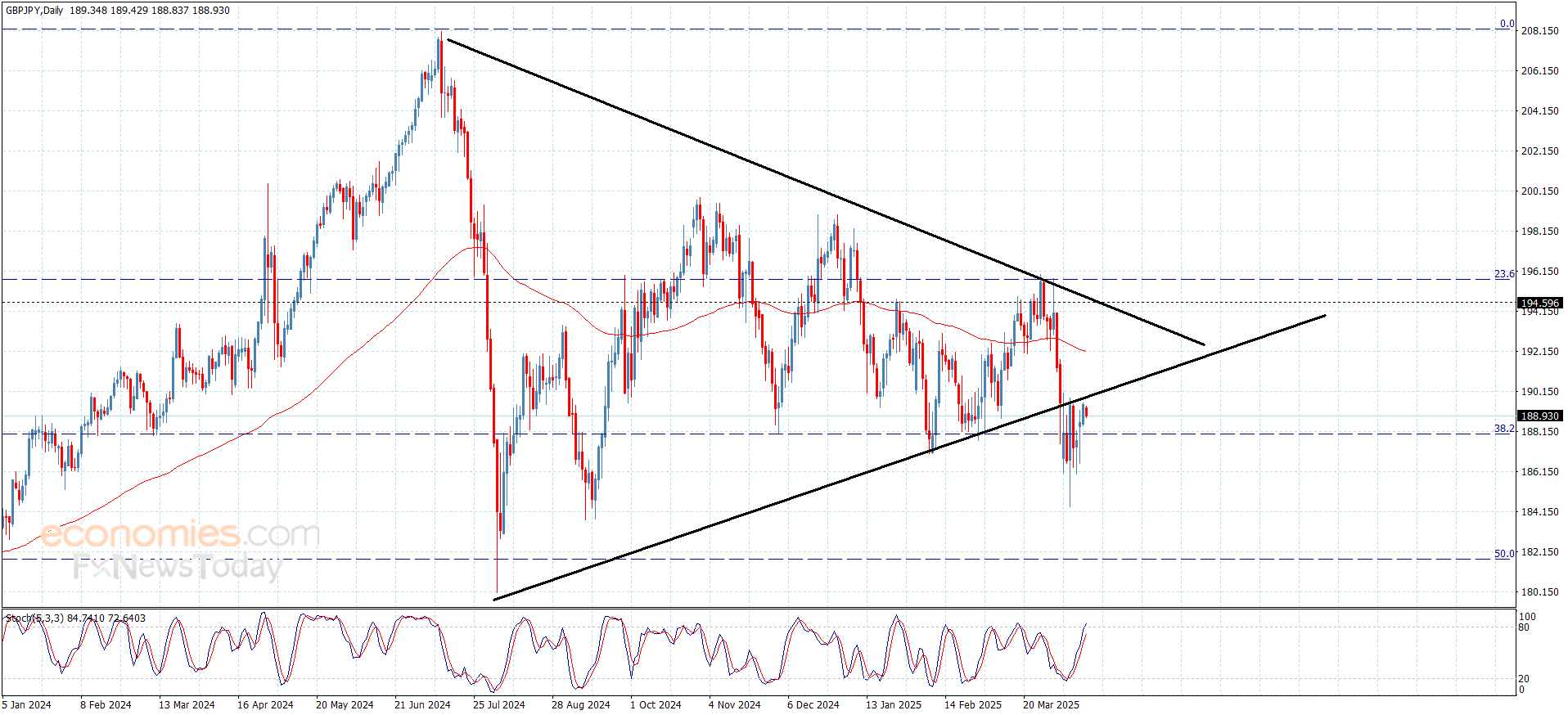
The GBPJPY pair ended yesterday’s trading by providing new negative close below 189.90 resistance, to be forced to form mixed sideways trading by its stability near 189.00, due to the continuation of the contradiction between the main indicators, specifically by stochastic approach from 80 level as appears in the above image.
The price success to gain the negative momentum will allow it to renew the negative trading, to press on 38.2% Fibonacci correction level at 187.85, as breaking it will extend the trading towards the next negative target near 186.50, while breaching the resistance and holding above it will cancel the negative suggestion, and makes the price begin building a new bullish track, to target several positive stations that begin at 190.50.
The expected trading range for today is between 187.85 and 189.60
Trend forecast: Bearish
Silver price (XAG/USD) is inching higher after recent losses, trading around $32.30 per troy ounce during Wednesday’s Asian session. The uptick comes as lingering uncertainty over US trade policy continues to fuel safe-haven demand for the precious metal.
A weaker US Dollar (USD) is also supporting Silver prices, making the dollar-denominated asset more attractive to foreign buyers. The US Dollar Index (DXY), which measures the Greenback against a basket of six major currencies, is trading lower near 99.80 at the time of writing. Market attention now turns to the upcoming US Retail Sales data for March, which could shed light on the impact of tariff tensions on consumer spending.
Safe-haven flows into Silver were further bolstered after US President Donald Trump called for an investigation into potential tariffs on all critical mineral imports. This move signals a more aggressive trade stance and raises the risk of tensions with key suppliers, including China. It also partially offsets the market optimism sparked by recent exemptions on certain tech products and possible exclusions for auto parts.
Meanwhile, Federal Reserve Governor Christopher Waller attempted to calm market nerves, saying that any inflation arising from tariffs would likely be temporary. Waller also reaffirmed the Fed’s willingness to lower interest rates if needed, signaling the central bank’s commitment to supporting growth. Investors now await the US retail sales report and a speech from Fed Chair Jerome Powell later in the day for further direction on the economic and monetary policy outlook.
Silver is a precious metal highly traded among investors. It has been historically used as a store of value and a medium of exchange. Although less popular than Gold, traders may turn to Silver to diversify their investment portfolio, for its intrinsic value or as a potential hedge during high-inflation periods. Investors can buy physical Silver, in coins or in bars, or trade it through vehicles such as Exchange Traded Funds, which track its price on international markets.
Silver prices can move due to a wide range of factors. Geopolitical instability or fears of a deep recession can make Silver price escalate due to its safe-haven status, although to a lesser extent than Gold’s. As a yieldless asset, Silver tends to rise with lower interest rates. Its moves also depend on how the US Dollar (USD) behaves as the asset is priced in dollars (XAG/USD). A strong Dollar tends to keep the price of Silver at bay, whereas a weaker Dollar is likely to propel prices up. Other factors such as investment demand, mining supply – Silver is much more abundant than Gold – and recycling rates can also affect prices.
Silver is widely used in industry, particularly in sectors such as electronics or solar energy, as it has one of the highest electric conductivity of all metals – more than Copper and Gold. A surge in demand can increase prices, while a decline tends to lower them. Dynamics in the US, Chinese and Indian economies can also contribute to price swings: for the US and particularly China, their big industrial sectors use Silver in various processes; in India, consumers’ demand for the precious metal for jewellery also plays a key role in setting prices.
Silver prices tend to follow Gold’s moves. When Gold prices rise, Silver typically follows suit, as their status as safe-haven assets is similar. The Gold/Silver ratio, which shows the number of ounces of Silver needed to equal the value of one ounce of Gold, may help to determine the relative valuation between both metals. Some investors may consider a high ratio as an indicator that Silver is undervalued, or Gold is overvalued. On the contrary, a low ratio might suggest that Gold is undervalued relative to Silver.
The GBPJPY pair ended yesterday’s trading by providing new negative close below 189.90 resistance, to be forced to form mixed sideways trading by its stability near 189.00, due to the continuation of the contradiction between the main indicators, specifically by stochastic approach from 80 level as appears in the above image.
The price success to gain the negative momentum will allow it to renew the negative trading, to press on 38.2% Fibonacci correction level at 187.85, as breaking it will extend the trading towards the next negative target near 186.50, while breaching the resistance and holding above it will cancel the negative suggestion, and makes the price begin building a new bullish track, to target several positive stations that begin at 190.50.
The expected trading range for today is between 187.85 and 189.60
Trend forecast: Bearish
Gold price is consolidating its latest uptick to a new record high of $3,275 early Wednesday as buyers take a breather in anticipation of the top-tier US Retail Sales data and Federal Reserve (Fed) Chairman Jerome Powell’s speech due later in the day.
Gold price preserves its renewed bullish momentum from the previous day after fairly upbeat growth and activity data from China, the world’s second biggest economy. China’s Q1 Gross Domestic Product (GDP) beat expectations with 5.4% year-over-year (YoY) while the country’s Retail Sales and Industrial Production also reported a bigger-than-expected growth in March.
Despite the improvement in China’s macro picture in the first quarter, looming risks from US tariffs impact dim its outlook, keeping investors on the edge while maintaining the safe-haven demand for Gold price. China’s National Bureau of Statistics (NBS), however, said that “US tariffs will not change the long-term improving trend in China’s economy.”
Heightened markets’ nervousness heading into China data dump propelled Gold price to a fresh all-time high. Additionally, the traditional safe-haven Gold price also capitalized a fresh risk-aversion wave in Asia as traders reacted negatively to the overnight slump in the American artificial intelligence (AI) leader Nvidia, who said that the US government will begin requiring a license to export the company’s H20 chips to China, citing about a likely $5.5 billion hit to the company.
Meanwhile, the US-China trade war fears show no signs of abating after the Wall Street Journal (WSJ) reported early Wednesday, citing sources, the Trump administration may use tariff negotiations to try to pressure US trading partners to limit dealings with China.
This comes after Bloomberg News reported on Tuesday that the European Union (EU) expects most of the US import tariffs to remain in place after little progress was made in the latest talks.
Escalating trade tensions and increasing recession risks continue to power the Gold price. Furthermore, ANZ Bank raised its year-end Gold price forecast to $3,600 per ounce and its six-month forecast to $3,500, keeping Gold buyers hopeful.
Traders eagerly look forward to the high-impact US Retail Sales data for March and Fed Chair Jerome Powell’s speech for hints on the state of the US economy and the Fed’s interest rate outlook, in the face of heightened geopolitical and economic risks.
The daily chart shows that the 14-day Relative Strength Index (RSI) has re-entered the overbought region, currently near 71, warranting caution for buyers.
If they manage to sustain above the $3,275 level on a daily closing basis, a test of the $3,300 mark will be inevitable, opening the door toward the $3,350 psychological mark.
Conversely, the initial support aligns at the $3,200 threshold, below which the April 11 low of $3,176 will be challenged.
Additional declines could test the $3,100 round level, where the 21-day Simple Moving Average (SMA) resistance-turned-support closes in.
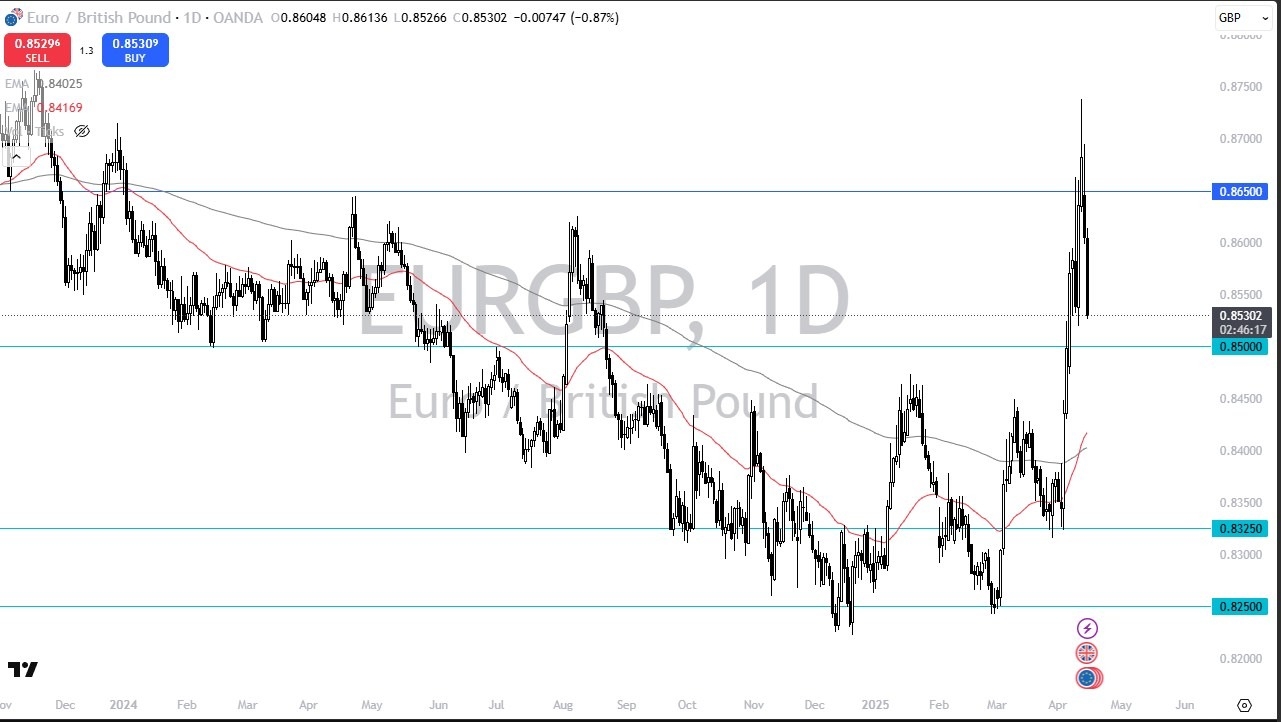
Keep in mind that there is a lot of noise out there with tariff wars, and while these 2 currencies don’t reflect a couple of economies going after each other, the reality is that the euro had gotten overbought against the US dollar and a whole host of other foreign currencies, so it needed to pull back. The question now is whether or not it can find its footing in turn things around? I do think the 0.85 level will tell the story. Furthermore, you need to keep in mind that Friday has most major economies shutting down large portions of their markets, so this decision may end up being made after the ECB press conference on Thursday.

I do think that it’s very unlikely that the markets will be easy anytime soon, and I just don’t think that this currency pair will be any different. Keep in mind that the pip value in this market is higher than many others, so it doesn’t take as much real estate to make a profit here. If you can make 50 pips in this chair, it’s a lot more impressive than other currency pairs such as the USD/JPY. Ultimately, I think we are getting close to an area where some value hunters might be interested, but I suspect that the next 2 days could be somewhat stagnant in this pair, before setting up for a bigger trade.
Ready to trade our daily forecast and analysis? Here’s a list of some of the top forex brokers UK to check out.
April 16, 2025 – Written by David Woodsmith
STORY LINK Pound to Dollar Forecast: Scope for GBP/USD Gains to 1.3290 say UoB
Market fear has eased considerably over the past 24 hours with gains in US equities and bonds.
The FTSE 100 index traded 0.9% higher in early trading, maintaining the recovery from last week’s slide.
Deutsche Bank commented; “Whilst equities were recovering, arguably a bigger relief for investors was the recovery in the bond market, which eased fears about some sort of serious financial turmoil developing.”
The Pound remains correlated strongly with global risk conditions and the currency gained important support from a rebound in asset prices.
Dovish Fed rhetoric also hampered the dollar in global markets.
The Pound to Dollar (GBP/USD) exchange rate surged to 6-month highs around 1.3240 and Sterling also posted net gains on the crosses.
UoB sees scope for further GBP/USD gains to 1.3290.
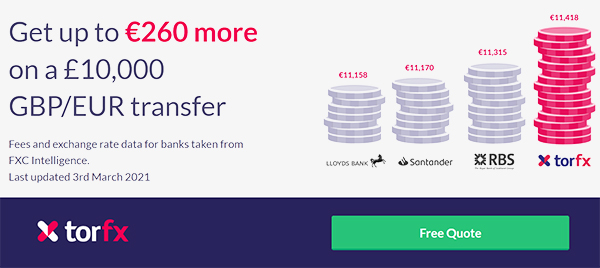
ING sees a bias for EUR/USD to strengthen to 1.15 and, if this scenario plays out, GBP/USD is likely to extend gains.
There is still an important element of caution surrounding the implications of US trade policies.
According to MUFG; “While we are seeing carve-outs emerge from Trump’s trade policy there is unlikely to be any let-up over the coming weeks/months. The next dangerous stage for the financial markets will be getting confirmation of the damage being done to the real economy from the tariff hit and the uncertainty.”
The latest UK labour-market data was mixed. The number of people on payrolls declined 8,000 for February and there was a provisional 78,000 slide for March.
Vacancies declined for the 33rd successive month and dipped below pre-pandemic levels.
The annual increase in headline wages growth increased marginally to 5.9% from a revised 5.8% previously while underlying growth was unchanged at 5.6%, further evidence of sticky wages increases.
According to ING; “The latest one-month and three-month changes in private-sector pay show that the pressure isn’t really abating. The latest rise in the National Living Wage will also keep pay growth supported through the spring.”

Pantheon Macroeconomics chief UK economist Rob Wood commented; “we would treat the initial estimate of payrolls with a large bucket of salt because the 78,000 month-to-month fall will get raised markedly in next month’s figures to around no change if revisions continue to follow the pattern of the past couple of years.
Nevertheless, he added; “There is enough here for the MPC to cut interest rates in May and to signal further reductions ahead. Accordingly, rate setters will likely sound a little more dovish at their May meeting, especially after the economic and market ructions following President Trump’s tariff hikes.”
ING also remains confident that there will be a May BoE rate cut.
Any potential negative Pound impact from BoE rate cuts would be offset if US rates decline.
There were dovish comments from Fed Governor Waller on Tuesday. If there is notable disruption from tariffs he noted; “With a rapidly slowing economy, even if inflation is running well above 2%, I expect the risk of recession would outweigh the risk of escalating inflation, especially if the effects of tariffs in raising inflation are expected to be short lived.”
He implied that the Fed will look through higher inflation and markets are expecting at least three rate cuts this year.
MUFG commented; “This kind of scenario points to a potential notable further decline in real yields, possibly into negative territory, at the front-end of the curve which is an unfavourable development for the dollar.”
International Money Transfer? Ask our resident FX expert a money transfer question or try John’s new, free, no-obligation personal service! ,where he helps every step of the way,
ensuring you get the best exchange rates on your currency requirements.
An upside breakout will be triggered on a rally above today’s high. That would put natural gas in a position to eventually test resistance around the top of the channel. For now, the intersection of two trendline at $3.80 can be used as a proxy for the top of the channel. That price level is another price level defined by last Wednesday’s high of $3.83.
Furthermore, better clarity is provided by potential resistance around the 20-Day MA, now at $3.82, and the 50-Day MA at $3.90. Note that the 20-Day MA is falling and will continue to represent a lower price area. It becomes a more significant potential resistance zone if a similar price level is indicated by other analysis.
There is a chance that bullish signs following the completion of an 88.6% retracement may mark the end of the bearish correction. Keep in mind that advances from current levels are counter-trend rallies within a decline trend channel. A rally above the 20-Day MA, followed by a daily close above it would be supportive of the bullish thesis. Earlier signs of strength would be indicated on a rally above Monday’s high of $3. 61. That price would be an initial short-term target following a breakout above today’s high.
Despite the potential for a bullish reversal from a key support zone, a trigger above today’s high is needed for confirmation of strength. There is always a possibility that the bulls cannot maintain control and the bearish correction continues to lower prices. An area of potential support confluence is shown on the chart from $3.08 to $2.99. That price range includes the potentially significant 200-Day MA as possible support at $3.05.
For a look at all of today’s economic events, check out our economic calendar.
Platinum price formed a new bullish rally achieving $958.00 level, then rebound directly to settle near the barrier at $950.00 level, affected by the continuation of the contradiction between the main indicators.
The price might be forced to form mixed sideways trading, but the main stability above the support level at $920.00 represents a main factor that motivates the bullish trading, reminding you that the main targets settled near $966,00, and surpassing it will confirm regaining the main bullish bias, by its stability within the bullish channel’s levels that appear in the above image.
The expected trading range for today is between $940,00 and $966.00
Trend forecast: Bullish
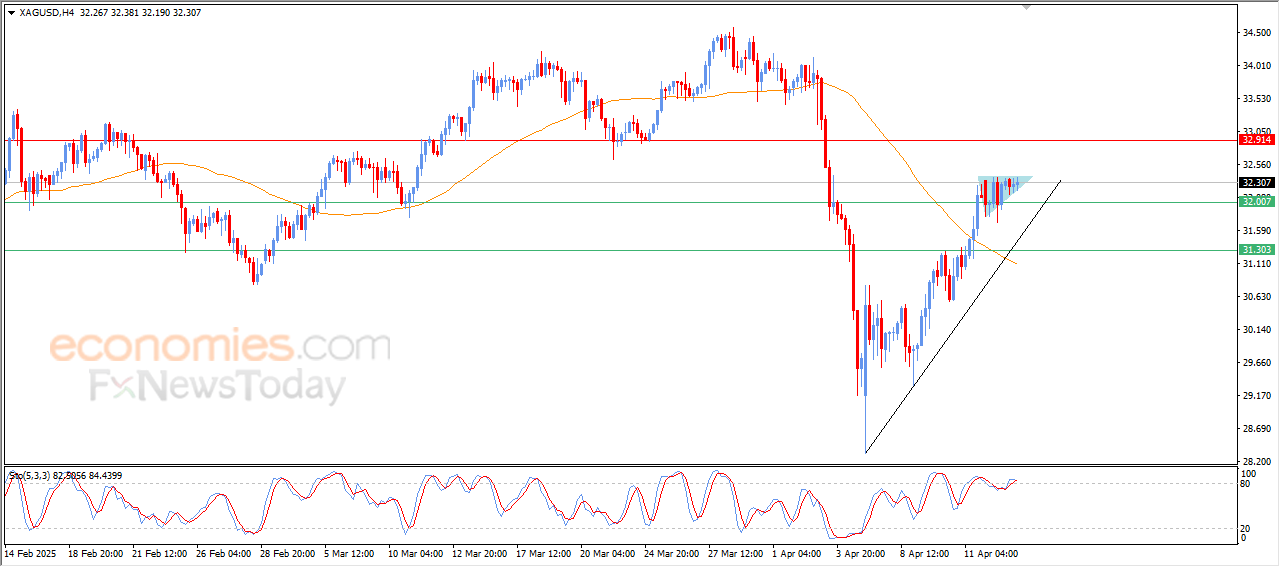
Silver price (XAG/USD) continues to show strength for the fifth consecutive session, trading around $32.30 per troy ounce during the Asian session on Tuesday. The technical analysis of the daily chart suggests a growing bullish trend, with the grey metal moving upward within an ascending channel pattern.
Silver price remains above both the nine-day and 50-day Exponential Moving Averages (EMAs), indicating strong short-term momentum. Furthermore, the 14-day Relative Strength Index (RSI) sits at the 50 level, reinforcing the active bullish bias.
On the upside, the XAG/USD pair may target the upper boundary of the ascending channel around $33.50. A decisive break above this level could strengthen the bullish outlook and pave the way for a retest of the six-month high at $34.59, last seen on March 28.
Silver price may find immediate support at the 50-day EMA near $32.21, followed by the nine-day EMA around $31.90. A break below this level could signal weakening short-term price momentum, potentially driving precious metals’ price toward the $31.50 support area. Further downside support lies at the seven-month low of $28.00, marked on April 7.
Silver is a precious metal highly traded among investors. It has been historically used as a store of value and a medium of exchange. Although less popular than Gold, traders may turn to Silver to diversify their investment portfolio, for its intrinsic value or as a potential hedge during high-inflation periods. Investors can buy physical Silver, in coins or in bars, or trade it through vehicles such as Exchange Traded Funds, which track its price on international markets.
Silver prices can move due to a wide range of factors. Geopolitical instability or fears of a deep recession can make Silver price escalate due to its safe-haven status, although to a lesser extent than Gold’s. As a yieldless asset, Silver tends to rise with lower interest rates. Its moves also depend on how the US Dollar (USD) behaves as the asset is priced in dollars (XAG/USD). A strong Dollar tends to keep the price of Silver at bay, whereas a weaker Dollar is likely to propel prices up. Other factors such as investment demand, mining supply – Silver is much more abundant than Gold – and recycling rates can also affect prices.
Silver is widely used in industry, particularly in sectors such as electronics or solar energy, as it has one of the highest electric conductivity of all metals – more than Copper and Gold. A surge in demand can increase prices, while a decline tends to lower them. Dynamics in the US, Chinese and Indian economies can also contribute to price swings: for the US and particularly China, their big industrial sectors use Silver in various processes; in India, consumers’ demand for the precious metal for jewellery also plays a key role in setting prices.
Silver prices tend to follow Gold’s moves. When Gold prices rise, Silver typically follows suit, as their status as safe-haven assets is similar. The Gold/Silver ratio, which shows the number of ounces of Silver needed to equal the value of one ounce of Gold, may help to determine the relative valuation between both metals. Some investors may consider a high ratio as an indicator that Silver is undervalued, or Gold is overvalued. On the contrary, a low ratio might suggest that Gold is undervalued relative to Silver.
The crude oil price move downside in its recent intraday trading, affected by the negative pressure that comes from the EMA50, besides the stability of the stubborn resistance level at $61.50, attempting to gain some of the positive momentum that might assist breaching the resistance and surpassing its negative pressures.
To get our more detailed analysis and 100% accurate signals provided by Best Trading Signal, subscribe to Economies.com VIP Club through the link below!