The main category of Forex News.
You can use the search box below to find what you need.
[wd_asp id=1]
The main category of Forex News.
You can use the search box below to find what you need.
[wd_asp id=1]
In this regard, the Chairman of the Policy Committee of the Japanese ruling party said before the start of trading this week that Japan should strengthen the yen, including by helping to enhance the country’s industrial competitiveness, as the currency’s weakness has led to higher household living costs. Itsunori Onodera, chairman of the Liberal Democratic Party’s Policy Research Council, emphasized that Japan should not deliberately sell its holdings of US Treasury bonds in retaliation for the tariffs imposed by President Donald Trump.
He added, “As an ally of the United States, the government should not consider deliberately using its holdings of US Treasury bonds,” rejecting an opposition deputy’s suggestion that Tokyo use its massive holdings of US government debt as a negotiating tool in bilateral trade talks.

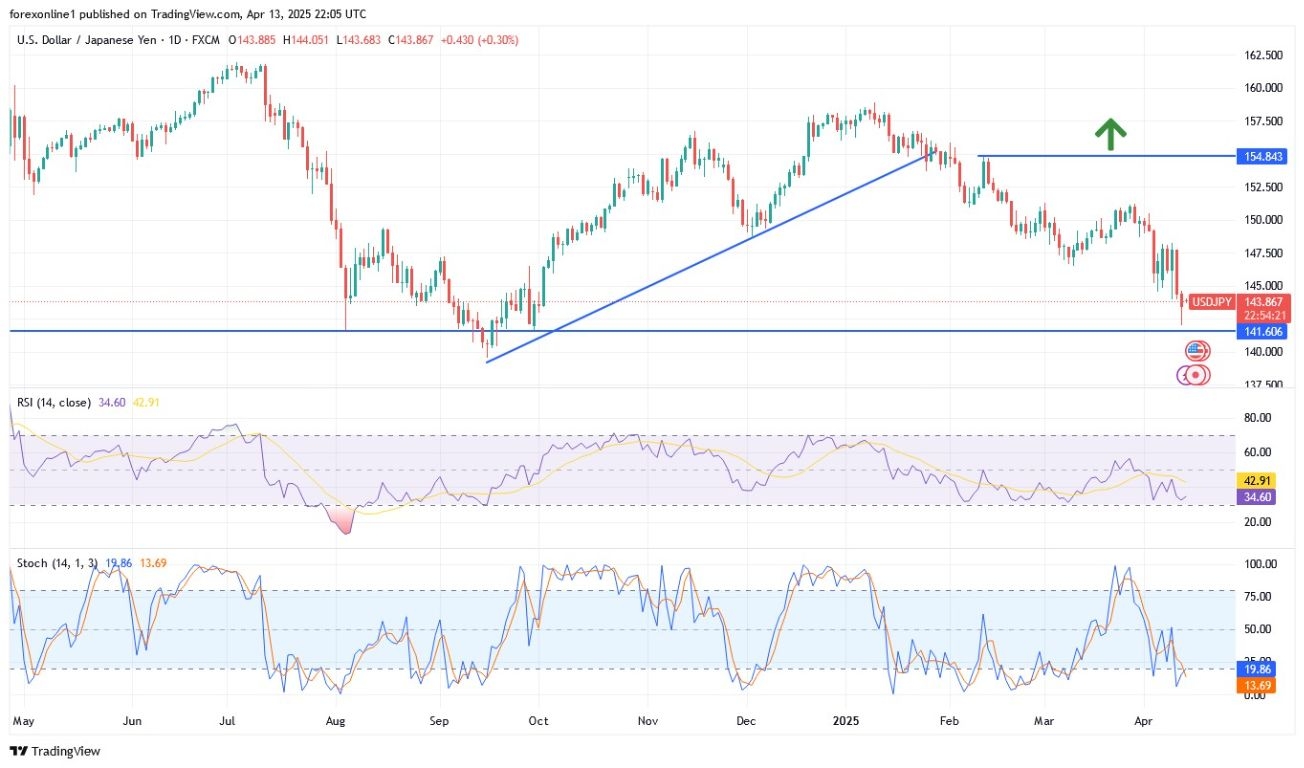
I still prefer buying USD/JPY from every downward level.
By the end of last week’s trading and across stock trading company platforms, Wall Street stocks rose, ending a volatile week amid trade hopes. Investor sentiment had risen thanks to hopes for a potential trade agreement between the United States and China. According to performance, the S&P 500 index rose by 1.8%, the Nasdaq by 2%, and the Dow Jones by 618 points. Optimism increased after the White House stated that President Trump is “optimistic” that China will seek an agreement, even as trade tensions escalated with Trump raising tariffs on Chinese goods to 145%, and China responding by imposing 125% tariffs on US imports.
On the economic front, according to the economic calendar data results, a University of Michigan survey showed US consumer confidence falling to its lowest levels since 2022, with inflation expectations reaching a peak not seen since 1981. Meanwhile, the earnings season kicked off with mixed results for banks – Wells Fargo shares fell by 1%, while Morgan Stanley shares rose by 1.4%, and JPMorgan shares rose by 4% after reporting record revenues.
Overall, during last week’s trading, the S&P 500 jumped 5.7%, the Nasdaq climbed 7.3%, and the Dow Jones rose nearly 5%, recording its best weekly performance in more than a year, driven by a historic high in mid-week trading.
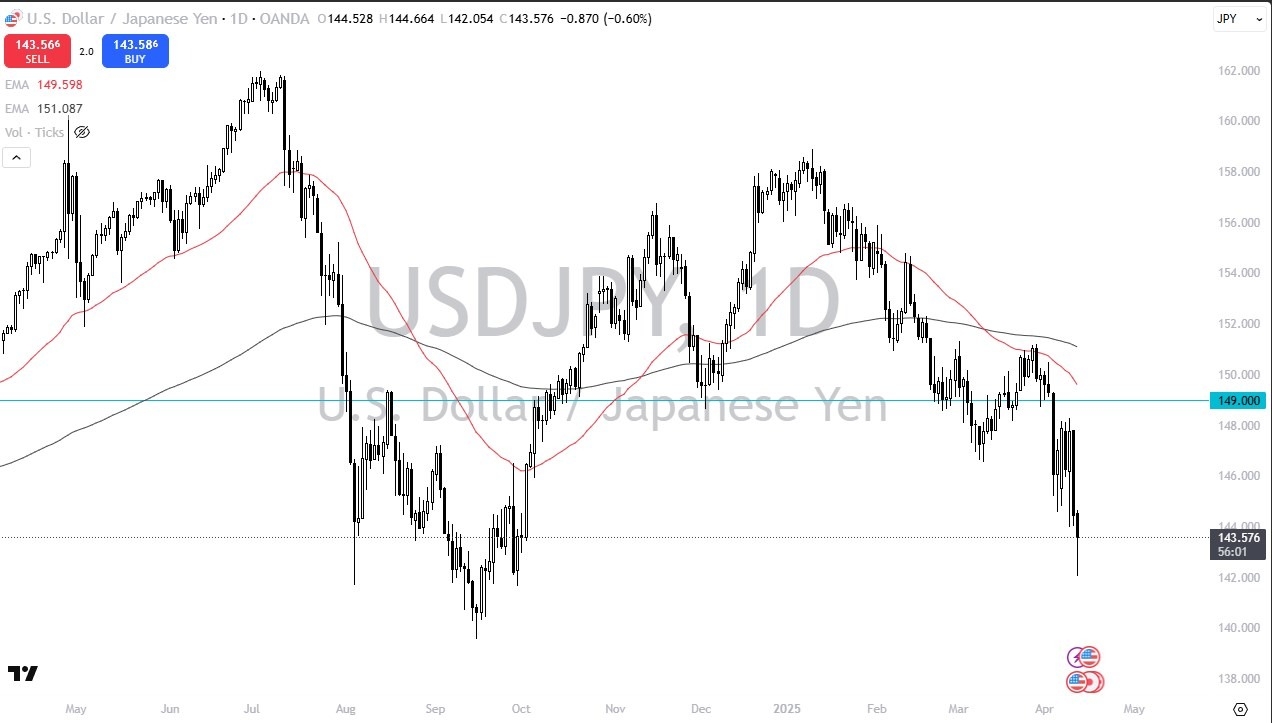
By observing the performance on the daily timeframe chart, the overall trend for USD/JPY is strongly bearish, and it appears closest to its peak if bears succeed in moving towards the psychological support level of 140.00. From there and from lower levels, buying USD/JPY is preferred. The support level of 141.60 is currently the most important for anticipating a move towards the psychological support. This level is also sufficient to push technical indicators towards strong oversold levels, as clearly shown by the performance of the Stochastic oscillator, the 14-day RSI, and the MACD. Conversely, on the same timeframe, the first break of the bearish trend will be an initial move towards the resistance level of 147.80, which leads us to the psychological resistance of 150.00.
The USD/JPY pair is not awaiting any significant economic data releases, so investor sentiment regarding risk appetite will be a key factor in determining the pair’s direction.
Want to trade our USD/JPY forex analysis and predictions? Here’s a list of forex brokers in Japan to check out.
Crude oil prices rose in its recent intraday trading, challenging the key resistance level at $61.50, supported by a short-term bullish correctional wave and the emergence of positive signals from the Relative Strength Index (RSI). However, the price is also facing a strong obstacle, which is the resistance of the EMA50.
To get our more detailed analysis and 100% accurate signals provided by Best Trading Signal, subscribe to Economies.com VIP Club through the link below!
The GBPJPY pair provided more negative attempts on Friday’s trading, but the contradiction between the main indicators pushed it to delay the negative attack, by its rebound above 186.50 level that represents a new obstacle against the negative attempts, which pushes it to form a sideways fluctuation by its stability near 187.50.
Reminding you that the bearish scenario remain valid, depending on the stability of the resistance at 189.75, besides 38.2% Fibonacci correction level’s attempt to settle at 188.00 as an extra barrier, therefore, we will keep waiting for gathering the negative momentum again, to ease the mission of renewing the pressure on 186.50, as breaking it will open the way towards reaching the extra negative stations, which might begin at 186.60 and 184.40.
The expected trading range for today is between 186.50 and 188.40
Trend forecast: Bearish
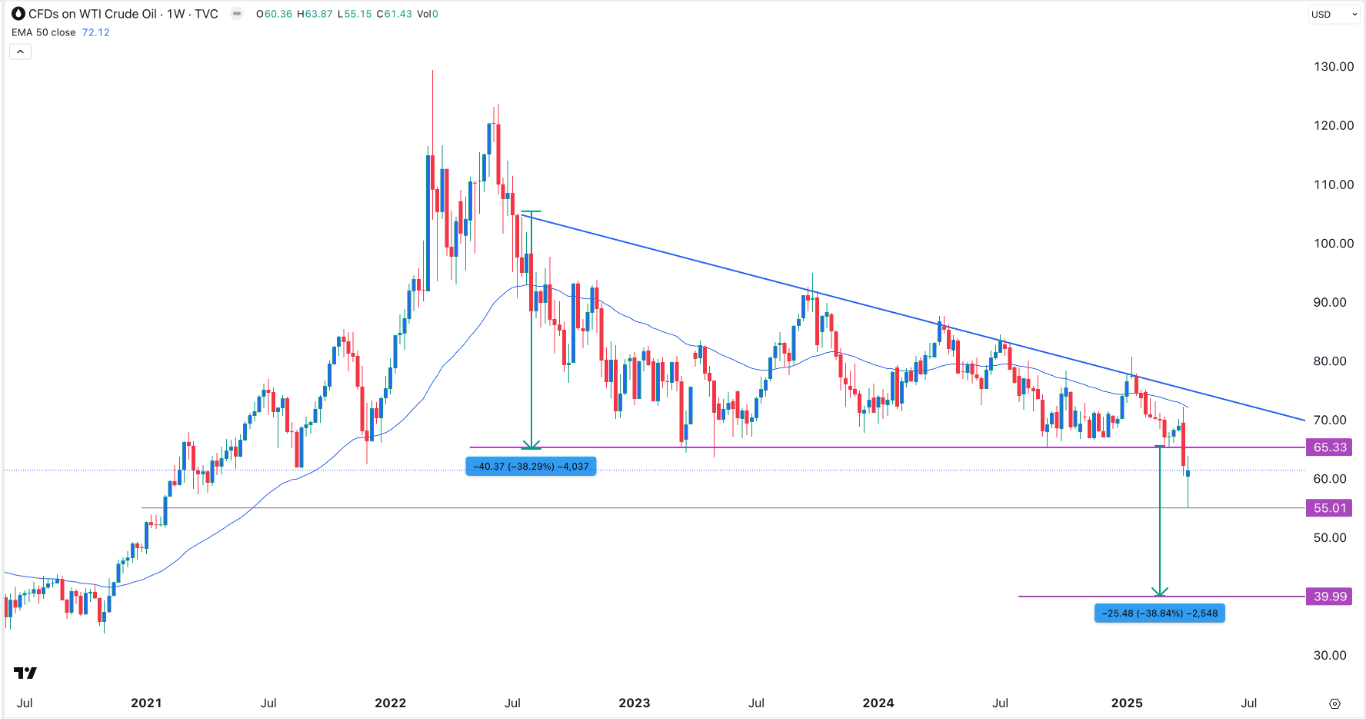
The WTI crude oil price crashed to $55 last week, its lowest level since February 2021 as demand concerns coincided with higher oil OPEC output. It then bounced back to end the week at $61.43.
The WTI crude oil price outlook is bearish as the industry battles numerous demand and supply concerns.
The main demand aspect is that there are concerns that the US and other countries may move into a recession this year. In a note last week, the Energy Information Administration (EIA) warned that demand could drop as uncertainties remains. It also slashed demand estimate for this year and 2025.
At the same time, oil producers are preparing production increases this year. OPEC member countries voted to increase production gradually in the coming months.
Donald Trump is also aiming to boost US oil production as he seeks to lower inflation and ease regulations. He campaigned on a “drill, baby, drill” mantra, which involves boosting production, which currently stands at 13.5 million barrels a day. Any trade deal with other countries will likely involve them buying more oil to reduce the US deficit.
The United States is talking to Russia on ending the war in Ukraine. Any potential deal would end the sanctions that the US and other countries have placed on Russia, a move that would bring more oil online.
Additionally, the US is negotiating with Iran on ending its nuclear power program. A deal would also involve the Trump administration removing sanctions on Iranian oil that have reduced its exports in the past few months.
The WTI crude oil price will react to trade news this week. Signs of de-escalation between China and the US will likely be a bullish sign for oil prices.
The weekly chart shows that the WTI crude oil price has been in a downward trend in the past few months. It has formed a descending triangle pattern, a popular bearish sign in the technical analysis.
The price has moved below all moving averages and the lower side of the descending triangle pattern. The widest point of this triangle is 38%, meaning that the longer-term target is about $40. This target was achieved by measuring the same distance from the lower side of this triangle.
In the short term, however, the WTI crude oil price may retest the lower side of this triangle and then resume the downtrend.
Ready to trade our weekly forecast? Here’s a list of some of the best Oil trading platforms to check out.
April 13, 2025 – Written by David Woodsmith
STORY LINK Pound to Euro Week Ahead Forecast: Short-Term Buy, 1.19 by Q3 2025
Investment banks have been scrambling to adjust forecasts following another week of turmoil in global markets as tariff developments have dominated. Markets are also adjusting to on-going evidence of major changes surrounding the global economy.
The Pound to Euro (GBP/EUR) exchange rate dived to 16-month lows just below 1.1450 on a Euro surge before a tentative recovery back above 1.15.
Most banks expect at least a short-term recovery from current levels, but longer-term forecasts are in a state of flux.
RBC Capital Markets (RBC) expects a recovery to 1.1900 by the third quarter of this year before renewed losses to 1.11 at the end of next year.
UBS recommends buying GBP/EUR on any dips to 1.1430. It has a March 2026 target of 1.1765.
There had been expectations that a lower rate of US trade tariffs on the UK compared with the EU would help support the Pound against the Euro.
On a short-term view, however, any potential support was more than offset by market turmoil, a collapse in risk appetite and the demand for safe-haven assets.
The US decision to delay reciprocal tariffs for 90 days also means that the UK and EU tariffs are at the same level for the time being.
Acute risk aversion amid a slide in equity markets triggered substantial defensive Euro demand and the Pound always struggles when risk appetite deteriorates.
According to Deutsche Bank; “EUR/GBP is now trading rich to front-end rate differentials, That makes the move more similar to the carry unwind of early August 2024, and also continues to a role for repatriation flows.”
Following very sharp losses, there will be speculation that the Pound is over-sold.
According to Credit Agricole; “the recent FX spot moves have pushed EUR/GBP deep into undervalued territory according to our short-term FX fair value model that is based on FX drivers like the EUR-GBP rate spread as well as measures of risk aversion.”
It added; “We thus believe that the cross is close to peaking.”
Bank of America is still cautious over the scope for Euro gains from current levels; “Sanity checks suggest EUR has outperformed. We do maintain a bearish bias vs. GBP.”

According to the bank net investment capital inflows into the Euro area have been disappointing.
BoA also considers that good news has been priced in; “A measured EU stance in relation to US tariffs would be good for the EUR – and in line with our economists’ baseline – but is likely in the price.”
Credit Agricole considers that the relative outlook is still favourable for the Pound; “The recovery should be broad-based and help ease market fears about the UK economic outlook in the near term. This, coupled with market and BoE expectations that inflation could remain sticky in the coming months could further encourage UK rate investors to pare back their aggressive rate cut expectations. All that could give the undervalued GBP some support.”
Nataxis forecasts a limited recovery to 1.1670 by end 2025.
Nomura is still targeting GBP/EUR losses to 1.1365.
Nomura maintains a bearish stance on the Pound; “the recent spike in bond yields will do more harm to the UK from a fiscal perspective than most other G10 countries.”
Nomura, however, also notes that trade fears could still undermine the Euro if there is a more aggressive stance. It added; “The risk of trade retaliation in Europe should not be ruled out, even if the approach so far has been pragmatic.”
RBC notes mixed influences on the cross. On a short-term view, it noted; “From here, GBP may find some support if headlines turn more negative on Europe, and in particular if we see more signs of the relative European equity outperformance stalling.”
RBC is, however, still wary over the UK outlook; “The concern from the OBR’s perspective is that a growth hit of that size would wipe out the UK’s fiscal buffer. The 2022 Truss episode has done lasting damage in that even under pretty extreme global conditions, gilt investors, and by extension the UK govt, see limited room for the govt to offer much fiscal support.”
For the next few months it noted; “Positioning in long EUR/GBP is at a two year high which is a headwind for further gains. GBP retains its significant yield advantage and is expected to maintain that through this year. That should ultimately cap GBP losses.”
The bank still pointed to longer-term vulnerability; “GBP remains overvalued on a REER basis, particularly based on unit labour cost measures for the real effective exchange rate. We see EUR/GBP drifting higher in 2026.”(Gradual GBP/EUR losses).
UBS points to two-sided risks for the UK economy and Pound.
On the positive side it noted; “The UK’s economy is far less susceptible to the US trade actions, which could translate into a reversal.”
On the downside; “The risk is that the UK lacks the increased structural support from higher fiscal spending seen in the Eurozone or Germany in particular.”
It summarised; “Overall, we see spot risks as slightly skewed to the downside. Further, elevated volatility and skewness further add to our rationale.”
Unicredit is forecasting GBP/EUR losses to 1.1235 by December 2025.
Rabobank has cut is end-2025 GBP/EUR forecast to 1.1765 from 1.2050.
International Money Transfer? Ask our resident FX expert a money transfer question or try John’s new, free, no-obligation personal service! ,where he helps every step of the way,
ensuring you get the best exchange rates on your currency requirements.
Natural gas price continued resisting the negative pressures, by its stability above $3.350 level, to decrease the chances for suffering extra losses, and increase the chances for activating the bullish track, due to stochastic exit from the oversold levels as appear in the above image.
The price rally is expected toward the extra resistance at $3.640, confirming that surpassing it is important to confirm regaining the bullish bias, by its rally directly to the positive stations near $3.950 reaching $4.180 in the medium period trading.
The expected trading range for today is between $3.450 and $3.950
Trend forecast: Bullish
Recently, the decline in the value of the US dollar to its lowest in 3 years coincided with a sharp deterioration in US stock markets, in a clear response to the White House’s trade policy, which aims to bring consumer goods production back domestically. This is expected to erode the earnings and margins of US companies in the short to medium term. This makes the astronomical, if not scandalous, valuations that have prevailed across the Pacific since at least the beginning of the first administration led by Donald Trump, if not longer, indefensible.
According to reliable trading company platforms, the stock market decline is providing a strong boost to the Euro, Swiss Franc, and Japanese Yen, which in turn exacerbates the ongoing declines in both the US Dollar (trade-weighted) and the Chinese Renminbi (trade-weighted), which has fallen significantly below the minimum level set by Beijing for the currency (CHF/CNY, JPY/CNY, and EUR/CNY).
The Pound will remain the strongest even with a rebound in the US Dollar price, and therefore, the strategy to buy GBP/USD remains in place.
Amid significant activity in the global bond market, analysts are asking, “If the US government causes stock prices to fall and reduces the profitability of US companies, we must ask ourselves: does the rest of the world still want to invest all its money in US bonds or in stocks?” and “Cash flows have become much larger than trading flows.”
Recently, the UK 10-year bond yield has been trading around 4.75%, maintaining a sense of unease about financial stability in Britain.
According to financial market experts, while bond market instability is driving outflows of US dollars from the United States, markets are anticipating instability in the UK bond market. The sell-off in British government bonds, as we have seen previously following UK financial events, coincided with temporary periods of weakness in the British pound and will increase the risk of a decline in growth in the UK if high yields persist.
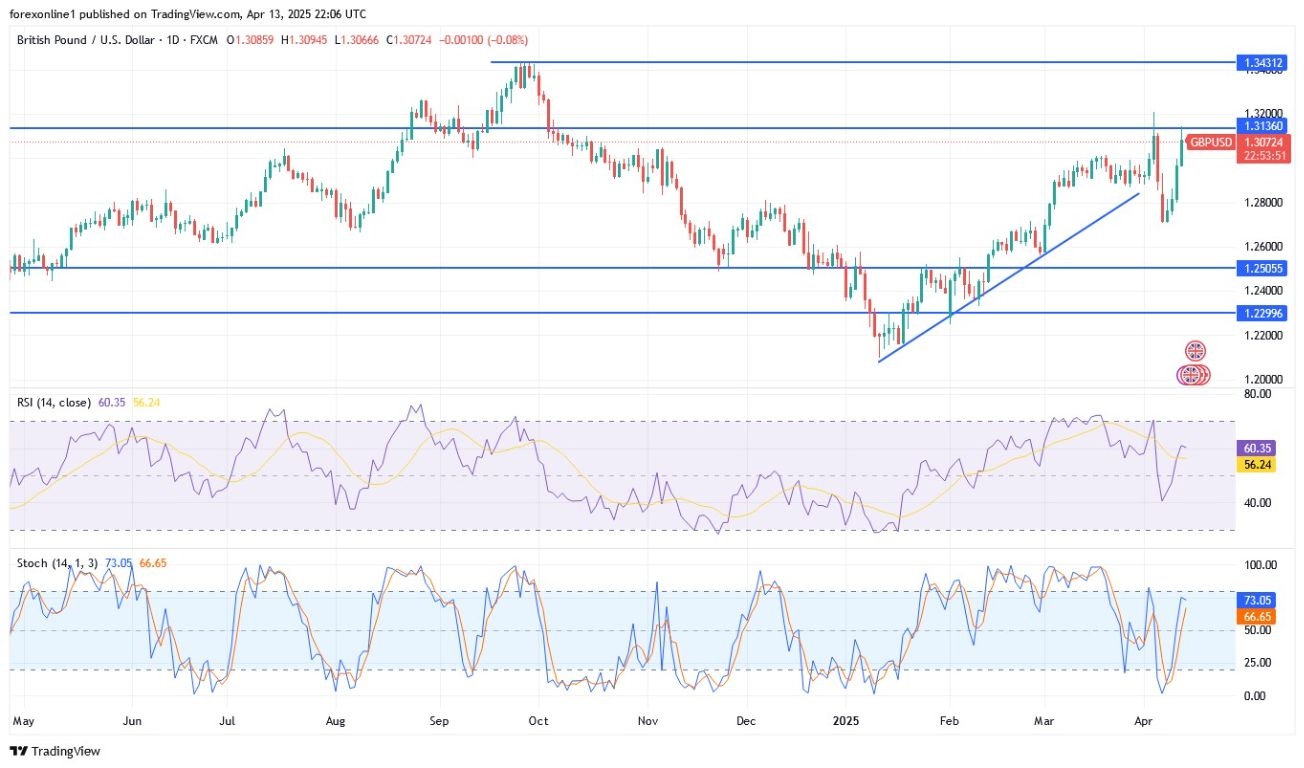
Looking at the daily chart above, you will notice that the overall trend for GBP/USD remains bullish and may continue as long as it remains stable above the psychological resistance of 1.3000. As mentioned before, this encourages technical buying for the GBP/USD pair. With the recent gains, the 14-day RSI has turned upwards and still has more room before reaching the overbought barrier. At the same time, the Stochastic oscillator is closest to breaking this barrier. The MACD indicator is also in a bullish turn. The nearest resistance levels for GBP/USD are currently 1.3140, 1.3220, and 1.3300 respectively. From the last level, technical indicators will move towards strong overbought levels.
Conversely, over the same timeframe, the 1.2880 support level will remain an important barrier to a downward trend. The currency pair is not awaiting significant performance-influencing data during today’s trading. Therefore, investor sentiment regarding risk appetite and the performance of global financial markets will continue to influence today’s trading.
Ready to trade the Forex GBP/USD analysis and predictions? Here are the best forex trading platforms UK to choose from.
Copper price resumed its bullish rally, to notice its approach from $4.5600 this morning, which represents 50%Fibonacci correction level for the last decline, which began from the top at $5.3200.
Note that the continuation of copper’s price stability below $4.5600 level as an important barrier might push it to delay the bullish attack, and providing new negative trading, to target $4.4300 and $4.3200, while breaching the barrier and holding above it will reinforce the chances for recording extra gains that might extend to $4.6800 and $4.7500.
The expected trading range for today is between $4.4300 and $4.5600
Trend forecast: Bearish
The technical analysis for this USD/JPY pair is extraordinarily negative, and I do recognize that although the interest rate differential continues to favor the US dollar, especially as bonds in America selloff, sometimes higher interest rates can be a bad thing. I think we are in one of those times right now, but if we do get some type of stability in the markets, that will probably turn this market right back around, sending the US dollar much higher against the Japanese yen.
If we were to break down below the ¥142 level, then I think it opens up the possibility of a move down to the 140 in level, which is a large, round, psychologically significant figure, and an area that historically speaking, has been important. On the other hand, if we can recapture the ¥145 level to the upside, then I think the US dollar starts to rally toward the crucial ¥148 level, an area that had been a massive barrier multiple times in the recent past. Regardless, I do think that we will see a fairly big move, and it might also be worth noting that the Friday session was when we saw a bit of a bounce, perhaps traders are a bit concerned about trying to hang onto a short trade heading into the weekend.
Want to trade our USD/JPY forex analysis and predictions? Here’s a list of forex brokers in Japan to check out.
No news for Platinum price by its repeated fluctuations below the obstacle at $950.00, which forces it to provide weak sideways trading, delaying the waited bullish rally.
Note that stochastic attempt to reach the overbought level supports the chances for gaining positive momentum, to keep waiting for breaching the current obstacle to ease achieving the extra gains, which are located near $963.00 and$976.00, while the failure of the breach will confirm the domination of the sideways scenario, with a chance for retesting the initial support at $920.00 before any attempt to reach the previously suggested targets.
The expected trading range for today is between $935.00 and $963.00
Trend forecast: Bullish