The main category of Forex News.
You can use the search box below to find what you need.
[wd_asp id=1]
The main category of Forex News.
You can use the search box below to find what you need.
[wd_asp id=1]
April 10, 2025 – Written by David Woodsmith
STORY LINK Pound to Euro Rate Dragged Lower by EUR/USD Rally to 1.11
A EUR/USD rally past 1.11 on foreign exchange markets has dragged the Pound Sterling lower against the Euro on Thursday.
The Pound Euro (GBP/EUR) exchange rate weakened on Thursday following US President Donald Trump’s U-turn on his global tariffs.
On Thursday, the Euro (EUR) gained strength against most of its trading partners as Donald Trump announced a 90-day pause on global tariffs for all countries, except China, with a temporary 10% tariff.
In response to this shift, the US Dollar (USD) continued its downward trend during Thursday’s European trading session.
Due to the inverse relationship between the Euro and the US Dollar, the Euro capitalised on the USD’s decline, rising against the majority of its counterparts.
On Thursday, the Pound (GBP) managed to hold its ground against most of its rival currencies, even in the absence of significant economic data.
Despite the lack of major British economic indicators, Sterling maintained its strength, partly because of a decrease in expectations for an interest rate cut by the Bank of England (BoE).
With the UK bond markets stabilising, the probability of a BoE interest rate cut next week dropped from almost 100% to 78%, offering support to the Pound.
Looking ahead to Friday, the primary drivers of movement for the Pound Euro exchange rate will likely be the economic releases from both the UK and the Eurozone.
In the UK, the latest GDP figures are set to be released, and if the index reports an expected minor rebound, it could provide a positive boost to GBP exchange rates, helping to end the week on a strong note.
Meanwhile, in the Eurozone, Germany will unveil its latest inflation data.
Should the Consumer Price Index (CPI) report a downturn as expected, it could put downward pressure on the Euro, potentially weakening the single currency as the week draws to a close.

International Money Transfer? Ask our resident FX expert a money transfer question or try John’s new, free, no-obligation personal service! ,where he helps every step of the way,
ensuring you get the best exchange rates on your currency requirements.
The bright metal soared on Thursday, hitting a fresh all-time high of $3,175.00 a troy ounce during American trading hours. The US Dollar (USD) plummeted on headlines indicating the trade war unleashed by US President Donald Trump is far from over.
Trump announced massive retaliatory tariffs last week, only to pause most of them on Wednesday. Stock markets collapsed with the original news, recovering with the more optimistic pause. However, the good mood was short-lived. The White House confirmed on Thursday that levies on China account for 145%, the original 20% plus an additional 125%, which followed Beijing’s announcement of retaliatory 84% levies.
Tensions between the two countries revived concerns about a potential United States (US) recession around the corner. Even further, the US March Consumer Price Index (CPI) released earlier in the day showed inflationary pressures eased by more than anticipated, which will help the Federal Reserve (Fed) extend its wait-and-see stance on monetary policy. With easing inflation and fears of an economic setback, it’s not crazy to think the Fed could even hike interest rates in the future.
Wall Street plummeted with the news, falling alongside the USD. At the time of writing, the Dow Jones Industrial Average is down roughly 4%, while the Nasdaq Composite and the S&P 500 shed over 5% each.
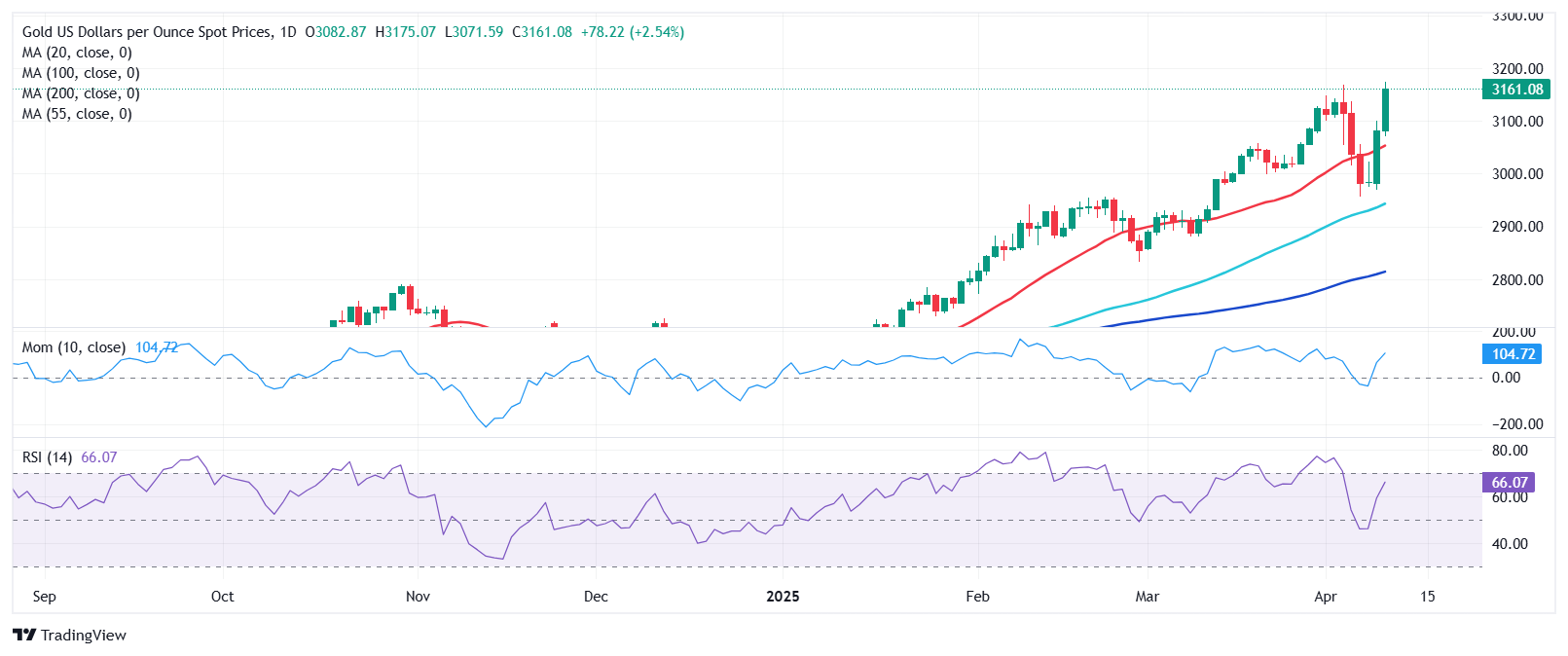
From a technical perspective, Valeria Bednarik, FXStreet Chief Analyst, notes: “The XAU/USD pair daily chart shows that additional gains are likely, given the strong upward momentum. Technical indicators head north almost vertically while still far from overbought levels. At the same time, the bright metal extended its advance beyond a now bullish 20 Simple Moving Average (SMA), currently at $3,052. Finally, the 100 and 200 SMAs also aim north, but far below the shorter one.”
Bednarik foresees XAU/USD reaching the $3,200 region in the upcoming sessions.
Generally speaking, a trade war is an economic conflict between two or more countries due to extreme protectionism on one end. It implies the creation of trade barriers, such as tariffs, which result in counter-barriers, escalating import costs, and hence the cost of living.
An economic conflict between the United States (US) and China began early in 2018, when President Donald Trump set trade barriers on China, claiming unfair commercial practices and intellectual property theft from the Asian giant. China took retaliatory action, imposing tariffs on multiple US goods, such as automobiles and soybeans. Tensions escalated until the two countries signed the US-China Phase One trade deal in January 2020. The agreement required structural reforms and other changes to China’s economic and trade regime and pretended to restore stability and trust between the two nations. However, the Coronavirus pandemic took the focus out of the conflict. Yet, it is worth mentioning that President Joe Biden, who took office after Trump, kept tariffs in place and even added some additional levies.
The return of Donald Trump to the White House as the 47th US President has sparked a fresh wave of tensions between the two countries. During the 2024 election campaign, Trump pledged to impose 60% tariffs on China once he returned to office, which he did on January 20, 2025. With Trump back, the US-China trade war is meant to resume where it was left, with tit-for-tat policies affecting the global economic landscape amid disruptions in global supply chains, resulting in a reduction in spending, particularly investment, and directly feeding into the Consumer Price Index inflation.
April 10, 2025 – Written by Ben Hughes
STORY LINK Pound to Dollar LIVE: Soft Inflation Print Sends Sterling Past 1.29
The US Dollar (USD) lost further ground against the Euro (EUR) and Pound Sterling (GBP) following the latest weaker-than-expected US inflation data.
The Pound to Dollar rate jumped to highs just above 1.2950 before settling around 1.2910.
According to Scotiabank; “Fundamentals are shifting in the pound’s favor as markets pare back their expectations for BoE easing, offering support via wider UK -US spreads.”
It added; “the focus is now on the 1.29-1.30 congestion range that had prevailed through much of March and the first couple of trading days in April. Resistance is expected between 1.31 and 1.32 while support is expected below 1.28.”
The Pound to Euro (GBP/EUR) exchange rate continued to lose ground, however, and retreated to 1.1615 from near 1.1650 ahead of the data with overall Pound confidence still fragile.
US consumer prices declined 0.1% for March compared with consensus forecasts of a 0.1% increase with the year-on-year inflation rate declining to 2.4% from 2.8% and below expectations of 2.5%.
Core prices increased 0.1% compared with expectations of another 0.3% increase with the annual rate slowing to 2.8% from 3.1%.
According to the Bureau of Labor Statistics; “Indexes that increased over the month include personal care, medical care, education, apparel, and new vehicles. The indexes for airline fares, motor vehicle insurance, used cars and trucks, and recreation were among the major indexes that decreased in March.”
The data eased inflation fears to some extent and traders were confident in pricing in at least three Fed interest rate cuts this year.
Goldman Sachs’s Kay Haigh commented; “We expect the Fed’s initial reaction to be cautious, but the risks remain that a sharper than expected slowdown in the economy could result in a resumption of the Fed’s easing cycle.”
According to Scotiabank; “Markets surged in response to the pause news but confidence in US policymaking has been severely dented and markets will remain vulnerable to trade-related headlines while the US and China continue to slug it out.”
It added; “Markets can breathe a sigh of relief but there are still major challenges here.”
There are also still reservations surrounding the UK bond market with the 10-year bond yield traded close to 4.70% from intra-day lows around 4.65%.
According to ING; “any greater slowdown in the UK economy, which would hit revenues/raise welfare spending, would only hit gilts harder. Clearly, then, the gilt market is an Achilles heel for sterling.”
International Money Transfer? Ask our resident FX expert a money transfer question or try John’s new, free, no-obligation personal service! ,where he helps every step of the way,
ensuring you get the best exchange rates on your currency requirements.
TAGS: Pound Dollar Forecasts
Today is the second sequential strong up day for gold as represented with the wide range green candles. Might a similar third day of gains be possible or will potential resistance lead to a pullback before gold attempts to go higher? Since three strong moves following a bearish pullback would provide a three white soldiers candlestick pattern, the possibility of a third strong up day needs to be considered. But, of course, a decisive breakout above today’s high would need to occur to signal that possibility. Otherwise, today’s high, which reached a potential significant resistance area, may lead to a pullback into Thursday’s trading range.
The next higher target above the prior record high was $3,170 and it slightly exceeded today. That price target is noted given how close it is to the top rising trend channel (blue) covering the advance from the December lows. A more significant potential target is up around $3,199 to $3,205. Since the market seems to be recognizing that top channel line, it can be watched along with the higher target zone. Following the $3,205 target are higher targets of $3,232 and 3,250.
In addition to signs of strength noted above, today’s advance triggered a second breakout attempt from a larger long-term rising parallel trend channel (purple). The first breakout last week failed but this second attempt may have greater success. If the breakout is sustained, then bullish continuation within the smaller trend channel parameters becomes more likely.
Therefore, the top purple channel line is potential support and is currently around $3,126 but since the line is rising the price will change. There are also prior weekly highs at $3,087 and $3,058 where support could be seen. Since this week established a wide trading range, a bearish pullback could result in volatility being higher than normal pullbacks.
For a look at all of today’s economic events, check out our economic calendar.
Brent crude oil price declined in its recent intraday trading, attempting to gain positive momentum that may help the price breach the current resistance at $64.80. At the same time, it is working to relieve the clear overbought conditions indicated by the Relative Strength Index (RSI), supported by the strong rally seen in yesterday’s session, announcing the start of a bullish corrective wave.
To get our more detailed analysis and 100% accurate signals provided by Best Trading Signal, subscribe to Economies.com VIP Club through the link below!
April 10, 2025 – Written by David Woodsmith
STORY LINK Euro to Dollar Forecast RAISED to 1.14 in 12 Months at Danske Bank
Since the US tariff policy was unveiled, the Euro (EUR) has been subjected to very choppy trading against the US Dollar (USD).
EURUSD is currently trading at 6-month highs just below 1.12 handle, quoted at 1.11936 (+2.22%).
A move above 1.1280 would be a 3-year high.
Several Investment Banks Slash Dollar Forecasts, New EUR/USD Targets Published
Many investment banks have maintained a bullish stance on the US dollar over the past few months based, to an important extent, on US exceptionalism.
There was talk of EUR/USD sliding to parity, but several key banks have now shifted their view and further forecast revisions are inevitable in the short term.
Nordea, for example, commented; “We have made a complete reversal in our dollar outlook and now expect the dollar to weaken rather than strengthen.”
Goldman Sachs has shifted its view sharply; “We have made a major shift in our Dollar view after seeing the developments of the last few weeks and rethinking the likely implications of these policy changes. We now expect recent Dollar weakness to persist, particularly in DXY terms.”
Goldman has increased its 12-month EUR/USD forecast to 1.20 from 1.02 previously.
Nordea has abandoned its call for a EUR/USD slide to 1.04 and has raised its end-2025 forecast to 1.12 from 1.07.
There has been persistent optimism that the US economy would out-perform Europe with this strength also encouraging further capital flows into US asset markets and maintaining strong dollar demand.
Expectations of Trump Administration tax cuts underpinned US growth hopes while there were also expectations that US trade tariffs would tend to underpin the dollar on defensive grounds.
The dollar index (DXY) hit 2-year highs in early January on a wave of Trump trades, but has since slumped close to 8% to 6-month lows.
Reaction to the aggressive trade policy has been a key element with the dollar weakening rather than strengthening amid the slide on Wall Street.
Scotiabank noted; “An unusual aspect of the recent market volatility is that the USD has fallen in tandem with the sharp decline in US equities. The lack of haven bid for the USD amid the sharp rise in broader market uncertainty and volatility raises a valid question about whether the USD is losing its “traditional” safe-haven status.”
The bond market has also been under sustained pressure.
HSBC delved into the statistics.
It noted; “It is rare to see US 10-year Treasury yields go up, the S&P 500 decline, and the USD struggle.
According to the bank, this has happened less than 7% of times.
HSBC commented that; “it could amplify concerns how a regime shift is unfolding and a bigger USD test is coming via its structural vulnerabilities.”
The bank is less confident in its bullish dollar view; “We have pushed back against such concerns over the years given resilient US growth supporting high yields and solid foreign demand for US assets. Yet, we cannot easily brush aside the USD’s structural weaknesses, especially given the current climate.”
Goldman cited three reasons for changing its view; “the combination of an unnecessary trade war and other uncertainty-raising policies is severely eroding consumer and business confidence. Second, negative trends in US governance and institutions are eroding the appeal of US assets for foreign investors. Third, rudimentary calculations and a constant back-and-forth makes it difficult for investors to price outcomes other than high uncertainty.
Danske Bank expects a notable negative economic impact; “Trump’s tariff proposals are set to significantly increase the weighted average tariff on US imports to levels not seen since the 1920s. Taken together, the tariff measures proposed this year would amount to the largest tax hike on the US consumer since World War II. In our view, this materially increases the risk of a US recession in 2025.”
Danske Bank has raised its 12-month EUR/USD forecast to 1.14 from 1.06.
Scotiabank sees an erosion of defensive support; “The USD’s safe haven status is being eroded as market participants grapple with the aggressive shift in US trade strategy, the implications for its trading partners, and the alternative opportunities available to traditional holders of US Treasuries as a result of changing fiscal attitudes in Europe.”
Nordea focussed on a shift in fiscal policy with attempts to curb US Federal spending. It commented; “The opposite is happening in rest of the world. Europe is focused on increasing military expenditures and public spending.”
Germany has launched a EUR500bn infrastructure plan and a new coalition has been agreed.
Nordea added; “The shifting fiscal policy and economic outlook is in favor of the euro versus the dollar, which is being reinforced by capital flows in the same direction. The rest of the world is overallocated in the US compared to historical average and a normalization will lead to further net dollar sales.”
ING noted an important element of uncertainty; “second-guessing the President’s next move has been a painful process to many, and ultimately we think he will get his way with a broadly weaker dollar, albeit a story for later this year and into 2026.”
The bank will adjust its forecasts shortly and is likely to downgrade dollar forecasts.
According to SocGen; “The global economy’s best hope is that this trade war is short. The alternative outcome is weaker growth for everybody, and a sharp slowdown in capital flows to the US, which would trigger a significant fall for the dollar.”
UBS has a March 2026 EUR/USD forecast of 1.14.
International Money Transfer? Ask our resident FX expert a money transfer question or try John’s new, free, no-obligation personal service! ,where he helps every step of the way,
ensuring you get the best exchange rates on your currency requirements.
There’s quite a few countries out there that have been tariffing the United States 20, 30, 40 % for decades. So really it does more or less kind of just somewhat even the playing field. It’s not aggressive. It’s something that producers of various goods around the world can absorb.

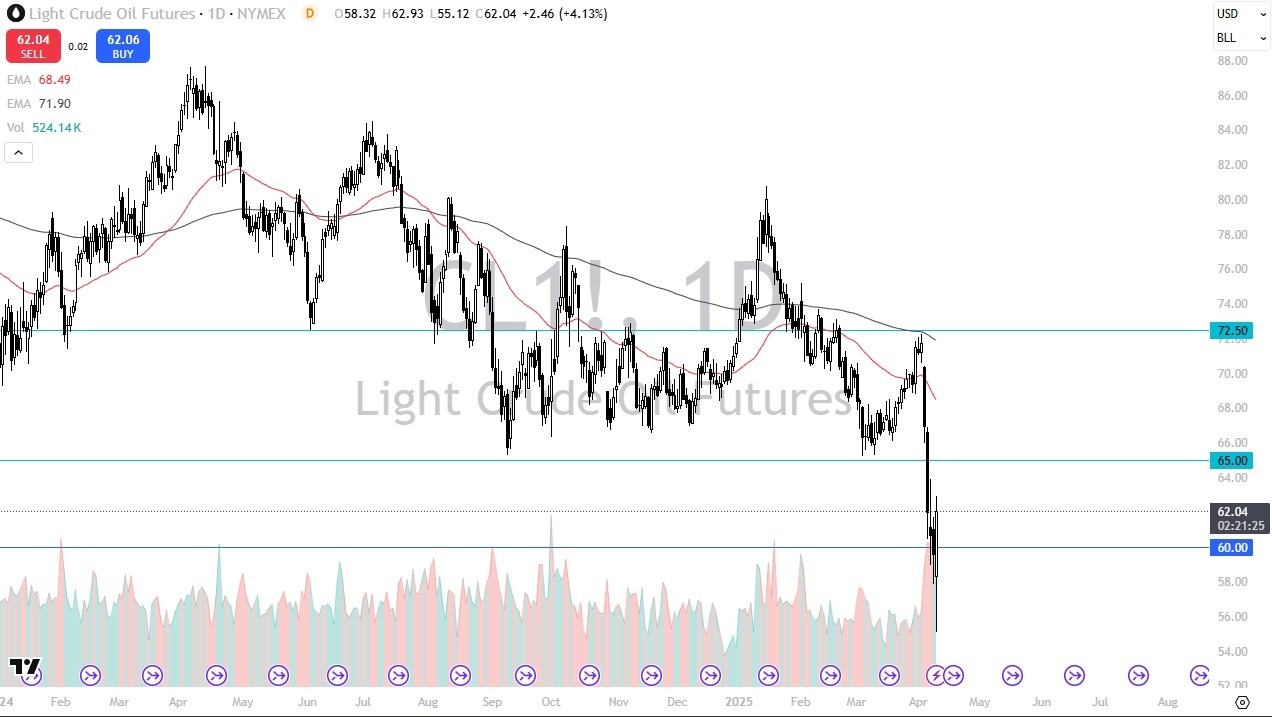
That being said, it’s worth noting that we are above the $60 level, but we are giving back some of the gains. And I think the process here is going to be extraordinarily noisy. The $65 level above is a massive barrier. If we could break that, it would be a huge win for the bulls. But right now, I don’t think we’re anywhere near that. I think we’re probably closer to a situation where we’re trying to form some type of basing pattern that is higher than we hit overnight. But we also have to worry about China and their reaction to the now 125 % tariffs on their goods, because during the day Amazon, and I’m starting to hear a little bit of chatter from Walmart as well, are canceling orders from China. This is a big deal. This means things just got a little uglier. Chinese banks have been ordered not to buy US dollars. Good luck with that. There’s no way to pay international debts without them. So, things are going to get very interesting very quick.
With that being said, there is a certain amount of concern about the overall global demand. If China slips into a recession and the US slips into a recession, everybody feels it. So, I think this is still a market that you would want to at least think about being bearish on, but you might want to get out of the way of trying to short it. A range between $60 and $65 does make a certain amount of sense, but you need stability before you start putting money to work.
Ready to trade daily crude oil price analysis? We’ve shortlisted the best Forex Oil trading brokers in the industry for you.
April 10, 2025 – Written by James Fuller
STORY LINK EUR/GBP Outlook: Pound Dips vs Euro on Drop in UK gilts, Rise in Yields
Pound Sterling is under pressure as gilts drop. EURGBP rose to 0.866 on Wednesday. The S&P500 closed 9.52% higher on Wednesday as Trump paused tariffs at a 10% rate. China was hit with further tariffs as the trade war escalates.
It’s a challenge to keep up with the news flow and manic moves across global markets. Wednesday was perhaps the wildest session of the recent week, and the 9.52% gain in the S&P500 was the third largest ever and has only been bettered by bear market rallies in 2008.
President Trump announced a 90-day tariff reprieve (excluding China) just two days after calling the same story fake news. The bond markets may have forced his hand – when stocks and bonds fall together there is no safe haven. This is what he posted on Truth Social
“I have authorized a 90 day PAUSE, and a substantially lowered Reciprocal Tariff during this period, of 10%, also effective immediately.”
Looking ahead, the US still has a major issue with China, and Trump’s poste increased tariffs yet again.
“Based on the lack of respect that China has shown to the World’s Markets, I am hereby raising the Tariff charged to China by the United States of America to 125%, effective immediately.”
China has vowed to fight to the end and increased its tariffs to 84%. It seems both sides are prepared to effectively stop trading with eachother.
As well as a huge rally in stocks, other market made significant moves, with gold, copper and oil all surging higher. Higher oil and higher yields are problematic for the US and for Trump who has vowed to lower them. The 10Y yield closed at 4.3%, 12% higher than Friday’s low.
The tariff reprieve has lifted spirits and sparked some huge rallies in risk assets, but risks remain high and the volatility in markets is a sign of underlying problems. As ING note:
“The increased volatility will also remain, preventing a full restoration of risk sentiment. Markets will not easily forget these episodes with wide market swings and thus the demand for safe assets should remain elevated. 10Y Bunds, for one, significantly outperformed swaps during the peak stress episode underscoring their safe haven role, even if they are now trading above the swap curve again.”
Currencies have remained stable but with a “risk off” tone as safe havens like the yen and Swiss Franc are outperforming, as is the euro due to its liquidity and stability. A flee from US assets may be underway and the US dollar remains under pressure near the 2025 lows. Notably, this is against a backdrop of higher yields.
Market volatility has been weighing on the pound which is not seen as a safe haven. EURGBP broke above 0.85 on Monday and already reached 0.866 on Wednesday.
Sterling weakness stems from the drop in UK gilts and rise in yields which has been exacerbated by tariffs and global market stress. We know from earlier occurrences this not a positive for the pound and reflects tight finances. As ING explain:
“That UK gilts even underperformed US Treasuries is quite remarkable and probably very unnerving for the UK’s Debt Management Office. One view here is that the DMO is already pushing the limits with £300bn of new issuance this year and that any greater slowdown in the UK economy, which would hit revenues/raise welfare spending, would only hit gilts harder. Clearly, then, the gilt market is an Achilles heel for sterling.”
Three cuts are now expected from the BoE who are coming under more pressure to support the economy, even though inflation concerns persist.
International Money Transfer? Ask our resident FX expert a money transfer question or try John’s new, free, no-obligation personal service! ,where he helps every step of the way,
ensuring you get the best exchange rates on your currency requirements.
TAGS: Euro Pound Forecasts
The bright metal soared on Thursday, hitting a fresh all-time high of $3,175.00 a troy ounce during American trading hours. The US Dollar (USD) plummeted on headlines indicating the trade war unleashed by US President Donald Trump is far from over.
Trump announced massive retaliatory tariffs last week, only to pause most of them on Wednesday. Stock markets collapsed with the original news, recovering with the more optimistic pause. However, the good mood was short-lived. The White House confirmed on Thursday that levies on China account for 145%, the original 20% plus an additional 125%, which followed Beijing’s announcement of retaliatory 84% levies.
Tensions between the two countries revived concerns about a potential United States (US) recession around the corner. Even further, the US March Consumer Price Index (CPI) released earlier in the day showed inflationary pressures eased by more than anticipated, which will help the Federal Reserve (Fed) extend its wait-and-see stance on monetary policy. With easing inflation and fears of an economic setback, it’s not crazy to think the Fed could even hike interest rates in the future.
Wall Street plummeted with the news, falling alongside the USD. At the time of writing, the Dow Jones Industrial Average is down roughly 4%, while the Nasdaq Composite and the S&P 500 shed over 5% each.
From a technical perspective, Valeria Bednarik, FXStreet Chief Analyst, notes: “The XAU/USD pair daily chart shows that additional gains are likely, given the strong upward momentum. Technical indicators head north almost vertically, while still far from overbought levels. At the same time, the bright metal extended its advance beyond a now bullish 20 Simple Moving Average (SMA), currently at $3,052. Finally, the 100 and 200 SMAs also aim north, but far below the shorter one.”
Bednarik foresees XAU/USD reaching the $3,200 region in the upcoming sessions.
Generally speaking, a trade war is an economic conflict between two or more countries due to extreme protectionism on one end. It implies the creation of trade barriers, such as tariffs, which result in counter-barriers, escalating import costs, and hence the cost of living.
An economic conflict between the United States (US) and China began early in 2018, when President Donald Trump set trade barriers on China, claiming unfair commercial practices and intellectual property theft from the Asian giant. China took retaliatory action, imposing tariffs on multiple US goods, such as automobiles and soybeans. Tensions escalated until the two countries signed the US-China Phase One trade deal in January 2020. The agreement required structural reforms and other changes to China’s economic and trade regime and pretended to restore stability and trust between the two nations. However, the Coronavirus pandemic took the focus out of the conflict. Yet, it is worth mentioning that President Joe Biden, who took office after Trump, kept tariffs in place and even added some additional levies.
The return of Donald Trump to the White House as the 47th US President has sparked a fresh wave of tensions between the two countries. During the 2024 election campaign, Trump pledged to impose 60% tariffs on China once he returned to office, which he did on January 20, 2025. With Trump back, the US-China trade war is meant to resume where it was left, with tit-for-tat policies affecting the global economic landscape amid disruptions in global supply chains, resulting in a reduction in spending, particularly investment, and directly feeding into the Consumer Price Index inflation.
Disclaimer: For information purposes only. Past performance is not indicative of future results.
April 10, 2025 – Written by Frank Davies
STORY LINK GBP/USD Prediction: Pound Sterling Outlook Flips “Neutral-Bullish” say Scotiabank
Examining the short-term outlook, the Pound Sterling (GBP) is tipped to extend its recent recovery against the US Dollar (USD), according to the latest technical analysis by FX strategists at Scotiabank.
“GBPUSD’s sharp recovery is notable” says Shaun Osborne, Chief FX Strategist at Scotiabank.
“The RSI’s dip into bearish territory (below 50) has proven to be short-lived, and the focus is now on the 1.29-1.30 congestion range that had prevailed through much of March and the first couple of trading days in April.
“Resistance is expected between 1.31 and 1.32 while support is expected below 1.28.”
The Pound US Dollar exchange rate advanced on Thursday following news that US President Donald Trump would implement a 90-day delay on most tariffs, sparking renewed market optimism.
The Pound (GBP) benefited from improved risk appetite on Thursday. The UK currency—which tends to perform well in risk-on environments—found support amid broad-based market optimism.
Investors reacted positively to Trump’s decision to shelve a sweeping series of new tariffs for 90 days, opting instead to impose a flat 10% levy on all countries aside from China.
The move triggered a rally in global stock markets and, by extension, helped lift the Pound.
Additionally, the decision prompted traders to reassess their interest rate expectations for the Bank of England (BoE). Earlier in the week, a 25-basis-point cut in May was seen as a near certainty, with some even pricing in a larger 50bps move. However, following the tariff news, the probability of a 25bps cut dropped to 78%.
The US Dollar (USD) weakened on Thursday as demand for safe-haven assets declined amid the improving market mood.
Compounding the pressure on USD were lingering doubts about Trump’s economic strategy.
The initial introduction of tariffs had already been criticised for its lack of economic modelling and potential fallout for the US economy.
Now, the abrupt reversal may have dealt another blow to confidence in the White House’s policy direction, further undermining the Dollar.
Looking to Friday, the Pound could climb higher if the UK’s GDP data meets forecasts. Economists expect February to show a modest 0.1% rebound in growth, following a 0.1% decline in January.
Meanwhile, the latest producer price index could affect the US Dollar. While rising PPI figures could support USD by dampening interest rate cut expectations, they could just as quickly stoke recession fears, thereby weighing on the currency.
Furthermore, the latest University of Michigan consumer sentiment index may also influence USD. Analysts anticipate another drop in confidence, which could intensify concerns over the US economic outlook and apply further pressure to the Dollar.
International Money Transfer? Ask our resident FX expert a money transfer question or try John’s new, free, no-obligation personal service! ,where he helps every step of the way,
ensuring you get the best exchange rates on your currency requirements.
TAGS: Pound Dollar Forecasts