The main category of Forex News.
You can use the search box below to find what you need.
[wd_asp id=1]
The main category of Forex News.
You can use the search box below to find what you need.
[wd_asp id=1]
Thursday’s breakdown below the 50-day moving average at $32.52 marked a major technical reversal. Friday’s continuation move sliced through the 50% Fibonacci retracement at $31.81, leading to a test of the 200-day moving average at $30.89. A close below that longer-term level would open the door for a deeper retracement toward $28.40. Resistance on the upside is now clearly defined at $31.81 and $32.53, both of which must be reclaimed to regain bullish footing.
Silver’s weakness is closely tied to forced selling across asset classes. As U.S. equity markets plummet—highlighted by a 2,000+ point drop in Dow futures over two sessions—margin calls are spilling into metals. Gold, which hit record highs Thursday, also saw liquidation pressure driven by margin demands and a bearish reversal pattern. These forced exits are compounding silver’s technical damage, dragging prices lower despite ongoing macro tailwinds like elevated inflation and Fed uncertainty.
Traders are also reacting to the latest tariff escalation, which threatens to further dampen global demand. The U.S. has implemented sweeping reciprocal tariffs affecting over 180 countries, prompting China to respond with a 34% levy on all American goods. These trade tensions are fueling risk-off flows and heightening fears of a global recession, with JPMorgan now assigning a 60% probability of a U.S. downturn. Weakening GDP forecasts and falling Treasury yields (10-year now at 3.882%) confirm the flight to safety and deteriorating sentiment.
While Friday’s payroll report showed robust job creation and stable wage growth, it has done little to counter the bearish mood. Traders remain focused on liquidity stress, softening real yields, and reduced Fed cut expectations. El-Erian’s revised call for potentially just one rate cut this year removes a key pillar of support for precious metals and leaves silver exposed in the near term.
With silver breaking key support levels and macro stress intensifying, the short-term outlook remains bearish. A failure to hold the 200-day moving average at $30.89 could accelerate the downside move toward $28.40.
Unless the metal reclaims resistance above $32.53, sellers are in control. Traders should prepare for continued volatility as recession fears, equity market stress, and policy uncertainty remain front and center.
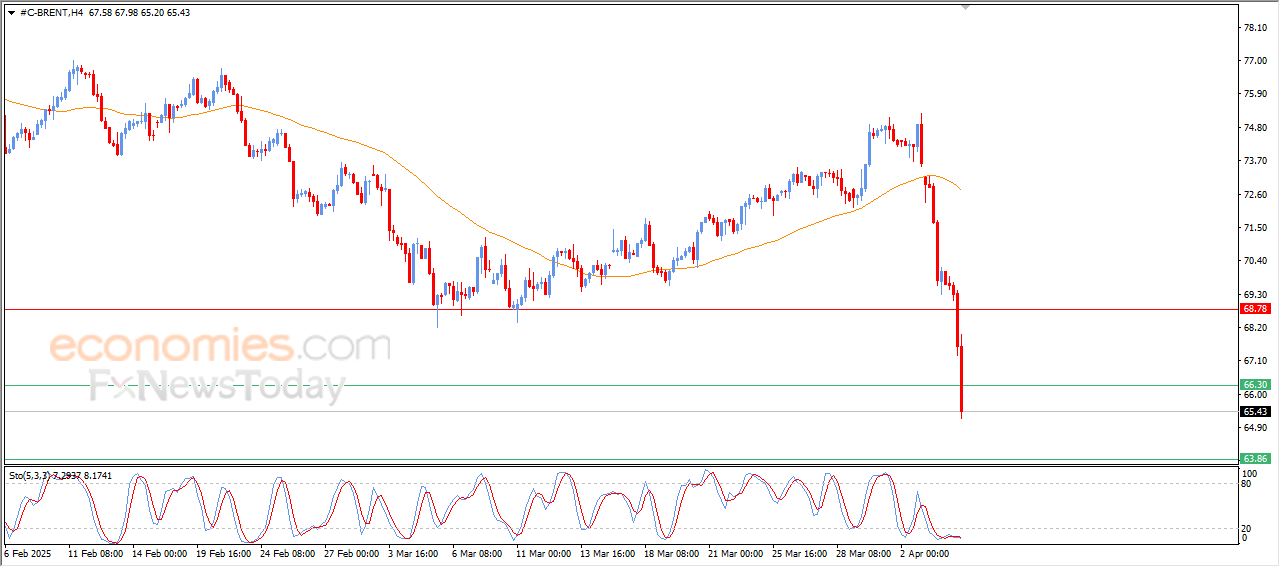
US crude oil price extended its losses in a free fall in the intraday levels, amid the dominance of the main downward trend, with the price breaching the current support of $63.10, as negative signals emerged from the Stochastic despite settling at oversold levels, indicating the strength of the selling momentum.
To get our more detailed analysis and 100% accurate signals provided by Best Trading Signal, subscribe to Economies.com VIP Club through the link below!
Goldman Sachs cut its oil price forecast for 2025 by 5.5% for Brent crude and by 4.3% for West Texas Intermediate citing OPEC+ decision to bring more production back in May and the tariff barrage that President Trump unleashed this week, which the bank expects will cause a global recession.
The bank’s analysts now expect Brent crude to average $69 per barrel this year and WTI to average $66 per barrel. The benchmarks have been trading around these levels earlier today.
Goldman did not stop there, however, expecting the doom and gloom to persist into 2026 as well. The bank also revised its 2026 Brent crude forecast by 9% to $62 per barrel and its 2026 WTI forecast by 6.3% to $59 per barrel.
“The risks to our reduced oil price forecast are to the downside, especially for 2026, given growing risks of recession and to a lesser extent of higher OPEC+ supply,” Goldman analysts wrote in a note, cited by Reuters.
The OPEC+ countries that have been cutting their oil production for more than a year to keep prices above a certain acceptable minimum decided on Thursday to continue easing the reductions by adding 411,000 barrels per day to their combined supply from May. The move came as a surprise to traders and analysts, who had expected a much smaller boost of 135,000 barrels daily.
Instead, the eight OPEC+ countries that have been withholding production – Saudi Arabia, Russia, Iraq, UAE, Kuwait, Kazakhstan, Algeria, and Oman – decided to bundle three monthly increases in output in the May production levels, which put additional pressure on prices.
In light of these latest developments, Goldman Sachs’ analysts have revised their oil demand projections for 2025 to 600,000 bpd from 900,000 bpd. For 2026, they project global oil demand growth of 700,000 barrels daily.
By Irina Slav for Oilprice.com
More Top Reads From Oilprice.com
Copper price gave in to negative pressures and fell below the stable support of $4.8100, and hesitantly approached $4.7400, delaying any attempts at rising even as the price remains within an ascending channel.
As the $5.000 forms as a barrier and negative signals emerge from the Stochastic, the price will likely head towards $4.6500 then $4.5600.
Expected trading range today is between $4.6500 and $4.9500.
Today’s price forecast: Bearish
Analysts warn that such measures could exacerbate global trade tensions, raising the risk of a slowdown in international commerce and potentially tipping the U.S. economy toward recession.
Even with downside pressure, gold continues to benefit from safe-haven flows. “The broader market is cautious, and gold is finding support from risk-off sentiment,” said a commodities strategist at a major European bank. “Tariff escalation has reignited concerns around economic stability.”
Silver (XAG/USD) slipped to $31.40, following broader risk aversion across commodities and equities. While silver’s industrial component makes it more sensitive to growth expectations, its safe-haven demand remains supported.
A firmer U.S. dollar ahead of the closely watched Nonfarm Payrolls (NFP) report also weighed on silver’s price. However, analysts expect downside in silver to remain limited, particularly if the NFP data reflects labor market softness or moderates expectations for U.S. growth.
The Federal Reserve’s expected dovish stance continues to underpin gold’s resilience. Traders are pricing in as many as four rate cuts by the end of 2025.
Meanwhile, the U.S. 10-year Treasury yield dipped below 4% for the first time in six months—a move that weakened the dollar and increased the appeal of non-yielding assets like gold. According to futures data, markets now assign a 64% probability of a rate cut by July.
April 3, 2025 – Written by David Woodsmith
STORY LINK Pound Sterling Slides vs Euro After UK 10% Tariff
The Pound to Euro (GBP/EUR) exchange rate fell back overnight, after markets reacted to the April 2 US Tariffs.
At the time of writing, GBP/EUR traded at 1.1951, a 0.41% decline on the daily opening levels.
GBPEUR had struggled for momentum on Wednesday as investors exercised caution ahead of US President Donald Trump’s impending tariff announcement.
The Euro (EUR) found little support on Wednesday as traders hesitated to take strong positions before Trump’s tariff decision.
The European Union has frequently been the target of Trump’s criticisms over trade imbalances, leading to concerns that the Eurozone economy could face significant disruptions if US tariffs are extended to European goods.
Adding to the uncertainty, European Commission President Ursula von der Leyen has reiterated that the EU is prepared to retaliate against any aggressive US trade measures, potentially imposing tariffs on American products such as motorcycles, whiskey, and denim.
EUR investors fear that escalating tensions between the US and EU could lead to a prolonged trade conflict, further undermining the Eurozone’s economic outlook.
The Pound (GBP) saw little movement on Wednesday as reports suggested that UK officials had yet to secure exemptions from Trump’s latest round of tariffs.
While discussions between Prime Minister Keir Starmer and President Trump have been described as constructive, no immediate resolution is in sight.
Even if a deal is reached in the future, GBP investors fear that the UK’s open economy remains vulnerable to disruptions in global trade.
Looking ahead, in addition to the fallout from Trump’s tariff announcement, the Pound to Euro exchange rate may also be influenced by an upcoming speech from European Central Bank (ECB) Vice President Luis de Guindos on Thursday.
If de Guindos signals that the ECB may need to implement more accommodative policies in response to Trump’s tariffs, the Euro could face additional downside pressure.
Meanwhile, the UK’s latest services PMI could provide some support for the Pound, particularly if the finalised March figures confirm a strong performance in the sector.
International Money Transfer? Ask our resident FX expert a money transfer question or try John’s new, free, no-obligation personal service! ,where he helps every step of the way,
ensuring you get the best exchange rates on your currency requirements.
TAGS: Pound Euro Forecasts
Natural gas price faced the negativity of the Stochastic by repeatedly holding within an upward channel, as the support of $3.750 held on, with the price marking some gains by touching $4.150.
The price is now in need of positive momentum to surpass $4.180 and open the door for more gains towards $4.260 then $4.480.
Expected trading range today is between $3.880 and $4.260.
Today’s price forecast: Bullish
GBP/USD climbed above 1.3200 for the first time since early October on Thursday but erased a portion of its daily gains later in the American session. The pair stays under bearish pressure in the European session on Friday and trades below 1.3000.
The table below shows the percentage change of British Pound (GBP) against listed major currencies this week. British Pound was the strongest against the Australian Dollar.
| USD | EUR | GBP | JPY | CAD | AUD | NZD | CHF | |
|---|---|---|---|---|---|---|---|---|
| USD | -1.52% | -0.35% | -2.30% | -1.23% | 1.32% | 0.51% | -2.84% | |
| EUR | 1.52% | 1.30% | -0.76% | 0.34% | 2.97% | 2.11% | -1.29% | |
| GBP | 0.35% | -1.30% | -2.05% | -0.90% | 1.65% | 0.83% | -2.50% | |
| JPY | 2.30% | 0.76% | 2.05% | 1.09% | 3.75% | 2.92% | -0.63% | |
| CAD | 1.23% | -0.34% | 0.90% | -1.09% | 2.61% | 1.77% | -1.62% | |
| AUD | -1.32% | -2.97% | -1.65% | -3.75% | -2.61% | -0.81% | -4.12% | |
| NZD | -0.51% | -2.11% | -0.83% | -2.92% | -1.77% | 0.81% | -3.33% | |
| CHF | 2.84% | 1.29% | 2.50% | 0.63% | 1.62% | 4.12% | 3.33% |
The heat map shows percentage changes of major currencies against each other. The base currency is picked from the left column, while the quote currency is picked from the top row. For example, if you pick the British Pound from the left column and move along the horizontal line to the US Dollar, the percentage change displayed in the box will represent GBP (base)/USD (quote).
The broad-based selling pressure surrounding the US Dollar (USD) fuelled GBP/USD rally on Thursday. US President Donald Trump’s aggressive tariffs fed into fears of an economic downturn in the US, forcing the USD to weaken against its peers.
As markets remain risk-averse on Friday, GBP/USD finds it difficult to hold its ground. At the time of press, the UK’s FTSE 100 Index was down nearly 1.5% on the day and US stock index futures were losing between 0.3% and 0.9%.
Later in the day, the US economic calendar will feature the March employment report, which will feature Nonfarm Payrolls (NFP), Unemployment Rate and wage inflation figures.
Markets forecast an increase of 135,000 in NFP in March. A significant negative surprise, with an NFP reading at or below 100,000, could weigh on the USD and help GBP/USD find support. Conversely, an NFP print of 160,000 or higher could have the opposite impact on the pair’s action with the immediate reaction.
Ahead of the weekend, Federal Reserve (Fed) Chairman Jerome Powell will speak on the US economic outlook at the annual conference for the Society for Advancing Business Editing and Writing. Powell will also attend a moderated panel discussion afterward.
In case Powell voices his concerns over the growth outlook, citing the new tariff regime, the USD could come under renewed selling pressure. On the other hand, the USD could end the week on a bullish note if Powell puts more emphasis on the upside risks to inflation outlook and reiterates their willingness to remain patient with regard to further policy easing.
According to the CME FedWatch Tool, investors are currently pricing in about a 32% probability of a 25 basis points Fed rate cut in May. The market positioning suggests that the USD has room on the upside if Powell’s remarks revive expectations for a policy hold at the next meeting.
The Relative Strength Index (RSI) indicator on the 4-hour chart dropped below 50, reflecting a bearish tilt in the short-term outlook.
On the downside, 1.2960 (100-period Simple Moving Average (SMA), 50-period SMA) aligns as first support before 1.2935 (lower limit of the ascending channel) and 1.2900 (static level, round level).
In case GBP/USD reclaims 1.3000 (round level, static level), technical buyers could take action. In this scenario, 1.3080 (mid-point of the ascending channel) and 1.3100 (round level, static level) could be seen as next resistance levels.
Tariffs are customs duties levied on certain merchandise imports or a category of products. Tariffs are designed to help local producers and manufacturers be more competitive in the market by providing a price advantage over similar goods that can be imported. Tariffs are widely used as tools of protectionism, along with trade barriers and import quotas.
Although tariffs and taxes both generate government revenue to fund public goods and services, they have several distinctions. Tariffs are prepaid at the port of entry, while taxes are paid at the time of purchase. Taxes are imposed on individual taxpayers and businesses, while tariffs are paid by importers.
There are two schools of thought among economists regarding the usage of tariffs. While some argue that tariffs are necessary to protect domestic industries and address trade imbalances, others see them as a harmful tool that could potentially drive prices higher over the long term and lead to a damaging trade war by encouraging tit-for-tat tariffs.
During the run-up to the presidential election in November 2024, Donald Trump made it clear that he intends to use tariffs to support the US economy and American producers. In 2024, Mexico, China and Canada accounted for 42% of total US imports. In this period, Mexico stood out as the top exporter with $466.6 billion, according to the US Census Bureau. Hence, Trump wants to focus on these three nations when imposing tariffs. He also plans to use the revenue generated through tariffs to lower personal income taxes.
Copper price gave in to negative pressures and fell below the stable support of $4.8100, and hesitantly approached $4.7400, delaying any attempts at rising even as the price remains within an ascending channel.
As the $5.000 forms as a barrier and negative signals emerge from the Stochastic, the price will likely head towards $4.6500 then $4.5600.
Expected trading range today is between $4.6500 and $4.9500.
Today’s price forecast: Bearish
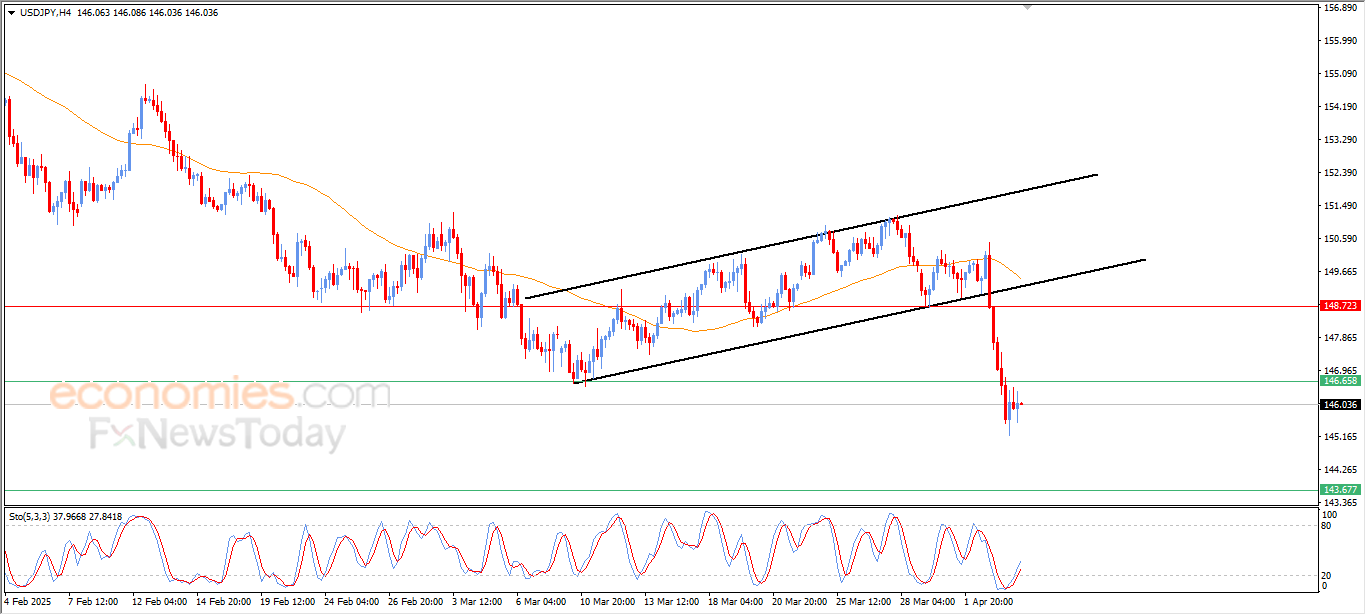
USD/JPY edged higher in latest intraday trading while trying to recoup some recent losses, as the price also tried to vent off oversold saturation in the Stochastic with positive signals emerging from it.
It comes as the price settles below the pivotal support of 146.65 that was breached yesterday, while hurt by exiting an ascending correctional price channel previously, with the dominance of the main downward trend.
To get our more detailed analysis and 100% accurate signals provided by Best Trading Signal, subscribe to Economies.com VIP Club through the link below!