The main category of Forex News.
You can use the search box below to find what you need.
[wd_asp id=1]
The main category of Forex News.
You can use the search box below to find what you need.
[wd_asp id=1]
Bitcoin price settled lower in the intraday levels, amid ongoing negative pressure due to trading below the 50-candle SMA, coupled with negative signals from the Stochastic, and amid the dominance of the main downward trend as the price trades alongside the trend line.
To get our more detailed analysis and 100% accurate signals provided by Best Trading Signal, subscribe to Economies.com VIP Club through the link below!
April 3, 2025 – Written by David Woodsmith
STORY LINK Euro to Dollar Forecast: EUR/USD Jumps Above 1.10 on US Recession Fears
The Euro (EUR) rallied sharply against the US Dollar on Thursday after President Trump’s imposition of tariffs increased fears over the US and global economy and sparked increased recession talk.
Danske Bank commented; “The new tariffs were generally stronger and broader than we and markets expected, and sent shockwaves through global markets amid worries that the aggressive duties will slow growth, hit corporate earnings, and increase inflation.”
There are fears that the Euro-Zone will be hit hard, but the Euro gained defensive support with the Euro to Dollar (EUR/USD) exchange rate hit 6-month highs just above the key 1.1000 level.
An exodus from US capital markets could support the Euro and undermine the dollar.
ING commented; “While a global trade war in theory is a euro-negative, the soft underbelly of the US economy is the dominant factor for EUR/USD right now. A much sharper sell-off in US equities, dragging US rates even lower, adds another nail in the coffin of US exceptionalism and could send EUR/USD over 1.10.”
It added; “Major medium-term resistance sits in the 1.11/12 area. It’s hard to call a major break of that unless US activity craters.”
According to Danske Bank; “we expect consolidation around current levels in the near term, with risks tilted to the upside.”
As part of its wider tariff plan, the US Administration has imposed a 20% tariff on goods imports from the EU.
At this stage, the EU has not announced any formal retaliation, but the rhetoric is tough.
According to European Commission chief Ursula von der Leyen said the new tax imports will see uncertainty spiral causing dire consequences for millions of people around the globe”.
She vowed that Europe would take a unified approach and warned that it is preparing countermeasures in case negotiations fail.
She added; “If you take on one of us, you take on all of us.”
There are potential interest rate implications with markets now pricing in over a 90% chance that the ECB will cut rates this month.
The chances of a May Fed rate cut have also increased to around 20% with around a 75% chance of a move by mid-year.
International Money Transfer? Ask our resident FX expert a money transfer question or try John’s new, free, no-obligation personal service! ,where he helps every step of the way,
ensuring you get the best exchange rates on your currency requirements.
TAGS: Euro Dollar Forecasts
Spot Gold battles to retain the $3,100 threshold in the American session, easing from a fresh all-time high of $3,167.68. The XAU/USD pair soared during Asian trading hours, as market players panicked following United States (US) President Donald Trump, “Liberation Day” announcement.
In a press conference in the Rose Garden on Wednesday, Trump detailed widespread tariffs on roughly 180 different countries, with a baseline of 10%. Levies on China reached 54% after an additional 34% was added to the previously announced 20%. The EU got 20%, while some Asian countries like Vietnam or Cambodia will pay taxes of over 40% to sell their goods into the US.
Financial markets panicked amid speculation that inflation would soar while economic progress would stall. Concerns about a US recession rose, alongside speculation that the Federal Reserve (Fed) will have to adjust its monetary policy accordingly. The US Dollar plummeted, and so did stock markets around the world.
Meanwhile, the US will release the March Nonfarm Payrolls report on Friday. The country is expected to have added 135K, following the 151K gained in February. The Unemployment Rate is foreseen steady at 4.1% while wage inflation is seen pretty much unchanged, up by 0.3% on a monthly basis and 3.9% from a year earlier.
As per XAU/USD, the pair retreated sharply after reaching the aforementioned high amid profit taking, with buyers finally returning at around $3,050. From a technical point of view, Gold has a limited bearish scope, according to technical readings in the daily chart. The intraday slide stalled far above a bullish 20 Simple Moving Average (SMA), currently at around $3,022. The 100 and 200 SMAs, in the meantime, maintain their sharp upward slopes far below the shorter one. Finally, technical indicators ease from extreme readings, yet remain far above their midlines, not enough to confirm a top in place.
The XAU/USD pair 4-hour chart shows XAU/USD trading below a now flat 20 SMA, but still well above a bullish 100 SMA, providing support at around $3,040. Technical indicators, in the meantime, have recovered from near oversold readings to stabilize within negative levels. A steep decline could take place on a break below the mentioned $3,040 region.
Support levels: 3,086.70 3,073.90 3,061.10
Resistance levels: 3,123.10 3,136.70 3,150.00
Tariffs are customs duties levied on certain merchandise imports or a category of products. Tariffs are designed to help local producers and manufacturers be more competitive in the market by providing a price advantage over similar goods that can be imported. Tariffs are widely used as tools of protectionism, along with trade barriers and import quotas.
Although tariffs and taxes both generate government revenue to fund public goods and services, they have several distinctions. Tariffs are prepaid at the port of entry, while taxes are paid at the time of purchase. Taxes are imposed on individual taxpayers and businesses, while tariffs are paid by importers.
There are two schools of thought among economists regarding the usage of tariffs. While some argue that tariffs are necessary to protect domestic industries and address trade imbalances, others see them as a harmful tool that could potentially drive prices higher over the long term and lead to a damaging trade war by encouraging tit-for-tat tariffs.
During the run-up to the presidential election in November 2024, Donald Trump made it clear that he intends to use tariffs to support the US economy and American producers. In 2024, Mexico, China and Canada accounted for 42% of total US imports. In this period, Mexico stood out as the top exporter with $466.6 billion, according to the US Census Bureau. Hence, Trump wants to focus on these three nations when imposing tariffs. He also plans to use the revenue generated through tariffs to lower personal income taxes.
April 3, 2025 – Written by Frank Davies
STORY LINK British Pound Climbs to Six-Month Best Against US Dollar as Trump Unveils Tariffs
At the time of writing, Pound US Dollar (GBP/USD) exchange rate was trading at $1.3148 – its highest level since October 2024 and up 1.3% from Wednesday.
The US Dollar (USD) suffered a sharp decline on Wednesday evening and into Thursday’s session after US President Donald Trump introduced sweeping new tariffs.
On what he declared ‘liberation day’, Trump announced a blanket 10% tariff on all imported goods, alongside increased reciprocal tariffs on countries that impose taxes on US exports.
The move intensified concerns that the US economy could slide into recession this year. Analysts at Barclays warned of a ‘high risk’ of recession, with rising inflation and higher unemployment adding to the economic uncertainty.
In response, USD tumbled, with the US Dollar index – which tracks the currency’s performance against a basket of rivals – plunging nearly 1.4% to its lowest level since October 2024.
Meanwhile, the Pound (GBP) capitalised on the US Dollar’s weakness, propelling GBP/USD to its highest level in six months.
While the UK will be affected by the new tariffs, the economic impact is expected to be significantly less severe than in the US. British exports to the US will face a 10% tariff, but this is a milder blow compared to the broader trade restrictions imposed on other nations.
Looking ahead, Trump’s aggressive tariff policy is likely to fuel further volatility in currency markets as traders assess the potential fallout and watch for retaliatory measures from other economies.
If global trade tensions escalate and recession fears deepen, the US Dollar could remain under pressure.
In addition, upcoming US economic data may influence GBP/USD. Friday’s non-farm payrolls report is expected to show a slowdown in job growth, which could further weigh on the ‘Greenback’ if it reinforces concerns about the health of the US economy.
Federal Reserve Chair Jerome Powell is also set to speak on Friday. Should he express worries about the economic impact of the trade war, GBP/USD could climb even higher, potentially testing new multi-month highs.
International Money Transfer? Ask our resident FX expert a money transfer question or try John’s new, free, no-obligation personal service! ,where he helps every step of the way,
ensuring you get the best exchange rates on your currency requirements.
TAGS: Pound Dollar Forecasts
Current price action shows natural gas testing major support at $3.924. If this level holds, the market could target minor resistance at $4.094, followed by $4.253. The critical trigger point for a decisive upside breakout sits at $4.317. Conversely, a breakdown below current support could accelerate selling pressure toward $3.732, with further downside risk to the major pivot at $3.350.
The Commodity Weather Group reports a notable shift to cooler temperatures for the eastern United States from April 7-11, potentially boosting heating demand. This weather pattern emerges as US electricity output shows positive growth trends, with the Edison Electric Institute reporting that total lower-48 electricity output rose 0.9% year-over-year to 72,289 GWh for the week ended March 22, while the 52-week period showed a stronger 3.55% increase.
Lower-48 state dry gas production stood at 105 bcf/day (+2.9% y/y) on Wednesday, while domestic demand registered at 74.2 bcf/day (-5.2% y/y). LNG net flows to export terminals were 14.2 bcf/day, down 9.6% week-over-week. The Baker Hughes rig count showed active natural gas drilling rigs increased by 1 to 103 for the week ending March 28, which remains significantly below the 5-1/4 year high of 166 rigs recorded in September 2022.
Thursday’s EIA storage report is projected to show a build of approximately 25-29 Bcf, considerably bearish compared to the five-year average draw of -13 Bcf. Despite this upcoming injection, the broader storage picture remains supportive for prices. Current inventories stand at 1,744 Bcf, which is 557 Bcf below last year and 122 Bcf below the five-year average. BloombergNEF projects US gas storage will run 10% below the five-year average this summer, suggesting sustained price support.
The longer-term outlook appears increasingly bullish as President Trump’s decision to lift restrictions on LNG export projects advances consideration for approximately a dozen new facilities, which would significantly boost demand for US natural gas and provide structural price support.
More Information in our Economic Calendar.
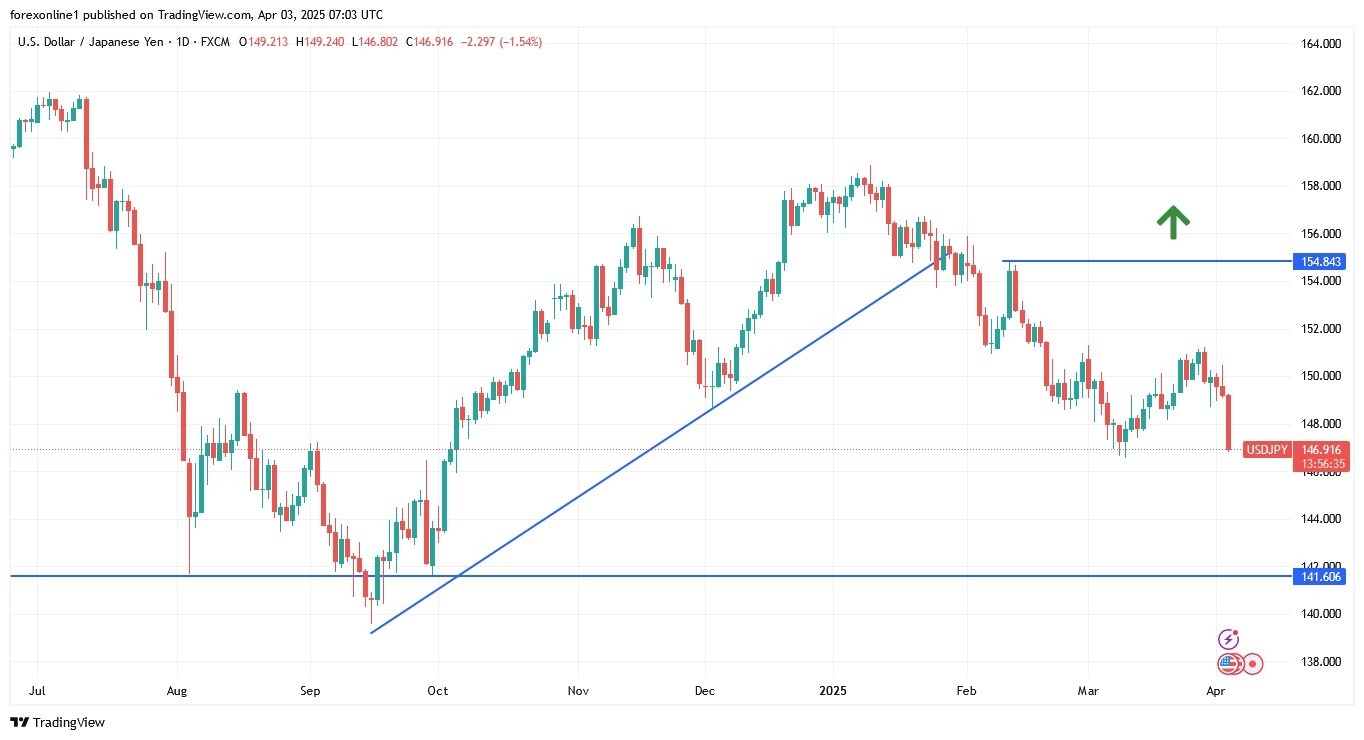
Trump imposed additional tariffs of 34% on China, bringing the total tariffs to 54%. Other major economies facing hefty tariffs include the European Union (20%), Japan (24%), India (26%), in addition to a base tariff of 10% on imports from all countries. Earlier this week, Bank of Japan Governor Kazuo Ueda warned that the new US tariffs could significantly impact global trade and economic growth. While the Bank of Japan is expected to raise interest rates again later this year, uncertainty about global trade and domestic economic conditions continues to overshadow the outlook.

We still recommend buying the US dollar against the Japanese yen, but without risk, spreading your trading amount across multiple levels, and monitoring the factors affecting the currency pair’s performance.
During today’s trading session and across stock trading platforms, the Nikkei 225 index fell 2.77% to close at 34,736 points, while the Topix index fell 3.08% to 2,569 points. Japanese stocks fell to their lowest levels in several months after US President Donald Trump announced comprehensive reciprocal tariffs, raising fears of a global trade war that could destabilize major economies.
Trump imposed 24% tariffs on Japanese goods, along with a 25% tariff on auto imports, dealing a severe blow to the Japanese auto industry. In response, Japanese Trade Minister Yuji Muto stated that his country would continue to request an exemption, announcing the formation of a task force to assess the impact of the US tariffs.
According to trading, all sectors declined, with heavy losses among the index’s leading companies, such as Mitsubishi UFJ (-7.2%), Toyota (-5.2%), Kawasaki Heavy Industries (-7.1%), Nintendo (-3.3%), and Advantest (-4.5%). In corporate news, Nissan shares fell 3.7% after reports confirmed it had suspended part of its production line in Mexico as previously planned.
This week, Bank of Japan Governor Kazuo Ueda warned that the new US tariffs could have a significant impact on global trade and economic growth. In his speech to the Japanese parliament, Ueda stressed the uncertainty surrounding the potential effects of reciprocal tariffs on trade flows, business sentiment, and inflation. The new tariffs, which take effect on April 3, include 25% tariffs on car imports. These tariffs are in addition to existing US tariffs on aluminium and steel, and higher tariffs on all Chinese imports.
Ueda intends to raise these concerns at the upcoming G20 meeting, where US trade policies and their implications will be a major point of discussion. Analysts indicate that the economic fallout could influence the Bank of Japan’s interest rate decision, with a rate hike expected in the third quarter of 2025, possibly in July.
According to the daily chart performance, the bears’ control over the USD/JPY pair is strengthening, and recent losses may push some technical indicators towards strong oversold levels, led by the Relative Strength Index (RSI) and the MACD indicator. Therefore, we recommend considering buying from the support levels of 146.70, 145.80, and 145.00, respectively. Conversely, on the same timeframe, the 152.00 resistance will remain the most important for the bulls to take control of the USD/JPY trend. Technically, the pair will continue to lean downwards until the reaction to the US jobs data announcement tomorrow, which will have an impact on market expectations for the future of the US Federal Reserve’s policies.
Want to trade our USD/JPY forex analysis and predictions? Here’s a list of forex brokers in Japan to check out.
Platinum price declined below the 50% Fibonacci retracement level at $983, and tackled $955.60, and retested this barrier anew, while settling above the 55 SMA.
As major indicators conflict, the price will likely engage in sideways trading for some time, but a drop below the 55 SMA would activate the negative path and send the price towards $950.00, representing the 50% Fibonacci retracement level.
Expected trading range today is between $950.00 and $985.
Today’s price forecast: Bearish
Meanwhile, recent economic data showed that the eurozone inflation rate fell to 2.2% in March, its lowest level since November 2024. Core inflation fell more than expected to 2.4%, its lowest level since January 2022. With easing inflationary pressures and escalating global trade tensions, market expectations have strengthened that the European Central Bank could cut interest rates by 65 basis points this year.
According to economic calendar data, Eurostat reported a slight decrease in the Eurozone’s annual inflation rate to 2.2% in March, from 2.3% in February, meeting expectations and approaching the ECB’s target of 2%. Economists say, “Eurozone inflation is easing as expected and is likely to fall below the ECB’s 2% target in the coming months.”
Encouragingly for the central bank, the eurozone’s core inflation gauge fell to 2.4% in March, from 2.6% in February, below the consensus forecast of 2.5%. Services inflation also fell to 3.4% from 3.7%, according to the announcement.
The European Central Bank is scheduled to announce its next interest rate decision on April 17, and market expectations now indicate a 72% chance of a rate cut. By then, the extent of the upcoming US tariffs will become clearer, as will any adjustments the White House may make. By the April meeting, the ECB will also learn the nature and scope of the eurozone’s countervailing tariffs, which will impact European import prices.
We still recommend selling the euro against the US dollar from every rising level, but without risk and monitoring the factors affecting prices.
According to yesterday’s trading session and across stock trading platforms, European markets closed lower as investors braced for new US trade tariffs. According to trading, the Stoxx 50 index fell 0.4%, and the Stoxx 600 index lost 0.6%, reversing Tuesday’s rebound.
According to performance, most sectors declined, with healthcare stocks being the hardest hit – falling about 2% – amid fading hopes for tariff exemptions. Bayer shares fell about 4%, leading the declines. Overall, concerns increased after Trump reiterated that his “reciprocal tariffs” would apply to “all countries.” Reports indicate that 20% tariffs will be imposed on most imports, but final details remain uncertain.
Meanwhile, the White House confirmed that the measures will take effect immediately upon their announcement. Further escalating trade tensions, the United States is set to impose a 25% tariff on foreign-made cars. Meanwhile, UniCredit has received approval for its bid to acquire Banco BPM, and Credit Agricole has received approval from the European Central Bank to increase its stake in the Italian bank.
According to the daily chart performance, the EUR/USD pair has an opportunity for a bullish shift, and as I mentioned before, the psychological resistance of 1.1000 will remain the most prominent for this shift, which may technically push the pair towards stronger peaks. I see these peaks as potential selling opportunities for the EUR/USD, but without risk, regardless of the strength of trading opportunities. Markets are now reacting to Trump’s tariffs, and attention will then turn to US jobs data tomorrow.
Conversely, over the same timeframe, the 1.0800 support level will remain a real threat to any upward shift in the EUR/USD pair.
Ready to trade our daily Forex analysis? We’ve made this forex brokers list for you to check out.
The Silver price (XAG/USD) falls to near $33.15 during the early European session on Thursday, pressured by some profit-taking. Nonetheless, the downside for the white metal might be limited as US President Donald Trump announced sweeping new global tariffs on Wednesday, raising the fears of a widening trade war.
According to the daily chart, the bullish trend of Silver remains in place as the commodity is well-supported above the key 100-day Exponential Moving Average (EMA). However, the 14-day Relative Strength Index (RSI) hovers around the midline, displaying neutral momentum in the near term. This suggests that further consolidation cannot be ruled out.
The immediate resistance level for white metal emerges at $34.23, the high of March 18. Further north, the next hurdle to watch is the $34.60-$34.70 zone, representing the high of March 28 and the upper boundary of the Bollinger Band. A decisive break above the mentioned level could pave the way to the $35.00 psychological level.
On the flip side, the first downside target for the silver price is seen at $32.66, the low of March 21. Sustained trading below the mentioned level could see a drop to the next contention level at $31.89, the 100-day EMA. Any follow-through selling could expose $30.82, the low of February 28.
Silver is a precious metal highly traded among investors. It has been historically used as a store of value and a medium of exchange. Although less popular than Gold, traders may turn to Silver to diversify their investment portfolio, for its intrinsic value or as a potential hedge during high-inflation periods. Investors can buy physical Silver, in coins or in bars, or trade it through vehicles such as Exchange Traded Funds, which track its price on international markets.
Silver prices can move due to a wide range of factors. Geopolitical instability or fears of a deep recession can make Silver price escalate due to its safe-haven status, although to a lesser extent than Gold’s. As a yieldless asset, Silver tends to rise with lower interest rates. Its moves also depend on how the US Dollar (USD) behaves as the asset is priced in dollars (XAG/USD). A strong Dollar tends to keep the price of Silver at bay, whereas a weaker Dollar is likely to propel prices up. Other factors such as investment demand, mining supply – Silver is much more abundant than Gold – and recycling rates can also affect prices.
Silver is widely used in industry, particularly in sectors such as electronics or solar energy, as it has one of the highest electric conductivity of all metals – more than Copper and Gold. A surge in demand can increase prices, while a decline tends to lower them. Dynamics in the US, Chinese and Indian economies can also contribute to price swings: for the US and particularly China, their big industrial sectors use Silver in various processes; in India, consumers’ demand for the precious metal for jewellery also plays a key role in setting prices.
Silver prices tend to follow Gold’s moves. When Gold prices rise, Silver typically follows suit, as their status as safe-haven assets is similar. The Gold/Silver ratio, which shows the number of ounces of Silver needed to equal the value of one ounce of Gold, may help to determine the relative valuation between both metals. Some investors may consider a high ratio as an indicator that Silver is undervalued, or Gold is overvalued. On the contrary, a low ratio might suggest that Gold is undervalued relative to Silver.
This announcement triggered a flight to safe havens and a shift towards low-risk assets, as investors grew increasingly concerned about the potential impact on the global economy. For her part, British Foreign Secretary Reynolds stated that the US is Britain’s “closest ally” and that the government’s approach is to “remain calm and committed to securing this deal, which we hope will mitigate the effects of what was announced today.”
UK inflation was a factor in the pound’s decline ahead of the US tariffs. According to forex trading, the pound fell below $1.29, its lowest level in nearly two weeks, as traders reacted to the weaker-than-expected February inflation reading and the Spring Statement. Chancellor Reeves said that UK inflation is expected to average 3.2% in 2025, up from the 2.6% forecast in October. At the same time, growth forecasts for 2025 were lowered to 1% from 2%, and public sector net borrowing is expected to fall from £137.3 billion (4.8% of GDP) this year to £74.0 billion (2.1% of GDP) by 2029-30. However, compared to the October estimate, borrowing for 2025-26 is expected to be £12.1 billion higher (0.4% of GDP).
The UK government has already announced several policy changes to restore the government’s budget, including social welfare reforms, cuts in administrative spending, and a small set of tax changes. The UK’s annual inflation rate fell to 2.8% in February, slightly lower than the expected 2.9% but in line with the Bank of England’s forecast.
The pound will remain supported for some time, but beware of profit-taking.
The British pound is experiencing sharp fluctuations following US President Donald Trump’s announcement of a 10% tariff on British imports. The 10% tariff imposed on Britain is much more lenient than those imposed on other countries, pushing the pound higher.
20% on the European Union
34% on China
46% on Vietnam
24% on Japan
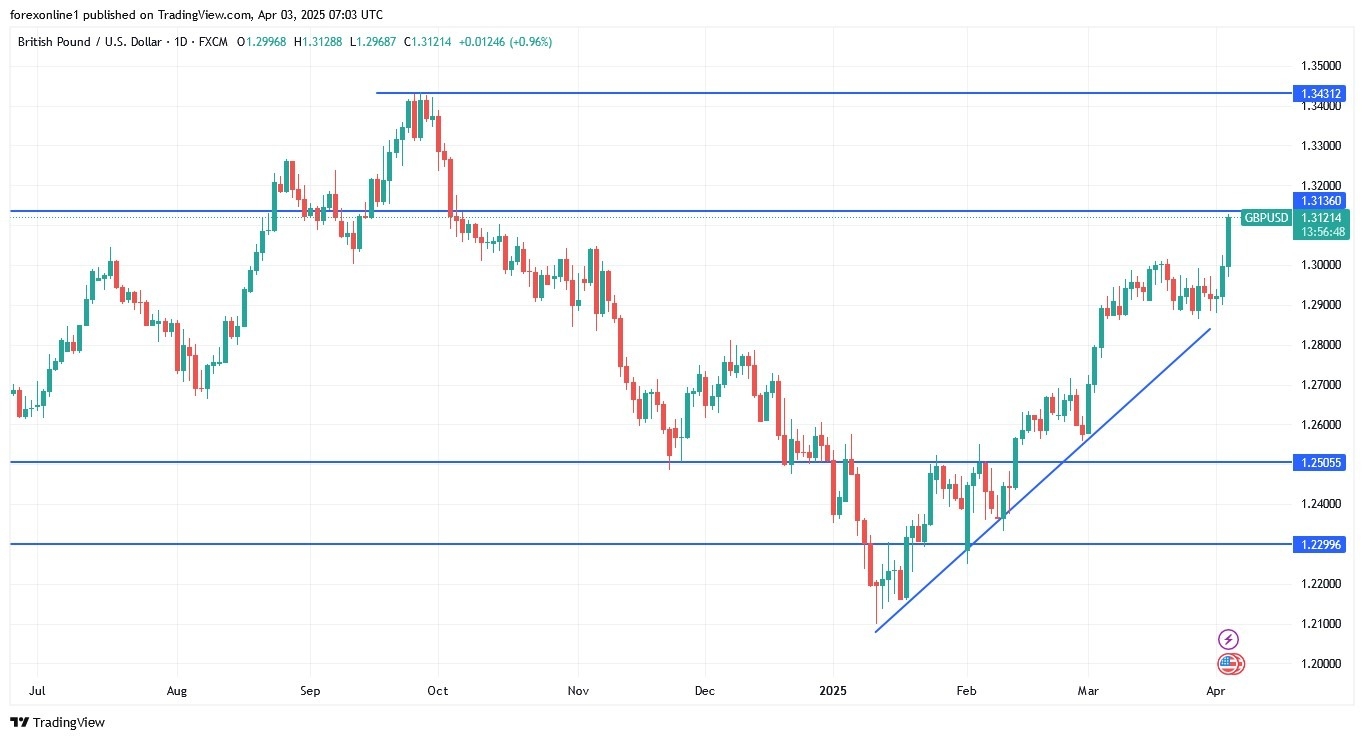
According to licensed trading company platforms, the British pound is rising against most major currencies, confirming its role as a safe haven in tariff trading. The GBP/USD exchange rate is higher at 1.3120, confirming that the dollar is a complete loser. This is understandable; ultimately, US consumers and businesses bear the costs of high imports. Also, the GBP/EUR exchange rate rose to 1.1989, a rise indicating that the EU’s 20% tariffs were lower than expected. In other markets, China-related currencies, such as the Australian dollar and the New Zealand dollar, are experiencing selloffs.
Trump asked a crowd gathered in the White House Rose Garden: “They’re charging us tariffs, and we’re charging them tariffs. How can anyone be upset?” Among other things, he specifically mentioned China and the European Union. “They’re deceiving us. It’s very sad to see this. It’s pathetic.”
He said, “India is very difficult. Very difficult.”
Regarding exchange rate reactions, we reported that the British pound entered the tariff announcements as a hedge due to its relatively low exposure. This is due to Britain’s declining manufacturing base, which keeps it balanced in goods trade with the United States.
Based on the performance on the daily chart, the GBP/USD pair is witnessing a strong upward movement towards levels that confirm this shift. Technically, from the resistance levels of 1.3120 and 1.3230, technical indicators will move towards strong overbought levels. Conversely, the currency pair will not abandon its upward recovery path without moving towards the support level of 1.2880 again. Finally, the GBP/USD may remain on its upward path until the reaction to the US jobs numbers tomorrow.
Ready to trade our daily Forex GBP/USD analysis? We’ve made this UK forex brokers list for you to check out.