The main category of Forex News.
You can use the search box below to find what you need.
[wd_asp id=1]
The main category of Forex News.
You can use the search box below to find what you need.
[wd_asp id=1]
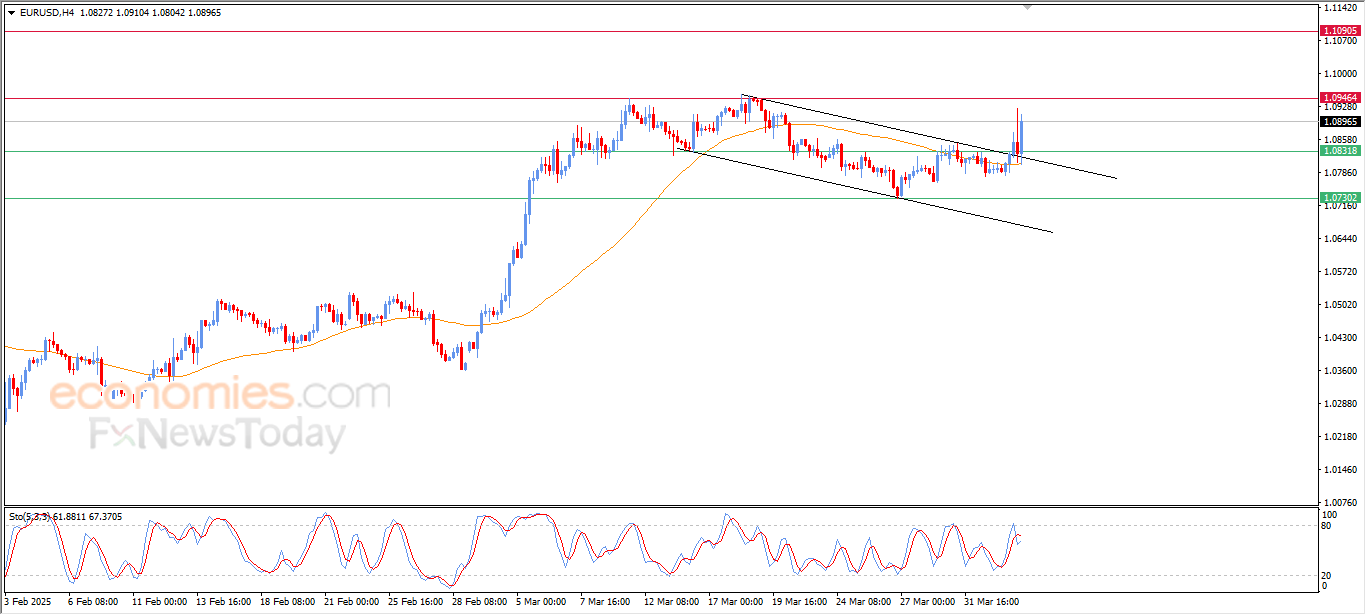
EUR/USD surged in latest intraday trading and managed to pierce the pivotal resistance of $1.0945, amid the dominance of the main upward trend, after the price exited a downward correctional price channel previously, embarking on a new upward wave.
To get our more detailed analysis and 100% accurate signals provided by Best Trading Signal, subscribe to Economies.com VIP Club through the link below!
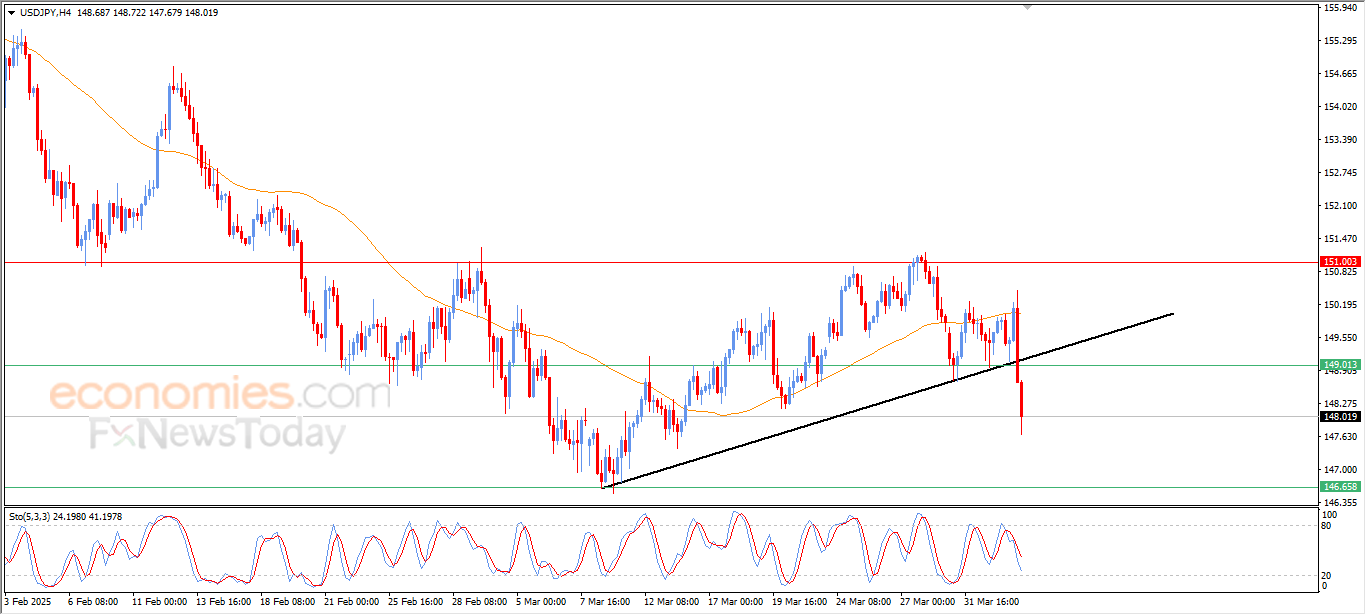
The USD/JPY outlook is predominantly bearish as the yen capitalizes on safe-haven appeal due to President Trump’s sweeping trade tariffs. The pair plummeted 1.2%, marking fresh 3-week lows near 147.20 during the early Asian session. With mounting fears of a US recession, investors are fleeing to the JPY, reinforcing its strength against the US dollar.
-Are you looking for the best AI Trading Brokers? Check our detailed guide-
Riskier assets saw a broader sell-off after the latest round of Trump’s tariffs. The stocks slipped, and bond yields dipped, creating a demand for conventional safe-haven assets. The US 10Y hit a YTD low at 4.0%, reinforcing the potential for a Fed rate cut.
The ongoing divergence between the Federal Reserve and the Bank of Japan further fueled the JPY rally. While the Fed is widely expected to cut rates, BoJ remains uncertain. Previously, market participants were expecting an aggressive stance from BoJ. However, Japan’s export-driven economy may suffer as a result of recent tariffs. Still, the recent Tokyo consumer inflation figures suggest that the BoJ may retain its hawkish stance.
Despite Trump’s tariffs favoring the US dollar in the long run, the likelihood of a rate cut and the risk of a recession has undermined the Greenback. According to Wells Fargo analysts, monetary easing is expected to be more pronounced in 2025-26, which could keep the dollar defensive.
Looking ahead, traders will primarily focus on the following:
Still, the broader focus remains on trade development and China’s potential reaction.
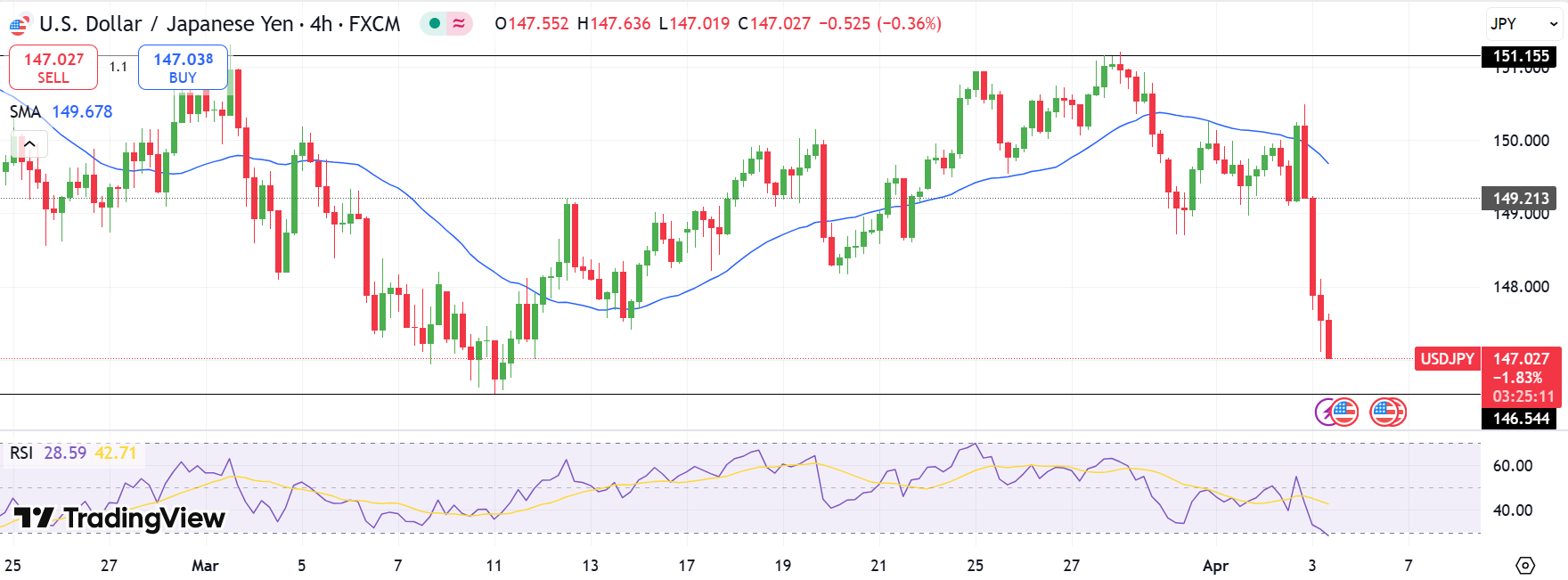
The USD/JPY 4-hour chart shows a gloomy picture. The price is slipping towards the key support level at 146.55. The pair lies well below the 30-period SMA, posing a risk of a deeper downside. However, the RSI value reaches 30.0, which indicates an oversold zone. Hence, corrective upside can be expected.
-Are you looking for the best MT5 Brokers? Check our detailed guide-
On the upside, the 30-period SMA is one tough nut to crack for the buyers. Meanwhile, a strong resistance level emerges at 151.15. The path of least resistance lies on the downside.
Looking to trade forex now? Invest at eToro!
75% of retail investor accounts lose money when trading CFDs with this provider. You should consider whether you can afford to take the high risk of losing your money.
Silver (XAG/USD) is trading at $33.28, having touched a session low of $33.07. Despite gold’s upward momentum, silver’s response has been more restrained, weighed down by its industrial use case.
With growth forecasts under pressure, traders remain cautious on silver exposure. The metal continues to trade below the key pivot of $33.49, limiting upside prospects in the near term.
Markets are now pricing in a 70% chance of a Federal Reserve rate cut in June, according to CME FedWatch. The 10-year Treasury yield dropped to 4.15%, driven by fears that tariff-driven weakness could prompt the Fed to act.
A weaker U.S. dollar—pressured by falling yields—has further supported gold, making it more attractive to non-dollar holders.
The ADP employment report surprised to the upside with 155,000 jobs added, exceeding the 105,000 forecast. However, markets shrugged it off, focusing instead on upcoming data. Weekly jobless claims, ISM Services PMI, and especially Friday’s Nonfarm Payrolls report are now in focus as traders weigh how deeply tariffs could impact the broader economy.
Gold remains bullish above $3,116 amid rising Fed cut bets and trade risks. Silver faces pressure below $33.49, with momentum tilted bearish unless key resistance levels are reclaimed.
EUR/USD gathers bullish momentum in the European session on Thursday and trades at its highest level since early October above 1.1000. Although the pair’s near-term technical outlook points to overbought conditions, buyers could retain control amid the broad-based US Dollar (USD) weakness.
The table below shows the percentage change of Euro (EUR) against listed major currencies today. Euro was the strongest against the US Dollar.
| USD | EUR | GBP | JPY | CAD | AUD | NZD | CHF | |
|---|---|---|---|---|---|---|---|---|
| USD | -1.39% | -0.89% | -1.64% | -0.70% | -0.56% | -0.80% | -1.72% | |
| EUR | 1.39% | 0.26% | -0.27% | 0.73% | 0.87% | 0.61% | -0.31% | |
| GBP | 0.89% | -0.26% | -0.50% | 0.47% | 0.63% | 0.36% | -0.60% | |
| JPY | 1.64% | 0.27% | 0.50% | 0.96% | 1.14% | 0.74% | -0.07% | |
| CAD | 0.70% | -0.73% | -0.47% | -0.96% | 0.24% | -0.11% | -1.05% | |
| AUD | 0.56% | -0.87% | -0.63% | -1.14% | -0.24% | -0.26% | -1.19% | |
| NZD | 0.80% | -0.61% | -0.36% | -0.74% | 0.11% | 0.26% | -0.95% | |
| CHF | 1.72% | 0.31% | 0.60% | 0.07% | 1.05% | 1.19% | 0.95% |
The heat map shows percentage changes of major currencies against each other. The base currency is picked from the left column, while the quote currency is picked from the top row. For example, if you pick the Euro from the left column and move along the horizontal line to the US Dollar, the percentage change displayed in the box will represent EUR (base)/USD (quote).
US President Donald Trump announced on “Liberation Day” that they will impose a 10% baseline tariff, effective April 5, on all imports to the US. The Trump administration will also impose higher reciprocal tariffs, which will go into effect on April 9, on about 60 countries they describe as “worst offenders.” The European Union will be within that list, facing 20%, tariffs.
In response, European Commission President Ursula von der Leyen said early Thursday that the US’ tariffs will be a major blow to the world economy. “We are preparing a further package of measures to protect our interests,” she added.
Investors grow increasingly concerned over the potential negative impact of the US’ new trade regime on the economic outlook. In turn, the USD suffers large losses against its major rivals. At the time of press, the USD Index was down about 1.4% on the day at 102.25.
In the second half of the day, the US economic calendar will feature weekly Initial Jobless Claims and March ISM Services Purchasing Managers Index (PMI) data. Investors are likely to ignore these releases and remain focused on trade war-related headlines.
The Relative Strength Index (RSI) indicator on the 4-hour chart rises toward 80, reflecting overbought conditions for EUR/USD. On the upside, 1.1040 (static level) aligns as next resistance level before 1.1100 (static level, round level).
In case EUR/USD drops below 1.1000 (static level, former resistance) and starts using this level as resistance, it could extend its correction toward 1.0950 (static level) and 1.0900 (static level, round level).
Tariffs are customs duties levied on certain merchandise imports or a category of products. Tariffs are designed to help local producers and manufacturers be more competitive in the market by providing a price advantage over similar goods that can be imported. Tariffs are widely used as tools of protectionism, along with trade barriers and import quotas.
Although tariffs and taxes both generate government revenue to fund public goods and services, they have several distinctions. Tariffs are prepaid at the port of entry, while taxes are paid at the time of purchase. Taxes are imposed on individual taxpayers and businesses, while tariffs are paid by importers.
There are two schools of thought among economists regarding the usage of tariffs. While some argue that tariffs are necessary to protect domestic industries and address trade imbalances, others see them as a harmful tool that could potentially drive prices higher over the long term and lead to a damaging trade war by encouraging tit-for-tat tariffs.
During the run-up to the presidential election in November 2024, Donald Trump made it clear that he intends to use tariffs to support the US economy and American producers. In 2024, Mexico, China and Canada accounted for 42% of total US imports. In this period, Mexico stood out as the top exporter with $466.6 billion, according to the US Census Bureau. Hence, Trump wants to focus on these three nations when imposing tariffs. He also plans to use the revenue generated through tariffs to lower personal income taxes.
Support for the past two days at $3.93 is near the prior interim swing low from mid-March. Moreover, a 61.8% Fibonacci retracement also was completed. However, given today’s lower daily high and the fact that the 20-Day MA has turned down, the next lower potential support level around the 50-Day MA, looks likely to be tested. It is now at $3.88. The 50-Day line is joined by the 78.6% retracement level at $3.84. That price level has added significance as it is this week’s low so far. It begins a pattern of higher weekly lows following the bullish reversal that triggered earlier this week on the weekly chart (not shown).
This means that the weekly chart just began a new potential upswing this week. Therefore, the bias should be towards the upside. However, that doesn’t mean that the current pullback can’t go lower first. But as long as natural gas remains above this week’s low, it retains the weekly bull trend price structure. If there is a sustained reclaim of the 20-Day MA and today’s high prior to a deeper decline, then the near-term outlook would switch to bullish.
The first advance off the recent higher swing low of $3.73 retraced a little less than 50% of the recent downswing. Therefore, the 50% retracement at $4.32 would mark an upside target, along with the interim swing high at $4.37. Further up is the 61.8% Fibonacci retracement level at $4.45. A daily close above today’s high and the 20-Day MA would indicate strength that could then lead to a bullish breakout above the recent swing high at $4.25. It is also possible that natural gas consolidates for a little while and takes a rest by moving relatively sideways.
For a look at all of today’s economic events, check out our economic calendar.
EUR/USD price surged in latest intraday trading, confirming its exit from a descending correctional price channel in the short term, while also shaking off negative pressure from the 50-candle SMA, regaining its footing amid the dominance of the main upward trend, while readying to tackle the pivotal resistance of $1.0945.
To get our more detailed analysis and 100% accurate signals provided by Best Trading Signal, subscribe to Economies.com VIP Club through the link below!
Gold price rose in latest intraday trading, boosted by a technical pattern that’s complementary to the main upward trend, the Flag pattern, while trading alongside the secondary short-term trend line, with positive signals from the Stochastic, coupled with ongoing positive support due to trading above the 50-candle SMA.
To get our more detailed analysis and 100% accurate signals provided by Best Trading Signal, subscribe to Economies.com VIP Club through the link below!
NZD/USD price engaged in highly volatile trading in the intraday levels after managing to exit the descending correctional price channel in the short term yesterday, however, it quickly bounced lower after the current resistance of $0.5762 held on, as the price tries to gather positive momentum that could help it pierce that resistance, thus leaning on the support of the 50-candle SMA and bouncing higher once more after receiving a boost.
To get our more detailed analysis and 100% accurate signals provided by Best Trading Signal, subscribe to Economies.com VIP Club through the link below!
US crude oil price turned its early losses into mild gains in latest intraday trading as it seeks a bottom to bounce it higher and help it gather necessary positive momentum to rebound, amid the dominance of the upward correctional trend in the short term, while a positive divergence starts to form in the Stochastic, sending out positive signals.
To get our more detailed analysis and 100% accurate signals provided by Best Trading Signal, subscribe to Economies.com VIP Club through the link below!
Notice that there is a higher daily low today and that support for the past two days was at a prior top trend channel line (purple). That line is the top of a long-term channel starting from February 2024. Signs of support at a prior resistance line is a sign of strengthening.
Nonetheless, what happens next is what matters. Is the bull channel breakout sustained or is it followed by a decline back into the channel. There is also a smaller rising parallel trend channel (blue) on the chart marking resistance around Tuesday’s high. That high also completed a 261.8% retracement of the bearish correction begun in the second half of February at $3,153.
Especially if gold can stay above the top purple channel line, it has a chance to continue towards higher potential targets. Above the 261.8% retracement level is a small target range from $3,170 to $3,177, consisting of the 250% retracement of the October 2024 decline, and the initial target from a rising ABCD pattern, respectively.
On the downside, a drop below Wednesday’s low of $3,108 puts Tuesday’s low of $3,101 at risk of failing as well. Gold would then be back below the top channel line and likely heading towards a test of support around the prior pivot around $3,077, and the recent high at $3,058. Further down is potential support at the 20-Day MA, now at $3,012.
For a look at all of today’s economic events, check out our economic calendar.