The main category of Forex News.
You can use the search box below to find what you need.
[wd_asp id=1]
The main category of Forex News.
You can use the search box below to find what you need.
[wd_asp id=1]
The forex market is stuck in a sideways range, but a breakout could be on the horizon.
In today’s video, I’ll show you how I’m trading the DXY, EURUSD, GBPUSD, USDJPY, and XAUUSD this week.
Don’t miss it!
Like most of the forex market, the DXY has been in a sideways range since early March, trading between 103.00 and 105.00.
However, the USD index has yet to test the 103.00 trend line from 2023 or the descending trend line at 105.00.
That tells me we could see recent highs and lows get swept before the next big move.
For now, I’m anticipating more sideways action until the DXY can prove it’s ready for a breakout.
EURUSD is also stuck in a sideways range between 1.0777 support and the 1.0900 resistance area.
The euro continues to hold below the 1.0900 region on a weekly closing basis, which aligns with a trend line from late 2022.
It’s tough to justify trading EURUSD while it’s range-bound between these two levels, especially without a clear signal.

GBPUSD has struggled to gain momentum since March 5th after a sharp three-day rally.
While I think there’s potential for more upside, I wouldn’t want to go long without a proper test of 1.2830.
That level would clear out liquidity below recent lows and give bulls a clear invalidation point.
There’s also a chance we see a sweep of recent highs first to fully retest the 1.3050 resistance.
As always, it’s a waiting game to see which scenario plays out first.

USDJPY has some of the cleanest levels in the forex market right now.
The pair recently broke below 148.64, but sellers couldn’t keep prices down.
The move back above 148.64 confirmed the sell-side fakeout and put 151.24 back in play.
For now, USDJPY is sideways, just like much of the forex market.
A sustained break above 151.24 would open the door to 154.80, while a break below 148.64 would expose the 146.60 lows again.

Gold is going parabolic again this week after breaking above the 2024 ascending channel.
Monday’s session confirmed the breakout with a retest of the level as new support.
Right now, XAUUSD bulls are in full control, so buying pullbacks seems like the best play for intraday traders.
However, if this breakout fails and gold drops back below $3,080 on the high time frames, we could see XAUUSD revisit $3,000 or even lower.
That would signal a failed breakout, which often leads to extended moves in the opposite direction.
But as long as $3,080 holds as support, there’s no reason to be bearish on gold.

Notice on the chart that last week’s new near-term trend high of $33.59 found resistance at the confluence of several indicators. They include the completion of a 100% target for a rising ABCD pattern at $34.51, and two trendlines that mark the top of rising parallel trend channels. There is a larger uptrend that begins from the August 2022 lows and a shorter advance starting from the December lows.
It can be argued that one of the top channel lines may not be in the perfect location. But the fact that the two lines converged around the same price at the time that silver was approaching, and then resistance was seen, followed by a one-day bearish reversal today, shows why confluence can be so useful.
Since the 20-Day MA was reclaimed on March 11 there has been only one dip to test is at as support. That happened on March 21, and it established a higher swing low. Since resistance has been seen from a high of $34.59, a successful test of support at or above the 20-Day MA, now at $33.35, seems possible. If price is rejected from the area around the 20-Day line, it would be bullish for the short-term uptrend that starts from the late-February higher swing low (C).
That swing low found support around the 50-Day MA. If this or a similar scenario unfolds then silver may continue to challenge highs and resistance around the top channel lines. Whether that could lead to a sustainable advance or not remains to be seen. It is important to add that silver ended last week at its highest weekly closing price since October 2012. This is consistent with the bullish long-term patterns in the price of silver.
For a look at all of today’s economic events, check out our economic calendar.
The USD/JPY forecast indicates increasing panic over the global economy as Trump’s April tariffs loom. As a result, the yen soared on Monday amid safe-haven demand. On the other hand, the dollar collapsed as Treasury yields fell due to increased demand for bonds.
-Are you looking for the best AI Trading Brokers? Check our detailed guide-
The yen was on the front foot to start the week as market participants worried about new Trump tariffs beginning on Wednesday. The US president has promised a 25% auto tariff and reciprocal tariffs on almost all countries that trade with the US. As a result, experts are forecasting an escalation of the global trade war. At the same time, the rising cost of goods might drive inflation higher in most countries.
Weak global growth will mean an erosion of investors’ money. Therefore, many traders prefer to put their cash in safe-haven assets like the yen, gold, and US debt. The dollar has remained fragile since Friday despite data showing an unexpected surge in underlying inflation.
Notably, the core PCE price index increased by 0.4%. Meanwhile, economists had expected an increase of 0.3%. The inflation report will keep the Fed cautious. This week, traders will watch the US monthly employment figures.
Market participants do not expect any key economic reports today. Therefore, all focus will remain on the looming Trump tariffs.
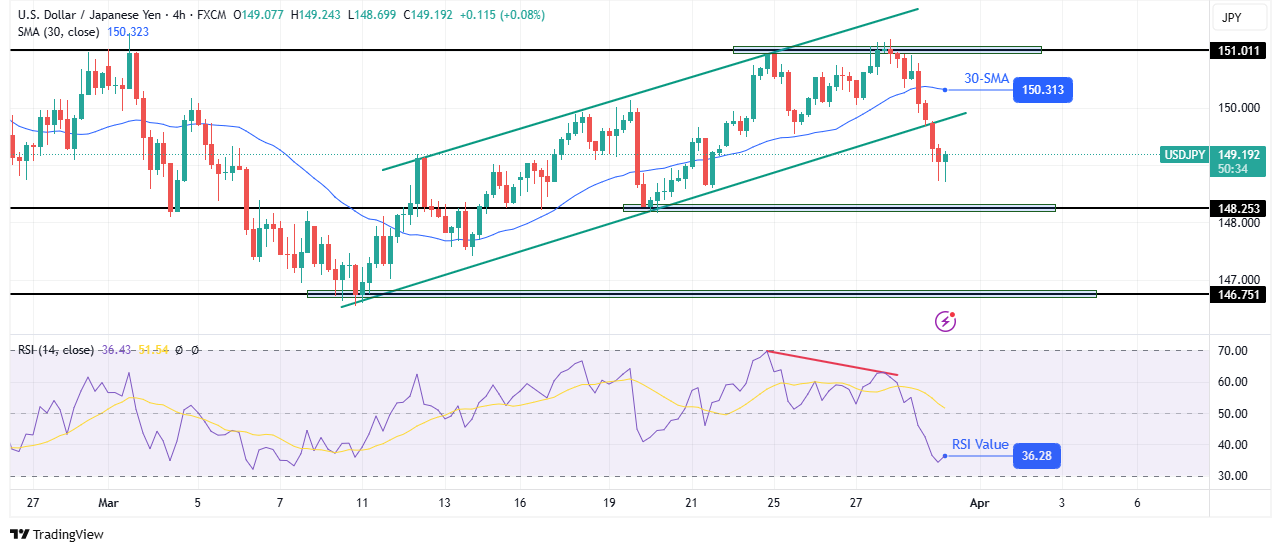
On the technical side, the USD/JPY price has broken out of its bullish channel, indicating a bearish shift in sentiment. Currently, the price trades well below the 30-SMA, and the RSI is nearing the oversold region. Therefore, the bearish bias is strong.
-Are you looking for the best MT5 Brokers? Check our detailed guide-
Initially, the price made higher highs and lows within a bullish channel. However, the rally paused when bulls met the 151.01 resistance level. The price made a double top at this level, plus a bearish RSI divergence, signalling a looming reversal. Soon after, a surge in bearish momentum saw the price break below the 30-SMA. At the same time, the RSI dipped into bearish territory below 50.
Given the solid bearish momentum, the price will soon retest the 148.25 support level If the downtrend continues, USD/JPY will likely reach the 146.75 support level.
Looking to trade forex now? Invest at eToro!
75% of retail investor accounts lose money when trading CFDs with this provider. You should consider whether you can afford to take the high risk of losing your money.
Even as the Stochastic continues to send out negative signals, as the price holds its ground above $5.00, it underpins the upward trend, however the price might engage in some sideways trading to gather enough momentum and rush towards $5.150, then target the major resistance at $5.340.
However, a breach of $5.00 would send the price towards more correctional negative trades towards $4.9200, then $4.8100.
Expected trading range today is between $5.000 and
$5.1500.
Today’s price forecast: Bullish
Conversely, the US dollar finds support from the higher-than-expected rise in US durable goods orders, in addition to the return of risk aversion due to Trump’s tariffs on car imports. Concerns about exacerbating trade uncertainty keep riskier currencies in a weak position.

The GBP/USD pair is on an upward trajectory, but it’s important to note that investor risk aversion will benefit the US dollar.
US trade policy has been a major focus of the forex markets following US President Trump’s announcement of a 25% tariff on all auto imports into the United States. Financial markets remain tense, as the US is expected to announce reciprocal tariffs this week. Uncertainty surrounds the level of tariffs and retaliatory measures from other countries.
The US tariffs will have some impact on the British economy, but the European Union is expected to perform worse. UK bond yields also rose slightly, boosting the pound.
The US dollar will be vulnerable if US economic conditions deteriorate, but there has been no evidence of labour market pressure in the latest jobless claims data. Major geopolitical developments have contributed to reducing market interest in the UK Spring Budget statement, but there are still fundamental concerns surrounding growth forecasts, which could weaken the British pound.
The GBP/USD pair is currently trading at 1.2940, showing signs of decline after reaching its recent highs. The chart shows a clear upward trend since January, with price action forming a series of bottoms and highs, although the pair has recently faced resistance. The GBP/USD pair is currently hovering around the 38.2% Fibonacci retracement level at 1.28379, after retreating from its recent peak. Important support lies at the 50% (1.27828) and 61.8% (1.27276) retracement levels, which could form potential rebound areas if the current decline continues.
Overall, the underlying trend remains bullish, as evidenced by the price trading above both the rising trend line established since January and the major moving averages. However, recent price action suggests a possible consolidation or minor correction phase. Currently, the price is testing the short-term 100-period simple moving average, which has acted as dynamic support throughout the uptrend. The long-term 200-period simple moving average continues to slope upward, confirming the overall bullish bias in the market.
Meanwhile, the stochastic indicator shows that the GBP/USD pair is moving away from overbought conditions, with readings recently declining from above 80. This suggests that momentum may be slowing in the short term, which could support continued neutrality.
Ready to trade our GBP/USD Forex analysis? Here are the best regulated trading platforms UK to choose from.
Platinum price kept trying to regain the upward trend with positive signals from major indicators, thus holding its ground above the 55 SMA, which recently represented an additional support at $964.00, with the price snagging some gains by wavering near $990.00.
The price will likely form additional ascending waves and might try to pressure the $1000.00 barrier, with a breach sending the price towards the 61.8% Fibonacci retracement level near $1017.
Expected trading range today is between $975 and $1000.
Today’s price forecast: Bullish
According to Forex market trading, the US dollar’s performance against other major currencies was affected by the announcement of accelerating US Personal Consumption Expenditures (PCE) inflation in February. According to the economic calendar results, US inflation rose by 0.4% month-on-month in February, from 0.3% in January, exceeding expectations of 0.3%. The annual rate reached 2.8% from 2.7%, also exceeding expectations of 2.7%.
As is well known, PCE inflation is a measure of US inflation that the Federal Reserve considers when making US interest rate decisions and is closely watched by markets. According to licensed trading platforms, the US dollar fell from its highs following these figures, providing a clear explanation for the current US economic dynamics: stagflation conditions are uncomfortably close.
In general, upside surprises in inflation typically indicate a robust economy, leading to higher US bond yields and a stronger dollar. However, we are beginning to see the opposite reaction, with the dollar declining on the back of better-than-expected inflation data. This is because rising inflation is not accompanied by corresponding economic strength: stagflation describes an economy experiencing high inflation and declining growth.
We still recommend buying the USD/JPY pair at every downward level, but without risk.
Under these circumstances, the US Federal Reserve is unable to respond to economic weakness because inflation is moving in the wrong direction, ensuring the entrenchment of economic weakness. This increasingly proves the negative situation for the US dollar because of President Donald Trump’s aggressive tariff agenda.
As is well known, tariffs risk raising domestic prices and negatively impacting confidence. Recently, the Conference Board reported that its US consumer confidence index fell 7.2 points to 92.9, its lowest level in more than two years. The expectations index fell 9.6 points to 65.2, its lowest level in 12 years and well below the 80-point threshold that often signals an impending recession.
According to recent trading, the USD/JPY pair has declined to trade slightly below the 100-hour moving average. Friday’s decline pushed the USD/JPY pair closer to the 14-hour RSI overbought levels. Therefore, bears will seek to extend the current decline towards 149.30 or lower to the 148.20 support. Conversely, bulls will seek to capitalize on upward rebounds around 150.55 or higher at the 151.60 resistance.
In the long term, based on the daily chart, the USD/JPY pair is trading within an ascending channel. However, the 14-day RSI still has room to move before reaching overbought conditions. Therefore, bulls will seek to capitalize on the current wave of gains towards the resistance level of 152.40 or higher to the resistance level of 154.00. Conversely, and over the same period, bears will seek to capitalize on selling operations to take profits around 146.80 or lower at the support level of 144.00, respectively.
Want to trade our USD/JPY forex analysis and predictions? Here’s a list of forex brokers in Japan to check out.
Silver price (XAG/USD) wobbles around $34.00 in Monday’s European session. The white metal trades flat as investors have sidelined to have a clear view on global economic outlook, with United States (US) President Donald Trump to unveil reciprocal tariffs on Wednesday.
Donald Trump is set to announce reciprocal levies on so-called “Liberation Day” after which tariffs be equivalent charged by other nations on the US for same products. The impact of reciprocal tariffs is expected to be significant on the global economic growth. The appeal of precious metals, such as Silver, increases amid heightening global economic tensions.
Investors expect Trump tariffs will also weaken the US economic growth, given that the impact of higher tariffs will be borne by US importers. This will also result in a resurgence in inflationary pressures.
Fears of US economic risks and accelerating price pressures in the near term have forced federal Reserve (Fed) officials to maintain a restrictive monetary policy guidance. On Friday, San Francisco Fed Bank President Mary Daly expressed that her confidence is easing in her expectations that there will be two interest rate cuts this year. Her confidence on two interest rate cuts this year shaken after the release of the US core Personal Consumption Expenditure Price Index (PCE) data for February, which accelerated at a faster-than-expected pace of 2.8% compared to estimates of 2.7% and the former release of 2.6%.
Historically, firm expectations for the Fed’s higher-for-longer interest rate stance weigh on non-yielding assets, such as Silver.
Silver price advances toward the flat border of the Ascending Triangle chart pattern formation on the daily timeframe near the October 22 high of $34.87. The upward-sloping border of the above-mentioned chart pattern is placed from the August 8 low of $26.45. Technically, the Ascending Triangle pattern indicates indecisiveness among market participants.
The 20-day Exponential Moving Average (EMA) near $33.30 continues to provide support to the Silver price.
The 14-day Relative Strength Index (RSI) rebounds above 60.00, suggesting a resurgence in bullish momentum.
Looking down, the March 6 high of $32.77 will act as key support for the Silver price. While, the October 22 high of $34.87 will be the major barrier.
Silver is a precious metal highly traded among investors. It has been historically used as a store of value and a medium of exchange. Although less popular than Gold, traders may turn to Silver to diversify their investment portfolio, for its intrinsic value or as a potential hedge during high-inflation periods. Investors can buy physical Silver, in coins or in bars, or trade it through vehicles such as Exchange Traded Funds, which track its price on international markets.
Silver prices can move due to a wide range of factors. Geopolitical instability or fears of a deep recession can make Silver price escalate due to its safe-haven status, although to a lesser extent than Gold’s. As a yieldless asset, Silver tends to rise with lower interest rates. Its moves also depend on how the US Dollar (USD) behaves as the asset is priced in dollars (XAG/USD). A strong Dollar tends to keep the price of Silver at bay, whereas a weaker Dollar is likely to propel prices up. Other factors such as investment demand, mining supply – Silver is much more abundant than Gold – and recycling rates can also affect prices.
Silver is widely used in industry, particularly in sectors such as electronics or solar energy, as it has one of the highest electric conductivity of all metals – more than Copper and Gold. A surge in demand can increase prices, while a decline tends to lower them. Dynamics in the US, Chinese and Indian economies can also contribute to price swings: for the US and particularly China, their big industrial sectors use Silver in various processes; in India, consumers’ demand for the precious metal for jewellery also plays a key role in setting prices.
Silver prices tend to follow Gold’s moves. When Gold prices rise, Silver typically follows suit, as their status as safe-haven assets is similar. The Gold/Silver ratio, which shows the number of ounces of Silver needed to equal the value of one ounce of Gold, may help to determine the relative valuation between both metals. Some investors may consider a high ratio as an indicator that Silver is undervalued, or Gold is overvalued. On the contrary, a low ratio might suggest that Gold is undervalued relative to Silver.
Bank of America expects further losses for the dollar in the second quarter; He stated, “If history is any guide, the US Dollar Index (DXY) could return to 100 in the second quarter, indicating renewed strength for the euro, the Japanese yen, and other G10 currencies.”
In general, the US dollar will be vulnerable if US economic conditions deteriorate, but there has been no evidence of labour market pressure in the latest jobless claims data. According to economists, even if the US dollar sees a short-term recovery, the deteriorating fiscal outlook, slowing consumer spending, and increasing political uncertainty – particularly regarding the DOGE index – will overshadow the US currency as the year progresses.
We still recommend selling the euro against the US dollar from every upside level, but without risk.
In recent trading and across stock trading platforms, US stock market indices closed sharply lower, affected by rising inflation concerns and increasing uncertainty regarding trade policy. According to trading, the S&P 500 index fell 2%, the Dow Jones Industrial Average fell 715 points, and the Nasdaq 100 fell 2.7%. Tech giants led the decline, with Alphabet, Amazon, and Meta shares falling more than 4% each, while Microsoft shares fell 3%.
In general, inflation concerns have escalated after the final reading of the University of Michigan’s US Consumer Confidence Index for March showed the highest long-term inflation expectations since 1993. At the same time, the core Personal Consumption Expenditures (PCE) price index, the Federal Reserve’s preferred US inflation measure, rose by 2.8% in February, exceeding expectations, while consumer spending grew by 0.4%. Investors are currently preparing for further trade disruptions as Trump’s 25% car tariff takes effect this week, raising fears of retaliatory action by major trading partners.
According to trading data, the S&P 500 and Nasdaq fell by more than 1% and 2%, respectively, marking their fifth weekly decline in six weeks, while the Dow Jones Industrial Average fell by 0.8%.
According to trading on the daily chart, downward pressure on the EUR/USD pair will increase if bears manage to stabilize below the 1.0800 support level. Technically, the next most important support levels will be 1.0720 and 1.0600, respectively. From the latter level, technical indicators will move towards strong oversold levels. Conversely, based on the performance on the daily chart, no real and strong trend reversal will occur unless the EUR/USD price moves above the psychological resistance of 1.1000.
The EUR/USD pair will be affected in the coming days by the US administration’s reaction to the imposition of tariffs that could harm the European economy, in addition to signals from global central bank officials regarding tightening or not.
Ready to trade our daily Forex analysis? We’ve made a list of the best forex demo accounts worth trading with.
Natural gas has broken decisively above a months-long descending trendline, with prices pushing through both the 50 EMA ($3.974) and 200 EMA ($3.937). The breakout is supported by a bullish ABCD harmonic pattern completing near $3.755, marking a strong inflection point.
Price is now trading comfortably above $4.00, with momentum accelerating toward the next key resistance at $4.228, followed by $4.416. This move confirms the end of the recent consolidation phase and suggests a shift in sentiment.
A sustained hold above $4.00 strengthens the bullish case, particularly with both EMAs now trending upward. Should prices dip, immediate support rests at $3.938, then $3.755—the breakout level and harmonic support.
With volume increasing on the breakout and structure aligning, bulls appear to have regained control. Natural gas breaks out above trendline and key EMAs. Bullish above $4.00, targeting $4.228 and $4.416. Pullbacks may attract buyers near $3.938.