The main category of Forex News.
You can use the search box below to find what you need.
[wd_asp id=1]
The main category of Forex News.
You can use the search box below to find what you need.
[wd_asp id=1]
GBP/USD gathered bullish momentum and closed in positive territory on Thursday. The pair stays in a consolidation phase near 1.2950 in the European session on Friday as markets await the next key data release from the US.
The table below shows the percentage change of British Pound (GBP) against listed major currencies this week. British Pound was the strongest against the Japanese Yen.
| USD | EUR | GBP | JPY | CAD | AUD | NZD | CHF | |
|---|---|---|---|---|---|---|---|---|
| USD | 0.45% | -0.22% | 0.86% | -0.19% | -0.29% | 0.33% | -0.03% | |
| EUR | -0.45% | -0.77% | -0.10% | -0.59% | -0.76% | -0.07% | -0.43% | |
| GBP | 0.22% | 0.77% | 1.05% | -0.45% | -0.02% | 0.71% | 0.24% | |
| JPY | -0.86% | 0.10% | -1.05% | -1.03% | -1.16% | -0.50% | -0.89% | |
| CAD | 0.19% | 0.59% | 0.45% | 1.03% | -0.05% | 0.52% | 0.16% | |
| AUD | 0.29% | 0.76% | 0.02% | 1.16% | 0.05% | 0.71% | 0.34% | |
| NZD | -0.33% | 0.07% | -0.71% | 0.50% | -0.52% | -0.71% | -0.29% | |
| CHF | 0.03% | 0.43% | -0.24% | 0.89% | -0.16% | -0.34% | 0.29% |
The heat map shows percentage changes of major currencies against each other. The base currency is picked from the left column, while the quote currency is picked from the top row. For example, if you pick the British Pound from the left column and move along the horizontal line to the US Dollar, the percentage change displayed in the box will represent GBP (base)/USD (quote).
The broad-based US Dollar (USD) weakness helped GBP/USD gain traction on Thursday as the auto tariffs announcement by US President Donald Trump revived concerns over an economic slowdown.
Early Friday, the UK’s Office for National Statistics reported that Retail Sales rose by 1% on a monthly basis in February. This reading followed the 1.4% increase (revised from 1.7%) recorded in January and came in better than the market expectation for a decrease of 0.3%.
Although the upbeat UK data helped Pound Sterling find demand with the immediate reaction, the risk-averse market atmosphere seems to be making it difficult for the pair to stretch higher. As of writing, US stock index futures were losing between 0.2% and 0.4% on the day.
The US Bureau of Economic Analysis will publish the Personal Consumption Expenditures (PCE) Price Index data, the Federal Reserve’s preferred gauge of inflation, for February. On a monthly basis, the core PCE Price Index is forecast to rise by 0.3%. A stronger-than-expected increase could support the USD with the immediate reaction and cause GBP/USD to stretch lower heading into the weekend. On the flip side, a soft reading of 0.1%, or lower, could help the pair stretch higher. Unless the risk mood improves, however, the pair’s upside is likely to remain capped.
GBP/USD manages to hold above the 100-period Simple Moving Average (SMA) on the 4-hour chart and the Relative Strength Index (RSI) indicator stays slightly above 50, reflecting a lack of bearish momentum.
On the downside, 1.2930 (20-day SMA) aligns as immediate support before 1.2900 (lower limit of the ascending regression channel) and 1.2800 (200-day SMA). Looking north, resistances could be spotted at 1.3000 (static level, round level) and 1.3040 (mid-point of the ascending channel).
The Pound Sterling (GBP) is the oldest currency in the world (886 AD) and the official currency of the United Kingdom. It is the fourth most traded unit for foreign exchange (FX) in the world, accounting for 12% of all transactions, averaging $630 billion a day, according to 2022 data.
Its key trading pairs are GBP/USD, also known as ‘Cable’, which accounts for 11% of FX, GBP/JPY, or the ‘Dragon’ as it is known by traders (3%), and EUR/GBP (2%). The Pound Sterling is issued by the Bank of England (BoE).
The single most important factor influencing the value of the Pound Sterling is monetary policy decided by the Bank of England. The BoE bases its decisions on whether it has achieved its primary goal of “price stability” – a steady inflation rate of around 2%. Its primary tool for achieving this is the adjustment of interest rates.
When inflation is too high, the BoE will try to rein it in by raising interest rates, making it more expensive for people and businesses to access credit. This is generally positive for GBP, as higher interest rates make the UK a more attractive place for global investors to park their money.
When inflation falls too low it is a sign economic growth is slowing. In this scenario, the BoE will consider lowering interest rates to cheapen credit so businesses will borrow more to invest in growth-generating projects.
Data releases gauge the health of the economy and can impact the value of the Pound Sterling. Indicators such as GDP, Manufacturing and Services PMIs, and employment can all influence the direction of the GBP.
A strong economy is good for Sterling. Not only does it attract more foreign investment but it may encourage the BoE to put up interest rates, which will directly strengthen GBP. Otherwise, if economic data is weak, the Pound Sterling is likely to fall.
Another significant data release for the Pound Sterling is the Trade Balance. This indicator measures the difference between what a country earns from its exports and what it spends on imports over a given period.
If a country produces highly sought-after exports, its currency will benefit purely from the extra demand created from foreign buyers seeking to purchase these goods. Therefore, a positive net Trade Balance strengthens a currency and vice versa for a negative balance.
Copper price wrapped up its upward surge temporarily after touching $5.3300, while collecting profits and settling near the previous psychological barrier of $5.000.
As the Stochastic settles below 50, the price will likely extend losses and target $4.9500, however, a renewal of the upward rush would require closing above $4.1800, sending the price to the next target at $5.4100.
Expected trading range today is between $4.9500 and $5.1300.
Today’s price forecast: Bearish
The USD/JPY pair edged lower in latest intraday trading, after the pivotal resistance of 150.95 held on, especially as the price finished a negative harmonic pattern there, the Gartley pattern, with negative signals emerging from the Stochastic after reaching overbought levels.
It comes as the price trades within an upward correctional price channel that guided recent short-term trading.
Gold price extends its record-setting rally toward $3,100 after settling above $3,050 on Thursday. Sitting at record highs, Gold price keenly awaits the US Personal Consumption Expenditures (PCE) Price Index data and US President Donald Trump’s tariff updates for additional trading impetus.
The safe-haven demand for the traditional store of value, Gold price, remains unabated amid a typical market unrest and panic situation, courtesy of Trump’s tariff plans. Investors scurry for safety in the bright metal, bracing for a raft of tariffs likely to be implemented as early as next week.
On Wednesday, Trump announced his plan to implement a 25% tariff on imported cars and light trucks, effective April 3, while the duty on auto parts is scheduled to begin on May 3. Markets also gear up for a wave of reciprocal tariffs on April 2.
Trump’s tariff wave has revived concerns over a potential trade war, which could lead to stagflation or recession in major economies. The revival of global economic slowdown fears and increased demand for Gold from Asian central banks have contributed to the latest record run in the bright metal.
Even though the recent economic data continue to indicate a healthy state of the American economy, tariff jitters overshadow and keep the US Dollar (USD) and the US Treasury bond yields on the losing end while propelling Gold price higher.
On Thursday, data showed that the fourth-quarter headline annualized Gross Domestic Product (GDP) growth was revised to 2.4%, higher than the previous and the consensus estimate of 2.3%. Meanwhile, the US Initial Jobless Claims came in at 224K, beating the expected 225K figure.
Looking ahead, the further upside in Gold price hinges on the US core PCE Price Index data release. Economists expect the Fed’s preferred inflation gauge to increase by 2.7% year-over-year (YoY) in February, following a 2.6% growth rate in January. A hotter-than-expected data release could prompt the US inflation print to justify the central bank’s prudent approach to interest rate cuts, weighing negatively on the non-interest-beating Gold price.
Conversely, a downside surprise in the data will likely bolster the ongoing rally in Gold price, alleviating pressure on the Fed over Trump’s tariffs-driven inflationary pressures. In such a scenario, markets will continue to bet on two rate cuts this year.
However, any reaction to the US data could be temporary as any developments on tariff plans by Trump could play a pivotal role in driving the market sentiment and the Gold price action. Additionally, a profit-taking slide in Gold price cannot be ruled out as traders reposition ahead of next week’s tariffs roll out and US Nonfarm Payrolls (NFP) data release.
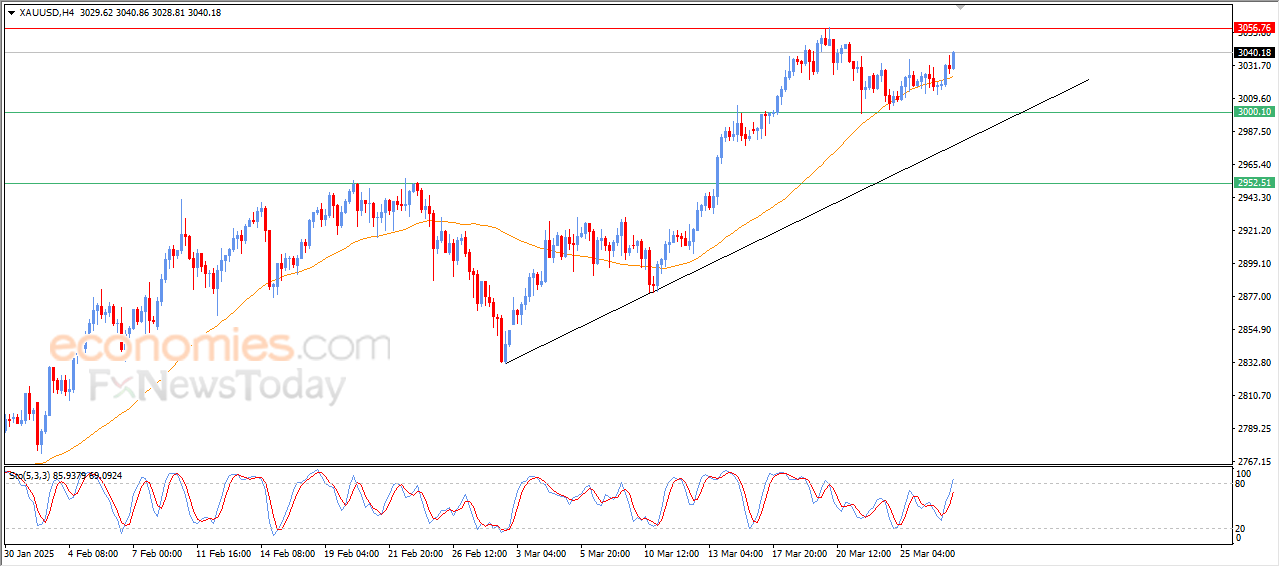
The daily chart shows that Gold price has almost tested the ascending triangle target, measured at $3,080.
Therefore, a minor pullback cannot be ruled out in the near term. Additionally, the 14-day Relative Strength Index (RSI) has entered the overbought region, currently at 72.50, lending credence to the retracement outlook.
If a correction unfolds, the immediate support for Gold buyers is at the $3,050 psychological barrier, below which the March 26 low of $3,012 could be tested.
Further down, the $3,000 round level will emerge as a significant support level.
On the other hand, if buyers manage to hold ground, the next topside target is seen at the $3,100 threshold.
Fresh buying opportunities would emerge above that level, opening doors for an advance toward the $3,150 level.
The Core Personal Consumption Expenditures (PCE), released by the US Bureau of Economic Analysis on a monthly basis, measures the changes in the prices of goods and services purchased by consumers in the United States (US). The PCE Price Index is also the Federal Reserve’s (Fed) preferred gauge of inflation. The YoY reading compares the prices of goods in the reference month to the same month a year earlier. The core reading excludes the so-called more volatile food and energy components to give a more accurate measurement of price pressures.” Generally, a high reading is bullish for the US Dollar (USD), while a low reading is bearish.
Silver price (XAG/USD) retreated after gaining over 2% in the previous session, trading near $34.30 per troy ounce during Asian hours on Friday. Despite the retreat, safe-haven demand for Silver remains strong amid heightened risk aversion, driven by escalating trade tensions ahead of new US tariffs next week.
US President Donald Trump recently imposed a 25% tariff on foreign-made cars and auto parts, triggering retaliation threats from the European Union and Canada. This has fueled concerns of a broader trade dispute and potential global economic fallout.
Silver, a non-yielding asset, could regain its footing as US Treasury yields decline. At the time of writing, the 2-year and 10-year yields stand at 3.99% and 4.34%, respectively. However, Moody’s has warned that increased tariffs and tax cuts could significantly widen government deficits, potentially leading to a US debt rating downgrade and higher Treasury yields.
Meanwhile, US Gross Domestic Product (GDP) grew at an annualized rate of 2.4% in Q4 2024, exceeding the 2.3% forecast, according to data released on Thursday. Investors now turn their attention to Friday’s US Personal Consumption Expenditures (PCE) Price Index for further insight into the Federal Reserve’s (Fed) monetary policy stance. The Fed held rates steady last week but reaffirmed expectations for two rate cuts by year-end.
Boston Fed President Susan Collins noted on Thursday that the central bank faces a tough choice between maintaining a restrictive policy stance or acting preemptively to address potential economic deterioration. Meanwhile, Richmond Fed President Thomas Barkin cautioned that uncertainty surrounding the Trump administration’s trade policies could push the Fed toward a more cautious, wait-and-see approach than markets anticipate.
Silver is a precious metal highly traded among investors. It has been historically used as a store of value and a medium of exchange. Although less popular than Gold, traders may turn to Silver to diversify their investment portfolio, for its intrinsic value or as a potential hedge during high-inflation periods. Investors can buy physical Silver, in coins or in bars, or trade it through vehicles such as Exchange Traded Funds, which track its price on international markets.
Silver prices can move due to a wide range of factors. Geopolitical instability or fears of a deep recession can make Silver price escalate due to its safe-haven status, although to a lesser extent than Gold’s. As a yieldless asset, Silver tends to rise with lower interest rates. Its moves also depend on how the US Dollar (USD) behaves as the asset is priced in dollars (XAG/USD). A strong Dollar tends to keep the price of Silver at bay, whereas a weaker Dollar is likely to propel prices up. Other factors such as investment demand, mining supply – Silver is much more abundant than Gold – and recycling rates can also affect prices.
Silver is widely used in industry, particularly in sectors such as electronics or solar energy, as it has one of the highest electric conductivity of all metals – more than Copper and Gold. A surge in demand can increase prices, while a decline tends to lower them. Dynamics in the US, Chinese and Indian economies can also contribute to price swings: for the US and particularly China, their big industrial sectors use Silver in various processes; in India, consumers’ demand for the precious metal for jewellery also plays a key role in setting prices.
Silver prices tend to follow Gold’s moves. When Gold prices rise, Silver typically follows suit, as their status as safe-haven assets is similar. The Gold/Silver ratio, which shows the number of ounces of Silver needed to equal the value of one ounce of Gold, may help to determine the relative valuation between both metals. Some investors may consider a high ratio as an indicator that Silver is undervalued, or Gold is overvalued. On the contrary, a low ratio might suggest that Gold is undervalued relative to Silver.
Bitcoin price settled higher in latest intraday trading after a batch of sideways trading while leaning on the current support of $86,000, coinciding with testing the upward correctional trend line in the short term, as it also leaned on the support of the 50-candle SMA, lending the price positive momentum, which helped it rebound rapidly and erase early losses.
To get our more detailed analysis and 100% accurate signals provided by Best Trading Signal, subscribe to Economies.com VIP Club through the link below!
The EUR/USD pair settled higher in latest intraday trading and retested the pivotal resistance of $1.0820, which represents the neckline of a negative technical pattern that’s forming in the short term, the Double Top pattern, which is decisive in determining the upcoming direction.
Despite the latest gains, the price is still dominated by a downward correctional trend as it continues to trade below the 50-candle SMA, with selling pressures bolstered even further by a forming negative divergence in the Stochastic after reaching overbought levels compared to the price’s movements, sending out negative signals.
To get our more detailed analysis and 100% accurate signals provided by Best Trading Signal, subscribe to Economies.com VIP Club through the link below!
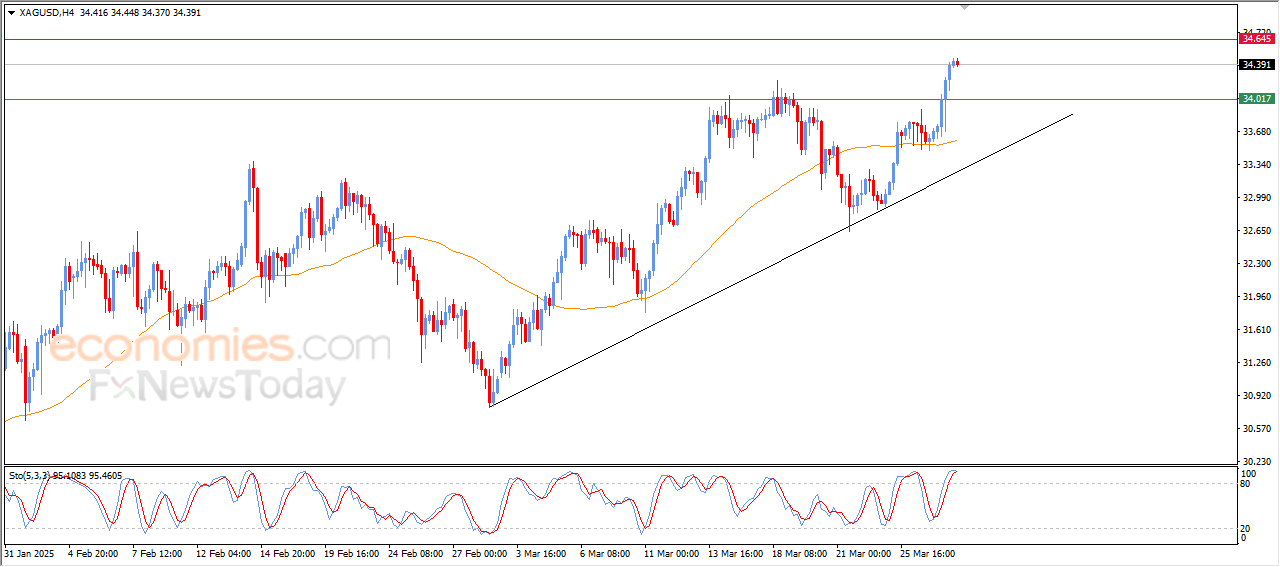
Silver price rallies sharply on Thursday, clears the $34.00 mark as uncertainty about US trade policies, regarding 25% tariffs in all cars, increased appetite for the precious metal. As of writing, the XAG/USD trades at #34.38, up over 2.20%
On Wednesday I wrote “After registering a solid rally on Tuesday, Silver failed to break the $34.00 mark, which opened the door for sellers.” Finally, buyers stepped in and pushed Silver’s price higher, clearing the previous year-to-date (YTD) high of $34.23, opening the door to test last year’s high at $34.86. On further strength, the grey metal could reach $35.00, a level last seen in October 2012. Next key resistance levels lie at $37.49, the February 2012 peak, and the August 2011 swing high of $44.22.
Conversely, if XAG/USD slips beneath $34.00, immediate support emerges at the March 26 low of $33.51. Once hurdled, the next stop is $33.00.
Silver is a precious metal highly traded among investors. It has been historically used as a store of value and a medium of exchange. Although less popular than Gold, traders may turn to Silver to diversify their investment portfolio, for its intrinsic value or as a potential hedge during high-inflation periods. Investors can buy physical Silver, in coins or in bars, or trade it through vehicles such as Exchange Traded Funds, which track its price on international markets.
Silver prices can move due to a wide range of factors. Geopolitical instability or fears of a deep recession can make Silver price escalate due to its safe-haven status, although to a lesser extent than Gold’s. As a yieldless asset, Silver tends to rise with lower interest rates. Its moves also depend on how the US Dollar (USD) behaves as the asset is priced in dollars (XAG/USD). A strong Dollar tends to keep the price of Silver at bay, whereas a weaker Dollar is likely to propel prices up. Other factors such as investment demand, mining supply – Silver is much more abundant than Gold – and recycling rates can also affect prices.
Silver is widely used in industry, particularly in sectors such as electronics or solar energy, as it has one of the highest electric conductivity of all metals – more than Copper and Gold. A surge in demand can increase prices, while a decline tends to lower them. Dynamics in the US, Chinese and Indian economies can also contribute to price swings: for the US and particularly China, their big industrial sectors use Silver in various processes; in India, consumers’ demand for the precious metal for jewellery also plays a key role in setting prices.
Silver prices tend to follow Gold’s moves. When Gold prices rise, Silver typically follows suit, as their status as safe-haven assets is similar. The Gold/Silver ratio, which shows the number of ounces of Silver needed to equal the value of one ounce of Gold, may help to determine the relative valuation between both metals. Some investors may consider a high ratio as an indicator that Silver is undervalued, or Gold is overvalued. On the contrary, a low ratio might suggest that Gold is undervalued relative to Silver.
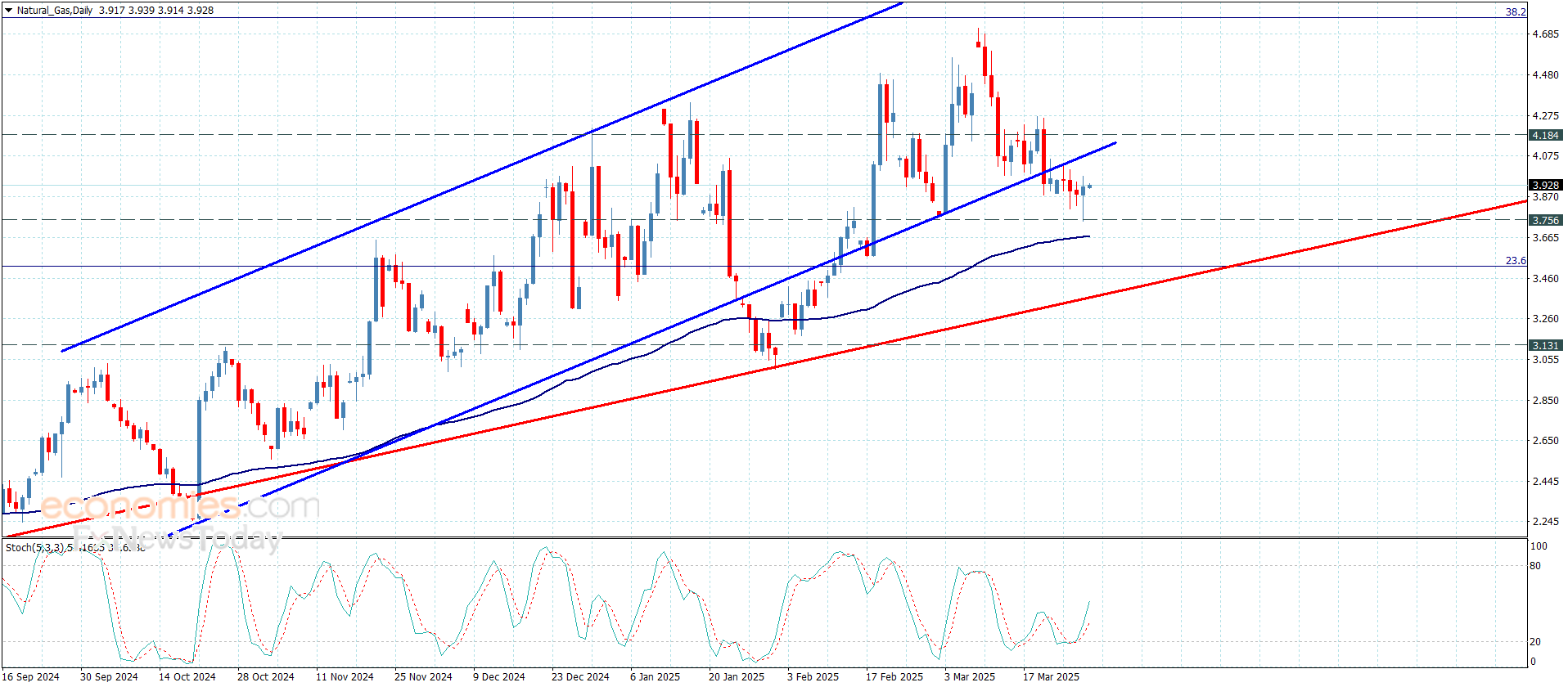
Furthermore, an outside day will be established today along with a likely bullish hammer candlestick pattern. Wednesday’s high was $3.93 and if natural gas closes above it today, the inside day breakout will be confirmed. Also, notice the relationship to the declining parallel trend channel. There was a breakout above the top of the channel and the day’s closing price may also be above the line.
The prior interim swing low at $3.96 can be used as a proxy for the line. Earlier in the day natural gas reclaimed the 50-Day MA on a move above $3.88. Therefore, the recovery since dropping below the line on Tuesday was relatively quick and therefore a bullish indication.
An initial upside target for natural gas should be around the 20-Day MA, now at $4.11. Since there is also the 38.2% Fibonacci retracement at $4.18, they can be watched together for signs of resistance. A little higher is a prior interim swing low at $4.26, also a weekly high. Since it is part of the recent decline, it represents a key potential resistance level, as a rally above $4.26 will signal a bullish reversal of the bearish correction.
Since there is only one more trading day to the week, today’s advance may establish a bullish weekly candlestick pattern. That would set up a potential bullish reversal on the weekly chart going into next week. If that happens then the higher targets should be more likely to be reached. Of course, there is always the possibility that trading next week is contained within this week’s price range.
For a look at all of today’s economic events, check out our economic calendar.
Platinum price was trapped in a tight range of trading near the $983 barrier on one hand, and the 55-day SMA support of $964 on the other hand, therefore we stand neutral until the price commits to a single path.
A breach of the current support would send the price towards $950.00, while an upward breach would send it towards $1000.00 first then the next major target at $1017.
Expected trading range today is between $964 and $983.
Today’s price forecast: Neutral