The main category of Forex News.
You can use the search box below to find what you need.
[wd_asp id=1]
The main category of Forex News.
You can use the search box below to find what you need.
[wd_asp id=1]
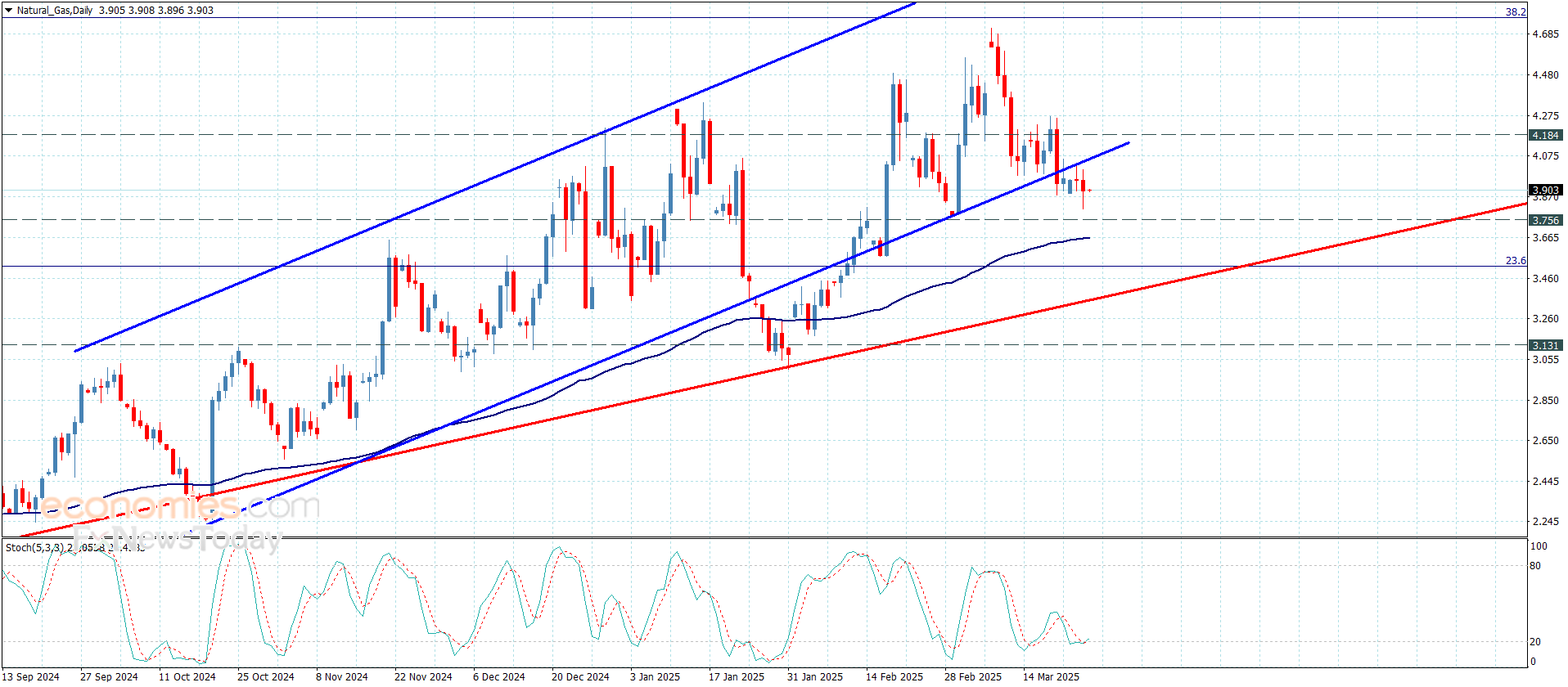
Natural gas prices fell and hit $3.810, thus approaching the support of $3.750, which is the key for deciding the overall trend in the near and medium term.
The price is now approaching the 55-day SMA support, which would reinforce its stability, while the Stochastic sends out positive signals, which boost the price further towards the resistance of $4.050, then $4.180.
Expected trading range today is between $3.750 and $4.050.
Today’s price forecast: Bullish as the support holds
GBP/USD stays under bearish pressure in the European session on Wednesday and trades at around 1.2900. The pair could stretch lower in case 1.2880 support area fails.
The table below shows the percentage change of British Pound (GBP) against listed major currencies this week. British Pound was the weakest against the Canadian Dollar.
| USD | EUR | GBP | JPY | CAD | AUD | NZD | CHF | |
|---|---|---|---|---|---|---|---|---|
| USD | 0.20% | 0.10% | 0.53% | -0.73% | -0.81% | -0.43% | 0.06% | |
| EUR | -0.20% | -0.21% | -0.21% | -0.90% | -1.03% | -0.58% | -0.10% | |
| GBP | -0.10% | 0.21% | 0.41% | -1.31% | -0.84% | -0.37% | -0.00% | |
| JPY | -0.53% | 0.21% | -0.41% | -1.24% | -1.34% | -0.91% | -0.47% | |
| CAD | 0.73% | 0.90% | 1.31% | 1.24% | -0.02% | 0.31% | 0.79% | |
| AUD | 0.81% | 1.03% | 0.84% | 1.34% | 0.02% | 0.45% | 0.93% | |
| NZD | 0.43% | 0.58% | 0.37% | 0.91% | -0.31% | -0.45% | 0.55% | |
| CHF | -0.06% | 0.10% | 0.00% | 0.47% | -0.79% | -0.93% | -0.55% |
The heat map shows percentage changes of major currencies against each other. The base currency is picked from the left column, while the quote currency is picked from the top row. For example, if you pick the British Pound from the left column and move along the horizontal line to the US Dollar, the percentage change displayed in the box will represent GBP (base)/USD (quote).
Pound Sterling weakens against its major rivals following the soft inflation readings from the UK.
The Office for National Statistics announced early Wednesday that the Consumer Price Index (CPI) rose 2.8% on a yearly basis in February. This reading followed the 3% increase recorded in January and came in below the market expectation of 2.9%. The core CPI, which excludes volatile food and energy prices, rose 3.5% in the same period, below analysts’ estimate of 3.6%.
The UK’s Office for Budget Responsibility (OBR) will publish its forecasts for the UK economy and Chancellor of the Exchequer Rachel Reeves will present the Spring budget on Wednesday.
Later in the day, February Durable Goods Orders data will be featured in the US economic docket. A significant negative surprise could weigh on the USD and help GBP/USD stage a rebound.
During the American trading hours, several Federal Reserve (Fed) policymakers will be delivering speeches as well.
The lower limit of the ascending regression channel and the 20-day Simple Moving Average (SMA) form a key support at 1.2880. In case GBP/USD falls below this level and fails to reclaim it, 1.2800 (200-day SMA) could be seen as the next bearish target.
On the upside, 1.2960 (50-period SMA) aligns as first resistance level before 1.3000 (static level, round level) and 1.3020 (mid-point of the ascending channel).
Inflation measures the rise in the price of a representative basket of goods and services. Headline inflation is usually expressed as a percentage change on a month-on-month (MoM) and year-on-year (YoY) basis. Core inflation excludes more volatile elements such as food and fuel which can fluctuate because of geopolitical and seasonal factors. Core inflation is the figure economists focus on and is the level targeted by central banks, which are mandated to keep inflation at a manageable level, usually around 2%.
The Consumer Price Index (CPI) measures the change in prices of a basket of goods and services over a period of time. It is usually expressed as a percentage change on a month-on-month (MoM) and year-on-year (YoY) basis. Core CPI is the figure targeted by central banks as it excludes volatile food and fuel inputs. When Core CPI rises above 2% it usually results in higher interest rates and vice versa when it falls below 2%. Since higher interest rates are positive for a currency, higher inflation usually results in a stronger currency. The opposite is true when inflation falls.
Although it may seem counter-intuitive, high inflation in a country pushes up the value of its currency and vice versa for lower inflation. This is because the central bank will normally raise interest rates to combat the higher inflation, which attract more global capital inflows from investors looking for a lucrative place to park their money.
Formerly, Gold was the asset investors turned to in times of high inflation because it preserved its value, and whilst investors will often still buy Gold for its safe-haven properties in times of extreme market turmoil, this is not the case most of the time. This is because when inflation is high, central banks will put up interest rates to combat it.
Higher interest rates are negative for Gold because they increase the opportunity-cost of holding Gold vis-a-vis an interest-bearing asset or placing the money in a cash deposit account. On the flipside, lower inflation tends to be positive for Gold as it brings interest rates down, making the bright metal a more viable investment alternative.
Silver (XAG/USD) attracts some sellers during the Asian session on Wednesday and erodes a part of the previous day’s strong move up. The white metal currently trades around the $33.65-$33.60 area, down 0.30% for the day, though the downside seems limited on the back of a bullish technical setup.
The XAG/USD last week showed some resilience below the $33.00 mark and the 100-period Simple Moving Average (SMA) on the 4-hour chart. The subsequent move-up and positive oscillators on the daily chart validate the positive outlook. Hence, any further intraday slide could be seen as a buying opportunity and remain limited near the said handle.
A convincing break below, however, might prompt some technical selling and drag the XAG/USD further below last week’s low, around the $32.65 region, towards testing the $32.00 round figure. This is followed by supports near the $31.80 zone (March 11 low), which if broken might shift the bias in favor of bears and expose the monthly low, around the $31.10 area.
On the flip side, bulls might now wait for a move beyond the $33.80 area, or the weekly high touched earlier this Wednesday, before placing fresh bets. The XAG/USD might then reclaim the $34.00 mark and climb further to a multi-month top, around the $34.20-$34.25 region touched on March 18, en route to a multi-year peak, around the $34.85 zone touched in October.
Silver is a precious metal highly traded among investors. It has been historically used as a store of value and a medium of exchange. Although less popular than Gold, traders may turn to Silver to diversify their investment portfolio, for its intrinsic value or as a potential hedge during high-inflation periods. Investors can buy physical Silver, in coins or in bars, or trade it through vehicles such as Exchange Traded Funds, which track its price on international markets.
Silver prices can move due to a wide range of factors. Geopolitical instability or fears of a deep recession can make Silver price escalate due to its safe-haven status, although to a lesser extent than Gold’s. As a yieldless asset, Silver tends to rise with lower interest rates. Its moves also depend on how the US Dollar (USD) behaves as the asset is priced in dollars (XAG/USD). A strong Dollar tends to keep the price of Silver at bay, whereas a weaker Dollar is likely to propel prices up. Other factors such as investment demand, mining supply – Silver is much more abundant than Gold – and recycling rates can also affect prices.
Silver is widely used in industry, particularly in sectors such as electronics or solar energy, as it has one of the highest electric conductivity of all metals – more than Copper and Gold. A surge in demand can increase prices, while a decline tends to lower them. Dynamics in the US, Chinese and Indian economies can also contribute to price swings: for the US and particularly China, their big industrial sectors use Silver in various processes; in India, consumers’ demand for the precious metal for jewellery also plays a key role in setting prices.
Silver prices tend to follow Gold’s moves. When Gold prices rise, Silver typically follows suit, as their status as safe-haven assets is similar. The Gold/Silver ratio, which shows the number of ounces of Silver needed to equal the value of one ounce of Gold, may help to determine the relative valuation between both metals. Some investors may consider a high ratio as an indicator that Silver is undervalued, or Gold is overvalued. On the contrary, a low ratio might suggest that Gold is undervalued relative to Silver.
The AUD/USD price inched higher in latest intraday trading amid the dominance of the main upward trend in the short term as the price trades alongside the trend line, while buoyed by piercing a downward correctional trend line, thus tackling the resistance of $0.6305, which represents the neckline of the positive Head and Shoulders pattern that’s contradictory to the downward correctional trend.
However, the price continues to suffer pressure due to trading below the 50-candle SMA, with negative signals from the Stochastic after reaching overbought levels, representing a strong obstacle to recovery.
To get our more detailed analysis and 100% accurate signals provided by Best Trading Signal, subscribe to Economies.com VIP Club through the link below!
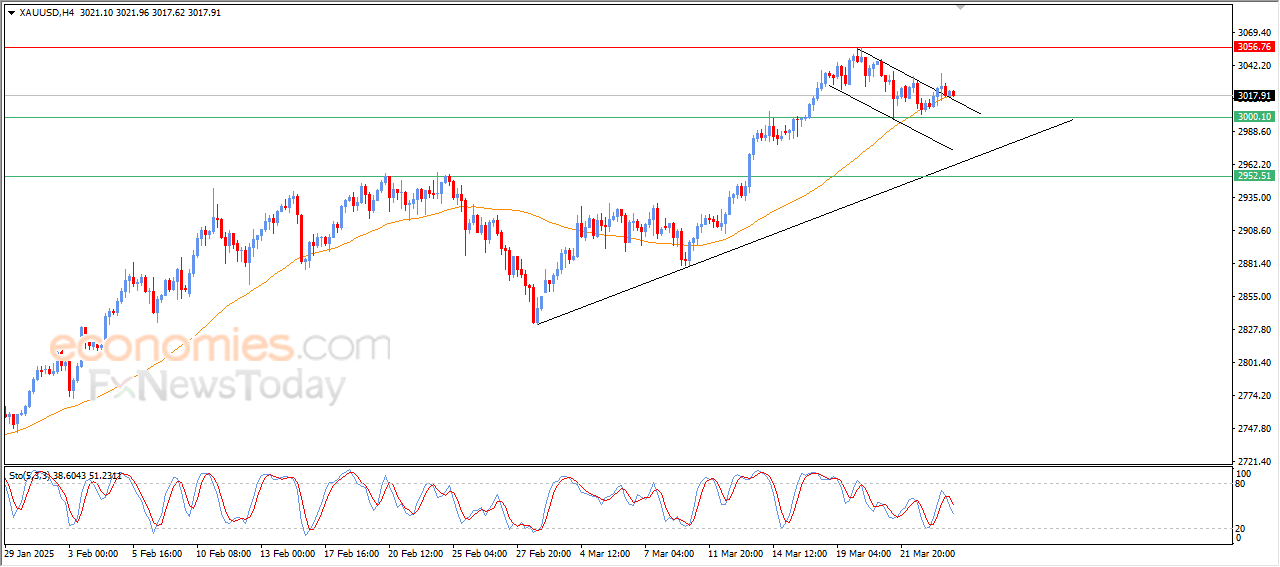
Gold price edged down in latest intraday trading with negative signals emerging from the Stochastic, as the price tries to gather positive momentum to rise anew, while also leaning on the support of the 50-candle SMA.
It comes amid the dominance of the main upward trend while trading alongside a secondary short-term trend line, as the price tries to breach the Flag pattern, which is complementary to that positive trend in the intraday levels.
To get our more detailed analysis and 100% accurate signals provided by Best Trading Signal, subscribe to Economies.com VIP Club through the link below!
The USD/JPY price settled slightly higher in latest intraday trading, while moving within an upward correctional price channel in the short term, as the price also benefits from positive support due to trading above the 50-candle SMA.
We also see positive signals emerging from the Stochastic after reaching oversold levels compared to the price’s movements, hinting at positive divergence, which boosts the upward scenario.
To get our more detailed analysis and 100% accurate signals provided by Best Trading Signal, subscribe to Economies.com VIP Club through the link below!
Notice that the price level around today’s low may have some significance. It is near a previously marked price level established by an interim swing low from December at $68.82. Also, last week’s high was at $68.97. Once resistance is surpassed in an advance that price area is typically tested as support in some form. Therefore, today’s low was a successful test of support, and last Friday’s high of $68.97 was a test of resistance. That is a sign of strengthening. Moreover, a bullish continuation signal was generated on the weekly chart with a rally above last week’s high of $68.96 on Monday. That showed strength and established the beginnings of an uptrend on the higher time frame weekly chart.
Nevertheless, if a drop below today’s low follows, there is potential support around $68.37 and the significant 20-Day MA, now at $67.97. Initial signs of a bullish reversal in crude oil triggered last week on a rally above the 20-Day line and downtrend line. Notice that they were identifying a very similar price level by the time the bullish reversal triggered last Thursday.
Given the extent of the of the recent bearish correction where the price of crude declined by $15.36 or 19%, it seems likely the current developing counter trend rally has more upside to go. That correction on a percentage basis was the largest of the prior larger four bearish corrections in crude oil, starting with the drop from the April 2024 peak.
If today’s high is exceeded, then crude oil looks like it heads towards the next higher target zone from $70.61 to $70.79. That range begins with the 50% retracement and ends with a prior resistance level. Also, included within the range is the 127.2% extended target for the rising ABCD pattern at $70.81.
For a look at all of today’s economic events, check out our economic calendar.
The AUD/USD price inched higher in latest intraday trading amid the dominance of the main upward trend in the short term as the price trades alongside the trend line, while buoyed by piercing a downward correctional trend line, thus tackling the resistance of $0.6305, which represents the neckline of the positive Head and Shoulders pattern that’s contradictory to the downward correctional trend.
However, the price continues to suffer pressure due to trading below the 50-candle SMA, with negative signals from the Stochastic after reaching overbought levels, representing a strong obstacle to recovery.
To get our more detailed analysis and 100% accurate signals provided by Best Trading Signal, subscribe to Economies.com VIP Club through the link below!
Silver price soared on Tuesday, registering gains of over 2.10%, as a weaker US Dollar could not cap the metal’s advance amid increased fears of a stagflationary scenario, following a Conference Board (CB) Consumer Confidence poll. At the time of writing, the XAG/USD trades at $33.72, virtually unchanged.
On Monday, I wrote, “Silver price formed a ‘quasi gravestone doji’ that usually appears in an uptrend, signifying a pause or end of the trend. Nevertheless, as it is preceded by a downtrend, it might indicate that bears had lost steam while buyers stepped in near the day’s lows of $32.89.” That’s what happened.
Bulls moved as a stampede and drove the precious metal higher, capitalizing on falling US yields, clearing the $33.00 and $33.50 psychological figures on its way to current spot prices. Should Silver continue to find acceptance higher, the XAG/USD could reach the March 20 peak of $33.94, ahead of testing the $34.00 figure. If surpassed, the next stop would be last October’s monthly peak at $34.86.
Conversely, if XAG/USD slips beneath $33.00, immediate support emerges at the March 21 low of $32.66. Once hurdled, the next stop is the 50-day Simple Moving Average (SMA) at $32.04.
Silver is a precious metal highly traded among investors. It has been historically used as a store of value and a medium of exchange. Although less popular than Gold, traders may turn to Silver to diversify their investment portfolio, for its intrinsic value or as a potential hedge during high-inflation periods. Investors can buy physical Silver, in coins or in bars, or trade it through vehicles such as Exchange Traded Funds, which track its price on international markets.
Silver prices can move due to a wide range of factors. Geopolitical instability or fears of a deep recession can make Silver price escalate due to its safe-haven status, although to a lesser extent than Gold’s. As a yieldless asset, Silver tends to rise with lower interest rates. Its moves also depend on how the US Dollar (USD) behaves as the asset is priced in dollars (XAG/USD). A strong Dollar tends to keep the price of Silver at bay, whereas a weaker Dollar is likely to propel prices up. Other factors such as investment demand, mining supply – Silver is much more abundant than Gold – and recycling rates can also affect prices.
Silver is widely used in industry, particularly in sectors such as electronics or solar energy, as it has one of the highest electric conductivity of all metals – more than Copper and Gold. A surge in demand can increase prices, while a decline tends to lower them. Dynamics in the US, Chinese and Indian economies can also contribute to price swings: for the US and particularly China, their big industrial sectors use Silver in various processes; in India, consumers’ demand for the precious metal for jewellery also plays a key role in setting prices.
Silver prices tend to follow Gold’s moves. When Gold prices rise, Silver typically follows suit, as their status as safe-haven assets is similar. The Gold/Silver ratio, which shows the number of ounces of Silver needed to equal the value of one ounce of Gold, may help to determine the relative valuation between both metals. Some investors may consider a high ratio as an indicator that Silver is undervalued, or Gold is overvalued. On the contrary, a low ratio might suggest that Gold is undervalued relative to Silver.
USD/JPY news today: discussions around whether USD/JPY will break the 150 mark are intensifying, driven by various economic indicators and geopolitical factors.
USD/JPY forecast: the sentiment surrounding the USD/JPY pair is influenced by a combination of economic data releases, central bank policies, and geopolitical developments. Recently, the pair has shown volatility, with fluctuations often reflecting broader market trends. Traders are closely monitoring the interplay between the U.S. dollar and the Japanese yen, particularly as the Federal Reserve and the Bank of Japan (BoJ) navigate their respective monetary policies.
Economic indicators play a crucial role in shaping the expectations of traders. Recent data from both the U.S. and Japan has been mixed, leading to uncertainty in the market. For instance, the U.S. economy has shown signs of resilience, with strong employment figures and consumer spending, which typically supports the dollar. Conversely, Japan’s economic indicators, such as inflation rates and wage growth, have been less robust, impacting the yen’s strength.
The upcoming release of key economic data, including Purchasing Managers’ Index (PMI) figures and inflation reports, will be critical in determining the direction of the USD/JPY pair. A stronger-than-expected performance from the U.S. economy could bolster the dollar, while any signs of weakness in Japan’s economic recovery could further weaken the yen.
Central bank policies are pivotal in influencing currency values. The Federal Reserve’s stance on interest rates has been particularly impactful for the USD/JPY pair. Recently, Fed officials have indicated a cautious approach to rate cuts, emphasizing the need for sustained economic growth before making any significant policy shifts. This hawkish tone generally supports the U.S. dollar, making it more attractive to investors.
On the other hand, the Bank of Japan has maintained a more dovish stance, focusing on stimulating economic growth through low-interest rates and quantitative easing. This divergence in monetary policy between the Fed and the BoJ creates a favorable environment for the dollar against the yen, potentially pushing USD/JPY toward the 150 mark.
Speculative trading also plays a significant role in the movements of the USD/JPY pair. Traders often react to news and market sentiment, leading to rapid price changes. The current market environment is characterized by heightened speculation, with many traders positioning themselves for potential breakouts or reversals.
As USD/JPY approaches the 150 level, traders are likely to increase their positions based on technical analysis and market sentiment. A break above this psychological level could trigger further buying, while a failure to maintain momentum could lead to profit-taking and a subsequent pullback.
Geopolitical developments can significantly impact currency markets, and the USD/JPY pair is no exception. Tensions in Asia, particularly related to trade policies and regional security, can influence investor sentiment and currency flows. For instance, any escalation in U.S.-China trade tensions could lead to a flight to safety, benefiting the yen as a traditional safe-haven currency.
Additionally, Japan’s economic ties with other Asian nations mean that regional developments can also affect the yen’s strength. Traders should remain vigilant regarding geopolitical news, as unexpected developments can lead to sudden shifts in market sentiment.
The question of whether USD/JPY will break the 150 mark remains open as traders analyze a complex interplay of economic indicators, central bank policies, speculative trading, and geopolitical factors. While the U.S. dollar currently enjoys a favorable position due to strong economic data and a hawkish Fed, the Japanese yen’s status as a safe-haven currency cannot be overlooked.
As we move forward, traders should stay informed about upcoming economic releases and central bank announcements, as these will be critical in shaping the future direction of the USD/JPY pair. The potential for volatility remains high, and both bullish and bearish scenarios are plausible as market dynamics continue to evolve.
In summary, while the USD/JPY pair is approaching a significant psychological level, the outcome will depend on a multitude of factors that traders must carefully monitor.
When considering shares, indices, forex (foreign exchange) and commodities for trading and price predictions, remember that trading CFDs involves a significant degree of risk and could result in capital loss.
Past performance is not indicative of any future results. This information is provided for informative purposes only and should not be construed to be investment advice.