The main category of Forex News.
You can use the search box below to find what you need.
[wd_asp id=1]
The main category of Forex News.
You can use the search box below to find what you need.
[wd_asp id=1]
July 8, 2025 – Written by Ben Hughes
STORY LINK Pound to Dollar Forecast: USD, Stocks Rally Despite Trump Tariff Threats
The Pound US Dollar exchange rate held steady as a risk-on market mood underpinned GBP/USD on Tuesday.
At the time of writing, GBP/USD was trading at approximately $1.3612, virtually unchanged from the start of Tuesday’s session.
The US Dollar (USD) weakened against most major currencies on Tuesday after President Donald Trump announced an overnight extension to the deadline for implementing global tariffs, pushing it from 9 July to 1 August.
Rather than sparking concern, the announcement was met with a wave of optimism during the European session, fuelling a broad risk-on rally.
Investors appeared largely unconcerned by the delay and prospects of additional tariffs.
The market’s muted reaction reflected a growing sense of fatigue toward tariff threats, which have become a recurring theme of Trump’s trade strategy but are often softened or reversed.
As Wind Shift Capital’s Bill Blain put it: ‘A year ago, the idea that a sovereign nation would blithely impose crippling global tariffs on its long-standing friends, allies, and competitors, and expect them to bend over and say, “Thank you sir, may I have some more”, would have been dismissed as the mad haverings of a dystopian crackpot. Today, it’s happening, and no one bats an eyelid. That’s because markets have concluded that last night’s tariffs are “just another TACO (Trump Always Chickens Out) ploy.”’
As such, the US Dollar lost ground as investors sought out riskier assets, shrugging off the latest tariff headlines.
The Pound (GBP) lacked clear momentum on Tuesday, with the absence of UK economic data leaving it to drift in response to global risk appetite.
As market sentiment improved, traders turned towards riskier assets, which weighed on Sterling against its risk-sensitive counterparts.
Although the Pound has increasingly shown risk-sensitive traits, it failed to attract the same level of demand as its more volatile counterparts in the buoyant trading conditions.
With no domestic catalysts to steer direction, Sterling traded in a narrow range, influenced more by shifting investor mood than by any economic developments.
Looking ahead to Wednesday’s European session, movement in the GBP/USD exchange rate is likely to be shaped by the release of the latest minutes from the Federal Reserve’s FOMC meeting.
If the minutes reinforce expectations for a cautious approach to future US interest rate cuts, the US Dollar may strengthen later in the day.

Meanwhile, the UK’s economic calendar remains quiet, offering little domestic impetus for Sterling.
In the absence of fresh data, GBP is expected to remain directionless, with broader market sentiment continuing to guide its path.
International Money Transfer? Ask our resident FX expert a money transfer question or try John’s new, free, no-obligation personal service! ,where he helps every step of the way,
ensuring you get the best exchange rates on your currency requirements.
TAGS: Pound Dollar Forecasts
The EURJPY pair resumed the bullish attempts, taking advantage of its repeated stability above the extra support at 169.10, reaching the previously suggested target at 171.60, to face the resistance of the main bullish channel, which forces it to form a sideways fluctuation by its rebound to 171.30.
Due to the strength of the current resistance we expect entering instability station by the contradiction of the resistance stability against the main indicators attempts to provide the positive momentum, while resuming the bullish attack requires forming new bullish wave to settle above 172.00 level, to open the way towards recording extra gains that might begin at 172.80 reaching 173.90.
The expected trading range for today is between 170.45 and 171.90
Trend forecast: Fluctuated within the bullish track
Copper price attempted to surpass stochastic negativity by its stability yesterday above $4.9000 level, which forms 68.00%Fibonacci correction level, to reinforce its stability within the bullish channel’s levels, extending its support to $4.8400.
Note that the continuation of the main indicator’s contradiction might push the price to provide weak sideways trading, but the bearish correctional suggestion will remain valid, depending on the stability of the barrier at $5.1000, to expect testing the bullish channel’s support, then monitor its behavior to detect the expected trend on the upcoming trading.
The expected trading range for today is between $4.8650 and $5.0000
Trend forecast: Fluctuated within the bullish track
The Gold price ( XAU/USD) trades in negative territory near $3,330 during the Asian trading hours on Tuesday, pressured by a firmer US Dollar (USD). The precious metal edges lower on easing trade tension after US President Donald Trump announced an extension to the upcoming tariff deadline and suggested that he was still open to additional negotiations.
Market concerns eased after Trump hinted at the possibility of an additional trade deal and delays of the tariff deadline. Trump further stated that the August 1 deadline was “not 100% firm,” signaling he remained open to continuing to tweak the rates. Optimism surrounding Trump’s tariff policies lifts the Greenback and weighs on the USD-denominated commodities price, as a firmer USD makes Gold more expensive for foreign buyers.
Gold traders will closely monitor further announcements in the White House’s trade negotiations. Any signs of renewed trade tensions and fears of a global trade war could boost the safe-haven flows, benefiting the Gold price.
Furthermore, rising major central banks’ gold buying might contribute to the yellow metal’s upside. According to a new report from the World Gold Council (WGC), global central banks have picked up on buying gold in May compared to other months. China’s central bank also added gold to its reserves in June for the eighth month in a row, official data from the People’s Bank of China (PBOC) showed on Monday.
“The PBoC in particular has been diversifying foreign exchange reserves substantially and an uptick in uncertainty and geopolitical risk may speed up the process,” said Zain Vawda, analyst at MarketPulse by OANDA.
Gold has played a key role in human’s history as it has been widely used as a store of value and medium of exchange. Currently, apart from its shine and usage for jewelry, the precious metal is widely seen as a safe-haven asset, meaning that it is considered a good investment during turbulent times. Gold is also widely seen as a hedge against inflation and against depreciating currencies as it doesn’t rely on any specific issuer or government.
Central banks are the biggest Gold holders. In their aim to support their currencies in turbulent times, central banks tend to diversify their reserves and buy Gold to improve the perceived strength of the economy and the currency. High Gold reserves can be a source of trust for a country’s solvency. Central banks added 1,136 tonnes of Gold worth around $70 billion to their reserves in 2022, according to data from the World Gold Council. This is the highest yearly purchase since records began. Central banks from emerging economies such as China, India and Turkey are quickly increasing their Gold reserves.
Gold has an inverse correlation with the US Dollar and US Treasuries, which are both major reserve and safe-haven assets. When the Dollar depreciates, Gold tends to rise, enabling investors and central banks to diversify their assets in turbulent times. Gold is also inversely correlated with risk assets. A rally in the stock market tends to weaken Gold price, while sell-offs in riskier markets tend to favor the precious metal.
The price can move due to a wide range of factors. Geopolitical instability or fears of a deep recession can quickly make Gold price escalate due to its safe-haven status. As a yield-less asset, Gold tends to rise with lower interest rates, while higher cost of money usually weighs down on the yellow metal. Still, most moves depend on how the US Dollar (USD) behaves as the asset is priced in dollars (XAU/USD). A strong Dollar tends to keep the price of Gold controlled, whereas a weaker Dollar is likely to push Gold prices up.
The EURJPY pair resumed the bullish attempts, taking advantage of its repeated stability above the extra support at 169.10, reaching the previously suggested target at 171.60, to face the resistance of the main bullish channel, which forces it to form a sideways fluctuation by its rebound to 171.30.
Due to the strength of the current resistance we expect entering instability station by the contradiction of the resistance stability against the main indicators attempts to provide the positive momentum, while resuming the bullish attack requires forming new bullish wave to settle above 172.00 level, to open the way towards recording extra gains that might begin at 172.80 reaching 173.90.
The expected trading range for today is between 170.45 and 171.90
Trend forecast: Fluctuated within the bullish track
July 8, 2025 – Written by Tim Boyer
STORY LINK Pound to Dollar Forecast: Trend Bullish, but “Near-term Pullback Possible”
GBP/USD short-term technicals remain bullish/neutral according to foreign exchange forecasters at Scotiabank.
“The multi-month trend remains bullish, but we are looking to the possibility of a near-term pullback from recent multi-year highs.”
US trade developments are likely to dominate in the short term with US Administration announcements on tariffs ahead of the July 9th deadline.
ING commented; “FX markets are preparing for a noisy week on trade.”
Meanwhile, the Pound is still vulnerable on fiscal grounds. The Pound to Dollar (GBP/USD) exchange rate dipped to lows at 1.3575 before settling close to 1.3600.
UoB commented; “Overall, only a breach of the ‘strong resistance’ at 1.3750 (no change in level) would indicate that the likelihood of GBP breaking clearly below 1.3560 has faded.”
Scotiabank, however, maintains a positive underlying stance on the Pound; “We remain bullish GBP and see no reason to make changes to our longer-term forecast targeting 1.40 by year-end 2025.”
US trade developments are likely to dominate in the short term.
On Monday, President Trump is set to start releasing letters informing countries of their tariff rates while last-minute negotiations will continue.
There have, however, also ben indications that tariffs would not come into effect until August 1st which would leave time for further negotiations.
Convera senior corporate FX dealer James Kniveton commented; “Market volatility appears inevitable when the pause officially ends and new tariff levels are announced.”
Nevertheless, he added; “the impact may prove more muted this time. Unlike previous announcements where tariff levels exceeded expectations, current proposals are largely anticipated. Moreover, markets appear to be pricing in continued deadline extensions.”
According to ING; “Threats of a resumption of 50% tariff levels could briefly hit the benign risk environment, although with a market already positioned underweight the dollar, the dollar might not have too far to fall.”
MUFG noted the risk of complacency given Administration unpredictability; “The ‘Trump Always Chickens Out’ (TACO) theory is certainly part of why investors show limited concerns. Hence, there is a risk of surprise for the markets if over the coming days the tariffs prove more aggressive than expected.”
It added; “More aggressive action will likely see some milder degree of repeat of what happened in April after ‘Liberation Day’ while a more benign scenario should push US Treasury yields lower, fuel stronger speculation of Fed rate cuts that would result in moderate dollar selling.”
Overall confidence in the Pound remains fragile amid fiscal and monetary policy reservations.
Expectations of tax increases in the Autumn budget have intensified further with some reports that tax increases of £20bn would be needed in the Autumn budget to meet current fiscal rules.
UBS economist Dean Turner commented; “We learned last week that any attempt to curb spending is going to prove almost impossible for this government, even with such a large majority. This inevitably means taxes are going up. The sooner the government is honest with the public and gets the deed done, the better.”
Turner downplayed the risk of selling in the UK bond market; “For investors in the gilt market, the volatility is likely here to stay for the time being. But this does not mean gilts do not look attractive, especially relative to cash, as interest rates will be much lower by the time the government’s second anniversary comes around.”
Scotiabank still has confidence in the Pound; “We see Wednesday’s political turbulence as a short-lived event with no lasting impact, given PM Starmer’s expression of continued support for Chancellor Reeves as both the PM and Chancellor seek to reinforce their commitment to fiscal responsibility in the UK.”
International Money Transfer? Ask our resident FX expert a money transfer question or try John’s new, free, no-obligation personal service! ,where he helps every step of the way,
ensuring you get the best exchange rates on your currency requirements.
TAGS: Pound Dollar Forecasts
Copper price attempted to surpass stochastic negativity by its stability yesterday above $4.9000 level, which forms 68.00%Fibonacci correction level, to reinforce its stability within the bullish channel’s levels, extending its support to $4.8400.
Note that the continuation of the main indicator’s contradiction might push the price to provide weak sideways trading, but the bearish correctional suggestion will remain valid, depending on the stability of the barrier at $5.1000, to expect testing the bullish channel’s support, then monitor its behavior to detect the expected trend on the upcoming trading.
The expected trading range for today is between $4.8650 and $5.0000
Trend forecast: Fluctuated within the bullish track
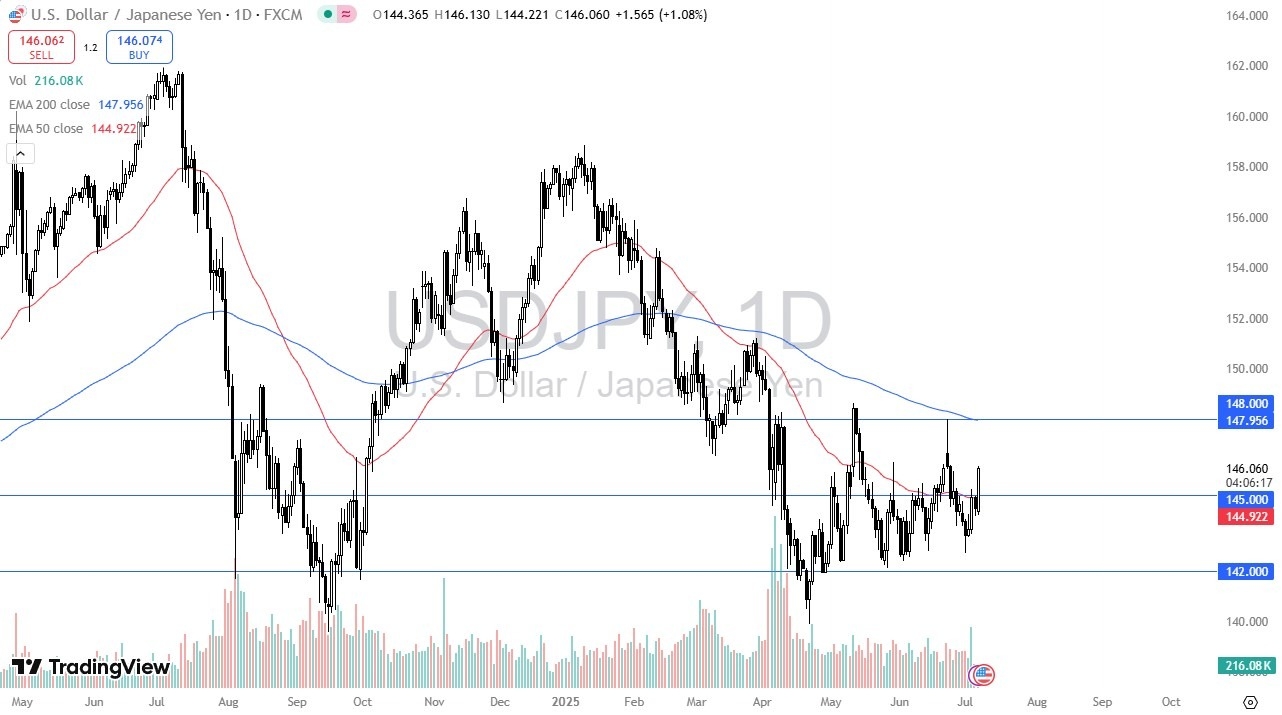
But ultimately, when you look at the price action, none of this should be a surprise because quite frankly, we have seen a lot of back and forth trading between 142 yen and 148 yen.

Ultimately, I think you have a situation where traders will continue to look at this as somewhat range bound and perhaps try to build a floor in the market as this is an area that previously had been very important also. With all of this, I think you have to look at this through the prism of just more of the same. It’s really not until we break above the 148 yen level that I think things change drastically. In that environment, then I believe that the US dollar goes looking to the 150 yen level, followed by 158 long-term.
Remember, you get paid to hang on to this pair via interest rate swap at the end of every day. And I think a lot of traders will be attracted to that in an environment that is uncertain to say the least. Rates have spiked in the U.S. as bonds have sold off. So that swap is only going to end up getting bigger at this point. The Bank of Japan, on the other hand, has its own issues with the bond market in Japan that nobody seems to be willing to bid on occasionally, which is disastrous for a currency. All things being equal, this is a market that is range bound, but I still favor the upside.
Want to trade our USD/JPY forex analysis and predictions? Here’s a list of forex brokers in Japan to check out.
Christopher Lewis has been trading Forex and has over 20 years experience in financial markets. Chris has been a regular contributor to Daily Forex since the early days of the site. He writes about Forex for several online publications, including FX Empire, Investing.com, and his own site, aptly named The Trader Guy. Chris favours technical analysis methods to identify his trades and likes to trade equity indices and commodities as well as Forex. He favours a longer-term trading style, and his trades often last for days or weeks.
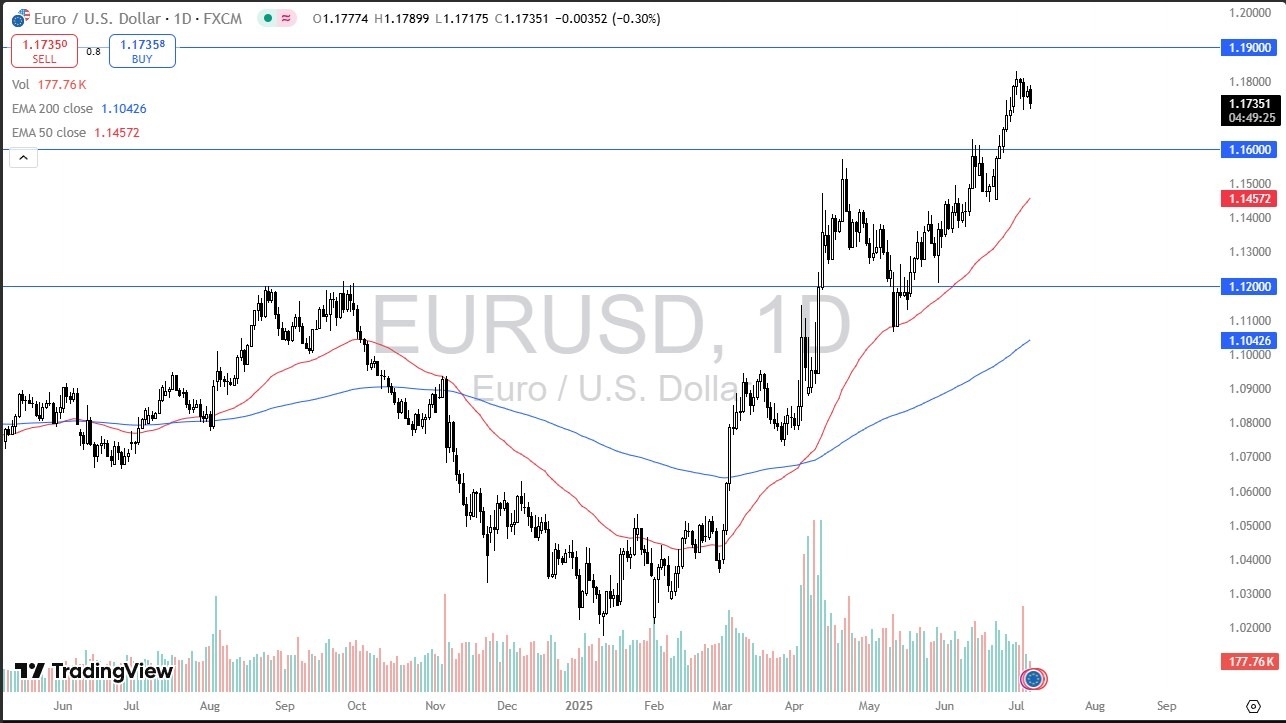
Nonetheless, this is a market that’s been bullish for a while. And I do think you have a situation where you have to look at this through the prism of just simply taking a bit of a breather.
Quite frankly, the market had been rather overdone. So, it doesn’t surprise me at all that we would see this market then perhaps try to fall in order to really see a collecting a profit, if you will, the 1.16 level is an area that I anticipate should offer pretty significant support based on not only psychology, but also the idea of market memory.
If we break down below there, then we start to target the 50 day EMA near the 1.1450 level. And that is an area that I think a lot of technical traders will be watching. If we get below there, then look out below, we really could start to change the trend. All things being equal though, I think we’ve got a situation where the euro continues to attract inflows. And if that ends up being the case, then I’m willing to buy the dip, especially near the 1.16 level, where I would be very interested in seeing a bounce that I can take advantage of if in fact we get it.
Ready to trade our daily Forex analysis? We’ve made a list of the best forex demo accounts worth trading with.
Christopher Lewis has been trading Forex and has over 20 years experience in financial markets. Chris has been a regular contributor to Daily Forex since the early days of the site. He writes about Forex for several online publications, including FX Empire, Investing.com, and his own site, aptly named The Trader Guy. Chris favours technical analysis methods to identify his trades and likes to trade equity indices and commodities as well as Forex. He favours a longer-term trading style, and his trades often last for days or weeks.
Although the relationship to the 200-Day MA carries more weight than the trendline, it is not yet clear whether today’s low will be established as a swing low. The low for the day was very close to the next lower trendline. It looks like that line may continue to take precedence over the rising line that recently crossed above the 200-Day MA and was shown as resistance today. This might mean there could be two or a few days of consolidation around the confluence of the next lower uptrend line, the 61.8% Fibonacci retracement at $3.51, and the 200-Day MA.
The relationship of the price of natural gas to the 200-Day MA is going to be key for finding clues in price behavior. If the 200-Day line fails to hold as a dynamic trend support area, then that would indicate that sellers dominate and therefore additional downside in prices could follow. The first sign of relative weaking would be on a daily closing price below the 200-Day MA, and that could happen today. At the time of this writing, trading has been occurring around the line could end Monday’s session either above or below the line.
Since October 2024 there have been only two instances where there was a daily closing price below the 200-Day MA. There were five days in April and then one day in May. In other words, natural gas remains in a support zone that could expand a little on the downside yet retain underlying buying pressure. A decisive daily close above the 200-Day line would show interest from buyers increasing. That would be for the short-term only, however, and further signs of strength would be needed to support a sustainable bullish reversal.
For a look at all of today’s economic events, check out our economic calendar.