The main category of Forex News.
You can use the search box below to find what you need.
[wd_asp id=1]
The main category of Forex News.
You can use the search box below to find what you need.
[wd_asp id=1]
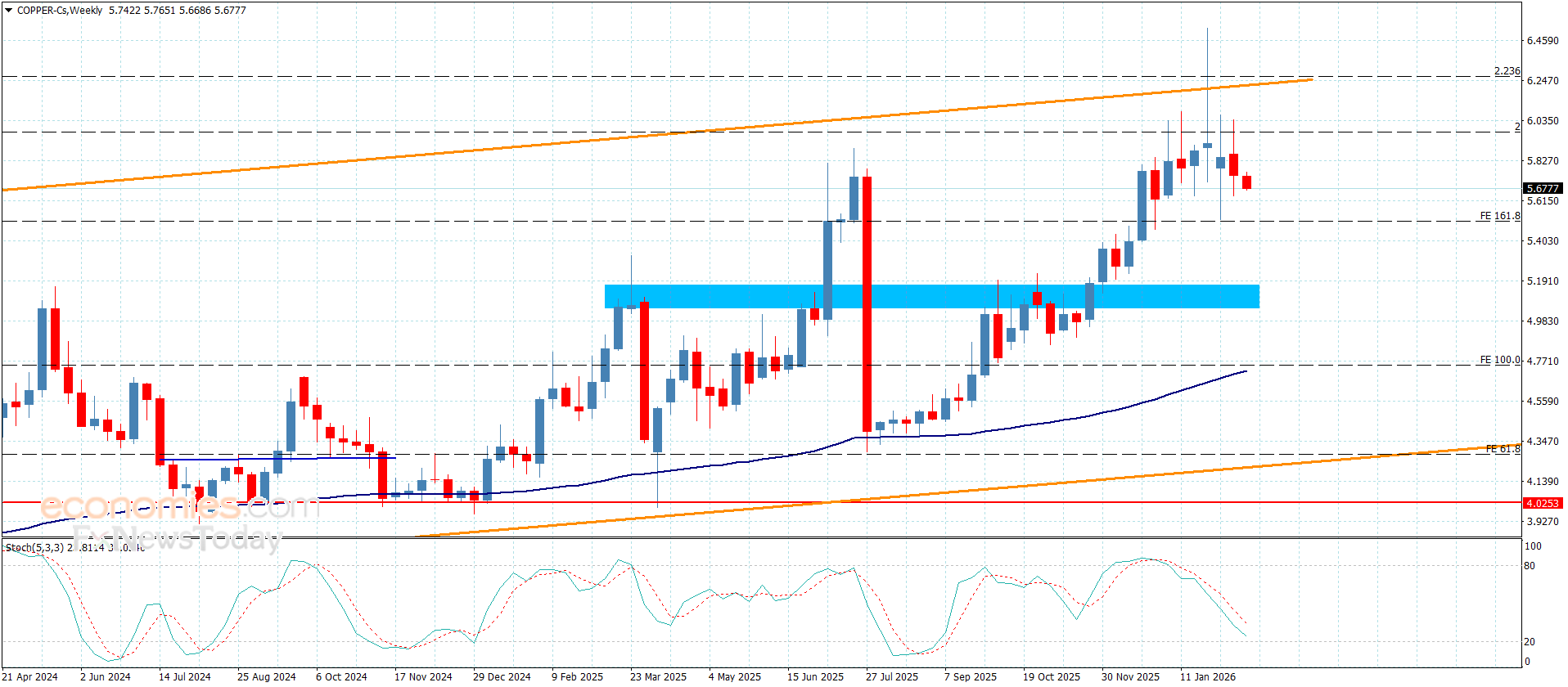
No change for copper price’s bearish corrective track, despite the continuation of the main indicators’ contradiction, but the stability below the barrier at $5.9700 supports this negativity in the near trading.
Therefore, we will keep waiting for the resuming negative attempts, which might target the extra support level at $5.5100, note that breaking this support will open the way for targeting new corrective stations that might extend towards $5.3600 reaching the next support base at $5.1000 level.
The expected trading range for today is between $5.5100 and $5.7500
Trend forecast: Bearish
The Euro is currently having issues trying to make a determined move, but seems to be a bit weak at the moment.
The Euro is currently navigating a policy divergence type of landscape while the US dollar remains resilient due to US labor market stabilizing. The European Central Bank is providing an unexpected tailwind. Unlike the Fed, which now markets price in 3 rate cuts in 2026 starting in maybe May or June, the ECB is signaling that they are going to hold for the remainder of the year.
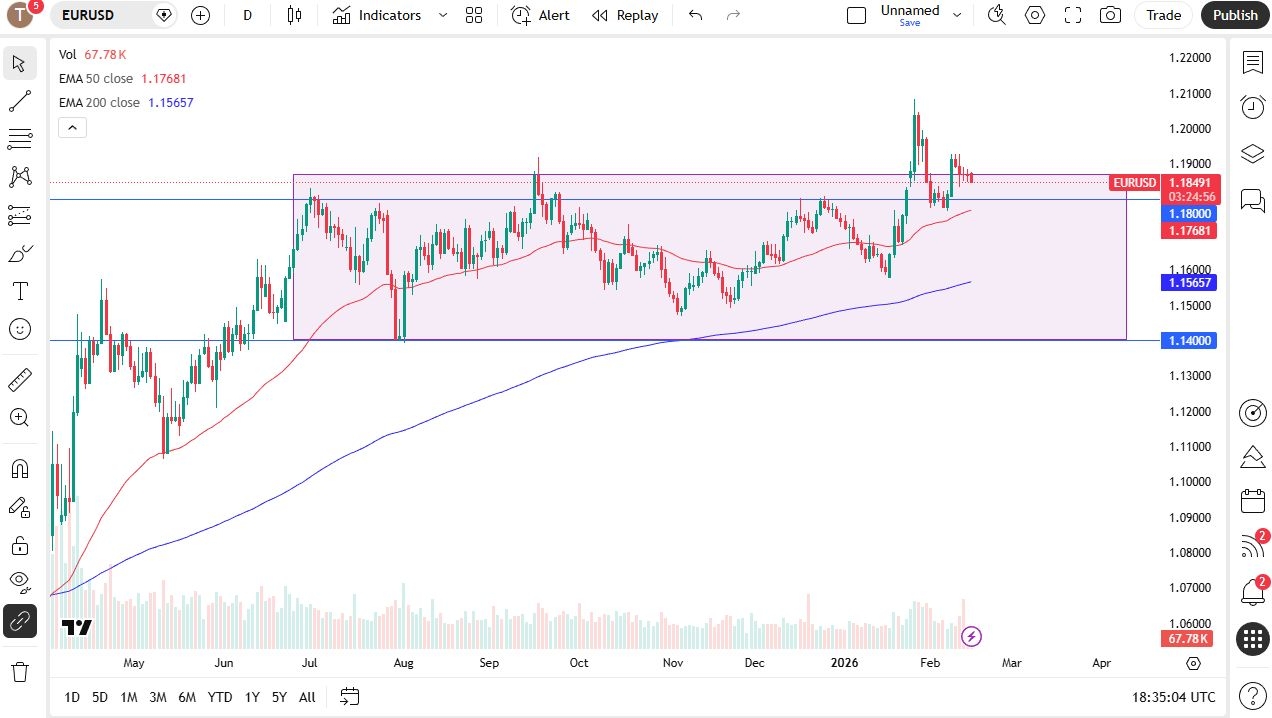
This relative hawkishness coming out of Frankfurt, combined with Eurozone current account surpluses, is keeping the well supported pair above the 1.18 level for the time being. That being said, there are a lot of questions to ask about where we go from here, and you should continue to look at this as a pair that might be positive over the longer term, but it is going to be a grind.
I am not looking for big numbers here. If we break down below the 50-day EMA, I start to buy the US dollar, not necessarily here, but in other pairs. I think it would really clean up against some of the laggards out there as far as economics are concerned, such as Switzerland, Canada, or the Japanese Yen.
If we do break down from here below the 50-day EMA, we could test the 200-day EMA, which is closer to the 1.1565 level. Rallying from here makes a bit of sense, but again, this is a neutral to slightly bullish scenario. When I say slightly, I am probably thinking about a 60% bullish 40% bearish scenario.
This is a market that will be very slow and deliberate but buying dips should work for the short term. I am not looking for big moves. The entire move that I think is possible at this point is 1.23, which could take months. That could be a middle of the summer thing once the Federal Reserve really starts to give the market what it wants as far as rate cuts.
If we continue to see labor and inflation in the United States support the idea of the Federal Reserve holding still, that could cause some downward pressure.
Ready to trade our EUR/USD analysis and predictions? Here are the best European brokers to choose from.
Silver prices (XAG/USD) collapsed for the first time in the week, down nearly 5% sponsored by steady US Treasury yields and a firm US Dollar, which weighed on the white metal. At the time of writing, XAG/USD trades at $73.49 after peaking at $76.87.
The technical picture shows Silver is neutral biased but tilted to the downside. Price action shows a successive series of lower highs, along with hitting a six-day low at $72.00, which once decisively surpassed, clears the door to test $70.00.
The Relative Strength Index (RSI) slope is downwards, along with remaining at bearish territory, hints that XAG/USD could continue its path towards testing the 100-day Simple Moving Average (SMA) at $64.71.
On further weakness, the next support would be the $60.00 milestone.
Conversely, if XAG/USD reclaims $75.00, buyers could remain hopeful of challenging the 50-day SMA at $79.39. A breach of the latter will expose $80.00.
Silver is a precious metal highly traded among investors. It has been historically used as a store of value and a medium of exchange. Although less popular than Gold, traders may turn to Silver to diversify their investment portfolio, for its intrinsic value or as a potential hedge during high-inflation periods. Investors can buy physical Silver, in coins or in bars, or trade it through vehicles such as Exchange Traded Funds, which track its price on international markets.
Silver prices can move due to a wide range of factors. Geopolitical instability or fears of a deep recession can make Silver price escalate due to its safe-haven status, although to a lesser extent than Gold’s. As a yieldless asset, Silver tends to rise with lower interest rates. Its moves also depend on how the US Dollar (USD) behaves as the asset is priced in dollars (XAG/USD). A strong Dollar tends to keep the price of Silver at bay, whereas a weaker Dollar is likely to propel prices up. Other factors such as investment demand, mining supply – Silver is much more abundant than Gold – and recycling rates can also affect prices.
Silver is widely used in industry, particularly in sectors such as electronics or solar energy, as it has one of the highest electric conductivity of all metals – more than Copper and Gold. A surge in demand can increase prices, while a decline tends to lower them. Dynamics in the US, Chinese and Indian economies can also contribute to price swings: for the US and particularly China, their big industrial sectors use Silver in various processes; in India, consumers’ demand for the precious metal for jewellery also plays a key role in setting prices.
Silver prices tend to follow Gold’s moves. When Gold prices rise, Silver typically follows suit, as their status as safe-haven assets is similar. The Gold/Silver ratio, which shows the number of ounces of Silver needed to equal the value of one ounce of Gold, may help to determine the relative valuation between both metals. Some investors may consider a high ratio as an indicator that Silver is undervalued, or Gold is overvalued. On the contrary, a low ratio might suggest that Gold is undervalued relative to Silver.
GBP/JPY snaps a two-day winning streak on Tuesday as weak UK labour market data fuels expectations of Bank of England (BoE) interest rate cuts, weighing on the British Pound (GBP). At the time of writing, GBP/JPY is trading around 207.28, down nearly 0.93% on the day and hovering near a two-month low.
Following the UK labour market data, markets are now fully pricing in two rate cuts by the BoE this year, with expectations building for the first reduction as early as March.
Meanwhile, the Japanese Yen (JPY) holds firm across the board, underpinned by growing optimism around Prime Minister Sanae Takaichi’s pro-stimulus policy agenda and firming expectations that the Bank of Japan (BoJ) could raise interest rates in the coming months.
From a technical perspective, the four-hour chart suggests the short-term structure has turned decisively bearish, with price action slipping below key moving averages.
GBP/JPY reversed sharply from multi-year highs after failing to sustain gains above the 214.00 mark earlier this month. Bearish momentum accelerated once the pair broke and retested the 210.00 psychological level, paving the way for fresh lower lows.
The 21-period Simple Moving Average (SMA) has crossed below the 50-period SMA and is now acting as immediate resistance near 208.58, reinforcing the negative bias. Both moving averages continue to slope lower, while prices remain capped beneath them.
On the downside, the 207.00 level may offer near-term support. A sustained break below this zone would likely intensify selling pressure and expose the next support around 205.00. Conversely, a decisive move back above 210.00 would be required to ease the downside bias, with 212.00 emerging as the next resistance zone.
Momentum indicators align with the bearish outlook. The Moving Average Convergence Divergence (MACD) histogram has slipped slightly below the zero line, signaling a bearish crossover and fading upside momentum.
Meanwhile, the Relative Strength Index (RSI) hovers near 31, approaching oversold territory, reflecting persistent selling pressure.
The table below shows the percentage change of Japanese Yen (JPY) against listed major currencies today. Japanese Yen was the strongest against the British Pound.
| USD | EUR | GBP | JPY | CAD | AUD | NZD | CHF | |
|---|---|---|---|---|---|---|---|---|
| USD | 0.27% | 0.72% | -0.23% | 0.17% | 0.45% | 0.23% | 0.23% | |
| EUR | -0.27% | 0.45% | -0.49% | -0.09% | 0.18% | -0.05% | -0.04% | |
| GBP | -0.72% | -0.45% | -0.91% | -0.54% | -0.27% | -0.49% | -0.49% | |
| JPY | 0.23% | 0.49% | 0.91% | 0.42% | 0.69% | 0.45% | 0.46% | |
| CAD | -0.17% | 0.09% | 0.54% | -0.42% | 0.27% | 0.04% | 0.05% | |
| AUD | -0.45% | -0.18% | 0.27% | -0.69% | -0.27% | -0.22% | -0.23% | |
| NZD | -0.23% | 0.05% | 0.49% | -0.45% | -0.04% | 0.22% | -0.00% | |
| CHF | -0.23% | 0.04% | 0.49% | -0.46% | -0.05% | 0.23% | 0.00% |
The heat map shows percentage changes of major currencies against each other. The base currency is picked from the left column, while the quote currency is picked from the top row. For example, if you pick the Japanese Yen from the left column and move along the horizontal line to the US Dollar, the percentage change displayed in the box will represent JPY (base)/USD (quote).
Gold buyers have been reluctant to give up, but XAU/USD’s behaviour suggests they may face a tough battle in the upcoming days. The rally that saw the Gold price double in a little over a year and drove the bright metal to record highs came to a halt at the end of January, when the price dropped $1,200 per ounce in a couple of days.
The subsequent recovery was initially encouraging, but continued failure to retain gains beyond the $5,000 is discouraging buyers more as time goes by. Even worse, risk-off peaks tend to benefit the Greenback, even against the safe-haven par excellence.
The battle between sellers and buyers is likely to continue, yet the firsts are slowly gaining ground. Following failure to retain the psychological mark, Gold is making lower lows on a daily basis, usually a sign of further declines ahead.
There’s one word to sum it up: resilience. The United States (US) economy has proven resilient, with steady growth despite fluctuations in the labor market and stubborn inflation. It has also proved resilient despite US President Trump’s foreign and protectionist policies, and even with the Federal Reserve’s independence under threat. One may love it or hate it, but there’s no doubt the US is the world’s largest economy, and there’s nobody out there to challenge the crown.
Gold drew a line in the sand in early February, bottoming at $4,402. As long as the price remains above the level, bulls will retain some hopes, yet the closer the level comes, the more discouraged they will be.
In the near term, and according to the 4-hour chart, XAU/USD is bearish. The 20-period Simple Moving Average (SMA) has slipped beneath the 100-period SMA, both tilt lower, and are above the current level, providing near-term dynamic resistance at $4,967 and $5,017. Meanwhile, a mildly bullish 200-period SMA provides support around $4,827. The Momentum indicator aims marginally lower within neutral levels, yet the Relative Strength Index (RSI) indicator at 33 hints at lower lows ahead.
In the daily chart, XAU/USD finally broke below the 20-day SMA, now capping advances in the $4,990 area. Price holds above the longer SMAs, which, anyway, develop below the critical $4,400 region. Finally, technical indicators aim firmly lower, with the Momentum dipping into negative territory and the RSI crossing its midline to the downside, in line with mounting selling pressure.
(The technical analysis of this story was written with the help of an AI tool.)
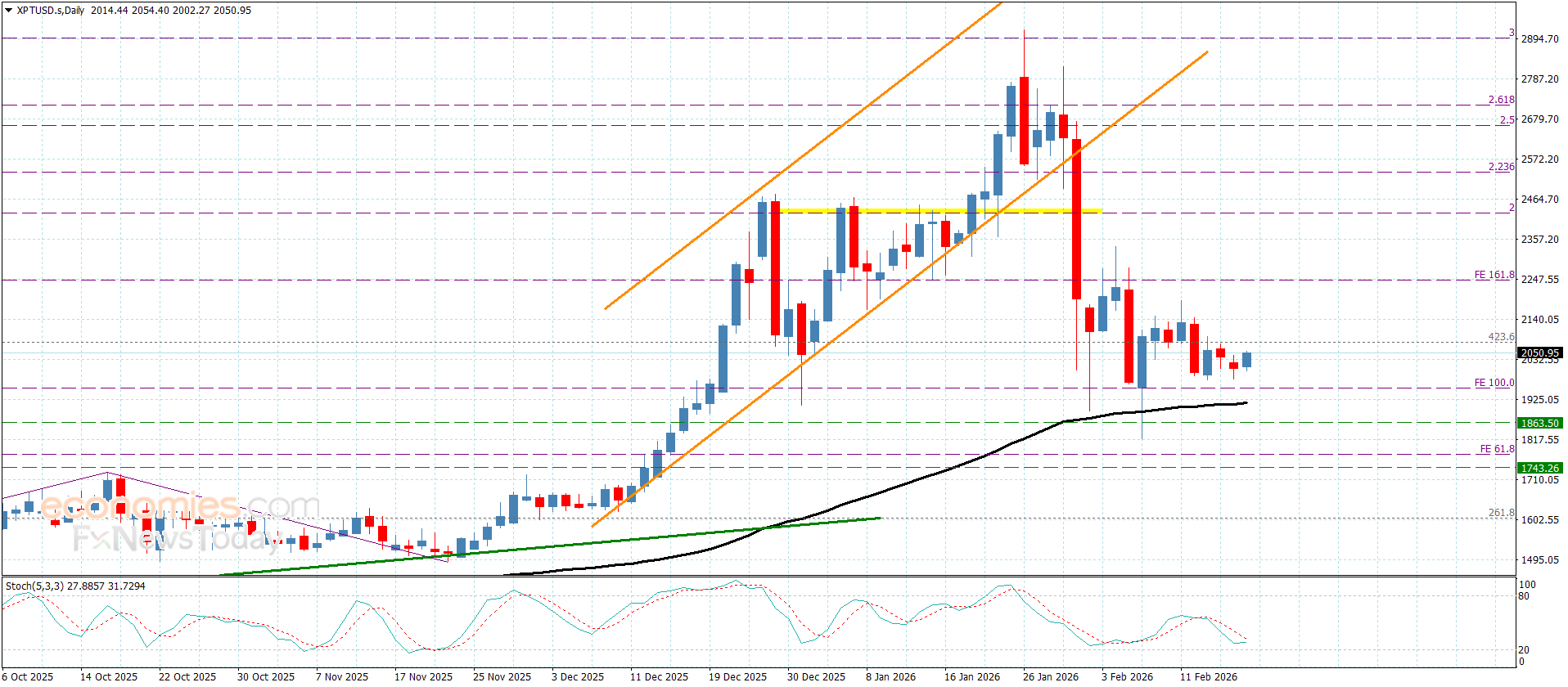
Platinum price forced to provide slow trading in the last period due to the continuation of the main indicators’ contradiction, especially with the stability of moving average 55 below the current trading, to form an intraday support at $1910.00 level.
In general, we will keep preferring the bearish corrective scenario, depending on the stability at $2245.00 and the continuation of the bearish momentum by stochastic, we will keep waiting for extra support at $1950.00 and breaking it might extend the losses directly towards $1880.00 reaching the next support at $1785.00.
The expected trading range for today is between $1950.00 and $2100.00
Trend forecast: Bearish
Silver price (XAG/USD) trades lower to near $73.70 on Tuesday at the time of writing, down 3.50% on the day. The white metal has been under pressure as dovish Federal Reserve (Fed) expectations remain capped despite cooling United States (US) inflation in January.
Theoretically, immaterial dovish Fed prospects in the near term weigh on non-yielding assets, such as Silver.
The data released on Friday showed that the US headline inflation dropped to 2.4% YoY from 2.7% in December. In the same period, the core Consumer Price Index (CPI) – which excludes volatile food and energy items – grew moderately by 2.5%, as expected, against the previous reading of 2.6%.
Meanwhile, investors brace for high volatility in the North American session as US markets will open after an extended weekend.
This week, the major trigger for the Silver price will be the release of Federal Open Market Committee (FOMC) minutes of the January policy meeting on Wednesday. In the meeting, the Federal Reserve left interest rates unchanged in the range of 3.50%-3.75%.
Globally, investors will pay attention to the second round of talks between the US and Iran in Geneva during the day. Delegates from both nations are expected to discuss the nuclear programme in Tehran. Ahead of talks, US President Donald Trump has signaled that Iran will make a deal, while warning that the nation will face consequences if they don’t resolve issues.
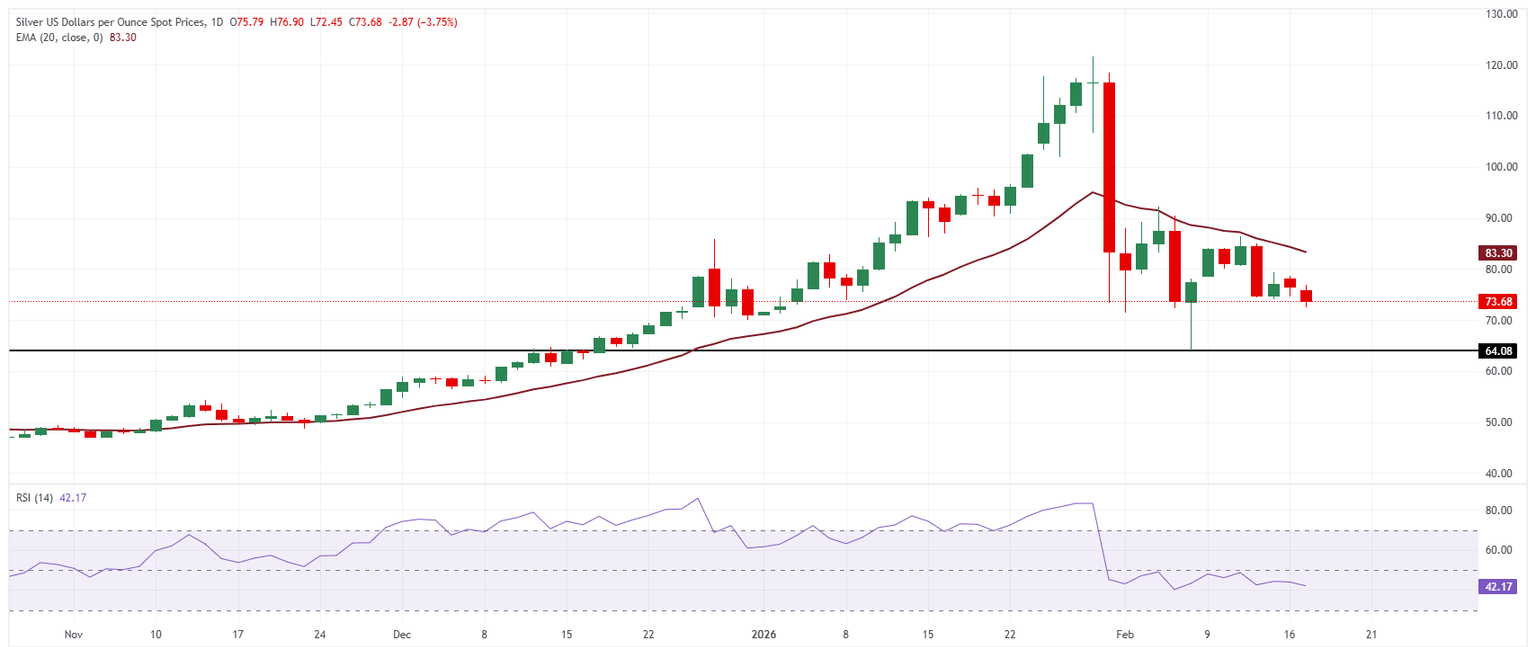
In the daily chart, XAG/USD trades at $73.68. The 20-day exponential moving average descends to $83.30, signaling a weakening short-term structure. Price holds below this gauge, keeping rebounds capped and leaving sellers in control. RSI (14) at 42.17 (neutral) stays under the midline, indicating momentum favors the downside without oversold conditions.
A daily close back above the falling 20-day EMA would ease immediate pressure and improve the near-term tone. Absent that, the path of least resistance remains lower, with failed bounces prone to being faded as the average continues to cap recovery attempts.
(The technical analysis of this story was written with the help of an AI tool.)
Silver is a precious metal highly traded among investors. It has been historically used as a store of value and a medium of exchange. Although less popular than Gold, traders may turn to Silver to diversify their investment portfolio, for its intrinsic value or as a potential hedge during high-inflation periods. Investors can buy physical Silver, in coins or in bars, or trade it through vehicles such as Exchange Traded Funds, which track its price on international markets.
Silver prices can move due to a wide range of factors. Geopolitical instability or fears of a deep recession can make Silver price escalate due to its safe-haven status, although to a lesser extent than Gold’s. As a yieldless asset, Silver tends to rise with lower interest rates. Its moves also depend on how the US Dollar (USD) behaves as the asset is priced in dollars (XAG/USD). A strong Dollar tends to keep the price of Silver at bay, whereas a weaker Dollar is likely to propel prices up. Other factors such as investment demand, mining supply – Silver is much more abundant than Gold – and recycling rates can also affect prices.
Silver is widely used in industry, particularly in sectors such as electronics or solar energy, as it has one of the highest electric conductivity of all metals – more than Copper and Gold. A surge in demand can increase prices, while a decline tends to lower them. Dynamics in the US, Chinese and Indian economies can also contribute to price swings: for the US and particularly China, their big industrial sectors use Silver in various processes; in India, consumers’ demand for the precious metal for jewellery also plays a key role in setting prices.
Silver prices tend to follow Gold’s moves. When Gold prices rise, Silver typically follows suit, as their status as safe-haven assets is similar. The Gold/Silver ratio, which shows the number of ounces of Silver needed to equal the value of one ounce of Gold, may help to determine the relative valuation between both metals. Some investors may consider a high ratio as an indicator that Silver is undervalued, or Gold is overvalued. On the contrary, a low ratio might suggest that Gold is undervalued relative to Silver.
Platinum price forced to provide slow trading in the last period due to the continuation of the main indicators’ contradiction, especially with the stability of moving average 55 below the current trading, to form an intraday support at $1910.00 level.
In general, we will keep preferring the bearish corrective scenario, depending on the stability at $2245.00 and the continuation of the bearish momentum by stochastic, we will keep waiting for extra support at $1950.00 and breaking it might extend the losses directly towards $1880.00 reaching the next support at $1785.00.
The expected trading range for today is between $1950.00 and $2100.00
Trend forecast: Bearish
Copper price continued its negative moves, conforming its surrender to the previously suggested bearish corrective scenario, fluctuating near $5.6780 level, the stability below $5.9700 barrier and the continuation of providing negative momentum by stochastic will increase the chances of facing $5.5100 support, and breaking it will force it to suffer extra losses by reaching $5.3600 initially, reaching the next support at $5.1000 level.
The expected trading range for today is between $5.5100 and $5.8500
Trend forecast: Bearish
Important DisclaimersFXEmpire is owned and operated by Empire Media Network LTD., Company Registration Number 514641786, registered at 7 Jabotinsky Road, Ramat Gan 5252007, Israel. The content provided on this website includes general news and publications, our personal analysis and opinions, and materials provided by third parties. This content is intended for educational and research purposes only. It does not constitute, and should not be interpreted as, a recommendation or advice to take any action, including making any investment or purchasing any product. Before making any financial decision, you should conduct your own due diligence, exercise your own discretion, and consult with competent advisors. The content on this website is not personally directed to you, and we do not take into account your individual financial situation or needs. The information contained on this website is not necessarily provided in real time, nor is it guaranteed to be accurate. Prices displayed may be provided by market makers and not by exchanges. Any trading or other financial decision you make is entirely your own responsibility, and you must not rely solely on any information provided through the website. FXEmpire does not provide any warranty regarding the accuracy, completeness, or reliability of any information contained on the website and shall bear no responsibility for any trading losses you may incur as a result of using such information. The website may include advertisements and other promotional content. FXEmpire may receive compensation from third parties in connection with such content. FXEmpire does not endorse, recommend, or assume responsibility for the use of any third-party services or websites. Empire Media Network LTD., its employees, officers, subsidiaries, and affiliates shall not be liable for any loss or damage resulting from your use of the website or reliance on the information provided herein.Risk DisclaimersThis website contains information about cryptocurrencies, contracts for difference (CFDs), and other financial instruments, as well as about brokers, exchanges, and other entities trading in such instruments. Both cryptocurrencies and CFDs are complex instruments and involve a high risk of losing money. You should carefully consider whether you understand how these instruments work and whether you can afford to take the high risk of losing your money. FX Empire encourages you to conduct your own research before making any investment decision and to avoid investing in any financial instrument unless you fully understand how it works and the risks involved.