The main category of Forex News.
You can use the search box below to find what you need.
[wd_asp id=1]
The main category of Forex News.
You can use the search box below to find what you need.
[wd_asp id=1]
The USD/JPY pair gains strong positive traction on Friday and, for now, seems to have snapped a four-day losing streak to over a two-week low, around the 152.30-152.25 region, touched the previous day. The US Dollar (USD) is looking to build on the post-NFP recovery amid reduced bets that the Federal Reserve (Fed) will cut rates soon, acting as a tailwind for the currency pair. Apart from this, some repositioning trade ahead of the latest US consumer inflation figures, due later during the North American session, turns out to be another factor acting as a tailwind for spot prices.
Both the headline Consumer Price Index (CPI) and the core gauge are seen rising 0.3% MoM in January and 2.5% from a year earlier. Any significant divergence from the expected readings will influence market expectations about the Fed’s policy path and drive the USD demand, which should provide a fresh impetus to the USD/JPY pair. In the meantime, the upbeat US Nonfarm Payrolls (NFP) report released on Wednesday forced investors to trim their bets for a March rate reduction. However, traders are still pricing in a greater chance of two more Fed rate cuts this year.
Furthermore, concerns about the central bank’s independence might hold back the USD bulls from placing aggressive bets. The Japanese Yen (JPY), on the other hand, could draw support from expectations that Prime Minister Sanae Takaichi could be more fiscally responsible. Investors also remain hopeful that Takaichi’s policies will boost the economy. This might prompt the Bank of Japan (BoJ) to stick to its rate-hike path, which marks a significant divergence in comparison to dovish Fed bets and might also contribute to keeping a lid on any meaningful appreciation for the USD/JPY pair.
Meanwhile, traders remain on high alert amid the possibility of a coordinated Japan-US intervention to stem the JPY weakness. This might further hold back traders from placing aggressive bullish bets around the USD/JPY pair, suggesting that the intraday move up is more likely to get sold into. Nevertheless, spot prices remain on track to register heavy weekly losses. Moreover, the aforementioned fundamental backdrop seems tilted firmly in favor of bearish traders and backs the case for an extension of the steep decline witnessed since the beginning of this week.
The USD/JPY pair once again shows some resilience below the 200-day Exponential Moving Average (SMA) and bounces off the 50% Fibonacci retracement level of the April 2025 to January 2026 strong move up. The rising 200-day EMA at 152.47 keeps the broader uptrend intact.
Meanwhile, the Moving Average Convergence Divergence (MACD) line sits below zero and has weakened, signaling bearish momentum within a corrective phase. RSI at 41 (neutral) reflects subdued impulse. The 38.2% retracement at 152.09 offers immediate support, and holding above it would preserve the bullish bias.
A close back above the 23.6% retracement at 154.91 would ease pressure and refocus topside. The 200-day EMA continues to underpin the structure, and a daily close below it would risk extending the pullback. MACD turning higher toward the zero line would hint at fading bearish momentum, while RSI pushing through 50 would reinforce an improving tone.
(The technical analysis of this story was written with the help of an AI tool.)
Silver price (XAG/USD) gains ground after registering 11.5% losses in the previous session, trading around $76.60 per troy ounce during the early European hours on Friday. However, the silver price is poised for a third consecutive weekly decline as volatility resurfaces.
Traders had no clear catalyst to explain Thursday’s drop, but parallel losses in equities and cryptocurrencies suggest broad forced liquidation, likely intensified by systematic and algorithmic trading flows.
Investors are now focused on the latest US consumer inflation data, which could help shape expectations for Federal Reserve policy. Headline Consumer Price Index (CPI) inflation is forecast to ease to 2.5% from 2.7%, while core CPI inflation is expected to slow to 2.5% from 2.6%. A softer print could give the Federal Reserve (Fed) room to resume rate cuts after holding steady at its first meeting of the year.
However, the CME FedWatch tool suggests that financial markets are now pricing in nearly a 92% probability that the Fed will leave rates unchanged at its March meeting, up from 82% the previous week.
The Fed is expected to deliver roughly two 25-basis-point rate cuts by year-end, with markets now pricing in a first move in June.
The safe-haven demand for Silver weakens as US President Donald Trump indicated that negotiations with Iran could continue for up to a month, lowering the immediate risk of military action. Trump is currently pursuing a diplomatic strategy aimed at curbing Iran’s nuclear program.
(This story was corrected on February 13 at 08:52 GMT to say that markets are now pricing in a first interest rate move in June, not July.)
Silver is a precious metal highly traded among investors. It has been historically used as a store of value and a medium of exchange. Although less popular than Gold, traders may turn to Silver to diversify their investment portfolio, for its intrinsic value or as a potential hedge during high-inflation periods. Investors can buy physical Silver, in coins or in bars, or trade it through vehicles such as Exchange Traded Funds, which track its price on international markets.
Silver prices can move due to a wide range of factors. Geopolitical instability or fears of a deep recession can make Silver price escalate due to its safe-haven status, although to a lesser extent than Gold’s. As a yieldless asset, Silver tends to rise with lower interest rates. Its moves also depend on how the US Dollar (USD) behaves as the asset is priced in dollars (XAG/USD). A strong Dollar tends to keep the price of Silver at bay, whereas a weaker Dollar is likely to propel prices up. Other factors such as investment demand, mining supply – Silver is much more abundant than Gold – and recycling rates can also affect prices.
Silver is widely used in industry, particularly in sectors such as electronics or solar energy, as it has one of the highest electric conductivity of all metals – more than Copper and Gold. A surge in demand can increase prices, while a decline tends to lower them. Dynamics in the US, Chinese and Indian economies can also contribute to price swings: for the US and particularly China, their big industrial sectors use Silver in various processes; in India, consumers’ demand for the precious metal for jewellery also plays a key role in setting prices.
Silver prices tend to follow Gold’s moves. When Gold prices rise, Silver typically follows suit, as their status as safe-haven assets is similar. The Gold/Silver ratio, which shows the number of ounces of Silver needed to equal the value of one ounce of Gold, may help to determine the relative valuation between both metals. Some investors may consider a high ratio as an indicator that Silver is undervalued, or Gold is overvalued. On the contrary, a low ratio might suggest that Gold is undervalued relative to Silver.
The EURJPY pair resumed the negative attack, taking advantage of stochastic negativity to break 181.05 level, reaching the second target at 180.80, forming a strong obstacle against the current negative trading.
Stochastic exit from the oversold level will provide intraday bullish momentum to allow it recover some losses to target 182.80 level, while the decline below 180.80 and providing negative attack to reach 180.15 reaching 179.45 in the medium period.
The expected trading range for today is between 180.80 and 182.00
Trend forecast: Fluctuated within bearish track
The GBPJPY pair attempted to recover some losses to notice its rally from 207.55 level, and formed some bullish corrective waves, to test the broken support at 209.15 level, to settle below it, confirming the negative scenario in the near and medium period trading.
The contradiction of the main indicators might push the price to provide sideways trading, but its negative stability below 209.15 will force it to provide new bearish trading, to reach near 207.60 to reach 50%Fibonacci corrective level at 207.05.
The expected trading range for today is between 207.00 and 209.00
Trend forecast: Bearish
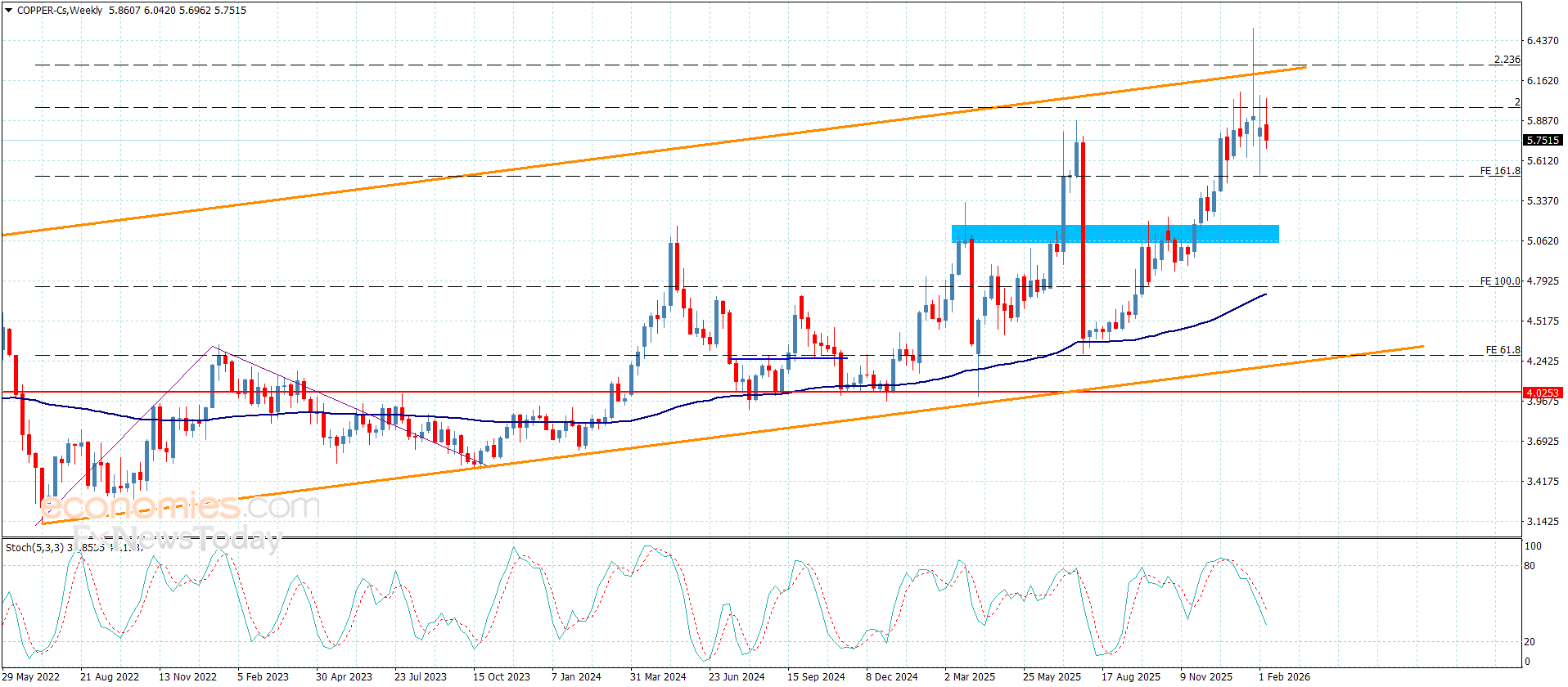
Copper price began forming corrective wave, moving away from $5.9700 barrier, noticing its fluctuations near the initial target by reaching $5.7000 level.
Note that the continuation of providing negative momentum by stochastic stability below 50 level will increase the negative pressure for today, to keep waiting for reaching extra support at $5.5100, to monitor its behavior due to the importance of this support to detect the near and medium period trading.
The expected trading range for today is between $5.5500 and $5.8500
Trend forecast: Bearish
The EURJPY pair resumed the negative attack, taking advantage of stochastic negativity to break 181.05 level, reaching the second target at 180.80, forming a strong obstacle against the current negative trading.
Stochastic exit from the oversold level will provide intraday bullish momentum to allow it recover some losses to target 182.80 level, while the decline below 180.80 and providing negative attack to reach 180.15 reaching 179.45 in the medium period.
The expected trading range for today is between 180.80 and 182.00
Trend forecast: Fluctuated within bearish track
Gold is staging a comeback toward $5,000 early Friday, reversing a part of Thursday’s 3.5% sell-off. The focus now remains on the all-important US Consumer Price Index (CPI) release for the next big move in Gold.
Gold is back on the bids, continuing to find bargain hunters at lower levels as geopolitical tensions and US Federal Reserve (Fed) interest rate cut expectations remain in play.
Despite a positive surprise in the January Nonfarm Payrolls data, markets still price in atleast two Fed rate cuts this year, according to the CME Group’s FedWatch Tool.
Therefore, the major US CPI data remains critical in gauging whether the Fed will conform to the market expectations or lean hawkish if inflation picks up in January.
The US core annual CPI is seen easing to 2.5% in January from December’s 2.6% print. The core monthly CPI is expected to rise by 0.3% in the same period against a 0.2% increase in December. Meanwhile, the headline annual CPI inflation is also likely to soften to 2.5%.
A hotter-than-expected core annual and monthly CPI readings could pour cold water on bets for two Fed rate cuts this year, fuelling a sustained US Dollar (USD) recovery at the expense of non-yielding assets such as Gold.
Markets brace for intense volatility on the US CPI release this Friday, with a sense of caution reviving Gold buyers in the lead-up to the critical event risk.
Gold tumbled close to 3.5% on Thursday as an intense selling wave gripped markets and unexpectedly ramped up haven demand for the USD. Concerns around artificial intelligence- (AI) driven disruption resurfaced, this time spreading to the commercial property space.
Real estate stocks were the latest sector to come under pressure following earlier sell-offs in software and financial services tied to AI fears, per CNBC News.
The 21-day Simple Moving Average (SMA) rises above the 50-, 100-, and 200-day SMAs, underscoring bullish alignment. All SMAs trend higher while price holds above them, keeping buyers in control. The 21-day SMA currently stands at $4,952.03 and offers nearby dynamic support. The Relative Strength Index (RSI) sits at 54.80 (neutral) and is edging higher, reinforcing a steady bid.
Measured from the $5,597.89 high to the $4,401.99 low, the Fibonacci retracement framework points to overhead barriers on rebounds. The 50% retracement at $4,999.94 caps initial advances, with the 61.8% at $5,141.05 as the next resistance. A sustained push above the former would open room toward the latter, while rejection keeps the upside constrained and leaves the focus on nearby moving average support.
(The technical analysis of this story was written with the help of an AI tool.)
Inflationary or deflationary tendencies are measured by periodically summing the prices of a basket of representative goods and services and presenting the data as the Consumer Price Index (CPI). CPI data is compiled on a monthly basis and released by the US Department of Labor Statistics. The MoM print compares the prices of goods in the reference month to the previous month.The CPI Ex Food & Energy excludes the so-called more volatile food and energy components to give a more accurate measurement of price pressures. Generally speaking, a high reading is seen as bullish for the US Dollar (USD), while a low reading is seen as bearish.
Inflation measures the rise in the price of a representative basket of goods and services. Headline inflation is usually expressed as a percentage change on a month-on-month (MoM) and year-on-year (YoY) basis. Core inflation excludes more volatile elements such as food and fuel which can fluctuate because of geopolitical and seasonal factors. Core inflation is the figure economists focus on and is the level targeted by central banks, which are mandated to keep inflation at a manageable level, usually around 2%.
The Consumer Price Index (CPI) measures the change in prices of a basket of goods and services over a period of time. It is usually expressed as a percentage change on a month-on-month (MoM) and year-on-year (YoY) basis. Core CPI is the figure targeted by central banks as it excludes volatile food and fuel inputs. When Core CPI rises above 2% it usually results in higher interest rates and vice versa when it falls below 2%. Since higher interest rates are positive for a currency, higher inflation usually results in a stronger currency. The opposite is true when inflation falls.
Although it may seem counter-intuitive, high inflation in a country pushes up the value of its currency and vice versa for lower inflation. This is because the central bank will normally raise interest rates to combat the higher inflation, which attract more global capital inflows from investors looking for a lucrative place to park their money.
Formerly, Gold was the asset investors turned to in times of high inflation because it preserved its value, and whilst investors will often still buy Gold for its safe-haven properties in times of extreme market turmoil, this is not the case most of the time. This is because when inflation is high, central banks will put up interest rates to combat it.
Higher interest rates are negative for Gold because they increase the opportunity-cost of holding Gold vis-a-vis an interest-bearing asset or placing the money in a cash deposit account. On the flipside, lower inflation tends to be positive for Gold as it brings interest rates down, making the bright metal a more viable investment alternative.
The GBP/USD pair is under heavy selling pressure in Friday’s European session, trading around 1.3609. Earlier, it tried to hold above 1.3650, but the recovery was weak. Ongoing concerns about slow UK growth and a strong US job market continue to push the pair lower.
The British Pound has been weak lately because of several disappointing reports from the Office for National Statistics (ONS).
These numbers have increased expectations for a Bank of England (BoE) rate cut at the March 19 meeting. Futures markets now see a higher chance that the BoE will act to support the economy, especially since the services sector is showing no growth.
Meanwhile, the US Dollar is still seen as a safe haven. The US Nonfarm Payrolls (NFP) report on February 11 showed 130,000 new jobs, almost twice the 70,000 expected, and the unemployment rate fell to 4.3%.
Yesterday, Initial Jobless Claims dropped to 227,000, which supports the Dollar’s strength. Although this is a bit higher than the best estimates, it still points to a strong job market, letting the Federal Reserve keep its current approach.
Traders are now watching today’s US CPI report at 13:30 GMT. If core inflation is above 2.5%, the USD could rise further, making it harder for the GBP to recover.
The GBP/USD 2-hour chart shows a weakening technical setup. The pair keeps making lower highs and lower lows after being repeatedly pushed down from a falling trendline that started near 1.3760.
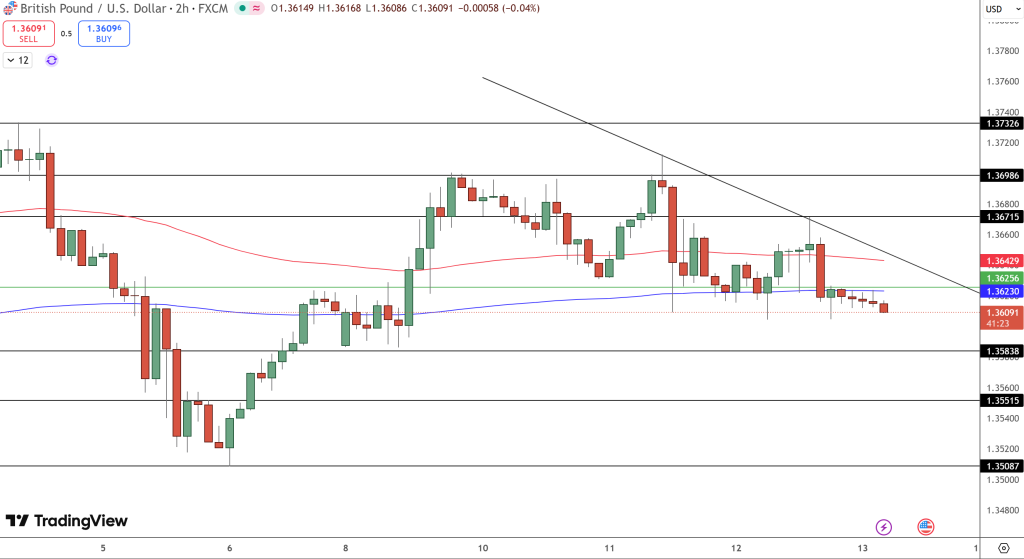
Trade Idea: If the price breaks clearly below 1.3600, consider a short position with a target at the 1.3550 level and a stop-loss above 1.3645.
The pair will likely stay under pressure unless the UK delivers unexpectedly strong news or US inflation drops more than expected.

Arslan Butt
Lead Markets Analyst – Multi-Asset (FX, Commodities, Crypto)
Arslan Butt serves as the Lead Commodities and Indices Analyst, bringing a wealth of expertise to the field. With an MBA in Behavioral Finance and active progress towards a Ph.D., Arslan possesses a deep understanding of market dynamics.
His professional journey includes a significant role as a senior analyst at a leading brokerage firm, complementing his extensive experience as a market analyst and day trader. Adept in educating others, Arslan has a commendable track record as an instructor and public speaker.
His incisive analyses, particularly within the realms of cryptocurrency and forex markets, are showcased across esteemed financial publications such as ForexCrunch, InsideBitcoins, and EconomyWatch, solidifying his reputation in the financial community.
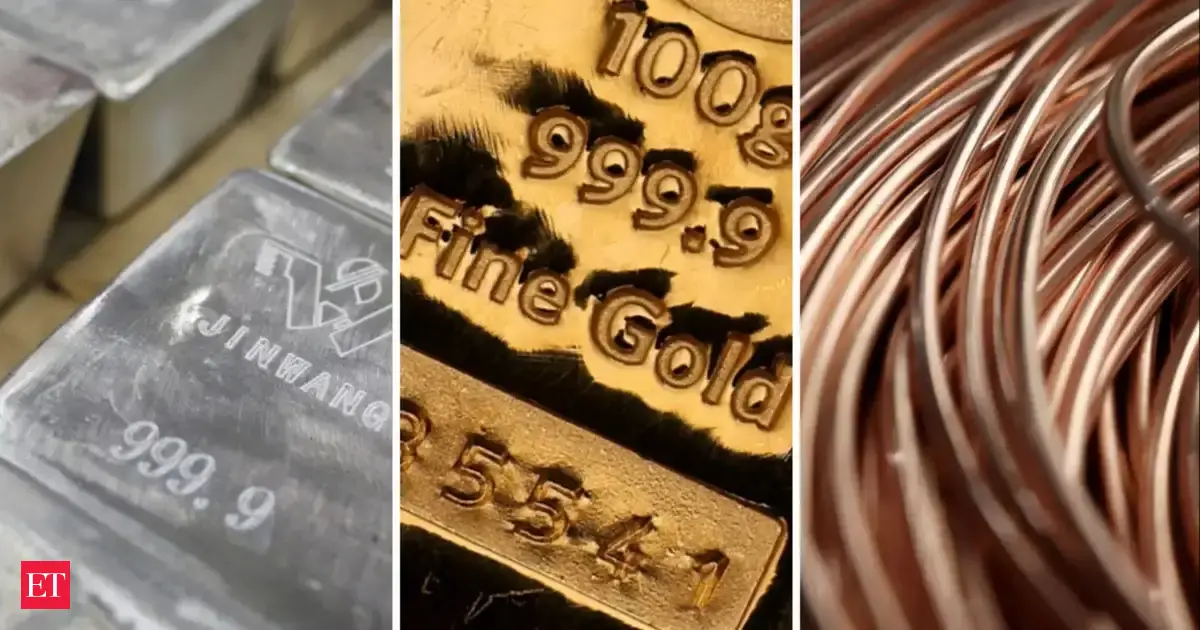
The sell-off followed stronger US economic data and a rebound in the US dollar. The latest jobless claims came in at 227,000. The January nonfarm payrolls report showed 130,000 jobs added, well above expectations of 70,000. The unemployment rate fell to 4.3%. That data reduced Federal Reserve rate cut expectations.
Gold fell below the key psychological $5,000 level. Silver broke under $80. These technical breaks triggered stop-loss selling and margin calls. The gold-silver ratio widened toward 66:1. Markets saw what traders call a “liquidity flush.” The broader trend remains under debate, but short-term volatility is elevated across commodities.
The immediate trigger was technical. For days, gold prices had traded in a tight range between $5,000 and $5,100. Silver hovered near $80 to $85. When markets coil like this, stop-loss orders build on both sides.
Gold had heavy stop orders below $5,000. Silver had leverage stacked above $80 after its massive 2025 rally that pushed prices as high as $121 earlier in the year. Once gold slipped below $5,000, automated selling accelerated. Silver followed sharply.
This type of move often happens when liquidity thins and technical levels break. There was no sudden geopolitical shock. The move was largely mechanical.
However, macro data added pressure. Strong US labor numbers reduced the urgency for Federal Reserve rate cuts. That strengthened the US dollar. A stronger dollar weighs on gold, silver, platinum, and copper because they are priced in dollars globally. The US Dollar Index rebounded after recent weakness. The labor market data changed rate expectations quickly. Before the jobs report, markets were pricing higher odds of a March rate cut. After payrolls beat forecasts, those odds fell sharply.
Higher-for-longer interest rate expectations hurt non-yielding assets like gold. When bond yields rise and the dollar strengthens, investors shift toward interest-bearing assets.
Gold is highly sensitive to real yields. Silver is even more volatile because it has both safe-haven and industrial demand exposure.
If upcoming inflation data surprises to the upside, rate cut expectations may fall further. That could keep pressure on metals.
Gold futures (GC00) are now trading near $4,966, down from recent highs above $5,600. The 52-week range remains wide, between $2,844 and $5,626.
The key support zone is $4,880 to $4,900. If that area holds, gold could stabilize. A break below $4,880 opens the door toward $4,800, then $4,700. The major long-term support stands near $4,500.
On the upside, gold must reclaim $5,000 on a daily closing basis. If it holds above that level, buyers may target $5,100 again. That area has acted as strong resistance.
Despite today’s drop, the broader uptrend from 2025 remains intact. Central bank buying continues. China’s central bank has maintained steady gold accumulation. Physical premiums remain elevated in some markets.
For now, the gold price forecast remains neutral with elevated volatility.
Silver fell nearly 10% in one session. That is far more aggressive than gold.
The reason is leverage. Silver experienced a record rally in 2025, gaining more than 140% at one point. Futures positioning became crowded. When prices broke below $80, margin calls triggered forced selling.
Silver’s key support now lies between $74 and $70. This zone aligns with previous consolidation levels. If silver holds above $74 and regains $85, the rally could resume toward $90 or higher.
But if dollar strength persists and risk appetite weakens, silver could test lower support zones.
The gold-silver ratio near 66:1 suggests silver is underperforming gold. Historically, elevated ratios sometimes precede silver outperformance, but timing remains uncertain.
Platinum (PL00) fell 5.63% to $2,024. Platinum often trades with both precious metals and industrial demand expectations. Weak risk sentiment and dollar strength weighed on prices.
Copper (HG00) dropped 2.78% to $5.80 per pound. Copper is closely linked to global growth, especially China’s demand. Slowing manufacturing signals and stronger US data created mixed signals.
Copper had traded above $6 earlier this year. Today’s drop reflects both technical pressure and macro uncertainty.
Industrial metals tend to fall when investors anticipate tighter financial conditions.
Some traders believe today’s move was a delayed reaction to the strong nonfarm payrolls report. The dollar initially struggled to hold gains after the data. But as rate expectations reset, metals came under pressure.
Unemployment fell to 4.3%. Wage growth surprised on the upside. Those factors reduce immediate pressure on the Federal Reserve to ease policy.
Jobless claims at 227,000 did not dramatically change the narrative. Markets are now focused on upcoming CPI data. A stronger inflation reading could support the dollar further.
The metals sell-off occurred alongside weakness in energy markets. WTI crude oil fell 2.99% to $62.70. Brent crude dropped 2.84% to $66.31. Unleaded gasoline and heating oil also declined. Natural gas was the exception, rising more than 3%.
This suggests a broader risk reset rather than an isolated gold event.
Short term, volatility remains high. Gold must defend $4,880. Silver must hold above $74. Platinum needs stability above $2,000. Copper must protect the $5.70 to $5.80 area.
If US economic data continues to surprise on the upside, metals may face further pressure. If inflation cools and rate cut expectations return, gold and silver could rebound sharply.
Today’s crash appears technically driven but reinforced by macro shifts. The longer-term bull case tied to central bank demand, inflation hedging, and industrial use remains intact.
For now, investors should expect sharp two-way moves in gold prices, silver prices, platinum prices, and copper prices as markets adjust to shifting Federal Reserve expectations in early 2026.
The massive price plunge is primarily driven by a “liquidity flush” triggered by unexpectedly strong U.S. labor data. With January payrolls jumping by 130,000 and unemployment falling to 4.3%, the market has abruptly repriced Federal Reserve interest rate expectations. This data reduced the urgency for rate cuts, causing the U.S. Dollar to rally and pressuring dollar-denominated metals. The crash was accelerated by technical factors as gold breached the critical $5,000 support level, triggering a massive wave of automated stop-loss orders and margin calls for leveraged traders.
Despite today’s $132 drop in gold and 10% cratering in silver, many institutional analysts view this as a necessary consolidation of an “overheated” market. While short-term volatility is expected to persist, the structural bull case remains supported by a sixth consecutive year of silver supply deficits and aggressive gold accumulation by global central banks. However, the immediate gold forecast is neutral-to-bearish until prices can reclaim and hold the $5,000 mark.
Industrial metals like copper and platinum are suffering from a “risk-off” sentiment and fears of high-for-longer interest rates. Copper dropped to $5.80 as traders worried that restrictive Fed policy could dampen global manufacturing demand, particularly as markets await fresh inflation data. Platinum’s 5.6% slide reflects its high sensitivity to industrial project financing costs and a broader retreat from “green” commodities as the U.S. dollar regains its dominance.
For gold, the $4,880 to $4,900 zone is now the must-hold line to prevent a deeper slide toward $4,500. Silver investors are looking for stability around the $75 mark, as a failure to hold this level could see the metal retest January’s lows near $65. Tomorrow’s Consumer Price Index (CPI) report is the next major volatility catalyst; a “cool” inflation print could spark a relief rally, while “hot” data may deepen today’s sell-off.