The main category of Forex News.
You can use the search box below to find what you need.
[wd_asp id=1]
The main category of Forex News.
You can use the search box below to find what you need.
[wd_asp id=1]
is falling as the dollar struggles across the board, while the yen continues to outperform following Prime Minister Takaichi’s landslide election victory at the weekend.
Expectations had been for the yen to weaken if Takaichi, a fiscal dove, won a landslide victory, but the reality is the yen has strengthened amid optimism over the growth prospects, the potential for a more hawkish Bank of Japan and political clarity, which is encouraging speculators to scale back on short yen positions.
Meanwhile, the is falling across the board, extending yesterday’s weakness, after slower-than-expected December and as investors look ahead to today’s nonfarm payrolls report.
The delayed , due to the government shutdown, is expected to show that 70,000 jobs were created last month, up from 50,000 in December.
The data comes at a time when the market is trying to decide whether the US economy is merely slowing towards trend or if the labour market is weakening in a way that would force the sooner.
The data could help shape expectations for Federal Reserve policy. The markets are currently pricing in 60 basis points of Fed easing by the end of the year. Weak data could lift Fed rate cut bets, weighing on USD/JPY
After running into resistance at 157.65 USD/JPY rebounded lower, breaking below 154.50 support to test the rising trendline at 152.80.
Sellers supported by the RSI below 50 will look to break below the trendline to test 152, the 2026 low. A break below here creates a lower low and exposes the 200 SMA at 150.30.
Resistance is seen at 154.50, the mid-December low, with a rise above this level opening the door to 156.00. A rise above 157.80 creates a higher high.
European stocks are under pressure on Wednesday, pulled lower by tech and financial stocks amid ongoing worries that new AI models could hurt traditional software businesses
While worries that AI is disrupting software companies hit tech stocks particularly hard in the US last week, those worries are also in Europe. French company Dassault’s shares are down almost 20% and on track for their largest daily drop after the software maker posted disappointing Q4 revenue growth and a weak outlook for this year.
Fears over AI disruption are not only affecting software firms; they are also spreading to other parts of the market, including insurers, asset managers, and index providers, following the release of several new AI tools.
On the macro front, attention is on the US jobs report later today, which could help gauge expectations for Federal Reserve rate cuts this year.
The report is expected to show 70,000 jobs added, up from 50,000 in December, and is expected to rise to 4.5%, up from 4.4%.
Slightly weaker jobs data could support expectations for Fed cuts, which would be positive for risk assets globally.
The rebounded from the rising trendline support, moving above the 50 SMA before encountering resistance around 25,000 as momentum faded. Buyers will look to rise above the 25,000 level towards 25,500 and fresh record highs.
Immediate support is seen at 24,650, the October and July high and the 50 SMA. A break below 24,200, the February low creates a lower low.
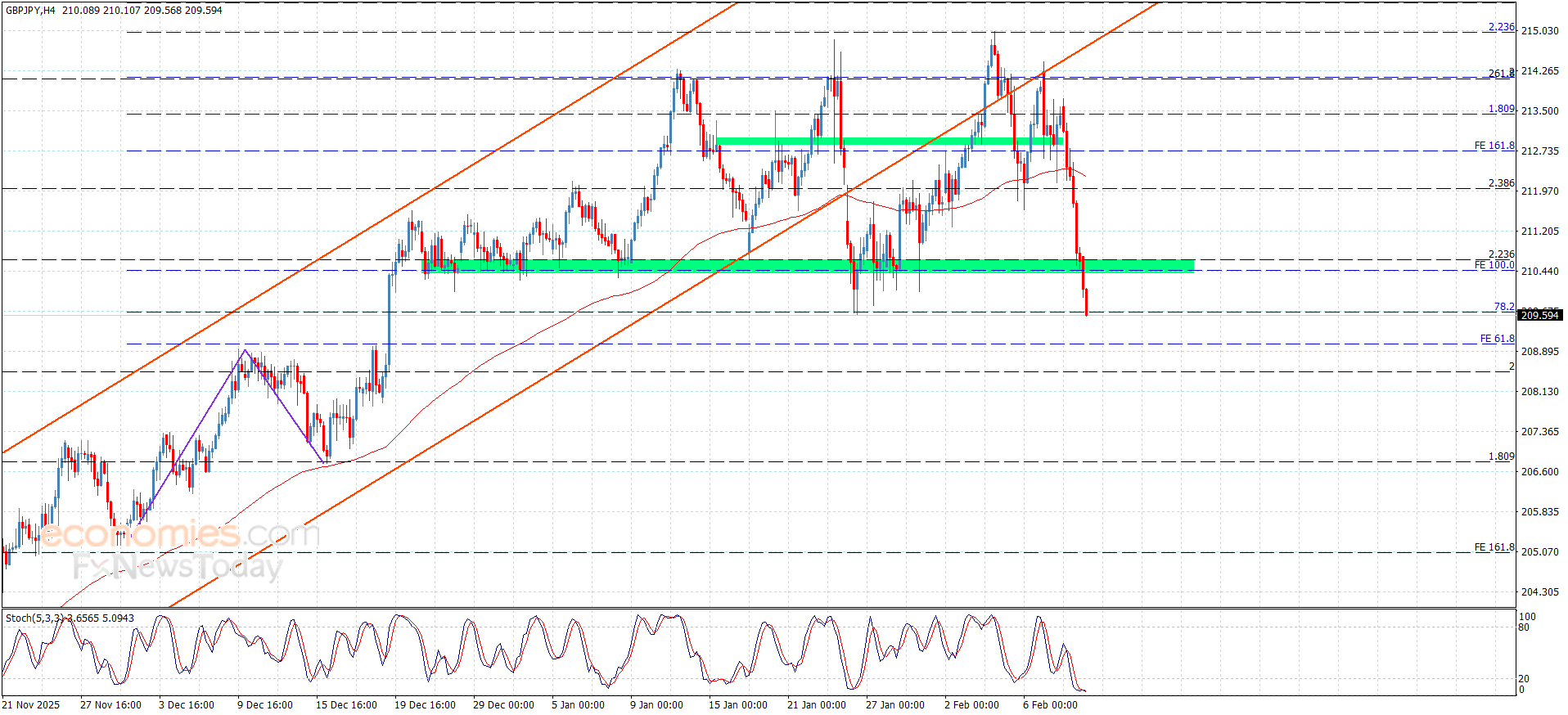
The GBPJPY pair achieved the previously suggested negative targets by hitting 210.40 level, but providing negative momentum by the main indicators pushed this morning trading to resume the negative trend.
Forming negative attempts make us expect targeting 209.10 level, which might form an important support to recover the losses gradually by its rally towards 209.90 and 210.40, while breaking this barrier will force it suffer extra losses that might extend towards 208.50 and 208.20.
The expected trading range for today is between 209.00 and 210.40
Trend forecast: Bearish
Natural gas price continued forming negative pressures to keep its positive stability above the bullish channel’s support at $3.050, forming weak sideways trading due to the contradiction of the main indicators by providing negative momentum in the last period.
Note that the stability above the support level makes us wait for gathering the bullish momentum, to ease the mission of forming bullish waves, to target $3.450 reaching $3.910 level, while breaking the support and holding below it will force it to resume the decline, suffering big losses by reaching $2.850 and $2.660.
The expected trading range for today is between $3.000 and $3.450
Trend forecast: Bullish
BitcoinWorld
Silver Price Forecast: XAG/USD Bulls Face Critical $82.00 Resistance as Crucial US NFP Data Looms
Global precious metals markets remain tense as silver prices hover below the critical $82.00 resistance level, with traders worldwide awaiting the March 2025 US Non-Farm Payrolls report that could determine the next major directional move for XAG/USD. The white metal’s recent consolidation reflects broader market uncertainty about Federal Reserve policy and global economic stability.
Silver’s XAG/USD pair currently faces significant technical resistance below the $82.00 psychological barrier. Market analysts observe that the precious metal has tested this level three times in the past month without achieving a decisive breakthrough. Consequently, technical indicators suggest potential consolidation between $78.50 support and $82.00 resistance until fundamental catalysts emerge.
Several key technical factors influence the current silver price forecast. First, the 50-day moving average at $79.25 provides immediate support. Second, the Relative Strength Index (RSI) reading of 58 indicates neither overbought nor oversold conditions. Third, trading volume patterns show decreased participation ahead of major economic data releases.
| Level | Type | Significance |
|---|---|---|
| $82.00 | Resistance | Psychological barrier, previous highs |
| $79.25 | Support | 50-day moving average |
| $78.50 | Support | March consolidation low |
| $84.75 | Resistance | 2025 year-to-date high |
The upcoming US employment report represents the most significant fundamental catalyst for silver prices this week. Economists project the March 2025 Non-Farm Payrolls will show 180,000 new jobs created, with unemployment holding steady at 3.8%. However, wage growth data may prove more influential for precious metals markets.
Historical analysis reveals specific patterns in silver’s response to NFP data. Strong employment numbers typically strengthen the US dollar, creating headwinds for dollar-denominated silver. Conversely, weaker-than-expected data often triggers safe-haven flows into precious metals. The Federal Reserve’s dual mandate of maximum employment and price stability makes this report particularly significant for monetary policy expectations.
Major financial institutions provide nuanced silver price forecasts based on multiple variables. Goldman Sachs analysts note industrial demand remains robust despite recent price consolidation. Meanwhile, JP Morgan researchers highlight central bank diversification into precious metals as a structural support factor. Bloomberg Intelligence reports ETF holdings have stabilized after February outflows.
The World Silver Survey 2024 provides crucial context for current market dynamics. Global silver demand reached 1.2 billion ounces last year, with industrial applications accounting for over 50% of total consumption. Photovoltaic panel manufacturing alone consumed 140 million ounces, representing 11% growth year-over-year. Mine production increased modestly to 850 million ounces, maintaining the market deficit that has persisted for three consecutive years.
Multiple macroeconomic variables beyond employment data affect the silver price forecast. Real interest rates remain the primary driver of opportunity costs for holding non-yielding assets. Inflation expectations continue to influence investor allocation decisions. Geopolitical tensions in multiple regions support safe-haven demand. Additionally, dollar strength inversely correlates with silver prices approximately 70% of the time.
Recent Federal Reserve communications suggest cautious optimism about inflation control. Chair Powell’s March testimony emphasized data-dependent decision-making. Consequently, each economic release carries amplified significance for forward guidance. Market-implied probabilities currently suggest 65% likelihood of a rate cut by June 2025, according to CME FedWatch Tool data.
Silver’s price action diverges notably from gold in recent sessions. While gold maintains strength above $2,150 per ounce, silver struggles with specific resistance. The gold-silver ratio currently stands at 86:1, above the 10-year average of 80:1. This discrepancy suggests potential mean reversion opportunities if silver catches up to gold’s performance.
Platinum and palladium provide additional context for industrial precious metals. Both face unique supply challenges but lack silver’s dual investment-industrial characteristics. Automotive sector transitions affect platinum group metals more directly than silver. However, all precious metals respond similarly to dollar strength and real yield movements.
Market psychology around key resistance levels often creates self-fulfilling prophecies. The $82.00 level represents not just technical resistance but psychological barrier for traders. Previous instances show that decisive breaks above such levels typically require fundamental catalysts combined with technical momentum. Volume analysis indicates institutional participation increases after major economic releases.
The 2020-2024 period provides relevant historical parallels. Silver broke above $30 resistance in 2020 following massive monetary stimulus. The 2022 consolidation around $24 preceded the 2023 rally. Current market structure resembles 2021’s sideways action before the September breakout. Options market data shows increased interest in $85 calls for April expiration.
Several risk factors could alter the current silver price forecast. Unexpectedly strong NFP data might trigger dollar rallies pressuring metals. Geopolitical de-escalation could reduce safe-haven demand. Technological breakthroughs in silver substitution represent longer-term risks. Regulatory changes in major markets might affect trading volumes and liquidity conditions.
Alternative scenarios deserve consideration in comprehensive analysis. A dovish Fed interpretation of strong data could support metals despite dollar strength. Coordinated central bank buying might provide unexpected support. Supply disruptions from major producing regions could tighten physical markets. Green energy acceleration might boost industrial demand beyond current projections.
The silver price forecast remains contingent on the upcoming US Non-Farm Payrolls data and the XAG/USD pair’s ability to overcome $82.00 resistance. Technical indicators suggest consolidation, while fundamental factors await clarification. Market participants should monitor employment data, dollar dynamics, and industrial demand indicators for directional signals. The precious metal’s dual nature as both monetary asset and industrial commodity creates unique opportunities amid current economic crosscurrents.
Q1: Why is $82.00 important for silver prices?
The $82.00 level represents significant technical resistance tested multiple times in recent months. A decisive break above could trigger further buying, while rejection might lead to consolidation or correction.
Q2: How does US employment data affect silver?
Strong NFP data typically strengthens the US dollar, creating headwinds for dollar-denominated silver. Weak data may boost safe-haven demand for precious metals as investors anticipate dovish Fed policy.
Q3: What percentage of silver demand comes from industrial uses?
Industrial applications account for approximately 50% of total silver demand, with photovoltaic manufacturing representing the fastest-growing segment at 11% annual growth.
Q4: How does silver differ from gold in market behavior?
Silver exhibits higher volatility and stronger correlation with industrial cycles than gold. The gold-silver ratio measures their relative performance, currently favoring gold at 86:1.
Q5: What are the main risk factors for silver prices?
Primary risks include dollar strength, rising real interest rates, economic slowdown reducing industrial demand, and technological substitution in key applications like photography and electronics.
This post Silver Price Forecast: XAG/USD Bulls Face Critical $82.00 Resistance as Crucial US NFP Data Looms first appeared on BitcoinWorld.
The EURJPY pair was under strong bearish pressure yesterday, to press on the bullish channel’s support, represented by 183.45 level, to begin this morning trading with new negative trading by its exit from the bullish track and suffering extra losses by reaching 182.60 level.
Providing negative momentum by the main indicators confirms the price surrender to the bearish scenario, to expect to continue targeting negative stations until reaching 182.00, to attempt to test the next support near 181.05.
The expected trading range for today is between 181.05 and 183.50
Trend forecast: Bearish
Natural gas price continued forming negative pressures to keep its positive stability above the bullish channel’s support at $3.050, forming weak sideways trading due to the contradiction of the main indicators by providing negative momentum in the last period.
Note that the stability above the support level makes us wait for gathering the bullish momentum, to ease the mission of forming bullish waves, to target $3.450 reaching $3.910 level, while breaking the support and holding below it will force it to resume the decline, suffering big losses by reaching $2.850 and $2.660.
The expected trading range for today is between $3.000 and $3.450
Trend forecast: Bullish
BitcoinWorld
EUR/GBP Forecast: Critical Resistance Battle Looms as Pair Hovers Below 0.8720 and 0.8745 Levels
London, March 2025 – The EUR/GBP currency pair currently faces a decisive technical juncture, hovering below significant resistance levels at 0.8720 and 0.8745. This positioning follows several weeks of consolidation within a narrowing trading range. Market participants closely monitor these technical barriers as they could determine the pair’s directional bias for the coming trading sessions. Meanwhile, fundamental factors from both the Eurozone and United Kingdom continue to influence price action through monetary policy expectations and economic data releases.
The EUR/GBP exchange rate demonstrates clear technical characteristics as it approaches critical resistance zones. Currently trading around 0.8705, the pair has tested the 0.8720 level three times in the past two weeks without sustaining a breakthrough. Each rejection has resulted in modest pullbacks toward the 0.8680 support area. The 0.8745 resistance represents a more significant barrier, corresponding with the 61.8% Fibonacci retracement level from the January decline. Technical analysts note that the pair maintains position above its 50-day moving average at 0.8682, suggesting underlying support remains intact despite resistance challenges.
Volume analysis reveals decreasing participation during recent resistance tests, potentially indicating weakening selling pressure at these levels. The Relative Strength Index (RSI) currently reads 58, positioned in neutral territory with room for movement in either direction. Bollinger Bands show contraction, typically preceding significant price movements. Furthermore, the Average Directional Index (ADX) registers at 22, suggesting the current trend lacks strong directional conviction. These technical indicators collectively paint a picture of a market awaiting a catalyst for decisive movement.
Multiple fundamental factors currently influence the EUR/GBP exchange rate, creating a complex backdrop for price action. The European Central Bank maintains a cautious approach to monetary policy normalization, with inflation in the Eurozone showing signs of moderation toward target levels. Recent ECB communications suggest a measured pace of interest rate adjustments, contrasting with more aggressive approaches seen in previous cycles. Meanwhile, the Bank of England faces its own policy challenges as UK economic data presents mixed signals about growth and inflation persistence.
Economic indicators from both regions reveal important divergences affecting currency valuations. Eurozone manufacturing PMI data recently improved to 47.8, though remaining in contraction territory. Services sector performance shows greater resilience at 52.3. UK economic data presents a different picture, with services PMI at 53.5 but manufacturing struggling at 46.2. These sectoral differences influence central bank policy expectations and consequently currency valuations. Additionally, political developments in both regions contribute to market uncertainty, with European Parliament elections approaching and UK political dynamics continuing to evolve post-Brexit.
Interest rate differentials remain a crucial factor for EUR/GBP direction. Current market pricing suggests approximately 75 basis points of ECB easing priced in for 2025, compared to 50 basis points from the Bank of England. This differential creates inherent support for sterling against the euro, though actual policy implementation may diverge from market expectations. Trade balance data also influences currency flows, with the UK maintaining a substantial goods trade deficit partially offset by services surplus, while the Eurozone shows more balanced external accounts.
The 0.8720 resistance level holds particular technical importance as it represents the convergence of multiple analytical factors. This price point aligns with the early March high and corresponds to the upper boundary of a descending trendline from the January peak. Additionally, option barriers reportedly cluster around this level, potentially amplifying its significance. The 0.8745 resistance carries even greater weight as it represents the 61.8% Fibonacci retracement of the January-February decline, a level many technical traders monitor for trend continuation or reversal signals.
Market positioning data reveals interesting dynamics around these resistance levels. According to recent Commitment of Traders reports, speculative positioning in EUR/GBP remains relatively balanced with a slight net long euro position. This contrasts with more extreme positioning seen in other major currency pairs. The balanced positioning suggests market participants await clearer directional signals before committing to substantial positions. Order flow analysis indicates substantial sell orders clustered above 0.8720, potentially explaining recent rejections at this level.
| Level | Type | Significance |
|---|---|---|
| 0.8745 | Resistance | 61.8% Fibonacci, January high |
| 0.8720 | Resistance | March highs, trendline resistance |
| 0.8680 | Support | 50-day MA, recent lows |
| 0.8650 | Support | 100-day MA, psychological level |
| 0.8600 | Support | 2025 low, major psychological |
Several technical patterns warrant attention in the current EUR/GBP price structure. The pair has formed a symmetrical triangle pattern over the past six weeks, with converging trendlines suggesting impending volatility expansion. Additionally, a bullish divergence appeared on the daily chart earlier this month, with price making lower lows while momentum indicators formed higher lows. This classic technical signal often precedes trend reversals, though confirmation requires price breaking above resistance levels. The 200-day moving average currently sits at 0.8665, providing additional context for the broader trend direction.
Historical analysis of EUR/GBP price action provides valuable context for current market conditions. The pair has demonstrated notable seasonal tendencies, with March typically showing increased volatility as financial year-ends approach in multiple jurisdictions. Over the past decade, March has produced positive returns for EUR/GBP in six of ten years, with an average monthly movement of approximately 1.8%. This historical context suggests the current consolidation may resolve with increased directional movement as the month progresses.
Longer-term charts reveal that the 0.8720-0.8745 resistance zone previously served as support during the latter half of 2023. This role reversal from support to resistance represents a common technical phenomenon that often creates significant price reactions. The psychological importance of round numbers in forex trading further amplifies the significance of these levels, with many algorithmic trading systems programmed to respond to tests of such technical thresholds. Market memory of previous price action around these levels may influence current trader behavior and order placement.
Major financial institutions offer varied perspectives on EUR/GBP’s near-term direction. Several investment banks highlight the importance of the 0.8745 level, suggesting a sustained break above could trigger momentum buying toward 0.8800. Conversely, other analysts emphasize downside risks should the pair fail to overcome current resistance, with potential declines toward 0.8600. These divergent views reflect genuine uncertainty in markets about the fundamental drivers and their relative importance.
Multiple risk scenarios could influence EUR/GBP direction in coming sessions. A breakthrough of 0.8745 resistance could trigger:
Conversely, rejection at current levels might prompt:
Trading volume patterns around key technical levels provide insights into market dynamics. Recent sessions show increased volume during European trading hours when the pair approaches resistance, suggesting institutional participation in these price tests. Asian session volume remains subdued, while North American participation varies with broader dollar dynamics. Liquidity conditions remain adequate, though bid-ask spreads occasionally widen during volatile periods, particularly around economic data releases from either region.
Options market activity reveals interesting positioning around current price levels. Implied volatility for at-the-money options remains elevated compared to historical averages, reflecting market uncertainty about near-term direction. Risk reversals show slight skew toward euro puts (sterling calls), indicating modest hedging demand for euro downside protection. This options market positioning provides additional context for spot price action and potential volatility events.
The EUR/GBP forecast remains contingent on the pair’s ability to overcome significant resistance at 0.8720 and 0.8745. Technical indicators suggest consolidation within a narrowing range, typically preceding directional movement. Fundamental factors present a mixed picture, with monetary policy expectations and economic data from both regions influencing trader sentiment. Market participants should monitor these resistance levels closely, as sustained breaks above could trigger momentum-based buying, while rejections might prompt renewed testing of support areas. The current technical setup, combined with fundamental uncertainties, creates conditions for potentially significant price movement once the consolidation phase resolves.
Q1: What are the key resistance levels for EUR/GBP?
The primary resistance levels are 0.8720 and 0.8745. The 0.8720 level represents recent highs and trendline resistance, while 0.8745 corresponds with the 61.8% Fibonacci retracement level from January’s decline.
Q2: What fundamental factors currently influence EUR/GBP?
Monetary policy expectations from the ECB and Bank of England, economic data from both regions, interest rate differentials, and political developments in Europe and the UK all influence the pair’s direction.
Q3: What technical patterns are visible in EUR/GBP charts?
The pair shows a symmetrical triangle pattern with converging trendlines, suggesting impending volatility expansion. The price also maintains position above its 50-day moving average while facing resistance from higher time frame levels.
Q4: How does market positioning affect EUR/GBP price action?
According to Commitment of Traders reports, speculative positioning remains relatively balanced with a slight net long euro position. This balanced positioning suggests traders await clearer directional signals before establishing substantial positions.
Q5: What happens if EUR/GBP breaks above 0.8745 resistance?
A sustained break above 0.8745 could trigger momentum buying, stop-loss activation on short positions, and potentially rapid movement toward the next resistance area around 0.8800, depending on accompanying volume and fundamental developments.
This post EUR/GBP Forecast: Critical Resistance Battle Looms as Pair Hovers Below 0.8720 and 0.8745 Levels first appeared on BitcoinWorld.
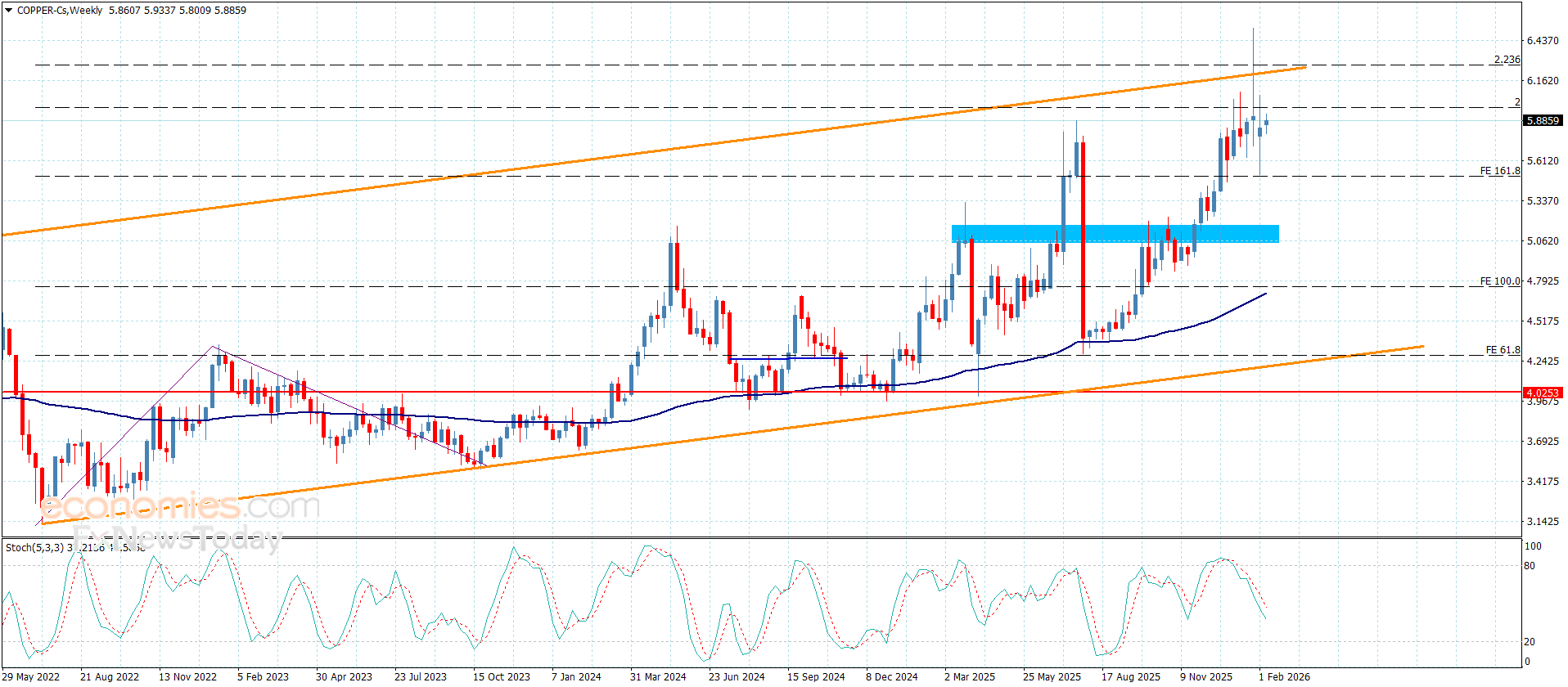
Despite the weakness of copper price’s last trading, the stability below $5.9700 level and providing bearish momentum by stochastic reaching below50 level makes us keep the bearish corrective scenario in the near-period trading, reminding you that the initial targets is located near $5.7200 and $5.5100 level.
While breaching the barrier and holding above it will reinforce the chances of forming new bullish waves, attempting to record some extra gains by reaching $6.1200.
The expected trading range for today is between $5.5100 and $5.9500
Trend forecast: Bearish
– Written by
David Woodsmith
STORY LINK GBP/USD Forecast: Pound Sterling Drifts Near $1.36
The Pound to US Dollar exchange rate (GBP/USD) struggled to gain momentum on Tuesday, with renewed political uncertainty in the UK weighing on Sterling sentiment.
At the time of writing, GBP/USD was trading around $1.3679, down close to 0.2% on the session as investors remained cautious.
The Pound stayed on the back foot as markets continued to digest a turbulent period for the UK government. Confidence was shaken by the resignation of two senior aides and renewed scrutiny of Prime Minister Keir Starmer’s leadership.
Adding to the pressure, Scottish Labour leader Anas Sarwar publicly urged Starmer to step aside, reigniting debate over the Prime Minister’s grip on power. While Starmer has resisted calls to resign, attention is already shifting to the upcoming Manchester by-election, where a poor result for Labour could intensify leadership concerns and keep Sterling exposed.
The US Dollar initially traded firmer, benefiting from a broader recovery in US markets. However, the Greenback’s upside proved limited after the release of disappointing US retail sales data.
Figures showed sales growth flatlined in December, undershooting expectations for a 0.4% rise. The miss revived concerns about the strength of US consumer spending and nudged markets toward more dovish Federal Reserve rate expectations, capping USD gains.
Get better rates and lower fees on your next international money transfer.
Compare TorFX with top UK banks in seconds and see how much you could save.
Looking ahead, the Pound to Dollar exchange rate could see increased volatility with the release of the latest US non-farm payrolls report. Forecasts point to job growth of around 70,000 in January, up from December’s 50,000 gain.
Given the recent run of weaker labour indicators, another soft reading could reinforce expectations for Fed rate cuts and place renewed pressure on the Dollar.
For Sterling, attention will turn to Thursday’s UK GDP figures. With domestic data scarce and political risks elevated, the Pound may struggle to find clear direction unless growth data delivers a meaningful surprise.

International Money Transfer? Ask our resident FX expert a money transfer question or try John’s new, free, no-obligation personal service! ,where he helps every step of the way,
ensuring you get the best exchange rates on your currency requirements.
TAGS: Pound Dollar Forecasts
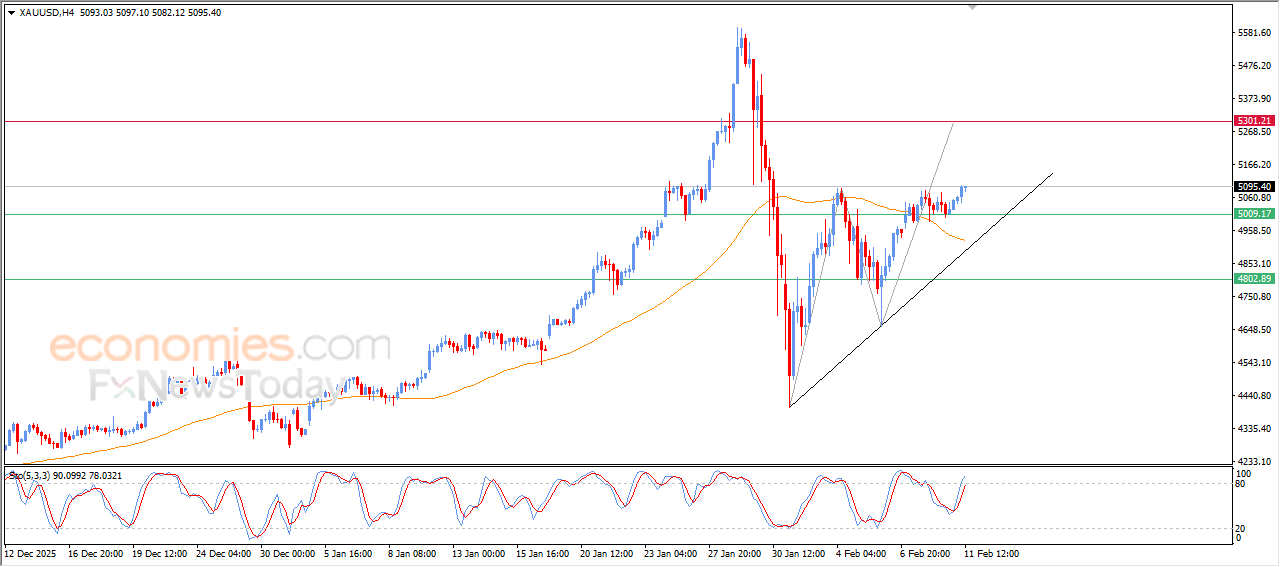
Gold is trading around $5,056 on the 4-hour chart, staying above the key $5,000 level after bouncing from the $4,540 low. The price is within the 0.382 ($4,854) to 0.618 ($5,138) Fibonacci retracement zone, which suggests a steady recovery instead of a full reversal.
Recent candlesticks have tight bodies and small pullbacks, showing steady demand near $4,996, where the 50-period moving average acts as support. A downward trendline from the $5,598 high is still present, keeping pressure near the $5,138 resistance. If price breaks above $5,138, it could move toward $5,303. If it falls below $4,855, attention may turn back to $4,680.
Trade idea: Consider buying if price moves above $5,140, with a stop below $4,855 and a target of $5,300.