The main category of Forex News.
You can use the search box below to find what you need.
[wd_asp id=1]
The main category of Forex News.
You can use the search box below to find what you need.
[wd_asp id=1]
According to Forex market trading, the USD/JPY price continued its upward rebound path as the US dollar’s value rose amid receding global trade tensions. Last week, Japanese Finance Minister Katsunobu Kato and US Treasury Secretary Scott Bessent held a closed-door meeting on the sidelines of the International Monetary Fund and World Bank Spring meetings in Washington. While Kato remained silent on the discussions, he emphasized that Japan and the United States would continue close and constructive dialogue on exchange rates, hinting that currency issues could be part of broader trade negotiations.
Senior Japanese trade negotiator, Hirose Akazawa, is also scheduled to visit Washington this week for a second round of bilateral talks. At the same time, the Bank of Japan is widely expected to keep its interest rate steady at 0.5% this week as it monitors the potential impact of US tariffs on the export-driven Japanese economy.

I still recommend buying the US dollar against the Japanese yen at every downward trend level, but without risk, while monitoring the factors influencing currency rates.
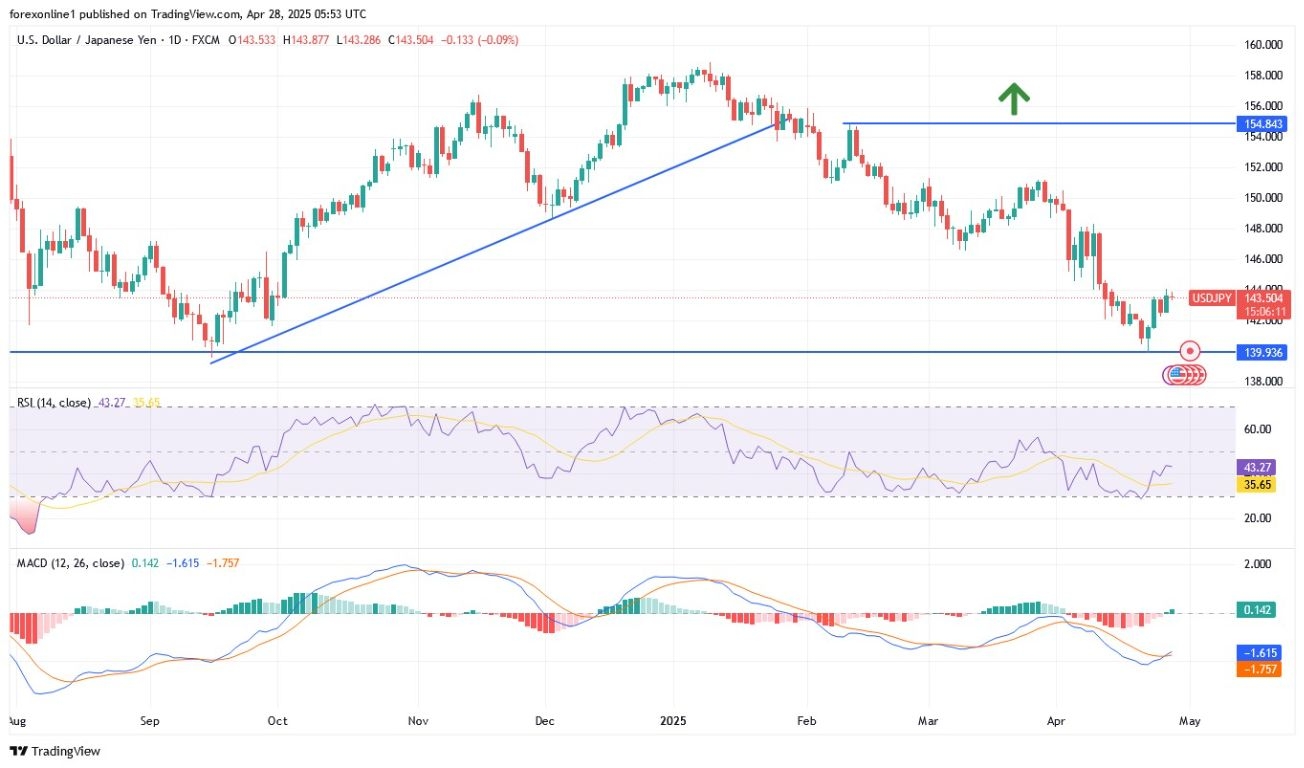
At the end of last week’s trading and in the short term, the USD/JPY pair rebounded from the trendline support level at around 142.48 to trade at around 143.80. The pair is trading within an ascending channel. The USD/JPY pair has now advanced to trade above the 100-hour moving average by a few levels. As a result, the pair is approaching entering overbought levels on the 14-hour RSI. Therefore, bulls will aim to extend the current gains towards the resistance at 144.30 and then to the resistance at 145.00. Conversely, bears will seek to capitalize on renewed profit-taking selling at the support level around 143.20 or lower at the support of 142.50.
In the long term, based on the daily chart, the USD/JPY pair is trading within a descending channel. However, the 14-day RSI has recently rebounded to avoid entering an oversold condition. Therefore, bulls will seek to extend their current rebound towards resistance at 146.00 or higher, reaching resistance at 149.00, respectively. On the other hand, and over the same period of time, bears will seek to take profits at the support level of 141.00 and then at the support level of 139.00, respectively.
Want to trade our USD/JPY forex analysis and predictions? Here’s a list of forex brokers in Japan to check out.
The EURJPY pair provided positive signal on Friday by forming a strong bullish rally, achieving 163.75, which forces it to fluctuate below 163.25 level, due to the contradiction between the main indicators by stochastic exit from the overbought level.
The price might be forced to provide more of the mixed trading, but its success in taking advantage of forming extra support at 162.40 might assist renewing the bullish attempts, to wait for confirming breaching 163.25 to increase the chances for recording new gains by its rally towards 164.20 reaching the next target near 164.90.
The expected trading range for today is between 162.50 and 164.25
Trend forecast: Bullish by confirming the breach
Do you need help in trading decisions? Do you want to learn how to start trading?
Join Economies.com VIP Club and benefit from over 15 years of market analysis expertise and get:
Special Offer: Subscribe to the Economies.com VIP channel and get also a free subscription to a trusted trading signals channel provided by Best Trading Signal.
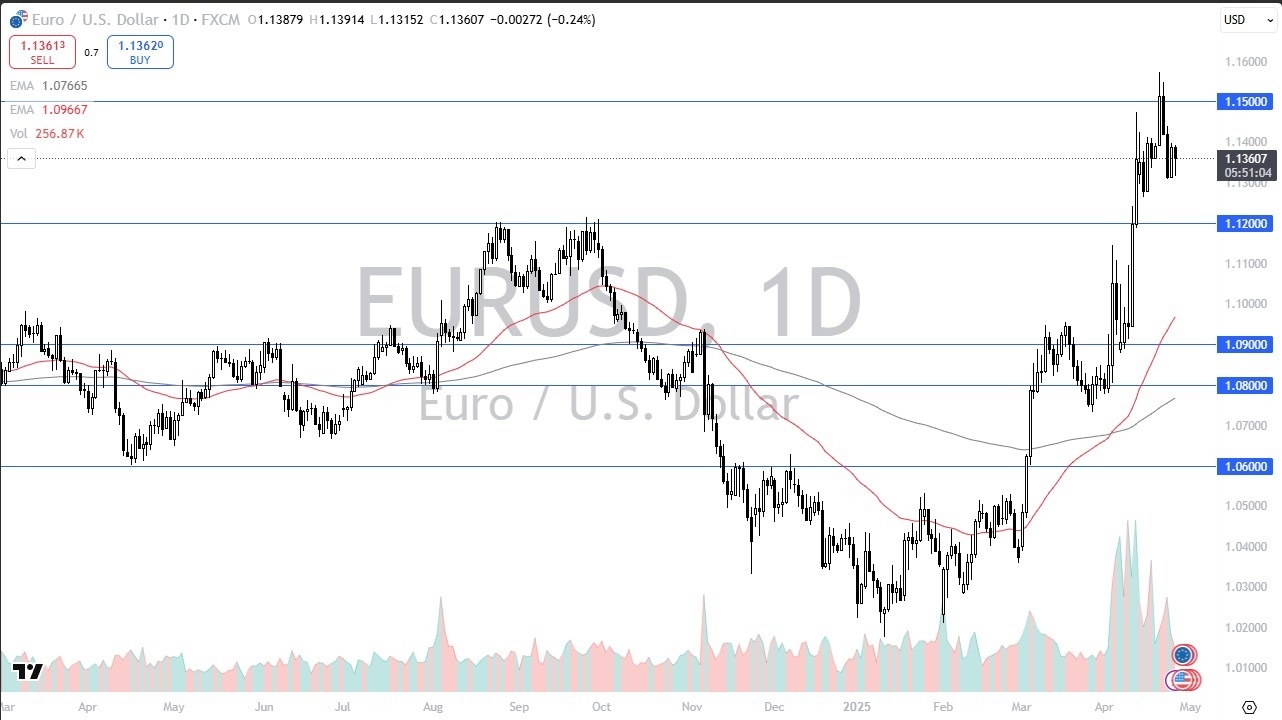
I do believe that the market’s overbought, so sideways action makes more sense than not, and it’s also likely to be a scenario where things are very noisy, and the latest Twitter spat might cause a move, at least with certain players such as President Donald Trump.
If the EUR/USD pair were to break down below the 1.12 level, then it’s likely that we could drop down to the 50 day EMA right around the 1.0965 level. On the other hand, if we were to break above the 1.16 level, then it’s possible that the market could go to the 1.23 level, an area on the longer term charts that matter.
As things stand right now, it looks more or less like a buy on the dip type of situation, but ultimately, we are more likely than not going to see a lot of sideways action, at least in the meantime, until we get a better read on where the global economy is going, central banks, obviously, and of course, what the trade tariff situation ends up being. I don’t think this is an easy trade in either direction, but you have to think that this does suggest that we have a lot of noise in the process to find a new trend in general.
Ready to trade our EUR/USD daily forecast? Here’s a list of some of the top forex brokers in Europe to check out.
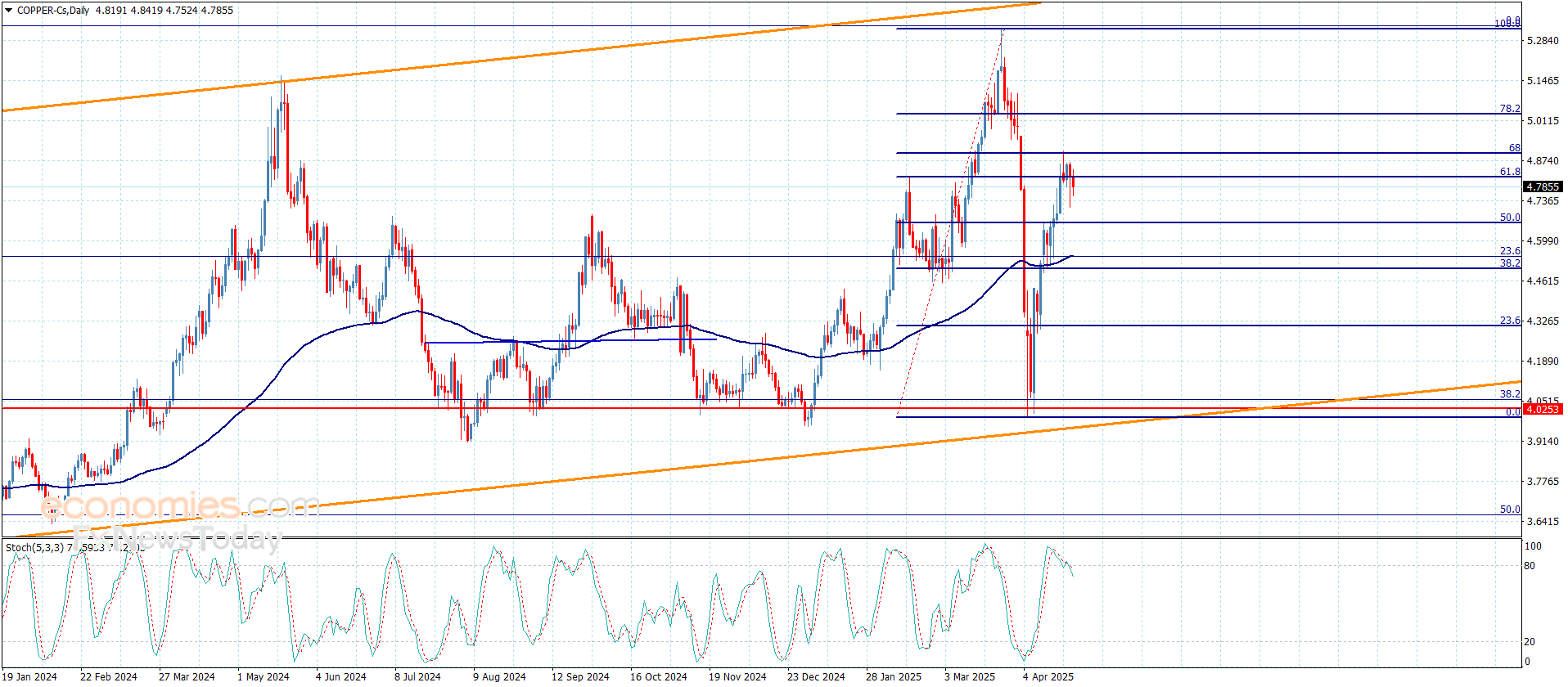
Copper price provided slow trading recently, due to the contradiction between the main indicators, to delay the negative attack and settles near $4.7500 level, reminding you that the bearish scenario will remain valid by the continuation of forming main barrier at $4.9100 against the current trading, which increases the chances for forming bearish waves to press on 50%Fibonacci correction level at $4.6600, and breaking it will extend the losses towards $4.5600, to face the moving average55.
The price rally above the mentioned barrier and holding above it, will confirming delaying the negative attack, and provide chances for recording some extra gains before reaching the previously waited negative targets.
The expected trading range for today is between $4.6600 and $4.8400
Trend forecast: Bearish
Do you need help in trading decisions? Do you want to learn how to start trading?
Join Economies.com VIP Club and benefit from over 15 years of market analysis expertise and get:
Special Offer: Subscribe to the Economies.com VIP channel and get also a free subscription to a trusted trading signals channel provided by Best Trading Signal.
Copper price provided slow trading recently, due to the contradiction between the main indicators, to delay the negative attack and settles near $4.7500 level, reminding you that the bearish scenario will remain valid by the continuation of forming main barrier at $4.9100 against the current trading, which increases the chances for forming bearish waves to press on 50%Fibonacci correction level at $4.6600, and breaking it will extend the losses towards $4.5600, to face the moving average55.
The price rally above the mentioned barrier and holding above it, will confirming delaying the negative attack, and provide chances for recording some extra gains before reaching the previously waited negative targets.
The expected trading range for today is between $4.6600 and $4.8400
Trend forecast: Bearish
Do you need help in trading decisions? Do you want to learn how to start trading?
Join Economies.com VIP Club and benefit from over 15 years of market analysis expertise and get:
Special Offer: Subscribe to the Economies.com VIP channel and get also a free subscription to a trusted trading signals channel provided by Best Trading Signal.
Copper price provided slow trading recently, due to the contradiction between the main indicators, to delay the negative attack and settles near $4.7500 level, reminding you that the bearish scenario will remain valid by the continuation of forming main barrier at $4.9100 against the current trading, which increases the chances for forming bearish waves to press on 50%Fibonacci correction level at $4.6600, and breaking it will extend the losses towards $4.5600, to face the moving average55.
The price rally above the mentioned barrier and holding above it, will confirming delaying the negative attack, and provide chances for recording some extra gains before reaching the previously waited negative targets.
The expected trading range for today is between $4.6600 and $4.8400
Trend forecast: Bearish
Do you need help in trading decisions? Do you want to learn how to start trading?
Join Economies.com VIP Club and benefit from over 15 years of market analysis expertise and get:
Special Offer: Subscribe to the Economies.com VIP channel and get also a free subscription to a trusted trading signals channel provided by Best Trading Signal.
Copper price provided slow trading recently, due to the contradiction between the main indicators, to delay the negative attack and settles near $4.7500 level, reminding you that the bearish scenario will remain valid by the continuation of forming main barrier at $4.9100 against the current trading, which increases the chances for forming bearish waves to press on 50%Fibonacci correction level at $4.6600, and breaking it will extend the losses towards $4.5600, to face the moving average55.
The price rally above the mentioned barrier and holding above it, will confirming delaying the negative attack, and provide chances for recording some extra gains before reaching the previously waited negative targets.
The expected trading range for today is between $4.6600 and $4.8400
Trend forecast: Bearish
Do you need help in trading decisions? Do you want to learn how to start trading?
Join Economies.com VIP Club and benefit from over 15 years of market analysis expertise and get:
Special Offer: Subscribe to the Economies.com VIP channel and get also a free subscription to a trusted trading signals channel provided by Best Trading Signal.
The Gold price (XAU/USD) drifts lower to around $3,310 during the early Asian session on Monday. The precious metal retreats after hitting its record high last week amid signs that global trade tensions may be easing.
US Agriculture Secretary Brooke Rollins said on Sunday that the Trump administration is having daily conversations with China over tariffs, per Reuters. Rollins noted that there were ongoing talks between the two nations and that trade deals with other nations were “very close.”
“Headlines over potential, partial exemptions in retaliatory tariffs further boosted sentiment today and allowed gold to dip below $3,300 levels,” said Yuxuan Tang, a strategist at JPMorgan Private Bank.
On the other hand, US President Donald Trump’s announcement of broad and steep tariffs earlier in April prompted fears of the US economy tipping into a recession in recent weeks. The International Monetary Fund (IMF) warned last week that the US is confronting an increased risk of recession as Trump’s trade war pushes the global economy into a significant slowdown. This, in turn, could boost the Gold price, a traditional safe-haven asset.
Gold traders will closely monitor the preliminary reading of US Gross Domestic Product (GDP) for the first quarter (Q1), which is due later on Wednesday. On Friday, the attention will shift to the US April employment report, including Nonfarm Payrolls (NFP), Unemployment Rate and Average Hourly Earnings.
Gold has played a key role in human’s history as it has been widely used as a store of value and medium of exchange. Currently, apart from its shine and usage for jewelry, the precious metal is widely seen as a safe-haven asset, meaning that it is considered a good investment during turbulent times. Gold is also widely seen as a hedge against inflation and against depreciating currencies as it doesn’t rely on any specific issuer or government.
Central banks are the biggest Gold holders. In their aim to support their currencies in turbulent times, central banks tend to diversify their reserves and buy Gold to improve the perceived strength of the economy and the currency. High Gold reserves can be a source of trust for a country’s solvency. Central banks added 1,136 tonnes of Gold worth around $70 billion to their reserves in 2022, according to data from the World Gold Council. This is the highest yearly purchase since records began. Central banks from emerging economies such as China, India and Turkey are quickly increasing their Gold reserves.
Gold has an inverse correlation with the US Dollar and US Treasuries, which are both major reserve and safe-haven assets. When the Dollar depreciates, Gold tends to rise, enabling investors and central banks to diversify their assets in turbulent times. Gold is also inversely correlated with risk assets. A rally in the stock market tends to weaken Gold price, while sell-offs in riskier markets tend to favor the precious metal.
The price can move due to a wide range of factors. Geopolitical instability or fears of a deep recession can quickly make Gold price escalate due to its safe-haven status. As a yield-less asset, Gold tends to rise with lower interest rates, while higher cost of money usually weighs down on the yellow metal. Still, most moves depend on how the US Dollar (USD) behaves as the asset is priced in dollars (XAU/USD). A strong Dollar tends to keep the price of Gold controlled, whereas a weaker Dollar is likely to push Gold prices up.
April 27, 2025 – Written by Tim Boyer
STORY LINK Pound to Euro Week Ahead Forecast: Overvalued Sterling “Vulnerable to Correction”
Foreign exchange analysts at Danske Bank now forecast the Pound Sterling (GBP) will slide to 1.1365 against the Euro (EUR) on a 12-month view amid a persistent slide in global risk appetite.
In contrast, Credit Agricole, expects Pound to Euro (GBP/EUR) exchange rate gains to 1.2050 by the end of 2025 with the Euro overvalued.
During the week, GBP/EUR was able to secure a tentative net gain to 2-week highs near 1.1730. Risk conditions were more benign during the week which helped underpin Sterling.
According to Credit Agricole; “we note that our estimates of short-term fair value that are based on FX drivers like relative rate spreads and risk aversion suggest that the GBP is looking quite undervalued vs the EUR.”
It added; “the very overvalued EUR/GBP could remain vulnerable to a correction lower in the near term.”
ING commented that there will be scope for further GBP/EUR gains if it can break above 1.1730.
The Pound will tend to gain support if there is a further improvement in confidence, but any renewed setback would put the currency under renewed pressure.
Danske Bank commented; “The key risk to seeing EUR/GBP trade substantially higher than our forecast is a sharp sell-off in global risk and/or renewed focus on the UK’s fragile fiscal position.”
MUFG noted the importance of safe-haven demand and noted; “the recent divergence in TWI performances for EUR and GBP with EUR supported by safe-haven demand that GBP is unlikely to see.”
Danske expanded its analysis; “While we see domestic factors and the relative growth outlook between the UK and the euro area as GBP positives, we think the global investment environment will be in the driver’s seat for EUR/GBP in the coming months.”
It added; “An investment environment characterised by elevated uncertainty, widening credit spreads and a positive correlation to a USD negative environment, in our view, favours a weaker GBP. The UK runs a large current-account deficit, which makes GBP vulnerable when capital inflows fade.”
As far as monetary policy is concerned, there are very strong expectations that the Bank of England will cut interest rates by a further 25 basis points to 4.25%.
In comments this week, Governor Bailey expressed concerns over the global growth outlook due to trade tariffs, but there are also inflation concerns which will make policy setting notably difficult.
Caution would help underpin the Pound on yield grounds.

MUFG commented; “While a 25bp cut at the next MPC meeting on 8th May is highly likely and fully priced, further cuts beyond could quickly be questioned if supply-side issue create inflationary pressures in the UK. Much stickier wage growth could force the BoE into a more cautious approach to rate cuts given fiscal uncertainties and Gilt market concerns.”
There has been dovish commentary from ECB officials with Governing Council member Rehn, for example, stating that the ECB should not rule out a larger 50bp rate cut if the conditions supported a bigger move.
There are expectations that there will be a further rate cut in June.
MUFG added; “Disinflation and the demand shock are the focus underlining rate cut prospects.”
Credit Agricole noted that Euro gains will curb Euro-Zone growth and put downward pressure on inflation.
It added; we believe a continuation of the recent EUR strength could be self-defeating as it would increase the risk of a more dovish ECB pivot.
International Money Transfer? Ask our resident FX expert a money transfer question or try John’s new, free, no-obligation personal service! ,where he helps every step of the way,
ensuring you get the best exchange rates on your currency requirements.
April 27, 2025 – Written by David Woodsmith
STORY LINK Pound to Dollar Forecast: RSI Firmly Bullish, Resistance Closer to 1.34
In view of sharp dollar losses, most investment banks have dropped their forecasts for sustained Pound to Dollar exchange rate (GBP/USD) losses.
Danske Bank and UBS both now have 12-month GBP/USD forecasts of 1.39.
Standard Chartered is more cautious and has a 12-month GBP/USD forecast of 1.34.
After testing 3-year highs around 1.3430, GBP/USD consolidated just above 1.3300 as the dollar recovered some ground.
President Trump rowed back on his threat to dismiss Fed Chair Powell which triggered a Wall Street rebound and dollar recovery.
The Pound was underpinned by steady gains in the FTSE 100 index as well as stronger than expected retail sales data.
Confidence in US assets and currency will remain crucial for global markets with trade and tariff developments inevitably playing a big part.
The Administration remains upbeat over the outlook for trade deals for countries such as Japan, but any positive headlines may not be backed up with substance.
US-China relations remain very difficult despite China’s move to cut tariffs on some key imports.
Markets will continue to track shipping data and evidence on the impact of tariffs.
ABN Amro expects there will be long-term dollar damage; “In trying to bring back manufacturing, and reducing its dependence on China, the US is destroying its reputation and risks losing its dominance of the financial system, perhaps even to China. Tariffs can be unwound quickly, but regaining the world’s trust will take much longer.”
According to Danske the dollar is still vulnerable; “In the near term, the brewing confidence crisis in US assets and mounting US recession concerns are likely to remain dominant market themes, offering continued support for the cross.”
Danske added; “Longer term, we believe the evolving structural backdrop — including the seismic shift in US politics, the ongoing trade war, and signs of capital rotation out of US assets — will leave the USD facing the greatest relative downside.”
Standard Chartered commented; “We now see downside risks primarily driven by renewed tariff noise. Reduced US policy uncertainty or a decisively hawkish turn in Fed policy is an upside risk for the USD.”
There are strong expectations that the Bank of England will cut rates at the May policy meeting with most banks expecting a further two cuts over the second half of the year.
UBS expects the Pound can hold its own in global markets and take advantage of a soft dollar; “While we do not believe investors are yet considering the GBP a safe haven, we acknowledge its high correlation to the EUR during these uncertain times. Its liquidity and carry profile do seem attractive to global investors. Both should remain in place for the time being, barring any yield blow ups.
The Pound could benefit if the Federal Reserve engages in sharp interest rate cuts.
According to Standard Chartered; “expectations of rising near-term inflation should keep the Fed cautious in its approach to interest rate adjustments, supporting the USD in the near term. However, trade policy uncertainty may hinder US economic growth and lead to fund rotations out of the US, potentially leading to a softer dollar over a 12-month horizon.”
The UK fiscal 2024/25 budget deficit was £151.9bn, £14.6 billion more than forecast by the Office for Budget Responsibility (OBR).
Commerzbank is not confident in the UK outlook; “the UK’s recent growth has been almost entirely based on the public sector. So, not a good sign for the pound: less growth and more rate cuts at the same time.”
RBC Capital Markets added; “less than a month after the Spring Statement it already looks likely that the Chancellor will have to make further policy changes at the Budget in the Autumn.”
Nevertheless, it considers that the structural process of updated forecasts overstates potential vulnerability.
The bank added; “For sure, it’s not that the UK has a great story to tell, it’s just that its story isn’t a significantly worse one than many of its peers.”
UBS expects global developments will dominate for now; “The UK data calendar is relatively light next week suggesting that the near-term outlook for the GBP could remain a function of global drivers like the resilience of market risk sentiment and the evolution of the USD across the board.”
International Money Transfer? Ask our resident FX expert a money transfer question or try John’s new, free, no-obligation personal service! ,where he helps every step of the way,
ensuring you get the best exchange rates on your currency requirements.