The main category of Forex News.
You can use the search box below to find what you need.
[wd_asp id=1]
The main category of Forex News.
You can use the search box below to find what you need.
[wd_asp id=1]
– Written by
David Woodsmith
STORY LINK GBP/USD Forecast: Pound Sterling Drifts Near $1.36
The Pound to US Dollar exchange rate (GBP/USD) struggled to gain momentum on Tuesday, with renewed political uncertainty in the UK weighing on Sterling sentiment.
At the time of writing, GBP/USD was trading around $1.3679, down close to 0.2% on the session as investors remained cautious.
The Pound stayed on the back foot as markets continued to digest a turbulent period for the UK government. Confidence was shaken by the resignation of two senior aides and renewed scrutiny of Prime Minister Keir Starmer’s leadership.
Adding to the pressure, Scottish Labour leader Anas Sarwar publicly urged Starmer to step aside, reigniting debate over the Prime Minister’s grip on power. While Starmer has resisted calls to resign, attention is already shifting to the upcoming Manchester by-election, where a poor result for Labour could intensify leadership concerns and keep Sterling exposed.
The US Dollar initially traded firmer, benefiting from a broader recovery in US markets. However, the Greenback’s upside proved limited after the release of disappointing US retail sales data.
Figures showed sales growth flatlined in December, undershooting expectations for a 0.4% rise. The miss revived concerns about the strength of US consumer spending and nudged markets toward more dovish Federal Reserve rate expectations, capping USD gains.
Get better rates and lower fees on your next international money transfer.
Compare TorFX with top UK banks in seconds and see how much you could save.
Looking ahead, the Pound to Dollar exchange rate could see increased volatility with the release of the latest US non-farm payrolls report. Forecasts point to job growth of around 70,000 in January, up from December’s 50,000 gain.
Given the recent run of weaker labour indicators, another soft reading could reinforce expectations for Fed rate cuts and place renewed pressure on the Dollar.
For Sterling, attention will turn to Thursday’s UK GDP figures. With domestic data scarce and political risks elevated, the Pound may struggle to find clear direction unless growth data delivers a meaningful surprise.

International Money Transfer? Ask our resident FX expert a money transfer question or try John’s new, free, no-obligation personal service! ,where he helps every step of the way,
ensuring you get the best exchange rates on your currency requirements.
TAGS: Pound Dollar Forecasts
Gold is trading around $5,056 on the 4-hour chart, staying above the key $5,000 level after bouncing from the $4,540 low. The price is within the 0.382 ($4,854) to 0.618 ($5,138) Fibonacci retracement zone, which suggests a steady recovery instead of a full reversal.
Recent candlesticks have tight bodies and small pullbacks, showing steady demand near $4,996, where the 50-period moving average acts as support. A downward trendline from the $5,598 high is still present, keeping pressure near the $5,138 resistance. If price breaks above $5,138, it could move toward $5,303. If it falls below $4,855, attention may turn back to $4,680.
Trade idea: Consider buying if price moves above $5,140, with a stop below $4,855 and a target of $5,300.
The US dollar tried to rally on Tuesday but failed miserably against the Japanese yen.
The US dollar initially rallied on Tuesday to break above the 50-day EMA but then fell rather significantly. At this point in time, the Japanese yen continues to strengthen, and I think part of this might be due to the fact that the elections in Japan probably were front run by the market, and I also believe that the market will eventually bounce and go higher.
The 200-day EMA sitting at the 152.37 level will be supported right along with the 152-yen level. Ultimately, I do think that buying this pair is the right thing to do but we just don’t have the setup yet. A little bit of a bounce that I can buy on the right-hand side of the V is what I’m looking for.
If we do break down below the 152-yen level, then the market could drop to the 148-yen level, kicking off an even deeper correction. Ultimately, this is a market that I think is going to continue to see plenty of people willing to come in and collect that swap at the end of the day.
I recognize that this has been a rough couple of days, but quite frankly, when you look at it, it is not a huge surprise because 158 yen has been important multiple times over the last couple of years. If we can break above there, it is worth noting that it is a major break that goes back to something like 1990.
If we break above there, who knows where we end up, but it is going to be much higher. I believe demographics and the fact that the Bank of Japan is essentially stuck at this point with loose monetary policy—I think that happens. But that is not going to happen easily and therefore you have to be vigilant; you have to be patient.
Christopher Lewis has been trading Forex and has over 20 years experience in financial markets. Chris has been a regular contributor to Daily Forex since the early days of the site. He writes about Forex for several online publications, including FX Empire, Investing.com, and his own site, aptly named The Trader Guy. Chris favours technical analysis methods to identify his trades and likes to trade equity indices and commodities as well as Forex. He favours a longer-term trading style, and his trades often last for days or weeks.
If a prediction from the U.S. Energy Information Administration is accurate, natural gas users better hang on tight for the next two months.
Natural gas prices, based on an EIA study, will skyrocket 40%.
EIA raises natural gas price forecast following increased heating demand amid severe winter weather
Natural gas prices rose sharply in January, averaging $7.72 per million British thermal units (MMBtu), as cold weather increased heating demand, reduced production, and led to record storage withdrawals during Winter Storm Fern. The drawdown for the week ending January 30 was the largest weekly net withdrawal recorded in the history of EIA’s Weekly Natural Gas Storage Report.
In the February Short-Term Energy Outlook (STEO), the U.S. Energy Information Administration (EIA) now forecasts U.S. natural gas inventories to end the withdrawal season in late March at less than 1.9 trillion cubic feet. This is 8% below previous forecasts, prompting the forecast for the Henry Hub spot price for February and March to be 40% higher than last month’s STEO.
“Winter Storm Fern caused significant short-term pressure on natural gas markets, but we expect higher prices in the near term will increase drilling, resulting in higher production later this year and helping to replenish storage,” said EIA Administrator Tristan Abbey. “Ultimately, this will result in lower natural gas prices next year than we had forecast. Our updated forecast anticipates Henry Hub prices will average $4.30/MMBtu in 2026 and $4.40/MMBtu in 2027, 5% lower than our January forecast.”
Other key takeaways from the February STEO are below.
|
2025 |
2026 |
2027 |
|
|
Brent crude oil spot price (dollars per barrel) |
$69 |
$58 |
$53 |
|
Retail gasoline price (dollars per gallon) |
$3.10 |
$2.91 |
$2.93 |
|
U.S. crude oil production (million barrels per day) |
13.6 |
13.6 |
13.3 |
|
Natural gas price at Henry Hub (dollars per million British thermal units) |
$3.53 |
$4.31 |
$4.38 |
|
U.S. liquefied natural gas gross exports (billion cubic feet per day) |
15 |
16 |
18 |
|
Shares of U.S. electricity generation |
|
|
|
|
Natural gas |
40% |
40% |
39% |
|
Coal |
17% |
16% |
15% |
|
Nuclear |
18% |
18% |
18% |
|
Conventional hydropower |
6% |
6% |
6% |
|
Wind |
11% |
11% |
12% |
|
Solar |
7% |
8% |
9% |
|
Other energy sources |
1% |
1% |
1% |
|
U.S. GDP (percentage change) |
2.2% |
2.4% |
2.0% |
|
U.S. CO2 emissions (billion metric tons) |
4.9 |
4.8 |
4.8 |
|
Data source: U.S. Energy Information Administration, Short-Term Energy Outlook, February 2026 Note: Values in this table are rounded and may not match values in other tables in this report. |
|||
EIA completed STEO modeling and analysis for this report on February 5, 2026, and therefore this month’s STEO report does not include the Petroleum Supply Monthly or Natural Gas Monthly data published on February 6, 2026.
Image © European Union, 2025. Photographer: Xavier Lejeune.
ING backs ongoing gains by the dollar, but warns the European Central Bank (ECB) will have a pain threshold.
In a new research note, ING says “appetite for the dollar is waning.”
At the same time, “the strong demand for pro-cyclical currencies, including the euro, is one factor drawing money away from the US.”
Uncertainties about U.S. policy into the U.S. midterm elections in November, which the Republicans are expected to find difficult, are anticipated to be another USD headwind.
“That is certainly the message from the options market, where dollar puts are in demand,” says ING.
Find out how much you could save on your euro to US dollar transfer
Potential saving vs high street banks:
$2,750.00
Compare EUR/USD Rates from Leading Providers →
Free • No obligation • Takes 2 minutes
But because U.S. growth remains reasonably strong, we’re facing “a dollar dip, not a collapse.”
“Unless the outlook for US bond and equity market returns deteriorates substantially (not our base case), we continue to favour EUR/USD edging up to 1.22 area in an orderly manner,” forecasts ING.
However, there could be a line in the sand that policy makers won’t want crossed. “Any overshoot to 1.25 could well prompt a European Central Bank rate cut,” says ING.
The ECB tends to not comment on the euro’s value, judging that silence is in itself a compelling policy tool.
However, it does plug into inflation forecasts, and a materially stronger euro implies materially lower import costs, which would weigh on inflation and invite speculation of a cut.
🎯 EUR/USD year-ahead forecast: Consensus targets from our survey of over 30 investment bank projections. Request your copy.
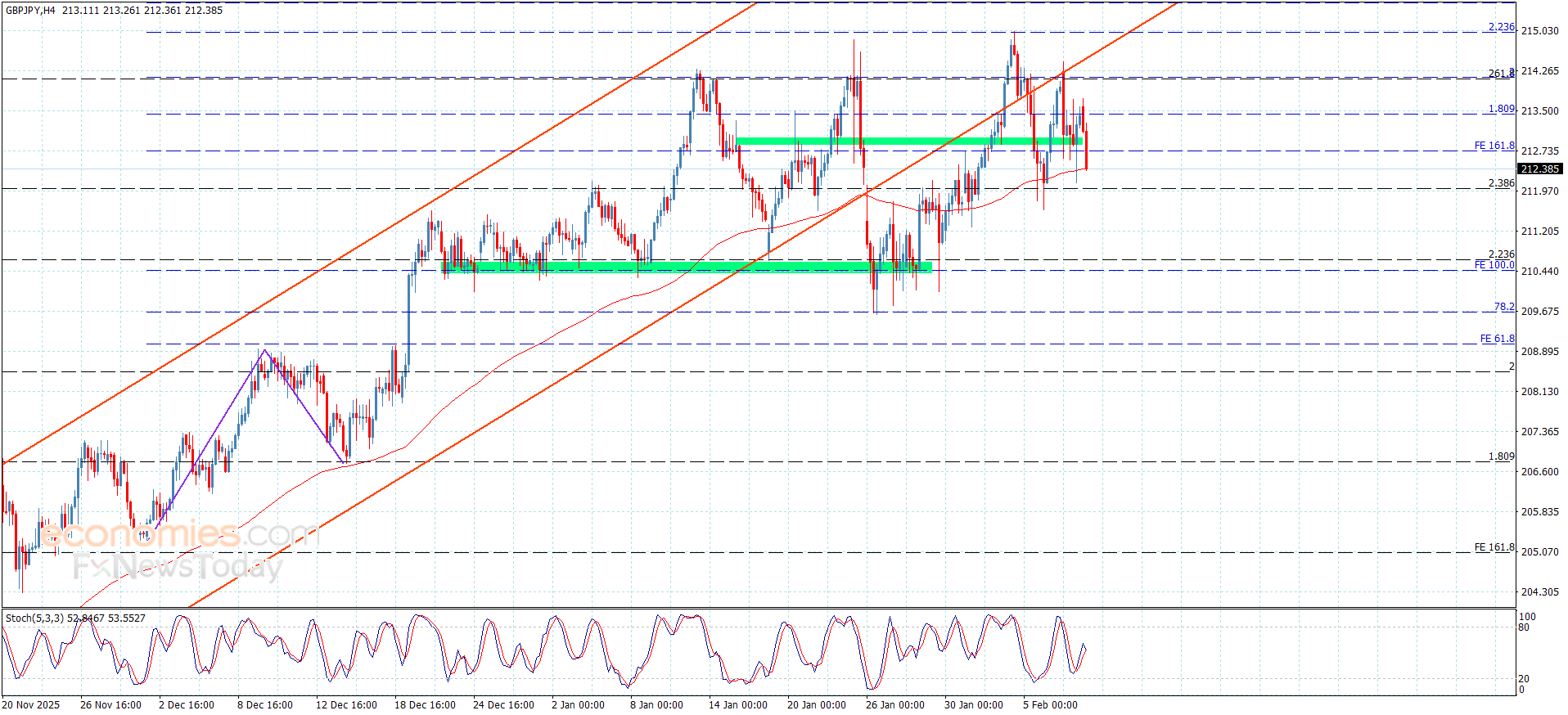
The GBPJPY pair activated with stochastic negativity this morning, forming some extra bearish waves after breaking the extra support at 212.85, announcing its readiness to resume the previously suggested bearish corrective attack, to settle near 212.40.
We expect reaching 212.00 level soon, which forms an intraday obstacle against the negative attempts, note that surpassing it will reinforce the chances of reaching corrective stations, that is located near 211.10 and 210.60.
The expected trading range for today is between 211.60 and 212.90
Trend forecast: Bearish
The EURJPY pair lost its bullish momentum due to stochastic exit from the overbought level, which forces it to delay the previously suggested bullish rally, reaching 184.85 level to find an exit to motivate the dominance of the bearish corrective trend in the current period.
Our bullish scenario depends on forming main barrier at 186.20 level, note that the continuation of the negative pressures might force the price to suffer some losses by reaching 184.10, then attempts to press on the bullish channel’s support at 183.55, which represents a confirmation key for the next trend in the upcoming trading.
The expected trading range for today is between 184.20 and 186.00
Trend forecast: Bearish
Silver (XAG/USD) struggles to capitalize on its recent goodish recovery move from the $64.00 mark, or its lowest level since December 17, touched last week, and edges lower on Tuesday. The white metal, however, trims a part of intraday losses and trades around the $82.25-$82.30 region during the first half of the European session.
From a technical perspective, Monday’s breakout and acceptance above the 23.6% Fibonacci retracement level of the recent sharp pullback from the all-time peak favors the XAG/USD bulls. The Moving Average Convergence Divergence (MACD) line remains above the Signal line and in positive territory, though the histogram has started to contract, suggesting fading upside momentum. The Relative Strength Index (RSI) prints at 52, neutral, reflecting a modest stabilization above the 50 mark.
Hence, any subsequent move up is likely to confront stiff resistance near the $86.25-$86.30 confluence – comprising the 200-period Simple Moving Average (SMA) on the 4-hour chart and the 38.2% Fibo. retracement level. A sustained break above the first barrier would bring $87.04 into focus and strengthen the rebound; failure to overcome it would preserve the broader bearish bias beneath the rising long-term average.
(The technical analysis of this story was written with the help of an AI tool.)
Silver is a precious metal highly traded among investors. It has been historically used as a store of value and a medium of exchange. Although less popular than Gold, traders may turn to Silver to diversify their investment portfolio, for its intrinsic value or as a potential hedge during high-inflation periods. Investors can buy physical Silver, in coins or in bars, or trade it through vehicles such as Exchange Traded Funds, which track its price on international markets.
Silver prices can move due to a wide range of factors. Geopolitical instability or fears of a deep recession can make Silver price escalate due to its safe-haven status, although to a lesser extent than Gold’s. As a yieldless asset, Silver tends to rise with lower interest rates. Its moves also depend on how the US Dollar (USD) behaves as the asset is priced in dollars (XAG/USD). A strong Dollar tends to keep the price of Silver at bay, whereas a weaker Dollar is likely to propel prices up. Other factors such as investment demand, mining supply – Silver is much more abundant than Gold – and recycling rates can also affect prices.
Silver is widely used in industry, particularly in sectors such as electronics or solar energy, as it has one of the highest electric conductivity of all metals – more than Copper and Gold. A surge in demand can increase prices, while a decline tends to lower them. Dynamics in the US, Chinese and Indian economies can also contribute to price swings: for the US and particularly China, their big industrial sectors use Silver in various processes; in India, consumers’ demand for the precious metal for jewellery also plays a key role in setting prices.
Silver prices tend to follow Gold’s moves. When Gold prices rise, Silver typically follows suit, as their status as safe-haven assets is similar. The Gold/Silver ratio, which shows the number of ounces of Silver needed to equal the value of one ounce of Gold, may help to determine the relative valuation between both metals. Some investors may consider a high ratio as an indicator that Silver is undervalued, or Gold is overvalued. On the contrary, a low ratio might suggest that Gold is undervalued relative to Silver.
BitcoinWorld
EUR/USD Analysis: ECB’s Cautious Stance on Strong Euro Reveals Critical Policy Dilemma
FRANKFURT, Germany – January 15, 2025: The European Central Bank maintains heightened vigilance regarding the euro’s persistent strength against the U.S. dollar, according to recent analysis from Commerzbank. This EUR/USD dynamic presents significant challenges for European monetary policymakers as they navigate complex economic crosscurrents in early 2025. Market participants closely monitor these developments, particularly as currency valuations influence inflation trajectories and export competitiveness across the Eurozone.
The European Central Bank operates within a dual mandate framework focusing on price stability and supporting economic growth. Currency valuation directly impacts both objectives through multiple transmission channels. A stronger euro typically exerts downward pressure on import prices, potentially helping to contain inflationary pressures. Conversely, currency appreciation can reduce export competitiveness, potentially dampening economic activity in export-dependent Eurozone economies.
Commerzbank’s foreign exchange strategists highlight the ECB’s delicate balancing act. They note that while the central bank doesn’t target specific exchange rate levels, policymakers carefully monitor EUR/USD movements for their macroeconomic implications. Historical data reveals that significant euro appreciation episodes have preceded periods of monetary policy adjustment, particularly when currency movements threatened to undermine the ECB’s inflation mandate.
The European Central Bank has demonstrated varying approaches to currency strength throughout its history. During the euro’s initial decade, policymakers frequently expressed concerns about excessive appreciation. More recently, the institution has adopted a more nuanced communication strategy. Verbal interventions have replaced direct market operations as the primary tool for influencing currency perceptions.
Commerzbank’s analysis references several key historical episodes:
Recent Eurozone economic data reveals several conflicting signals for policymakers. Manufacturing PMI readings remain below expansion thresholds in several member states, suggesting vulnerability to currency strength. Meanwhile, services sector activity demonstrates greater resilience. Inflation metrics show gradual moderation, though core measures remain above target levels.
Commerzbank economists emphasize that the ECB’s reaction function depends on multiple factors:
| Factor | Current Status | Policy Implication |
|---|---|---|
| Core Inflation | 2.8% (December 2024) | Supports cautious policy stance |
| Economic Growth | 0.3% QoQ (Q4 2024) | Limits tightening appetite |
| EUR/USD Level | 1.12-1.15 range | Moderate appreciation concern |
| Energy Prices | Stable to declining | Reduces imported inflation risk |
Currency movements affect the Eurozone economy through several well-documented channels. The trade channel represents the most direct impact, as exchange rates influence the price competitiveness of European exports in global markets. Additionally, the financial channel operates through cross-border investment flows and balance sheet effects. The confidence channel affects business and consumer sentiment, potentially influencing spending and investment decisions.
Commerzbank’s research indicates that the current EUR/USD level presents manageable challenges for most Eurozone economies. However, significant further appreciation could trigger more explicit policy responses. The analysis suggests that the 1.18-1.20 range represents a potential threshold where currency considerations might more directly influence monetary policy decisions.
The ECB’s approach to currency considerations differs notably from other major central banks. The Federal Reserve typically maintains a stronger dollar policy focus, while the Bank of Japan has historically demonstrated greater willingness to intervene directly in currency markets. The Swiss National Bank represents perhaps the most active major central bank regarding currency management, regularly citing franc strength as a policy concern.
This comparative context helps explain why the ECB maintains its cautious but non-interventionist stance. Institutional mandates, economic structures, and historical experiences shape each central bank’s currency policy framework. The Eurozone’s unique multi-country composition further complicates currency policy decisions, as exchange rate effects vary significantly across member economies.
Foreign exchange markets exhibit heightened sensitivity to central bank communications regarding currency levels. Commerzbank’s analysis suggests that EUR/USD volatility may increase around key ECB communications, particularly press conferences following monetary policy meetings. Options market pricing indicates growing investor attention to tail risks associated with potential policy shifts.
Several factors could amplify currency market reactions in coming months:
The European Central Bank maintains appropriate vigilance regarding EUR/USD strength, balancing multiple policy objectives in a complex economic environment. Commerzbank’s analysis highlights the nuanced relationship between currency valuations and monetary policy decisions. While direct intervention remains unlikely under current conditions, verbal guidance and policy adjustments may respond to significant exchange rate movements. Market participants should monitor ECB communications closely for evolving perspectives on currency considerations, particularly as economic conditions continue to evolve throughout 2025.
Q1: Why does the ECB care about the euro’s strength?
The European Central Bank monitors currency strength because it affects inflation through import prices and economic growth through export competitiveness. While not targeting specific levels, significant movements can influence monetary policy decisions.
Q2: What exchange rate level might trigger ECB action?
Commerzbank analysis suggests the 1.18-1.20 EUR/USD range represents a potential threshold where currency considerations might more directly influence policy, though specific triggers depend on accompanying economic conditions.
Q3: How does euro strength affect different Eurozone countries?
Effects vary significantly across member states. Export-dependent economies like Germany face greater challenges from currency appreciation, while countries with higher import dependence may benefit from reduced inflationary pressures.
Q4: What tools does the ECB have to influence the euro’s value?
The primary tools are verbal interventions through official communications. The ECB can also adjust monetary policy parameters, though these decisions consider multiple factors beyond currency valuations.
Q5: How does the ECB’s approach compare to other central banks?
The ECB maintains a more restrained approach than the Swiss National Bank but shows greater currency sensitivity than the Federal Reserve. This reflects the Eurozone’s unique economic structure and policy constraints.
This post EUR/USD Analysis: ECB’s Cautious Stance on Strong Euro Reveals Critical Policy Dilemma first appeared on BitcoinWorld.
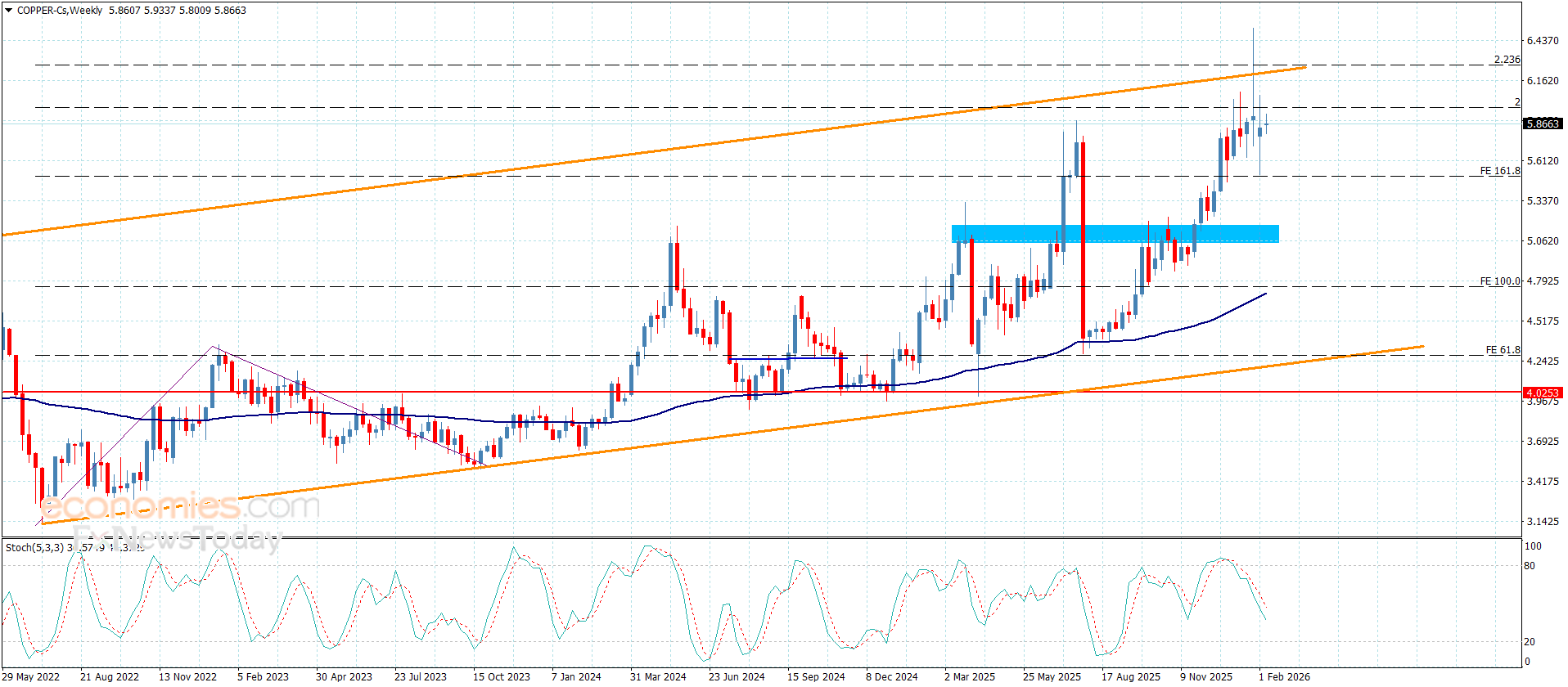
Copper prices forced to provide slow trading recently, due to the contradiction between the main indicators, fluctuating near $5.8500 level without recording any new corrective target.
Reminding you that the stability below $5.9700 barrier makes us keep the bearish corrective scenario, which might target $5.7200 level reaching $5.5100 support, while breaching the barrier will reinforce the chances of forming new bullish waves, to attempt to record extra gains by reaching $6.1200.
The expected trading range for today is between $5.5100 and $5.9500
Trend forecast: Bearish