The main category of Forex News.
You can use the search box below to find what you need.
[wd_asp id=1]
The main category of Forex News.
You can use the search box below to find what you need.
[wd_asp id=1]
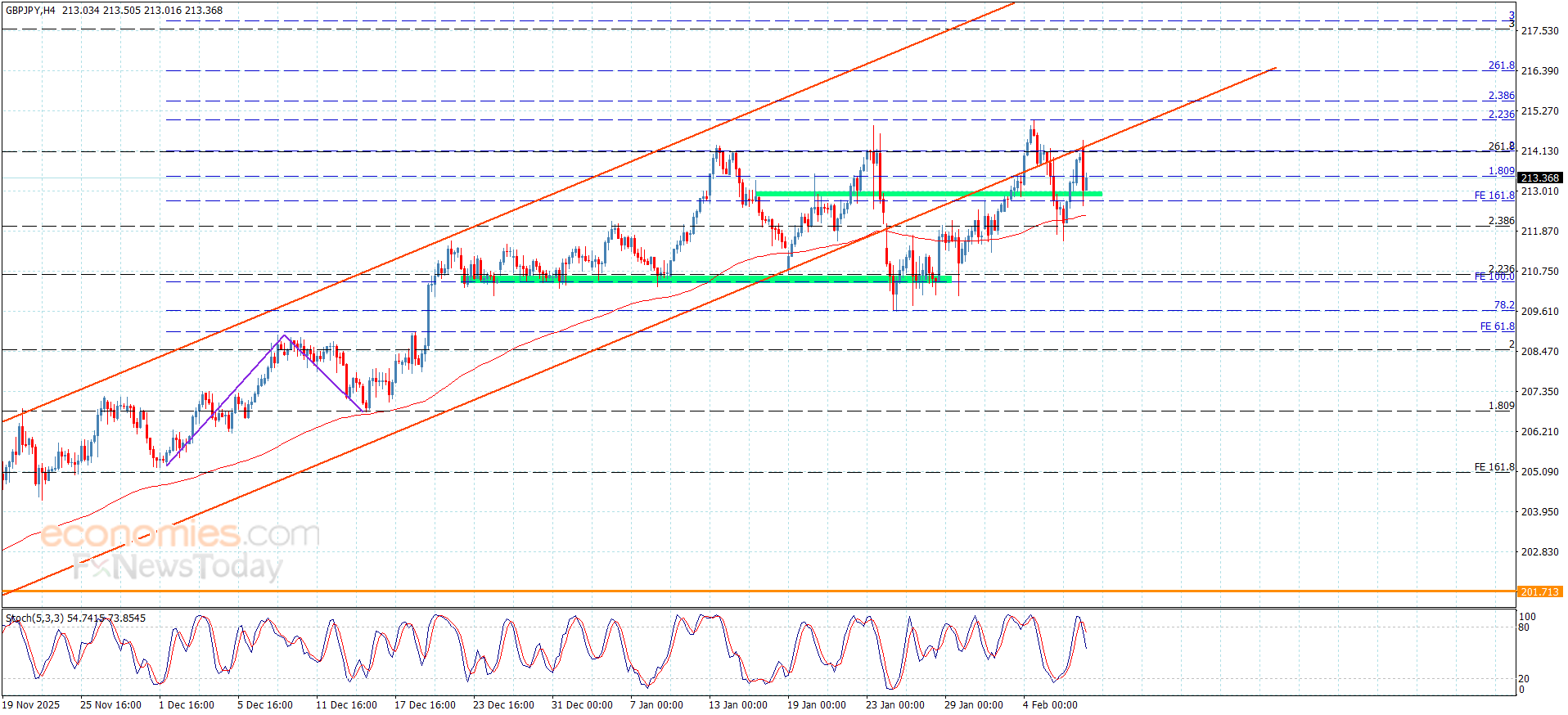
The GBPJPY pair failed to confirm breaking 212.85 level, which forces it to delay the previously suggested negative scenario, forming bullish waves to test the broken bullish channel’s support at 214.40 in this morning’s trading, forming a new bearish decline to settle near 213.40.
The contradiction between the main indicators might push the price to provide temporary trading, to keep waiting to confirm the negative scenario by reaching below 212.85, opening the way for targeting negative stations at 212.00 and 211.25, while breaching 214.40 and holding above it will confirm regaining the bullish track, providing strong chances to record new gains by its rally towards 215.50.
The expected trading range for today is between 211.25 and 213.85
Trend forecast: Sideways
The driving force today is the softer U.S. Dollar, which fell to its lowest level since January 30, down about 0.84%. A weaker dollar tends to drive up foreign demand for dollar-denominated assets like gold. The price action in both the dollar and gold suggests growing expectations for weak economic data, especially the labor market.
Last week’s Challenger January layoffs report, the mid-week ADP private-sector hirings report, and the government’s weekly initial claims report all pointed toward a feeble jobs market. This is leading investors to expect a weak U.S. Non-Farm Payrolls report on Wednesday.
According to a Reuters poll, non-farm payrolls are expected to have risen by 70,000 in January. A big miss to the downside will send investors scrambling to price in a rate cut as early as March, and that would be bad news for the dollar but good news for gold bulls. They have been on hold the past two weeks after the Fed implied at its January meeting that the focus had shifted to getting inflation under control and not labor. They felt that a premature cut in rates could boost inflation during a steady labor market period. However, a collapse in the jobs market will surely catch their eye and probably lead to increased speculation that an earlier-than-expected rate cut is forthcoming.
Providing additional support was the news that China’s central bank extended its gold-buying campaign for a 15th month in January, serving as proof that the dollar debasement trade is alive and well.
Finally, geopolitical concerns have kept a steady floor under the market to go along with China’s gold purchases. This is good for the long-term bullish foundation. Short-term, the market seems to be shedding its weaker buyers with excessive price swings, heightened volatility, and margin hikes by the CME Group. The market now looks as if it is getting ready to launch another rally, but buyers aren’t hitting offers yet without near-term catalysts. This extra confidence boost could come from Wednesday’s NFP report and/or Friday’s CPI data.
– Written by
Tim Boyer
STORY LINK GBP/USD Forecast: Pound Sterling Supported Amid Yen Strength, Jobs Doubts
The Pound to US Dollar exchange rate (GBP/USD) found modest support at the start of the week, with the pair steadying as doubts over the outlook for US employment weighed on the Dollar.
At the time of writing, GBP/USD was trading close to $1.3652, up around 0.3% from Monday’s opening levels as investors grew increasingly cautious ahead of key US labour market data.
The US Dollar struggled to find momentum as confidence in the resilience of the American jobs market continued to ebb.
A run of softer-than-expected employment indicators released last week has left markets wary ahead of January’s delayed non-farm payrolls report. Any disappointment could weigh heavily on the Greenback and further complicate expectations for Federal Reserve policy in the months ahead.
Adding to the Dollar’s woes was renewed strength in the Japanese Yen.
The Yen rallied after Japan’s ruling Liberal Democratic Party secured a decisive election victory, fuelling expectations of fresh fiscal stimulus and pushing Japanese government bond yields higher. The move encouraged capital flows away from the US Dollar, further pressuring USD exchange rates.
Sterling, meanwhile, struggled to build on its early gains as political uncertainty in the UK resurfaced.
Get better rates and lower fees on your next international money transfer.
Compare TorFX with top UK banks in seconds and see how much you could save.
Confidence in the Pound took a knock following the resignation of Prime Minister Keir Starmer’s chief of staff, Morgan McSweeney, over the weekend. The departure has intensified scrutiny of Starmer’s leadership and unsettled investors.
The episode has also revived attention on Starmer’s decision to appoint Peter Mandelson as the UK’s ambassador to Washington, with renewed focus on Mandelson’s past links to Jeffrey Epstein adding to the unease.
For GBP investors, McSweeney’s exit has heightened concerns over instability within the government, particularly at a time when divisions inside the Labour Party appear to be becoming more visible.
Looking ahead, the next major test for the Pound to US Dollar exchange rate will be Wednesday’s release of the US non-farm payrolls report.
Markets are forecasting job creation of around 70,000 in January, an improvement on December’s 50,000 gain. A result in line with expectations could offer the US Dollar some support.
However, another downside surprise would likely trigger renewed USD selling, especially given the recent run of underwhelming labour data.

With no significant UK economic releases scheduled, Sterling is likely to remain sensitive to domestic political developments. Any further pressure on Prime Minister Starmer’s leadership could leave the Pound vulnerable through the remainder of the week.
International Money Transfer? Ask our resident FX expert a money transfer question or try John’s new, free, no-obligation personal service! ,where he helps every step of the way,
ensuring you get the best exchange rates on your currency requirements.
TAGS: Pound Dollar Forecasts
NEW YORK, Feb 9, 2026, 06:48 EST — Premarket
U.S. natural gas prices slumped nearly 7% early Monday. The March NYMEX contract dropped 25.2 cents, trading near $3.17 per million British thermal units (mmBtu). 1
The drop is significant, with traders still dealing with the aftermath of a sharp winter reversal. Late January’s cold snap squeezed supply, but now shifting weather models are dragging demand lower. Utilities and LNG-linked players? Lately, it’s those two-week temperature forecasts that have been steering the price action above all else.
LSEG reported average gas production in the Lower 48 hitting 106.9 billion cubic feet per day so far in February. Demand — factoring in exports — is set to slide from 159.5 bcfd this week to 141.4 bcfd next week, and then to 132.6 bcfd in two weeks. Meteorologists expect most of the U.S. to stay on the warmer side through Feb. 21, though the Northeast could hang onto colder temps for several days. LSEG also estimated average flows to the eight major U.S. LNG export facilities at 18.5 bcfd for the month. 2
It’s a bearish tilt for traders heading into late February, with supply staying strong, demand losing steam, and LNG prices hovering close to the upper end of their recent band. Sure, storage remains part of the conversation—but as the warmer forecast sticks, that angle is quickly losing its punch.
Commodity Weather Group is calling for warmer-than-usual conditions to stick around the Midwest and South through Feb. 20. Over in drilling, Baker Hughes reported that active U.S. natural gas rigs climbed by five last week, reaching 130—up to a level not seen in two and a half years and reinforcing the ongoing supply story. 3
The market’s still on edge. Any sudden cold snap or new hit to production could tighten things up fast this winter — and while the broader U.S. outlook has softened, the Northeast still isn’t in the clear.
The next key number for traders to watch is Thursday’s U.S. weekly storage report—essentially the market’s go-to gauge for shifts in inventory levels. 4
Looking to the week ahead, shifting weather forecasts could cause the biggest swings—up or down. The next flashpoint: Thursday’s storage report on Feb. 12. Traders are watching closely to see if withdrawals keep topping the usual pace as we get deeper into February.
The interest rate differential continues to be a mainstay of this pair, as we are levitating into the weekend, looking bullish overall.
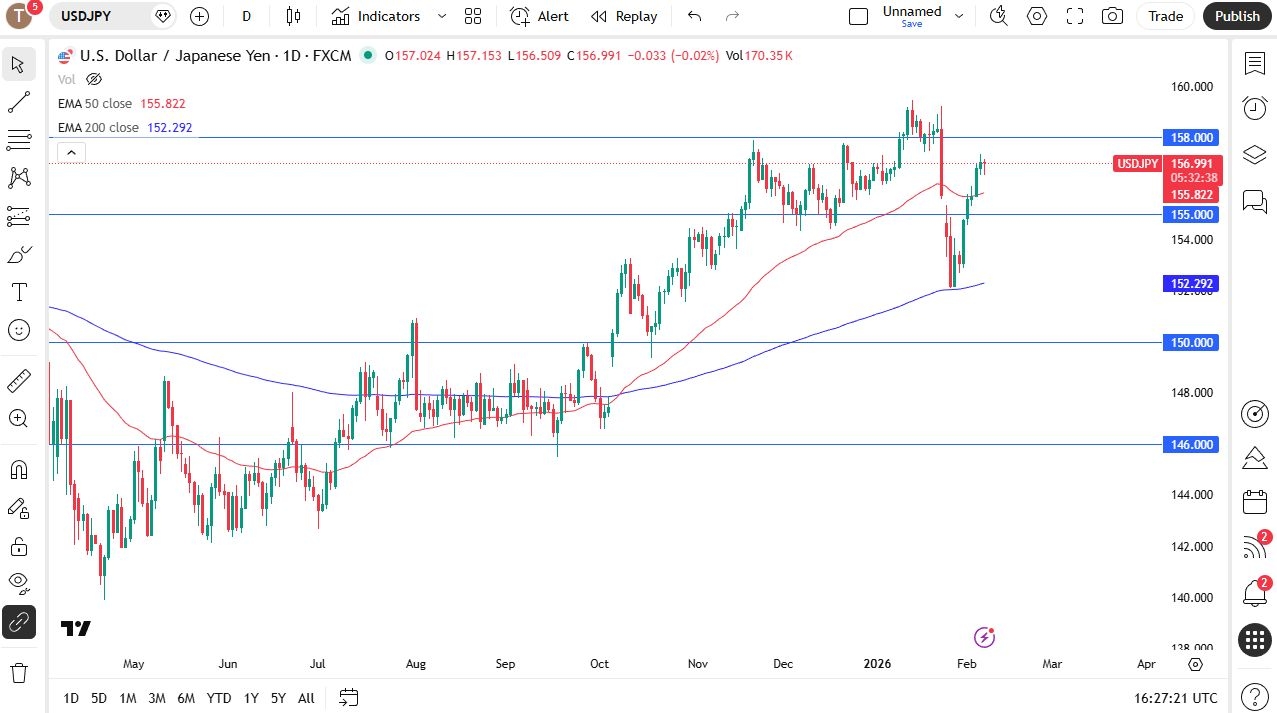
The US dollar has been noisy against the Japanese yen during the trading session here on Friday as we are simply hanging around the 156-yen level. I think at this point in time we are probably due for a little bit of a pullback, but I do not want to buy the yen. What I want to do is buy cheaper US dollars.
The interest rate differential continues to favor the United States and that will play a major part in where we go next. Ultimately, I think this is a scenario that remains a buy-on-the-dip for some time, and I just don’t have any interest whatsoever in trying to fight the interest rate differential.
The 158-yen level followed by the 159-yen level, both I think are resistance and I think it’s going to be difficult to get above there. But if we can break above the dollar-yen reading of about 162, that’s the highest level since something like 1990.
So, we are on the precipice of something big. We could be talking about 100 yen before it’s all said and done. That doesn’t mean that you put all of your money in aiming for 250 yen, but I think you have to understand that this is a long-term problem for Japan, and I think it continues to be so.
Shorting the yen against a multitude of currencies might be the trade for the next several years, and this is the first place you do it, but there are other places: the Australian dollar, the New Zealand dollar, British pound, etc. I have no interest in shorting this pair. It would have to break down below the 150-yen level for me to rethink things. That doesn’t mean I chase it up here though, and that’s the point of the analysis.
Christopher Lewis has been trading Forex and has over 20 years experience in financial markets. Chris has been a regular contributor to Daily Forex since the early days of the site. He writes about Forex for several online publications, including FX Empire, Investing.com, and his own site, aptly named The Trader Guy. Chris favours technical analysis methods to identify his trades and likes to trade equity indices and commodities as well as Forex. He favours a longer-term trading style, and his trades often last for days or weeks.
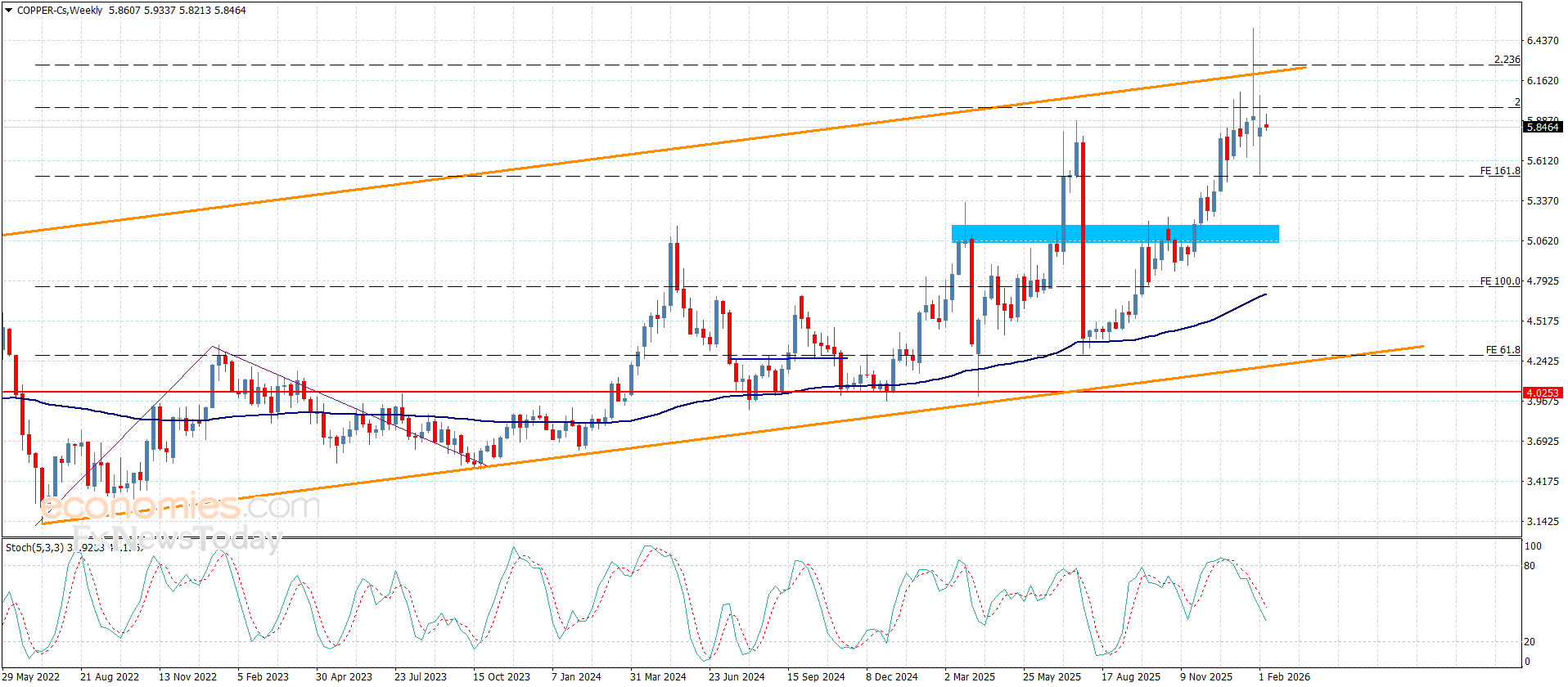
Copper price reached the corrective target in Friday’s trading by reaching $5.5100 extra support level, rebounding quickly but its stability below $5.9700 barrier by providing negative momentum by stochastic, so that makes us keep the corrective scenario in the near- term trading.
Therefore, we expect renewing the negative attempts to press on $5.5100 level again, and breaking it will ease the mission of targeting new negative stations that might extend towards $5.4100 and $5.2800.
The expected trading range for today is between $5.5100 and $5.9500
Trend forecast: Bearish
After closing the previous week in negative territory, EUR/USD gains traction on Monday and trades above 1.1850. In the second half of the day, investors will pay close attention to comments from central bankers.
The table below shows the percentage change of Euro (EUR) against listed major currencies today. Euro was the strongest against the British Pound.
| USD | EUR | GBP | JPY | CAD | AUD | NZD | CHF | |
|---|---|---|---|---|---|---|---|---|
| USD | -0.33% | 0.14% | -0.25% | -0.09% | -0.26% | 0.12% | -0.32% | |
| EUR | 0.33% | 0.47% | 0.06% | 0.25% | 0.07% | 0.45% | 0.00% | |
| GBP | -0.14% | -0.47% | -0.40% | -0.24% | -0.40% | -0.02% | -0.46% | |
| JPY | 0.25% | -0.06% | 0.40% | 0.16% | -0.01% | 0.37% | -0.08% | |
| CAD | 0.09% | -0.25% | 0.24% | -0.16% | -0.17% | 0.21% | -0.24% | |
| AUD | 0.26% | -0.07% | 0.40% | 0.00% | 0.17% | 0.38% | -0.06% | |
| NZD | -0.12% | -0.45% | 0.02% | -0.37% | -0.21% | -0.38% | -0.45% | |
| CHF | 0.32% | -0.00% | 0.46% | 0.08% | 0.24% | 0.06% | 0.45% |
The heat map shows percentage changes of major currencies against each other. The base currency is picked from the left column, while the quote currency is picked from the top row. For example, if you pick the Euro from the left column and move along the horizontal line to the US Dollar, the percentage change displayed in the box will represent EUR (base)/USD (quote).
The selling pressure surrounding the US Dollar (USD) seems to be helping EUR/USD edge higher at the beginning of the week. The positive shift seen in risk mood and the sharp decline in the USD/JPY pair following the verbal intervention by Japanese officials to offset the JPY weakness on the election outcome cause the USD to lose interest. At the time of press, the USD Index was down 0.3% on the day at 97.35.
Later in the day, European Central Bank (ECB) President Christine Lagarde will speak on the state of the EU economy and ECB activities in an event in France. In the American session, several policymakers from the Federal Reserve (Fed) will be delivering speeches.
The CME FedWatch Tool currently shows that markets are pricing in about a 16% probability of a 25 basis points (bps) rate cut next month. In case officials reiterate that they are willing to remain patient and watch the data before deciding on the next policy move, the USD could find a foothold and limit EUR/USD’s upside.
Nevertheless, investors could refrain from betting on a steady recoveryin the USD ahead of the critical Nonfarm Payrolls data for January, which is scheduled to be released on Friday.
In the 4-hour chart, EUR/USD trades at 1.1858. The 20-period Simple Moving Average (SMA) has turned higher but remains below the 50-period SMA, which slopes gently lower. The 100- and 200-period SMAs trend upward, hinting at a firmer medium-term bias. The 14-period RSI at 61.8 rises above the midline, underscoring building bullish momentum.
Measured from the 1.1590 low to the 1.2025 high, the 38.2% retracement at 1.1860 aligns as a pivot point. If this level stays intact and EUR/USD failes to stabilize above it, the 50% retracement and the 100-period SMA in the 1.1810-1.1800 could act as the next support. On the upside, 1.1900 (static level) could be seen as an interim resistance level ahead of 1.1925 (Fibonacci 23.6% retracement).
(The technical analysis of this story was written with the help of an AI tool.)
The Euro is the currency for the 20 European Union countries that belong to the Eurozone. It is the second most heavily traded currency in the world behind the US Dollar. In 2022, it accounted for 31% of all foreign exchange transactions, with an average daily turnover of over $2.2 trillion a day.
EUR/USD is the most heavily traded currency pair in the world, accounting for an estimated 30% off all transactions, followed by EUR/JPY (4%), EUR/GBP (3%) and EUR/AUD (2%).
The European Central Bank (ECB) in Frankfurt, Germany, is the reserve bank for the Eurozone. The ECB sets interest rates and manages monetary policy.
The ECB’s primary mandate is to maintain price stability, which means either controlling inflation or stimulating growth. Its primary tool is the raising or lowering of interest rates. Relatively high interest rates – or the expectation of higher rates – will usually benefit the Euro and vice versa.
The ECB Governing Council makes monetary policy decisions at meetings held eight times a year. Decisions are made by heads of the Eurozone national banks and six permanent members, including the President of the ECB, Christine Lagarde.
Eurozone inflation data, measured by the Harmonized Index of Consumer Prices (HICP), is an important econometric for the Euro. If inflation rises more than expected, especially if above the ECB’s 2% target, it obliges the ECB to raise interest rates to bring it back under control.
Relatively high interest rates compared to its counterparts will usually benefit the Euro, as it makes the region more attractive as a place for global investors to park their money.
Data releases gauge the health of the economy and can impact on the Euro. Indicators such as GDP, Manufacturing and Services PMIs, employment, and consumer sentiment surveys can all influence the direction of the single currency.
A strong economy is good for the Euro. Not only does it attract more foreign investment but it may encourage the ECB to put up interest rates, which will directly strengthen the Euro. Otherwise, if economic data is weak, the Euro is likely to fall.
Economic data for the four largest economies in the euro area (Germany, France, Italy and Spain) are especially significant, as they account for 75% of the Eurozone’s economy.
Another significant data release for the Euro is the Trade Balance. This indicator measures the difference between what a country earns from its exports and what it spends on imports over a given period.
If a country produces highly sought after exports then its currency will gain in value purely from the extra demand created from foreign buyers seeking to purchase these goods. Therefore, a positive net Trade Balance strengthens a currency and vice versa for a negative balance.
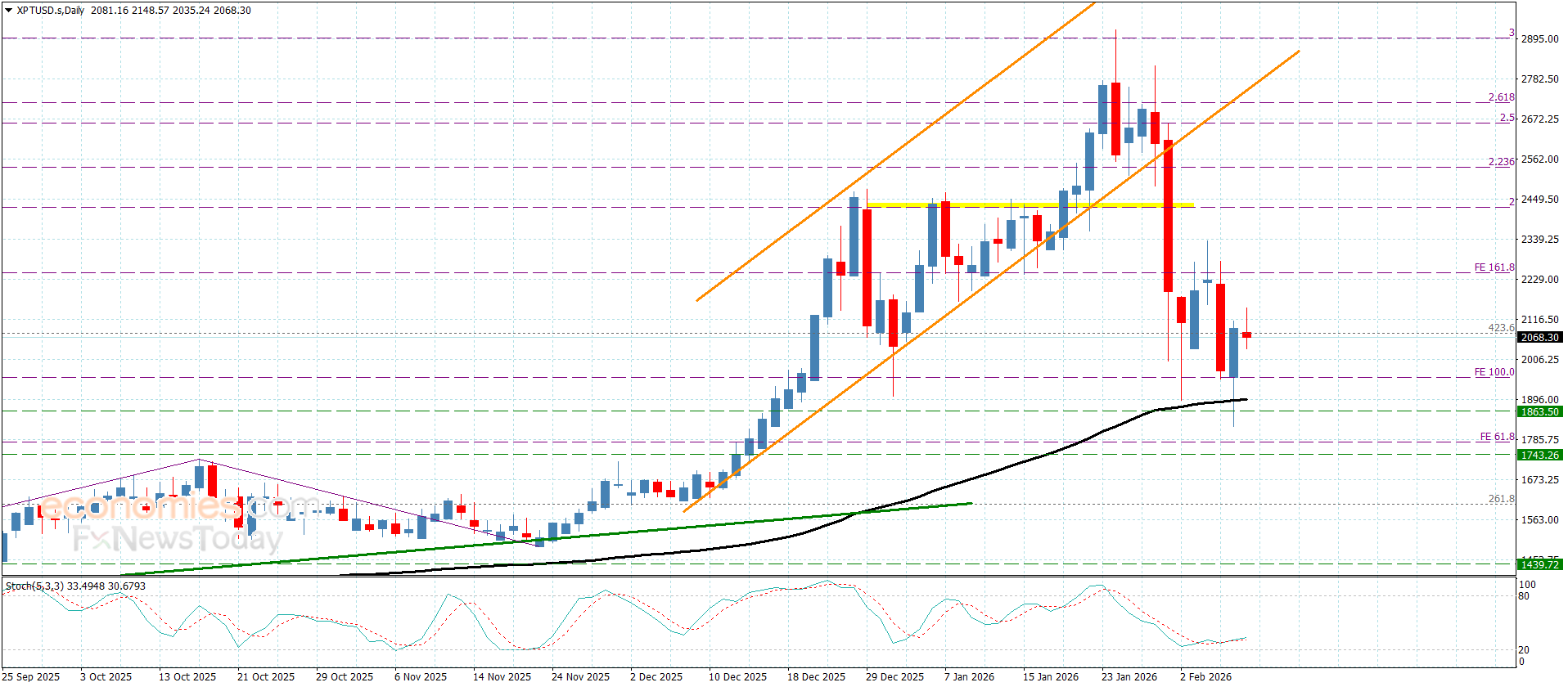
Platinum price attempted to surpass the negative pressures by forming some bullish waves, achieving $2145.00 level to settle above the moving average 55, noting that this rebound will not confirm regaining the bullish trend, due to the continuation of forming an important barrier at $2245.00 level, which makes us prefer the sideways bias dominance in the current period trading until gathering negative momentum, which allows it to decline below $1950.00, to target the corrective stations near $1860.00 and $1740.00.
While breaching the barrier and holding above it, will increase the chances of recording several gains, to expect its rally towards $2340.00 to press on $2425.00 barrier.
The expected trading range for today is between $1780.00 and $2070.00
Trend forecast: Bearish
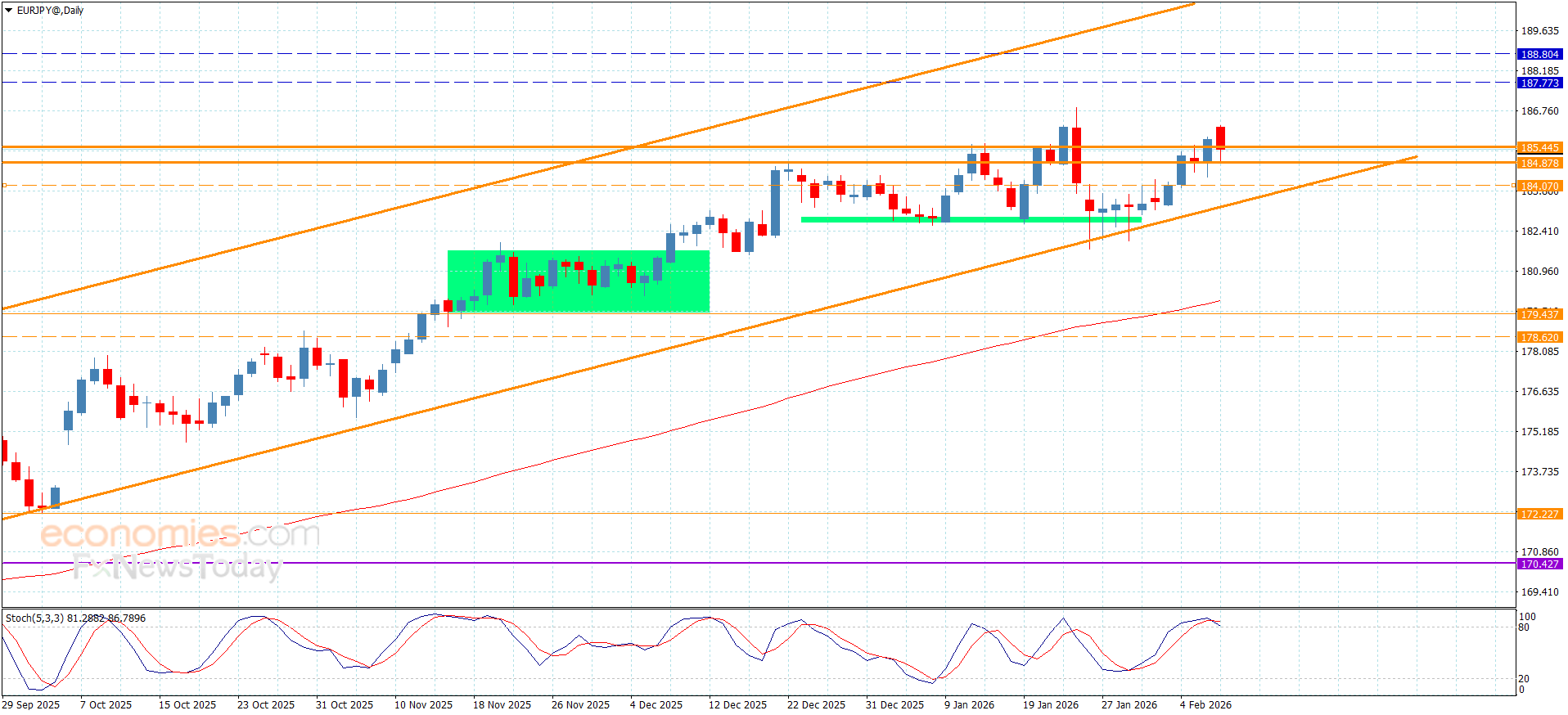
The EURJPY pair began new positivity this morning by its rally towards 186.22, but its neediness to negative momentum that pushed it to retest 184.85 level, to begin forming sideways waves as appears in the above image.
In general, we will keep preferring the bullish bias by the stability of the trading within the bullish channel’s levels and its main support settles near 183.40, therefore, we recommend waiting for gathering bullish momentum in the near period, reinforcing the chances of reaching 186.85, and surpassing it will form next main target at 187.75 in the upcoming trading.
The expected trading range for today is between 184.90 and 186.85
Trend forecast: Bullish
Gold price (XAU/USD) rises to near $5,035 during the early Asian session on Monday. The precious metal extends its recovery amid a weaker US Dollar (USD) and rising demand from central banks. The delayed release of the US employment report for January will be in the spotlight later on Wednesday.
US Treasury Secretary Scott Bessent on Thursday refused to rule out the possibility of a criminal investigation of Kevin Warsh, President Donald Trump’s nominee for US Federal Reserve (Fed) chair, if Warsh ends up refusing to lower the interest rates. Concerns over the Fed’s independence continue to drag the Greenback lower and provide some support to the USD-denominated commodity price.
The People’s Bank of China (PBOC) extended its gold buying reserve for a 15th consecutive month in January. The Chinese central bank’s gold holdings rose to 74.19 million fine troy ounces by the end of January, up from 74.15 million the previous month. Rising demand from China, the world’s largest gold consumer, might contribute to the Gold’s upside.
Iran’s President Masoud Pezeshkian described the Friday nuclear talks with the United States (US) as “a step forward,” even as he pushed back against any attempts at intimidation. Meanwhile, Iranian Foreign Minister Abbas Araghchi underlined that any dialogue required refraining from threats.
Trump said another meeting would be held early this week, adding that “If they don’t make a deal, the consequences are very steep.” Traders will closely monitor the developments surrounding US-Iran talks. Any positive signs of negotiations could undermine the precious metals in the near term.
Gold has played a key role in human’s history as it has been widely used as a store of value and medium of exchange. Currently, apart from its shine and usage for jewelry, the precious metal is widely seen as a safe-haven asset, meaning that it is considered a good investment during turbulent times. Gold is also widely seen as a hedge against inflation and against depreciating currencies as it doesn’t rely on any specific issuer or government.
Central banks are the biggest Gold holders. In their aim to support their currencies in turbulent times, central banks tend to diversify their reserves and buy Gold to improve the perceived strength of the economy and the currency. High Gold reserves can be a source of trust for a country’s solvency. Central banks added 1,136 tonnes of Gold worth around $70 billion to their reserves in 2022, according to data from the World Gold Council. This is the highest yearly purchase since records began. Central banks from emerging economies such as China, India and Turkey are quickly increasing their Gold reserves.
Gold has an inverse correlation with the US Dollar and US Treasuries, which are both major reserve and safe-haven assets. When the Dollar depreciates, Gold tends to rise, enabling investors and central banks to diversify their assets in turbulent times. Gold is also inversely correlated with risk assets. A rally in the stock market tends to weaken Gold price, while sell-offs in riskier markets tend to favor the precious metal.
The price can move due to a wide range of factors. Geopolitical instability or fears of a deep recession can quickly make Gold price escalate due to its safe-haven status. As a yield-less asset, Gold tends to rise with lower interest rates, while higher cost of money usually weighs down on the yellow metal. Still, most moves depend on how the US Dollar (USD) behaves as the asset is priced in dollars (XAU/USD). A strong Dollar tends to keep the price of Gold controlled, whereas a weaker Dollar is likely to push Gold prices up.