The main category of Forex News.
You can use the search box below to find what you need.
[wd_asp id=1]
The main category of Forex News.
You can use the search box below to find what you need.
[wd_asp id=1]
The British pound rose against the US dollar on Thursday after the Bank of England decided to keep its base rate unchanged at 3.75%. This decision was in line with the markets and showcases the central bank’s carefulness regarding inflation. The soft dollar helped GBP in staying supported with USD above the important levels of technical pressure. This came after the Fed kept the rates unchanged a day before.
The BoE believes, and the forecasts suggest, that inflation will experience a significant dip. The high prices of energy, due to the geopolitical unrest in the Middle East, will increase inflation again. There is now a combination of inflation, and an economy and labor market in a state of recession. The BoE now faces the problem of inflation vs recession.
This decision was on the back of the Bank’s Monetary Policy Report that has shown a significant dip in inflation. The UK consumer price index shows inflation rates of 2.6% in June, however, energy is expected to become more expensive and push inflation higher in the second half of 2026. The MPC believes that the current rate will ensure that the inflationary pressures, if any, will be temporary.
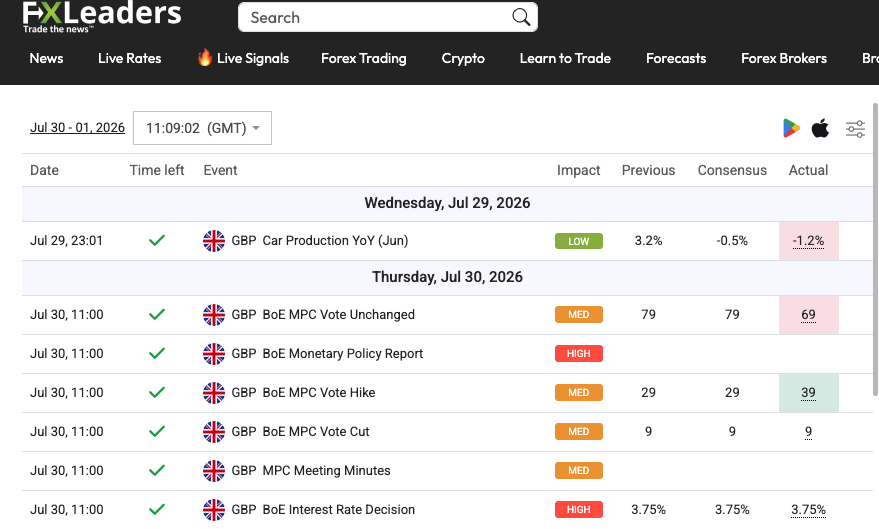
Officials noted that a more restrictive monetary policy weakens household spending and business investment. A more flexible labor market will likely prevent higher energy prices from producing broad-based wage and price inflation.
Market participants are focusing on the MPC vote split, along with upcoming inflation and growth forecasts, as the monetary policy forecast is already in the price following the rate decision. Andrew Bailey’s comments will also be watched for policy direction.
The market will assess whether the decision makers are keeping the door open for additional tightening if inflation persists, especially if geopolitically-driven energy price spikes also come into play.
Increased concern about inflation from the BoE would likely support the pound. The opposite would likely be true if a more dovish, growth-concerned approach is pursued.
https://www.bankofengland.co.uk/monetary-policy-report/2026/july-2026/
The pound also strengthened after the Federal Reserve chose to keep the target policy rate between 3.50 and 3.75. While three Federal Reserve policy makers were in favor of tightening, Fed Chair Kevin Warsh did not signal an imminent decision to tighten, which caused a September rate increase to be taken off the table, decreasing Treasury yields and strengthening the pound along with other major currencies.
The focus will be on the upcoming U.S. economic releases, especially the PCE deflator and second quarter GDP, as these may impact forecasts of U.S. monetary policy more than others.
UK inflation appears to be under control, but UK economic prospects remain weak. UK consumers and businesses remain under the pressure of high energy costs. This, paired with a slacking labor market and tightening financial conditions, suggests further weakness in UK economic prospects.
In contrast, the US economy is performing better with greater productivity and investment. This tilt in the economic balance is USD supportive in the medium term as the dollar has weakened recently on the back of FOMC comments.
With both central banks on hold, the main drivers of the GBP/USD rate will be divergence in economic data, inflation and central bank communications.
GBP/USD is continuing its upward trend after testing and successfully bouncing off of the rising trendline at 1.3272, with buyers breaking the 50-period EMA at 1.3346, and the 200-period EMA at 1.3363. Renewed buying momentum was confirmed by a bullish engulfing candle, and the pattern of higher lows was maintained.
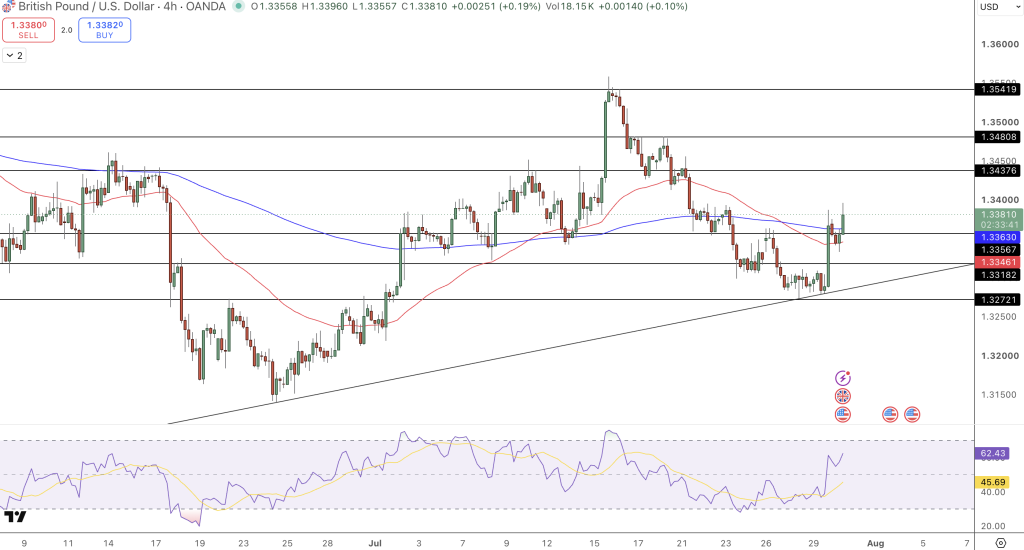
The next resistance level is at 1.3383, where prior price action has resulted in a pause. A break and close above this level will open price action to the 1.3438, 1.3481 and the July peak at near 1.3542.
Momentum indicators are bullish, with the RSI at approximately 62, indicating bullish momentum. The 50 and 200 period EMAs are converging and if price momentum continues, a bullish crossover of the EMAs is likely.
Resistance: 1.3383, 1.3438, 1.3481, 1.3542
Support: 1.3363, 1.3318, 1.3272
The decision by the Bank of England (BOE) to keep rates on hold was largely expected. Therefore, the market was second guessing the BOE’s future inflation assessment and monetary policy signaling. The BOE stated that inflation was on a downward trend; however, they highlighted that the situation may be reversed by higher energy prices in the second half of the year.
GBP/USD is technically in a good position while trading above the 1.3346 – 1.3363 EMA support range. A break above 1.3383 would add to the bullish momentum with 1.3481 in the line of sight. A break below 1.3318 would indicate a loss of bullish momentum, and would likely target the ascending trendline support, which is at 1.3272.

Arslan Ali Butt
Lead Markets Analyst – Multi-Asset (FX, Commodities, Crypto)
Arslan Ali Butt serves as the Lead Commodities and Indices Analyst, bringing a wealth of expertise to the field. With an MBA in Behavioral Finance and active progress towards a Ph.D., Arslan possesses a deep understanding of market dynamics.
His professional journey includes a significant role as a senior analyst at a leading brokerage firm, complementing his extensive experience as a market analyst and day trader. Adept in educating others, Arslan has a commendable track record as an instructor and public speaker.
His incisive analyses, particularly within the realms of cryptocurrency and forex markets, are showcased across esteemed financial publications such as ForexCrunch, InsideBitcoins, and EconomyWatch, solidifying his reputation in the financial community.
Silver price (XAG/USD) gives back its early gains and turns negative on Thursday. The white metal trades 0.7% lower at around $57.25 in the European trade after a positive start, which led to hitting an intraday high at $58.65.
Surging US Treasury Yields on expectations that the Federal Reserve (Fed) would need to hike interest rates in the near-term have diminished the appeal of non-yielding assets, such as Silver.
“Yields are a byproduct of the rate expectations, and if the market expects that inflation fears will translate into higher rates, yields will be higher,” and this is pressuring gold, ANZ analyst Soni Kumari said. The remarks from the bank were especially for Gold; however, historically, Silver reacts in a similar fashion to Gold against bond yields.
At press time, 10-year US Treasury Yields trade 1.8% higher, close to their 18-month high of around 4.71%. A decent recovery in the US Dollar Index (DXY) to near 101.00 after a weak Wednesday is also hurting the Silver price. Technically, a higher US Dollar makes the Silver price an unfavorable risk-reward bet for investors.
The table below shows the percentage change of US Dollar (USD) against listed major currencies today. US Dollar was the strongest against the Swiss Franc.
| USD | EUR | GBP | JPY | CAD | AUD | NZD | CHF | |
|---|---|---|---|---|---|---|---|---|
| USD | 0.27% | 0.22% | 0.18% | 0.11% | 0.04% | -0.19% | 0.43% | |
| EUR | -0.27% | -0.07% | -0.07% | -0.16% | -0.25% | -0.48% | 0.16% | |
| GBP | -0.22% | 0.07% | 0.00% | -0.10% | -0.18% | -0.40% | 0.25% | |
| JPY | -0.18% | 0.07% | 0.00% | -0.08% | -0.14% | -0.39% | 0.27% | |
| CAD | -0.11% | 0.16% | 0.10% | 0.08% | -0.07% | -0.31% | 0.34% | |
| AUD | -0.04% | 0.25% | 0.18% | 0.14% | 0.07% | -0.21% | 0.44% | |
| NZD | 0.19% | 0.48% | 0.40% | 0.39% | 0.31% | 0.21% | 0.68% | |
| CHF | -0.43% | -0.16% | -0.25% | -0.27% | -0.34% | -0.44% | -0.68% |
The heat map shows percentage changes of major currencies against each other. The base currency is picked from the left column, while the quote currency is picked from the top row. For example, if you pick the US Dollar from the left column and move along the horizontal line to the Japanese Yen, the percentage change displayed in the box will represent USD (base)/JPY (quote).
According to the CME FedWatch tool, there is an almost 75% chance that the Fed will deliver at least one interest rate hike by the October meeting.
The Silver price opened higher as the US Dollar fell sharply after the Fed’s monetary policy announcement on Wednesday, in which it decided to leave interest rates unchanged in the range of 3.50%-3.75%. Fed’s monetary policy statement and Chairman Kevin Warsh’s press conference signaled that policymakers are highly concerned about inflation remaining well-above the central bank’s 2% target for a longer period.
Silver is a precious metal highly traded among investors. It has been historically used as a store of value and a medium of exchange. Although less popular than Gold, traders may turn to Silver to diversify their investment portfolio, for its intrinsic value or as a potential hedge during high-inflation periods. Investors can buy physical Silver, in coins or in bars, or trade it through vehicles such as Exchange Traded Funds, which track its price on international markets.
Silver prices can move due to a wide range of factors. Geopolitical instability or fears of a deep recession can make Silver price escalate due to its safe-haven status, although to a lesser extent than Gold’s. As a yieldless asset, Silver tends to rise with lower interest rates. Its moves also depend on how the US Dollar (USD) behaves as the asset is priced in dollars (XAG/USD). A strong Dollar tends to keep the price of Silver at bay, whereas a weaker Dollar is likely to propel prices up. Other factors such as investment demand, mining supply – Silver is much more abundant than Gold – and recycling rates can also affect prices.
Silver is widely used in industry, particularly in sectors such as electronics or solar energy, as it has one of the highest electric conductivity of all metals – more than Copper and Gold. A surge in demand can increase prices, while a decline tends to lower them. Dynamics in the US, Chinese and Indian economies can also contribute to price swings: for the US and particularly China, their big industrial sectors use Silver in various processes; in India, consumers’ demand for the precious metal for jewellery also plays a key role in setting prices.
Silver prices tend to follow Gold’s moves. When Gold prices rise, Silver typically follows suit, as their status as safe-haven assets is similar. The Gold/Silver ratio, which shows the number of ounces of Silver needed to equal the value of one ounce of Gold, may help to determine the relative valuation between both metals. Some investors may consider a high ratio as an indicator that Silver is undervalued, or Gold is overvalued. On the contrary, a low ratio might suggest that Gold is undervalued relative to Silver.
The US dollar initially was a bit weak on Wednesday but has since bounced a bit as we are waiting for the interest rate decision coming out of the Federal Reserve.

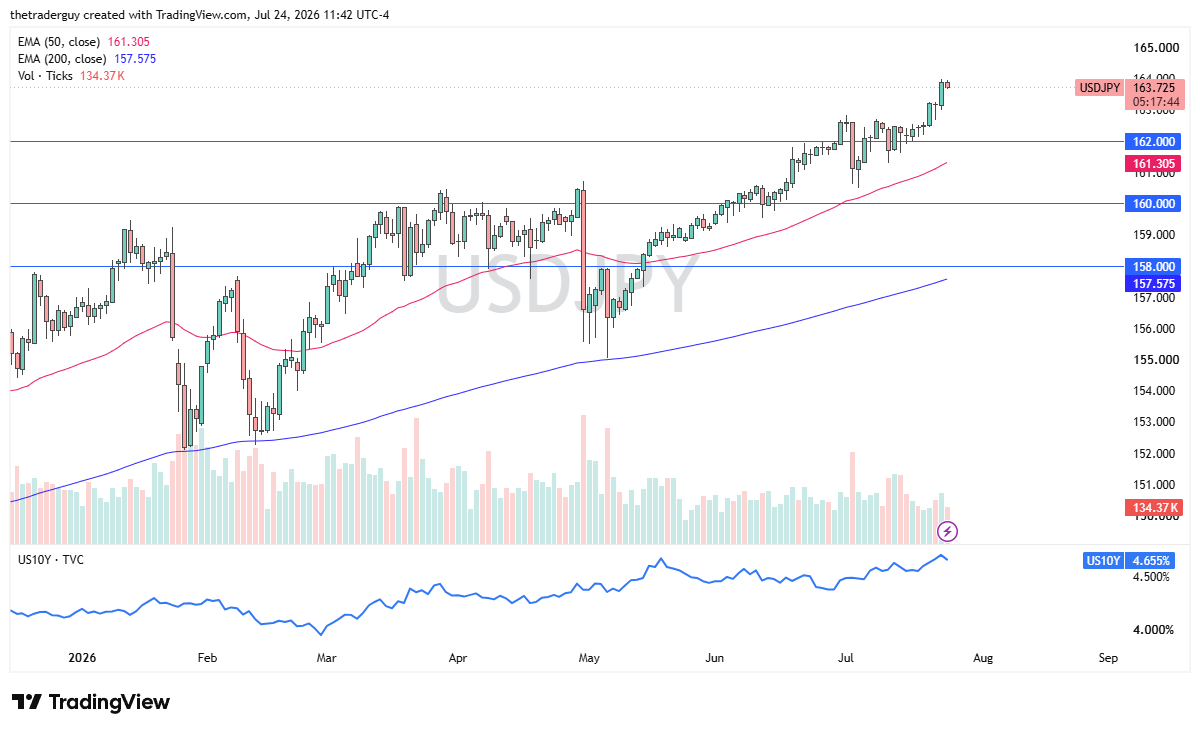
The US dollar fell early against the Japanese Yen during the trading session on Wednesday as the market continues to see a lot of noisy behavior. Ultimately, this is a market that I think a lot of people will look at through the prism of the interest rate differential, and that of course has been paying traders quite nicely.
Now the question, of course, is whether or not the Federal Reserve interest rate decision later in the day is going to be a headline event or not. There’s about a 40% chance of an interest rate hike according to the FedWatch tool, and that means that a significant number of traders, one way or the other, are going to be surprised. That should make for a nice volatile move.
Ultimately, the interest rate differential between the United States dollar and the Japanese Yen remains wide, and that allows traders to take advantage of getting paid at the end of every day. In fact, that’s what I’ve done for the last several months. I’ve been a buyer of this pair, and I’ve added every time it dipped.
I don’t have any concerns about shorting, quite frankly. This interest rate differential will continue to pay traders over the longer term, even if the Federal Reserve does not hike and the Bank of Japan raises. Yes, that could cause a little bit of short-term volatility, but at the end of the day, the trend is well entrenched. We are trading at levels not seen since the 1980s, and there’s a reason for that.
I look at the 50-day EMA and the 162-yen level as support at the moment. I do not have a target per se but based on the rounding bottom that just broke out of a 40-year pattern, the measured move is 224 yen. That would take some time, obviously.
Christopher Lewis is a technical analyst and market commentator at DailyForex with more than two decades of trading experience in Forex and other leveraged markets. Based in Columbus, Ohio, he specializes in chart-based analysis of major currency pairs, stock indices, commodities, and energy markets, focusing on clear support and resistance levels, trend structure, and risk management. Christopher produces daily written and video analysis for traders who rely on technical setups to navigate volatile market conditions
As seen on: Pairs Of Aces Podcast,The Trader Guy, FXEmpire
Domestic coffee prices today
Coffee prices today in the domestic market turned down sharply after the previous increase session. Coffee prices on July 30th averaged 96,600 VND/kg, down 1,800 VND/kg compared to the previous day. The highest level in key regions of the Central Highlands was recorded at 96,800 VND/kg.
In Lam Dong, coffee prices today reached 96,000 VND/kg, down 1,800 VND/kg compared to the previous day. This is the lowest level among regions with detailed updated tables.
In Gia Lai, coffee prices were recorded at 96,500 VND/kg, down 1,800 VND/kg compared to the previous session.
The old Dak Nong area recorded a level of 96,800 VND/kg, down 1,700 VND/kg. This is the highest level among the regions updated in detail.
In Dak Lak, coffee prices also decreased according to the general trend of the market.
World coffee prices
In the world market, coffee prices fell sharply on both the London and New York exchanges.
On the London exchange, the September 2026 Robusta futures fell 104 USD/ton, equivalent to 2.68%, to 3.773 USD/ton. The November 2026 futures fell 110 USD/ton, equivalent to 2.85%, to 3.749 USD/ton.
Further terms also decreased. Robusta in January 2027 lost 108 USD/ton, down to 3.716 USD/ton; March 2027 term decreased by 108 USD/ton, to 3,686 USD/ton.
On the New York exchange, the September 2026 Arabica futures fell 13.60 US cents/lb, equivalent to 4.01%, to 325.80 US cents/lb. The December 2026 futures fell 8.75 US cents/lb, to 308.55 US cents/lb.
Coffee price assessment
Domestic coffee prices fell sharply in the context of the global market adjusting. For Vietnam, Robusta London is still a variable that needs to be closely monitored due to its direct impact on domestic purchasing prices.
Today’s decrease also shows that the general level of coffee prices is still fluctuating very quickly. Just after one day of strong increase to the area of 98. 400 VND/kg, the average price has retreated to 96. 600 VND/kg.
From a supply-demand perspective, USDA/FAS forecasts Vietnam’s coffee production in the 2026-2027 crop year to reach 32.5 million bags converted to green beans. For Brazil, USDA/FAS forecasts coffee production in the 2026-2027 crop year to reach 71.9 million bags, an increase of 14% compared to the previous crop year.
Regarding the weather, the Central Highlands is in the rainy season. According to the National Center for Hydro-Meteorological Forecasting, on July 30, day and night, the Central Highlands area will have showers and thunderstorms in some places; especially in the afternoon and night, there will be rain, moderate rain and scattered thunderstorms, locally heavy to very heavy rain. In thunderstorms, there is a possibility of tornadoes, lightning, hail and strong gusts of wind.
Heavy rain needs to be monitored in the stages of garden care, pest and disease prevention, and goods preservation.
In the coming sessions, developments on the London exchange, New York exchange, USD/VND exchange rate, inventory and demand for export purchases will continue to dominate domestic prices.
The Federal Open Market Committee approved the following statement for release by a 9 3 vote: The Committee decided to maintain the target range for the federal funds rate at 3-1/2 to 3-3/4 percent, in support of the Federal Reserve’s dual mandate. The Committee is continuing its policy of maintaining ample reserves in the banking system. Economic activity is expanding at a solid pace despite elevated uncertainty that owes, in part, to the conflict in the Middle East. Productivity growth and capital investment are strong. Job gains have kept pace with the workforce, and the unemployment rate has changed little. Inflation remains elevated relative to the Committee’s 2 percent goal, in part reflecting supply shocks that have driven price increases in certain sectors, including energy. The Committee will deliver price stability. Voting against the monetary policy action were Beth M. Hammack, Neel Kashkari, and Lorie K. Logan, who preferred to raise the target range for the federal funds rate by 1/4 percentage point at this meeting. *fed: Hammack, Kashkari And Logan Dissent In Favor Of Rate Hike Fomc Statement Compare Fed: Economic activity is expandng at solid pace despite elevated uncertainty. Fed: FOMC is continuing policy of maintaining ample reserves in the banking system.
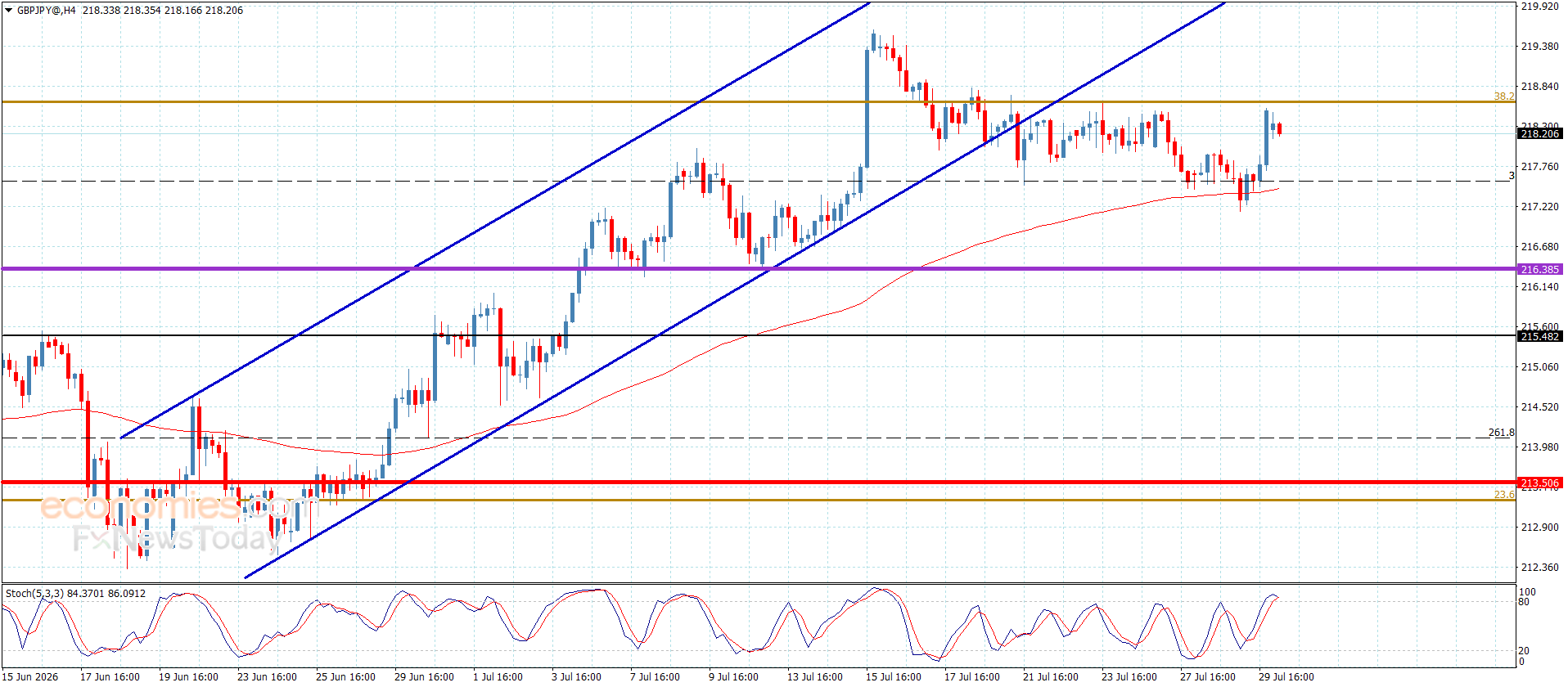
The GBPJPY pair ended the temporary negative rebound by reaching 217.15 level, to begin activating with the positivity of the main indicators by its rally above 217.55 level to rally sharply towards 218.55 approaching the initial barrier that we expected in our previous report.
The attempt of the main indicators to provide extra positive momentum will reinforce the chances pf breaching the barrier at 218.65, to open the way for targeting extra positive stations that might begin at 219.40 and 220.00, while the risk of changing the main trend is represented by breaking 216.35 level and holding below it.
The expected trading range for today is between 217.80 and 219.40
Trend forecast: Bullish
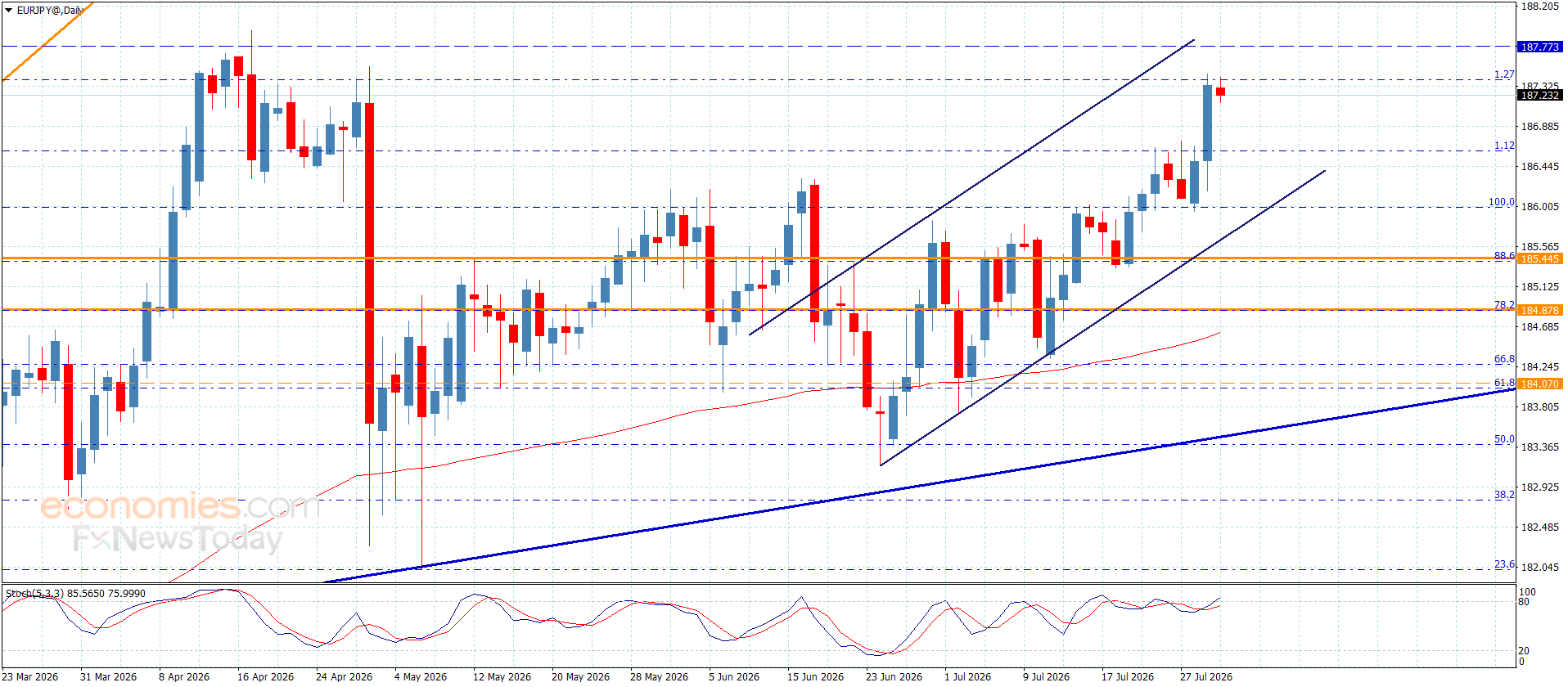
The EURJPY pair succeeded in resuming the bullish trend by surpassing the barrier at 186.65, opening the way for reaching the extra positive stations to notice recording some previously suggested targets by reaching 187.45 level.
The stability of the trading within the bullish channel’s levels and providing positive momentum by the main indicators makes us expect reaching 187.80, surpassing it will open the way for recording new historical gains that might begin at 188.25 and 188.80.
The expected trading range for today is between 186.65 and 187.80
Trend forecast: Bullish
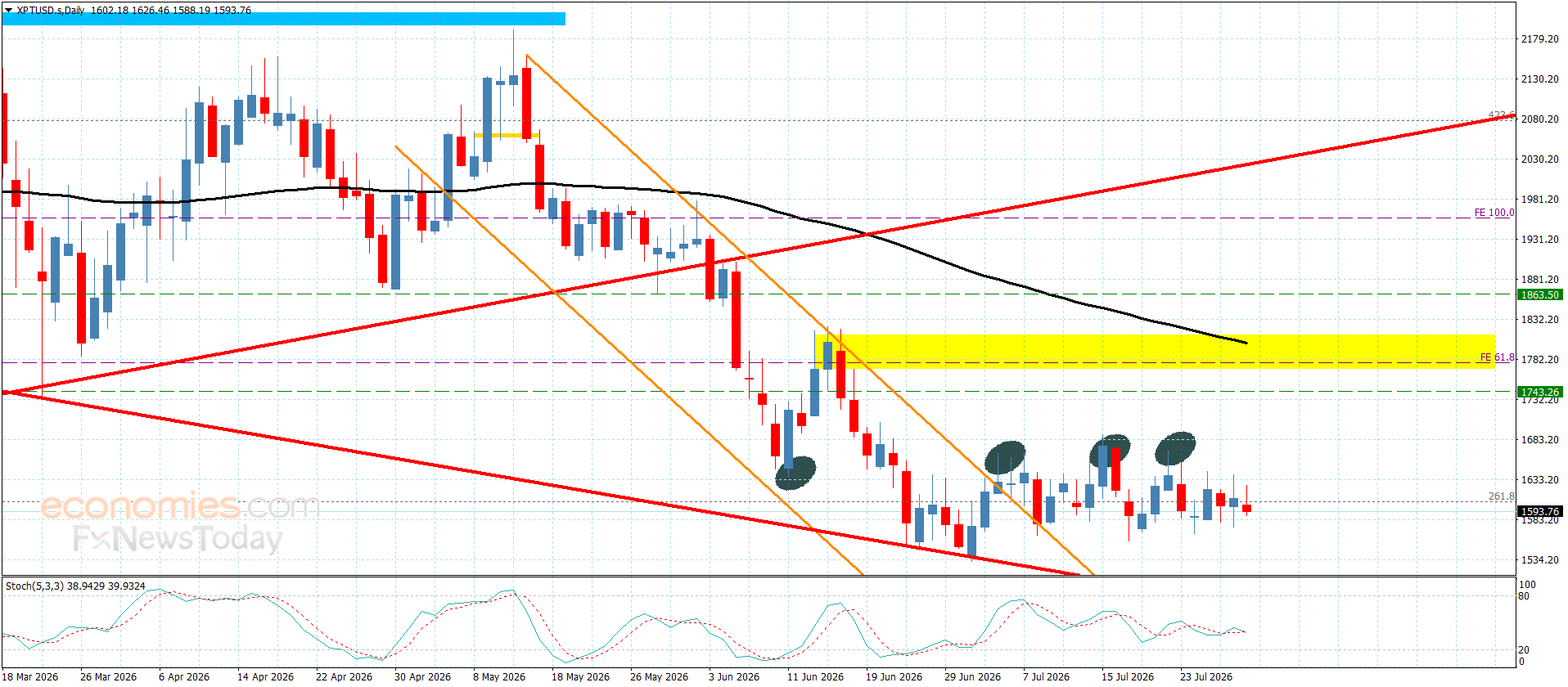
Despite the continuation of forming weak sideways trading by Platinum price in the last period, its negative stability below the extra barrier at $1695.00 confirms its surrender to the suggested negative scenario, to settle near $1595.00.
Stochastic attempt to provide negative momentum by its stability below 50 level makes us prefer reaching $1550.00, where breaking it will open the way for reaching extra negative stations near $1515.00 and $1475.00.
The expected trading range for today is between $1515.00 and $1640.00
Trend forecast: Bearish
– Written by
Ben Hughes
STORY LINK Pound-to-Dollar Forecast: Safe-Haven USD Demand Caps GBP Recovery
The Pound to US Dollar (GBP/USD) exchange rate remained close to a three-week low on Tuesday as another bout of weakness in technology shares dampened market sentiment.
At the time of writing, GBP/USD was trading at around $1.3228, slightly down from Tuesday’s opening levels.
The US Dollar (USD) retained a firm footing on Tuesday as investors continued to seek the safety of the ‘Greenback’ amid a prolonged selloff in global technology stocks.
The latest wave of risk aversion was driven by heavy losses across semiconductor and artificial intelligence-related companies, with investors becoming increasingly concerned about the scale of borrowing undertaken to finance AI infrastructure projects.
At the same time, growing competition from Chinese chip manufacturers added to pressure in global equity markets.
Even so, broader gains for the US Dollar remained limited as the improving geopolitical backdrop in the Middle East helped temper demand for traditional safe-haven assets.
The Pound (GBP) traded without a clear direction on Tuesday as the lack of significant UK economic data left investors with little fresh incentive to reposition.
Get better rates and lower fees on your next international money transfer.
Compare TorFX with top UK banks in seconds and see how much you could save.
Sterling also remained anchored by caution ahead of Thursday’s Bank of England (BoE) policy announcement.
Markets overwhelmingly expect policymakers to leave interest rates unchanged at 3.75%, meaning the accompanying guidance is likely to determine the Pound’s next move.
Should the BoE refrain from hinting that further policy tightening remains a possibility later this year, Sterling could struggle to attract meaningful support.
Attention will shift to the Federal Reserve on Wednesday as the US central bank announces its latest interest rate decision.
Although the Fed is expected to leave borrowing costs unchanged, investors will closely scrutinise the accompanying statement for clues on the future path of monetary policy.
While Chair Kevin Warsh has moved away from providing explicit forward guidance, markets will still be looking for signals that policymakers remain open to another interest rate increase in September.

Until then, the Pound to US Dollar (GBP/USD) exchange rate may remain trapped within a narrow range as traders await the outcome of both the Federal Reserve and Bank of England meetings.
International Money Transfer? Ask our resident FX expert a money transfer question or try John’s new, free, no-obligation personal service! ,where he helps every step of the way,
ensuring you get the best exchange rates on your currency requirements.
TAGS: Pound Dollar Forecasts
The US Dollar traded close to 163.84 against the Japanese Yen on Wednesday, holding near its highest level of 2026 as markets awaited policy decisions from both the Federal Reserve and Bank of Japan.
USD/JPY has gained around 4.5% since the end of December and approximately 0.8% in July alone. The pair has also risen in five of the past six months, leaving the Yen under sustained pressure.
Rabobank says Friday’s BoJ meeting will come with one advantage: policymakers will already know the outcome of the Fed decision.
That matters because the bank believes the FOMC “may have more impact on the USD/JPY exchange rate than” the BoJ’s own announcement.
A surprise Fed hike would likely deliver another powerful Dollar boost. Rabobank does not expect that outcome, however, and says unchanged US rates could instead trigger “a little profit-taking on long USD positions”.
The Yen’s bigger test comes a day later.
Rabobank argues that recent BoJ comments may have been “specifically aimed at preparing markets for hawkish signals” from Friday’s meeting. Without them, the risk is straightforward: “an absence of hawkish signals from the BoJ this week could open the door for further upside pressure on USD/JPY”.

USD/JPY’s path this year helps explain why Rabobank thinks the BoJ cannot afford an ambiguous message. The pair has not simply spiked towards 164; it has rebuilt its advance in stages since May, repeatedly recovering from shallow setbacks.
That persistence is the uncomfortable part for Tokyo. Verbal warnings and earlier Ministry of Finance intervention have slowed the move at times, but neither has changed its direction for long. The chart therefore supports Rabobank’s view that intervention alone may be “too costly” when the underlying force is an appreciating US Dollar.
Rabobank notes that the MoF has not bought Yen in the open market since spending JPY11.73 trillion between late April and late May.
One explanation is cost. The bank says officials may simply consider it “too costly to push against an appreciating USD”, particularly while US rate expectations remain firm.
There are signs that Japanese policy support has had some impact. Although USD/JPY has climbed sharply, the Yen is still the fourth-best-performing G10 currency over the past three months because the Dollar has strengthened even more broadly.
Rabobank says this suggests “both the MoF’s intervention and the hawkish signals from the BoJ have had some impact in supporting the JPY”.
Rabobank maintains a three-month USD/JPY forecast of 159, but admits that target “currently looks optimistic”.
A faster BoJ tightening cycle would help. The bank says an October rate increase, rather than waiting until December, could provide the Yen with support.
Japan’s inflation backdrop gives policymakers room to sound firmer. The BoJ has said an underlying price measure remains well above its 2% target, while wage negotiations have delivered another strong result.
Even that may not be enough on its own.
Rabobank says a move to 159 would likely require “various factors to come together”: greater reassurance over Japan’s fiscal outlook, a clearly hawkish BoJ and a decline in fears of further Fed tightening.
The final ingredient may prove decisive. As the bank puts it, “how far the JPY can recover versus the USD, if at all, is likely to be determined” by the Fed Chair’s message.