The main category of Forex News.
You can use the search box below to find what you need.
[wd_asp id=1]
The main category of Forex News.
You can use the search box below to find what you need.
[wd_asp id=1]
Gold price (XAU/USD) gains momentum around $2,580 during the early Asian session on Monday. The precious metal reached a fresh all-time high at $2,586 on Friday amid rising expectations of a significant Federal Reserve (Fed) rate cut. The Federal Open Market Committee (FOMC) meeting on Wednesday will be in the spotlight.
The growing speculation of an interest rate cut by the Fed after US economic data signaled a slowing of the economy has boosted the yellow metal as lower interest rates reduce the opportunity cost of holding non-yielding Gold. Financial markets are now pricing in a 48% chance of a 25 basis points (bps ) US rate cut at its upcoming meeting on September 17-18, while the odds of a 50 bps cut stand at 52%, according to the CME FedWatch tool.
“We are headed towards a lower interest rate environment, so gold is becoming a lot more attractive… I think we could potentially have a lot more frequent cuts as opposed to a bigger magnitude,” said Alex Ebkarian, chief operating officer at Allegiance Gold.
Additionally, the ongoing geopolitical tensions in the Middle East provide further support to the safe-haven Gold price. Israeli Prime Minister Benjamin Netanyahu said on Sunday that Yemen’s Houthis will pay a “heavy price” after a missile fired by the group landed in central Israel, per the BBC.
Nonetheless, the sluggish economy and the concerns about the economic slowdown in China might cap the upside for precious metals as China is the world’s biggest producer and consumer. The Chinese Retail Sales and Industrial Production were weaker than the expectation in August. Industrial output grew at the slowest pace since March, while Retail Sales had their second-slowest month of the year.
Gold has played a key role in human’s history as it has been widely used as a store of value and medium of exchange. Currently, apart from its shine and usage for jewelry, the precious metal is widely seen as a safe-haven asset, meaning that it is considered a good investment during turbulent times. Gold is also widely seen as a hedge against inflation and against depreciating currencies as it doesn’t rely on any specific issuer or government.
Central banks are the biggest Gold holders. In their aim to support their currencies in turbulent times, central banks tend to diversify their reserves and buy Gold to improve the perceived strength of the economy and the currency. High Gold reserves can be a source of trust for a country’s solvency. Central banks added 1,136 tonnes of Gold worth around $70 billion to their reserves in 2022, according to data from the World Gold Council. This is the highest yearly purchase since records began. Central banks from emerging economies such as China, India and Turkey are quickly increasing their Gold reserves.
Gold has an inverse correlation with the US Dollar and US Treasuries, which are both major reserve and safe-haven assets. When the Dollar depreciates, Gold tends to rise, enabling investors and central banks to diversify their assets in turbulent times. Gold is also inversely correlated with risk assets. A rally in the stock market tends to weaken Gold price, while sell-offs in riskier markets tend to favor the precious metal.
The price can move due to a wide range of factors. Geopolitical instability or fears of a deep recession can quickly make Gold price escalate due to its safe-haven status. As a yield-less asset, Gold tends to rise with lower interest rates, while higher cost of money usually weighs down on the yellow metal. Still, most moves depend on how the US Dollar (USD) behaves as the asset is priced in dollars (XAU/USD). A strong Dollar tends to keep the price of Gold controlled, whereas a weaker Dollar is likely to push Gold prices up.
The GBP/USD weekly forecast supports a bullish trend as the FOMC meeting could lead to further weakness for the greenback.
The GBP/USD pair had a bullish week after a mix of UK and US economic reports. Notably, the UK labor market showed resilience, with jobless claims plunging. Meanwhile, the economy stagnated, with no growth, indicating a weaker-than-expected recovery.
–Are you interested in learning more about STP brokers? Check our detailed guide-
On the other hand, US data showed higher-than-expected consumer and producer prices, reducing the likelihood of a super-sized rate cut. Consequently, the dollar rose. However, this changed late on Thursday after reports indicated that a 50 bps rate cut was a close call. The dollar dropped, allowing the pound to close on a bullish candle.
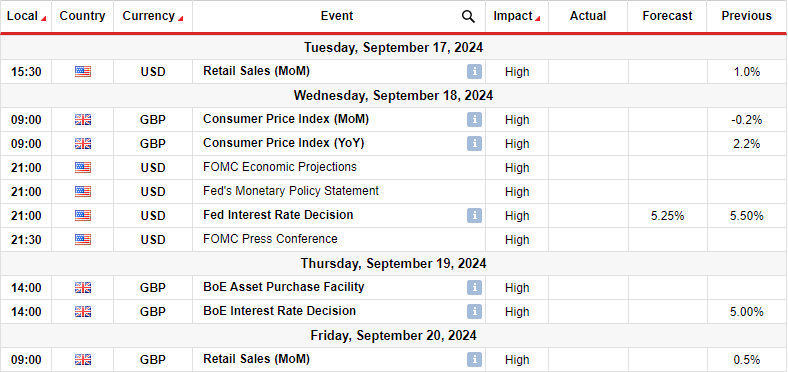
Next week, high-impact UK events will include the consumer inflation and retail sales reports and the Bank of England policy meeting. Meanwhile, in the US, the market will focus on the FOMC meeting and retail sales data.
Experts believe the US central bank will cut rates by 25 bps. However, there is still uncertainty regarding this, as some expect a more significant cut. Therefore, there might be a lot of volatility in the markets on Wednesday. Meanwhile, the Bank of England might keep rates unchanged owing to recent better-than-expected economic data. However, this outlook might change if inflation eases more than expected.
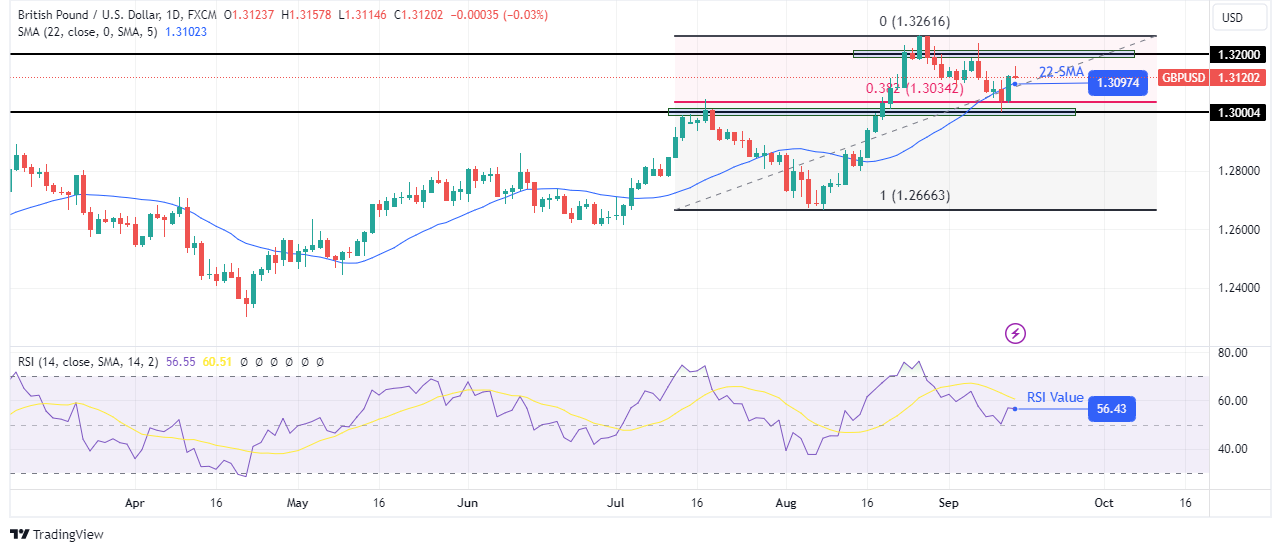
On the technical side, the GBP/USD price is on a developed bullish trend, with higher highs and higher lows. At the same time, the price has traded mostly above the 22-SMA, a sign that bulls are in the lead. Meanwhile, the RSI has traded in bullish territory, touching the overbought region several times.
–Are you interested in learning more about forex robots? Check our detailed guide-
The uptrend recently reached the 1.3200 critical resistance level, but the price failed to sustain a move above it. Consequently, bears took charge, triggering a pullback to the 22-SMA support. The SMA coincided with the 1.3000 psychological level and the 0.382 Fib, creating a solid support zone. The price has made a strong bullish candle that shows it might bounce higher to retest the 1.3200 level. A higher high will strengthen the bullish bias.
Looking to trade forex now? Invest at eToro!
68% of retail investor accounts lose money when trading CFDs with this provider. You should consider whether you can afford to take the high risk of losing your money
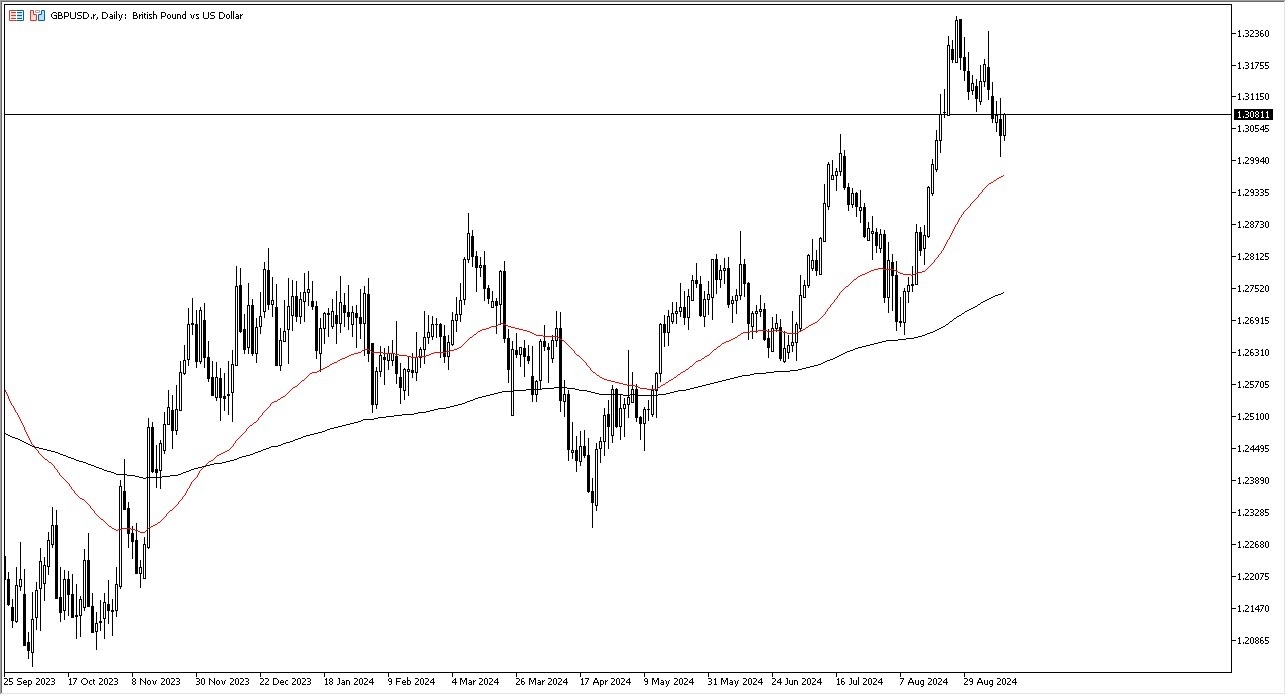
All things being equal, it’s worth noting that the Bank of England is probably going to be cutting rates, but it seems like most people are out there focusing on the Federal Reserve, and the fact that we are more likely than not going to continue to cut rates in an aggressive manner, at least as far as the market is concerned, and therefore it’s likely that we will continue to see a lot of traders trying to get short of the US dollar in general. Whether or not that actually pans out for the longer term, the reality is that the momentum is with the British pound at the moment.

Central banks around the world are racing to the bottom as far as interest rates are concerned, so to be a bit of an interesting situation to trade, mainly due to the fact that it comes down to the destruction of their own currencies, as the market will try to price all of that in. All things being equal, this is a market that I think continues to see the US dollar in its crosshairs, but if we do get some type of massive “risk off move”, this will send the US dollar much higher against most currencies, including this one. As things stand right now though, there’s nothing on the chart that suggests that we are going to do so.
Want to begin trading the daily GBP/USD Forex analysis? Get our top rated Forex brokers in the UK here.
Benchmark arabica coffee futures on ICE exchange gained 4.5% at $2.3595 per lb. Prices for this type of mild-tasting coffee, the preferred choice by large chains including Starbucks and Tim Hortons, increased 25% so far this year.
Meanwhile, robusta coffee, which used to be a cheaper variety used in blends for popular supermarket brands, posted a 5% price increase in London on Tuesday to $4,383 per metric ton. Robusta is up 44% this year, after gaining 63% in 2023.
Analysts say financial investors are building long positions in coffee futures, betting prices will continue to climb on the back of production problems, particularly in Brazil.
“There are initial signs of leaf wilting and leaf dropping on Brazilian coffee fields,” said U.S. broker and analyst StoneX, when it cut its estimate for the Brazilian production following months of below-average rains.
On Monday, the head of Brazil’s largest coffee co-op Cooxupe said the company no longer expects increase in production this year in the area where it operates in the Brazilian states of Minas Gerais and Sao Paulo due to dry, hot weather.”Dry weather in Brazil is supportive and after no talk of concern for the 2025/26 crop, there is now a comment from a large producer which should know if there is a problem,” said a U.S. coffee broker referring to Cooxupe’s views.Brazil production problems follow difficulties seen in Asia, where robusta production suffered with adverse climate conditions.
With limited supplies, coffee stocks remain tight in the main consuming regions. European stocks were 27% lower in June when compared to a year earlier, while Japanese coffee stocks are 12% below the five-year average.
In other soft commodities, London cocoa rose 1.5% to 5,426 pounds per ton, while New York cocoa gained 1.4% to $6,770 a ton.
Raw sugar settled down 0.21 cent, or 1.2%, at 17.87 cents per lb and refined sugar fell 1.6% at $507.60 a ton.
Weaker-than-expected demand is set to tip the oil market into a surplus over the next five quarters, Macquarie said in a Friday note as it lowered its Brent and WTI oil forecasts for the rest of the year.
“As we enter shoulder and turnaround season, the ‘last hurrah’ for oil in the form of Q3 tightness is quickly fading as our balances contemplate heavy oversupply across the next five quarters,” according to the Macquarie note cited by BOEreport.com.
The bank revised down its forecast for Brent Crude price by $2 per barrel to $80 for the rest of 2024. Macquarie cut by the same amount its estimate for the WTI Crude price, expecting it to average $75 a barrel for the remainder of the year.
The market is set to tip into a “heavy surplus” in 2025 as non-OPEC+ supply is set to increase amid tepid demand growth. This expected heavy surplus could limit the need for the OPEC+ group to begin unwinding their production cuts, according to the bank.
This week, both OPEC and the International Energy Agency (IEA) lowered their global oil demand growth forecasts, citing weaker Chinese consumption so far this year.
Despite the second consecutive downward revision of its demand growth estimate, OPEC is still much more optimistic than the IEA on Chinese and global oil consumption growth this year.
Other Wall Street banks have also recently lowered their oil price estimates.
Weaker Chinese oil demand, high inventories, and rising U.S. shale production have prompted Goldman Sachs to reduce its expected range for Brent oil prices by $5 to $70-$85 per barrel.
Just two weeks after lowering its Brent estimate to $80 per barrel for the fourth quarter, Morgan Stanley cut again its forecast, now expecting the international benchmark to average $75 a barrel in the last quarter of the year. Analysts at Morgan Stanley see rising headwinds on the demand side, which has been their key reason for cutting their Q4 oil price forecast.
By Charles Kennedy for Oilprice.com
The USD/JPY weekly forecast indicates a potential collapse if the Fed cuts by 50-bps and the Bank of Japan delivers a hawkish meeting.
USD/JPY has fallen and closed on a bearish candle in the past week. This came as the dollar collapsed while the yen strengthened. The dollar fell due to renewed bets for a 50 bps rate cut towards the end of the week. Initially, inflation reports had pointed to a smaller cut.
–Are you interested in learning more about STP brokers? Check our detailed guide-
On the other hand, the yen rallied as several Bank of Japan policymakers drummed up support for more rate hikes.
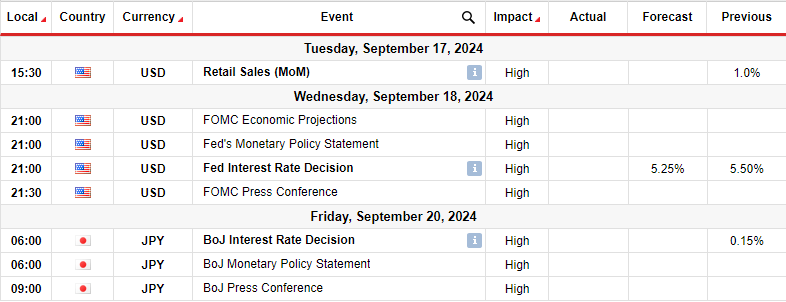
Next week, investors will focus on the FOMC policy meeting and retail sales data from the US. At the same time, the Bank of Japan will hold its policy meeting on Friday. Investors have waited for the September Fed meeting for a long time. The Fed will likely pivot at this meeting, implementing its first rate cut.
However, investors are unsure whether this will be 25 or 50 bps. A small rate cut could boost the dollar as it would precede a gradual pace for easing. On the other hand, a large rate cut would sink the greenback.
Meanwhile, the Bank of Japan might maintain rates for now. However, economists are pricing another rate hike before the year ends.
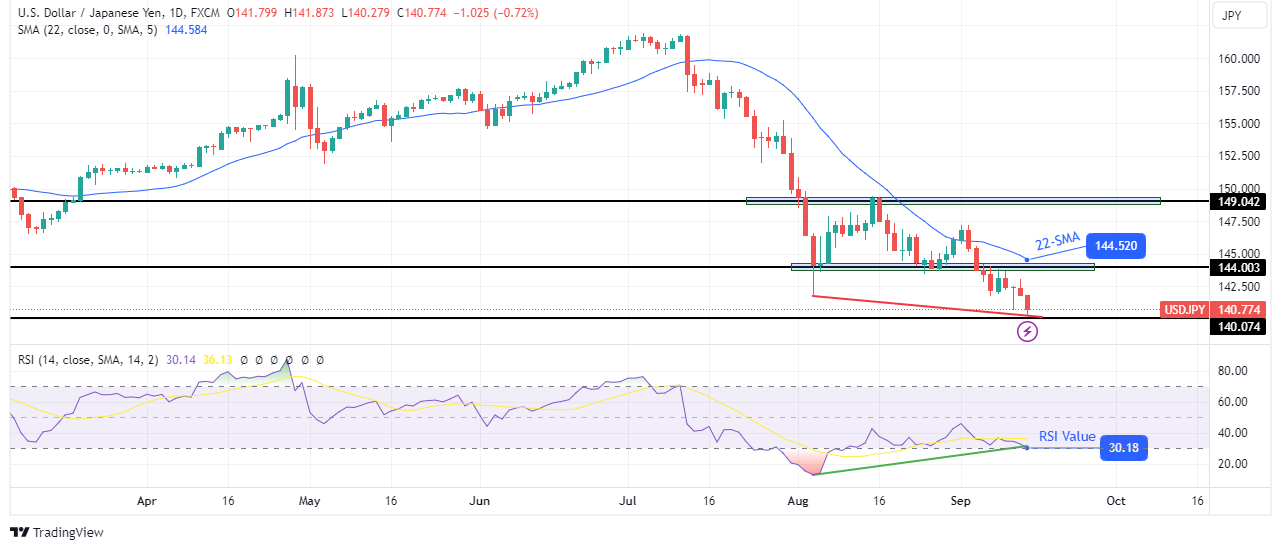
On the technical side, the USD/JPY price has made a new low in the downtrend after breaking below the 144.00 support level. Bears have remained in charge since the price broke below the 22/SMA, and the RSI dipped below 50. Since then, the price has declined steeply and paused near the 140.07 support level.
–Are you interested in learning more about forex robots? Check our detailed guide-
However, bears have weakened with time, and the price started consolidating near the 22-SMA. At the same time, the RSI has made a bullish divergence, indicating fading bearish momentum. Therefore, the tides might soon change. If bears fail to breach the 140.07 support, the price might reverse to challenge the 22-SMA and the 144.00 level.
A break above the SMA would indicate a shift in sentiment. On the other hand, if the SMA holds firm, the downtrend might continue.
Looking to trade forex now? Invest at eToro!
68% of retail investor accounts lose money when trading CFDs with this provider. You should consider whether you can afford to take the high risk of losing your money
Since the August swing low of 1.875, natural gas has had one leg up followed by a minor pullback to 2.125 (C). The pullback completed a 38.2% Fibonacci retracement and then reversed higher. Finding support after a relatively minor pullback is a sign of strength. This week’s bullish continuation above the 2.30 interim swing high confirmed the second leg up. The rise also triggered a double bottom bullish reversal pattern as the neckline is 2.30 swing high. Therefore, the technical clues point to a continuation higher.
A rising ABCD pattern is shown on the chart with an initial target of 2.54. That is a potential pivot level as there will be symmetry in price between the two swings in the pattern. The 50% retracement is near to that target at 2.52. As of today, the 20-Day MA has begun to cross above the 50-Day MA, another sign that the trend is strengthening. This doesn’t mean that natural gas goes straight to higher targets, but it has the potential to do so eventually.
Another indication for the near term is related to where natural gas ends in the week. A bullish breakout in the weekly chart also occurred on the move above 2.30. The high last week was 2.29 So, a weekly close above 2.29 will confirm the breakout on the weekly time frame and suggests that the buyers remain in charge. Further, a close today above 2.29 will be the highest weekly close in nine weeks. Nevertheless, natural gas has advanced off the August bottom and it would not be surprising to see a a short rest before it is ready to proceed higher.
For a look at all of today’s economic events, check out our economic calendar.
STORY LINK Pound to Euro Exchange Rate Today: GBP Lower as UK GDP Misses Forecasts
The Pound Euro (GBP/EUR) exchange rate edged lower on Wednesday following the UK’s latest GDP release.
At the time of writing GBP/EUR was trading at €1.1847, down approximately 0.2% from Wednesday’s opening rate.
The Pound (GBP) faced a downturn following the release of the UK’s GDP figures on Wednesday.
Contrary to the anticipated growth of 0.2%, the economy showed no growth in July, deviating from the previous month’s 0.2% expansion.
Additionally, July’s industrial output in Britain saw a decline of 0.8%, contrary to the expected increase of 0.3%. Manufacturing output also declined by 1%, falling short of the forecasted 0.2% rise.
However, despite signs of a weakened economic landscape in the UK, analysts believe that these figures will not heavily influence the Bank of England’s current trajectory towards policy easing.
Luke Bartholomew, Deputy Chief Economist at abrdn, noted:
‘The broader trend remains solid, although it is likely that the underlying pace of growth will slow somewhat over the second half of the year.
Certainly, there is no reason yet for the Bank and England to feel it needs to speed up the pace of rate cuts, and we expect the Bank to keep interest rates on hold next week.’
As a result, the Pound’s depreciation was minimal, with only slight losses noted against major currencies on Wednesday.
The Euro (EUR) displayed limited fluctuations against the majority of its significant trading partners on Wednesday, as market participants held back from making substantial moves ahead of the European Central Bank’s (ECB) highly anticipated interest rate decision.
The ECB is set to announce its decision on Thursday afternoon, with market consensus leaning heavily towards a 25 basis-point reduction in interest rates. This expectation has been largely priced into the market, reflecting a cautious optimism among investors.
Michael Field, Strategist at Morningstar, commented:
‘With 85% of economists polled expecting a 25 basis point rate cut by the ECB, it’s safe to say the markets will be disappointed if this doesn’t happen. When expectations are so unified though, generally it’s for a reason. In fact, two reasons that we can clearly identify.’
Amid a series of lacklustre economic reports from the Eurozone, the anticipated confirmation of a rate cut by the ECB could potentially lead to a weakening of the Euro against its global counterparts. Investors are closely monitoring the situation, gauging the potential impacts on the currency’s performance in the near term.
Looking forward, markets are keenly awaiting to see if the ECB opts for a rate cut, which could lead to a depreciation of the Euro. Conversely, should the ECB surprise markets by holding rates steady, the euro might find unexpected strength against its counterparts.
Looking to the Pound, a lack of substantial economic releases in the UK could leave GBP somewhat adrift, potentially causing Sterling to trade erratically or without clear direction.
International Money Transfer? Ask our resident FX expert a money transfer question or try John’s new, free, no-obligation personal service! ,where he helps every step of the way,
ensuring you get the best exchange rates on your currency requirements.
TAGS: Pound Euro Forecasts
The Pound Sterling (GBP) stalled its correction from over two-year highs against the US Dollar (USD) and staged an impressive comeback, with the GBP/USD pair having tested the critical 1.3000 threshold.
GBP/USD witnessed good two-way price action, correcting sharply to a three-week low of 1.3002 in the first half of the week only to recover the weekly losses in the latter part. The sentiment around the pair was mainly driven by the dynamics of the US Dollar. The Greenback continued to remain at the mercy of the market’s expectations on the size of the interest rate cut by the US Federal Reserve (Fed) in the upcoming week.
The August US labor market data fuelled a late recovery in the USD against its major rivals last week, which extended well into this week and weighed heavily on the GBP/USD pair. US Nonfarm Payrolls rose by 142,000, missing a 160,000 gain estimated. On the other hand, the Unemployment Rate edged down to 4.2%, in line with expectations.
Discouraging US employment data rekindled worries about a possible economic downturn and lifted the haven demand for the Greenback. Markets continued to run for cover in the buck, bracing for the critical US inflation data on Wednesday. Data published by the US Bureau of Labour Statics (BLS) showed Wednesday that the CPI rose 0.2% MoM in August, aligning with the expected 0.2% print. US August core CPI jumped 0.3% MoM vs. estimates of 0.2%. Sticky underlying inflation figures prompted markets to rule out an outsized Fed rate cut this month.
The Pound Sterling also felt the heat from softer UK pay growth and Gross Domestic Product (GDP) data released on Tuesday and Wednesday respectively. Average Earnings excluding Bonus in the UK rose 5.1% 3M YoY in July versus a 5.4% growth seen in June. The UK economy showed no growth over the month in July after stalling in June, data from the Office for National Statistics (ONS) showed Wednesday, missing the expected 0.2% growth.
These fundamental factors dragged GBP/USD to the lowest level in three weeks to just above the 1.3000 level. Buyers, however, managed to defend that key level, as the US Dollar saw a fresh selling wave on dismal US Producers Price Index (PPI) and Jobless Claims data, which reinforced bets of a 50 basis points (bps) rate reduction by the Fed at its September 18 policy announcement.
Annually, the headline PPI rose 1.7% in August, compared to the market consensus of a 1.8% print. The core PPI increased by 2.4% YoY in the same period, below the estimate of 2.5%. Meanwhile, the Initial Jobless Claims came in at 230,000 for the week ended Sept. 7, up 2,000 from the previous period while aligning with the forecast. Dismal US data combined with the Wall Street Journal (WSJ) article on the Fed’s rate cut dilemma brought back bets for a jumbo cut at the September meeting, smashing the Greenback while propping up GBP/USD back above 1.3100.
Markets are now pricing in a 43% chance of the Fed cutting rates by 50 bps, up from 27% a day earlier, with a 57% probability of a 25 bps cut, the CME Group’s FedWatch tool showed. Increased dovish Fed expectations exacerbated the US Dollar’s pain on Friday. The last data release from the US showed ahead of the weekend that the consumer confidence improved slightly in early September, with the preliminary University of Michigan’s Consumer Sentiment Index edging higher to 69 from 67.9 in August. This reading came in above the market expectation of 68 but failed to help the USD stage a rebound.
All eyes now turn to the high-impact UK CPI inflation report and the all-important Fed and BoE policy announcements, which will determine the next directional move in the GBP/USD pair.
It’s a quiet start to the big central banks’ week, with no relevant data to be released on Monday. Tuesday will feature the US Retail Sales data while the UK docket remains data-dry.
Wednesday is a busy one, with the UK inflation data slated for release before the key Fed verdict and Chairman Jerome Powell’s press conference.
It’s not a ‘Super Thursday’, as the BoE will only announce its rate decision without the update projections and Governor Andrew Bailey’s presser to follow. That same day, the US calendar will see the publication of the weekly Jobless Claims, Existing Home Sales and Philly Fed Manufacturing data.
On Friday, the UK will release the Retail Sales data, as traders will look to a speech from BoE policymaker Cathrine Mann.
Fed policymakers will also return to the rostrum on Friday, as the Fed’s ‘blackout period’ comes to an end.
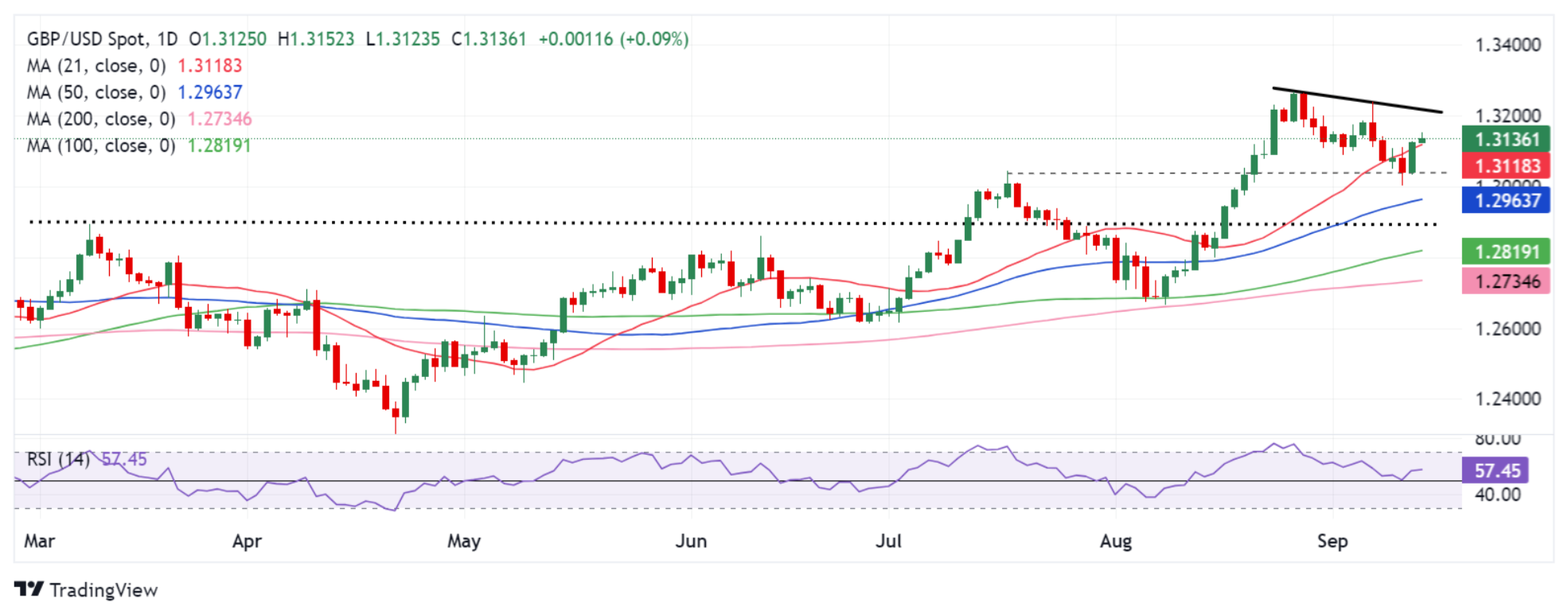
As observed on the daily chart, the GBP/USD pair defied bearish pressures and managed to find its footing above the key support at 1.3045 (July 17 high), having tested bids briefly at 1.3000.
On the road to recovery, the pair recaptured the 21-day Simple Moving Average (SMA) at 1.3119 on a daily closing basis, negating the bearish outlook in the near term.
Adding credence to the renewed upside, the 14-day Relative Strength Index (RSI) has regained the 50 level, currently near 58.00.
On the upside, GBP/USD must crack the falling trendline resistance at 1.3218 before aiming for the 29-month high of 1.3266.
Further up, Pound Sterling buyers will find the next relevant resistance levels at the 1.3300 round level and the 1.3350 psychological barrier.
Should buyers face rejection at the abovementioned trendline barrier at 1.3218, a correction could unfold toward the July 17 high of 1.3045.
A failure to sustain above that level could trigger a fresh decline toward the 50-day SMA at 1.2964.
The next relevant cushion aligns at the March 8 top of 1.2894, a break below which the 100-day SMA support at 1.2819 will come into play.
Monetary policy in the US is shaped by the Federal Reserve (Fed). The Fed has two mandates: to achieve price stability and foster full employment. Its primary tool to achieve these goals is by adjusting interest rates. When prices are rising too quickly and inflation is above the Fed’s 2% target, it raises interest rates, increasing borrowing costs throughout the economy. This results in a stronger US Dollar (USD) as it makes the US a more attractive place for international investors to park their money. When inflation falls below 2% or the Unemployment Rate is too high, the Fed may lower interest rates to encourage borrowing, which weighs on the Greenback.
The Federal Reserve (Fed) holds eight policy meetings a year, where the Federal Open Market Committee (FOMC) assesses economic conditions and makes monetary policy decisions. The FOMC is attended by twelve Fed officials – the seven members of the Board of Governors, the president of the Federal Reserve Bank of New York, and four of the remaining eleven regional Reserve Bank presidents, who serve one-year terms on a rotating basis.
In extreme situations, the Federal Reserve may resort to a policy named Quantitative Easing (QE). QE is the process by which the Fed substantially increases the flow of credit in a stuck financial system. It is a non-standard policy measure used during crises or when inflation is extremely low. It was the Fed’s weapon of choice during the Great Financial Crisis in 2008. It involves the Fed printing more Dollars and using them to buy high grade bonds from financial institutions. QE usually weakens the US Dollar.
Quantitative tightening (QT) is the reverse process of QE, whereby the Federal Reserve stops buying bonds from financial institutions and does not reinvest the principal from the bonds it holds maturing, to purchase new bonds. It is usually positive for the value of the US Dollar.
The USD/JPY outlook shows a free-falling dollar as markets move to price in a higher likelihood of a super-sized Fed rate cut next week. At the same time, the yen strengthened as more Bank of Japan policymakers took on a hawkish tone.
–Are you interested to learn more about forex options trading? Check our detailed guide-
On Thursday, the dollar fell to a fresh low for the year after reports that the Fed might consider a 50 bps rate cut at next week’s meeting. Moreover, former Fed official Bill Dudley said that there was a strong case for a 50 bps rate cut. As a result, the likelihood of a 50 bps rate cut shot up from 28% to 45%. Data on Wednesday showed that core consumer inflation beat expectations in August. Therefore, market participants increased the likelihood of a 25 bps rate cut, boosting the dollar.
Furthermore, data on Friday revealed that wholesale inflation was higher than expected. Recent data has pointed to a gradual pace for rate cuts. However, the reports on Friday showed that policymakers might consider a bigger cut.
Meanwhile, the yen was strong after another policymaker supported more rate hikes. BoJ board member Naoki Tamura noted that the upside risk to inflation was increasing. Higher inflation creates the best conditions for the Bank of Japan to hike interest rates.
Investors do not expect any key economic reports from the US or Japan. Therefore, the pair might extend Thursday’s move.
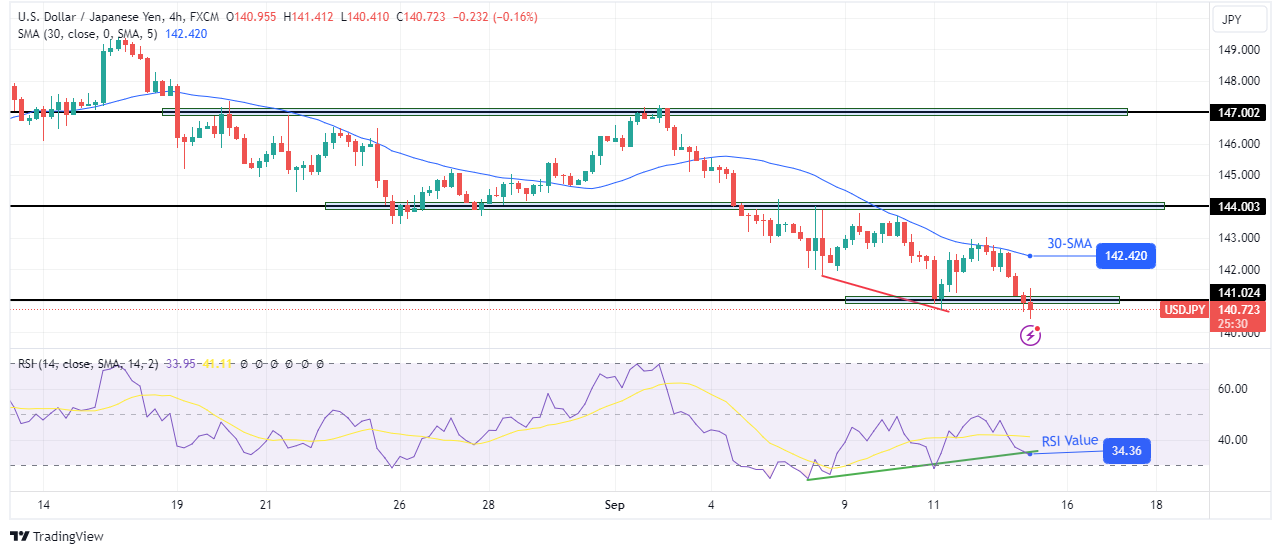
On the technical side, the USD/JPY price is on the brink of falling below the 141.02 support level. The bias is bearish as the price has made a series of lower highs and lows, indicating a downtrend. However, the decline has slowed near the 141.02 key level. It is becoming harder for the price to make lower lows.
–Are you interested to learn about forex robots? Check our detailed guide-
At the same time, the RSI has made a bullish divergence, indicating fading bearish momentum. If this is the end of the road for bears, the price might bounce higher from 14.02 to challenge the 30-SMA resistance. A break above the SMA would confirm a shift in sentiment. On the other hand, if bears remain in charge, the price will stay below the SMA.
Looking to trade forex now? Invest at eToro!
67% of retail investor accounts lose money when trading CFDs with this provider. You should consider whether you can afford to take the high risk of losing your money.