The main category of Forex News.
You can use the search box below to find what you need.
[wd_asp id=1]
The main category of Forex News.
You can use the search box below to find what you need.
[wd_asp id=1]
Silver price (XAG/USD) gains ground after two days of losses, reached fresh record high of $94.15 during earlier hours. Currently, the Silver price is trading around $$93.70 per troy ounce during early European hours on Monday. The technical analysis of the daily chart timeframe suggests the price of the precious metal remains within an ascending channel pattern, indicating a sustained bullish bias.
The 14-day Relative Strength Index (RSI) at 72.65 is overbought, pointing to stretched momentum that could shift into consolidation. RSI stays above 70, confirming strong momentum yet warning of limited upside without pause.
The nine-day Exponential Moving Average (EMA) slopes higher and stands well above the 50-day EMA, confirming an entrenched uptrend. The strong separation between averages supports the bullish bias. Price action remains above short- and medium-term averages as both slopes rise, keeping bulls in control.
On the upside, the Silver price could test the upper boundary of the ascending channel around $96.80, followed by the psychological level of $97.00
The initial support lies at the nine-day EMA of $87.05; a break would encourage a pullback toward the lower ascending channel boundary around $79.10. A daily close below the channel would expose the 50-day base at $69.23.
(The technical analysis of this story was written with the help of an AI tool.)
Silver is a precious metal highly traded among investors. It has been historically used as a store of value and a medium of exchange. Although less popular than Gold, traders may turn to Silver to diversify their investment portfolio, for its intrinsic value or as a potential hedge during high-inflation periods. Investors can buy physical Silver, in coins or in bars, or trade it through vehicles such as Exchange Traded Funds, which track its price on international markets.
Silver prices can move due to a wide range of factors. Geopolitical instability or fears of a deep recession can make Silver price escalate due to its safe-haven status, although to a lesser extent than Gold’s. As a yieldless asset, Silver tends to rise with lower interest rates. Its moves also depend on how the US Dollar (USD) behaves as the asset is priced in dollars (XAG/USD). A strong Dollar tends to keep the price of Silver at bay, whereas a weaker Dollar is likely to propel prices up. Other factors such as investment demand, mining supply – Silver is much more abundant than Gold – and recycling rates can also affect prices.
Silver is widely used in industry, particularly in sectors such as electronics or solar energy, as it has one of the highest electric conductivity of all metals – more than Copper and Gold. A surge in demand can increase prices, while a decline tends to lower them. Dynamics in the US, Chinese and Indian economies can also contribute to price swings: for the US and particularly China, their big industrial sectors use Silver in various processes; in India, consumers’ demand for the precious metal for jewellery also plays a key role in setting prices.
Silver prices tend to follow Gold’s moves. When Gold prices rise, Silver typically follows suit, as their status as safe-haven assets is similar. The Gold/Silver ratio, which shows the number of ounces of Silver needed to equal the value of one ounce of Gold, may help to determine the relative valuation between both metals. Some investors may consider a high ratio as an indicator that Silver is undervalued, or Gold is overvalued. On the contrary, a low ratio might suggest that Gold is undervalued relative to Silver.
The Pound is attempting to return above the 212.00 level after bouncing from lows near 211.00 earlier on the day. News that Japanese Prime Minister Sanae Takaichi has called for a snap election on February 8 has sent the Yen tumbling across the board.
Markets are fearing that Takaichi’s increasing popularity will render her a larger parliamentary support to deepen into her policy of large-stimulus measures and accommodative monetary policy, which, considering Japan’s balooning public debt, might lead the country into a fiscal crisis.
The GBP/JPY trades at 211.81 at the time of writing. Price action has broken trendline support from eally November lows, which is holding bulls now at the 212.00 area, a negative sign.
Technical indicators remain neutral-to-bearish. The Moving Average Convergence Divergence (MACD) line remains below the Signal line and below zero, while the Relative Strength Index (RSI) sits near 44, neutral below the 50 midline.
Failure to breach the mentioned 212.00 area would add pressure towards the late December and early January lows in the area of 210.30, ahead of the December 10 high, at 208.90. If 212.00 gives way, the path would be clear for a retest of the January 15 high, at 212.80, and the long-term high, near 214.30.
(The technical analysis of this story was written with the help of an AI tool.)
The table below shows the percentage change of Japanese Yen (JPY) against listed major currencies today. Japanese Yen was the strongest against the US Dollar.
| USD | EUR | GBP | JPY | CAD | AUD | NZD | CHF | |
|---|---|---|---|---|---|---|---|---|
| USD | -0.26% | -0.23% | -0.08% | -0.20% | -0.30% | -0.56% | -0.60% | |
| EUR | 0.26% | 0.03% | 0.18% | 0.06% | -0.04% | -0.30% | -0.34% | |
| GBP | 0.23% | -0.03% | 0.17% | 0.03% | -0.08% | -0.33% | -0.38% | |
| JPY | 0.08% | -0.18% | -0.17% | -0.15% | -0.24% | -0.50% | -0.55% | |
| CAD | 0.20% | -0.06% | -0.03% | 0.15% | -0.09% | -0.35% | -0.42% | |
| AUD | 0.30% | 0.04% | 0.08% | 0.24% | 0.09% | -0.27% | -0.30% | |
| NZD | 0.56% | 0.30% | 0.33% | 0.50% | 0.35% | 0.27% | -0.05% | |
| CHF | 0.60% | 0.34% | 0.38% | 0.55% | 0.42% | 0.30% | 0.05% |
The heat map shows percentage changes of major currencies against each other. The base currency is picked from the left column, while the quote currency is picked from the top row. For example, if you pick the Japanese Yen from the left column and move along the horizontal line to the US Dollar, the percentage change displayed in the box will represent JPY (base)/USD (quote).
On January 19, 2026, crude oil trades mixed in a tight range as markets digest recent OPEC+ signals and inventory trends, keeping Crude Oil Price Risk elevated.
Live market dashboards show WTI fluctuating in a narrow band around recent closes, while Brent trades near its latest reference level with only modest percentage changes on the day. The absence of a dramatic price spike does not mean risk has disappeared; instead, it suggests that buyers and sellers are locked in a fragile equilibrium where any surprise in demand, supply, or geopolitics can rapidly tip the balance.
For risk-takers: Trade Oil volatility now
The key driver behind today’s cautious trading tone is the market’s digestion of recent U.S. inventory and OPEC+ signals rather than a brand-new shock headline. Recent reports have highlighted changes in U.S. crude and product stocks, with prior data pointing to fluctuating draws and builds that have kept direction uncertain. At the same time, the latest OPEC+ communications have reaffirmed a focus on supply management and gradual adjustments rather than abrupt policy shifts, limiting today’s directional impulse but maintaining a tight underlying balance.
This combination has left Oil Price Forecast models finely balanced: modest changes in forecast demand for the U.S., Europe, and especially China can swing expectations between deficit and surplus for the coming quarters. Traders looking to Buy WTI Oil or focus on Brent Price Live quotes are watching macro data closely: growth indicators, central bank rate expectations, and industrial output figures all feed directly into demand assumptions. In a high-frequency trading environment, even a slightly weaker purchasing managers index or a surprise in U.S. macro releases can trigger algorithmic flows that push prices quickly in either direction.
One reason today feels deceptively quiet is that the market is pricing in event risk rather than reacting to it in real time. Tensions in key producing regions remain an ever-present tail risk, and any escalation in the Middle East, disruption to shipping lanes, or surprise sanctions decision can instantly widen spreads and trigger a spike in volatility. Meanwhile, the refined products side adds another layer of complexity: changing crack spreads, seasonal demand for heating and transportation fuels, and refinery outages can all feed back into crude benchmarks.
For active Energy Trading participants, this environment is particularly treacherous. Order books can look deep and liquid one moment, only to thin out sharply when a headline flashes across terminals or when an economic release deviates from consensus. In such moments, Crude Oil Price Risk manifests as rapid gaps between quotes, slippage on stops, and large intraday swings that can wipe out positions within minutes. The intraday patterns in both WTI and Brent today highlight that although the net change may appear small, the path during the session has included fast, short-lived bursts of volatility around data and news windows.
Retail traders eyeing opportunities to Buy WTI Oil or trade Brent around Brent Price Live levels need to understand that this market is driven not only by visible fundamentals like inventories and OPEC+ policy, but also by positioning, option gamma, and short-term systematic flows. When speculative positioning becomes crowded on one side, even a modestly negative headline can force rapid liquidations, compounding price moves well beyond what the underlying news might justify. This reflexive behavior can turn what starts as a mild session into a sharp intraday reversal.
Above all, it is critical to acknowledge the total loss risk that comes with leveraged exposure to crude benchmarks, whether through CFDs, futures, or options. Oil can gap significantly on geopolitical surprises, weekend developments, or unexpected OPEC+ commentary outside scheduled meetings. In such scenarios, stop-loss orders may not execute at the expected level, leaving traders with far larger losses than planned. The apparent stability in today’s tape should not lull anyone into complacency: a flat or slightly choppy session can be followed by an abrupt breakout once new information hits the market.
Anyone considering short-term Energy Trading strategies around crude should carefully calibrate position size, leverage, and risk limits. It is essential to plan for scenarios where prices move sharply through technical levels overnight or over illiquid periods, especially around key macro releases, OPEC+ communications, or geopolitical flashpoints. Monitoring both Oil Price Forecast revisions and Brent Price Live and WTI quote behavior intraday can help traders recognize when the market is transitioning from range-bound to trending or from calm to stressed conditions.
Risk Warning: Financial instruments, especially commodity CFDs, are complex and come with a high risk of losing money rapidly due to leverage. You should consider whether you understand how these instruments work and whether you can afford to take the high risk of losing your money. This content is for informational purposes only and does not constitute investment advice.
– Written by
David Woodsmith
STORY LINK British Pound to Euro Forecast: GBP Nears Best Levels in Four Months
The Pound-to-Euro exchange rate (GBP/EUR) edged higher after traders absorbed stronger-than-expected UK GDP data, with Sterling finding support as immediate recession fears eased and risk appetite improved.
There was a muted initial response to the UK GDP data, but the Pound has gained some traction with the Pound to Euro (GBP/EUR) exchange rate edging above the 1.15750 level.
GBP/EUR needs to move above 1.1570 to reach a 4-month high.
There was stronger than expected GDP data while risk appetite was stronger amid immediate relief that there have been no US attacks on Iran.
ING sees scope for short-term Pound gains; “Given the positioning, we think EUR/GBP support at 0.8645/55 looks vulnerable and the risks are building towards a breakdown to 0.8600 next week (Gains to 1.1630 for GBP/EUR).
ING still expects Pound losses later in the year.
Get better rates and lower fees on your next international money transfer.
Compare TorFX with top UK banks in seconds and see how much you could save.
MUFG played down the GDP impact; “While the upside growth surprise is a welcome development, it does not significantly alter our expectations for further BoE cuts and a weaker pound this year.”
UK GDP increased 0.3% for November after a 0.1% decline the previous month and compared with consensus forecasts of a 0.1% advance for the month.
For November, the services sector grew 0.3% while there was a 1.1% gain for industrial production as Jaguar Land Rover output continued to rebound from the cyber attack.
There was, however, a 1.3% slide in construction output.
ING expressed concern over the construction sector; What really stands out in these figures, though, is what’s happening in construction. Output was down sharply (again) in November and is now almost 3% lower since July. That goes hand-in-hand with a purchasing managers index (PMI) which has recently fallen off a cliff.”
Wider economic fears will ease to some extent.
According to Thomas Pugh, chief economist at audit, tax and consulting firm RSM UK; “The risk that the economy outright contracted in Q4 has sharply receded.”

He was still cautious over the outlook; “However, we doubt the economy did little more than stagnate in Q4, as the initial data for December has been weak, and doctor’s strikes will add to the drag on growth.”
There are potentially significant implications for monetary and fiscal policy
Pugh added; “The stronger-than-expected outturn in November will also further dent any chances of a back-to-back rate cut in February. We doubt the next rate cut will come until April.”
Markets see less than a 10% chance of a February rate cut.
National Institute of Economic and Social Research senior economist Ben Caswell noted; “Given today’s figure, we now project that the economy grew 1.4 per cent in 2025 – a rise in the growth rate compared to the year before.
He added; “Against this backdrop, the Chancellor more than doubled her fiscal headroom at the Budget in an effort to bolster economic confidence. While it is too early to see the full effect of this, the move appears to have eased speculation over future tax policy and the uncertainty that came with it.”
International Money Transfer? Ask our resident FX expert a money transfer question or try John’s new, free, no-obligation personal service! ,where he helps every step of the way,
ensuring you get the best exchange rates on your currency requirements.
TAGS: Pound Euro Forecasts
The EURJPY pair confirmed its surrender to the bearish corrective bias by reaching below 184.10 level, reaching the next target in the previous report at 183.40, to form a strong obstacle against the negative attempts.
The price is affected by sideways bias dominance due to its confinement between the barrier at 184.10 level, and forming a strong support base at 183.40 level, note that providing bullish momentum that might reinforce the chances of surpassing 184.10 level, to confirm its readiness to activate the bullish trend by its rally towards 184.85, while breaking the support will open the way for targeting new corrective stations that begin at 182.65.
The expected trading range for today is between 183.40 and 184.10
Trend forecast: Bullish
– Written by
Tim Boyer
STORY LINK Euro to Dollar Forecast: Can EUR/USD Break Higher as Fed Risks Grow?
The Euro to Dollar exchange rate (EUR/USD) has eased back from recent highs, slipping toward 1.16 as investors grow more cautious on the timing and scale of Federal Reserve rate cuts.
While some banks still see scope for euro gains over the medium term, resilient US data and a firmer dollar tone have capped upside for now.
Markets are increasingly focused on Fed policy credibility and whether US rates can stay higher for longer into 2026.
RBC Capital Markets expects that the Euro to Dollar (EUR/USD) exchange rate will make gains in 2026, but has lowered its end-year projection to 1.20 from 1.24 with this level now seen as being reached at the end of 2024.
After little change initially, ING is continuing to back gains to 1.22 by the end of 2026 as US interest rates continue.
EUR/USD drifted lower to test the 1.1600 area during the week.
Get better rates and lower fees on your next international money transfer.
Compare TorFX with top UK banks in seconds and see how much you could save.
Markets are expecting two Fed rate cuts during 2026.
Credit Agricole is expecting Euro losses as the Fed resists rate cuts; “We continue to expect unchanged rates in January.
Past that, our current base case has the pause turning into an extended one that lasts through the entirety of 2026, though this is predicated upon seeing some stabilisation in the labour market in upcoming reports, where weaker-than-expected data would raise the risks of a shorter pause and/or more easing than we currently project.”
The issue of Fed independence will remain a key issue.
Early this week, the justice department issued subpoenas against the Federal Reserve and Chair Powell with claims of malpractice over Federal Reserve building renovations.
Powell pushed back strongly against the move and defended the bank strongly. MUFG commented;
“The repeated attacks on the Fed’s independence to satisfy President Trump’s desire for lower rates continues to pose downside risks for the US dollar and supports our forecast for a weaker US dollar.
It added; “However, it could backfire on President Trump if Fed officials dig in and keep rates on hold as an act of defiance to highlight the Fed’s ongoing independence in setting policy.”
RBC still expects net dollar losses against the Euro on three grounds as the cost of carry compresses between the countries, hedges on US assets will rise. It also expects a rotation into European assets and stronger Euro-Zone growth.
RBC is still cautious over the scope for substantial gains;
“We are aware of the headwinds to long-term EUR/USD strength – US productivity growth outperforms Europe’s, there is no good European alternative to USTs, the US dominates Europe in AI and tech and the EU also still has an undercurrent of political risk.”
ING also sees near-term potential barriers to Euro support;
“With volatility low, and high-yield and emerging market currencies in demand, it seems investors are preferring to fund carry trades out of the euro at a cost of just 2.00% rather than dollars at around 3.55%.”
Deutsche Bank expects Asian currency developments will be a key element;
“Comparing medium-term FX valuation estimates to mid-dated forwards shows that EUR/USD is now very close to fair value, even if the dollar is still expensive. It will be very hard for EUR/USD to break 1.20 in the absence of greater idiosyncratic strength in Asia FX.
International Money Transfer? Ask our resident FX expert a money transfer question or try John’s new, free, no-obligation personal service! ,where he helps every step of the way,
ensuring you get the best exchange rates on your currency requirements.
TAGS: Euro Dollar Forecasts
Gold price (XAU/USD) rises to a fresh record high near $4,675 during the early Asian session on Monday. The precious metal gains momentum after US President Donald Trump said he would slap tariffs on eight European nations that have opposed his plan to take Greenland.
Trump announced a 10% tariff on goods from countries including Denmark, Sweden, France, Germany, the Netherlands and Finland, along with the United Kingdom (UK) and Norway, starting from February 1, until the US is allowed to buy Greenland. The move sparked fears of retaliation from Europe, supporting traditional safe-haven assets such as Gold.
European Union (EU) ambassadors reached a broad agreement on Sunday to intensify efforts to dissuade Trump from imposing levies on European allies, while also preparing retaliatory measures should the duties go ahead.
On the other hand, a slew of US economic data, including improving US labor market data, have lowered the implied probabilities of imminent US Federal Reserve (Fed) rate cuts. Fed funds futures have pushed back expectations for the next rate cut to June and September from January and April.
The view that the US central bank can keep interest rates higher for longer generally underpins the US Dollar (USD) and weighs on the non-interest-bearing assets like Gold.
Gold has played a key role in human’s history as it has been widely used as a store of value and medium of exchange. Currently, apart from its shine and usage for jewelry, the precious metal is widely seen as a safe-haven asset, meaning that it is considered a good investment during turbulent times. Gold is also widely seen as a hedge against inflation and against depreciating currencies as it doesn’t rely on any specific issuer or government.
Central banks are the biggest Gold holders. In their aim to support their currencies in turbulent times, central banks tend to diversify their reserves and buy Gold to improve the perceived strength of the economy and the currency. High Gold reserves can be a source of trust for a country’s solvency. Central banks added 1,136 tonnes of Gold worth around $70 billion to their reserves in 2022, according to data from the World Gold Council. This is the highest yearly purchase since records began. Central banks from emerging economies such as China, India and Turkey are quickly increasing their Gold reserves.
Gold has an inverse correlation with the US Dollar and US Treasuries, which are both major reserve and safe-haven assets. When the Dollar depreciates, Gold tends to rise, enabling investors and central banks to diversify their assets in turbulent times. Gold is also inversely correlated with risk assets. A rally in the stock market tends to weaken Gold price, while sell-offs in riskier markets tend to favor the precious metal.
The price can move due to a wide range of factors. Geopolitical instability or fears of a deep recession can quickly make Gold price escalate due to its safe-haven status. As a yield-less asset, Gold tends to rise with lower interest rates, while higher cost of money usually weighs down on the yellow metal. Still, most moves depend on how the US Dollar (USD) behaves as the asset is priced in dollars (XAU/USD). A strong Dollar tends to keep the price of Gold controlled, whereas a weaker Dollar is likely to push Gold prices up.
According to January’s Reuters poll, conducted between January 6-13, 43% of economists predicted a July BoJ rate hike, 27% a June hike, and just 8% an April hike. Economists expect the BoJ to delay raising interest rates to assess the impact of December’s rate hike on the economy.
However, the weaker yen has pushed import prices higher, reducing households’ purchasing power. A more hawkish BoJ policy stance, including hints at cutting JGB purchases, would likely offer much-needed relief. Private consumption is a key contributor to Japan’s economy, accounting for roughly 60% of GDP.
The BoJ monetary policy decision is set for January 23. 65 of 67 economists polled expected the BoJ to keep rates steady in January and March. The slump in machinery orders supported the economists’ outlook. But, political developments and fiscal spending plans are likely to change the narrative, suggesting a USD/JPY pullback from current levels. Sentiment toward the BoJ’s rate path through H1 2026 will be key, given that most economists expect a rate hike in July.
The political uncertainty and fiscal concerns support a cautiously bullish short-term price outlook for USD/JPY. Meanwhile, warnings of yen interventions and expectations of Bank of Japan rate hikes reinforce the bearish medium-term projection. Hawkish BoJ rhetoric and intervention warnings would likely challenge the cautiously bullish short-term outlook.
Rising Japan-China tensions have added another layer of policy uncertainty into the mix. US tariffs and friction with China have led economists to predict slower growth and softer inflation in 2026.
Natixis Asia Pacific Chief Economist Alicia Garcia Herrero commented:
“All in all, Japan’s GDP is expected to slow to +0.9% in 2026 from +1.3% in 2025, dragged by higher US tariffs and tensions with China. […] With the Yen remaining relatively weak, inflation is expected to slow down only to +2.3% YoY in 2026 from +3.1% YoY in 2025.”
On the BoJ’s monetary policy stance, Alicia Garcia Herrero stated:
“With PM Takaichi’s strong preference for a lax monetary policy to realize her vision, the BoJ is likely to remain cautious in normalizing further. In fact, uncertainties are compounded by the political tension with China, raising the bar to hike. Nevertheless, the ongoing tug of war over policy normalization with the government is anticipated to keep the Yen stubbornly weak. These developments are expected to force the BoJ to hike by 25 bps, possibly in July, to stabilize the currency.”
The prospect of BoJ rate hikes and Fed rate cuts reinforces the bearish medium- to longer-term price trajectory.
This week, investors should closely monitor developments on tariffs. A US Supreme Court ruling on the legality of the US administration’s tariff policies is imminent.
A court ruling that blocks tariffs would likely boost risk sentiment, easing demand for the US dollar. Furthermore, the removal of tariffs would improve global trade, benefiting Japanese exporters. These dynamics would likely overshadow the downward effect of removing tariffs on Japanese import prices and the yen, indicating a bearish USD/JPY outlook.
On Monday, US markets are closed for Martin Luther King Jr. Day, with the Fed in its Blackout Period, leaving the USD/JPY exposed to geopolitical risks. President Trump announced tariffs on eight European countries on Saturday, January 17, in a bid to acquire Greenland, potentially escalating trade tensions. The eight countries included Denmark, Norway, Sweden, France, Germany, the UK, the Netherlands, and Finland.
Despite rising geopolitical tensions, expectations of multiple BoJ rate hikes and a new Fed Chair favoring lower interest rates suggest narrower US-Japan rate differentials. These factors reaffirm the bearish medium-term outlook for USD/JPY.
For USD/JPY price trends, traders should assess technicals and closely track the fundamentals.
Viewing the daily chart, USD/JPY remains above its 50-day and 200-day Exponential Moving Averages (EMAs), signaling bullish momentum. While technicals remain bullish, bearish fundamentals are developing, countering the technicals.
A break below 157 would expose the 50-day EMA and the 155 support level. A sustained fall through the 50-day EMA would indicate a bearish near-term trend reversal, bringing the 200-day EMA into play. If breached, 150 would be the next key support level.
Crucially, a sustained fall through the 50-day and 200-day EMAs would reaffirm the bearish medium-term price outlook.
New York, Jan 18, 2026, 12:27 EST — The market has closed.
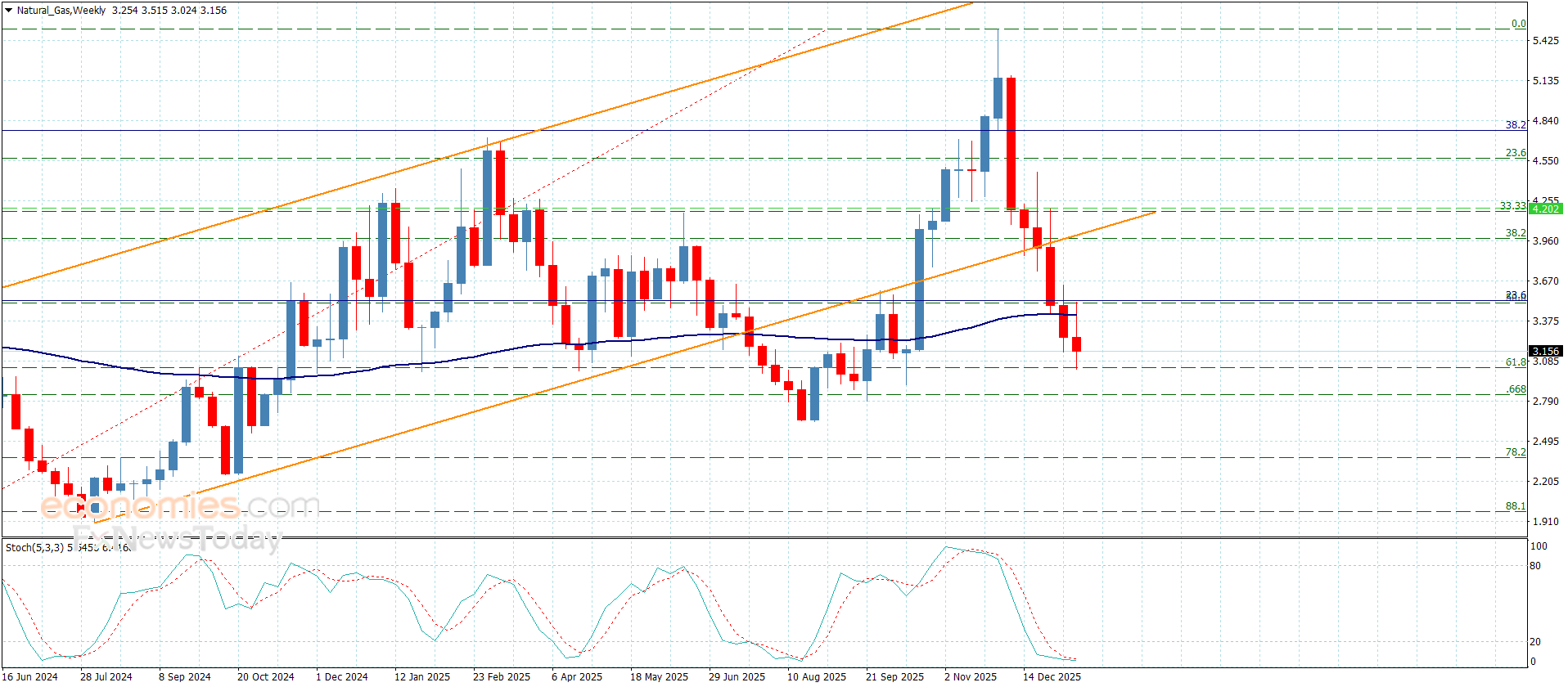
U.S. natural gas futures slipped Friday as traders turned their focus back to weather risks ahead of the long weekend.
The front-month Henry Hub contract closed at $3.103 per million British thermal units (mmBtu), slipping 2.5 cents. According to CME’s daily bulletin, it swung between $3.020 and $3.230 during the session.
Monday’s U.S. holiday will thin liquidity, which matters since gas prices often shift sharply on forecast updates when heating demand is the key factor.
The upcoming session falls amid a biting cold snap hitting sections of the United States. A winter storm is sparking hazardous wind chills and snow threats stretching from the Midwest to the East Coast, the National Weather Service warned, according to The Associated Press. (AP News)
Overseas demand is playing a role. Spot liquefied natural gas (LNG) prices in Asia hit a six-week peak this week, driven by colder weather forecasts that boosted buying, Reuters reported. “The weather outlook across Northeast Asia and Europe has turned colder week-on-week,” said Kesher Sumeet, senior LNG analyst at Energy Aspects. (Reuters)
Heating degree days (HDDs), which increase as temperatures drop and heating demand grows, are expected to stay above average in Northeast Asia later this January, Sumeet said. (Reuters)
European delivered LNG benchmarks climbed on expectations of colder weather and quicker storage withdrawals. “European delivered prices have risen sharply this week for the first quarter,” said Martin Senior, head of LNG pricing at Argus. (Reuters)
U.S.-listed United States Natural Gas Fund (UNG), following front-month gas futures, ended Friday at $10.33, rising 0.29%, according to Nasdaq data. (Nasdaq)
Storage remains a key metric for traders trying to validate weather-related swings. On Jan. 15, the Energy Information Administration reported that working gas in storage was 3,185 billion cubic feet (Bcf) as of Jan. 9. That’s a decline of 71 Bcf from the previous week but still above the five-year average. (EIA Information Releases)
A major concern for bulls is the potential fading of the cold signal. Forecasts often shift rapidly in late January, and a sudden warm-up could reduce heating demand, even as supply and storage stay relatively ample compared to recent levels. (EIA Information Releases)
Markets are also contending with holiday scheduling. CME announced it won’t calculate or release settlement prices this Monday. (CME Group)
Coming soon: revised U.S. temperature forecasts for late January and the next EIA weekly storage report, set for Jan. 22 at 10:30 a.m. ET. (EIA Information Releases)
Traders of the GBP/USD will have to decide on their personal perspectives while judging technical, fundamental and behavioral sentiment this coming week.
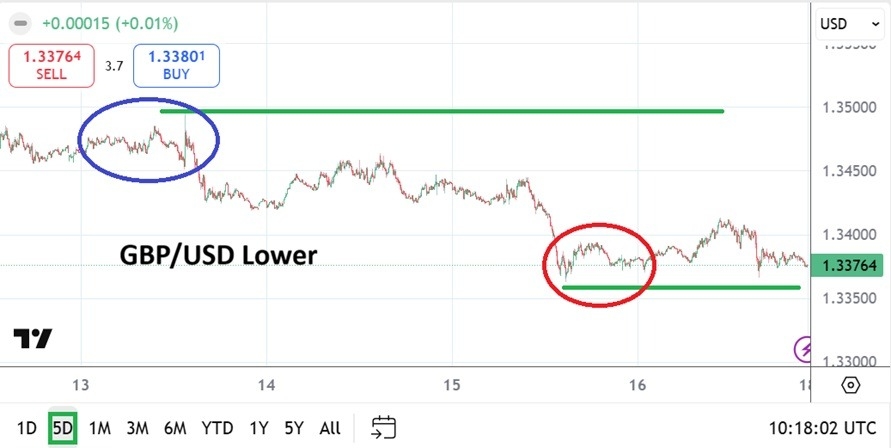
On the 6th of January the GBP/USD was at nearly 1.35680. Last Tuesday the GBP/USD was around 1.34955 as the high for the week, but the currency pair closed close to 1.33764 going into this weekend. The incremental lower action since the highs made in the first week of January do correlate to the broad Forex markets.
The highs seen on the 6th of January touched values last seen in September of 2025, but remained far below the apex highs attained then and in the month of June when the 1.37000 value was penetrated. However, the recent lower price action in the GBP/USD is still within the lower middle crux of the currency pair’s value via a one month chart. And near higher elements when a GBP/USD three month technical glance is taken.

The U.K still is producing rather lackluster economic data, this Tuesday employment data will come from Britain, and inflation via CPI statistics will be published on Wednesday. Yet, U.S data and influence via USD centric action remains the dominant force with the GBP. U.S economic data via its inflation statistics were rather mixed, but the most recent releases (October and November data were released last week at the same time due to the U.S government shutdown a couple of months ago) showed inflation remained rather tame – this if you looked at the November results.
However, this point can be argued and certainly did not impact the USD with weakness. In fact the USD got stronger and the downwards price of action of the GBP/USD and the EUR/USD reflected this trend. It can be said that more risk adverse attitudes in the financial markets caused the selloff of the GBP/USD, which picked up moment from late Tuesday and into the remainder of the week. The close of nearly 1.33764 is traversing territory last seen around the 19th of December.
The U.S Federal Reserve is suffering from a rather public debate in its FOMC about the direction of interest rates. Fed Chairman Jerome Powell and President Trump are engaged in a rather unprecedented tussle regarding policy.
Speculative price range for GBP/USD is 1.32950 to 1.35020
Day traders and financial institutions may both feel that the GBP/USD is oversold at its current levels, but nervous sentiment early this coming week should be watched. Depending on news developments the USD could see rather volatile price action due to rhetoric which could influence sentiment rather dramatically in the near-term. If global conditions remain tranquil this could help ease tensions among large institutions, but this doesn’t feel likely. This weekend has produced loud noise regarding threats of more tariffs against Europe due to political diatribes from President Trump about Greenland once again, yes, believe it or not. Thus, large traders are getting hit from many directions regarding noise in the markets.
Also it should be remembered that President Trump is scheduled to speak in the middle of this week at the Davos summit in Switzerland. Trump could engage in a calm tranquil policy speech, or he could easily veer off into rhetoric which makes financial markets nervous. If nervousness wins the day, this could create downwards trajectory for the GBP/USD. Although the GBP/USD may be thought of as being oversold for the moment, looking for sustained upside this coming week may be difficult. Short, quick hitting wagers are recommended for day traders depending on the their perspectives and sentiment shifts which are a certainty.
Ready to trade our weekly forecast? Check out the best forex trading company in UK worth using.