The main category of Forex News.
You can use the search box below to find what you need.
[wd_asp id=1]
The main category of Forex News.
You can use the search box below to find what you need.
[wd_asp id=1]
Crude oil prices are in retreat after rising on the possibility of U.S. strikes on Iran. Before the retreat, however, Brent crude and WTI had jumped to the highest in months, countering bearish forecasts for the year—and tearing traders between geopolitics and fundamentals.
In fundamentals, the majority of observers and forecasters are unanimous that the supply of crude oil is substantially higher than demand. In fact, Goldman Sachs recently revised its price predictions for 2026, saying it now expected Brent crude to go even lower after shedding about a fifth of its value last year.
“Rising global oil stocks and our forecast of a 2.3mb/d surplus in 2026 suggest that rebalancing the market likely requires lower oil prices in 2026 to slow down non-OPEC supply growth and support solid demand growth, barring large supply disruptions or OPEC production cuts,” Goldman said earlier this week—even though protests in Iran were already making headlines and pushing the benchmarks higher.
On the other hand, the effective takeover by the United States of Venezuela’s oil industry has had an understandably bearish effect on prices. This week, a Washington official told media that the U.S. has sold the first batch of Venezuelan crude for $500 million, and more sales would follow. In terms of fundamentals, this strengthens the case for a bearish mood. However, statements by oil industry executives urging caution about the possibility of a quick turnaround in Venezuelan oil production have had a restraining effect on that mood.
Meanwhile, drone strikes on three tankers in the Black Sea fueled a new bout of supply disruption concern, to add to expectations of possible disruption in Iranian oil flows abroad. A Reuters report cited an unnamed source as saying Kazakhstan had suffered a 35% drop in its oil output over the first two weeks of January because of attacks that also included strikes on the Caspian Pipeline Consortium by Ukrainian forces. Kazakhstan has called on the United States and the European Union to help secure oil transport in the Black Sea.
Speaking of the European Union, reports emerged this week saying Brussels was planning a further cut in its price cap for Russian oil in a bid to reduce Russia’s oil revenues by tying Western insurance coverage to the price cap. The new level of the price cap will be set at $44.10 per barrel from next month. So far, the price caps have failed to cause much pain to the Russian budget, but the EU considers them a working mechanism to hurt Russia’s economy in a bid to make it withdraw from Ukraine.
Perhaps the most bullish development for oil from the past few days was the signal, from President Donald Trump, that he was not excluding the possibility of a military strike against Iran. That signal, however, has been quite quickly replaced by observations by the U.S. president that the Iranian government was easing its crackdown on the protesters, reducing the likelihood of a military strike. That’s when oil’s retreat began and continues today, in evidence that the glut narrative holds sway over the oil market.
Expectations of further growth in oil production remain dominant on that market, with forecasters such as the U.S. Energy Information Administration and the International Energy Agency both predicting further supply growth, even as OPEC pauses its unwinding of production cuts implemented back in 2022 to prop up prices. Even so, shale drillers are signaling they would not be happy with WTI closer to $50 than to $60, and production growth is slowing. Indeed, the EIA forecast in its latest Short-Term Energy Outlook that U.S. oil production will flatten this year, even inch down and extend that decline into 2027.
This has been ignored by the oil market so far, even though U.S. oil production has been the main driver behind bearish market predictions thanks to its fast and significant growth. That growth is now gone but everyone seems to be ignoring the fact in the firm belief there is already too much oil in the world—and the data seems to support this, with media citing a Kpler calculation there were some 1.3 billion barrels of crude on water in December, which was the highest since 2020 and the pandemic lockdowns.
Reuters’ Ron Bousso, however, noted in a recent column that a quarter of that oil comes from Russia, Iran, and Venezuela—the sanctioned producers. That oil takes longer to find buyers because of the sanctions but it does find buyers, Bousso pointed out. This suggests the number of barrels on tankers is not necessarily the most accurate indication of a physical glut, especially in light of recently released Chinese import data, showing oil imports into the country hit a record both in December and in 2025 as a whole. Predicting oil prices is notoriously unreliable. These days it is even more unreliable than usual, it seems, as conflicting narratives and agendas keep clashing, making the oil market a confusing place to be.
By Irina Slav for Oilprice.com
More Top Reads From Oilprice.com
Important DisclaimersFXEmpire is owned and operated by Empire Media Network LTD., Company Registration Number 514641786, registered at 7 Jabotinsky Road, Ramat Gan 5252007, Israel. The content provided on this website includes general news and publications, our personal analysis and opinions, and materials provided by third parties. This content is intended for educational and research purposes only. It does not constitute, and should not be interpreted as, a recommendation or advice to take any action, including making any investment or purchasing any product. Before making any financial decision, you should conduct your own due diligence, exercise your own discretion, and consult with competent advisors. The content on this website is not personally directed to you, and we do not take into account your individual financial situation or needs. The information contained on this website is not necessarily provided in real time, nor is it guaranteed to be accurate. Prices displayed may be provided by market makers and not by exchanges. Any trading or other financial decision you make is entirely your own responsibility, and you must not rely solely on any information provided through the website. FXEmpire does not provide any warranty regarding the accuracy, completeness, or reliability of any information contained on the website and shall bear no responsibility for any trading losses you may incur as a result of using such information. The website may include advertisements and other promotional content. FXEmpire may receive compensation from third parties in connection with such content. FXEmpire does not endorse, recommend, or assume responsibility for the use of any third-party services or websites. Empire Media Network LTD., its employees, officers, subsidiaries, and affiliates shall not be liable for any loss or damage resulting from your use of the website or reliance on the information provided herein.Risk DisclaimersThis website contains information about cryptocurrencies, contracts for difference (CFDs), and other financial instruments, as well as about brokers, exchanges, and other entities trading in such instruments. Both cryptocurrencies and CFDs are complex instruments and involve a high risk of losing money. You should carefully consider whether you understand how these instruments work and whether you can afford to take the high risk of losing your money. FX Empire encourages you to conduct your own research before making any investment decision and to avoid investing in any financial instrument unless you fully understand how it works and the risks involved.
This is bullish behavior, as that price zone is the first anticipated support area for gold, and support has been seen. The market is confirming significance of the 10-day indicator and if gold remains above that line, the short-term trend is bullish. Friday’s low provides a possible minor swing low if it is sustained, and key short-term support along with the 10-day line.
On the upside, a decisive breakout above the record high of $4,643 is needed to trigger a continuation. However, gold will then quickly approach a potential resistance zone from $4,664 to $4,721. There are four indicators marking that range as a potential resistance zone. Given confirmation of strength with a bounce off the 10-day average on a pullback following a new all time high, gold could quickly push through that price zone and head towards a 78.6% projected measured move at $4,760.
The top of the range, however, shows minor confluence with two indicators and therefore possibly a more significance resistance area. A 432.6% (261.8% + 161.8%) is at $4,713, and the 161.8% Fibonacci extension of the December decline is at $4,721. The first 127.2% extended target from December was near the trend high at $4,625 and shows a relationship with the ratios. The recognition of the first retracement ratio target enhances the chance that the higher 161.8% price area is reached as well.
Momentum shows slowing somewhat on the weekly chart, as gold is set to close near or below the mid-point of the week’s range, which was $4,578. A stronger closing price in the upper half of the week’s range would show greater control by buyers and therefore increase confidence that bullish momentum may dominate once again. This week began with a new all time high on Monday, followed by a stall.
Nonetheless, this week’s breakout confirms on a weekly basis with a closing above the prior high of $4,550. Whether bullish momentum shows soon or after some consolidation, the bull trend remains solid if gold remains above the 20-day average, now at $4,466.
If you’d like to know more about how to trade gold and silver, please visit our educational area.
GBP/USD closed last week on the defensive below 1.3400, paring weekly gains despite a mildly positive data surprise from the UK. The release of UK GDP m/m showed modest growth, but the data failed to trigger sustained buying interest in sterling.
–Are you interested to learn more about crypto signals? Check our detailed guide-
Markets mainly interpreted the improvement as technical rather than structural, which aligns with the assumption that UK growth is sluggish when money is tight. GBP bulls were uncertain; therefore, the rising momentum faded.
The dollar has better fundamentals in the US. Producer Price Index, Retail Sales, and Initial Jobless Claims all exceeded expectations, indicating a healthy US economy. These disclosures lowered expectations that the Fed would cut rates soon, raising Treasury yields and strengthening the dollar.
A defensive bid for the dollar followed increased geopolitical concerns over Iran, which made people less risk-taking. This accelerated GBP/USD’s decline at week’s end.
The next week will be full of important UK data releases that could set the pound’s course in the near future. The Claimant Count numbers will give us an idea of how the job market is doing, and the Retail Sales and CPI numbers will be crucial for setting expectations for Bank of England rates. Markets will pay close attention to inflation data, especially for signs that prices are easing. Flash PMIs will give us a timely snapshot of business activity in key sectors later this week.
On the US side, investors are now looking at GDP, Core PCE, and Flash PMIs. The Fed still likes Core PCE as an inflation measure, and an unexpected rise could support the view that prices will remain high for a long time. GDP data will help us determine whether the recent strength is widespread or is slowing.
In general, GBP/USD is sliding lower unless UK data clearly beats expectations and US inflation signals weaken. The dollar is still in charge for now, especially given the world’s greater uncertainty.
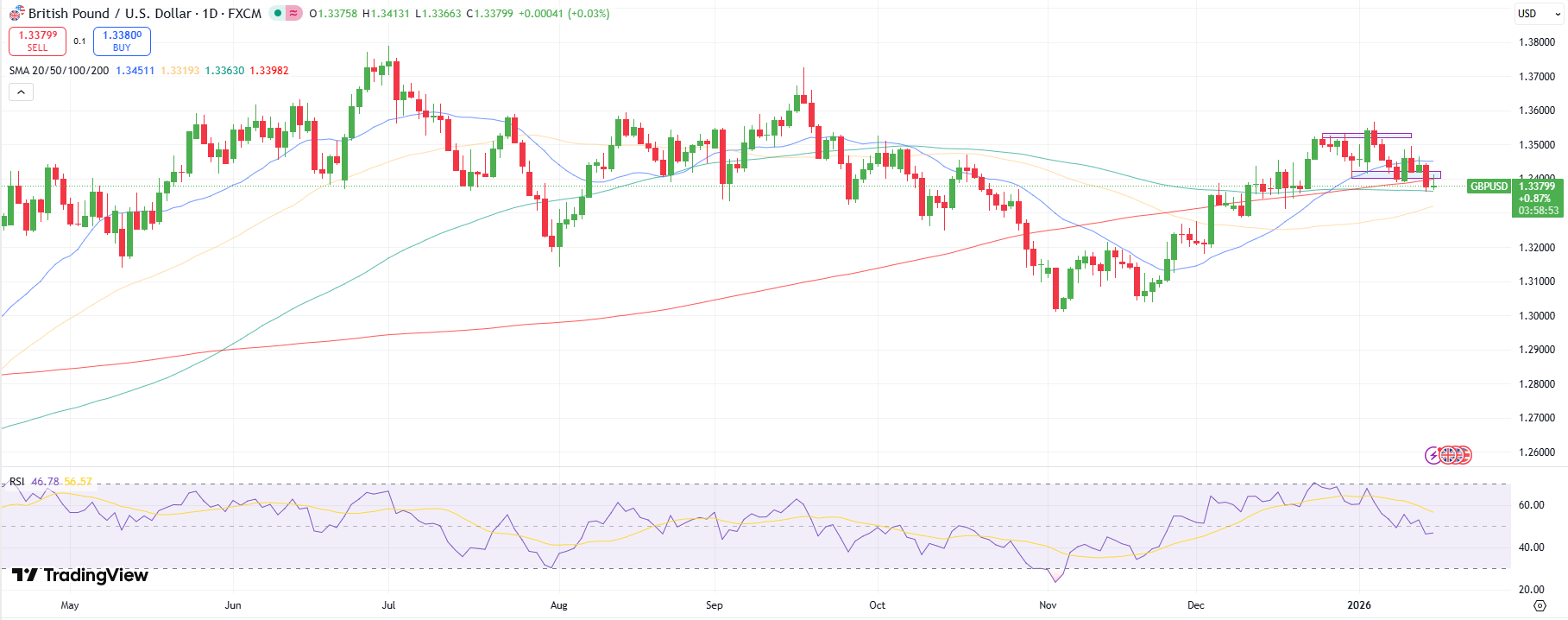
GBP/USD is consolidating after a rejection from the 1.3550-1.3600 resistance zone, suggesting bullish momentum is fading. The price is below both the 20- and 50-day MA, which are flattening. This supports a neutral to mildly bearish bias. RSI is moving toward the middle line, indicating the market is consolidating rather than continuing its trend.
–Are you interested in learning more about tips for forex traders? Check our detailed guide-
The 100-day MA near 1.3360 is a key support level. If the market closes below this level every day, it will open up to 1.3250-1.3200. On the upside, 1.3450-1.3500 is immediate resistance, followed by 1.3600. If the price breaks through this level, it will gain momentum toward 1.3750.
Looking to trade forex now? Invest at eToro!
68% of retail investor accounts lose money when trading CFDs with this provider. You should consider whether you can afford to take the high risk of losing your money.
Gold treads water around $4.600 after failure to break record highs, at $4,640
Strong US employment and manufacturing data boost expectations of a Fed pause.
XAU/USD is forming a potential H&S pattern with its neckline at $4,570.
Gold’s (XAU/USD) is looking for direction at the $4,600 area on Friday. The precious metal failed to breach all-time highs at $4,640, weighed by a stronger US Dollar on Thursday, but downside attempts remain contained above the $4,570 area so far.
Macroeconomic data from the US released on Thursday showed an unexpected decline in weekly Jobless Claims. These figures, coupled with the solid improvements in manufacturing conditions in the New York Empire State and the Philadelphia Fed manufacturing Indexes, have provided further reasons for the US Federal Reserve (Fed) to keep interest rates on hold for some time.
The XAU/USD pair trades at $4,606, practically flat on the daily chart. The broader trend remains bullish with the ascending 100-period Simple Moving Average (SMA) providing dynamic support near $4,480, yet with mounting signs that the rally is losing strength.
Recent price action shows a small Head & Shoulders pattern, a common figure for trend shifts. Beyond that, the Relative Strength Index (RSI), approaching the 50 line, suggests a bearish divergence. The Moving Average Convergence Divergence (MACD) line remains below the Signal line, although the histogram has begun to contract, highlighting a fading bearish momentum.
Bears, however, will need to clear out the mentioned $4,570 area (January 13, 14 lows) to confirm a deeper correction. Further down, the targetis the confluence of the are the January 6 high, and the mentioned 100 SMA right below $4,500. To the upside, above $4,640, the next targets would be at the 127.2% and the 161.8% Fibonacci extensions of the January 8-12 rally, at $4,689 and $4,763, respectively.
(The technical analysis of this story was written with the help of an AI tool.)
Gold has played a key role in human’s history as it has been widely used as a store of value and medium of exchange. Currently, apart from its shine and usage for jewelry, the precious metal is widely seen as a safe-haven asset, meaning that it is considered a good investment during turbulent times. Gold is also widely seen as a hedge against inflation and against depreciating currencies as it doesn’t rely on any specific issuer or government.
Central banks are the biggest Gold holders. In their aim to support their currencies in turbulent times, central banks tend to diversify their reserves and buy Gold to improve the perceived strength of the economy and the currency. High Gold reserves can be a source of trust for a country’s solvency. Central banks added 1,136 tonnes of Gold worth around $70 billion to their reserves in 2022, according to data from the World Gold Council. This is the highest yearly purchase since records began. Central banks from emerging economies such as China, India and Turkey are quickly increasing their Gold reserves.
Gold has an inverse correlation with the US Dollar and US Treasuries, which are both major reserve and safe-haven assets. When the Dollar depreciates, Gold tends to rise, enabling investors and central banks to diversify their assets in turbulent times. Gold is also inversely correlated with risk assets. A rally in the stock market tends to weaken Gold price, while sell-offs in riskier markets tend to favor the precious metal.
The price can move due to a wide range of factors. Geopolitical instability or fears of a deep recession can quickly make Gold price escalate due to its safe-haven status. As a yield-less asset, Gold tends to rise with lower interest rates, while higher cost of money usually weighs down on the yellow metal. Still, most moves depend on how the US Dollar (USD) behaves as the asset is priced in dollars (XAU/USD). A strong Dollar tends to keep the price of Gold controlled, whereas a weaker Dollar is likely to push Gold prices up.
GBP/JPY hits weekly lows below 212.00 after rejection at 213.30 on Thursday.
The Yen rallies following bold intervention warnings by Japanese authorities.
The pair is testing the ascending trendline support from early November lows.
The Yen is outperforming most of its peers in an otherwise quiet session on Friday, as Japanese authorities ramped up their threats of intervention. The GBP/JPY is extending its reversal from long-term highs above 214.00 to test levels below the 212.00 line at the time of writing.
comments
The Japanese Finance Minister, Satsuki Katayama, affirmed in a press conference on Friday that she would not “rule out any options” to defend the Japanese currency. Katayama also recalled that the joint statement with the US in September was “extremely significant and included language on intervention,” hinting at a concerted action with US economic authorities.
The 4-hour chart shows the GBP/JPY trading right above 212.00, testing the support area in the confluence of the late December highs, and the ascending trendline support from the November lows in the area between 211.60 and 212.00.
The broader trend remains bullish, but technical indicators hint at a fading momentum. The Moving Average Convergence Divergence (MACD) remains below zero, reflecting a moderate bearish pressure. The Relative Strength Index (RSI) sits near 42in neutral-to-bearish territory.
A confirmation below the mentioned 211.60 level would put the bullish trend into question, and increase pressure towards 210.00, where bears were capped on December 24 and 31 and January 8. To the upside, Thursday’s high, near 213.30 are closing the path to the long-term highs, at 214 30 hit earlier in the week.
(The technical analysis of this story was written with the help of an AI tool.)
The table below shows the percentage change of Japanese Yen (JPY) against listed major currencies today. Japanese Yen was the strongest against the US Dollar.
| USD | EUR | GBP | JPY | CAD | AUD | NZD | CHF | |
|---|---|---|---|---|---|---|---|---|
| USD | -0.12% | -0.20% | -0.30% | -0.06% | -0.10% | -0.43% | -0.23% | |
| EUR | 0.12% | -0.09% | -0.17% | 0.05% | 0.02% | -0.30% | -0.12% | |
| GBP | 0.20% | 0.09% | -0.08% | 0.15% | 0.11% | -0.21% | -0.02% | |
| JPY | 0.30% | 0.17% | 0.08% | 0.26% | 0.20% | -0.13% | 0.07% | |
| CAD | 0.06% | -0.05% | -0.15% | -0.26% | -0.06% | -0.39% | -0.20% | |
| AUD | 0.10% | -0.02% | -0.11% | -0.20% | 0.06% | -0.33% | -0.15% | |
| NZD | 0.43% | 0.30% | 0.21% | 0.13% | 0.39% | 0.33% | 0.19% | |
| CHF | 0.23% | 0.12% | 0.02% | -0.07% | 0.20% | 0.15% | -0.19% |
The heat map shows percentage changes of major currencies against each other. The base currency is picked from the left column, while the quote currency is picked from the top row. For example, if you pick the Japanese Yen from the left column and move along the horizontal line to the US Dollar, the percentage change displayed in the box will represent JPY (base)/USD (quote).
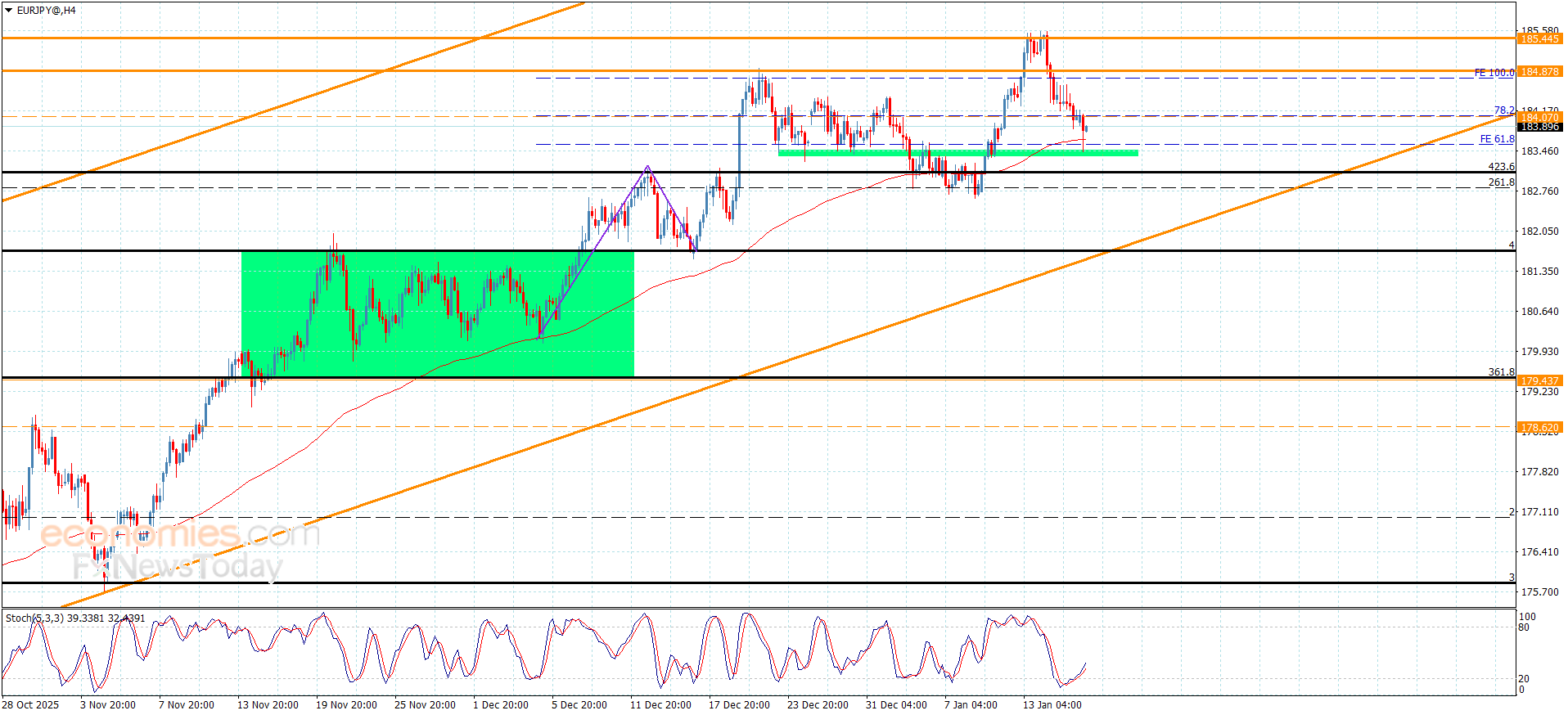
The EURJPY pair confirmed its surrender to the bearish corrective bias by reaching below 184.10 level, reaching the next target in the previous report at 183.40, to form a strong obstacle against the negative attempts.
The price is affected by sideways bias dominance due to its confinement between the barrier at 184.10 level, and forming a strong support base at 183.40 level, note that providing bullish momentum that might reinforce the chances of surpassing 184.10 level, to confirm its readiness to activate the bullish trend by its rally towards 184.85, while breaking the support will open the way for targeting new corrective stations that begin at 182.65.
The expected trading range for today is between 183.40 and 184.10
Trend forecast: Bullish
Copper price provided a new negative close below the barrier at$5.9700, announcing to delay the bullish attack, to begin activating the bearish corrective trend by reaching $5.7900 initially, approaching the initial suggested target in the previous report.
Stochastic exit from the overbought level will increase the negative pressure on the price, which makes us keep the bearish corrective suggestion, to expect targeting $5.6000 level, to press on the extra support at $5.5100.
The expected trading range for today is between $5.6000 and$5.8600
Trend forecast: Bearish correctly
Copper price provided a new negative close below the barrier at$5.9700, announcing to delay the bullish attack, to begin activating the bearish corrective trend by reaching $5.7900 initially, approaching the initial suggested target in the previous report.
Stochastic exit from the overbought level will increase the negative pressure on the price, which makes us keep the bearish corrective suggestion, to expect targeting $5.6000 level, to press on the extra support at $5.5100.
The expected trading range for today is between $5.6000 and$5.8600
Trend forecast: Bearish correctly
The Pound Sterling (GBP) started off the week on a firm footing against the US Dollar (USD) and jumped to 1.3486 on Monday, following criminal charges against Federal Reserve’s (Fed) Chair Jerome Powell over cost overrun in the reconstruction of Washington’s headquarters.
However, the GBP/USD pair turned down steadily as the week passed after Bank of England (BoE) policymaker Alan Taylor delivered dovish comments on the monetary policy outlook, and investors shifted their focus to the Fed’s monetary policy decision scheduled later this month.
The Pound Sterling gained sharply against the US Dollar on Monday after United States (US) federal prosecutors opened a criminal investigation into Fed Chair Powell over mismanaging funds in the reconstruction of Washington’s headquarters.
In response, Powell said that the “new threat is not about the renovation project but a pretext”. He also added that the threat of criminal charges is a “consequence of the Fed setting interest rates based on its assessment of the public interest rather than the president’s preferences”.
Market experts viewed the accusation of cost overruns against Powell as an attack on the central bank’s independence, which could undermine US assets and impact the US sovereign rating in the long run.
It remained clear from US President Donald Trump’s comments over the past several months that he was unhappy with the Fed not reducing interest rates aggressively, criticizing Chairman Powell several times for the same.
On Tuesday, US President Trump criticized Fed’s Powell again after the release of the Consumer Price Index (CPI) data for December, which showed price pressures rising steadily, demonstrating his dislike for him for not prioritizing his economic agenda. “We have very low inflation. That would give ’too late Powell’ the chance to give us a nice beautiful big rate cut,” Trump said.
Chiefs from global central banks came in support of Powell, stating that “Independence of central banks is a cornerstone of price, financial and economic stability in the interest of the citizens that we serve”, and “we stand in full solidarity with the Fed System and its Chair Jerome H. Powell.”
However, the steady US CPI report on Tuesday provided relief for the US Dollar against the British currency, as it intensified speculation that the Fed will announce a pause in its ongoing monetary-easing campaign at its policy meeting later this month.
On Wednesday, dovish commentary from BoE’s Taylor on the monetary policy outlook dragged the Pound Sterling further against the US Dollar.
Taylor said in a speech on Wednesday that inflation could return to the central bank’s 2% target in mid-2026 more quickly than having to wait until 2027, and projected that interest rates could “normalise to neutral sooner rather than later”. In the December policy meeting, the BoE guided that the monetary policy will remain on a “gradual downward path”.
The impact of expectations for the Fed holding interest rates steady and BoE Taylor’s dovish commentary was significant for GBP/USD, restraining the pair from regaining ground despite strong United Kingdom (UK) monthly Gross Domestic Product (GDP) data for November on Thursday.
The Office for National Statistics (ONS) reported that the economy returned to growth after contracting 0.1% in both September and October. The GDP growth came in at 0.3%, stronger than estimates of 0.1%. Month-on-month (MoM) Industrial and Manufacturing Production also grew at a robust pace of 1.1% and 2.1%, respectively.
GBP/USD revisited a four-week low around 1.3360 on late Thursday as the US Dollar Index (DXY) posted a fresh six-week high at 99.50, following a few Fed officials. Kansas Fed Bank President Jeffrey Schmid and Atlanta Fed Bank President Raphael Bostic came out in support for modestly restrictive monetary policy stance, citing upside inflation risks. “We need to stay restrictive because inflation is too high,” Bostic said, adding, “I expect inflation pressures will continue through 2026 as many businesses are still incorporating tariffs into prices.”
The major events for the Pound Sterling in January’s third week will be the release of UK employment data for the three months ending in November and the Consumer Price Index (CPI) data for December, which will be released on Tuesday and Wednesday, respectively.
Investors will pay close attention to both data for fresh cues on the BoE’s likely interest rate decision at its first monetary policy meeting of 2026 on February 5.
The UK ILO Unemployment Rate jumped to 5.1% in the three months ending October, the highest level seen since March 2021. Meanwhile, inflationary pressures cooled down for the second straight month in November after peaking in September.
Next week, investors will also focus on the UK Retail Sales data for December, and on the preliminary S&P Global Purchasing Managers’ Index (PMI) data for January for both the UK and the US.
During the week, US President Donald Trump could also reveal the name of the next Fed Chairman. In December, Trump said that he could announce Powell’s successor at the Fed sometime in January. The comments from Trump in his latest interviews indicated that White House Economic Adviser Kevin Hassett, former Fed Chair Kevin Warsh, and current Fed Governors Christopher Waller and Michelle Bowman are major contenders to replace Jerome Powell.
In the daily chart, GBP/USD trades at 1.3404. The 21-day Simple Moving Average (SMA) rises above the longer ones, while the 50- and 200-day SMAs advance and the 100-day SMA flattens. Price holds above the 50- and 100-day averages but sits beneath the 21-day, with the 200-day SMA at 1.3406 acting as immediate resistance and the 100-day at 1.3365 supporting. The Relative Strength Index (RSI) at 48 (neutral) edges higher but remains below the midline, indicating subdued momentum.
A break above the 200-day SMA at 1.3406 could open a path toward the rising 21-day SMA at 1.3460, while a pullback would shift focus to the 100-day SMA at 1.3365 and then the 50-day at 1.3335. The upward slope of the 200-day SMA underpins the medium-term bias, but traction would improve if the RSI reclaims 50. A sustained move through nearby resistance would favor an extension toward the short-term average, whereas failure to gain above the long-term gauge would keep the pair contained within the moving-average cluster.
(The technical analysis of this story was written with the help of an AI tool.)
Inflation measures the rise in the price of a representative basket of goods and services. Headline inflation is usually expressed as a percentage change on a month-on-month (MoM) and year-on-year (YoY) basis. Core inflation excludes more volatile elements such as food and fuel which can fluctuate because of geopolitical and seasonal factors. Core inflation is the figure economists focus on and is the level targeted by central banks, which are mandated to keep inflation at a manageable level, usually around 2%.
The Consumer Price Index (CPI) measures the change in prices of a basket of goods and services over a period of time. It is usually expressed as a percentage change on a month-on-month (MoM) and year-on-year (YoY) basis. Core CPI is the figure targeted by central banks as it excludes volatile food and fuel inputs. When Core CPI rises above 2% it usually results in higher interest rates and vice versa when it falls below 2%. Since higher interest rates are positive for a currency, higher inflation usually results in a stronger currency. The opposite is true when inflation falls.
Although it may seem counter-intuitive, high inflation in a country pushes up the value of its currency and vice versa for lower inflation. This is because the central bank will normally raise interest rates to combat the higher inflation, which attract more global capital inflows from investors looking for a lucrative place to park their money.
Formerly, Gold was the asset investors turned to in times of high inflation because it preserved its value, and whilst investors will often still buy Gold for its safe-haven properties in times of extreme market turmoil, this is not the case most of the time. This is because when inflation is high, central banks will put up interest rates to combat it.
Higher interest rates are negative for Gold because they increase the opportunity-cost of holding Gold vis-a-vis an interest-bearing asset or placing the money in a cash deposit account. On the flipside, lower inflation tends to be positive for Gold as it brings interest rates down, making the bright metal a more viable investment alternative.