The main category of Forex News.
You can use the search box below to find what you need.
[wd_asp id=1]
The main category of Forex News.
You can use the search box below to find what you need.
[wd_asp id=1]
Within the 2.27 to 2.17 price zone are two additional indications on the daily chart that support the identification of that price zone. First, there is a descending ABCD pattern where the CD leg of the pattern has been extended by 127.2% of the initial AB decline. It reaches the target at 2.20. In addition, there is a 61.8% Fibonacci retracement that completes at 2.18.
Since today is Thursday, if natural gas stays around current price levels or lower heading into the weekend, it is set to end with another bearish weekly candlestick pattern and a close near the lows of the week. Regardless, this week will complete the fourth sequential week of lower weekly highs and lower weekly lows. As of the 2.26 low today, the price of natural gas has declined by 28.4% from the June swing high of 3.16 (A).
If support is seen in the price zone that leads to a bullish reversal, rallies will first need to contend with possible resistance around the 200-Day MA, currently at 2.46. It represented resistance earlier this week and may do so again. Given how persistent the current correction has been to date, there is a chance for a bounce up into resistance, followed by a turn back down.
Either way, if the 2.17 price area is decisively broken to the downside, the initial bullish breakout from the top of a bottom symmetrical triangle pattern could eventually be challenged as support. That price level is at 2.00 and highlighted on the chart with a red box.
The current retracement followed a failed attempt to break out above the downtrend line in early-June. That created a lower swing high and kept the downtrend price structure in place. Failed moves can lead to fast moves and that looks to be what we’ve been seeing in natural gas since the June high.
For a look at all of today’s economic events, check out our economic calendar.
The US Dollar (USD) accelerated its downward trend big time on Thursday, dragging the USD Index (DXY) to multi-week lows near the 104.00 neighbourhood in the wake of the publication of lower-than-estimated US inflation figures gauged by the CPI.
The steep decline in the Greenback motivated EUR/USD to revisit the 1.0900 hurdle for the first time since early June, always against the backdrop of further repricing of the start of the easing cycle by the Federal Reserve (Fed) in September.
Following the US CPI data, the CME Group’s FedWatch Tool suggests a nearly 93% chance of interest rate cuts in September, increasing to around 99% by December.
But then again, that’s the market speaking.
Against that backdrop, it is worth remembering that Chief Jerome Powell indicated he was not yet convinced that inflation was sustainably decreasing to 2%, though he showed “some confidence” it was trending in that direction. On Thursday, Federal Reserve Bank of St. Louis President Alberto Musalem argued that the consumer price data released earlier in the day is moving in the right direction. Musalem remarked that recent inflation data “has slowed and is consistent” with more price-sensitive consumers. He also expressed his belief that monetary policy is currently in the right place and mentioned that he is monitoring the data to see if inflation continues to moderate back to the 2% target.
Her colleague Mary Daly, President of the San Francisco Federal Reserve Bank, remarked that recent cooler inflation readings are a “relief,” and she anticipates further easing in both price pressures and the labour market, which would justify interest rate cuts. She noted that while inflation is likely to cool further, the progress may be “bumpy.” Daly indicated that the economy appears to be moving towards a scenario where one or two interest rate cuts this year, as projected in the June Fed policymaker forecasts, “would be the appropriate path.”
In the meantime, the macroeconomic landscape remained stable on both sides of the Atlantic. The European Central Bank (ECB) is considering further rate cuts beyond the summer, with markets anticipating two additional cuts by year-end, while debate continues among investors about whether the Fed will implement one or two (or three?) rate cuts this year, despite the Fed’s current projection of a single cut, likely in December.
The ECB’s rate cut in June, along with the Fed’s decision to maintain rates, has widened the policy divergence between the two central banks, potentially leading to further weakening of EUR/USD in the short term.
However, economic recovery prospects in the Eurozone, combined with signs of cooling in key US economic indicators, may mitigate this disparity and occasionally support the pair in the near future.
Looking ahead, market participants should closely monitor the release of further US inflation data gauged by Producer Prices on Friday as well as the advanced Michigan Consumer Sentiment print.
EUR/USD daily chart
EUR/USD is expected to meet the next up-barrier at the July peak of 1.0900 (July 11), followed by the June peak of 1.0916 (June 4). If the pair rises over this level, it may bring the March peak of 1.0981 (March 8) back into focus, followed by the psychological 1.1000 barrier.
If bears get the upper hand, spot might touch the 200-day SMA at 1.0802 before sliding to a low of 1.0666 on June 26. From here, the May low of 1.0649 (May 1) leads to the 2024 bottom of 1.0601 (April 16).
Looking at the larger picture, it looks that further gains are on the way if the key 200-day SMA is routinely surpassed.
So far, the 4-hour chart indicates a modest improvement in the upside momentum. Initial resistance comes at 1.0900 ahead of 1.0916. On the flip side, the 55-SMA at 1.0798 comes first ahead of the 200-SMA at 1.0784 and ultimately 1.0709. The Relative Strength Index (RSI) has dropped below 65.
But I look at this market as one that is very likely going to continue to find plenty of buyers on each and every dip. We recently did consolidate a little bit, but it was just a few trading sessions and bounced short term pullbacks. At this point in time, we’ll see a bit of support at the ¥108.50 level, and then again down at the ¥105 level.

The 50 day EMA is closer to the ¥105 level as well, and it is rising quite significantly. In general, this is a market that I think continues to be very noisy, but it doesn’t make a lot of sense that you would be interested in owning the Australian dollar against the Japanese yen as the interest rate differential will continue to favor the trader who holds it.
The swap should continue to be very positive. The Bank of Japan has always had no interest whatsoever in trying to change the interest rate policy due to the fact that the debt is so high in Japan. And of course, that means that the central bank is essentially stuck with what it’s going to do. The AUD/JPY market is completely overstretched, like I said, but at this point in time, there’s only one way to trade this market, and that is to buy each and every pullback as we go forward. I have no interest whatsoever in shorting this market, as it is far too strong.
Ready to trade our daily Forex analysis? Check out the best forex trading platform for beginners Australia worth using.
Federal Reserve Chair Jerome Powell’s recent congressional testimony has sparked renewed interest in gold. During his appearances before Senate and House committees, Powell indicated that the Fed is moving closer to a rate cut decision, while maintaining caution about declaring victory over inflation.
The Consumer Price Index (CPI) report, due later today, is expected to show core inflation rising 0.2% month-on-month in June. Economists surveyed by Dow Jones forecast June’s headline CPI to reflect a 0.1% rise monthly and 3.1% annually, down from May’s 3.3% yearly increase. The Producer Price Index (PPI) follows on Friday. These reports are crucial for gauging the Fed’s next moves.
According to the CME FedWatch tool, markets are now pricing in a more than 71% chance of a Fed rate cut in September, a significant increase from the near-even odds a month ago. This shift in expectations has put pressure on the U.S. dollar, making gold more attractive to investors holding other currencies.
U.S. Treasury yields remained stable as investors await the inflation data. The dollar edged 0.2% lower against a basket of currencies, with traders hesitant to take new positions before the CPI report. The Fed’s 2% inflation target remains a key focus, with Powell suggesting that the central bank might not wait for inflation to reach this level before considering rate cuts.
Lukman Otunuga, senior research analyst at FXTM, noted that “Gold continues to shine on rising Fed rate cut bets following dovish comments by Powell during his congressional testimony.” Zain Vawda, market analyst at MarketPulse by OANDA, added that a softer-than-expected CPI could push gold above $2,400.
The short-term outlook for gold appears bullish. If CPI data comes in softer than expected, gold prices could potentially break above the $2,400 mark. The current trend in monetary policy and sustained gold demand indicate the ongoing bull market in gold could persist.
According to reliable trading platforms, the Japanese yen also weakened in the run-up to the Bank of Japan’s monetary policy meeting in July, despite expectations that it could raise interest rates again and announce plans to reduce bond purchases this month. The central bank is under pressure to normalize monetary conditions more aggressively, as a weaker yen is pushing up import costs, raising inflationary risks.
On the economic data front, Japan’s corporate goods price index rose 2.9% year-on-year in June, the highest reading since August last year.
On the stock trading front, Japan’s Nikkei index hits new record high. According to trading, Japan’s Nikkei 225 index rose 0.61% to close at 41,832 on Wednesday, hitting a new all-time high as AI-related stocks and a weaker yen continued to push Japanese markets higher. Also, the broader TOPIX index rose 0.47% to 2,909, a 34-year high.
Likewise, Japanese stocks followed Wall Street gains after Federal Reserve Chairman Jerome Powell warned that keeping policy tightening for too long could hamper economic growth. Meanwhile, economic data showed that Japan’s corporate goods price index rose 2.9% year-on-year in June, the highest reading since August last year. Moreover, the index heavyweights saw notable gains such as Disco Corp (2.5%), Mitsubishi UFJ (1.5%), Sony Group (1.6%), Tokyo Electron (1.1%) and Fast Retailing (1.4%). In corporate news, Recruit Holdings jumped 3.6% after revealing that it will buy back up to 5.7% of its outstanding shares over the course of one year.
As we expected before, the general trend of the USD/JPY will remain bullish until a Japanese intervention in the forex markets stops the collapse of the yen exchange rate. Otherwise, the general trend of the USD/JPY will remain bullish and break record levels as the divergence between the US Federal Reserve’s policy. Clearly, this will be affected by the announcement of US inflation figures today, and the Bank of Japan’s policy remains clear and ongoing. Currently, the closest resistance levels for the currency pair are 161.85, 162.30 and 163.00 respectively.
Want to trade our USD/JPY analysis and predictions? Here’s a list of forex brokers in Japan to check out.
Notice accounts have seen a rally in recent times, with rates on the rise.
Some of these accounts are offering some of the highest rates outside of regular savings accounts. OakNorth’s 95-Day Base Rate Tracker, paying 5.37% AER, and Vanquis’s 90 and 60-Day accounts, paying 5.35% and 5.30% AER respectively, even beat any fixed-rate term accounts currently available.
As the name suggests, notice accounts require you to give notice to access your money without a penalty. Usual notice periods range from 30 to 120 days, although there are some accounts on the market that require six months or even a year’s notice.
While you need to give the required notice to access your cash on the majority of notice accounts, some will allow immediate access with a penalty equivalent to the notice period – although this is now less common. This penalty can be taken from the capital if insufficient interest has built up prior to access, so it’s important to plan carefully as you could end up with less money than you put in.
It’s also important to note that unlike fixed-rate bonds, notice accounts pay a variable rate of interest so are subject to fluctuations in rates over time. This is particularly pertinent given the speculation that the Bank of England is considering cutting interest rates in the coming months, which may well be passed onto savers in variable rate accounts by the underlying provider.
In the case of notice accounts, when rates decrease, the amount of notice given to customers varies from provider to provider. Some providers will give customers the full notice period, plus x number of days, before any rate reductions take effect – in essence, allowing clients to give notice and withdraw their funds from the account before the new, lower rate takes effect.
Other providers may only give a set amount of days, less than the notice period itself, which means that, even if you were to give notice on the day you were informed of the rate drop, your money would be subject to the lower rate for at least part of the notice period. As there is no hard and fast rule on this, it is important to check the terms and conditions of the account so you know what situation you will be in if or when rates start to fall.
For some people, not being able to access their money immediately is important to help them to resist dipping into their savings and it could also be a good way of getting a higher return on money that you know you will not need straight away – so could be a serious consideration for many cash savers.
The 1.08 level has been a very important level multiple times, and therefore I think it’s a situation where traders are paying close attention to what’s going on from an inflationary standpoint in the United States, because we have already seen the European Central Bank cut rates, so the question now is whether or not the Federal Reserve will do the same. This of course is what a lot of institutional traders are begging for, because quite frankly most of them have never lived through a situation where interest rates were actually offering a real rate of return.
This could be a major point of inflection for this currency pair, and if we do take off to the upside, I think this is a situation where the next large round figure will be the thing that stops the euro. If we can break above the 1.09 level, then we could get something going. However, if we were to break down below the 1.08 level on a daily close, then it’s likely that the market could go down to the 1.07 level. The 1.07 level has been important more than once, and therefore it’s likely to offer support on any type of breakdown from here. If we break down below there, then the euro is probably in serious trouble.
All things being equal, I will probably wait to see what happens at the end of the week before I put any money to work, because quite frankly the euro is a great way to watch money grind back and forth and do nothing most of the time.
Ready to trade Forex daily analysis and predictions? We’ve shortlisted the best European brokers in the industry for you.
You have reached your limit of 5 free articles for this month.
Only $9.99 on your first month! And access to all our articles and insights.
Your coupon code
Gold price is extending its upbeat momentum into a third consecutive day on Thursday, eagerly looking forward to the US Consumer Price Index (CPI) data release later in the day to seal in a US Federal Reserve (Fed) interest rate cut in September.
Following a brief pause in the Gold price recovery following round one of Fed Chair Jerome Powell’s testimony on Tuesday, buyers regained control on Wednesday after Powell’s second congressional appearance.
Powell’s caution on loosening labor market conditions suggested a September rate cut is likely on the cards, knocking off the US Dollar (USD) once again alongwith the US Treasury bond yields. Heightening dovish Fed expectations fuelled a risk-on rally on Wall Street, which exerted additional downside pressure on the safe-haven Greenback.
Broad US Dollar weakness, Gold price made another run toward $2,400 but failed due to risk appetite, diminishing the demand for the non-yielding Gold price.
On Thursday, risk flows extend into Asian trading, keeping Gold price afloat at the expense of the US Dollar. Meanwhile, the modest uptick in the US Treasury bond yields seems to lack conviction, in the face of the expected slowdown in the annual US CPI inflation data for June.
The US CPI is seen rising 3.1% YoY in June, slowing from a 3.3% increase in May while the annual core CPI inflation is likely to steady at 3.4% in the same period. On a monthly basis, CPI is set to rise 0.1% while core CPI is seen up by 0.2%.
A softer-than-expected US headline annual CPI data or a downside surprise in the monthly inflation figure could affirm a September Fed rate cut while boosting odds for another rate cut in December. Conversely, hot inflation data could push back against Fed rate cuts as early as September.
In the former case, Gold price could storm through the roof and retest all-time highs, as the US Dollar is likely to melt with the yields. However, hot US inflation data could sink Gold price toward $2,300.
Markets are currently pricing in a 74% chance that the Fed will lower rates in September, according to the CME Group’s FedWatch Tool.
Besides, speeches from Fed officials and US President Joe Biden could also have some bearing on the USD-denominated Gold price. Biden could express his take on the June inflation data and the timing of the Fed rate cut. Also, markets could focus on his comments on the nomination issue amid long-simmering concerns about Biden’s age and whether he’s fit to serve a second term as a US President.
The short-term technical outlook for Gold price continues to lean in favor of buyers, as the 14-day Relative Strength Index (RSI) points north above the 50 level.
Gold buyers need to find acceptance above the six-week high of $2,393 to resume the uptrend toward the all-time high of $2,450. Ahead of that, the $2,400 level could act as a tough nut to crack for them.
On the downside, Gold price could face immediate support at the $2,350 psychological barrier, below which the $2,340 demand area will be challenged.
Around that level, the 50-day Simple Moving Average (SMA) and the 21-day SMA close in. A sustained move below the latter could trigger a fresh downtrend toward the $2,300 round level.
Inflationary or deflationary tendencies are measured by periodically summing the prices of a basket of representative goods and services and presenting the data as The Consumer Price Index (CPI). CPI data is compiled on a monthly basis and released by the US Department of Labor Statistics. The YoY reading compares the prices of goods in the reference month to the same month a year earlier.The CPI is a key indicator to measure inflation and changes in purchasing trends. Generally speaking, a high reading is seen as bullish for the US Dollar (USD), while a low reading is seen as bearish.
Read more.
Gold price is extending its upbeat momentum into a third consecutive day on Thursday, eagerly looking forward to the US Consumer Price Index (CPI) data release later in the day to seal in a US Federal Reserve (Fed) interest rate cut in September.
Following a brief pause in the Gold price recovery following round one of Fed Chair Jerome Powell’s testimony on Tuesday, buyers regained control on Wednesday after Powell’s second congressional appearance.
Powell’s caution on loosening labor market conditions suggested a September rate cut is likely on the cards, knocking off the US Dollar (USD) once again alongwith the US Treasury bond yields. Heightening dovish Fed expectations fuelled a risk-on rally on Wall Street, which exerted additional downside pressure on the safe-haven Greenback.
Broad US Dollar weakness, Gold price made another run toward $2,400 but failed due to risk appetite, diminishing the demand for the non-yielding Gold price.
On Thursday, risk flows extend into Asian trading, keeping Gold price afloat at the expense of the US Dollar. Meanwhile, the modest uptick in the US Treasury bond yields seems to lack conviction, in the face of the expected slowdown in the annual US CPI inflation data for June.
The US CPI is seen rising 3.1% YoY in June, slowing from a 3.3% increase in May while the annual core CPI inflation is likely to steady at 3.4% in the same period. On a monthly basis, CPI is set to rise 0.1% while core CPI is seen up by 0.2%.
A softer-than-expected US headline annual CPI data or a downside surprise in the monthly inflation figure could affirm a September Fed rate cut while boosting odds for another rate cut in December. Conversely, hot inflation data could push back against Fed rate cuts as early as September.
In the former case, Gold price could storm through the roof and retest all-time highs, as the US Dollar is likely to melt with the yields. However, hot US inflation data could sink Gold price toward $2,300.
Markets are currently pricing in a 74% chance that the Fed will lower rates in September, according to the CME Group’s FedWatch Tool.
Besides, speeches from Fed officials and US President Joe Biden could also have some bearing on the USD-denominated Gold price. Biden could express his take on the June inflation data and the timing of the Fed rate cut. Also, markets could focus on his comments on the nomination issue amid long-simmering concerns about Biden’s age and whether he’s fit to serve a second term as a US President.
The short-term technical outlook for Gold price continues to lean in favor of buyers, as the 14-day Relative Strength Index (RSI) points north above the 50 level.
Gold buyers need to find acceptance above the six-week high of $2,393 to resume the uptrend toward the all-time high of $2,450. Ahead of that, the $2,400 level could act as a tough nut to crack for them.
On the downside, Gold price could face immediate support at the $2,350 psychological barrier, below which the $2,340 demand area will be challenged.
Around that level, the 50-day Simple Moving Average (SMA) and the 21-day SMA close in. A sustained move below the latter could trigger a fresh downtrend toward the $2,300 round level.
Inflationary or deflationary tendencies are measured by periodically summing the prices of a basket of representative goods and services and presenting the data as The Consumer Price Index (CPI). CPI data is compiled on a monthly basis and released by the US Department of Labor Statistics. The YoY reading compares the prices of goods in the reference month to the same month a year earlier.The CPI is a key indicator to measure inflation and changes in purchasing trends. Generally speaking, a high reading is seen as bullish for the US Dollar (USD), while a low reading is seen as bearish.
Read more.
Image: Keir Starmer campaign staff.
MUFG Bank says the UK’s political outlook contrasts favourably with developments in Europe and a strengthening economy will limit the amount of interest rate cuts the Bank of England can deliver in 2024.
These developments are constructive for the Pound, according to MUFG Bank, which has upgraded its forecasts against the Euro and Dollar in a mid-year research update.
The UK has not typically been associated with political stability since 2016, to the detriment of the Pound. But that could be about to change.
“We see the Labour Party winning a large majority in the UK general election on 4th July. We have raised our GBP forecasts in part on better political stability ahead and in part on the signs of a stronger rebound in economic growth than we previously expected,” says Derek Halpenny, head of FX research at MUFG Bank Ltd.

UK polls show the Labour Party’s likely vote share has fallen in the past two weeks but by not nearly enough to prevent Keir Starmer from being installed as the next Prime Minister.
Unfortunately for Prime Minister Rishi Sunak, the Conservatives have not been the beneficiary of falling Labour support; instead, Reform UK and the Liberal Democrats have increased their vote share.
Nevertheless, households and businesses will now look to Labour to formulate a plan for an economy that has struggled over recent years.
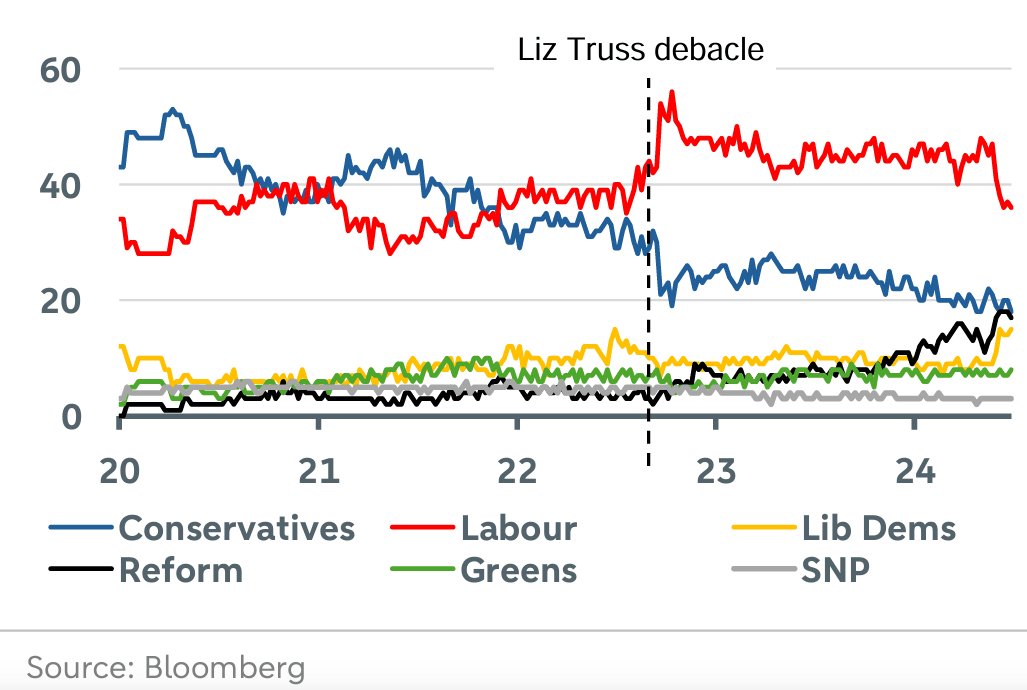
Image courtesy of ABN Amro.
“The economic policies put forward by Labour are very cautious and the strategy is clearly to strengthen trust with voters that it can govern and manage the economy,” says Halpenny. “We certainly assume better political stability is on its way with Labour intending to focus on ‘wealth creation’.”
The Euro has recently struggled amid increased political uncertainties following the June EU Parliamentary elections. However, in France, Emmanuel Macron took a gamble by dissolving the legislature and calling a snap vote that has caused considerable anxiety for market participants.
“The prospect of the Labour Party winning a large majority in the general election on 4th July is certainly helping to define a clear distinction with Europe,” says Halpenny.
The UK economy is meanwhile expected to strengthen, which can prevent the Bank of England from cutting interest rates as fast as previously expected.
Like the consensus of investment banks, MUFG thinks the first rate cut will fall in August. What will matter for the Pound is how many subsequent rate cuts come after this.
The rule of thumb is that the Pound would appreciate against currencies belonging to central banks that cut deeper.
“We see one further cut this year, in November, one less than previously given the better growth pick-up than we previously assumed,” says Halpenny.
MUFG thinks inflation rates will tick up towards the end of the year while real incomes rise and business and consumer confidence improve.
The investment bank raises its Pound to Euro forecast for end-Q3 from 1.17 to 1.19 (EUR/GBP: 0.8550 to 0.84). The year-end forecast is raised from 1.1630 to 1.19 (EUR/GBP: 0.86 to 0.84).
You can see how these forecasts compare to the median of all investment bank forecasts in the Pound Sterling Live / Corpay Q3 download.
The bank effectively maintains its Pound to Dollar forecast for end-Q3 (old: 1.2870, new: 1.2860), lowers its year-end target from 1.3020 to 1.2980, but there is a 3% uplift for the end-Q1 2025 forecast from 1.2870 to 1.3250.
To see how this contrasts with the consensus of the world’s biggest investment banks, please see here.
One product you should never skimp on – as make-up experts reveal best affordable dupes this summer
By Emily Mee, Money reporter
If TikTok is anything to go by, many of us are seeking that Sabrina Carpenter bronzed look this summer (me included).
But without a pop star’s team of make-up artists and the bank account to boot, how can the rest of us get that perfect glow?
We’ve asked four beauty experts to give us their top affordable dupes for high-end products. Here’s what they said (before one of them reveals the product you should never skimp on)…
Suzanne Baum, freelance beauty editor
For Suzanne, affordable make-up brand e.l.f. can’t be beaten for its dupes: “Super affordable, long-lasting and provides a perfect finish for a summer glow.”
These are her picks from the brand…
e.l.f. Bronzing Drops, £12
It’s a dupe for… Drunk Elephant’s D-Bronzi drops, £34
“A nourishing tinted serum for a sun-kissed glow,” she says.
Just add one to three drops to your moisturiser, face oil or body cream.
e.l.f. Halo Glow Liquid Filter, £15
It’s a dupe for… Charlotte Tilbury Flawless Filter, at £39
“A multi-purpose, liquid glow booster that gives your complexion a soft-focus social filter effect IRL,” says Suzanne.
Wear on its own for sheer coverage, under foundation as a luminous base, as a highlighter or mixed with foundation for a dewy glow.
e.l.f. Power Grip Primer, £10
It’s a dupe for… Milk Makeup Hydro Grip Primer, £35
“A gel-based, hydrating face primer that smooths skin while gripping your make-up,” Suzanne says.
e.l.f. Halo Glow Contour Beauty Wand, £9
It’s a dupe for… Charlotte Tilbury Beauty Light Wand, £30
“A liquid contour wand with a cushion-tip applicator for a naturally sculpted complexion,” the beauty expert says.
Apply to your hairline, temples, sides of your nose, hollows of your cheeks and jawline, then blend with a brush.
e.l.f. Camo Liquid Blush, £7
It’s a dupe for…. Rare Beauty Soft Pink Liquid Blush, £24
“A long-lasting liquid blush that delivers a high pigment pop of colour to cheeks with a dewy finish,” says Suzanne.
e.l.f. Glow Reviver Lip Oil, £8
It’s a dupe for… Dior Lip Glow Oil, £32
“An ultra-glossy tinted lip oil that nourishes, hydrates and enhances your lips’ natural colour,” Suzanne says.
Joyce Connor, make-up artist
For Joyce, she’ll often go for the high-end brands over dupes – but there was one product that she thought was even better than the original.
Here are her picks…
Revolution Pro CC Perfecting Skin Enhancer, £10
It’s a dupe for… IT Cosmetics CC+ Nude Glow, £37
The IT Cosmetics product is Joyce’s go-to, but she says the Revolution version makes for a “very good” dupe.
She says it gives a “nice glow without being shiny, because in the summer we don’t want to be caked in make-up”.
It is worth noting that the IT Cosmetics version includes SPF 40, whereas the Revolution one does not.
Apply before foundation for an added glow.
Boots Glow Essence Serum, £5
It’s a dupe for… Glossier Future Dew Facial Oil Serum Hybrid, £30
There’s quite a difference in price here, and Joyce says the Boots version gives a “nice sheen” under your foundation.
However, she notes the Glossier product has a more golden tint.
Massage two to three drops onto your skin before moisturising.
Avon Radiance Ritual Touch Of Gold Body Oil, £5
It’s a dupe for… Sol De Janeiro GlowMotions Glow Body Oil, £35
For added glow, massage into the skin and do not rinse – or you can use it as a bath oil.
NYX Professional Makeup Fat Oil Lip Drip Lip Gloss, £7.99
It’s a dupe for… Dior Addict Lip Glow Oil, £32
“To be honest, I prefer the Fat Oil to the Dior one,” says Joyce, picking it out as her favourite dupe.
“It lasted longer on my lips. I didn’t have to top it up as quickly. I like the sheen of it. The colour was lovely,” she raves.
Sue Moxley, beauty expert
Sue believes you don’t have to spend a fortune to get quality products – and she’s a fan of “good old” Revlon and L’Oreal.
Here are her picks…
Revolution Fix and Glow Setting Spray, £8.99
It’s a dupe for… Charlotte Tilbury Hollywood Flawless Filter, £39
Okay, this isn’t a direct dupe as it’s a setting spray rather than a foundation. But Sue says if you pair this with your favourite foundation, it should give you that “wonderful flawless glow” similar to Flawless Filter.
She recommends spraying it about 10 inches from your face all over and allowing it to dry for a few minutes.
NYX Bare With Me Blur Tint Foundation, £9.99
It’s a dupe for… Jones Road What the Foundation, £42
A good alternative to the trending Jones Road foundation is NYX’s Bare With Me, which Sue says “smoothes pores but looks really light and natural”.
“Apply with a make-up brush all over your face for a professional finish,” she says.
Lacura Luminous Filter Foundation, £5
It’s a dupe for… Clinique Even Better SPF15 Foundation, £34.50
TikTok went wild for this Aldi dupe, which Sue says is an alternative to the “high end glossy foundations”.
“It’s such a bargain – it’s definitely up there,” she says.
She recommends applying all over with a sponge, pressing rather than rubbing into the skin.
Rimmel Natural Bronzer, £6.99
It’s a dupe for… Iconic London Kissed By the Sun Bronzer, £25
Sue says this is a light bronzer that “glides on easily with a blusher brush”.
Swirl it on the hollows of your cheeks, up to your temples, down underneath your jawline and on the bridge of your nose.
So, how much difference is there between the dupes and the high-end products?
You might be wondering just how noticeable the difference is if you go for the cheaper alternative.
It’s a difficult question to answer as it can vary from product to product – and not all the experts we spoke to were in total agreement.
Sue Moxley says a lot of the lower end budget brands use similar ingredients to their more expensive counterparts.
“You can get better packaging or the quality of the packaging is better, but it’s also the brand name that is putting the prices up,” she says.
The high-end brands do put extra ingredients in, she says, but “they don’t warrant the amount of difference in price”.
“It’s still lovely to go and buy a Chanel lipstick or something and have it in your bag and it makes you feel wonderful. You get it out and it’s gorgeous packaging and you put it on in the restaurant,” she says.
“It does make you feel good, but I do believe that there are products out there that are equivalent in quality and ingredients wise.”
But Joyce Connor says the high-end brands are often worth it – although she does say you can “mix and match”.
More expensive brands rarely sell single-ingredient products, she says, and this can make a difference in terms of what you’re getting.
For example, she says an own-brand hyaluronic acid cream will often have that single ingredient but a similar product from a high-end brand will likely include peptides and ceramides – all providing extra value.
One item not to skimp on
Joyce says if you’re going to spend money on anything, it should be your moisturiser so you can get a perfect base for your make-up.
“There are plenty of dupes out there that that are going to be effective as long as you are moisturising,” she says.
Her pick is the Goldfaden MD Vital Boost Even Skintone Daily Moisturiser – but at £60 for 50ml, that might be a bit much for some.