The main category of Forex News.
You can use the search box below to find what you need.
[wd_asp id=1]
The main category of Forex News.
You can use the search box below to find what you need.
[wd_asp id=1]
The article covers the following subjects:
Consider long positions from corrections above 67.00 with a target of 91.80–105.17.
Breakout and consolidation below 67.00 will allow the asset to continue declining to the levels of 62.00–58.50.
A descending correction appears to have formed as the second wave of larger degree (2) on the weekly chart, with wave C of (2) completed as its part. On the daily time frame, an ascending third wave (3) is likely developing. Within it, the first wave of smaller degree 1 of (3) has formed, and a downward correction has been completed as the second wave 2 of (3). Wave 3 of (3) has presumably started developing on the H4 time frame, with wave (i) of i of 3 forming as its part. If the presumption is correct, WTI will continue to rise to 91.80–105.17. The level of 67.00 is critical in this scenario as a breakout below it will enable the asset to continue declining to the levels of 62.00–58.50.
This forecast is based on the Elliott Wave Theory. When developing trading strategies, it is essential to consider fundamental factors, as the market situation can change at any time.
The content of this article reflects the author’s opinion and does not necessarily reflect the official position of LiteFinance broker. The material published on this page is provided for informational purposes only and should not be considered as the provision of investment advice for the purposes of Directive 2014/65/EU.
According to copyright law, this article is considered intellectual property, which includes a prohibition on copying and distributing it without consent.
The article covers the following subjects:
Consider long positions from corrections above 160.35 with a target of 165.00–170.00.
Breakout and consolidation below 160.35 will allow the pair to continue declining to the levels of 158.90–158.00.
On the weekly time frame, an ascending third wave of larger degree 3 has formed, a downward correction has been completed as the fourth wave 4, and the fifth wave 5 is developing. On the daily chart, the third wave of smaller degree (3) of 5 appears to be developing, with wave 3 of (3) forming as its part. On the H4 time frame, wave i of 3 has formed, a local correction has been completed as wave ii of 3, and wave iii of 3 has started developing. If the presumption is correct, USD/JPY will continue to rise to 165.00–170.00. The level of 160.35 is critical in this scenario as a breakout below it will enable the pair to continue declining to the levels of 158.90–158.00.
This forecast is based on the Elliott Wave Theory. When developing trading strategies, it is essential to consider fundamental factors, as the market situation can change at any time.
The content of this article reflects the author’s opinion and does not necessarily reflect the official position of LiteFinance broker. The material published on this page is provided for informational purposes only and should not be considered as the provision of investment advice for the purposes of Directive 2014/65/EU.
According to copyright law, this article is considered intellectual property, which includes a prohibition on copying and distributing it without consent.
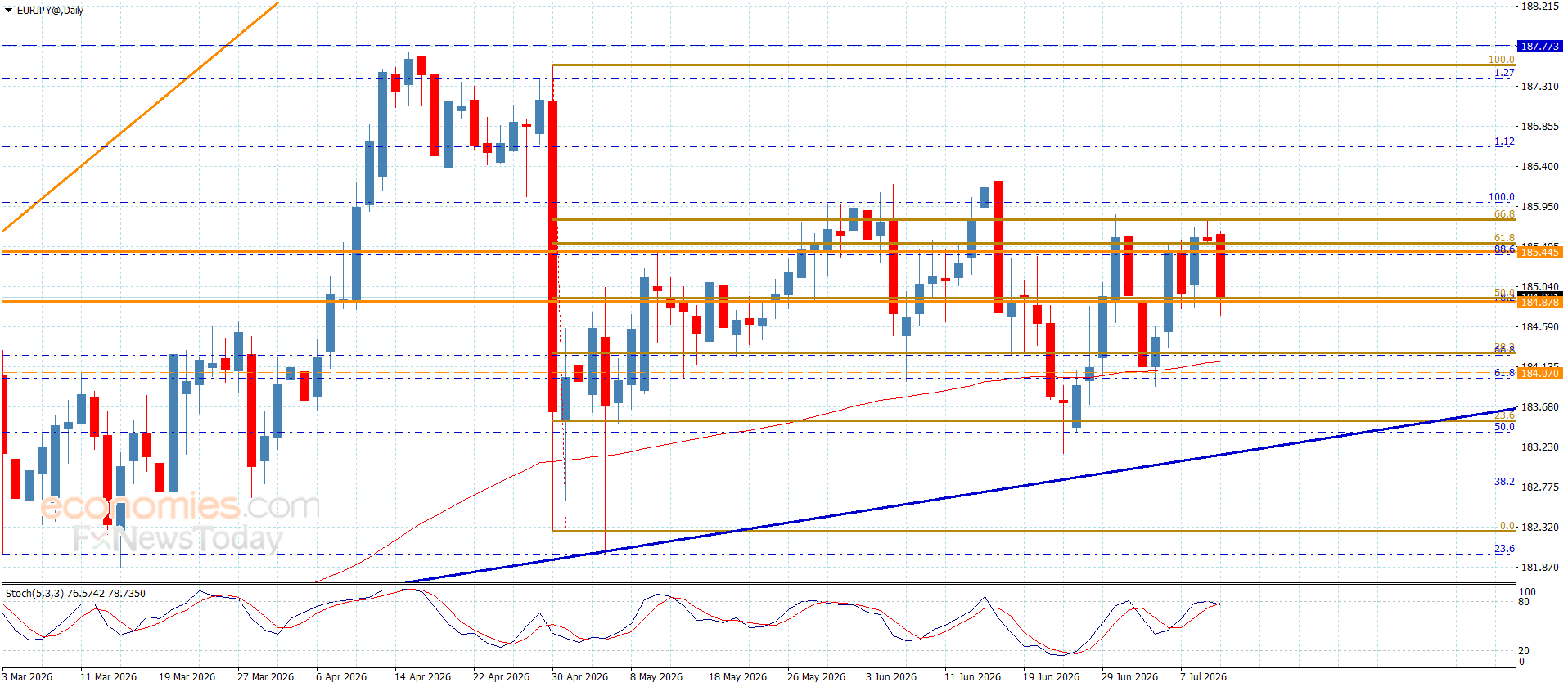
The EURJPY pair repeated providing negative closes below the barrier at 185.85, forcing it to delay the bullish trend, to activate the bearish corrective trend by reaching 184.75.
Suffering new negative pressure makes us resume the corrective attempts, attempting to reach 184.55, to press on the support at 184.20 to find an exit to resume the negative trading, while breaching the barrier will confirm its readiness to record new gains by its rally towards 186.20 and 186.60.
The expected trading range for today is between 184.20 and 185.60
Trend forecast: Bearish
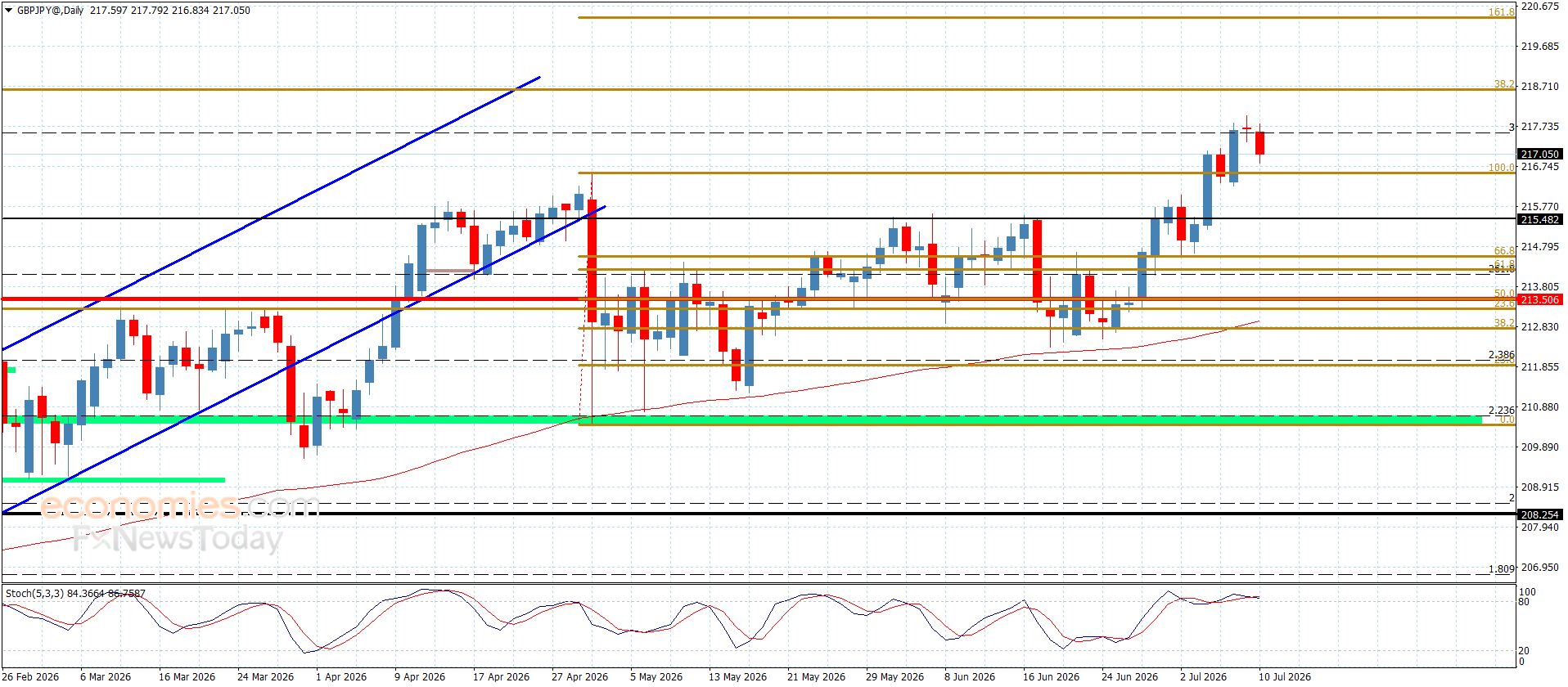
The GBPJPY pair approached the extra target at 218.10 by its last bullish rally, but its neediness to the bullish momentum by stochastic attempt to exit the overbought level that pushed it to form corrective rebound, to settle near 217.00.
The continuation of the trading fluctuation below the barrier at 118.10 makes us expect forming corrective trading, to target 216.30 level reaching the extra support near 215.45, while breaching the barrier and holding above it will open the way for resuming the bullish trend, reminding you that the stability of the next main target near 218.65 level.
The expected trading range for today is between 216.55 and 218.10
Trend forecast: Fluctuated within the bullish trend
Copper price failed to break $2.9500 level, affected by the stability of the moving average 55 near it, forcing it to delay the corrective decline and forming some bullish waves, to settle near $6.2000.
The current bullish rally doesn’t affect the bearish corrective trend due to the stability below $6.3000 barrier, which makes us wait for gathering the negative momentum again, which allows it to renew the pressure on the barrier at $5.9500 to find an exit for targeting new bearish stations that begin at $5.8100, while breaching the barrier and holding above it will open the way for recording extra gains that might begin at $6.4600.
The expected trading range for today is between $5.9500 and $6.3000
Trend forecast: Bearish
The GBPJPY pair approached the extra target at 218.10 by its last bullish rally, but its neediness to the bullish momentum by stochastic attempt to exit the overbought level that pushed it to form corrective rebound, to settle near 217.00.
The continuation of the trading fluctuation below the barrier at 118.10 makes us expect forming corrective trading, to target 216.30 level reaching the extra support near 215.45, while breaching the barrier and holding above it will open the way for resuming the bullish trend, reminding you that the stability of the next main target near 218.65 level.
The expected trading range for today is between 216.55 and 218.10
Trend forecast: Fluctuated within the bullish trend
The British pound initially rallied against the USD on Thursday but seems to be running into a touch of trouble.
The British pound initially rallied against the US dollar during trading here on Thursday, and it then tested an area that was a major resistance barrier just waiting to happen, where supply had come into the market aggressively several days ago. Now we find ourselves trying to form a bit of a shooting star just above the 200-day EMA. We have to ask whether or not the sellers are going to get aggressive.

Interest rates in America did dip just a touch. I think you also have a situation where it’s difficult to get aggressive against the US dollar, although you can certainly make an argument if there is one currency that probably has a good shot at really taking it to the US dollar, it’s the British pound.
That being said, I think there are a lot of questions right now about what’s going to happen next in the Middle East, and that’s causing some chaos. The markets, I believe, continue to just hang around this area, and I just don’t see how markets are looking for a big move in one direction or the other. This is a currency pair that tends to range quite a bit, and we are basically in the middle of the range from last year. So, a little bit of hesitation here makes sense. Maybe a short-term selling opportunity, but I think you’re somewhat in no man’s land.
I did this yesterday, I put this out, and I suggested that maybe the British pound is a great measure of the US dollar. If the pound starts to fall, then that means your dollar is going to strengthen against multiple other currencies. If the US dollar starts to fall apart, you should see the pound be one of the biggest beneficiaries. So, I think this is still very much a tertiary indicator more than anything else.
Ready to trade our daily Forex GBP/USD analysis? We’ve made this UK forex brokers list for you to check out.
Christopher Lewis is a technical analyst and market commentator at DailyForex with more than two decades of trading experience in Forex and other leveraged markets. Based in Columbus, Ohio, he specializes in chart-based analysis of major currency pairs, stock indices, commodities, and energy markets, focusing on clear support and resistance levels, trend structure, and risk management. Christopher produces daily written and video analysis for traders who rely on technical setups to navigate volatile market conditions
As seen on: Pairs Of Aces Podcast,The Trader Guy, FXEmpire
Domestic coffee prices today
Coffee prices today in the domestic market simultaneously increased very strongly in key production areas. The average price was recorded at 98,300 VND/kg, an increase of 6,000 VND/kg compared to the previous update.
In Dak Lak, coffee prices increased by 6,000 VND/kg, to 98,200 VND/kg. In Gia Lai, coffee prices reached 98,300 VND/kg, also increasing by 6,000 VND/kg.
In Lam Dong, coffee prices today increased by 6,100 VND/kg, to 97,900 VND/kg. This is still the lowest level among the surveyed areas.
The old Dak Nong area recorded the highest purchase price, reaching 98,400 VND/kg, an increase of 6,100 VND/kg compared to the previous update.
Thus, domestic coffee prices currently fluctuate from 97. 900-98. 400 VND/kg. The gap between the region with the highest and lowest prices is 500 VND/kg.
After a strong increase session, the domestic coffee price level has approached the threshold of 100,000 VND/kg. This is a notable increase after two previous deep decline sessions.
The USD/VND exchange rate according to Vietcombank is recorded at 26,074 VND/USD.
World coffee prices
World coffee prices simultaneously increased sharply in the most recent trading session. Both Robusta on the London exchange and Arabica on the New York exchange recorded large increases.
On the London exchange, the September 2026 Robusta futures contract increased by 302 USD/ton, equivalent to 8.07%, to 4,043 USD/ton.
During the session, this contract at one point increased to 4,066 USD/ton. Trading volume reached 14,265 lots.
Robusta for November 2026 delivery increased by 290 USD/ton, equivalent to 7.81%, to 4,002 USD/ton.
The January and March 2027 terms increased by 285 USD/ton and 282 USD/ton respectively, to 3,967 USD/ton and 3,933 USD/ton.
The July 2026 Robusta contract reached 4,603 USD/ton, up 171 USD/ton. However, this term has low trading volume because it is close to maturity, so the September contract reflects the market trend more clearly.
On the New York exchange, Arabica increased very strongly. September 2026 Arabica futures contract increased by 38.10 US cents/lb, equivalent to 12.30%, to 347.90 US cents/lb.
During the session, this contract at one point increased to 348.55 US cents/lb. Trading volume reached 34,370 lots.
Arabica December 2026 futures increased by 30.95 US cents/lb, equivalent to 10.41%, to 328.20 US cents/lb.
The March and May 2027 terms increased by 28.80 US cents/lb and 27.85 US cents/lb respectively, to 321.00 US cents/lb and 318.30 US cents/lb.
The July 2026 Arabica contract increased by 32.70 US cents/lb, to 356.95 US cents/lb. However, this term has lower volume than long-term contracts because it is close to maturity.
Coffee price assessment
Domestic coffee prices surged sharply after two consecutive deep declines. This development is accompanied by a very strong recovery of Robusta and Arabica prices in the world market.
In the short term, the coffee market is fluctuating strongly due to the intertwined impact between profit-taking activities, buying force returning after deep declines and cautious psychology in the face of weather risks in large production areas.
The fact that Arabica prices increased by more than 12% and Robusta increased by more than 8% shows that buying power has returned quite strongly on the two exchanges. With the domestic market, the upward momentum of world prices often quickly affects buying and selling sentiment, especially when the price level has fluctuated strongly in recent sessions.
However, it should be noted that too strong uptrends often come with technical correction risks. After coffee prices increase rapidly, profit-taking activities may appear in the market, causing prices to continue to fluctuate strongly in the following sessions.
From a global supply-demand perspective, a report by the International Coffee Organization (ICO) shows that the market previously reacted to the prospect of improved supply. This is a factor that may limit the upward momentum of coffee prices in the medium term.
For Brazil, the Foreign Agricultural Services Agency of the US Department of Agriculture (USDA/FAS) said that the Brazilian National Supply Company (CONAB) forecasts Brazil’s coffee production in the 2026-2027 crop year to reach 66.7 million bags, an increase of 18% compared to 2025.
Brazil is the world’s largest Arabica producer. Therefore, the prospect of a large crop in this country is still an important factor that could put pressure on Arabica prices, although the short-term market is still sensitive to weather risks and harvest progress.
Rabobank of the Netherlands also assessed that the expectation of a large coffee crop in Brazil may put pressure on global prices, in the context of generally favorable weather conditions for crop development.
With Robusta, supply from our country continues to be a noteworthy factor. The USDA/FAS report in Vietnam forecasts that Vietnam’s coffee production in the 2026-2027 crop year will increase to 32.5 million bags converted to green beans, thanks to production expansion after a period of high coffee prices.
Our country is the world’s largest Robusta producer, so the prospect of increased production may put pressure on Robusta in the medium term. However, in the short term, prices may still fluctuate sharply due to export demand, inventory and developments on international exchanges.
The British Pound (GBP) is pulling lower against the Japanese Yen (JPY) on Thursday, after hitting a fresh all-time high at 218.01 earlier on the day. The pair has returned to the mid-range of the 217.00s at the time of writing, yet with the bullish trend in place, holding comfortably above the previous highs, in the 217.20 area.
Risks of an intervention by the Japanese authorities remain high, but the wide divergence between the Bank of Japan’s (BoJ) interest rates and those of the major central banks poses a heavy weight on the JPY. More so with Oil prices bouncing up and pressuring global central banks to tighten their borrowing costs.
GBP/JPY trades at 217.60, with Elliott Wave analysis suggesting that the pair might be on the fifth and last wave of a bullish cycle. The Pound has pulled back from the 127.2% Fibonacci extension of the fourth wave, at 218.00, and the bearish divergence in the four-hour Relative Strength Index suggests that some consolidation or a corrective reversal might follow from here.
Bears, however, should break the July 7 lows, at 216.35, to confirm that the bullish cycle has completed. In that case, the early July trading floor, near 214.65, would emerge as the next target.
The broader bias, on the other hand, remains positive, and bulls might attempt a further rally, heading for the 261.8% Fibonacci extension of the mentioned rally, at 218.90. Furter appreciation seems off the cards right now.
(The technical analysis of this story was written with the help of an AI tool. Know more.)
The table below shows the percentage change of Japanese Yen (JPY) against listed major currencies today. Japanese Yen was the strongest against the Canadian Dollar.
| USD | EUR | GBP | JPY | CAD | AUD | NZD | CHF | |
|---|---|---|---|---|---|---|---|---|
| USD | -0.08% | -0.00% | -0.08% | 0.05% | -0.05% | -0.59% | -0.12% | |
| EUR | 0.08% | 0.08% | 0.00% | 0.12% | 0.05% | -0.49% | -0.03% | |
| GBP | 0.00% | -0.08% | -0.09% | 0.05% | -0.03% | -0.56% | -0.11% | |
| JPY | 0.08% | 0.00% | 0.09% | 0.11% | 0.06% | -0.51% | -0.04% | |
| CAD | -0.05% | -0.12% | -0.05% | -0.11% | -0.07% | -0.61% | -0.15% | |
| AUD | 0.05% | -0.05% | 0.03% | -0.06% | 0.07% | -0.53% | -0.08% | |
| NZD | 0.59% | 0.49% | 0.56% | 0.51% | 0.61% | 0.53% | 0.46% | |
| CHF | 0.12% | 0.03% | 0.11% | 0.04% | 0.15% | 0.08% | -0.46% |
The heat map shows percentage changes of major currencies against each other. The base currency is picked from the left column, while the quote currency is picked from the top row. For example, if you pick the Japanese Yen from the left column and move along the horizontal line to the US Dollar, the percentage change displayed in the box will represent JPY (base)/USD (quote).