The main category of Forex News.
You can use the search box below to find what you need.
[wd_asp id=1]
The main category of Forex News.
You can use the search box below to find what you need.
[wd_asp id=1]
STORY LINK Euro to Pound Rate Rallies after French Election First Round, GBP/EUR 3-Week Lows
The Pound to Euro (GBP/EUR) exchange rate retreated to 3-Week lows around 1.1775 after the French election results.
There was some relief on expectations that the National Rally (RN) would fall short of a majority in next week’s second round, although still with a high degree of uncertainty.
ING commented; “the case for a materially stronger EUR/GBP within the next couple of weeks is not very compelling. (Solid support for GBP/EUR). Key support remains at 1.1765.
In the first round of French elections, RN won around 33% of the vote followed by 28% for the left-wing alliance (NPF) with President Macron’s centrist party in third place.
Attention will now focus on the second round on Sunday with the position complicated by a substantial number of three-way contests.
There will be calls for candidates to drop out to block the RN from winning seats.
Opinion polls suggest that the RN will fall short of an overall majority in parliament.
According to Bank of America; “We expect some EUR recovery in a “hung parliament” scenario. Commonwealth Bank of Australia (CBA) strategist Carol Kong commented; “They (RN) have actually performed a little bit worse than what was expected,”
She added; “As a result of that, we saw the euro rise modestly in early Asian trade just because we might actually get less fears of more expansionary and unsustainable fiscal policy if the far-right party did a little bit worse.”
Fiona Cincotta, senior markets analyst at City Index took a similar view; “Le Pen had a slightly smaller margin than some of the polls had pointed to, which may have helped the euro a little bit higher on the open.”
There had also been some talk that the NPF would do better than expected.
There are still underlying concerns over the underlying outlook.
ING commented; “Still, first round results are not offering much certainty about the composition of the parliament, and the second round scheduled for the next weekend is in fact the big risk event.
It added that bond markets will be important; “We’ll be monitoring closely the performance of OAT versus the bund today. There is a chance of some tightening in the spread which can help the euro, but our rates team continues to view structurally wider spreads beyond the short term and we doubt the euro will be able to entirely erase political risk premium this summer.”
As far as the UK General election is concerned, Labour remains dominant in opinion polls.
According to ING; “There has, indeed, been very little doubt about a Labour landslide win, so the election should not be a huge event for markets. We suspect that a stronger than expected result by populist/hard-Brexiteer Reform UK is the most tangible risk for some slight adverse reacting in GBP assets.”
There has been no significant shift in polls, although with some indication that support for the Reform Party has peaked which could ease political risk slightly.
International Money Transfer? Ask our resident FX expert a money transfer question or try John’s new, free, no-obligation personal service! ,where he helps every step of the way,
ensuring you get the best exchange rates on your currency requirements.
You have reached your limit of 5 free articles for this month.
Access all our articles, insights, and analysts.
Your coupon code
GBP/USD holds its ground early Monday after closing the previous week virtually unchanged. The technical outlook points to a bullish tilt in the short term.
The table below shows the percentage change of British Pound (GBP) against listed major currencies today. British Pound was the strongest against the Swiss Franc.
| USD | EUR | GBP | JPY | CAD | AUD | NZD | CHF | |
|---|---|---|---|---|---|---|---|---|
| USD | -0.49% | -0.24% | 0.14% | -0.01% | -0.21% | -0.14% | 0.19% | |
| EUR | 0.49% | 0.02% | 0.33% | 0.18% | 0.16% | 0.04% | 0.37% | |
| GBP | 0.24% | -0.02% | 0.29% | 0.16% | 0.15% | 0.02% | 0.35% | |
| JPY | -0.14% | -0.33% | -0.29% | -0.15% | -0.30% | -0.29% | 0.06% | |
| CAD | 0.00% | -0.18% | -0.16% | 0.15% | -0.16% | -0.13% | 0.19% | |
| AUD | 0.21% | -0.16% | -0.15% | 0.30% | 0.16% | -0.13% | 0.28% | |
| NZD | 0.14% | -0.04% | -0.02% | 0.29% | 0.13% | 0.13% | 0.35% | |
| CHF | -0.19% | -0.37% | -0.35% | -0.06% | -0.19% | -0.28% | -0.35% |
The heat map shows percentage changes of major currencies against each other. The base currency is picked from the left column, while the quote currency is picked from the top row. For example, if you pick the British Pound from the left column and move along the horizontal line to the US Dollar, the percentage change displayed in the box will represent GBP (base)/USD (quote).
The selling pressure surrounding the US Dollar (USD) at the beginning of the week helps GBP/USD edge higher. On Friday, the data from the US showed that the Personal Consumption Expenditures (PCE) Price Index, the Federal Reserve’s (Fed) preferred gauge of inflation, rose 2.6% on a yearly basis in May. On a monthly basis, the PCE Price Index remained unchanged. These figures came in line with analysts’ estimates and made it difficult for the USD to stay resilient against its rivals.
The US economic docket will feature the ISM Manufacturing PMI data for June later in the day. Investors expect the headline PMI to rise slightly to 49 from 48.7 in May. A reading above 50, which would point to an expansion in the manufacturing sector’s business activity, could help the USD find demand.
In case the PMI data comes near the market expectation, investors are likely to pay close attention to inflation and employment components. A sharp decline in the Prices Paid Index could weigh on the USD.
The Relative Strength Index (RSI) indicator on the 4-hour chart rose to 60, reflecting a buildup of bullish momentum. On the upside, 1.2700-1.2710 (100-period Simple Moving Average (SMA) on the 4-hour chart, 200-period SMA) aligns as first resistance before 1.2760 (static level) and 1.2800 (psychological level, static level).
On the downside, the 50-period SMA aligns as interim support at 1.2665 before 1.2640 (100-day SMA) and 1.2600 (psychological level, static level).
The Pound Sterling (GBP) is the oldest currency in the world (886 AD) and the official currency of the United Kingdom. It is the fourth most traded unit for foreign exchange (FX) in the world, accounting for 12% of all transactions, averaging $630 billion a day, according to 2022 data. Its key trading pairs are GBP/USD, aka ‘Cable’, which accounts for 11% of FX, GBP/JPY, or the ‘Dragon’ as it is known by traders (3%), and EUR/GBP (2%). The Pound Sterling is issued by the Bank of England (BoE).
The single most important factor influencing the value of the Pound Sterling is monetary policy decided by the Bank of England. The BoE bases its decisions on whether it has achieved its primary goal of “price stability” – a steady inflation rate of around 2%. Its primary tool for achieving this is the adjustment of interest rates. When inflation is too high, the BoE will try to rein it in by raising interest rates, making it more expensive for people and businesses to access credit. This is generally positive for GBP, as higher interest rates make the UK a more attractive place for global investors to park their money. When inflation falls too low it is a sign economic growth is slowing. In this scenario, the BoE will consider lowering interest rates to cheapen credit so businesses will borrow more to invest in growth-generating projects.
Data releases gauge the health of the economy and can impact the value of the Pound Sterling. Indicators such as GDP, Manufacturing and Services PMIs, and employment can all influence the direction of the GBP. A strong economy is good for Sterling. Not only does it attract more foreign investment but it may encourage the BoE to put up interest rates, which will directly strengthen GBP. Otherwise, if economic data is weak, the Pound Sterling is likely to fall.
Another significant data release for the Pound Sterling is the Trade Balance. This indicator measures the difference between what a country earns from its exports and what it spends on imports over a given period. If a country produces highly sought-after exports, its currency will benefit purely from the extra demand created from foreign buyers seeking to purchase these goods. Therefore, a positive net Trade Balance strengthens a currency and vice versa for a negative balance.
GBP/USD holds its ground early Monday after closing the previous week virtually unchanged. The technical outlook points to a bullish tilt in the short term.
The table below shows the percentage change of British Pound (GBP) against listed major currencies today. British Pound was the strongest against the Swiss Franc.
| USD | EUR | GBP | JPY | CAD | AUD | NZD | CHF | |
|---|---|---|---|---|---|---|---|---|
| USD | -0.49% | -0.24% | 0.14% | -0.01% | -0.21% | -0.14% | 0.19% | |
| EUR | 0.49% | 0.02% | 0.33% | 0.18% | 0.16% | 0.04% | 0.37% | |
| GBP | 0.24% | -0.02% | 0.29% | 0.16% | 0.15% | 0.02% | 0.35% | |
| JPY | -0.14% | -0.33% | -0.29% | -0.15% | -0.30% | -0.29% | 0.06% | |
| CAD | 0.00% | -0.18% | -0.16% | 0.15% | -0.16% | -0.13% | 0.19% | |
| AUD | 0.21% | -0.16% | -0.15% | 0.30% | 0.16% | -0.13% | 0.28% | |
| NZD | 0.14% | -0.04% | -0.02% | 0.29% | 0.13% | 0.13% | 0.35% | |
| CHF | -0.19% | -0.37% | -0.35% | -0.06% | -0.19% | -0.28% | -0.35% |
The heat map shows percentage changes of major currencies against each other. The base currency is picked from the left column, while the quote currency is picked from the top row. For example, if you pick the British Pound from the left column and move along the horizontal line to the US Dollar, the percentage change displayed in the box will represent GBP (base)/USD (quote).
The selling pressure surrounding the US Dollar (USD) at the beginning of the week helps GBP/USD edge higher. On Friday, the data from the US showed that the Personal Consumption Expenditures (PCE) Price Index, the Federal Reserve’s (Fed) preferred gauge of inflation, rose 2.6% on a yearly basis in May. On a monthly basis, the PCE Price Index remained unchanged. These figures came in line with analysts’ estimates and made it difficult for the USD to stay resilient against its rivals.
The US economic docket will feature the ISM Manufacturing PMI data for June later in the day. Investors expect the headline PMI to rise slightly to 49 from 48.7 in May. A reading above 50, which would point to an expansion in the manufacturing sector’s business activity, could help the USD find demand.
In case the PMI data comes near the market expectation, investors are likely to pay close attention to inflation and employment components. A sharp decline in the Prices Paid Index could weigh on the USD.
The Relative Strength Index (RSI) indicator on the 4-hour chart rose to 60, reflecting a buildup of bullish momentum. On the upside, 1.2700-1.2710 (100-period Simple Moving Average (SMA) on the 4-hour chart, 200-period SMA) aligns as first resistance before 1.2760 (static level) and 1.2800 (psychological level, static level).
On the downside, the 50-period SMA aligns as interim support at 1.2665 before 1.2640 (100-day SMA) and 1.2600 (psychological level, static level).
The Pound Sterling (GBP) is the oldest currency in the world (886 AD) and the official currency of the United Kingdom. It is the fourth most traded unit for foreign exchange (FX) in the world, accounting for 12% of all transactions, averaging $630 billion a day, according to 2022 data. Its key trading pairs are GBP/USD, aka ‘Cable’, which accounts for 11% of FX, GBP/JPY, or the ‘Dragon’ as it is known by traders (3%), and EUR/GBP (2%). The Pound Sterling is issued by the Bank of England (BoE).
The single most important factor influencing the value of the Pound Sterling is monetary policy decided by the Bank of England. The BoE bases its decisions on whether it has achieved its primary goal of “price stability” – a steady inflation rate of around 2%. Its primary tool for achieving this is the adjustment of interest rates. When inflation is too high, the BoE will try to rein it in by raising interest rates, making it more expensive for people and businesses to access credit. This is generally positive for GBP, as higher interest rates make the UK a more attractive place for global investors to park their money. When inflation falls too low it is a sign economic growth is slowing. In this scenario, the BoE will consider lowering interest rates to cheapen credit so businesses will borrow more to invest in growth-generating projects.
Data releases gauge the health of the economy and can impact the value of the Pound Sterling. Indicators such as GDP, Manufacturing and Services PMIs, and employment can all influence the direction of the GBP. A strong economy is good for Sterling. Not only does it attract more foreign investment but it may encourage the BoE to put up interest rates, which will directly strengthen GBP. Otherwise, if economic data is weak, the Pound Sterling is likely to fall.
Another significant data release for the Pound Sterling is the Trade Balance. This indicator measures the difference between what a country earns from its exports and what it spends on imports over a given period. If a country produces highly sought-after exports, its currency will benefit purely from the extra demand created from foreign buyers seeking to purchase these goods. Therefore, a positive net Trade Balance strengthens a currency and vice versa for a negative balance.
The EUR/USD forecast leans bullish as the euro rises after round one of the French elections. Meanwhile, the dollar was on the back foot after inflation data in the previous session raised bets for a Fed cut in September.
–Are you interested in learning more about forex conventions? Check our detailed guide-
On Sunday, elections in France put the far-right National Rally party in first position. However, the win was by a smaller margin than expected, supporting the euro. If the far right performs poorly, there will be less fear of a financial crisis. The euro has fallen in recent sessions since Macron announced a snap election that created a cloud of political uncertainty. However, after the election, the EUR/USD pair reached a two-week high before pulling back.
Elsewhere, ECB policymakers remain confident that inflation will reach the central bank’s target. Consequently, the central bank will likely continue cutting interest rates. Meanwhile, the Fed is yet to start its cutting cycle.
The dollar was weak after data on Friday showed weaker inflation in May. The US core PCE price index met expectations at 2.6%, easing from the previous month. This gave investors more confidence that the Fed will cut in September. However, policymakers might continue watching incoming data for more evidence that the decline to 2% will continue.
Currently, markets are pricing a 63% chance that the Fed will start lowering borrowing costs in September. This might change this week after the US nonfarm payrolls report, which is due on Friday.
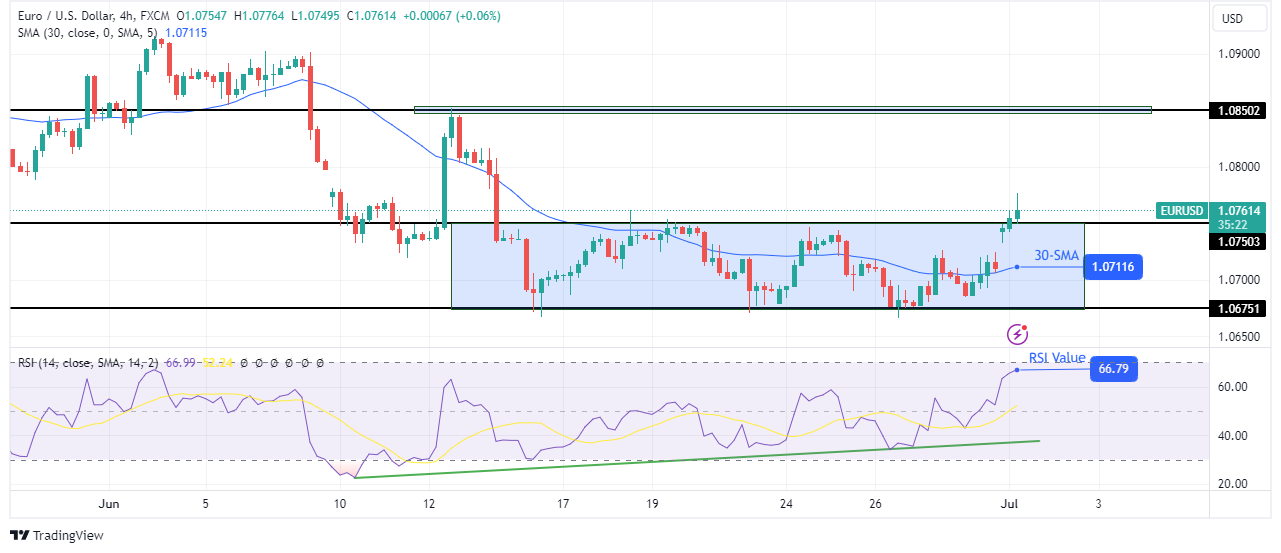
On the technical side, the EUR/USD price has gapped up and broken above the 1.0750 resistance level. Moreover, the price has broken out of its consolidation area between the 1.0675 support and the 1.0750 resistance.
–Are you interested in learning more about Ethereum price prediction? Check our detailed guide-
The previous bearish move showed weakness when the price punctured the 30-SMA resistance. At the same time, the RSI made a bullish divergence, showing fading bearish momentum.
Afterwards, the price entered an area of consolidation, where bulls and bears fought for control. Bulls won when the price gapped up, showing massive bullish momentum, before breaking above 1.0750. Bulls might now target the 1.0850 resistance level.
Looking to trade forex now? Invest at eToro!
68% of retail investor accounts lose money when trading CFDs with this provider. You should consider whether you can afford to take the high risk of losing your money.
You have reached your limit of 5 free articles for this month.
Access all our articles, insights, and analysts.
Your coupon code
Gold price is treading water near $2,325 in Asian trading hours on Monday, holding Friday’s range play. Gold price fails to capitalize on the US Personal Consumption Expenditure (PCE) inflation data-led US Dollar (USD) weakness, as buyers turn to the sidelines heading into a Big week.
Gold traders refrain from placing any fresh directional bets on the bright metal ahead of this week’s speech by US Federal Reserve (Fed) Jerome Powell at the European Central Bank’s (ECB) forum on Tuesday and Friday’s all-important Nonfarm Payrolls data.
These high-impact events from the US economy will likely help reprice the market expectations for a potential Fed rate cut later this year, heavily impacting the value of the Greenback and the Gold price.
Traders raised their bets for a Fed rate cut in September after data on Friday showed that the annual core PCE Price Index, the Fed’s preferred inflation measure, rose 2.6% in May, slowing from a 2.8% increase in April. Following the data release, markets saw a roughly 68% chance that the Fed will lower rates in September, compared to about 64% ahead of the data, according to CME Group’s FedWatch Tool.
At the moment, the chances of a September Fed rate cut are seen at 63%, as markets assess the recent hawkish Fed commentary. San Francisco Fed President Mary Daly told CNBC on Friday that “Fed is not done yet but PCE data is good news.”
Softer US inflation data continued to weigh on the US Dollar, with the pain exacerbated early Monday, thanks to the strong gains in the EUR/USD pair. The Euro rose after the first round of France’s snap election showed the far-right National Rally (RN) party winning, though by a smaller margin than projected.
However, the US Dollar downside appears capped due to the latest leg higher in the USD/JPY pair, in the wake of the downward revision to the Japanese Gross Domestic Product (GDP) data. The Japanese economy shrank more than initially reported in the first quarter, which raised concerns about the timing of the next rate hike by the Bank of Japan (BoJ) and dented the sentiment around the Yen.
Looking ahead, Gold price remains exposed to downside risks should the Greenback stage a comeback on a profit-taking rally ahead of the US ISM Manufacturing PMI data due later on Monday and Fed Chair Jerome Powell’s speech on Tuesday.
But the losses in Gold price could be capped by a strong-than-expected China’s Caixin Manufacturing PMI data and renewed expectations of a Fed rate cut as early as in September. Further, if the Euro extends early gains in the European trading hours, it could accentuate the US Dollar downtrend, providing the much-needed lift to the Gold price.
Gold price looks vulnerable so long as the 14-day Relative Strength Index (RSI) stays below the 50 level and the 21-day Simple Moving Average (SMA) at $2,328 acts as a tough nut to crack for buyers.
Acceptance above the 21-day SMA is critical on a daily closing basis to resume the recovery from the monthly low of $2,287.
Further up, the 50-day SMA at $2,338 will be challenged, followed by the two-week high of $2,369.
However, if sellers regain poise, the immediate support is seen at the $2,300 threshold, below which the $2,290 support area will come into play. Around that level, the previous week’s low and the June low hang around.
The last line of defense for Gold buyers is aligned at the May 3 low at $2,277.
Gold has played a key role in human’s history as it has been widely used as a store of value and medium of exchange. Currently, apart from its shine and usage for jewelry, the precious metal is widely seen as a safe-haven asset, meaning that it is considered a good investment during turbulent times. Gold is also widely seen as a hedge against inflation and against depreciating currencies as it doesn’t rely on any specific issuer or government.
Central banks are the biggest Gold holders. In their aim to support their currencies in turbulent times, central banks tend to diversify their reserves and buy Gold to improve the perceived strength of the economy and the currency. High Gold reserves can be a source of trust for a country’s solvency. Central banks added 1,136 tonnes of Gold worth around $70 billion to their reserves in 2022, according to data from the World Gold Council. This is the highest yearly purchase since records began. Central banks from emerging economies such as China, India and Turkey are quickly increasing their Gold reserves.
Gold has an inverse correlation with the US Dollar and US Treasuries, which are both major reserve and safe-haven assets. When the Dollar depreciates, Gold tends to rise, enabling investors and central banks to diversify their assets in turbulent times. Gold is also inversely correlated with risk assets. A rally in the stock market tends to weaken Gold price, while sell-offs in riskier markets tend to favor the precious metal.
The price can move due to a wide range of factors. Geopolitical instability or fears of a deep recession can quickly make Gold price escalate due to its safe-haven status. As a yield-less asset, Gold tends to rise with lower interest rates, while higher cost of money usually weighs down on the yellow metal. Still, most moves depend on how the US Dollar (USD) behaves as the asset is priced in dollars (XAU/USD). A strong Dollar tends to keep the price of Gold controlled, whereas a weaker Dollar is likely to push Gold prices up.
Gold price is treading water near $2,325 in Asian trading hours on Monday, holding Friday’s range play. Gold price fails to capitalize on the US Personal Consumption Expenditure (PCE) inflation data-led US Dollar (USD) weakness, as buyers turn to the sidelines heading into a Big week.
Gold traders refrain from placing any fresh directional bets on the bright metal ahead of this week’s speech by US Federal Reserve (Fed) Jerome Powell at the European Central Bank’s (ECB) forum on Tuesday and Friday’s all-important Nonfarm Payrolls data.
These high-impact events from the US economy will likely help reprice the market expectations for a potential Fed rate cut later this year, heavily impacting the value of the Greenback and the Gold price.
Traders raised their bets for a Fed rate cut in September after data on Friday showed that the annual core PCE Price Index, the Fed’s preferred inflation measure, rose 2.6% in May, slowing from a 2.8% increase in April. Following the data release, markets saw a roughly 68% chance that the Fed will lower rates in September, compared to about 64% ahead of the data, according to CME Group’s FedWatch Tool.
At the moment, the chances of a September Fed rate cut are seen at 63%, as markets assess the recent hawkish Fed commentary. San Francisco Fed President Mary Daly told CNBC on Friday that “Fed is not done yet but PCE data is good news.”
Softer US inflation data continued to weigh on the US Dollar, with the pain exacerbated early Monday, thanks to the strong gains in the EUR/USD pair. The Euro rose after the first round of France’s snap election showed the far-right National Rally (RN) party winning, though by a smaller margin than projected.
However, the US Dollar downside appears capped due to the latest leg higher in the USD/JPY pair, in the wake of the downward revision to the Japanese Gross Domestic Product (GDP) data. The Japanese economy shrank more than initially reported in the first quarter, which raised concerns about the timing of the next rate hike by the Bank of Japan (BoJ) and dented the sentiment around the Yen.
Looking ahead, Gold price remains exposed to downside risks should the Greenback stage a comeback on a profit-taking rally ahead of the US ISM Manufacturing PMI data due later on Monday and Fed Chair Jerome Powell’s speech on Tuesday.
But the losses in Gold price could be capped by a strong-than-expected China’s Caixin Manufacturing PMI data and renewed expectations of a Fed rate cut as early as in September. Further, if the Euro extends early gains in the European trading hours, it could accentuate the US Dollar downtrend, providing the much-needed lift to the Gold price.
Gold price looks vulnerable so long as the 14-day Relative Strength Index (RSI) stays below the 50 level and the 21-day Simple Moving Average (SMA) at $2,328 acts as a tough nut to crack for buyers.
Acceptance above the 21-day SMA is critical on a daily closing basis to resume the recovery from the monthly low of $2,287.
Further up, the 50-day SMA at $2,338 will be challenged, followed by the two-week high of $2,369.
However, if sellers regain poise, the immediate support is seen at the $2,300 threshold, below which the $2,290 support area will come into play. Around that level, the previous week’s low and the June low hang around.
The last line of defense for Gold buyers is aligned at the May 3 low at $2,277.
Gold has played a key role in human’s history as it has been widely used as a store of value and medium of exchange. Currently, apart from its shine and usage for jewelry, the precious metal is widely seen as a safe-haven asset, meaning that it is considered a good investment during turbulent times. Gold is also widely seen as a hedge against inflation and against depreciating currencies as it doesn’t rely on any specific issuer or government.
Central banks are the biggest Gold holders. In their aim to support their currencies in turbulent times, central banks tend to diversify their reserves and buy Gold to improve the perceived strength of the economy and the currency. High Gold reserves can be a source of trust for a country’s solvency. Central banks added 1,136 tonnes of Gold worth around $70 billion to their reserves in 2022, according to data from the World Gold Council. This is the highest yearly purchase since records began. Central banks from emerging economies such as China, India and Turkey are quickly increasing their Gold reserves.
Gold has an inverse correlation with the US Dollar and US Treasuries, which are both major reserve and safe-haven assets. When the Dollar depreciates, Gold tends to rise, enabling investors and central banks to diversify their assets in turbulent times. Gold is also inversely correlated with risk assets. A rally in the stock market tends to weaken Gold price, while sell-offs in riskier markets tend to favor the precious metal.
The price can move due to a wide range of factors. Geopolitical instability or fears of a deep recession can quickly make Gold price escalate due to its safe-haven status. As a yield-less asset, Gold tends to rise with lower interest rates, while higher cost of money usually weighs down on the yellow metal. Still, most moves depend on how the US Dollar (USD) behaves as the asset is priced in dollars (XAU/USD). A strong Dollar tends to keep the price of Gold controlled, whereas a weaker Dollar is likely to push Gold prices up.
As we get paid at the end of every day to hang on to it. If we pull back from here, the ¥200 level, of course, is an area that a lot of people will be paying attention to unless it was previous resistance and now based on market memory should be supported. The 50 day EMA is racing towards the ¥200 level as well, so that all comes together to offer a significant opportunity if we do get down there.

On the other hand, we could just continue to go higher. That would make a certain amount of sense as well. But we are overbought at this point. You do have to be cautious with this type of stretched out GBP/JPY market. With that being said, I like the idea of buying short term dips as a value proposition. I don’t have any interest in shorting this market.
I certainly wouldn’t want to pay the swap at the end of every day for that. privilege. So really, at this point, I don’t see much keeping this pair from going to the ¥205 level, other than we might be a little stretch, but I think any pullback gets bought into rather quickly. That gives you an opportunity to chase what is obviously a very strong upside. That swap at the end of every day cannot be overstated. I think continues to be one of the main drivers of where we go next.
Ready to start trading the daily Forex forecasts? Get our Forex demo account reviews to begin practice trading here.
Fastmarkets calculated the weekly copper concentrate TC index, cif Asia Pacific at a discount of $4.10 per tonne on Friday, down from a discount of $3.80 per tonne in the preceding assessment and a new record low since Fastmarkets began tracking the price in 2013.
“The market is a bit quiet, with smelters seemingly not eager to buy, but there is also little rebound in spot TCs,” one market participant said.
Market participants also added recent support from ample supplies of blister copper and anodes in China’s domestic spot market has allowed some smelters to reduce the use of copper concentrates while largely maintaining refined copper production.
“Domestic supplies of blister copper and anodes made of copper scraps are increasing notably, and the two are becoming more competitive due to cheaper prices and easily accessible compared to copper concentrates,” a second market participant said.
More supplies of blister copper have also reduced demand for imported blister copper, with minimal buying interest despite higher offers, sources told Fastmarkets.
“There is no interest in importing blister copper now, with refining charges [RCs] for domestic units rising to 2,200 yuan [roughly $270] per tonne in some regions, much better than those for imported units,” a third market participant said.
Fastmarkets’ monthly price assessment of copper blister 98-99% RC, spot, cif China was $160-200 per tonne on May 31, up from $100 per tonne in April.
Elsewhere, Chilean copper miner Antofagasta met Chinese copper smelters this past week for the first round of copper concentrates supply talks, but no agreed upon figures have been announced, sources told Fastmarkets.
“There is market consensus on supply shortage of copper concentrates, and the severity of the shortages may vary. Supply talks have just begun ,[and] I heard the miner tentatively offers [of TCs] at $10 [per tonne], but smelters haven’t given their numbers yet,” a fourth market participant said.
Other coverage:
BHP shuts up, for now: Hotter Commodities
BHP’s bid for Anglo American fails but can high copper price increase supply?
US copper premium rises; high exchange prices keep Asia, London markets flat
Inform your base metals strategy with metals price forecasts and analysis for the global base metals industry. Get a free sample of our base metals price forecast today.

Natural gas markets have done very little during the trading session on Tuesday as we continue to hang around the very lows of this massive selloff. At this point, we are trying to find some type of reason for natural gas to go higher, and as I currently look outside, it is 17°F. For those of you not in the United States, that translates to -8.333 Celsius. That being said, even with the cold weather in the US, we just don’t have enough demand to send this higher. This is mainly due to the fact that the Freeport LNG export terminal is up and running.
Beyond that, it’s been a relatively mild winter in both the United States and the European Union, which of course helps natural gas prices drop as well. The market has been very noisy along the way, and I do think that eventually we will get some type of bear market bounce. That being said, I’m not looking to buy this market but rather I’d be looking to short this market after that bear market bounce.
With that in mind, I think we’ve got a situation where you are going to have to be very patient. As you can see, the angle of the trajectory is starting to slow down, so that at least suggests that a lot of the pressure is starting to abate. That being said, if we were to break down below the $2.40 area, then the market could go all the way down to the $2.00 level. Do not get me wrong, someday there is going to be a great trade here, right now unless you are short already, you are just simply fading short-term rallies at best.
For a look at all of today’s economic events, check out our economic calendar.
This article was originally posted on FX Empire
According to the preliminary survey, the S&P Global Manufacturing PMI increased from 51.3 to 51.7.
While the stats may have a limited impact on the USD/JPY, FOMC Member speeches could move the dial.
Beyond the numbers, investors should monitor FOMC Member chatter. Reactions to the US Personal Income and Outlays Report could influence investor expectations of a September Fed rate cut.
In particular, investors should consider views on inflation and the timing of a Fed rate cut.
USD/JPY trends depend on intervention threats, consumer confidence numbers from Japan, and central bank speeches. Better-than-expected consumer confidence figures could raise investor bets on a BoJ rate hike and support a USD/JPY drop below 160. However, an intervention could send the USD/JPY through the 152 handle.
The USD/JPY sat well above the 50-day and 200-day EMAs, confirming the bullish price signals.
A USD/JPY breakout from the June 28 high of 161.283 would support a move toward the 162 handle.
Intervention threats, Bank of Japan commentary, consumer confidence numbers from Japan, and Fed speakers require investor attention.
Conversely, a fall through the 160 handle could signal a USD/JPY break below the 50-day EMA. A drop below the 50-day EMA could give the bears a run at the $151.685 support level.
The 14-day RSI at 72.85 shows a USD/JPY in overbought territory. Selling pressure may increase at the June 28 high of 161.283.
Beyond the numbers, investors should monitor intervention threats and BoJ commentary. Concerns about the effect of a weak Yen on the Japanese economy could influence the government and the BoJ. Intervention or BoJ support for a July interest rate hike and aggressive cuts to Japanese Government Bonds could potentially push the USD/JPY towards 150.
Last week, Finance Minister Shunichi Suzuki also talked about an intervention, saying,
“We would respond appropriately to excessive currency moves.”
However, Bruegel Senior Fellow Alicia Garcia Herrero believed monetary policy tools could be more effective, saying,
“Bank of Japan to start quantitative tightening, which could support the Yen more than intervention.”
Given these dynamics, investors should be mindful of potential downside risks for the USD/JPY. While economic indicators from Japan could send mixed signals, moves to bolster the Yen could materially impact the USD/JPY pairing.
Beyond the Japanese economic calendar, economic data from the US may also influence monetary policy intentions for the BoJ and the Fed.
Meanwhile, it will be another pivotal week for the US dollar amidst ongoing speculation about a September Fed rate cut.
On Monday, ISM Manufacturing PMI figures will garner investor interest. While accounting for less than 30% of the US economy, the numbers may influence investor expectations of a soft US economic landing.
Economists forecast the ISM Manufacturing PMI to increase from 48.7 to 49.0 in June. The PMI will unlikely influence sentiment toward the Fed rate path despite the likely interest. The services sector remains the focal point vis-à-vis the US economy and inflation trends.
However, JOLTs job openings and job quits could influence investor expectations of a September rate cut.
Economists forecast job openings to fall from 8.059 million in April to 7.850 million in May. Additionally, economists expect job quits to decline from 3.507 million to 3.500 million.
A sharp fall in job openings and quits could signal a weakening US labor market. Weaker labor market conditions might impact wage growth and reduce disposable income. Downward trends in disposable income could curb consumer spending and dampen demand-driven inflation.
On Wednesday, the US labor market will be in focus again alongside the all-important services sector.
Economists predict the ADP to report a 170k increase in employment in June after a 152k rise in May.
Additionally, economists forecast initial jobless claims to increase from 233k to 235k in the week ending June 29.
A less marked increase in the ADP numbers and a sharper rise in jobless claims could fuel speculation about a September rate cut.
However, investors should consider the ISM Services PMI and its sub-components. The services sector accounts for over 70% of the US economy and remains a driving force behind inflation.
Economists forecast the ISM Services PMI to fall from 53.8 to 52.5 in June. Furthermore, economists expect the ISM Services Prices Index to drop from 58.1 to 57.8.
Slower service sector activity and softer input price pressures would support investor expectations of a September rate cut.
Friday could be a critical day for the US dollar, with the crucial US Jobs Report in the spotlight.
Weaker wage growth, an unexpected rise in the US unemployment rate, and a less marked-than-expected rise in nonfarm payrolls could sink the USD/JPY. Forecasts are as follows:
Last week, Arch Capital Global Chief Economist Parker Ross reacted to recent US jobless claims trends, stating:
“Continuing claims of 1,839k (sa) surprised more meaningfully to the upside for the week ending June 15 (1,828k cons) but was just above my estimate of 1,835k. […]. Continuing claims still reflect a more substantial softening of the labor market.”
The jobless claims data for the week ending June 22 suggested a higher unemployment rate.
STORY LINK Euro to Dollar Outlook Scenarios: French Election 2024
The Euro to Dollar exchange rate (EUR/USD) touched seven-week lows at 1.0660 during the week before creeping back above 1.07.
The near-term focus will be on the French parliamentary elections with opinion polls suggesting that President Macron’s centrist party is running behind the right-wing National Rally (RN) and left-wing alliance (NPF).
MUFG notes the risk that the Euro to Dollar (EUR/USD) exchange rate could weaken to 1.05 if President Macron suffers heavy losses in the French parliamentary elections.
Danske Bank forecasts EUR/USD at 1.03 in 12 months with Wells Fargo expecting a very slow recovery to 1.11 at the end of 2025.
ING looked at the implications of an RN victory; “The question for the market is whether a Le Pen government looks at the French bond market and starts dropping some of its plans for seemingly unfunded tax cuts – or pushes ahead.”
It added; “Our eurozone team suspects it will be too early for a new government to substantially water down its pre-election pledges and that it may well be a rocky few months into September.
According to MUFG; “Obviously if RN and NPF were to do worse than expected at the expense of Macron’s Ensemble or Les Republicans, we will likely see some spread narrowing on Monday and some modest EUR gains. With the EUR risk premium relatively modest strong RN & NPF performances will likely see EUR/USD close to the 1.0500-level.”
There were no major US economic developments during the week with the evidence still pointing to a slightly softer labour market. There also no shift in Federal Reserve rhetoric with Governor Bowman, for example, starting that it was still too early to cut inflation rates given on-going inflation concerns.
Markets continued to price in around a 65% chance of rates being cut at the September meeting.
Wells Fargo looks at near-term yield trends and commented; “For now, we continue to see U.S. dollar strength into Q3-2024 as the Fed delays easing until September, while central banks such as the ECB, Bank of Canada and Bank of England cut interest rates earlier than the FOMC.”
The bank still expects a reversal from later in 2024.
According to Wells Fargo; “longer term, we continue to believe the greenback can weaken starting in Q4 of this year, and for dollar depreciation to persist over the course of 2025. In our view, the combination of the Fed cutting interest rates and slower U.S. economic growth should place depreciation pressures on the U.S. dollar for an extended period of time.
The wider global environment will also be important and it added; “As G10 growth converges toward the U.S., and the U.S. exceptionalism theme fades, we believe sentiment toward foreign currencies can ultimately be supported. In addition, an FOMC that is lowering interest rates should also lead to easier global financial conditions.”
US political developments will also be important with this week’s TV debate between President Biden and former President Trump triggering a fresh round of uncertainty and speculation amid a consensus that Biden performed poorly.
ING commented; “Our baseline assumption is that Trump is the most dollar-positive candidate due to protectionism pledges, geopolitical stance and plans for lower taxes, but markets have not had a real chance to trade on the back of US political news as monetary policy dominated.”
There were no major Euro-Zone economic developments during the week, but weaker-than-expected German business confidence data reinforced market reservations over the outlook.
As far as ECB policy is concerned markets expect gradual rate cuts.
According to HSBC; “Our central case remains that we then see 25bp every other meeting until the key deposit rate reaches 2.5% in September 2024, which should put it close to neutral. However, the stickiness of services inflation means the risks are now tilted towards a slower pace of easing.”
Danske Bank still sees scope for Euro losses; “We believe that fundamental factors indicate a lower EUR/USD in the medium term. In the near term, we expect the cross to continue trading within a range, but we slightly favour the downside due to the EUR leg potentially remaining fragile owing to the political risk premium.”
International Money Transfer? Ask our resident FX expert a money transfer question or try John’s new, free, no-obligation personal service! ,where he helps every step of the way,
ensuring you get the best exchange rates on your currency requirements.
TAGS: Euro Dollar Forecasts