The main category of Forex News.
You can use the search box below to find what you need.
[wd_asp id=1]
The main category of Forex News.
You can use the search box below to find what you need.
[wd_asp id=1]
Hanoi (VNA) – The Ministry of Agriculture and Rural Development said that Vietnam’s coffee output in the 2023–2024 crop year is estimated to decrease by 20% compared to the previous crop year, to 1.47 million tonnes, the lowest in four years, putting pressure on Robusta supply in the world market.
Due to the impact of climate change, the dry season comes earlier than usual in Vietnam, and prolonged hot weather causes water levels at dams in some provinces to rapidly decrease. Fears that drought could affect crops have caused domestic coffee prices to increase sharply in the past week.
The price of coffee bean in the Central Highlands and southern provinces soared by 1,500 VND (0.059 USD) per kg, bringing the domestic purchase price of coffee bean to 114,500 – 116,000 VND per kg.
Over the past years, coffee prices were low, prompting many farmers to gradually switch to higher value crops. However, this year’s coffee prices are experiencing a record high, and it’s expected to be an opportunity to motivate farmers to restore coffee growing area.
According to the Ministry of Agriculture and Rural Development, Vietnam exported 756,000 tonnes of coffee, earning nearly 2.57 billion USD in the first four months of the year, up 5.4% in volume and 57.9% in value from the same period last year./.
Holiday money – where to buy it, how to avoid fees, and one thing you must not do
By Brad Young and Katie Williams, from the Money team
UK residents spend billions of pounds abroad each year, but it can be difficult to know how to make sterling go as far as possible.
With summer fast approaching, so too are the opportunities to splash out on holidays, so the Money team spoke with three travel experts to find out when, where and how to pay abroad.
CREDIT CARD
“The cheapest way to spend overseas is often on plastic, if you’ve got the right plastic,” said James Jones, head of consumer affairs at Experian.
“Using credit and debit cards can be a great way to get the very best exchange rates.”
He said rates offered by currency exchange shops are usually “much less attractive” than those offered on some cards, which were much closer to the rates the banks use themselves.
Fees could wipe out any gains
But it’s essential to be aware of things like non-sterling transaction fees, cash withdrawal fees and credit card interest.
So shop around for a card with travel rewards, Mr Jones said – and do this before your trip.
“You probably need to give yourself, ideally, six weeks.”
Extra protection
When you book a trip between £100 and £30,000, try and pay for some of it on a credit card to get “extra protection” under section 75 of the Consumer Credit Act, said Mr Jones.
That means the card provider is jointly responsible with the retailer if something goes wrong, such as arriving at a hotel only to find it has closed down.
If you are using a credit card, make sure you are can pay it off in full to avoid interest charges, said Sean Tipton from the Association of British Travel Agents (ABTA).
One trap you must not falling into
An increasingly common trap when paying with card (credit or debit) is being presented with the option to pay in the local currency or in pounds, said Mr Jones and Mr Tipton.
While paying in sterling might “seem like a wonderful convenience” you will ultimately be paying “quite a bit more for the purchase”, Mr Jones said.
If you pay in pounds, the local retailer’s bank sets the exchange rate, but if you pay in the local currency, your UK bank sets the rate.
DEBIT CARDS
“Some service providers don’t apply fees for overseas use on their regular UK debit cards,” says Moneyfacts – but you must always check as some incur big fees.
Alternatively, “some service providers offer specialist travel debit cards that don’t impose non-sterling transaction fees and cash withdrawal fees”.
PREPAID TRAVEL CARDS
If you’re looking to avoid a credit check, prepaid cards can be loaded with multiple currencies and work like a debit card, without being connected to your bank.
“Typically, prepaid travel cards will offer competitive or even no charges for foreign usage, which can make them a cheaper alternative to using a normal credit or debit card while on holiday,” says MoneyFacts.
One of the most popular prepaid cards, Revolut, uses its own exchange rates, which might not always be the best you can find – and while it is fee free on weekdays, there are charges at weekends, so do your research.
Also be aware – prepaid cards do not offer purchase protection like a credit card and aren’t regulated by the Financial Conduct Authority.
CASH
“Don’t rely solely on a card – it can backfire on you if you do,” said Mr Tipton.
Some taxis only take cash, leaving you to face hefty charges withdrawing from an ATM.
In some countries, like Argentina, it can be difficult to get money out of ATMs without a local bank account, Mr Tipton said.
Mr Jones added: “If you’re in a very remote part of the world that actually doesn’t have many ATMs and maybe where cash is king, then that might dictate what you need to do.”
Where and when to get cash
“I’d strongly recommend [to] get some cash out in the UK,” said Mr Tipton.
It can be difficult to find a bureau de change in some developing nations, and ATMs have “started introducing quite hefty charges” across the board, he said.
The exceptions are countries with really high inflation rates, where it may make more sense to get cash out when you arrive, he added.
When to exchange currency really depends on the destination, said Laura Plunkett, head of travel money at the Post Office.
“Exchange rates change frequently, so if you have time, do your homework and lock in a rate when it is good.”
What is a good exchange rate for Europe?
Some 80% of British holidays abroad take place in the Eurozone, said Mr Tipton.
The rate has remained “fairly stable”, but if you see the pound increasing in value that may be the time to buy a larger amount of Euros for a couple of years in advance, he added.
Mr Tipton said 1.2 to the pound is a “pretty healthy” time to buy, but “it is a bit of a lottery”.
Every year the pound gets stronger against the South African rand, and the same in Argentina, where the peso is “unbelievably weak”, Mr Tipton suggested.
In store or online?
“Most online suppliers will insist on a minimum order value that might be too high for some people, and you’ll have to make sure that you’re home for when it’s delivered,” said Ms Plunkett.
“But typically, rates are better online if that’s an option for you.”
Holiday money – where to buy it, how to avoid fees, and one thing you must not do
By Brad Young and Katie Williams, from the Money team
UK residents spend billions of pounds abroad each year, but it can be difficult to know how to make sterling go as far as possible.
With summer fast approaching, so too are the opportunities to splash out on holidays, so the Money team spoke with three travel experts to find out when, where and how to pay abroad.
CREDIT CARD
“The cheapest way to spend overseas is often on plastic, if you’ve got the right plastic,” said James Jones, head of consumer affairs at Experian.
“Using credit and debit cards can be a great way to get the very best exchange rates.”
He said rates offered by currency exchange shops are usually “much less attractive” than those offered on some cards, which were much closer to the rates the banks use themselves.
Fees could wipe out any gains
But it’s essential to be aware of things like non-sterling transaction fees, cash withdrawal fees and credit card interest.
So shop around for a card with travel rewards, Mr Jones said – and do this before your trip.
“You probably need to give yourself, ideally, six weeks.”
Extra protection
When you book a trip between £100 and £30,000, try and pay for some of it on a credit card to get “extra protection” under section 75 of the Consumer Credit Act, said Mr Jones.
That means the card provider is jointly responsible with the retailer if something goes wrong, such as arriving at a hotel only to find it has closed down.
If you are using a credit card, make sure you are can pay it off in full to avoid interest charges, said Sean Tipton from the Association of British Travel Agents (ABTA).
One trap you must not falling into
An increasingly common trap when paying with card (credit or debit) is being presented with the option to pay in the local currency or in pounds, said Mr Jones and Mr Tipton.
While paying in sterling might “seem like a wonderful convenience” you will ultimately be paying “quite a bit more for the purchase”, Mr Jones said.
If you pay in pounds, the local retailer’s bank sets the exchange rate, but if you pay in the local currency, your UK bank sets the rate.
DEBIT CARDS
“Some service providers don’t apply fees for overseas use on their regular UK debit cards,” says Moneyfacts – but you must always check as some incur big fees.
Alternatively, “some service providers offer specialist travel debit cards that don’t impose non-sterling transaction fees and cash withdrawal fees”.
PREPAID TRAVEL CARDS
If you’re looking to avoid a credit check, prepaid cards can be loaded with multiple currencies and work like a debit card, without being connected to your bank.
“Typically, prepaid travel cards will offer competitive or even no charges for foreign usage, which can make them a cheaper alternative to using a normal credit or debit card while on holiday,” says MoneyFacts.
One of the most popular prepaid cards, Revolut, uses its own exchange rates, which might not always be the best you can find – and while it is fee free on weekdays, there are charges at weekends, so do your research.
Also be aware – prepaid cards do not offer purchase protection like a credit card and aren’t regulated by the Financial Conduct Authority.
CASH
“Don’t rely solely on a card – it can backfire on you if you do,” said Mr Tipton.
Some taxis only take cash, leaving you to face hefty charges withdrawing from an ATM.
In some countries, like Argentina, it can be difficult to get money out of ATMs without a local bank account, Mr Tipton said.
Mr Jones added: “If you’re in a very remote part of the world that actually doesn’t have many ATMs and maybe where cash is king, then that might dictate what you need to do.”
Where and when to get cash
“I’d strongly recommend [to] get some cash out in the UK,” said Mr Tipton.
It can be difficult to find a bureau de change in some developing nations, and ATMs have “started introducing quite hefty charges” across the board, he said.
The exceptions are countries with really high inflation rates, where it may make more sense to get cash out when you arrive, he added.
When to exchange currency really depends on the destination, said Laura Plunkett, head of travel money at the Post Office.
“Exchange rates change frequently, so if you have time, do your homework and lock in a rate when it is good.”
What is a good exchange rate for Europe?
Some 80% of British holidays abroad take place in the Eurozone, said Mr Tipton.
The rate has remained “fairly stable”, but if you see the pound increasing in value that may be the time to buy a larger amount of Euros for a couple of years in advance, he added.
Mr Tipton said 1.2 to the pound is a “pretty healthy” time to buy, but “it is a bit of a lottery”.
Every year the pound gets stronger against the South African rand, and the same in Argentina, where the peso is “unbelievably weak”, Mr Tipton suggested.
In store or online?
“Most online suppliers will insist on a minimum order value that might be too high for some people, and you’ll have to make sure that you’re home for when it’s delivered,” said Ms Plunkett.
“But typically, rates are better online if that’s an option for you.”
The GBP/USD weekly forecast shows more downside potential as Fed forecasts for rate cuts overshadow the recent cooler inflation figures.
The pound had a bearish week amid a range of economic reports from the US and the UK. At the start of the week, UK data revealed a significant jump in monthly unemployment claims, showing a decline in the labor market that weighed on the pound.
–Are you interested in learning more about Bitcoin price prediction? Check our detailed guide-
However, the move later reversed when US data revealed a smaller-than-expected figure for consumer inflation in May. Investors raised bets for a Fed rate cut in September, pushing the dollar lower. Unfortunately, Fed forecasts at the FOMC meeting showed only one rate cut in December, which helped the dollar recover as the week ended. This recovery continued despite softer-than-expected wholesale inflation data.
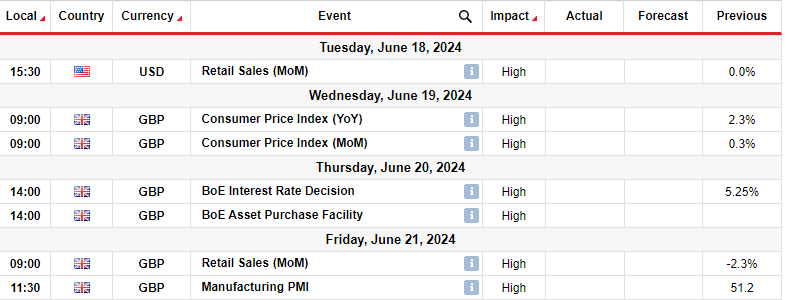
Next week, the UK will release several major reports, including the CPI, retail sales, and manufacturing PMI. At the same time, investors will pay attention to Thursday’s Bank of England policy meeting. Meanwhile, the US will only release its retail sales report.
The UK consumer inflation report will significantly shape the outlook for interest rates. Inflation in the country has been on a downtrend and is currently at 2.3%, near the central bank’s target. However, in the last report, economists had expected it to reach 2.1%. Another bigger-than-expected figure would lower bets for a cut in August.
Meanwhile, the Bank of England will likely maintain rates at its policy meeting.
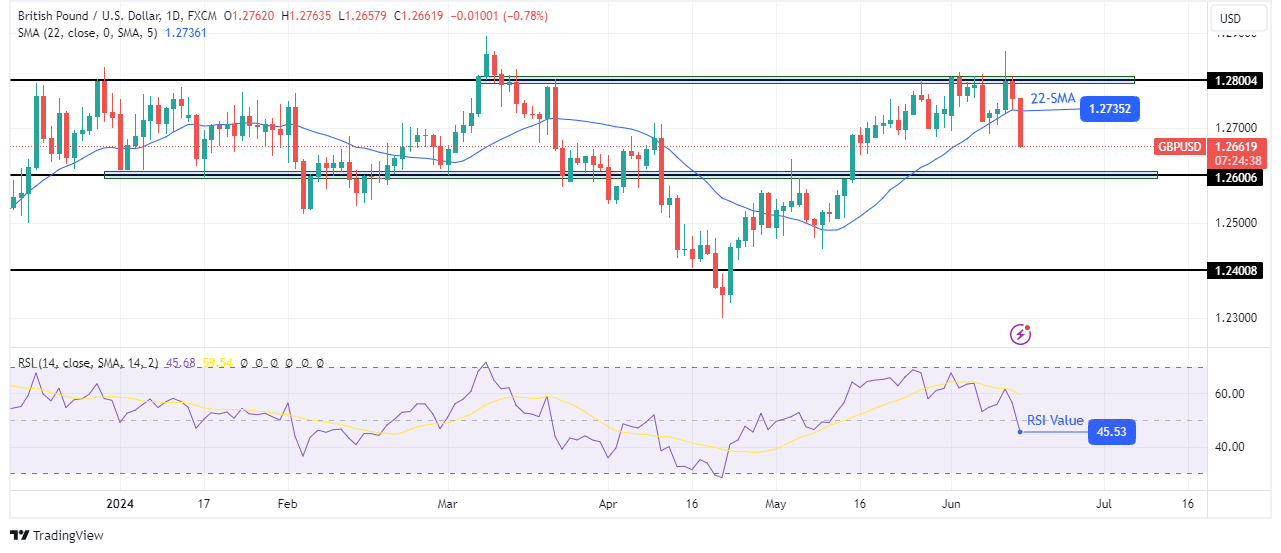
On the technical side, the GBP/USD price has broken below the 22-SMA after failing to breach the 1.2800 critical resistance level. At the same time, the RSI has broken below 50, signaling a shift in sentiment to bearish.
–Are you interested in learning more about forex basics? Check our detailed guide-
The previous bullish move paused at 1.2800, and bears started showing strength with large candles. The shift in sentiment will allow them to revisit the 1.2600 support level. If bears can break below this level to start making lower highs and lows, they will confirm a new downtrend. Moreover, the decline might continue to the 1.2400 key level.
Looking to trade forex now? Invest at eToro!
68% of retail investor accounts lose money when trading CFDs with this provider. You should consider whether you can afford to take the high risk of losing your money.
You have reached your limit of 5 free articles for this month.
Access all our articles, insights, and analysts.
Your coupon code
GBP/USD closed in negative territory on Thursday and snapped a three-day winning streak. The pair struggles to hold its ground early Friday and tests 1.2700.
The table below shows the percentage change of British Pound (GBP) against listed major currencies this week. British Pound was the weakest against the Swiss Franc.
| USD | EUR | GBP | JPY | CAD | AUD | NZD | CHF | |
|---|---|---|---|---|---|---|---|---|
| USD | 1.09% | 0.13% | 0.17% | -0.00% | -0.43% | -0.36% | -0.42% | |
| EUR | -1.09% | -0.61% | -0.67% | -0.83% | -1.23% | -1.18% | -1.24% | |
| GBP | -0.13% | 0.61% | 0.08% | -0.21% | -0.62% | -0.58% | -0.64% | |
| JPY | -0.17% | 0.67% | -0.08% | -0.16% | -0.67% | -0.64% | -0.54% | |
| CAD | 0.00% | 0.83% | 0.21% | 0.16% | -0.39% | -0.36% | -0.42% | |
| AUD | 0.43% | 1.23% | 0.62% | 0.67% | 0.39% | 0.05% | -0.02% | |
| NZD | 0.36% | 1.18% | 0.58% | 0.64% | 0.36% | -0.05% | -0.06% | |
| CHF | 0.42% | 1.24% | 0.64% | 0.54% | 0.42% | 0.02% | 0.06% |
The heat map shows percentage changes of major currencies against each other. The base currency is picked from the left column, while the quote currency is picked from the top row. For example, if you pick the British Pound from the left column and move along the horizontal line to the US Dollar, the percentage change displayed in the box will represent GBP (base)/USD (quote).
The US Dollar erased a portion of Wednesday losses in the European session on Thursday. Although the soft producer inflation data limited the USD’s rebound in the early American session, the souring risk mood helped the currency regather its strength later in the day.
Early Friday, safe-haven flows continue to dominate the financial markets, helping the USD continue to outperform its rivals. Additionally, the USD seems to be capturing capital outflows out of the Euro, which struggles to find demand amid political jitters, and the Japanese Yen, which stays under selling pressure following the Bank of Japan’s decision to hold policy settings unchanged.
The University of Michigan’s (UoM) Consumer Sentiment Survey will be featured in the US economic calendar on Friday. Investors, however, could continue to react to changes in risk perception heading into the weekend.
As of writing, US stock index futures were down between 0.65% and 0.1%. A bearish opening in Wall Street, followed by an extended slide, could further boost the USD and weigh on GBP/USD.
GBP/USD dropped below the lower limit of the ascending regression channel and the Relative Strength Index (RSI) indicator on the 4-hour chart fell below 40, reflecting the bearish tilt in the short term outlook.
On the downside, the 200-period Simple Moving Average (SMA) aligns as first support at 1.2670 before 1.2640 (Fibonacci 38.2% retracement) and 1.2600 (psychological level, static level).
If GBP/USD returns within the ascending channel by rising above 1.2730, sellers could be discouraged. In this case, 1.2750 (100-period SMA) could act as interim resistance before 1.2800 (psychological level, static level).
The Pound Sterling (GBP) is the oldest currency in the world (886 AD) and the official currency of the United Kingdom. It is the fourth most traded unit for foreign exchange (FX) in the world, accounting for 12% of all transactions, averaging $630 billion a day, according to 2022 data. Its key trading pairs are GBP/USD, aka ‘Cable’, which accounts for 11% of FX, GBP/JPY, or the ‘Dragon’ as it is known by traders (3%), and EUR/GBP (2%). The Pound Sterling is issued by the Bank of England (BoE).
The single most important factor influencing the value of the Pound Sterling is monetary policy decided by the Bank of England. The BoE bases its decisions on whether it has achieved its primary goal of “price stability” – a steady inflation rate of around 2%. Its primary tool for achieving this is the adjustment of interest rates. When inflation is too high, the BoE will try to rein it in by raising interest rates, making it more expensive for people and businesses to access credit. This is generally positive for GBP, as higher interest rates make the UK a more attractive place for global investors to park their money. When inflation falls too low it is a sign economic growth is slowing. In this scenario, the BoE will consider lowering interest rates to cheapen credit so businesses will borrow more to invest in growth-generating projects.
Data releases gauge the health of the economy and can impact the value of the Pound Sterling. Indicators such as GDP, Manufacturing and Services PMIs, and employment can all influence the direction of the GBP. A strong economy is good for Sterling. Not only does it attract more foreign investment but it may encourage the BoE to put up interest rates, which will directly strengthen GBP. Otherwise, if economic data is weak, the Pound Sterling is likely to fall.
Another significant data release for the Pound Sterling is the Trade Balance. This indicator measures the difference between what a country earns from its exports and what it spends on imports over a given period. If a country produces highly sought-after exports, its currency will benefit purely from the extra demand created from foreign buyers seeking to purchase these goods. Therefore, a positive net Trade Balance strengthens a currency and vice versa for a negative balance.
GBP/USD closed in negative territory on Thursday and snapped a three-day winning streak. The pair struggles to hold its ground early Friday and tests 1.2700.
The table below shows the percentage change of British Pound (GBP) against listed major currencies this week. British Pound was the weakest against the Swiss Franc.
| USD | EUR | GBP | JPY | CAD | AUD | NZD | CHF | |
|---|---|---|---|---|---|---|---|---|
| USD | 1.09% | 0.13% | 0.17% | -0.00% | -0.43% | -0.36% | -0.42% | |
| EUR | -1.09% | -0.61% | -0.67% | -0.83% | -1.23% | -1.18% | -1.24% | |
| GBP | -0.13% | 0.61% | 0.08% | -0.21% | -0.62% | -0.58% | -0.64% | |
| JPY | -0.17% | 0.67% | -0.08% | -0.16% | -0.67% | -0.64% | -0.54% | |
| CAD | 0.00% | 0.83% | 0.21% | 0.16% | -0.39% | -0.36% | -0.42% | |
| AUD | 0.43% | 1.23% | 0.62% | 0.67% | 0.39% | 0.05% | -0.02% | |
| NZD | 0.36% | 1.18% | 0.58% | 0.64% | 0.36% | -0.05% | -0.06% | |
| CHF | 0.42% | 1.24% | 0.64% | 0.54% | 0.42% | 0.02% | 0.06% |
The heat map shows percentage changes of major currencies against each other. The base currency is picked from the left column, while the quote currency is picked from the top row. For example, if you pick the British Pound from the left column and move along the horizontal line to the US Dollar, the percentage change displayed in the box will represent GBP (base)/USD (quote).
The US Dollar erased a portion of Wednesday losses in the European session on Thursday. Although the soft producer inflation data limited the USD’s rebound in the early American session, the souring risk mood helped the currency regather its strength later in the day.
Early Friday, safe-haven flows continue to dominate the financial markets, helping the USD continue to outperform its rivals. Additionally, the USD seems to be capturing capital outflows out of the Euro, which struggles to find demand amid political jitters, and the Japanese Yen, which stays under selling pressure following the Bank of Japan’s decision to hold policy settings unchanged.
The University of Michigan’s (UoM) Consumer Sentiment Survey will be featured in the US economic calendar on Friday. Investors, however, could continue to react to changes in risk perception heading into the weekend.
As of writing, US stock index futures were down between 0.65% and 0.1%. A bearish opening in Wall Street, followed by an extended slide, could further boost the USD and weigh on GBP/USD.
GBP/USD dropped below the lower limit of the ascending regression channel and the Relative Strength Index (RSI) indicator on the 4-hour chart fell below 40, reflecting the bearish tilt in the short term outlook.
On the downside, the 200-period Simple Moving Average (SMA) aligns as first support at 1.2670 before 1.2640 (Fibonacci 38.2% retracement) and 1.2600 (psychological level, static level).
If GBP/USD returns within the ascending channel by rising above 1.2730, sellers could be discouraged. In this case, 1.2750 (100-period SMA) could act as interim resistance before 1.2800 (psychological level, static level).
The Pound Sterling (GBP) is the oldest currency in the world (886 AD) and the official currency of the United Kingdom. It is the fourth most traded unit for foreign exchange (FX) in the world, accounting for 12% of all transactions, averaging $630 billion a day, according to 2022 data. Its key trading pairs are GBP/USD, aka ‘Cable’, which accounts for 11% of FX, GBP/JPY, or the ‘Dragon’ as it is known by traders (3%), and EUR/GBP (2%). The Pound Sterling is issued by the Bank of England (BoE).
The single most important factor influencing the value of the Pound Sterling is monetary policy decided by the Bank of England. The BoE bases its decisions on whether it has achieved its primary goal of “price stability” – a steady inflation rate of around 2%. Its primary tool for achieving this is the adjustment of interest rates. When inflation is too high, the BoE will try to rein it in by raising interest rates, making it more expensive for people and businesses to access credit. This is generally positive for GBP, as higher interest rates make the UK a more attractive place for global investors to park their money. When inflation falls too low it is a sign economic growth is slowing. In this scenario, the BoE will consider lowering interest rates to cheapen credit so businesses will borrow more to invest in growth-generating projects.
Data releases gauge the health of the economy and can impact the value of the Pound Sterling. Indicators such as GDP, Manufacturing and Services PMIs, and employment can all influence the direction of the GBP. A strong economy is good for Sterling. Not only does it attract more foreign investment but it may encourage the BoE to put up interest rates, which will directly strengthen GBP. Otherwise, if economic data is weak, the Pound Sterling is likely to fall.
Another significant data release for the Pound Sterling is the Trade Balance. This indicator measures the difference between what a country earns from its exports and what it spends on imports over a given period. If a country produces highly sought-after exports, its currency will benefit purely from the extra demand created from foreign buyers seeking to purchase these goods. Therefore, a positive net Trade Balance strengthens a currency and vice versa for a negative balance.
The US dollar has been fairly noisy during the week against the Japanese yen, but that’s to be expected. We had both an FOMC meeting and a Bank of Japan meeting, so there was always going to be a bit of concern when it comes to potential fundamental noise.
That being said, it looks like we are recovering, and it looks like we are just basically working off some froth trying to determine whether or not we can get above the 158 yen level, an area that’s been significant resistance. And then again, we also need to pay close attention to the 160 yen level, an area that seems to be a trip wire for the Bank of Japan as they intervened near that level in the past.
With that being the case, the market certainly looks as if it remains a buy on the dip scenario, with the 155 yen level underneath being massive potential support. So with this, I like the idea of buying these dips and not necessarily worrying about trying to get too cute with this. You get paid at the end of every day. So it is worth recognizing that it is a positive swap and therefore you can’t short it. I think a lot of institutional traders are looking at this through the same prism as well. So as long as that’s going to be the case, I just don’t see a situation where we can do anything other than buy any signs of weakness that give us an opportunity to pick up cheap greenbacks.
For a look at all of today’s economic events, check out our economic calendar.
This article was originally posted on FX Empire
Following Wednesday’s upsurge, EUR/USD turned south and registered large losses on Thursday. The pair stays under pressure on Friday and trades at its lowest level since early May slightly below 1.0700.
The table below shows the percentage change of Euro (EUR) against listed major currencies this week. Euro was the weakest against the Swiss Franc.
| USD | EUR | GBP | JPY | CAD | AUD | NZD | CHF | |
|---|---|---|---|---|---|---|---|---|
| USD | 1.02% | -0.02% | 0.47% | -0.02% | -0.50% | -0.47% | -0.63% | |
| EUR | -1.02% | -0.68% | -0.30% | -0.77% | -1.24% | -1.23% | -1.38% | |
| GBP | 0.02% | 0.68% | 0.50% | -0.09% | -0.55% | -0.54% | -0.69% | |
| JPY | -0.47% | 0.30% | -0.50% | -0.48% | -1.04% | -1.04% | -1.04% | |
| CAD | 0.02% | 0.77% | 0.09% | 0.48% | -0.45% | -0.45% | -0.61% | |
| AUD | 0.50% | 1.24% | 0.55% | 1.04% | 0.45% | 0.01% | -0.17% | |
| NZD | 0.47% | 1.23% | 0.54% | 1.04% | 0.45% | -0.01% | -0.15% | |
| CHF | 0.63% | 1.38% | 0.69% | 1.04% | 0.61% | 0.17% | 0.15% |
The heat map shows percentage changes of major currencies against each other. The base currency is picked from the left column, while the quote currency is picked from the top row. For example, if you pick the Euro from the left column and move along the horizontal line to the US Dollar, the percentage change displayed in the box will represent EUR (base)/USD (quote).
The negative shift seen in risk mood helped the US Dollar (USD) gather strength during the American trading hours on Thursday. Additionally, the negative impact of soft inflation data on the USD started to fade away as investors reassessed the Federal Reserve’s policy outlook amid the hawkish revisions to the Summary of Economic Projections.
Meanwhile, investors’ focus shifts back to political jitters in the Eurozone following the key macroeconomic events in the US, making it difficult for the Euro to find demand.
In the second half of the day, the US economic docket will feature the University of Michigan’s preliminary Consumer Sentiment Survey for June. Nevertheless, market participants are likely to ignore this report and stay focused on the risk perception.
At the time of press, Dow Futures were down 0.5% while S&P 500 Futures were losing 0.2%. On the other hand, Nasdaq Futures were last seen posting small daily gains. In case Wall Street’s main indexes push lower heading into the weekend, the USD is likely to continue to outperform its rivals.
The Relative Strength Index (RSI) indicator on the 4-hour chart stays slightly above 30, suggesting that the pair has some more room on the downside before it turns technically oversold. 1.0670 (Fibonacci 78.6% retracement of the latest uptrend) aligns as next support before 1.0600 (psychological level, static level).
In case EUR/USD manages to stabilize above 1.0700 (psychological level, static level), sellers could look to book profits ahead of the weekend and allow the pair to correct higher. In this scenario, 1.0760 (Fibonacci 50% retracement) could be seen as next resistance before 1.0790-1.0800, where the 100-day and the 200-day Simple Moving Averages are located.
The Euro is the currency for the 20 European Union countries that belong to the Eurozone. It is the second most heavily traded currency in the world behind the US Dollar. In 2022, it accounted for 31% of all foreign exchange transactions, with an average daily turnover of over $2.2 trillion a day. EUR/USD is the most heavily traded currency pair in the world, accounting for an estimated 30% off all transactions, followed by EUR/JPY (4%), EUR/GBP (3%) and EUR/AUD (2%).
The European Central Bank (ECB) in Frankfurt, Germany, is the reserve bank for the Eurozone. The ECB sets interest rates and manages monetary policy. The ECB’s primary mandate is to maintain price stability, which means either controlling inflation or stimulating growth. Its primary tool is the raising or lowering of interest rates. Relatively high interest rates – or the expectation of higher rates – will usually benefit the Euro and vice versa. The ECB Governing Council makes monetary policy decisions at meetings held eight times a year. Decisions are made by heads of the Eurozone national banks and six permanent members, including the President of the ECB, Christine Lagarde.
Eurozone inflation data, measured by the Harmonized Index of Consumer Prices (HICP), is an important econometric for the Euro. If inflation rises more than expected, especially if above the ECB’s 2% target, it obliges the ECB to raise interest rates to bring it back under control. Relatively high interest rates compared to its counterparts will usually benefit the Euro, as it makes the region more attractive as a place for global investors to park their money.
Data releases gauge the health of the economy and can impact on the Euro. Indicators such as GDP, Manufacturing and Services PMIs, employment, and consumer sentiment surveys can all influence the direction of the single currency. A strong economy is good for the Euro. Not only does it attract more foreign investment but it may encourage the ECB to put up interest rates, which will directly strengthen the Euro. Otherwise, if economic data is weak, the Euro is likely to fall. Economic data for the four largest economies in the euro area (Germany, France, Italy and Spain) are especially significant, as they account for 75% of the Eurozone’s economy.
Another significant data release for the Euro is the Trade Balance. This indicator measures the difference between what a country earns from its exports and what it spends on imports over a given period. If a country produces highly sought after exports then its currency will gain in value purely from the extra demand created from foreign buyers seeking to purchase these goods. Therefore, a positive net Trade Balance strengthens a currency and vice versa for a negative balance.
The next area to watch for support activity is around the uptrend line and it was reached today. But if the line fails to hold the next lower price zone is around 2.84 to 2.82, consisting of a crossover of two trendlines and the 50% retracement, respectively. The uptrend line is a relatively short-term line having defined support of the rising trend starting from the April swing low of 1.58. It is used as a guide and is not so reliable without confirming evidence.
Given that the angle of ascent has been relatively steep, an adjustment to a lower slope angle would be common and healthy for the trend. Rising trends that start steep will eventually reach a point where demand can no longer support the price momentum and they will adjust to a lower slope. Alternatively, uptrends that start with a low slope angle typically see the angle increase as the trend progresses. Frequently, there are three angles that might be observed in either scenario.
What about the weekly time frame? The weekly chart is about to close the week with a bearish shooting star pattern. But before being alarmed notice that three weeks ago ended with a similar candlestick pattern. It was followed by a resumption of the uptrend after a brief drop below the bearish week. That was followed by a three-week continuation of the uptrend until this week’s high of 3.16.
The breakout of the bull pennant just got started and if it follows through it projects an initial target up to 3.78. That target is above the 2023 high of 3.64. Nonetheless, the main point is that there looks to be more upside in natural gas for the current trend. The target may be reached or not, but it is supportive of a continuation higher above this week’s high once the retracement is complete.
For a look at all of today’s economic events, check out our economic calendar.
U.S. crude oil was on pace Friday to break a three-week losing streak as analysts see a tighter market heading into the third quarter.
Oil prices are up more than 3% this week as summer fuel demand is expected to reduce inventories in the coming weeks, even though the season has gotten off to a tepid start.
Here are today’s energy prices:
Matt Smith, lead oil analyst at Kpler, said the risk is to the upside for oil prices, though gains will be fairly limited.
“You kind of got the bullish argument that we’re going into summer, refinery runs are going to be super strong drawing down inventories,” Smith told CNBC’s “Squawk Box” Friday.
“We could get up to $90, but we’ll come back down again,” Smith said. “We’re not going to $95, by no means are we going to $100 per barrel here.”
Though the market has largely shrugged off geopolitical risk and refocused on fundamentals, RBC Capital Markets cautioned investors to keep a close eye on an increasingly precarious situation on the Israel-Lebanon border.
“We are closely watching whether Benny Gantz’s departure from the Israeli wartime cabinet will tip the scales in favor of a ground operation aimed at pushing Hezbollah back from the border,” Helima Croft, head of global commodity strategy, told RBC clients in a note Thursday.
Oil remains well below annual highs set in April but has regained ground after a sell-off last week that pushed prices to four-month lows after OPEC+ unveiled plans to increase production in the fourth quarter.
Still, the cartel is keeping all output cuts in place until October, and has rolled two tranches of reductions over until the end of 2025.
“We stay with our tactical long crude recommendation, as our expectations for rising seasonal summer demand and lesser step-up in supply remain intact,” Deutsche Bank analyst Michael Hsueh told clients in a note Thursday.
Deutsche sees the oil supply deficit expanding to nearly 1 million barrels per day in the third quarter, which should support Brent prices rising to the mid-to-upper $80s per-barrel range.
“It would only take a minor overshoot to bring Brent to around USD 90/bbl at some point during the second half,” Hsueh told clients.
Citigroup also sees a tighter market in the third quarter, though it will likely enter a surplus in 2025 on solid production growth and slowing demand, according to the bank.
“When we’re looking at the fundamental picture going into 3Q whether its oil, copper or gold, it looks very solid driven by seasonal increases in demand,” Jeff Currie, an energy analyst at Carlyle, told “Squawk Box” Thursday.
“The supply situation given the recent OPEC meeting points to a tighter 3Q,” Currie said.
The Pound Sterling (GBP) rebounded firmly against the US Dollar (USD) this week, propelling GBP/USD to a new three-month top, but sellers once again lurked above the 1.2800 mark.
Following a bullish start to the week, GBP/USD turned south in the second half of the week after failing to recapture the 1.2800 level.
The pair extended its previous week’s decline at the start of the week on Monday, as the US Dollar stretched its robust Nonfarm Payrolls data-inspired uptrend. Further, the Greenback also capitalized on the EUR/USD sell-off, as the Euro was undermined by the Euro area political jitters after French President Emmanuel Macron announced snap elections on Sunday, dissolving parliament after exit polls showed his alliance suffered a heavy defeat in European elections to Marine Le Pen’s far-right National Rally (RN) party.
In lieu of this, GBP/USD touched a weekly low at 1.2688 on Monday. Thereafter, the Pound Sterling staged a comeback and extended the renewed upside into early Wednesday, as the US Dollar paused its uptrend ahead of the critical US Consumer Price Index (CPI) data.
The US CPI data came in softer than expected and bolstered expectations of Federal Reserve (Fed) interest rate cuts this year. Increased dovish Fed bets smashed the US Dollar alongside the US Treasury bond yields across the curve, driving GBP/USD to the highest level in three months at 1.2861.
The headline CPI was flat over the month in May, below expectations for a 0.1% gain. Core CPI rose 0.2%, which is below estimates for a 0.3% increase. The annual figures also came in softer than the market consensus.
However, the pair failed to sustain at higher levels, as sellers quickly jumped back into the game on the Fed policy announcements. Fed held policy rates steady in the range of 5.25%-5.50%, following the June policy meeting. The revised Summary of Economic Projections, the so-called dot-plot, indicated the policymakers expect to cut rates only once in 2024, against a projection of three rate cuts in the March forecasts and down from two rate cuts widely anticipated.
Fed Chair Jerome Powell delivered hawkish comments during his post-policy meeting press conference, further allowing the US Dollar buyers to recover lost ground. GBP/USD reversed sharply in the Fed aftermath and gave up the 1.2800 threshold once again.
The Fed’s signal that it is eyeing only one rate cut this year continued to fuel the US Dollar recovery momentum, exerting additional downside pressure on the Pound Sterling in the second half of the week and dragging GBP/USD to multi-week lows below 1.2700 on Friday. Markets are now pricing in about a 58% chance of a 25 basis points (bps) Fed rate cut in September, compared to a 47% probability of such a reduction seen a week ago, CME Group’s FedWatch tool showed.
Meanwhile, the UK employment data released on Tuesday failed to have any significant impact on the Pound Sterling. With all the public appearances from the Bank of England (BoE) policymakers canceled ahead of the July 4 general elections in the UK, the pair remained at the mercy of the US Dollar dynamics.
With the US CPI data and Fed policy announcements out of the way, the focus now shifts toward the inflation report from the UK and the Bank of England (BoE) interest rate decision in the week ahead.
There are no relevant economic statistics due from both sides of the Atlantic on Monday, but China’s activity numbers could keep traders entertained.
Tuesday will feature the US Retail Sales report, followed by Industrial Production and other minor data. The UK CPI data for May will be published on Wednesday, ahead of the BoE policy verdict on Thursday. The US weekly Jobless Claims and Building Permits data will be released the same day.
On Friday, the UK Retail Sales data will drop, followed by the S&P Global Preliminary Manufacturing and Services PMI reports from the UK and the US.
Speeches from the Fed policymakers will be closely scrutinized during the week for fresh insights on the Fed’s interest rate path.
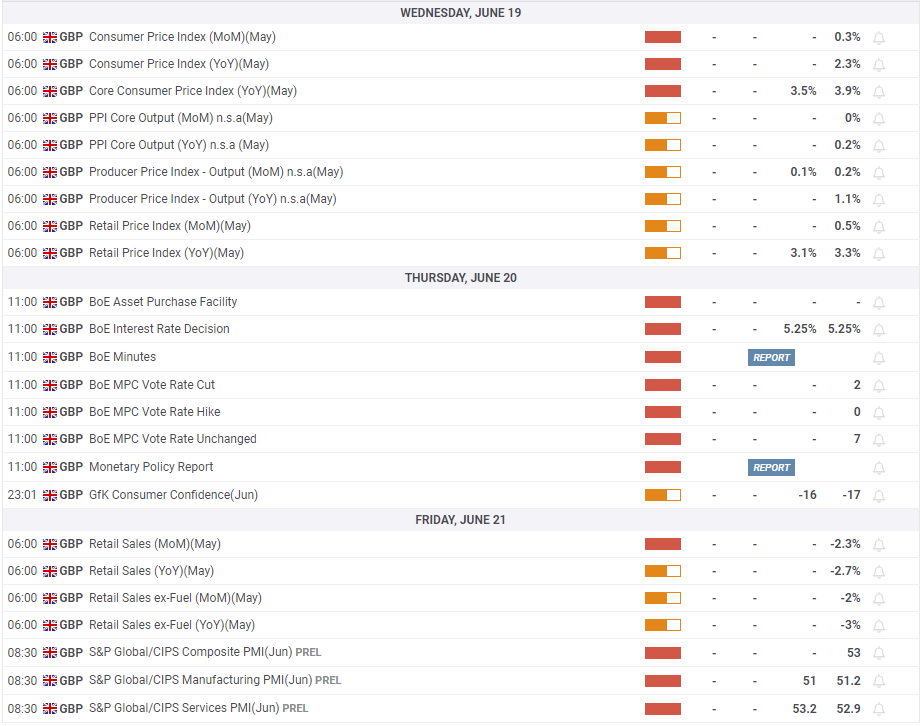
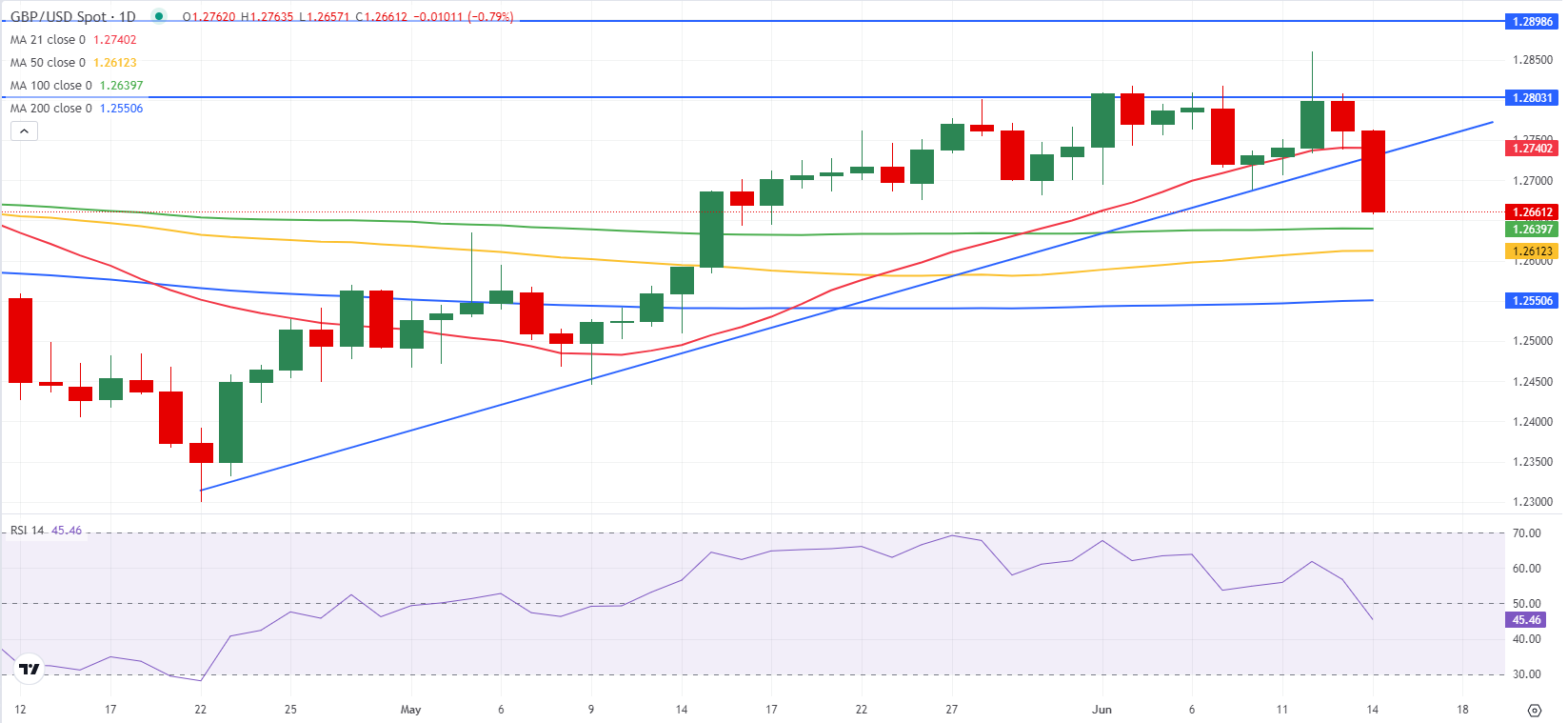
As observed on the daily chart, GBP/USD continued to face rejection above the 1.2800 threshold.
Therefore, buyers yearn for a weekly candlestick close above that level for the Pound Sterling to accelerate the uptrend.
Acceptance above the latter would open the door for a test of the March 8 high of 1.2894. The next relevant resistance is seen at the 1.2950 psychological level.
The 14-day Relative Strength Index (RSI) dropped below 50 for the first time since early May, suggesting a buildup of bearish pressure. Additionally, GBP/USD made a daily close below the 21-day Simple Moving Average (SMA), currently located at 1.2744, for the first time since April 30 and dropped below the rising trendline support at 1.2725.
If GBP/USD fails to reclaim the above-mentioned levels, sell-off could be extended toward the confluence zone of the 100-day SMA and the 50-day SMA at around 1.2630.
The 200-day SMA at 1.2551 will be the last line of defense for Pound Sterling buyers.
The Bank of England (BoE) announces its interest rate decision at the end of its eight scheduled meetings per year. If the BoE is hawkish about the inflationary outlook of the economy and raises interest rates it is usually bullish for the Pound Sterling (GBP). Likewise, if the BoE adopts a dovish view on the UK economy and keeps interest rates unchanged, or cuts them, it is seen as bearish for GBP.
Frequency: Irregular
Actual: 5.25%
Consensus: 5.25%
Previous: 5.25%
Source: Bank of England