The main category of Forex News.
You can use the search box below to find what you need.
[wd_asp id=1]
The main category of Forex News.
You can use the search box below to find what you need.
[wd_asp id=1]
The US dollar rallied nicely during the Friday session, despite the fact that the Non-Farm Payroll announcement was weaker than expected.
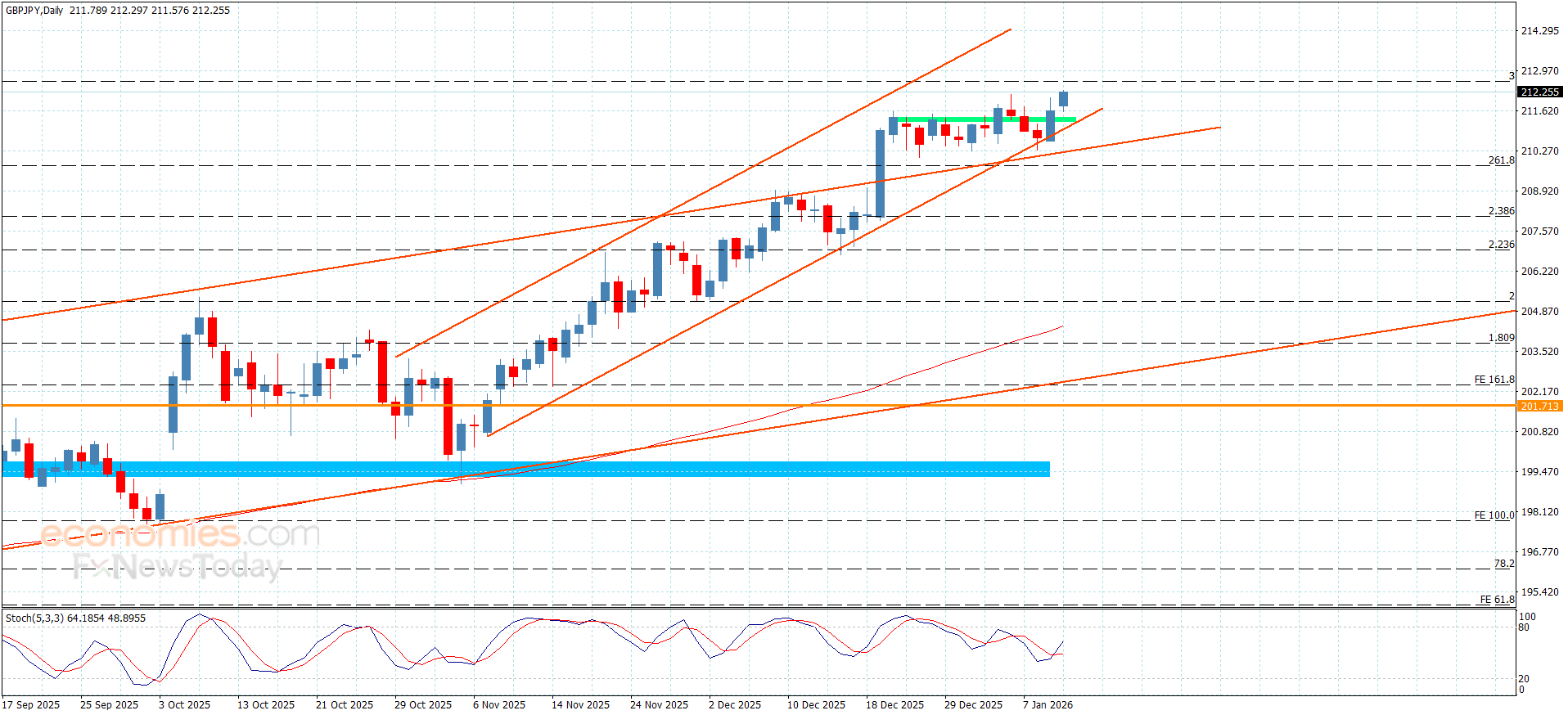
The US dollar rallied quite significantly during the trading session on Friday to test the crucial 158 yen level. The 158 yen level, of course, is an important area to pay close attention to, and if we can break above there, then I think it truly unleashes the US dollar to go much higher.

The Japanese yen has been struggling for a while, and with the interest rate differential favoring the US dollar the way it does, I do think we break out eventually. I have been buying dips in this pair for as long as I can remember and building a position. If we can break above the 158 yen level on a daily close, then it opens up the possibility to the 160 yen level.
Short-term pullbacks, I think, open up the possibility of value yet again with a floor in this market closer to the 154.50 yen level. The Bank of Japan is currently threatening to raise interest rates, but they just have far too much in the way of debt and plenty of other concerns about blowing up the entire carry trade to truly do so aggressively.
The Federal Reserve is likely to cut rates a couple of times during 2026, but it is a bit slower than anticipated, and of course, it is worth noting that inflation is a little sticky at this point, so pay close attention to that. I still like this pair. I get paid at the end of every day for holding it and have continued to do so for several months. Whether or not we can break above 160 yen remains to be seen because it was an area of intervention quite some time ago, so there might be some market memory there.
Want to trade our USD/JPY forex analysis and predictions? Here’s a list of forex brokers in Japan to check out.
Christopher Lewis has been trading Forex and has over 20 years experience in financial markets. Chris has been a regular contributor to Daily Forex since the early days of the site. He writes about Forex for several online publications, including FX Empire, Investing.com, and his own site, aptly named The Trader Guy. Chris favours technical analysis methods to identify his trades and likes to trade equity indices and commodities as well as Forex. He favours a longer-term trading style, and his trades often last for days or weeks.
Silver price surged high in its last intraday trading, to breach the historical resistance level at $81.00, this resistance represents our expected targe in our previous analysis, approaching from recording new all-time highs, amid the continuation of the dynamic support that is represented by its trading above EMA50, reinforcing the strength and stability of the main bullish trend on the short-term basis, especially with its trading alongside trendline, on the other hand, we notice the emergence of negative signals from the relative strength indicators, after reaching overbought levels, which might reduce the upcoming gains.
– Written by
Ben Hughes
STORY LINK Euro-to-Dollar Forecast: EUR/USD Pressured as Markets Reassess Fed Cuts
The Euro to Dollar exchange rate has drifted lower towards the 1.16 area after the dollar secured net gains during the week.
With US data firm enough to dampen expectations of a near-term Federal Reserve rate cut, markets are increasingly focused on whether the Fed will validate or push back against still-dovish pricing for 2026.
That reassessment is set to be the dominant driver for EUR/USD in the near term.
Credit Agricole forecasts EUR/USD will retreat to 1.14 by mid-year with a further slide to 1.10 at the end of the year.
After a hesitant short-term performance, ING forecasts that EUR/USD will strengthen to above 1.20.
The dollar secured net gains during the week and EUR/USD retreated to lows just below 1.1620.
Get better rates and lower fees on your next international money transfer.
Compare TorFX with top UK banks in seconds and see how much you could save.
There was mixed US data, but the data was strong enough that markets considered that a further Fed rate cut in January was even less likely.
Geo-political developments will remain a key element of major developments at the start of 2026.
According to Credit Agricole, President Trump’s decision to remove Venezuelan President Maduro could prolong the Ukraine war by lessening pressure on Russian President Putin to make a deal.
It noted; “The conflict in Ukraine could remain a huge source of uncertainty and thus a drag on the Eurozone business and consumer confidence in the foreseeable future. We further doubt that the Eurozone would benefit from any sustained drop in energy prices on the back of growing Venezuelan oil exports just yet.”
Market positioning could also be a significant factor
Credit Agricole commented; “We further note that the EUR remains one of the biggest longs in G10 FX according to our FX positioning data.”
ING expects net dollar losses; “A large part of the dollar’s 10% decline was attributed to currency hedging rather than an outright sale of US assets. We think this move could extend a little further in 2026, given our house call for another 50bp of Fed rate cuts and the acceleration of the eurozone economy on the back of German fiscal stimulus. We’re still happy with our call that EUR/USD ends 2026 somewhere around 1.22.”

According to UBS; “With markets currently assigning a low probability to a January rate cut, the risks are tilted toward USD weakness if the data disappoint and increase the likelihood of a cut.”
Credit Agricole expects a reassessment of Fed policy; “Evidence today that the US labour market conditions and consumer confidence are improving while the FOMC remains noncommittal with respect to further policy easing could encourage US rate markets to reassess their still dovish Fed outlook, in a boost to the USD.
MUFG expects dollar losses, especially with a positive Euro outlook.
The bank expects no further rate cuts; “We see the ECB as on hold this year as any miss to the downside for inflation is unlikely to be large and persistent, and GDP growth should reduce the need for additional rate cuts.”
The bank also expects central bank Euro demand; “Assuming dollar reserves continue to decline (our view) we see the euro better positioned to take up a greater role in diversification. It remains the second largest currency in reserves but well below the pre-GCF peak of around 28% and the end negative rates and economic stability could see a return of central banks.”
International Money Transfer? Ask our resident FX expert a money transfer question or try John’s new, free, no-obligation personal service! ,where he helps every step of the way,
ensuring you get the best exchange rates on your currency requirements.
TAGS: Euro Dollar Forecasts
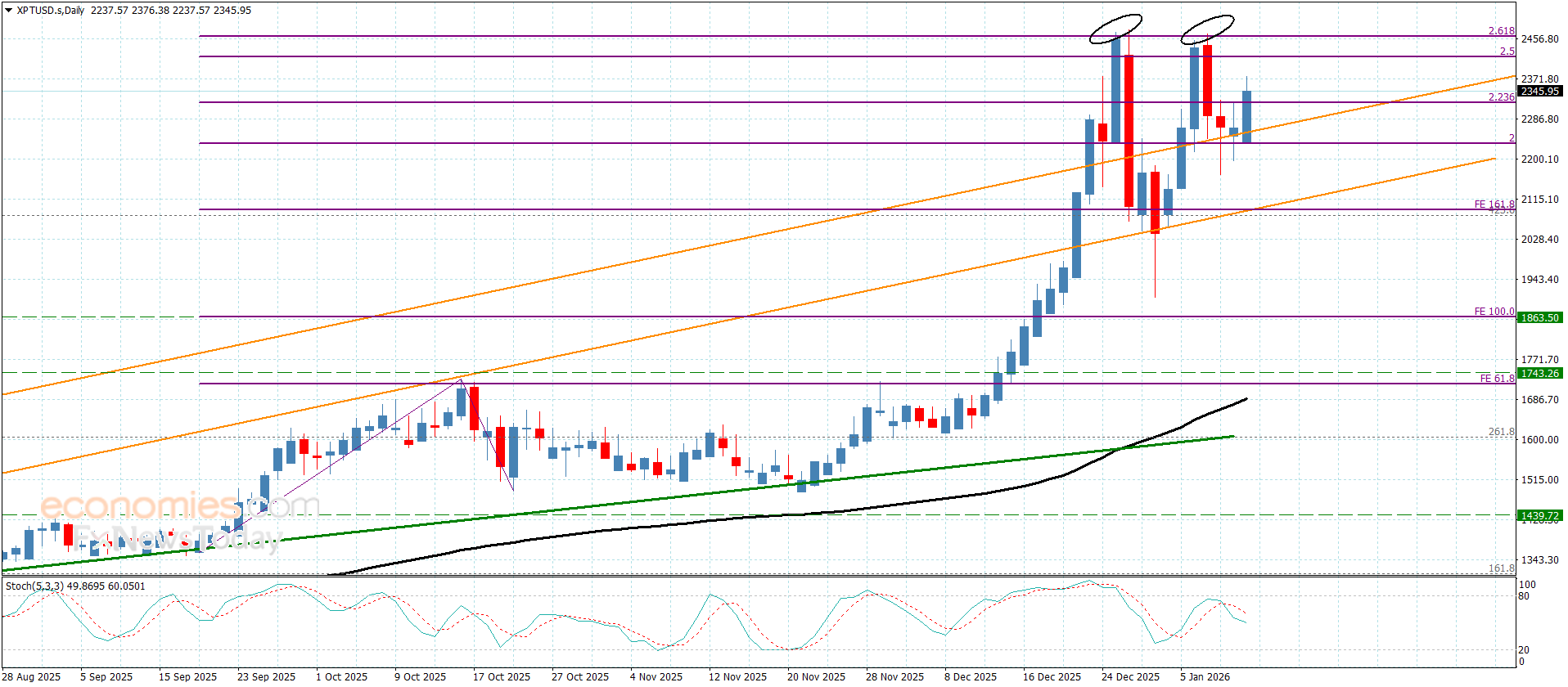
Platinum price leaned in its last trading above %2.0 Fibonacci extension level at $2230.00, to form strong bullish rally this morning to surpass the barrier at $2320, recording some gains by hitting $2375.00 level.
Despite the continuation of the main indicators’ contradiction, the stability above $2320.00 will provide a chance for resume the bullish attempts, to expect targeting $2415.00, to repeat the pressure on the resistance at $2467.00.
The expected trading range for today is between $2265.00 and $2415.00
Trend forecast: Bullish
Platinum price leaned in its last trading above %2.0 Fibonacci extension level at $2230.00, to form strong bullish rally this morning to surpass the barrier at $2320, recording some gains by hitting $2375.00 level.
Despite the continuation of the main indicators’ contradiction, the stability above $2320.00 will provide a chance for resume the bullish attempts, to expect targeting $2415.00, to repeat the pressure on the resistance at $2467.00.
The expected trading range for today is between $2265.00 and $2415.00
Trend forecast: Bullish
Silver price (XAG/USD) extends its gains for the second successive day, trading around $83.10 per troy ounce during the Asian hours on Monday. Precious metals, including Silver, attract buyers as safe-haven demand rises amid escalating geopolitical tensions.
Investors closely watched nationwide protests in Iran, now in their third week and reportedly claiming hundreds of lives. US President Donald Trump warned Tehran against using force on demonstrators and signaled possible action if the crackdown intensifies, while Iranian officials cautioned against any US or Israeli intervention.
Bloomberg reported that European countries led by the UK and Germany are considering increasing their military presence in Greenland to bolster Arctic security. Germany may propose a joint NATO mission, while UK Prime Minister Keir Starmer has urged allies to strengthen efforts in the High North, following renewed remarks by US President Donald Trump calling for US ownership of Greenland.
Safe-haven demand for Silver also rises as traders turn cautious amid concerns surrounding the Federal Reserve. Federal prosecutors have opened a criminal investigation into Fed Chair Jerome Powell regarding the central bank’s renovation of its Washington headquarters and whether Powell lied to Congress about the project’s scope, the New York Times reported on Sunday.
Markets also assessed the likelihood of further Fed rate cuts after Friday’s jobs report showed job growth fell short of expectations. US Nonfarm Payrolls (NFP) rose by 50,000 in December, falling short of November’s 56,000 (revised from 64,000) and came in weaker than the market expectation of 60,000.
Traders continue to price in two Fed rate cuts this year, though the central bank is widely expected to keep policy unchanged later this month. According to the CME Group’s FedWatch tool, Fed funds futures continue to price in about a 95% probability that the US central bank will keep rates unchanged at its January 27–28 meeting.
Silver is a precious metal highly traded among investors. It has been historically used as a store of value and a medium of exchange. Although less popular than Gold, traders may turn to Silver to diversify their investment portfolio, for its intrinsic value or as a potential hedge during high-inflation periods. Investors can buy physical Silver, in coins or in bars, or trade it through vehicles such as Exchange Traded Funds, which track its price on international markets.
Silver prices can move due to a wide range of factors. Geopolitical instability or fears of a deep recession can make Silver price escalate due to its safe-haven status, although to a lesser extent than Gold’s. As a yieldless asset, Silver tends to rise with lower interest rates. Its moves also depend on how the US Dollar (USD) behaves as the asset is priced in dollars (XAG/USD). A strong Dollar tends to keep the price of Silver at bay, whereas a weaker Dollar is likely to propel prices up. Other factors such as investment demand, mining supply – Silver is much more abundant than Gold – and recycling rates can also affect prices.
Silver is widely used in industry, particularly in sectors such as electronics or solar energy, as it has one of the highest electric conductivity of all metals – more than Copper and Gold. A surge in demand can increase prices, while a decline tends to lower them. Dynamics in the US, Chinese and Indian economies can also contribute to price swings: for the US and particularly China, their big industrial sectors use Silver in various processes; in India, consumers’ demand for the precious metal for jewellery also plays a key role in setting prices.
Silver prices tend to follow Gold’s moves. When Gold prices rise, Silver typically follows suit, as their status as safe-haven assets is similar. The Gold/Silver ratio, which shows the number of ounces of Silver needed to equal the value of one ounce of Gold, may help to determine the relative valuation between both metals. Some investors may consider a high ratio as an indicator that Silver is undervalued, or Gold is overvalued. On the contrary, a low ratio might suggest that Gold is undervalued relative to Silver.
I wrote on the 4th January that the best trades for the week would be:
Overall, these trades gave a loss of 1.43% (0.36% per asset).
A summary of last week’s most important data:
Last week’s data had limited impact. You can say there were two effects:
The major geopolitical event right now is likely to be the unrest in Iran. Despite the internet blackout of the past 48 hours, and very limited coverage by much of the media, it seems as if the unrest is threatening the survival of the Islamic Republic.
The USA has threatened to intervene if the regime cracks down with a great deal of violence, and this is raising tensions. President Trump has also raised the possibility of acquiring Greenland by force, even though it is under the control of a NATO ally! However, risk-on sentiment seemed to be strong and healthy right up to Friday’s close, with the major US equity Index the S&P 500 closing at a fresh all-time high.
The other major story of the week was the continuing bullishness in all metals, not just precious metals, with Gold notably closing very near $4,500 which is within sight of its record high. Silver also traded above $80 on Friday before closing a little below that round number.
The coming week’s most important data points, in order of likely importance, are:
Although there are not a lot of data items, the first few are highly important for the Forex market, so it could be an important week. Monday is a public holiday in Japan.
Currency Price Changes and Interest Rates
For the month of January 2026, I forecasted that the USD/JPY currency pair would rise in value.

January 2026 Monthly Forecast Performance to Date
Last week, I made no forecast, as there were no recent excessive moves in currency crosses. I again make no forecast, as low volatility persists.
The US Dollar was the strongest major currency last week, while the Canadian Dollar was the weakest. Directional volatility remained low last week, with only 11% of all major pairs and crosses changing in value by more than 1%.
Next week’s volatility will probably be considerably higher.
You can trade these forecasts in a real or demo Forex brokerage account.
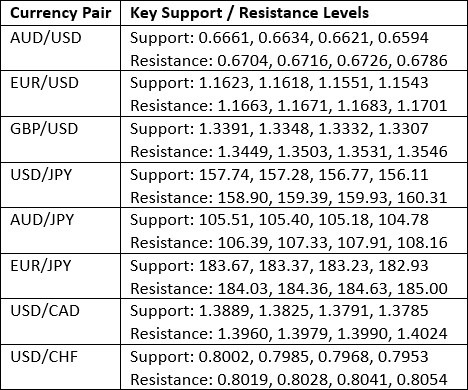
Key Support and Resistance Levels
Last week, the US Dollar Index printed a relatively large bullish candlestick which closed near the high of its range. These are moderately bullish signs. The price action is still suggesting a long-term bullish trend with the price above its levels of both 13 and 26 weeks ago.
The slightly stronger than expected US economic data released last week helped firm up the Dollar, as it has given a slightly hawkish tilt against rate cut expectations in 2026, although two rate cuts of 0.25% are still widely seen as likely to happen.
I take a weakly bullish bias on the US Dollar right now and am comfortable being long of the greenback.
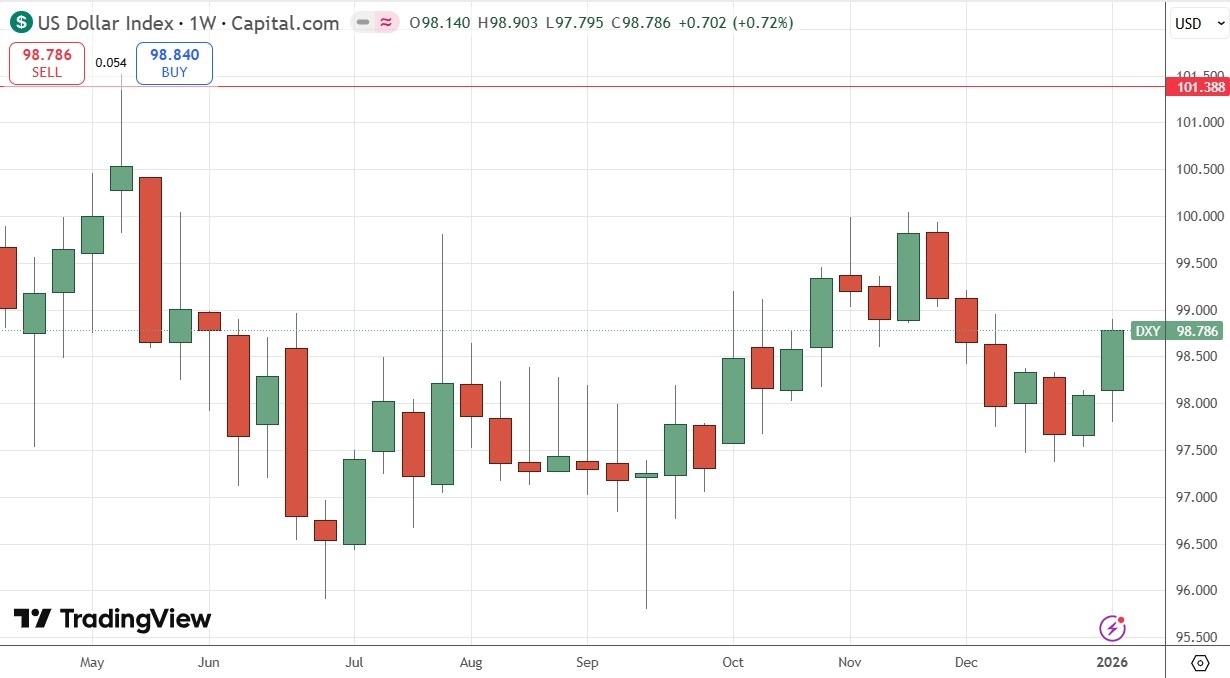
US Dollar Index Weekly Price Chart
The USD/JPY currency pair advanced last week, making a significant bullish breakout on Friday which pushed the price near to a fresh 1-year high.
The price closed quite near its high, but below the round number at ¥158, which might be a little worrying for bulls.
Another thing for bulls to worry about is that the price chart below shows there is a major inflection point just ahead which made the high of 2025. The price has still not got beyond this.
Despite these fears, we have a long-term bullish trend, a bullish breakout, and reasons to be bullish on the US Dollar (strong US economy) and bearish on the Japanese Yen (too much debt to hike rates significantly), so I am very comfortable being long of this currency pair, even if the trade is requiring patience.
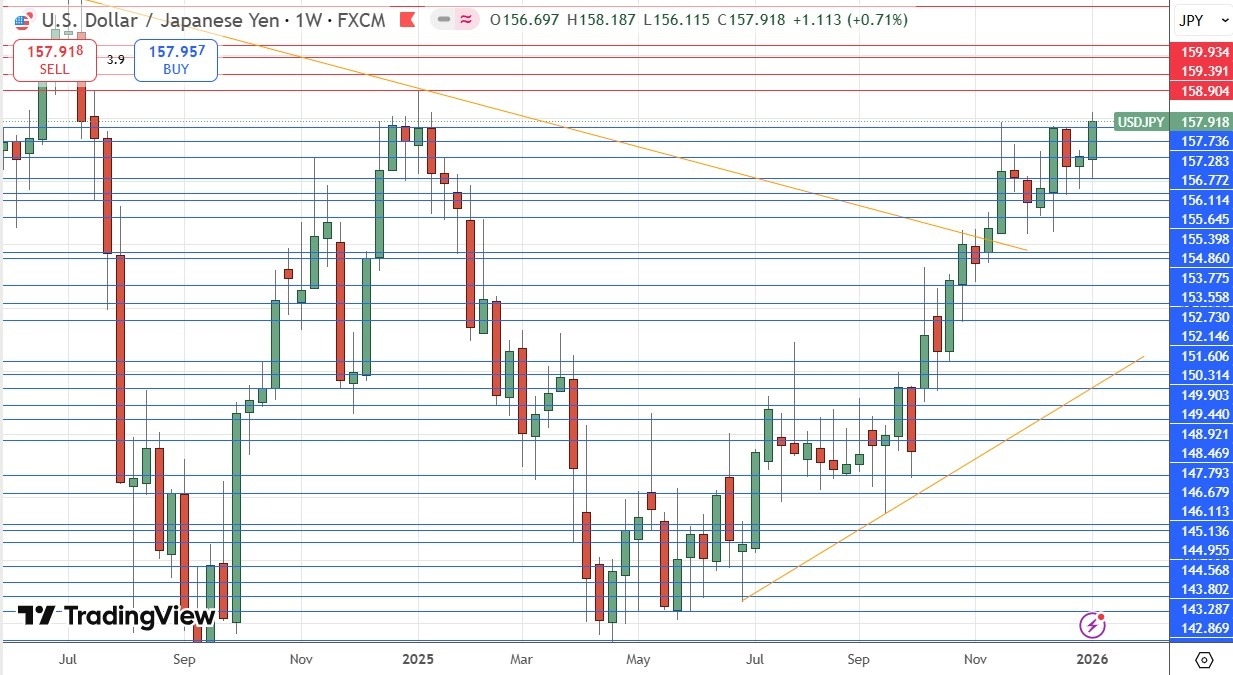
USD/JPY Weekly Price Chart
After reaching a new record high three weeks ago, and making a meaningful dip last week, the US stock market has recovered, and this Index broke to a new all-time high last Friday.
I think the bullish momentum in the US stock market has slowed, and I was even thinking we were starting to see a top, but it seems that bulls have further to go.
I am already long here as a trend trader, but the real test for bulls will be the big round number at 7,000 – more cautious traders or market timing investors might want to see a close above this level before entering a long trade.
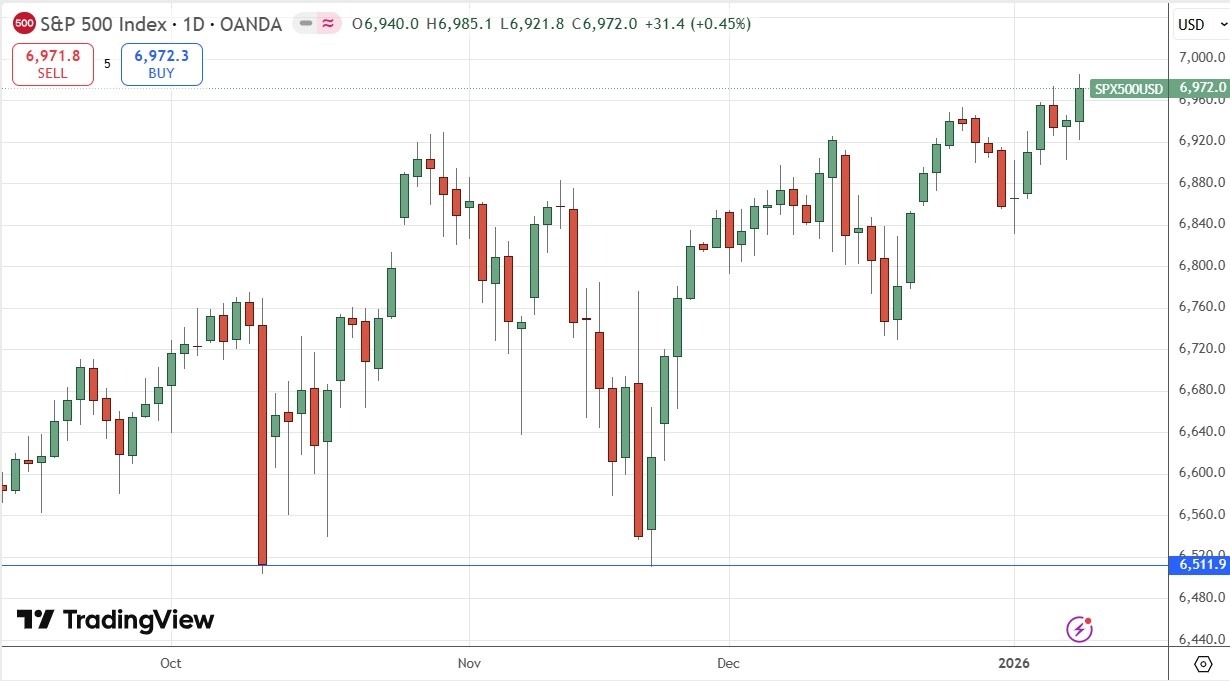
S&P 500 Index Daily Price Chart
Silver is still showing very high volatility, but it rose quite strongly over the past week, making a new record high close on Tuesday, then pulling back, then advancing again.
The most discouraging thing for bulls last week was the fact that the price was unable to close the week above the big round number at $80, which is a mildly bearish sign.
Volatility is much higher here than in Gold, but it is still possible that we could see a bullish breakout and new record highs, and the price possibly even reaching $100 or beyond within a few days or weeks.
All precious metals are advancing, so I think it is worth going long if we get another record daily closing price. As we had one on Tuesday, I am already long, but only with half of my normal position size.
I think it makes sense to think about getting long here, but with a smaller than usual position size.
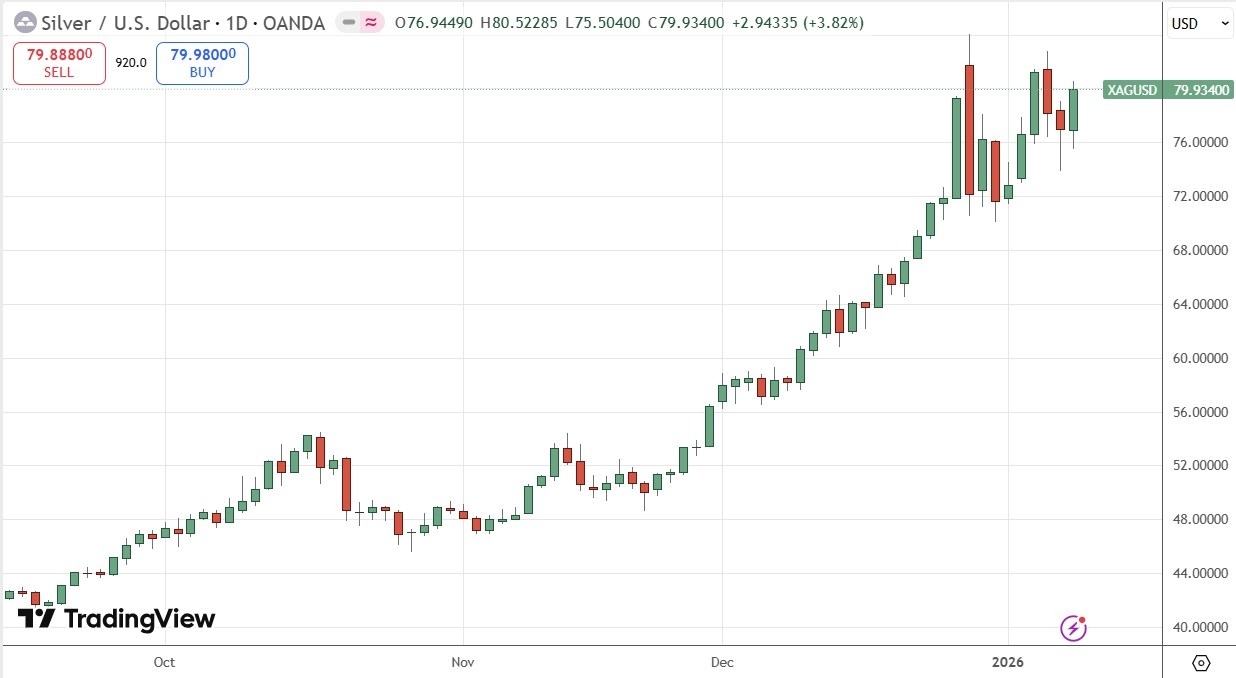
Silver Daily Price Chart
Gold saw quite a firm rise last week, as did all other precious metals. However, Gold has still not made a fresh record high, although it is within sight of the high. Possibly the most bullish signs were that it closed near the top of its weekly range above the big round number at $4,500.
I am prepared to enter another long trade if we do get a new record high daily (New York) closing price (above $4,533.21), and I think it might happen this week.
The new record high made Friday in the S&P 500 Index also makes me more bullish on Gold, as recent years have seen a strong positive correlation between these two assets.
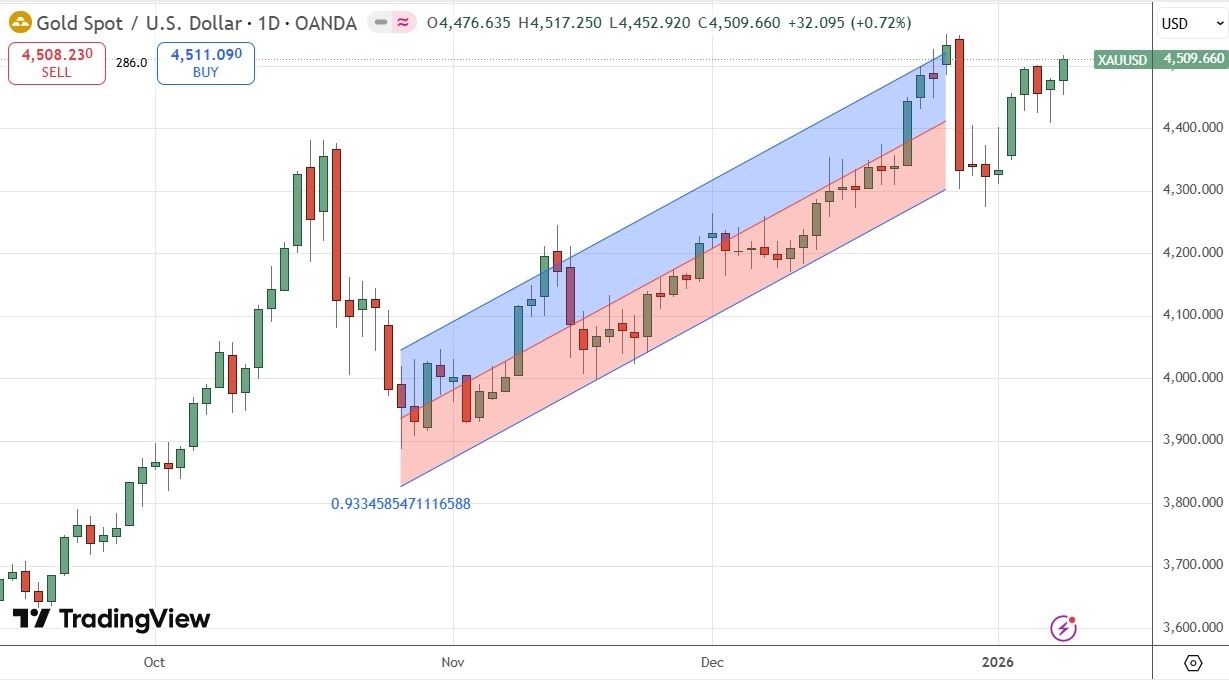
Gold Daily Price Chart
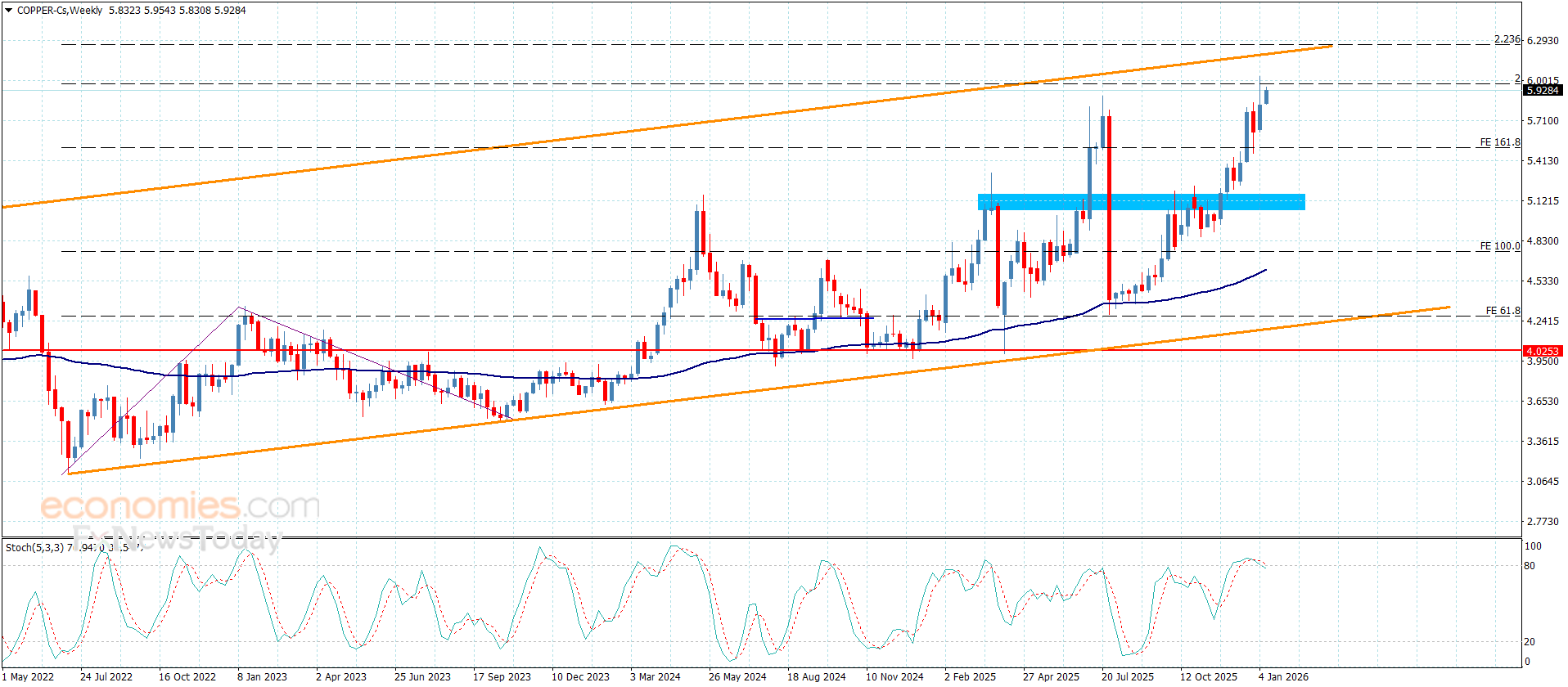
The industrial metal Copper has reached new long-term high prices, due partly to supply (mining) problems, and partly due to massive demand from the technology sector, as well as general industrial demand.
Monday and Tuesday saw Copper futures advance strongly, before pulling back over most of the rest of the week. Friday saw a fresh advance but the highs earlier in the week were not recaptured.
We are seeing industrial metals starting to advance strongly as an asset class just as we saw earlier with precious metals – and precious metals have advanced again, so it looks as if money is flowing into all metals.
For this reason, I think a long Copper trade is worth looking out for, once we get a new fresh daily high close.
If you can’t afford Copper futures (there is a CME micro future sized at about $15,000), you could try a Copper ETF like CPER.
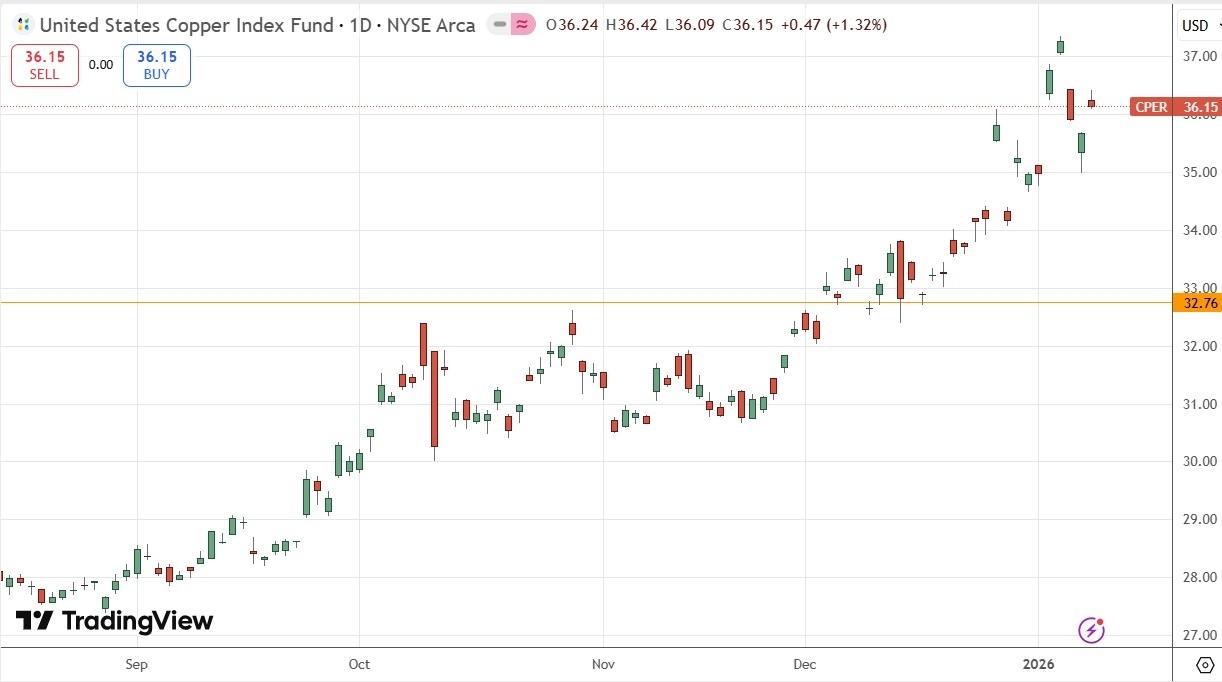
Copper (ETF CPER) Daily Price Chart
I see the best trades this week as:
Ready to trade our Weekly Forex forecast? Check out our list of the best Forex brokers in the world.
Gold is holding its profit-taking pullback from fresh record highs just above $4,600 on Monday, starting the week with a bang, courtesy of escalating geopolitical tensions and intensifying concerns over the US Federal Reserve’s (Fed) independence, which both induce a full-fledged risk-off environment.
Investors flock to safety in the traditional store of value, Gold, digesting the weekend’s reports that US President Donald Trump is weighing a series of potential military options in Iran, following days of civil unrest and should the Iranian regime use lethal force against civilians.
Further, ongoing tensions between Russia and Ukraine also add to the risk-off market mood. The United Nations Security Council called for an emergency meeting on Monday after Russia used its new Oreshnik hypersonic ballistic missile on Friday in a major strike on Ukraine.
Moreover, markets also remain wary over the Fed’s independence after US federal prosecutors opened a criminal investigation into Chair Jerome Powell regarding the central bank’s renovation of its Washington headquarters.
In response, Powell called out on Trump’s attacks, saying that the” new threat is not about his testimony or the renovation project but a pretext.”
These factors, combined with increased odds of interest rate cuts by the Fed this year, continue to undermine the USD, while boosting the sentiment around the non-yielding Gold.
Data on Friday showed that Nonfarm Payrolls increased by 50,000 jobs last month after a downwardly revised rise of 56,000 in November and against the expected gain of 60,000 jobs. The Unemployment Rate dipped to 4.4% in December, compared to the estimated 4.5% reading.
Attention now turns to the US Consumer Price Index (CPI) data for December, which will inject fresh volatility in the market. The data will be critical to gauging the chance of a March Fed rate cut, the odds of which currently sit at about 30%, according to the CME Group’s FedWatch tool.
In the meantime, geopolitical developments and worries over the Fed’s autonomy will continue to drive Gold price action.
In the daily chart, XAU/USD trades at $4,575.47. The 21- and 50-day Simple Moving Averages (SMAs) advance and remain below price, underscoring firm bullish momentum. Shorter SMAs sit above the 100- and 200-day ones, with all slopes rising and buyers in control. The 21-day SMA at $4,403.01 offers nearby dynamic support. The Relative Strength Index (14) prints 69 (near overbought), in line with strong momentum; a pause could emerge if it pushes above 70. A dip would target the 50-day SMA at $4,243.70.
Longer-term SMAs reinforce the uptrend as the 100-day rises to $4,032.27 and the 200-day to $3,674.30, both well beneath price. The bullish alignment of shorter above longer averages supports an extension while pullbacks hold above the 21-day and 50-day SMAs. RSI at 69 stays just below overbought, keeping momentum strong but leaving room for brief consolidation if it cools toward 60. Initial support is layered at $4,403.01–$4,243.70, while the broader bullish bias would persist above the rising 100-day SMA.
(The technical analysis of this story was written with the help of an AI tool)
Gold has played a key role in human’s history as it has been widely used as a store of value and medium of exchange. Currently, apart from its shine and usage for jewelry, the precious metal is widely seen as a safe-haven asset, meaning that it is considered a good investment during turbulent times. Gold is also widely seen as a hedge against inflation and against depreciating currencies as it doesn’t rely on any specific issuer or government.
Central banks are the biggest Gold holders. In their aim to support their currencies in turbulent times, central banks tend to diversify their reserves and buy Gold to improve the perceived strength of the economy and the currency. High Gold reserves can be a source of trust for a country’s solvency. Central banks added 1,136 tonnes of Gold worth around $70 billion to their reserves in 2022, according to data from the World Gold Council. This is the highest yearly purchase since records began. Central banks from emerging economies such as China, India and Turkey are quickly increasing their Gold reserves.
Gold has an inverse correlation with the US Dollar and US Treasuries, which are both major reserve and safe-haven assets. When the Dollar depreciates, Gold tends to rise, enabling investors and central banks to diversify their assets in turbulent times. Gold is also inversely correlated with risk assets. A rally in the stock market tends to weaken Gold price, while sell-offs in riskier markets tend to favor the precious metal.
The price can move due to a wide range of factors. Geopolitical instability or fears of a deep recession can quickly make Gold price escalate due to its safe-haven status. As a yield-less asset, Gold tends to rise with lower interest rates, while higher cost of money usually weighs down on the yellow metal. Still, most moves depend on how the US Dollar (USD) behaves as the asset is priced in dollars (XAU/USD). A strong Dollar tends to keep the price of Gold controlled, whereas a weaker Dollar is likely to push Gold prices up.
– Written by
David Woodsmith
STORY LINK Pound-to-Dollar Forecast: GBP/USD Risks Sustained Decline Below 1.34
The Pound to US Dollar exchange rate (GBP/USD) briefly tested the 1.34 level after US jobs data showed slowing payroll growth but a firmer unemployment picture.
The mixed outcome left the dollar supported and reinforced caution around further near-term Fed easing.
The Pound to Dollar rate touched the 1.3400 level in immediate reaction to the US jobs data before a recovery to 1.3435 as the dollar failed to hold gains.
The 1.3400 level remains a significant support area for the pair.
UoB commented; “Our view remains unchanged. Looking ahead, if GBP breaks below 1.3400, it could trigger a more sustained decline.”
According to Scotiabank, there has been some evidence of a shift in Pound dynamics; “we see some added near-term risk from the turn in sentiment as we note the signs of exhaustion in risk reversals stalling out after fading a considerable portion of the premium for protection against GBP weakness over the past month or so.”
Get better rates and lower fees on your next international money transfer.
Compare TorFX with top UK banks in seconds and see how much you could save.
It added; “We remain neutral absent a clear break below the 200 day MA (1.3393), after which we see risk of an extension to the 50 day MA at 1.3304.”
The latest US jobs report recorded an increase in non-farm payrolls of 50,000 for December compared with consensus forecasts of around 65,000 while the November increase was revised down slightly to 56,000 from the 64,000 reported previously.
The October figure was revised to show a 173,000 decline, primarily due to the slump in government jobs.
The household survey recorded a decline in unemployment to 4.4% from 4.6% and compared with expectations of a slight decline to 4.5%.
Overall, the data was not considered weak enough to justify a further near-term cut in interest rates.
In response, markets priced out the potential for a rate cut at the late-January meeting with the chances of a March move lowered to around 30%.
Peter Cardillo, Chief Market Economist at Spartan Capital Securities commented; “It should mean that the Fed will continue to eye the labor market before cutting rates in the first quarter.”
Markets remain on alert for any nomination over the next Fed Chair.
Scotiabank commented; “President Trump said yesterday that he had made up his mind on his Fed chair pick. There was no additional information from the president—other than he had not divulged his choice to anyone— but the comment will likely bolster speculation that an announcement could come shortly.”
There is also the potential for the Supreme Court to make an announcement on the reciprocal tariffs announced in April.
Either of these factors could have a significant impact on the dollar, wider currency markets and risk appetite.
International Money Transfer? Ask our resident FX expert a money transfer question or try John’s new, free, no-obligation personal service! ,where he helps every step of the way,
ensuring you get the best exchange rates on your currency requirements.
TAGS: Pound Dollar Forecasts
Important DisclaimersFXEmpire is owned and operated by Empire Media Network LTD., Company Registration Number 514641786, registered at 7 Jabotinsky Road, Ramat Gan 5252007, Israel. The content provided on this website includes general news and publications, our personal analysis and opinions, and materials provided by third parties. This content is intended for educational and research purposes only. It does not constitute, and should not be interpreted as, a recommendation or advice to take any action, including making any investment or purchasing any product. Before making any financial decision, you should conduct your own due diligence, exercise your own discretion, and consult with competent advisors. The content on this website is not personally directed to you, and we do not take into account your individual financial situation or needs. The information contained on this website is not necessarily provided in real time, nor is it guaranteed to be accurate. Prices displayed may be provided by market makers and not by exchanges. Any trading or other financial decision you make is entirely your own responsibility, and you must not rely solely on any information provided through the website. FXEmpire does not provide any warranty regarding the accuracy, completeness, or reliability of any information contained on the website and shall bear no responsibility for any trading losses you may incur as a result of using such information. The website may include advertisements and other promotional content. FXEmpire may receive compensation from third parties in connection with such content. FXEmpire does not endorse, recommend, or assume responsibility for the use of any third-party services or websites. Empire Media Network LTD., its employees, officers, subsidiaries, and affiliates shall not be liable for any loss or damage resulting from your use of the website or reliance on the information provided herein.Risk DisclaimersThis website contains information about cryptocurrencies, contracts for difference (CFDs), and other financial instruments, as well as about brokers, exchanges, and other entities trading in such instruments. Both cryptocurrencies and CFDs are complex instruments and involve a high risk of losing money. You should carefully consider whether you understand how these instruments work and whether you can afford to take the high risk of losing your money. FX Empire encourages you to conduct your own research before making any investment decision and to avoid investing in any financial instrument unless you fully understand how it works and the risks involved.