The main category of All News Articles.
You can use the search box below to find what you need.
[wd_asp id=1]
The main category of All News Articles.
You can use the search box below to find what you need.
[wd_asp id=1]
EUR/GBP Holds Near 0.8500 as Bullish Momentum Fades: Technical Outlook
EUR/GBP is trading sideways around the 0.8500 level as of [current date], with the pair losing its earlier bullish traction and consolidating in a narrow range.
The recent rally in EUR/GBP has stalled, with buyers failing to push the pair decisively above the 0.8500 handle. The lack of fresh catalysts from either the European Central Bank or the Bank of England has left the pair directionless, as markets digest mixed economic data from both economies.
Technical indicators on the daily chart show fading bullish momentum, with the Relative Strength Index (RSI) retreating from overbought levels. The pair remains supported by the 20-day moving average, but a break below that could open the door for a test of lower supports.
Immediate resistance is seen at 0.8520, followed by the recent swing high near 0.8550. On the downside, support lies at 0.8480 and then the 50-day moving average around 0.8450. A sustained move above 0.8550 would signal a resumption of the uptrend, while a break below 0.8450 could shift the bias to bearish.
The consolidation reflects a broader market uncertainty about the policy paths of the ECB and the BoE. With inflation still above targets in both regions, any surprise in upcoming data or central bank commentary could trigger a breakout. For traders, the current range offers opportunities but also requires patience, as the pair may remain choppy until a clear catalyst emerges.
EUR/GBP is stuck in a tight range near 0.8500, with fading bullish momentum suggesting a period of consolidation. Traders should watch for a break of the range boundaries for directional cues, while keeping an eye on economic releases and central bank speeches for potential volatility.
Q1: What does ‘trading sideways’ mean in forex?
It means the price is moving within a narrow range without a clear upward or downward trend, often reflecting indecision in the market.
Q2: What is the significance of the 0.8500 level for EUR/GBP?
0.8500 is a psychological round number and a key support/resistance zone. It has acted as a pivot point in recent trading, and a break above or below could signal the next directional move.
Q3: How can central bank policy affect EUR/GBP?
Differences in interest rates and monetary policy between the European Central Bank and the Bank of England influence the relative attractiveness of the euro and the pound, driving the exchange rate.
This post EUR/GBP Holds Near 0.8500 as Bullish Momentum Fades: Technical Outlook first appeared on BitcoinWorld.
Geopolitical risk has once again taken centre stage in crude oil markets as we enter September. Iran and the US traded strikes in the Middle East, pushing Brent crude futures above $90 — right where they started in August.
This recent price increase highlights how quickly crude markets are responding to geopolitical developments. The path towards the psychological price of $100 seems increasingly plausible.
On 1 September, oil prices rose as renewed tensions between the US and Iran in the Middle East heightened concerns over potential supply disruptions from the world’s major crude-producing region.
Brent crude futures increased by 56 cents (0.6%) to $91.05 per barrel, while US West Texas Intermediate (WTI) crude rose by 83 cents (1%) to $86.59 per barrel.
These increases followed strong performances in the previous session, when Brent settled 2.7% higher after reaching its highest level since 25 August. WTI also advanced by 2.8% and briefly reached its highest level since 21 August.
|
Oil benchmark |
September 1, 2026 |
Recent move |
Key level to watch |
|
Brent crude |
$91.05/bbl |
+0.6% |
$100 |
|
WTI crude |
$86.59/bbl |
+1.0% |
$90–$100 |
|
Brent previous-session gain |
— |
+2.7% |
— |
|
WTI previous-session gain |
— |
+2.8% |
— |
In September, US President Donald Trump warned of additional strikes against Iran after the two countries exchanged direct attacks for the first time in a month on Sunday. This development has further escalated tensions in the ongoing conflict, which recently evolved into an economic standoff.
Meanwhile, according to shipping data from Kpler, the number of visible commodity vessels passing through the Strait of Hormuz fell to just five a day over the weekend. Efforts by mediators, including Qatar and Oman, to broker an agreement to reopen the strategic waterway have so far been unsuccessful.
Before the conflict began in late February, the Strait of Hormuz accounted for around one-fifth of global oil supplies. Iran closed the waterway after the United States and Israel launched attacks on the country on 28 February, disrupting a critical route for global energy shipments.
If traffic through the Strait of Hormuz remains severely restricted, the oil market could remain structurally tight even if global demand weakens. The longer the disruption lasts, the greater the probability that Brent will reach $100 or more.
Renewed U.S.-Iran tensions have once again brought Brent crude into the spotlight, raising concerns over the global oil supply. The key question for investors is whether this latest rally can push Brent back above the important psychological threshold of $100 per barrel. The answer is yes, but whether $100 becomes a temporary spike or a sustainable trading level will depend on the duration of the geopolitical disruption.
The strongest bullish catalyst is currently geopolitical supply disruption. The Strait of Hormuz is particularly important as it is a major transit route for global oil flows. According to EIA data, Brent climbed as high as $105 per barrel on 23 July 2026 following renewed tanker attacks and restrictions on shipments through the waterway.
Another bullish factor is the decline in global oil inventories. The IEA reported that global oil supply remained substantially below pre-war levels and that continued disruption to Middle Eastern production and transportation had reduced the 2026 supply outlook.
This creates a scenario in which Brent could quickly return to $100 if physical supply losses accelerate. $100 is now a realistic upside scenario rather than a certain outcome. Before the market could establish a convincing path towards the psychological $100 threshold, Brent would likely need to break and hold above $95.
|
Brent forecast |
Probability |
Implication |
Key driver |
|
Bear case |
$75–$85 |
Lower |
Ceasefire + reopening of Hormuz |
|
Base case |
$85–$95 |
Moderate |
Persistent disruption but partial flows |
|
Bull case |
$95–$110 |
Rising |
Prolonged shipping restrictions |
|
Extreme upside |
$110–$120 |
Low |
Major infrastructure/export disruption |
Prolonged supply disruptions in the Middle East have kept the outlook for crude oil prices elevated. However, market forecasts remain significantly more conservative than the current geopolitical risk premium.
According to a Reuters poll, analysts have maintained forecasts for oil prices above $80 a barrel in 2026, as shipping disruptions linked to the U.S.-Iran conflict drive expectations of reduced supplies, while weak demand in China limits the upside.
In an August survey, 31 economists and analysts predicted an average Brent crude price of $85.08 per barrel and an average U.S. crude price of $80.20 per barrel in 2026, which is roughly in line with July’s forecasts of $85.22 and $80.14, respectively.
TA Securities increased its forecast for the price of Brent crude to US$90 per barrel in 2026, stating that prices could surpass US$100 per barrel in the event of a more severe escalation that disrupts regional oil production or the flow of oil through the Strait of Hormuz.
The research firm maintained its ‘neutral’ outlook on the oil and gas sector, stating that stronger upstream and gas earnings were offset by downstream losses and uncertainty regarding the sustainability of elevated oil prices.
The oil market enters September with an unusually powerful combination of geopolitical and fundamental risks. $100 Brent is achievable, but it is not yet the most likely sustained price level. The next major signal for traders will be whether Brent can decisively break $95 while physical supply disruptions continue. If that happens alongside further inventory draws and worsening tensions around Hormuz, $100–$120 becomes a realistic upside zone. Conversely, a durable ceasefire and reopening of key shipping routes could quickly remove the geopolitical premium and send crude back toward the $75–$85 range.
1. Can oil prices reach $100 per barrel again?
Yes. Brent crude could retest $100 per barrel if U.S.-Iran tensions escalate further, shipping through the Strait of Hormuz remains severely restricted, or major Middle Eastern oil infrastructure is disrupted. Brent was recently trading around $91 per barrel, leaving it roughly 10% below the $100 threshold.
2. Why is oil rising amid Middle East tensions?
The latest rally is primarily driven by concerns about potential disruptions to crude production and transportation, particularly around the Strait of Hormuz. Reuters reported that renewed U.S.-Iran hostilities have revived fears that oil flows through the strategic waterway could remain constrained.
4. Why is the Strait of Hormuz so important for oil prices?
The Strait of Hormuz is one of the world’s most important oil chokepoints and historically handled approximately one-fifth of global oil flows. Any prolonged disruption can tighten physical supply and increase the geopolitical risk premium embedded in crude prices.
5. What could push Brent crude above $100?
The most important bullish catalysts include a prolonged Hormuz disruption, attacks on Middle Eastern energy infrastructure, declining global inventories, and further reductions in Gulf oil exports. A sustained supply shortage would make a move above $100 more likely.
6. What could prevent oil from reaching $100?
A durable U.S.-Iran ceasefire, restoration of Hormuz shipping, recovery of Middle Eastern production and weaker global oil demand could limit the upside. EIA currently expects Brent to average around $85 per barrel in Q3 2026 and gradually decline as production recovers.
– Written by
David Woodsmith
STORY LINK Pound to Dollar Forecast: Hawkish Warsh Sends GBP to 10-Day Lows
The Pound to Dollar exchange rate (GBP/USD) has slipped to 10-day lows around 1.3525 after Federal Reserve Chair Kevin Warsh used his Jackson Hole speech to reinforce concerns over persistent US inflation. Markets have responded by raising the probability of a September Fed rate hike to around 60%, providing renewed support for the Dollar and leaving the important 1.3500 area in focus for Sterling.
The dollar posted net gains following hawkish comments from Federal Reserve Chair Warsh’s comment on Friday.
The Pound to Dollar (GBP/USD) exchange rate dipped to 10-day lows around 1.3525 before trading around 1.3545 on Monday. Trading ranges were narrow with UK markets closed for a holiday.
There is important GBP/USD support in the 1.3500 area.
According to UoB; “Today, GBP may edge lower, but any decline should remain within a range of 1.3520/1.3570.”
From a slightly longer-term view, it added; “The risk remains on the downside, and the level to watch is 1.3480. Overall, GBP is likely to remain under pressure as long as it holds below 1.3600.”
Get better rates and lower fees on your next international money transfer.
Compare TorFX with top UK banks in seconds and see how much you could save.
In his speech at the Jackson Hole symposium, Warsh expressed some unease over underlying inflation trends and added; “we must be confident that underlying inflation is moving to our objective, clearly and at sufficient speed. Otherwise, we have work to do.”
Cleveland Fed President Hammack, who voted for a hike in July, maintained a hawkish stance and continued to back an immediate rate hike.
MUFG commented; “While stopping short of explicitly backing a September rate hike, Warsh stressed that inflation remains insufficiently contained, reaffirmed the Fed’s commitment to its 2% target, and argued that current financial conditions are not restrictive. He also noted that recent improvements in inflation data are not yet enough to signal a meaningful improvement in underlying price trends.”
According to Elwin de Groot, head of macro strategy at Rabobank; “Warsh’s prepared remarks seemed designed to lift rate-hike expectations, rebalance the September debate towards the hawks and rebuild his inflation-fighting credibility.”
He added; “Warsh delivered an important signal: the Fed is not relying on tighter financial conditions alone and remains willing to tighten further if underlying inflation stalls.”
In response, markets now consider that there is close to a 60% chance that the Fed will hike rates at the September meeting.
ING still considers that there is a high degree of uncertainty; “We are far more constructive on inflation, and its path lower through 2027, and without the need for hikes. But there may well be a sense here that the wider FOMC might not have the same patience that we have on the timing of inflation falls. As it is, the September meeting is now a market toss-up.”
According to Rabobank; “The next round of economic data – especially the Employment Report on September 4 and the CPI on September 11 – could be crucial to the swing voters in the Committee.”

International Money Transfer? Ask our resident FX expert a money transfer question or try John’s new, free, no-obligation personal service! ,where he helps every step of the way,
ensuring you get the best exchange rates on your currency requirements.
TAGS: Pound Dollar Forecasts
Gold Price Forecast: XAU/USD Slips Below $4,400 as Fed Hawkish Repricing Boosts Dollar
Gold price (XAU/USD) has extended its reversal below the $4,400 mark, pressured by a hawkish repricing of Federal Reserve interest rate expectations that has strengthened the US Dollar and pushed Treasury yields higher. As of the latest trading session, spot gold is trading around $4,380, down from recent highs, as markets adjust to the possibility of prolonged higher borrowing costs.
The primary driver behind gold’s decline is the market’s reassessment of the Federal Reserve’s monetary policy path. Recent comments from Fed officials, coupled with resilient economic data, have led traders to trim bets on early rate cuts, boosting the US Dollar and diminishing the appeal of non-yielding assets like gold. The 10-year Treasury yield has climbed to multi-week highs, increasing the opportunity cost of holding bullion.
The Federal Reserve’s stance remains data-dependent, but the market now prices in a higher peak rate and a slower pace of cuts than previously anticipated. This shift has been reflected in the dollar index, which has rallied to a two-month high, directly pressuring gold. According to the CME FedWatch Tool, the probability of a rate cut in March has fallen below 30%, down from over 50% a month ago.
For investors, the current environment suggests that gold may face headwinds in the near term. However, analysts note that physical demand from central banks and safe-haven buying amid geopolitical uncertainties could provide a floor. The key support level to watch is $4,350, while resistance sits at $4,420.
From a technical perspective, gold has broken below its 50-day moving average, signaling further downside potential. The Relative Strength Index (RSI) is hovering near 45, indicating bearish momentum but not yet oversold. If the $4,350 support holds, a rebound toward $4,400 is possible; otherwise, the next target could be $4,280.
Gold’s reversal below $4,400 reflects a broader market shift toward a more hawkish Fed outlook, strengthening the dollar and yields. While the near-term bias remains bearish, underlying demand and geopolitical risks could limit losses. Traders should monitor upcoming US economic data and Fed speeches for further direction.
Q1: What is the current gold price forecast?
As of the latest data, gold is trading around $4,380, with a bearish bias as long as it stays below $4,400. Key support is at $4,350, and resistance is at $4,420.
Q2: How does Federal Reserve policy affect gold prices?
Gold is sensitive to interest rate expectations. When the Fed signals higher rates for longer, the dollar strengthens and yields rise, making gold less attractive and typically pushing prices lower.
Q3: What are the key levels to watch in XAU/USD?
Immediate support is at $4,350, followed by $4,280. On the upside, resistance is at $4,400 and then $4,420. A break above $4,420 could signal a reversal of the current downtrend.
This post Gold Price Forecast: XAU/USD Slips Below $4,400 as Fed Hawkish Repricing Boosts Dollar first appeared on BitcoinWorld.
The US Dollar (USD) is up 0.15% to near 160.00 against the Japanese Yen (JPY) during the European trading session on Tuesday. The USD/JPY pair strengthens as the US Dollar outperforms due to surging United States (US) Treasury Yields amid fiscal concerns and questions over the credibility of the Federal Reserve’s (Fed) decision-making.
As of writing, the US Dollar Index (DXY), which gauges the Greenback’s value against six major currencies, trades 0.2% higher to near 99.60. 10-year US Treasury Yields hit a fresh 19-month high at 4.78% and are approaching the multi-year high of 4.81%.
The table below shows the percentage change of US Dollar (USD) against listed major currencies today. US Dollar was the strongest against the New Zealand Dollar.
| USD | EUR | GBP | JPY | CAD | AUD | NZD | CHF | |
|---|---|---|---|---|---|---|---|---|
| USD | 0.18% | 0.05% | 0.10% | 0.10% | 0.34% | 0.37% | 0.19% | |
| EUR | -0.18% | -0.12% | -0.06% | -0.09% | 0.15% | 0.17% | 0.00% | |
| GBP | -0.05% | 0.12% | 0.04% | 0.08% | 0.27% | 0.30% | 0.13% | |
| JPY | -0.10% | 0.06% | -0.04% | 0.00% | 0.23% | 0.28% | 0.09% | |
| CAD | -0.10% | 0.09% | -0.08% | -0.01% | 0.23% | 0.24% | 0.08% | |
| AUD | -0.34% | -0.15% | -0.27% | -0.23% | -0.23% | 0.04% | -0.15% | |
| NZD | -0.37% | -0.17% | -0.30% | -0.28% | -0.24% | -0.04% | -0.17% | |
| CHF | -0.19% | -0.01% | -0.13% | -0.09% | -0.08% | 0.15% | 0.17% |
The heat map shows percentage changes of major currencies against each other. The base currency is picked from the left column, while the quote currency is picked from the top row. For example, if you pick the US Dollar from the left column and move along the horizontal line to the Japanese Yen, the percentage change displayed in the box will represent USD (base)/JPY (quote).
Strategists at BNY Markets highlight that, although he “stopped short of explicit forward guidance in his Jackson Hole address,” Fed Chair Kevin Warsh “stepped as close to the line as possible in advocating a hike,” with the market now “pricing an almost two-thirds probability for one at the FOMC’s September 16 meeting.” Beyond that decision, they note that “the view is murkier,” but futures still “see at least an additional hike into early 2027 and more upside – although not a full hike – beyond that, with a total of about two-and-a-half currently priced.”
BNY observes that the rate repricing has been accompanied by a notable move at the back end of the curve: “The long end has sold off, betraying the view of many (including ours) that a more hawkish Fed would help bring yields lower as credibility would be seen to be enhanced.” Instead, “both the 10y and 30y yields have moved much higher since Friday,” a development that “continues to reinforce for us the view that the long end of the curve is being led by something other than mere inflation expectations and policy conjectures.” BNY concludes, “We think of fiscal concerns and doubts about institutional credibility as the culprits.”
Meanwhile, the Japanese Yen struggles to attract bids even as market experts are confident about the Bank of Japan (BoJ) raising interest rates in the policy meeting this month.
Analysts at Danske Bank highlight that the latest commentary from the BoJ has sharpened market expectations for further tightening. They note that “markets were already pricing a high likelihood of a 25bp hike to 1.25% at the September meeting,” but stress that “the remarks added to the pressure with markets now pricing a rate hike by 70%.”
In the daily chart, USD/JPY trades at 159.91. The pair holds above the 20-day exponential moving average (EMA) at 159.59, which suggests that the near-term bias remains mildly bullish as price respects trend support. Momentum is constructive rather than aggressive, with the 14-day Relative Strength Index (RSI) hovering near 51, hinting at a modest upside tilt after recovering from previously oversold readings.
On the downside, immediate support is located at the 20-day EMA around 159.59, where buyers have scope to defend the current upswing. On the upside, the pair needs a decisive break above the August 28 high at 160.20 to extend the rally towards the July 31 high at 160.88.
(The technical analysis of this story was written with the help of an AI tool. Know more.)
The US Dollar (USD) is the official currency of the United States of America, and the ‘de facto’ currency of a significant number of other countries where it is found in circulation alongside local notes. It is the most heavily traded currency in the world, accounting for over 88% of all global foreign exchange turnover, or an average of $6.6 trillion in transactions per day, according to data from 2022.
Following the second world war, the USD took over from the British Pound as the world’s reserve currency. For most of its history, the US Dollar was backed by Gold, until the Bretton Woods Agreement in 1971 when the Gold Standard went away.
The most important single factor impacting on the value of the US Dollar is monetary policy, which is shaped by the Federal Reserve (Fed). The Fed has two mandates: to achieve price stability (control inflation) and foster full employment. Its primary tool to achieve these two goals is by adjusting interest rates.
When prices are rising too quickly and inflation is above the Fed’s 2% target, the Fed will raise rates, which helps the USD value. When inflation falls below 2% or the Unemployment Rate is too high, the Fed may lower interest rates, which weighs on the Greenback.
In extreme situations, the Federal Reserve can also print more Dollars and enact quantitative easing (QE). QE is the process by which the Fed substantially increases the flow of credit in a stuck financial system.
It is a non-standard policy measure used when credit has dried up because banks will not lend to each other (out of the fear of counterparty default). It is a last resort when simply lowering interest rates is unlikely to achieve the necessary result. It was the Fed’s weapon of choice to combat the credit crunch that occurred during the Great Financial Crisis in 2008. It involves the Fed printing more Dollars and using them to buy US government bonds predominantly from financial institutions. QE usually leads to a weaker US Dollar.
Quantitative tightening (QT) is the reverse process whereby the Federal Reserve stops buying bonds from financial institutions and does not reinvest the principal from the bonds it holds maturing in new purchases. It is usually positive for the US Dollar.
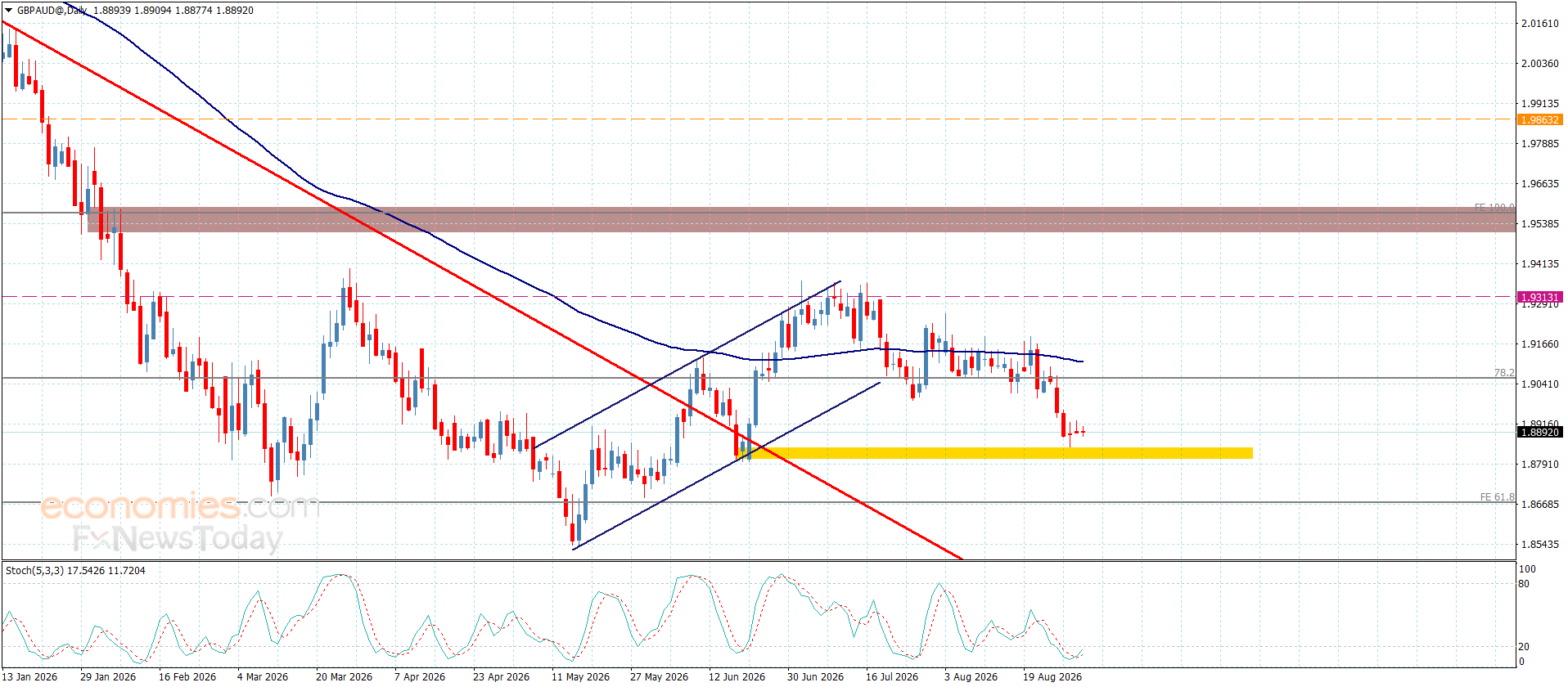
The GBPAUD pair confirmed its ability to withstand negative pressure by posting another positive close above the support level at 1.8815. The pair is currently forming a temporary sideways fluctuation, stabilizing near 1.8890.
stochastic’ attempt to exit oversold territory will give the price a real opportunity to regain positive momentum, making it easier to form bullish waves and begin recording further gains, with the pair expected to advance soon toward 1.8950 and 1.9030.
The expected trading range for today is between 1.8860 and 1.8950
Trend forecast: Bullish
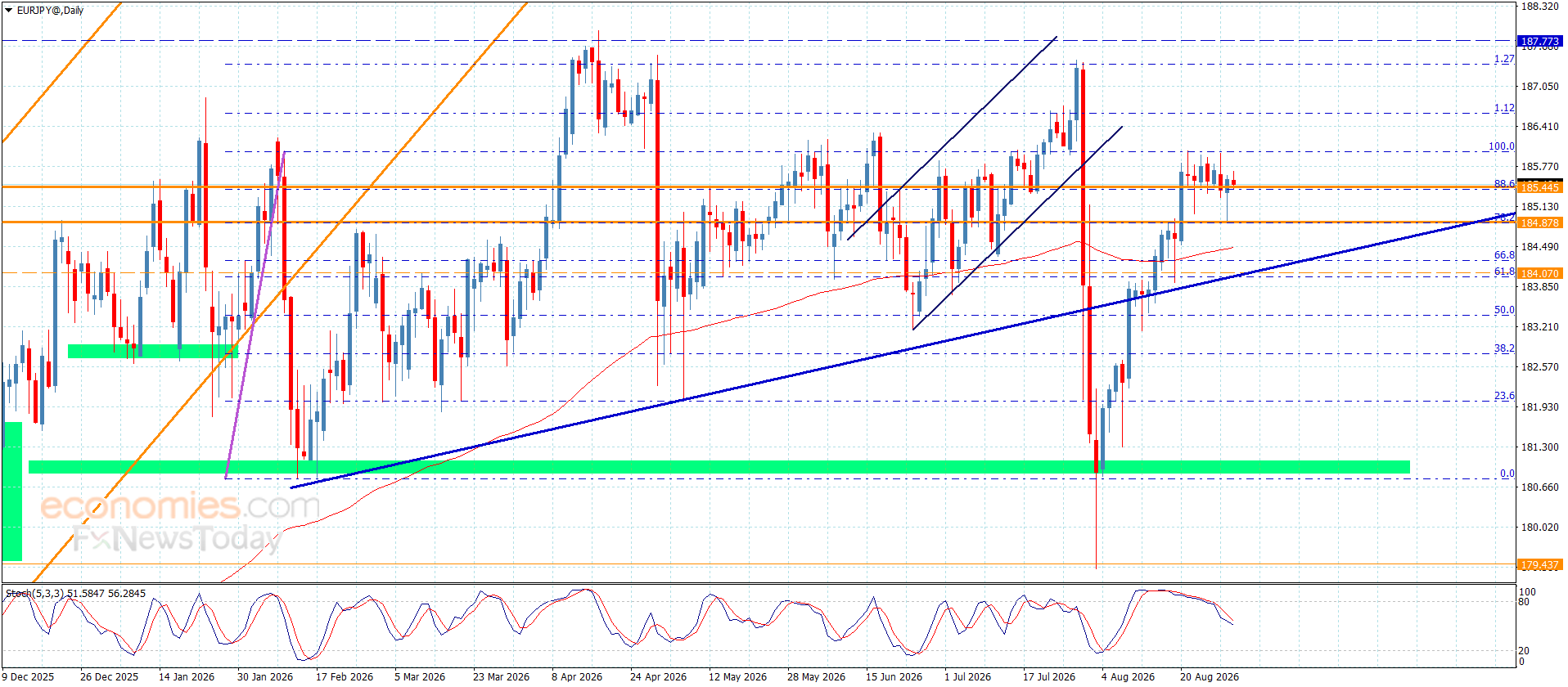
The EURJPY pair ended its bearish corrective attempts after touching the first target at 184.85, which in turn formed an additional support level, giving the price an opportunity to renew its bullish attempts, with the pair currently stabilizing around 185.45.
Noting that the continued conflict between the main indicators, along with the continued formation of 186.05 as a strong barrier against further bullish attempts, may force the price to move sideways with mixed trading during the current period. Should the pair come under renewed negative pressure, it may be forced to form new corrective waves, attempting to break below 184.85 and then target the 55-period moving average, currently positioned near 184.40.
The expected trading range for today is between 184.40 and 185.50
Trend forecast: Bearish
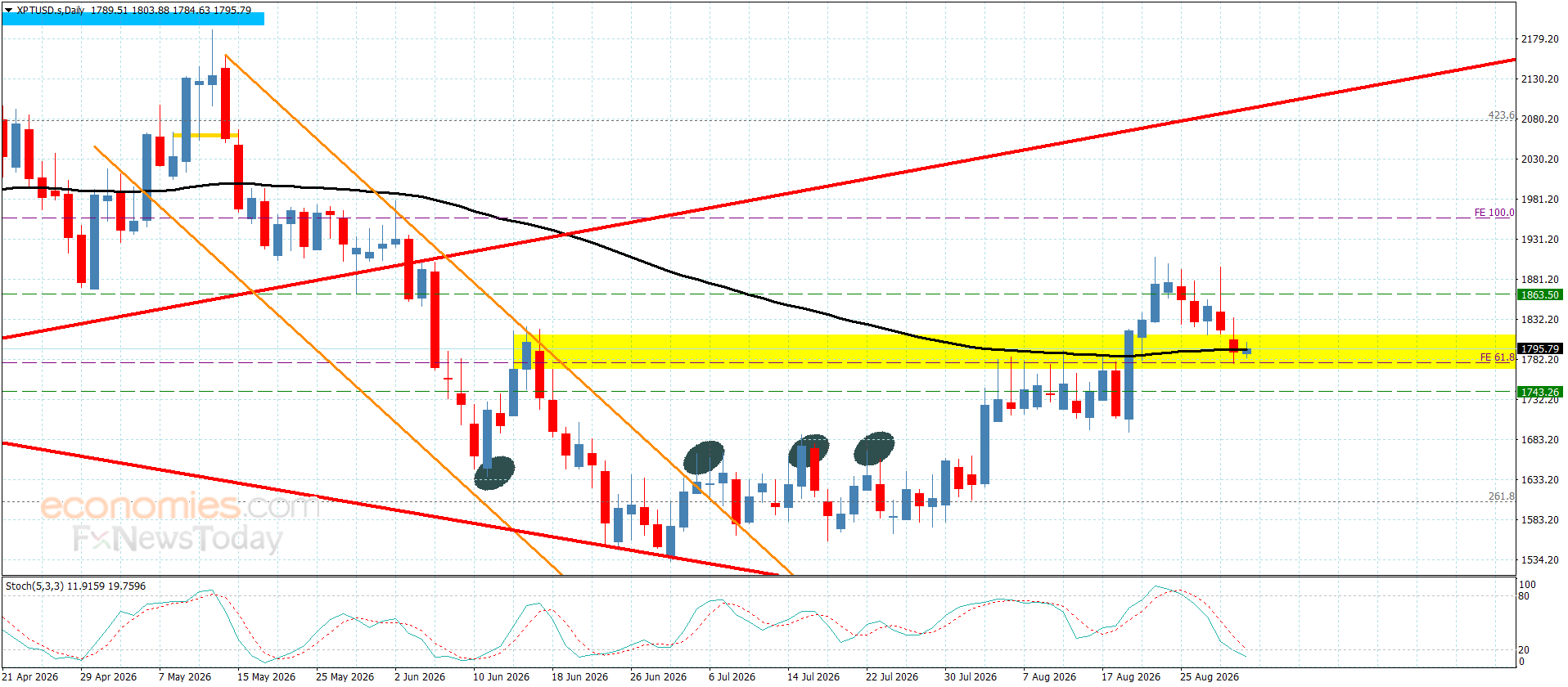
Despite facing negative pressures and suffering some losses by Platinum price reaching $1777.00, it didn’t affect the main bullish trend, depending on its stability above the main support level near $1695.00.
The price needs to gain a new bullish momentum to help it renew the bullish attempts, to expect an attempt to rally towards $1830.00, then attempting to surpass the additional barrier at $1870.00, to confirm its readiness to form extra bullish waves in the upcoming period.
The expected trading range for today is between $1750.00 and $1830.00
Trend forecast: fluctuating within the bullish path
EUR/JPY Holds Below Nine-Day EMA Near 185.50 – Technical Outlook
As of early trading on [current date], the EUR/JPY cross currency pair remains under pressure, trading below its nine-day exponential moving average (EMA) near the 185.50 level. The pair’s inability to reclaim this short-term indicator suggests that bearish momentum may persist in the near term, with traders closely watching key support and resistance zones for directional cues.
The nine-day EMA has emerged as a critical resistance level for EUR/JPY, capping upside attempts since the pair’s recent decline. The current price action shows the pair hovering around 185.50, with the EMA acting as a dynamic ceiling that has rejected multiple rally attempts. A sustained break above this level could signal a shift in momentum, potentially opening the door for a test of the 187.00 region, while failure to do so may lead to further downside toward the 184.00 support area.
The EUR/JPY pair is heavily influenced by the monetary policy stances of the European Central Bank (ECB) and the Bank of Japan (BoJ). The ECB has maintained a hawkish tone, emphasizing the need for further rate hikes to combat inflation, while the BoJ remains committed to its ultra-loose monetary policy, keeping yields low. This policy divergence has historically favored the euro, but recent risk-off sentiment and safe-haven flows into the yen have put downward pressure on the cross. Additionally, global economic uncertainties and geopolitical tensions are prompting investors to seek refuge in the Japanese currency, further weighing on EUR/JPY.
Traders should monitor the following levels for potential breakout or breakdown scenarios:
A close above the EMA on a daily basis could attract bullish momentum, while a break below 184.00 may accelerate selling pressure.
For forex traders, the current positioning of EUR/JPY below the nine-day EMA suggests a cautious approach. Short-term traders may look for short opportunities on rallies toward the EMA, while swing traders might wait for a clear breakout above 186.20 to confirm a reversal. Risk management remains crucial, given the pair’s sensitivity to central bank commentary and macroeconomic data releases. The upcoming eurozone inflation figures and BoJ policy signals will be pivotal in determining the next directional move.
EUR/JPY remains technically bearish as long as it trades below the nine-day EMA near 185.50. The pair’s fate hinges on whether buyers can reclaim this level or if sellers maintain control, with key support at 184.00. Traders should stay alert to central bank news and broader risk sentiment, as these factors are likely to drive volatility in the sessions ahead.
Q1: What is the nine-day EMA and why is it important for EUR/JPY?
The nine-day EMA is a short-term moving average that smooths price data over nine periods, often used by traders to gauge immediate trend direction. For EUR/JPY, it acts as a dynamic resistance level, and a break above or below can signal potential trend changes.
Q2: What are the key support and resistance levels for EUR/JPY right now?
Key resistance is at the nine-day EMA near 185.50, with further levels at 186.20 and 187.00. On the downside, support is seen at 184.00, followed by 183.50 and 182.80.
Q3: How do central bank policies affect EUR/JPY?
The ECB’s hawkish stance and the BoJ’s ultra-loose policy create a yield differential that typically supports the euro. However, risk-off sentiment and safe-haven demand for the yen can override this, causing EUR/JPY to decline.
This post EUR/JPY Holds Below Nine-Day EMA Near 185.50 – Technical Outlook first appeared on BitcoinWorld.
Track the latest platinum price trends in Malappuram. Today, platinum is priced at
₹55,130 for 10 grams, ₹5,51,300 for 100 grams, and ₹55,13,000
per kilogram. In August, platinum prices fluctuated. The highest for 100 grams was
₹5,78,100, and the lowest ₹5,02,400. For 1
kg, prices ranged from ₹50,24,000 to ₹57,81,000.
Several factors affect platinum prices, such as global demand and supply dynamics,
mining activity, and geopolitical risks. Industrial consumption—mainly in the automotive
and electronics sectors—also drives price trends. Currency movements, especially of
the US dollar, along with inflation, investor behavior, and central bank actions, further
influence market value.