The main category of All News Articles.
You can use the search box below to find what you need.
[wd_asp id=1]
The main category of All News Articles.
You can use the search box below to find what you need.
[wd_asp id=1]
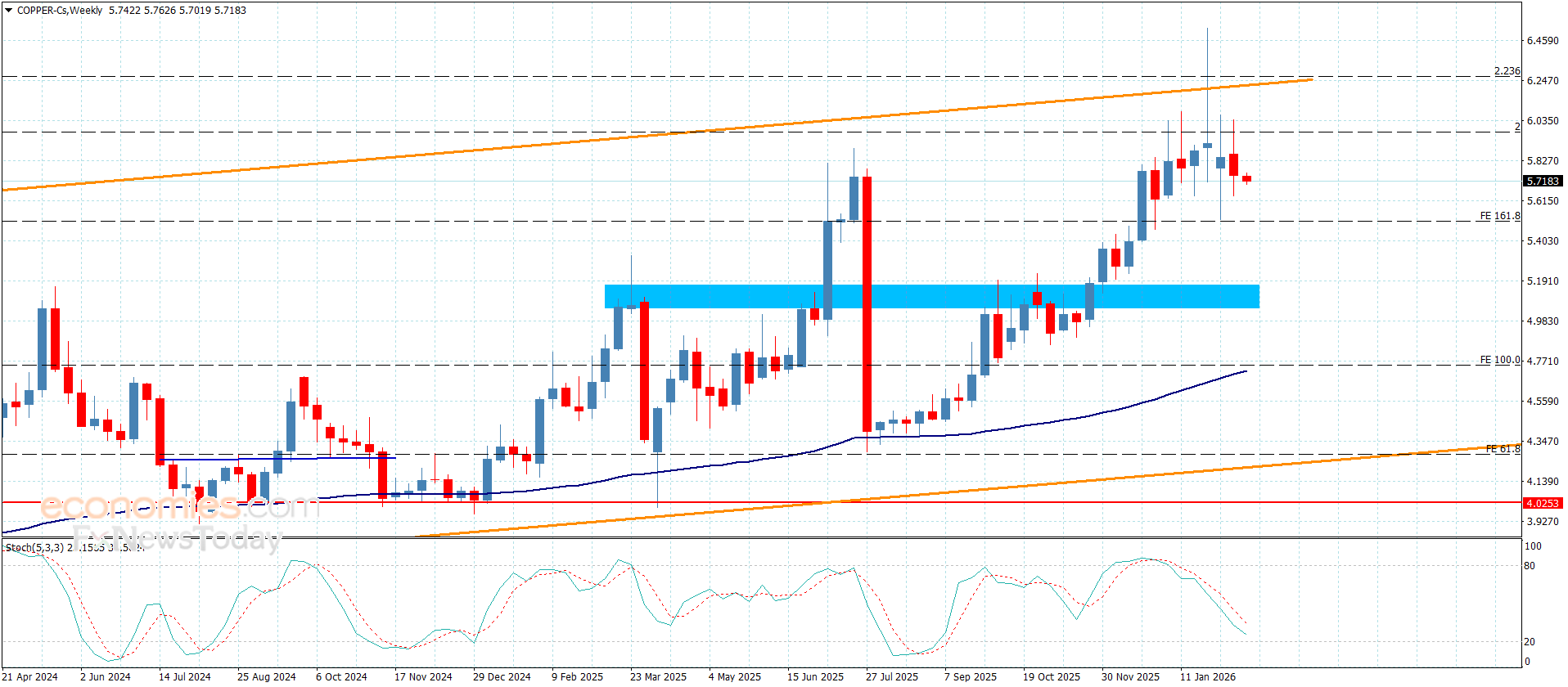
Copper price began this morning, activating with the negative factors that are represented by the stability of the barrier at $5.9700 besides the continuation of providing negative momentum, fluctuating near $5.7000 level.
We will keep our bearish corrective suggestion until facing extra support level at $5.5100, representing key for detecting the expected targets in the medium period trading
The expected trading range for today is between $5.5100 and $5.8500
Trend forecast: Bearish
– Written by
Tim Boyer
STORY LINK GBP/USD Forecast: Pound Sterling Flat as Traders Await Key UK Labour Data
The Pound US Dollar (GBP/USD) exchange rate moved within a tight range on Monday, as a thin economic calendar in both the UK and the US left investors without a clear catalyst.
At the time of writing, GBP/USD was trading at $1.3645, little changed from its opening level.
The Pound (GBP) traded sideways at the start of the week, with no fresh domestic data to provide Sterling with clear momentum.
In the absence of immediate catalysts, many GBP investors appeared reluctant to take decisive positions, particularly with a raft of influential UK figures scheduled for release in the coming days. The latest labour market report, consumer price index, retail sales data and preliminary PMIs are all due, each with the potential to shift the outlook.
These indicators are likely to shape expectations around the Bank of England’s (BoE) next policy moves. Any signs of cooling inflation or softer economic activity could reinforce speculation that interest rate cuts are drawing closer.
As a result, the Pound remained confined to a narrow range, with traders seemingly content to wait for clearer signals before committing to a stronger directional move.
The US Dollar (USD) struggled for direction at the start of the week, with a sparse US economic calendar leaving the currency without a clear driver.
Get better rates and lower fees on your next international money transfer.
Compare TorFX with top UK banks in seconds and see how much you could save.
At the same time, an indecisive market mood offered little impetus for the safe-haven ‘Greenback’. With investors lacking a strong risk-on or risk-off bias, USD exchange rates drifted, particularly against the more risk-sensitive Pound, resulting in relatively contained movement.
The Pound faces a pivotal test on Tuesday with the publication of the UK’s latest labour market figures – the first in a series of high-impact domestic releases this week.
Forecasts suggest the unemployment rate held at its highest level since March 2021 in December, while wage growth is expected to have moderated. Any confirmation that the jobs market is losing momentum could weigh on Sterling, particularly if it strengthens the view that the Bank of England is edging closer to lowering interest rates.
Across the Atlantic, the US Dollar may take its cue from the latest ADP employment change reading. Robust hiring could lend the ‘Greenback’ support by reinforcing confidence in the resilience of the US economy. Conversely, a softer-than-expected print may sap demand for USD.
Broader market sentiment will also remain a key variable. A steady or indecisive mood could keep GBP/USD confined to familiar levels, while a decisive shift in risk appetite may hand the advantage to either the risk-sensitive Pound or the safe-haven Dollar.

International Money Transfer? Ask our resident FX expert a money transfer question or try John’s new, free, no-obligation personal service! ,where he helps every step of the way,
ensuring you get the best exchange rates on your currency requirements.
TAGS: Pound Dollar Forecasts
Gold is on the defensive but holds the $5,000 threshold in early trading on Monday. Market holidays in the United States (US) and China leave the bright metal trading listlessly, so far.
Gold buyers seem to have taken a breather at the start of the week on Monday, following Friday’s solid return. Traders also take account of the latest US inflation and jobs data, while bracing for the US Gross Domestic Product for the fourth quarter of 2025.
The key US economic data will not be released until Friday and hence, China’s Lunar New Year holiday lull and sentiment surrounding the Fed and artificial intelligence (AI) concerns-driven rotation could continue to lead the way for the precious metal traders.
On Friday, the unexpected slowdown in the US Consumer Price Index (CPI) inflation data for January bolstered bets that the US Federal Reserve will deliver at least two interest rate cuts this year.
Futures imply a 68% chance the Fed will cut in June and have 62 basis points of easing priced in for the year, per Reuters.
The US Labor Department said that the CPI rose 0.2% last month after an unrevised 0.3% gain in December, falling short of the estimated increase of 0.3%. The headline annual inflation fell to 2.4% in January, against the forecast of 2.5%.
Excluding the volatile food and energy components, the CPI increased 0.3% after rising by an unrevised 0.2% in December, matching the market expectations.
US Treasury bond yields slipped on increased dovish Fed rate cut bets, smashing the US Dollar (USD) across the board, while lifting the USD-denominated Gold price.
The 21-day Simple Moving Average (SMA) climbs above the 50-, 100- and 200-day readings, underscoring a firm bullish alignment. All SMAs slope higher while price holds above them. The 21-day SMA at $4,973.78 offers immediate dynamic support. The 14-day Relative Strength Index stands at 54.62 (neutral), indicating momentum has normalized after the recent surge. Measured from the $5,597.89 high to the $4,401.99 low, the 50% retracement at $4,999.94 and the 61.8% retracement at $5,141.05 cap the recovery and would need to give way for an upside continuation.
The medium-term structure stays positive as the 50- and 100-day SMAs continue to rise above the 200-day one, and the price retains altitude over these baselines. Initial downside cushions emerge at the 50-day SMA at $4,644.95, while the 100-day SMA at $4,360.91 marks a deeper floor. A daily close above the immediate retracement barriers would open room for a continuation of the primary trend, whereas rejection near them would keep trade confined to the 21-day SMA-led range.
(The technical analysis of this story was written with the help of an AI tool.)
Gold has played a key role in human’s history as it has been widely used as a store of value and medium of exchange. Currently, apart from its shine and usage for jewelry, the precious metal is widely seen as a safe-haven asset, meaning that it is considered a good investment during turbulent times. Gold is also widely seen as a hedge against inflation and against depreciating currencies as it doesn’t rely on any specific issuer or government.
Central banks are the biggest Gold holders. In their aim to support their currencies in turbulent times, central banks tend to diversify their reserves and buy Gold to improve the perceived strength of the economy and the currency. High Gold reserves can be a source of trust for a country’s solvency. Central banks added 1,136 tonnes of Gold worth around $70 billion to their reserves in 2022, according to data from the World Gold Council. This is the highest yearly purchase since records began. Central banks from emerging economies such as China, India and Turkey are quickly increasing their Gold reserves.
Gold has an inverse correlation with the US Dollar and US Treasuries, which are both major reserve and safe-haven assets. When the Dollar depreciates, Gold tends to rise, enabling investors and central banks to diversify their assets in turbulent times. Gold is also inversely correlated with risk assets. A rally in the stock market tends to weaken Gold price, while sell-offs in riskier markets tend to favor the precious metal.
The price can move due to a wide range of factors. Geopolitical instability or fears of a deep recession can quickly make Gold price escalate due to its safe-haven status. As a yield-less asset, Gold tends to rise with lower interest rates, while higher cost of money usually weighs down on the yellow metal. Still, most moves depend on how the US Dollar (USD) behaves as the asset is priced in dollars (XAU/USD). A strong Dollar tends to keep the price of Gold controlled, whereas a weaker Dollar is likely to push Gold prices up.
The USD/JPY pair gains some positive traction at the start of a new week and moves away from its lowest level since January 28, around the 152.30-152.25 region, touched last Thursday. The Japanese Yen (JPY) weakens following the disappointing release of the Q4 GDP report, which tempers bets for an immediate rate hike by the Bank of Japan (BoJ). Apart from this, the underlying bullish tone undermines the JPY’s safe-haven status and acts as a tailwind for the currency pair amid a modest US Dollar (USD) uptick.
Japan’s Cabinet Office reported earlier today that the Gross Domestic Product (GDP) in the world’s fourth-biggest economy grew by just 0.1% during the October-December quarter, undershooting market forecasts of 0.4% rise. Adding to this, the previous quarter’s reading was revised down to show a contraction of 0.7%, dampening hopes for further BoJ policy tightening in April. Meanwhile, the data puts more pressure on Japan’s Prime Minister Takaichi to announce stimulus after her landslide victory.
This, in turn, remains supportive of the upbeat market mood and turns out to be another factor weighing on the JPY. Meanwhile, investors remain hopeful that Takaichi could be fiscally responsible. and that her policies will boost the economy. This might prompt the BoJ to stick to its policy normalization path, which should help limit deeper losses for the JPY. The USD, on the other hand, struggles to lure buyers amid dovish Federal Reserve (Fed) expectations, which further contribute to keeping a lid on the USD/JPY pair.
Despite last Wednesday’s blowout US Nonfarm Payrolls (NFP) report, traders ramped up their bets that the US central bank will lower borrowing costs in June after data released on Friday showed that consumer inflation rose less than expected in January. In fact, the headline US Consumer Price Index (CPI) rose 0.2%, while the core gauge climbed 0.3% last month. This, along with threats to the Fed’s independence, keeps the USD bulls on the defensive and warrants caution before positioning for a further USD/JPY upside.
Meanwhile, trading volumes remain thin on the back of the Lunar New Year holidays in China, South Korea, and Taiwan. Moreover, US markets will be closed on Monday in observance of Presidents’ Day. Traders might also opt to wait for the release of FOMC minutes on Wednesday. This, along with speeches from influential FOMC members, will be looked for more cues about the Fed’s rate-cut path, which will drive the USD demand and provide a fresh impetus to the USD/JPY pair during the latter part of the week.
From a technical perspective, the USD/JPY pair continues to show resilience below the 200-day Exponential Moving Average (SMA) on Monday and rebounds from the vicinity of the 38.2% Fibonacci retracement level of the April 2025-January 2026 rally. Spot prices hold above the rising 200-EMA at 152.55, maintaining a broader bullish bias. Pullbacks would find initial support at that average.
That said, the Moving Average Convergence Divergence (MACD) line remains below the Signal line, and both sit below the zero line, while the negative histogram contracts, suggesting fading bearish pressure. Moreover, the daily Relative Strength Index (RSI) at 39.75 reflects subdued momentum.
Meanwhile, the 38.2% Fibo. retracement level at 152.11 might continue to offer near-term support, with the 50.0% retracement at 149.80 as the next downside level. Holding above 152.11 would keep recovery attempts in play, while a daily close beneath 149.80 would warn of a deeper retracement within the broader advance.
(The technical analysis of this story was written with the help of an AI tool.)
The EURCHF continued to form bearish waves in the last period, to reach the second target at 0.9075 which represents %78.2 Fibonacci extension level.
The main indicators contradiction might push the price to provide mixed trading, however the negative stability below 0.9215 level and the stability of the moving average 55 above the current trading, these factors make us keep the negative scenario, which might target 0.8975 level reaching towards 0.8860.
The expected trading range for today is between 0.9030 and 0.9155
Trend forecast: Bearish
EUR/USD fluctuates in a narrow channel below 1.1900 in the European session on Monday after posting small gains in the previous week. The pair’s trading action is likely to remain subdued in the short term, with stock and bond markets in the US remaining closed in observance of the Presidents Day holiday.
The table below shows the percentage change of Euro (EUR) against listed major currencies last 7 days. Euro was the strongest against the US Dollar.
| USD | EUR | GBP | JPY | CAD | AUD | NZD | CHF | |
|---|---|---|---|---|---|---|---|---|
| USD | -0.41% | -0.39% | -2.53% | -0.39% | -1.05% | -0.43% | -0.97% | |
| EUR | 0.41% | 0.02% | -2.17% | 0.02% | -0.64% | -0.03% | -0.56% | |
| GBP | 0.39% | -0.02% | -1.91% | -0.01% | -0.67% | -0.05% | -0.59% | |
| JPY | 2.53% | 2.17% | 1.91% | 2.24% | 1.56% | 2.20% | 1.53% | |
| CAD | 0.39% | -0.02% | 0.00% | -2.24% | -0.56% | -0.03% | -0.58% | |
| AUD | 1.05% | 0.64% | 0.67% | -1.56% | 0.56% | 0.62% | 0.07% | |
| NZD | 0.43% | 0.03% | 0.05% | -2.20% | 0.03% | -0.62% | -0.54% | |
| CHF | 0.97% | 0.56% | 0.59% | -1.53% | 0.58% | -0.07% | 0.54% |
The heat map shows percentage changes of major currencies against each other. The base currency is picked from the left column, while the quote currency is picked from the top row. For example, if you pick the Euro from the left column and move along the horizontal line to the US Dollar, the percentage change displayed in the box will represent EUR (base)/USD (quote).
Soft inflation data from the US made it difficult for the US Dollar (USD) to gather strength heading into the weekend and allowed EUR/USD to hold its ground. The US Bureau of Labor Statistics reported that the Consumer Price Index (CPI) rose 2.4% on a yearly basis in January, following the 2.7% increase recorded in December. This print came in below the market expectation of 2.5%. On a monthly basis, the CPI and the core CPI, which excludes volatile food and energy prices, increased 0.2% and 0.3%, respectively.
In the second half of the day, European Central Bank (ECB) policymaker Joachim Nagel will be delivering a speech.
Meanwhile, the ECB announced over the weekend that they are planning to widen the global access to the Euro liquidity backstop to boost the Euro’s global role, by making it easier for foreign central banks to secure funding in Euros at times of financial stress.
Rabobank analysts pointed out some potential issues with this decision. “The key issues are: (1) is the supply of Euros globally an issue or the demand for them?; (2) it implies a much larger number of Euro-denominated assets and a much larger European trade deficit; and (3) a much higher Euro exchange rate, which wouldn’t be welcome in all member states to put it mildly,” they explained.
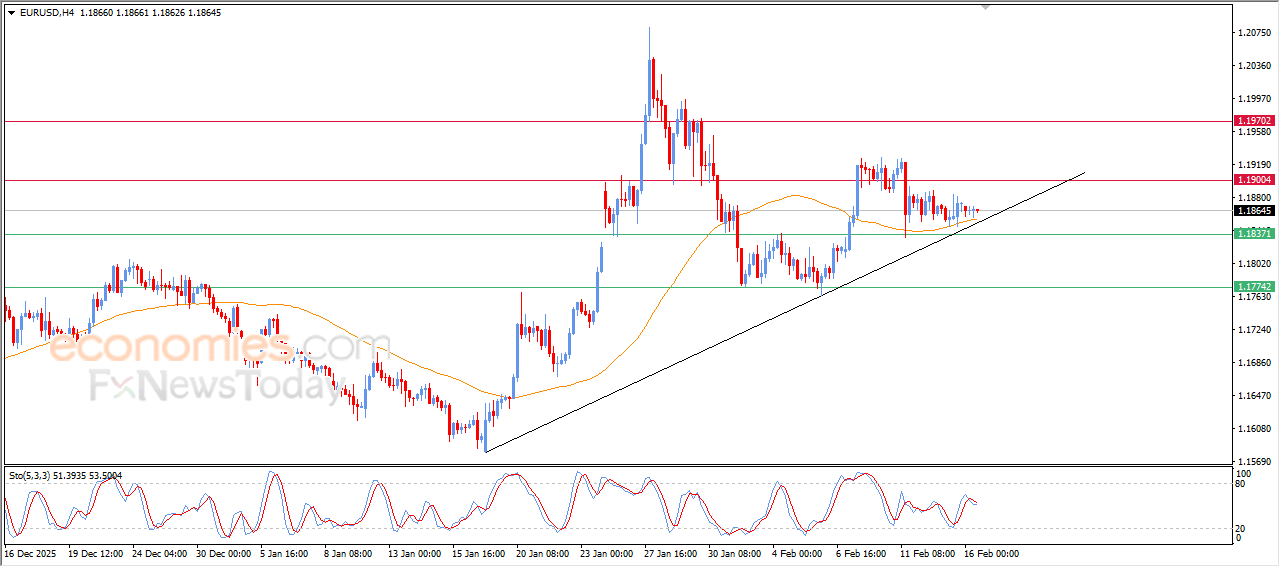
The Relative Strength Index (RSI) indicator on the 4-hour chart moves sideways slightly below 50 and EUR/USD fluctuates at around the 20-period, 50-period and 100-period SMAs, reflecting the pair’s indecisiveness.
The Fibonacci 38.2% retracement of the latest uptrend, the 100-period SMA and the 50-period SMA form a pivot area in 1.1850-1.1860. In case EUR/USD stabilizes above this region, technical buyers could remain interested. In this case, 1.1900 (static level, round level) could be seen as an interim resistance level before 1.1925 (Fibonacci 23.6% retracement).
Looking south, support levels could be spotted at 1.1810-1.1800 (Fibonacci 50% retracement, static level) and 1.1770 (200-period SMA).
The Euro is the currency for the 20 European Union countries that belong to the Eurozone. It is the second most heavily traded currency in the world behind the US Dollar. In 2022, it accounted for 31% of all foreign exchange transactions, with an average daily turnover of over $2.2 trillion a day.
EUR/USD is the most heavily traded currency pair in the world, accounting for an estimated 30% off all transactions, followed by EUR/JPY (4%), EUR/GBP (3%) and EUR/AUD (2%).
The European Central Bank (ECB) in Frankfurt, Germany, is the reserve bank for the Eurozone. The ECB sets interest rates and manages monetary policy.
The ECB’s primary mandate is to maintain price stability, which means either controlling inflation or stimulating growth. Its primary tool is the raising or lowering of interest rates. Relatively high interest rates – or the expectation of higher rates – will usually benefit the Euro and vice versa.
The ECB Governing Council makes monetary policy decisions at meetings held eight times a year. Decisions are made by heads of the Eurozone national banks and six permanent members, including the President of the ECB, Christine Lagarde.
Eurozone inflation data, measured by the Harmonized Index of Consumer Prices (HICP), is an important econometric for the Euro. If inflation rises more than expected, especially if above the ECB’s 2% target, it obliges the ECB to raise interest rates to bring it back under control.
Relatively high interest rates compared to its counterparts will usually benefit the Euro, as it makes the region more attractive as a place for global investors to park their money.
Data releases gauge the health of the economy and can impact on the Euro. Indicators such as GDP, Manufacturing and Services PMIs, employment, and consumer sentiment surveys can all influence the direction of the single currency.
A strong economy is good for the Euro. Not only does it attract more foreign investment but it may encourage the ECB to put up interest rates, which will directly strengthen the Euro. Otherwise, if economic data is weak, the Euro is likely to fall.
Economic data for the four largest economies in the euro area (Germany, France, Italy and Spain) are especially significant, as they account for 75% of the Eurozone’s economy.
Another significant data release for the Euro is the Trade Balance. This indicator measures the difference between what a country earns from its exports and what it spends on imports over a given period.
If a country produces highly sought after exports then its currency will gain in value purely from the extra demand created from foreign buyers seeking to purchase these goods. Therefore, a positive net Trade Balance strengthens a currency and vice versa for a negative balance.
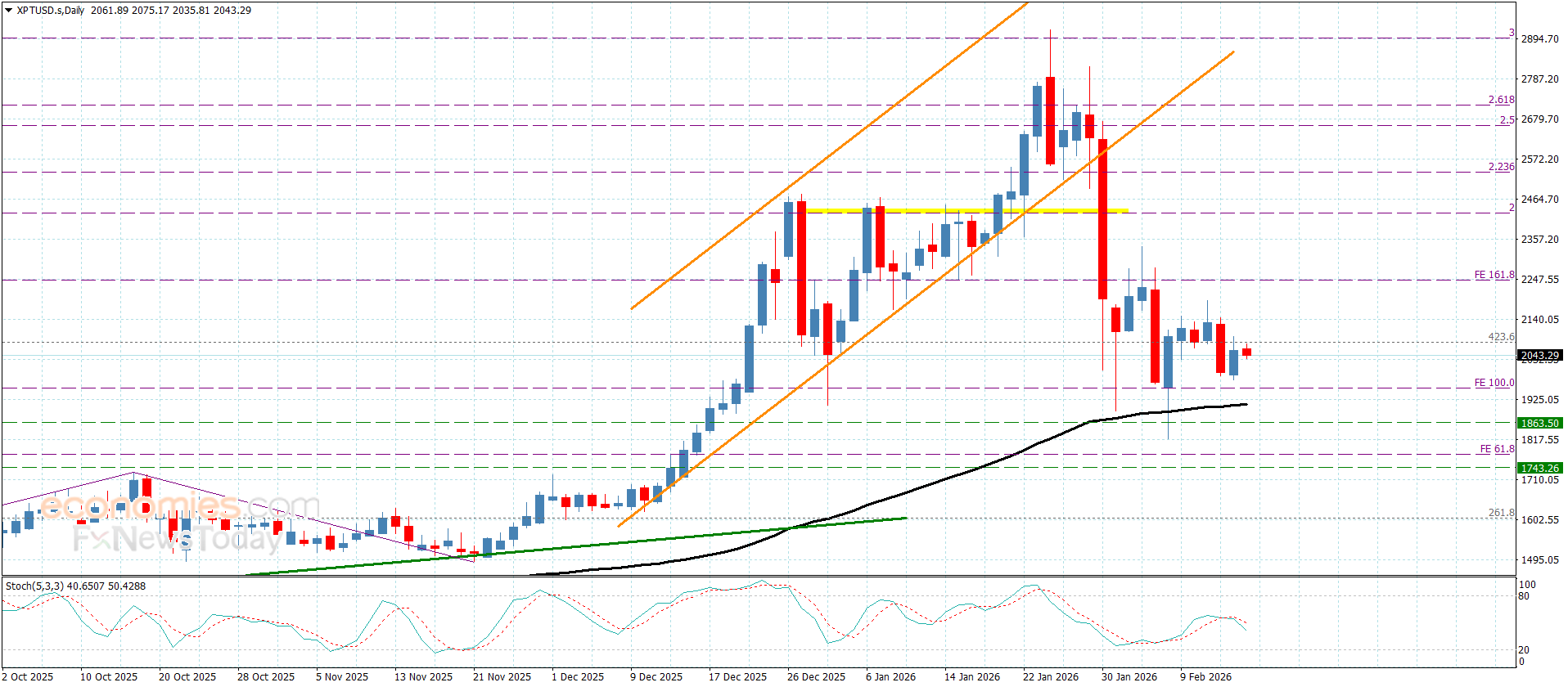
Platinum price remains under the dominance of the bearish trend until this moment, due to its stability below $2245.00 level, forming mixed trading to keep its stability near $2040.00.
We will keep waiting for the price to activate with stochastic negativity, to repeat the pressure on $1950.00 level, and breaking it will open the way for resuming the bearish moves until reaching the extra targets that are located at $1880.00 and $1785.00.
The expected trading range for today is between $1950.00 and $2100.00
Trend forecast: Bearish
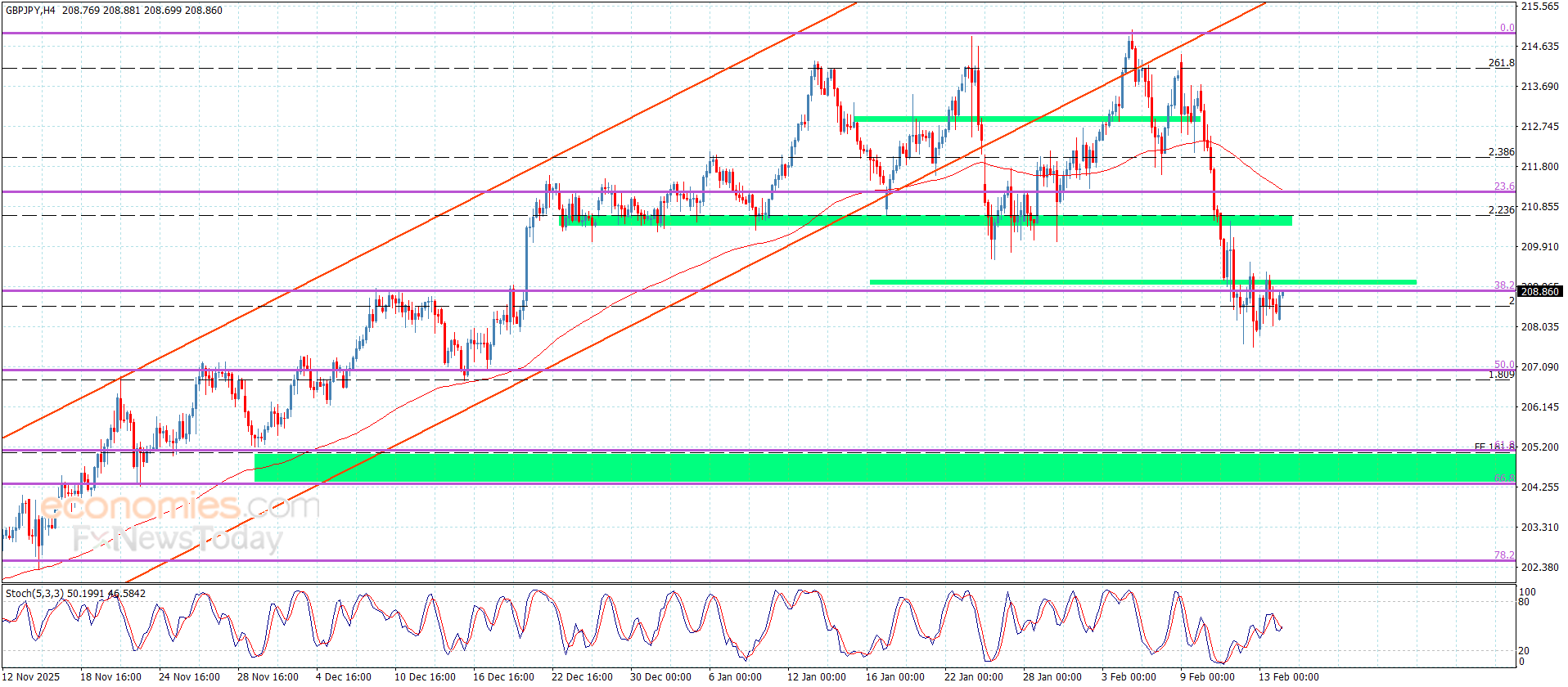
The GBPJPY pair affected by the contradiction of the main indicators, since Friday’s trading to delay the negative attack and providing mixed trading, to approach from 209.15 barrier.
This scenario depends on the strength of this barrier, the stability below it will increase the chances of forming new bearish waves, attempting to reach 207.60 and 207.05, while surpassing the barrier will allow it to recover some losses by its rally towards 209.80 directly, to attempt to test the resistance near 210.60.
The expected trading range for today is between 208.00 and 209.20
Trend forecast: Fluctuated within the bearish track.
Silver price (XAG/USD) trades 2% lower at around $75.00 during the Asian trading session on Monday. The white metal is under pressure as lower-than-expected United States (US) Consumer Price Index (CPI) data for January fails to prompt hopes of interest rate cuts by the Federal Reserve (Fed) in the near term.
Theoretically, lower inflation boosts hopes of monetary policy easing by the Fed in the near term. It seems that market participants are more focused on the labor market than on changes in price pressures.
According to the CME FedWatch tool, traders remain confident that the Fed will keep interest rates steady in the current range of 3.50%-3.75% in March and April.
The data showed on Friday that the US headline inflation cooled down to 2.4% Year-on-year (YoY) from 2.7% in December. On a monthly basis, the US headline CPI grew at a slower pace of 0.2% against estimates and the prior reading of 0.3%.
On the geopolitical front, investors remain concerned over tensions between the US and Iran. A report from Reuters has stated that the US military is preparing for the possibility of sustained, weeks-long operations against Iran if President Donald Trump orders an attack, a scenario that would force investors to shift to the safe-haven fleet.
XAG/USD trades down to near $75.61 as of writing. Price holds below the falling 20-EMA at $84.23, keeping the near-term bias heavy as trend pressure remains to the downside. The average continues to descend, underscoring persistent supply. RSI at 43.47 sits below the 50 midline, confirming weak momentum rather than capitulation.
Below the dynamic cap, rebounds could fade on approach to the average and keep the sequence of lower highs intact. A daily close above $84.23 would ease pressure and open room for a corrective recovery, with confirmation strengthened if RSI reclaims 50. Until that occurs, risk stays skewed toward further weakness, and rallies would be sold into.
(The technical analysis of this story was written with the help of an AI tool.)
Silver is a precious metal highly traded among investors. It has been historically used as a store of value and a medium of exchange. Although less popular than Gold, traders may turn to Silver to diversify their investment portfolio, for its intrinsic value or as a potential hedge during high-inflation periods. Investors can buy physical Silver, in coins or in bars, or trade it through vehicles such as Exchange Traded Funds, which track its price on international markets.
Silver prices can move due to a wide range of factors. Geopolitical instability or fears of a deep recession can make Silver price escalate due to its safe-haven status, although to a lesser extent than Gold’s. As a yieldless asset, Silver tends to rise with lower interest rates. Its moves also depend on how the US Dollar (USD) behaves as the asset is priced in dollars (XAG/USD). A strong Dollar tends to keep the price of Silver at bay, whereas a weaker Dollar is likely to propel prices up. Other factors such as investment demand, mining supply – Silver is much more abundant than Gold – and recycling rates can also affect prices.
Silver is widely used in industry, particularly in sectors such as electronics or solar energy, as it has one of the highest electric conductivity of all metals – more than Copper and Gold. A surge in demand can increase prices, while a decline tends to lower them. Dynamics in the US, Chinese and Indian economies can also contribute to price swings: for the US and particularly China, their big industrial sectors use Silver in various processes; in India, consumers’ demand for the precious metal for jewellery also plays a key role in setting prices.
Silver prices tend to follow Gold’s moves. When Gold prices rise, Silver typically follows suit, as their status as safe-haven assets is similar. The Gold/Silver ratio, which shows the number of ounces of Silver needed to equal the value of one ounce of Gold, may help to determine the relative valuation between both metals. Some investors may consider a high ratio as an indicator that Silver is undervalued, or Gold is overvalued. On the contrary, a low ratio might suggest that Gold is undervalued relative to Silver.
The GBPJPY pair affected by the contradiction of the main indicators, since Friday’s trading to delay the negative attack and providing mixed trading, to approach from 209.15 barrier.
This scenario depends on the strength of this barrier, the stability below it will increase the chances of forming new bearish waves, attempting to reach 207.60 and 207.05, while surpassing the barrier will allow it to recover some losses by its rally towards 209.80 directly, to attempt to test the resistance near 210.60.
The expected trading range for today is between 208.00 and 209.20
Trend forecast: Fluctuated within the bearish track.