The main category of All News Articles.
You can use the search box below to find what you need.
[wd_asp id=1]
The main category of All News Articles.
You can use the search box below to find what you need.
[wd_asp id=1]
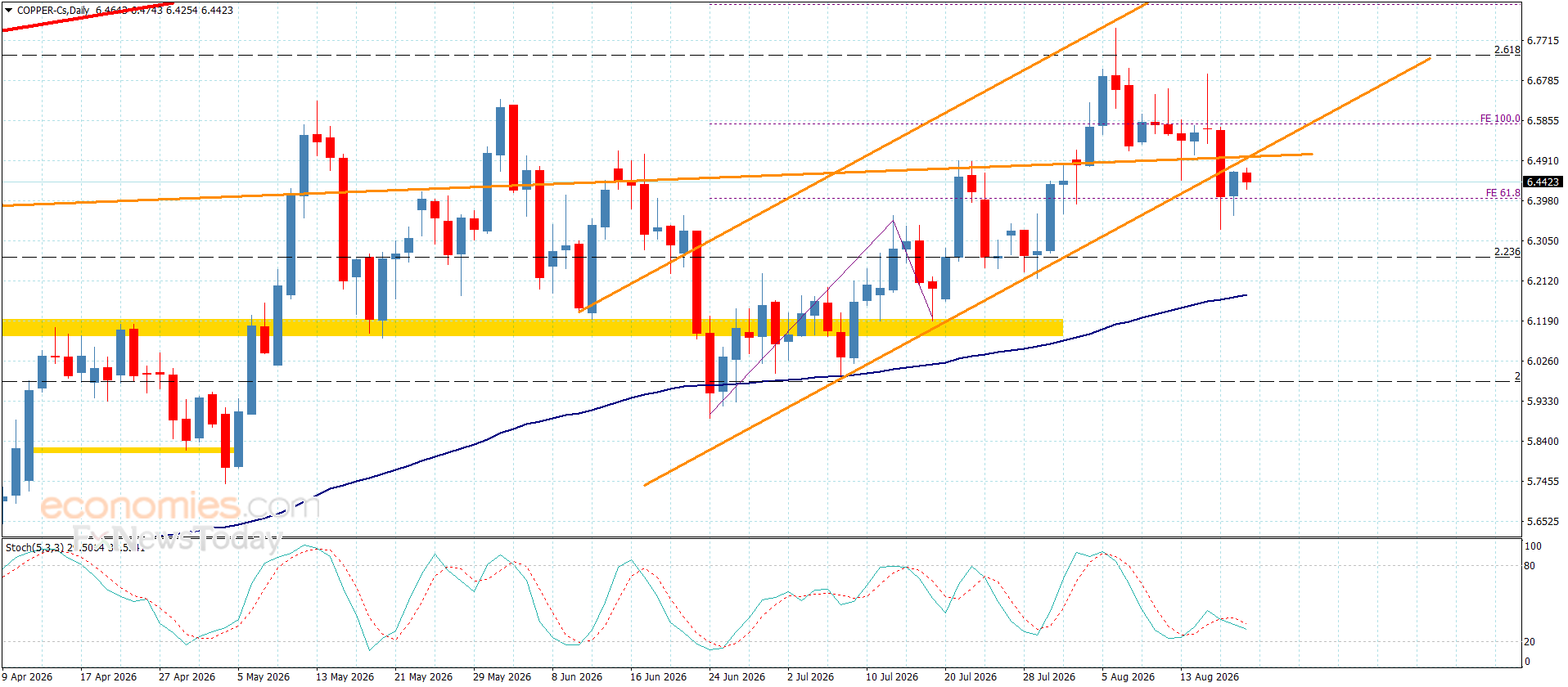
Copper price repeatedly formed mixed trading, which forced it to delay the bullish rally due to the contradiction of the main indicators, which forces it to fluctuate below $6.5100 level, which represents the extension of the broken minor bullish channel’s support.
Reminding you that the bullish scenario will remain valid, depending on the stability of the main support level at $6.2700, which makes us wait to gather the required bullish momentum to activate the bullish trend by targeting $6.5800 reaching $6.6700.
The expected trading range for today is between $6.3700 and $6.5800
Trend forecast: Bullish
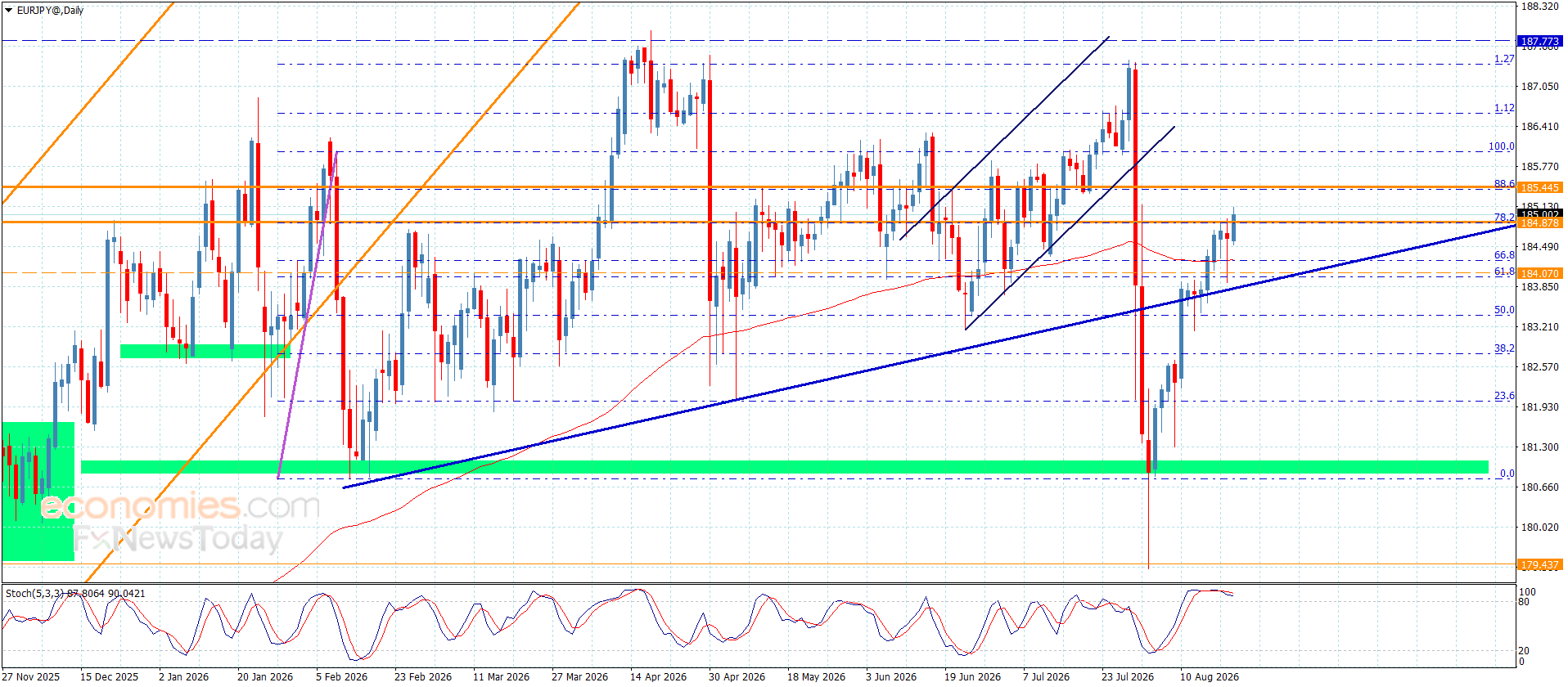
The EURJPY pair provided some corrective trading yesterday by reaching 183.90 level, holding positively above the main support at 183.15, renewing the main bullish attempts by surpassing the barrier at 184.90.
Providing a positive close above the current barrier is important for reinforcing the chances of recording new gains by its rally towards 185.45 initially, reaching the next target at 185.95.
The expected trading range for today is between 184.60 and 85.45
Trend forecast: Bullish
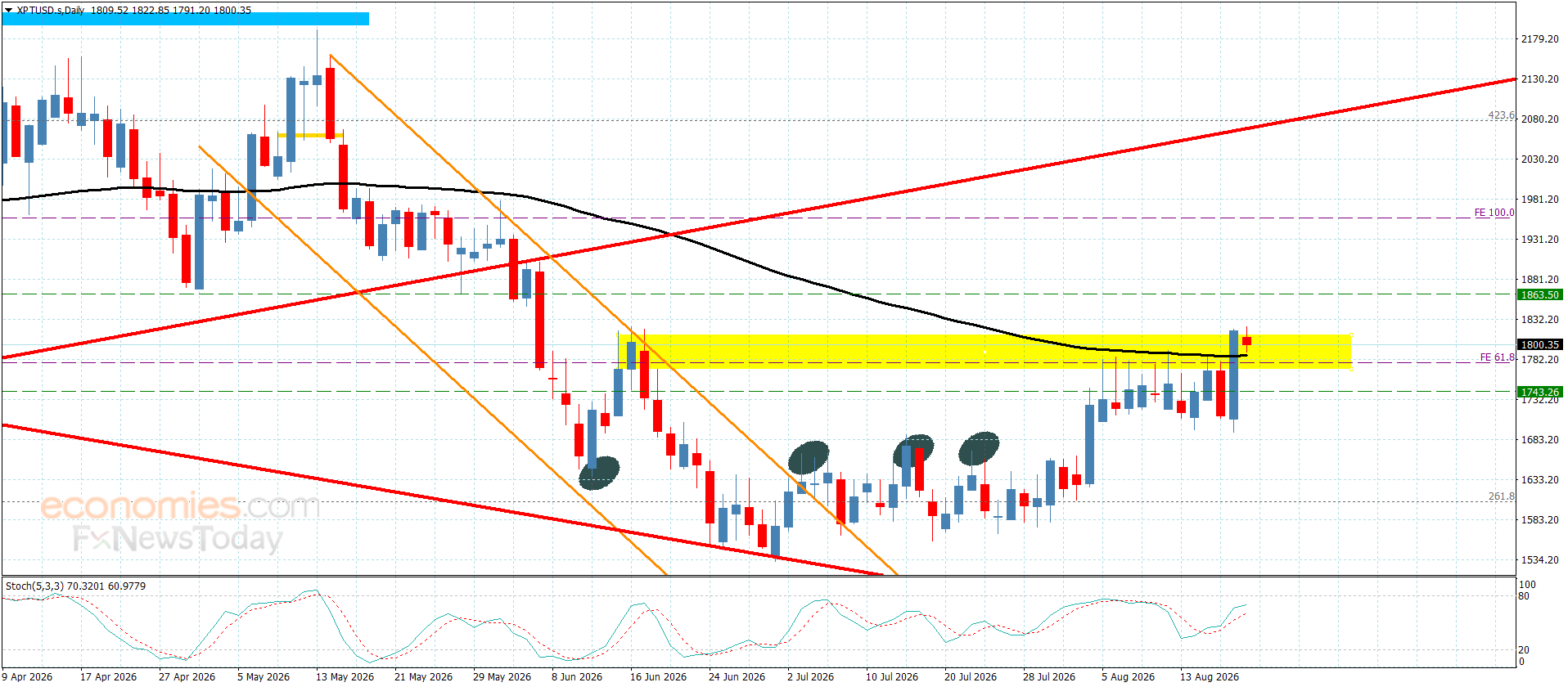
Platinum price faced strong bullish pressures yesterday, benefiting from forming a new support level at $1685.00 level, besides providing positive momentum by the main indicators, to attack $1785.00 resistance to find an exit to confirm its move to the bullish trend in the near period trading.
The price attempt to settle above the moving average 55 will increase the chances of forming new bullish waves, to expect targeting $1865.00 level, reaching the next barrier near $1900.00, while holding below $1785.00 level and providing a negative close will force it to renew the bearish attempts by reaching $1730.00 initially.
The expected trading range for today is between $1770.00 and $1865.00
Trend forecast: Bullish
The Euro and the pound continue to lock horns in a relatively fairly matched battle near the 0.8550 level.
The Euro and the pound continue to lock horns in a relatively fairly matched battle near the 0.8550 level. I’m watching this market because we had recently dropped pretty significantly, bounced to test the 50% Fibonacci retracement level and the 50-day EMA as a result.
And ultimately, I think this means that you have a scenario where technical traders may have entered the fray. The question is now: do we get any type of follow-through? This market is still asking questions about interest rates, but also the energy supply that may or may not be coming to the UK and the EU. As I record, missiles are flying in the Gulf again.
If we do, then you have the possibility of the market really taking off to the downside, perhaps to the 0.85 level, maybe even revisiting the 0.8450 level where we had bounced from.

Rallies at this point in time will have to contend with the 50-day EMA, which of course will cause some technical resistance. But breaking above there would be a very bullish sign and could open up the door to 0.86. This would be a reversal of the overall sentiment at the moment and therefore be difficult to achieve.
This is a market that’s been bearish for a while. Interest rates do favor the British pound, so that in and of itself might be a reason to think about it. This is a form of the carry trade, but in slow motion. The stability here, though, could be a bonus for those worried about intervention in the yen-denominated markets.
I like the idea of taking advantage of the yield differential in a situation where, quite frankly, I just don’t see a good argument for the market taking off to the upside. But you always have to be open to the other possibilities.
Ready to trade our Forex EUR/USD forecast? We’ve shortlisted the best European brokers in the industry for you.
Christopher Lewis is a technical analyst and market commentator at DailyForex with more than two decades of trading experience in Forex and other leveraged markets. Based in Columbus, Ohio, he specializes in chart-based analysis of major currency pairs, stock indices, commodities, and energy markets, focusing on clear support and resistance levels, trend structure, and risk management. Christopher produces daily written and video analysis for traders who rely on technical setups to navigate volatile market conditions
As seen on: Pairs Of Aces Podcast,The Trader Guy, FXEmpire
USD/CAD pulled back as traders reacted to the strong rally in precious metals markets. Gold climbed towards the $4500 level, while silver moved towards $66.00. Other commodity-related currencies have also gained upside momentum in today’s trading session.
Currently, USD/CAD is trying to settle below the support level at 1.3825 – 1.3840. In case USD/CAD manages to settle below the 1.3825 level, it will head towards the next support, which is located in the 1.3735 – 1.3750 range. RSI has recently moved into oversold territory, but there is enough room to gain momentum in case the right catalysts emerge.
Domestic coffee prices today
Coffee prices today in the domestic market continue to increase sharply in key areas. According to giacaphe. com, the average coffee price on August 19 was 98,400 VND/kg, an increase of 1,500 VND/kg compared to the previous session.
In Dak Lak, coffee prices were recorded at 98,300 VND/kg, an increase of 1,500 VND/kg.
In Lam Dong, coffee prices reached 97,700 VND/kg, an increase of 1,500 VND/kg. This is the lowest level among the surveyed areas.
In Gia Lai, coffee prices are at 98,300 VND/kg, an increase of 1,500 VND/kg.
The old Dak Nong area recorded a level of 98,500 VND/kg, an increase of 1,500 VND/kg. This is the highest level in today’s price list.
After two consecutive strong increases, the price level has approached the 99,000 VND/kg mark, significantly narrowing the gap with the 100,000 VND/kg mark.
The USD/VND exchange rate according to Vietcombank is recorded at 25,920 VND/USD.
World coffee prices
In the world market, coffee prices increased sharply on both the London and New York exchanges.
On the London exchange, the September 2026 Robusta futures contract increased by 85 USD/ton, equivalent to 2.32%, to 3,755 USD/ton. The November 2026 futures increased by 95 USD/ton, equivalent to 2.61%, to 3,739 USD/ton.
Further maturities also increased. Robusta in January 2027 increased by 88 USD/ton, to 3,716 USD/ton; March 2027 term increased by 82 USD/ton, to 3,685 USD/ton; May 2027 term increased by 80 USD/ton, to 3,662 USD/ton.
On the New York floor, the Arabica contract for September 2026 increased by 18.30 US cents/lb, equivalent to 5.30%, to 363.40 US cents/lb. December 2026 futures increased by 14.55 US cents/lb, to 332.45 US cents/lb.
Coffee price assessment
Domestic coffee prices increased sharply for the second consecutive session, in the same direction as positive developments in the world market. The increase of Robusta London by more than 2% is a noteworthy signal for the Vietnamese market, because Robusta is a commodity group that directly affects domestic purchasing prices more.
According to Barchart, Safras & Mercado recorded Brazil’s coffee harvest for the 2026-2027 crop reaching 90% as of August 12, lower than the same period last year’s 97% and the 5-year average of 94%. Brazil’s Arabica harvest progress alone reached 86%, lower than the same period’s 95%.
Meanwhile, Arabica inventory certified on ICE fell to its lowest level in 2.75 years. The increase in Robusta inventory is a factor that could put pressure on Robusta. This shows that the current upward momentum is still interspersedly affected by supply, inventory and harvesting activities in major producing countries.
Domestically, according to the Ministry of Agriculture and Environment, in July, Vietnam exported about 147,600 tons of coffee, worth 639.5 million USD. Accumulated in the first 7 months of the year, coffee exports reached about 1.2 million tons, up 10.8% in volume but turnover decreased by 11.2%, to 5.45 billion USD. This development is mainly due to the average export price decreasing by 19.9% compared to the same period, down to 4,537 USD/ton.
Regarding the weather, the National Center for Hydro-Meteorological Forecasting said that on the day and night of August 19, the Central Highlands area is cloudy, with showers and scattered thunderstorms, locally heavy rain; the rain concentrated mainly in the afternoon and night. The lowest temperature is 21-24 degrees C, in some places below 20 degrees C; the highest is 26-29 degrees C, in some places above 29 degrees C.
Rainstorms in this season need to be monitored in terms of garden care, pest and disease prevention, and goods preservation.
In the coming sessions, the diễn biến of Robusta London, Arabica New York, USD/VND exchange rate, inventory and demand for export purchases will continue to dominate the domestic price level.
The Euro to Dollar (EUR/USD) exchange rate has climbed back towards 1.1600, but the move is starting to look less convincing once valuation and Europe’s energy exposure are brought into the picture.
EUR/USD traded around 1.1597 early on Wednesday after reaching 1.1614 earlier in the week.
Softer expectations for Federal Reserve tightening should, on paper, have given the Euro more room to run. It hasn’t quite happened.
MUFG sees the hesitation as significant.
“The 200-day moving average is offering resistance at 1.1630,” the bank said, noting that the best level reached on Monday was 1.1614. “We do certainly sense a high level of caution in buying EUR/USD.”

EUR/USD has recovered from below 1.1570, but the latest advance still leaves the pair short of the 1.1630 area highlighted by MUFG.
The more striking warning comes from MUFG’s valuation model.
“Our short-term regression model for EUR/USD already indicates current spot is about 2.5%-3.0% overvalued,” the bank said.
That is the awkward part. The Dollar has lost some rate support, yet MUFG argues the Euro is already trading richer than underlying short-term fundamentals justify.
Energy is central to the concern.
European gas storage is running just below the range seen in comparable years since 2011, while delayed winter purchases risk becoming more expensive as Asian LNG demand competes for supply.
MUFG also points to unusually low river levels across the Rhine, Danube, Loire and Po. That is not merely a transport problem. Lower waterways can disrupt industry, food production and power generation at the same time.
“If the refilling period continues to disappoint ahead of winter, a more severe terms of trade hit is likely,” MUFG warned.
ING is cautious about the immediate upside too, although its medium-term conclusion is notably more bullish.
“Yesterday’s EUR/USD rally stalled shortly above 1.16, and investors will be reluctant to push it much higher given energy price developments,” ING’s Chris Turner said.
ING also thinks the Dollar is “not quite ready to make a sustained break lower just yet”, with higher energy prices and long-dated US Treasury yields offering support. It expects DXY to remain broadly inside 99.40-100.00 in the near term.
Still, the bank keeps EUR/USD at 1.17 for end-September and 1.18 for year-end, based on its view that the Fed does not raise rates.

The wider bank consensus also leans higher, with the median path reaching around 1.18 by Q2 2027, although the full forecast range stretches from roughly 1.10 to 1.21.
So there are really two EUR/USD stories here.
ING still sees a route higher once Fed tightening risk fades.
MUFG is warning that the Euro may already have run ahead of the near-term fundamentals, especially if Europe’s energy bill starts climbing again.
For the immediate trade, 1.1630 looks like the line that matters.
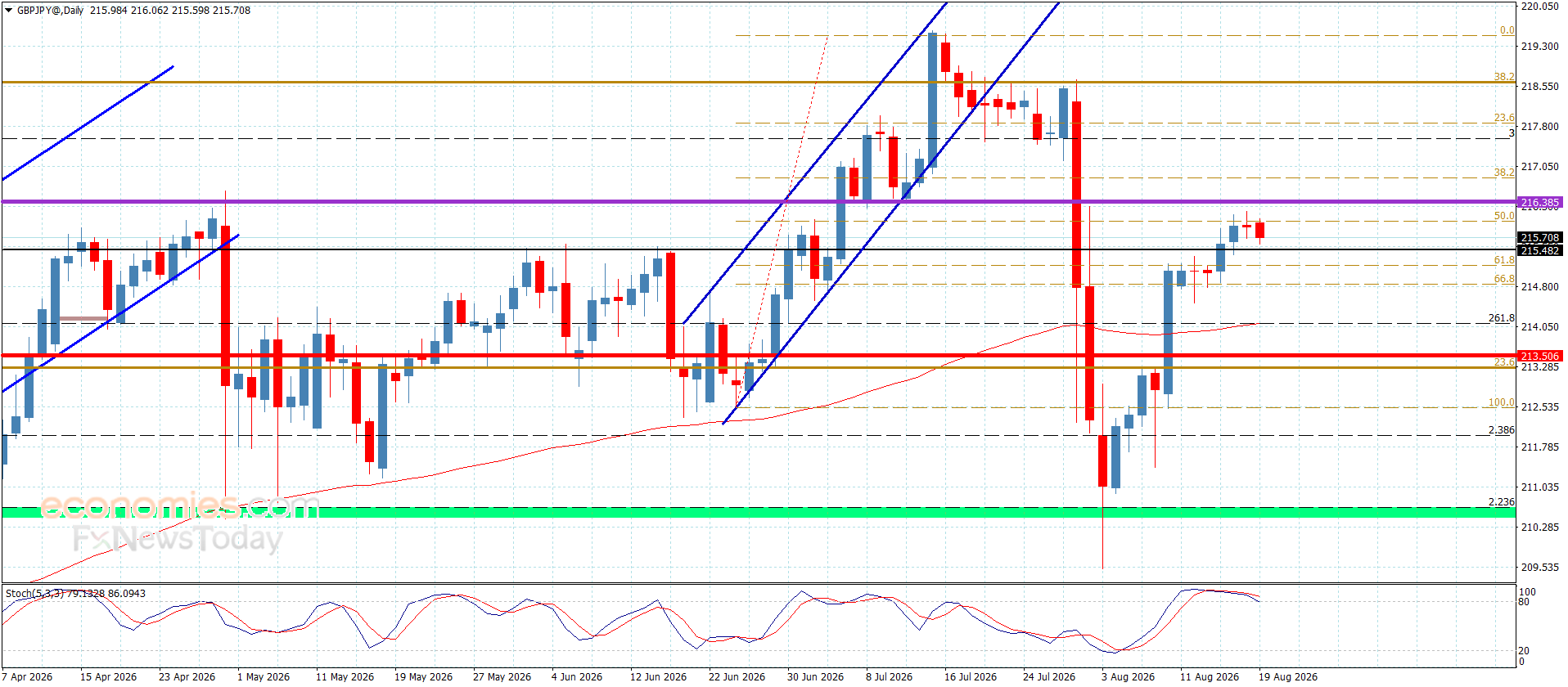
The GBPJPY pair ended the last bullish rally by providing a new close below the barrier at 216.35, affected by stochastic exit from the overbought level and forming some corrective waves, to settle near 215.65.
Note that the neediness of the positive momentum might force it to provide more corrective attempts, forcing it to suffer some losses by reaching 214.85 reaching 214.15 level, while breaching the barrier and holding above it will open the way for recording extra gains that might extend in the initial period at 216.85 and 217.55.
The expected trading range for today is between 215.10 and 216.35
Trend forecast: Bearish
.jpeg "EUR/GBP Forecast 19/08: Continues to Drift Against Sterling")