The main category of All News Articles.
You can use the search box below to find what you need.
[wd_asp id=1]
The main category of All News Articles.
You can use the search box below to find what you need.
[wd_asp id=1]
The price of gold rose slightly during its recent intraday trading, affected by the stability of the support level at $4,380, gaining bullish momentum that helped it to stop its early losses, amid the dominance of the bullish trend on the short-term basis, with the continuation of the positive pressure that comes from its trading above EMA50, reinforcing the chances of a near term recovery. The relative strength indicators reached oversold levels, exaggeratedly compared to the price move, to suggest forming bullish momentum with bullish overlapping signals.
The EUR/USD pair settled in the 1.1580 area marginally higher in the week, yet unable to find a clear path. The pair holds near its August peak at 1.1581, as demand for the US Dollar (USD) remains subdued amid poor employment figures and steady inflation.
Contributing to the lack of directional strength, the United States (US) and Iran remain in a stalemate, without attacking each other or negotiating a way out.
At this point, the key is that the Strait of Hormuz remains closed and both Tehran and Washington claim to have it under control. The truth is, traffic through the sea passage is severely disrupted, resulting in higher Oil prices and fears that higher energy prices will soon spill back into inflation.
US Treasury Secretary Scott Bessent has threatened Iran with economic isolation “like the world has never seen before,” as the US maintains its demand for Iran to drop all nuclear weapons. Tehran, on the other hand, demands sole control of the Strait of Hormuz, while claiming it will not end its fight in the Middle East until President Donald Trump is out of office in 2029.
Other than that, the Memorandum of Understanding (MoU) signed in June is set to expire on Sunday. And while some tit-for-tat fire took place and talks were interrupted, there were no major strikes that could fuel concerns. That may come to an end without the MoU in the way.
The macroeconomic calendar was pretty scarce in the past week, with one major exception: the US released the July Consumer Price Index (CPI). Annual inflation, as measured by the change in the CPI, declined to 3.4% in July from 3.5% in June, in line with market expectations. In fact, all figures matched expectations, with core annual CPI printing at 2.5%, down from 2.6% posted in June. The figures supported the case for an on-hold Federal Reserve (Fed) in September, limiting USD demand.
Other data showed that Retail Sales were up 5% in July, while the June reading was upwardly revised to 6.8%. Finally, the preliminary estimate of the August Michigan Consumer Sentiment Index contracted to 51 from the 55.2 posted in July. The same report showed inflation expectations on a 1-year perspective ticked higher, to 4.3% from 4.2%, while the 5-year view remained unchanged at 3.3%.
The Euro was unable to attract investors amid the lack of a fresh catalyst. On the one hand, Germany confirmed the Harmonized Index of Consumer Prices (HICP) at 2.8% YoY in July as previously estimated. On the other hand, the Euro area released the second estimate of the Q2 Gross Domestic Product (GDP), reporting quarterly growth at 0.4%.
The figures reaffirmed the market’s conviction that the European Central Bank (ECB) will hike the benchmark interest rate by 25 basis points (bps) in the upcoming September meeting. At the time of writing, hike odds stand at 90%, according to the ECB Watch tool.
War developments could be at the top of the market movers in the upcoming days, particularly if any party involved decides to resume attacks. And it’s not just about the US or Iran. Israel, Saudi Arabia, Iraq and Oman are lately making it to the headlines amid rising tensions over the usage of the Strait of Hormuz.
A war escalation that pushes Oil prices further up will likely revive demand for the safe-haven USD, mostly because it would also push up Fed hike odds.
Data-wise, there’s little to take care of: Germany will publish the August ZEW Survey on Economic Sentiment, while ECB President Christine Lagarde will be on the wires on Wednesday, and the Federal Open Market Committee (FOMC) will release the Minutes of its July meeting. On Friday, S&P Global, alongside local banks, will publish the preliminary estimates of the August Purchasing Managers’ Indexes (PMIs) for European economies and the US.

From a technical standpoint and according to the daily chart, EUR/USD trades at 1.1582. The pair holds is bullish. It advances above the 100-day Simple Moving Average (SMA) at 1.1568 and the 20-day SMA at 1.1482, but remains capped by the 200-day SMA at 1.1630. Momentum stays constructive, with the 14-period Relative Strength Index (RSI) indicator heading north at 63 and the 14-period Momentum indicator firmly positive above its midline, which suggests buyers still have the upper hand while the 200-day SMA acts as an inmediate ceiling at 1.1630.
In the weekly chart, EUR/USD is more neutral. The pair remains above the 20-, 100- and 200-week SMAs at 1.1569, 1.1321 and 1.1050 respectively, now advancing above the shorter one for the first time since last May. Still, the the Momentum indicator aims modestly lower in negative territory and a the RSI indicator hovers around 51 suggesting only subdued upside pressure rather than an aggressive bullish trend.
On the topside, initial resistance is located at the 200-day SMA at 1.1630, and a sustained break above this level would open the door to further gains intially towards the 1.1700 mark. On the downside, immediate support emerges at the 1.1560 region, followed by the more relevant 1.1470 price zone.
(The technical analysis of this story was written with the help of an AI tool. Know more.)
Silver Price Forecast: XAG/USD Stalls as Rising Yields Cap Recovery
Silver (XAG/USD) is struggling to extend its recovery, with prices stalling as rising US Treasury yields continue to cap upside momentum. As of [current date], spot silver trades near [current price] after failing to hold recent gains, reflecting a market caught between safe-haven demand and yield-driven headwinds.
Silver, like gold, is a non-yielding asset, so rising Treasury yields increase the opportunity cost of holding it. The recent uptick in yields, particularly on the US 10-year note, has strengthened the US dollar and weighed on precious metals. This dynamic has kept silver’s recovery attempts shallow, with each rally met by fresh selling interest.
From a technical standpoint, silver is hovering near a critical support zone. The immediate support is seen around the $[support level] area, with a break below that opening the door to the next downside target at $[next support]. On the upside, resistance is located at $[resistance level], and a daily close above that level would signal a more meaningful recovery. However, as long as yields remain elevated, the path of least resistance appears to be lower.
The current stall in silver’s recovery reflects a broader consolidation phase in the precious metals complex. Investors are balancing expectations of Federal Reserve policy with global growth concerns. If yields continue to climb, silver could face renewed selling pressure, but any dovish signal from the Fed or a risk-off shift in markets could quickly revive demand for the metal.
Silver’s price action remains subdued as Treasury yields cap recovery attempts. Traders should monitor yield movements and key technical levels for the next directional cue. Until the macro backdrop shifts, silver is likely to remain range-bound with a bearish tilt.
Q1: What is the current silver price forecast?
Silver is currently stalling as rising Treasury yields limit upside. The short-term outlook is mixed, with key support and resistance levels to watch.
Q2: How do Treasury yields affect silver prices?
Higher yields increase the opportunity cost of holding non-yielding assets like silver, making it less attractive to investors and typically putting downward pressure on prices.
Q3: What are the key support and resistance levels for XAG/USD?
Immediate support is near $[support level], with resistance at $[resistance level]. A break of these levels will likely determine the next trend.
This post Silver Price Forecast: XAG/USD Stalls as Rising Yields Cap Recovery first appeared on BitcoinWorld.
The question now will be what happens when we roll over into the October contract in a couple of weeks. We start to think about cooler weather in the Northeast here in the United States. That’s generally when we have a couple of days here and there that we have to start turning on the heat.
So that is typically the beginning of a little bit more bullish momentum. The situation in the Middle East could get out of hand pretty quickly, and if Qatar’s natural gas production gets hit again by Iranian missiles, that could throw things into disarray, especially in the winter.
Ultimately, I am a seasonal trader here. We’re still in a pretty weak time of year, so I don’t like natural gas overall, but there are a few months coming up that tend to be very bullish. As things stand right now, any rally would probably have to contend with the 50-day EMA at $2.90, and then the $3 level as potential resistance.
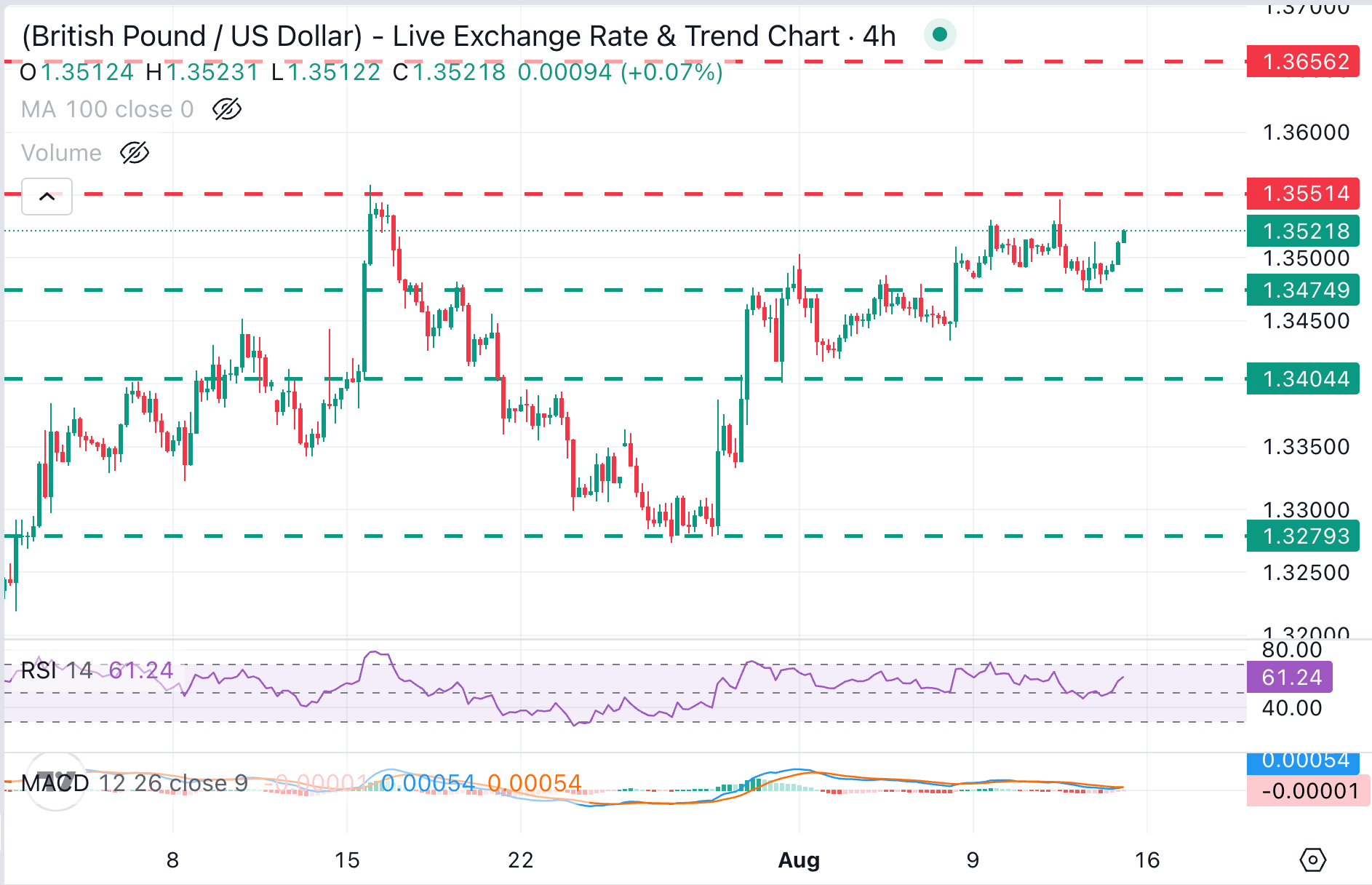
The British Pound (GBP) pares losses against a weaker US Dollar (USD) on Friday, as a run of soft US inflation figures and growing signs of labour market deterioration have cast doubt about the odds for an immediate Federal Reserve (Fed) rate hike. The GBP/USD has returned to the 1.3520 area from Thursday’s lows at 1.3474, inching towards a key resistance around 1.3550.
The focus on Friday is on the US Retail Sales, which are expected to show a 0.1% uptick in July, after a 0.2% gain in June, alongside the University of Michigan survey, which is foreseen to be little changed in August.
FX Strategists at ING state that these are “second-tier releases” that would “likely need to deliver significant surprises to trigger a meaningful dollar reaction,” reinforcing the sense that, absent a major data shock, the Dollar is unlikely to break decisively from its current, relatively stable trading pattern.
GBP/USD trades at 1.3520 at the time of writing, trapped within the weekly trading range, with key resistance area around 1.3550. Momentum indicators show an incipient bullish traction with the 4-hour Relative Strength Index (14) above 60, yet with the Moving Average Convergence Divergence (MACD) indicator flat near the zero line, which suggests that the move is far from impulsive.
Pound bulls would need to confirm above the July 15 and August 12 highs, around 1.3550, to resume their broader bullish trend, aiming for a retest of the early May highs in the mid-range of the 1.3600s.
Downside attempts, on the other hand, have been contained at Thursday’s low of 1.3474, ahead of the previous week’s trading bottom, just above 1.3400. Further down, there is no clear support until the July 27 low, at 1.3273.
(The technical analysis of this story was written with the help of an AI tool. Know more.)
The table below shows the percentage change of US Dollar (USD) against listed major currencies today. US Dollar was the strongest against the Swiss Franc.
| USD | EUR | GBP | JPY | CAD | AUD | NZD | CHF | |
|---|---|---|---|---|---|---|---|---|
| USD | -0.20% | -0.26% | -0.25% | -0.28% | -0.16% | -0.44% | -0.09% | |
| EUR | 0.20% | -0.06% | -0.06% | -0.11% | 0.05% | -0.24% | 0.11% | |
| GBP | 0.26% | 0.06% | 0.02% | -0.05% | 0.11% | -0.16% | 0.18% | |
| JPY | 0.25% | 0.06% | -0.02% | -0.01% | 0.09% | -0.20% | 0.18% | |
| CAD | 0.28% | 0.11% | 0.05% | 0.01% | 0.11% | -0.16% | 0.20% | |
| AUD | 0.16% | -0.05% | -0.11% | -0.09% | -0.11% | -0.28% | 0.09% | |
| NZD | 0.44% | 0.24% | 0.16% | 0.20% | 0.16% | 0.28% | 0.38% | |
| CHF | 0.09% | -0.11% | -0.18% | -0.18% | -0.20% | -0.09% | -0.38% |
The heat map shows percentage changes of major currencies against each other. The base currency is picked from the left column, while the quote currency is picked from the top row. For example, if you pick the US Dollar from the left column and move along the horizontal line to the Japanese Yen, the percentage change displayed in the box will represent USD (base)/JPY (quote).
USD/JPY rebounded from session lows and moved back towards the key 159.50 level. Treasury yields are moving higher despite weak Retail Sales data, providing additional support to USD/JPY. The yield of 2-year Treasuries climbed above the 4.15% level, while the yield of 10-year Treasuries settled above 4.69%. Treasury yields moved higher as bond traders focused on rising oil prices.
If USD/JPY manages to settle above the resistance level at 159.50 – 160.00, it will head towards the next resistance at 161.50 – 162.00. It remains to be seen whether BoJ is ready to intervene in case USD/JPY climbs above the psychologically important 160.00 level.
The GBPJPY pair didn’t change anything since yesterday, to notice forming weak sideways moves by its stability near 215.10, affected by the stability of 215.50 barrier, which obstructs the chances of resuming the previously suggested bullish trend.
We recommend waiting for achieving the breach to confirm the chances of reaching the extra positive stations, which might begin at 216.35 and 216.85, while the failure of breaching it might force the price to activate the corrective attempts again, which forces it to suffer some losses by reaching 214.00 followed by 213.50 support.
The expected trading range for today is between 214.55 and 216.35
Trend forecast: Bullish
The US 10-year yield is basically just treading water above the 4.60 level, an area that has been supportive for yields for a while now. And the 50-day EMA sits just below there as well, so I’m looking at this as neutral today, until something happens, of course. There are major headline risks going into the weekend, so that could come into play as well as far as how people behave.