The main category of All News Articles.
You can use the search box below to find what you need.
[wd_asp id=1]
The main category of All News Articles.
You can use the search box below to find what you need.
[wd_asp id=1]
Domestic coffee prices today
Coffee prices today in the domestic market turned down sharply after the previous increase session. According to giacaphe. com, the average coffee price on August 7 was 97,400 VND/kg, down 1,500 VND/kg compared to the previous day. The highest level in key regions of the Central Highlands was recorded at 97,500 VND/kg.
In Dak Lak, coffee prices were recorded at 97,300 VND/kg, down 1,500 VND/kg compared to the previous session.
In Lam Dong, coffee price today reached 96,800 VND/kg, down 1,500 VND/kg.
In Gia Lai, coffee prices are at 97,300 VND/kg, down 1,500 VND/kg compared to the previous day.
The old Dak Nong area recorded a level of 97,500 VND/kg, down 1,500 VND/kg.
After the increase brought prices close to 99,000 VND/kg, the domestic coffee price level has receded deeply to the 97,000 VND/kg zone. The decrease range of 1,500 VND/kg caused domestic prices to lose most of the increase of the previous session.
World coffee prices
In the world market, coffee prices fell on both the London and New York exchanges.
According to Barchart, the September 2026 Arabica futures contract closed down 5.25 US cents/lb, equivalent to 1.61%. The final price was recorded at 321.65 US cents/lb.
Robusta London also fell more sharply in percentage margin. Robusta contract for September 2026 delivery fell 93 USD/ton, equivalent to 2.39%, to 3,798 USD/ton.
This development creates clear pressure on domestic coffee prices, as Robusta London is an important reference for Vietnamese coffee.
Coffee price assessment
Coffee prices today decreased in the same direction as the world market. Robusta lost nearly 100 USD/ton in the most recent session, making it difficult for domestic purchasing prices to maintain the close range of 99,000 VND/kg.
According to Barchart, coffee prices fall as drier weather forecasts in Brazilian coffee growing areas may help coffee beans dry faster and support farmers to accelerate harvest progress. Barchart also quoted Somar Meteorologia as saying that the Minas Gerais region did not record rain in the week ending August 2.
On the supporting side, the progress of Arabica harvesting in Brazil is still slower than the same period. Barchart recorded that Cooxupe cooperative members harvested 67.3% of the expected output as of July 31, lower than 74.2% in the same period last year. However, this factor was not enough to stop the decline in the recent session.
Regarding domestic weather, the National Center for Hydro-Meteorological Forecasting said that on the day and night of August 7, the Central Highlands area will have showers and thunderstorms in some places; especially in the afternoon and evening, there will be scattered showers and thunderstorms, locally heavy rain. Lowest temperature 20-23 degrees C, highest temperature 27-30 degrees C.
This season’s thunderstorms need to be monitored in terms of garden care, pest and disease prevention, and goods preservation.
Coffee prices today decreased sharply domestically and in the same direction as Robusta and Arabica in the world. In the coming sessions, developments on the London exchange, New York exchange, USD/VND exchange rate and demand for export purchases will continue to dominate the domestic price level.
The US Dollar to Yen (USD/JPY) exchange rate has recovered to around 158.3 after last week’s violent intervention-driven fall, but Crédit Agricole does not think the underlying case for a high exchange rate has disappeared.
The bank still forecasts USD/JPY averaging 162 in the third quarter and 163 in Q4, while treating 164 as the effective ceiling authorities are prepared to defend.
“We continue to believe 164 in USD/JPY is the line in the sand for authorities,” Crédit Agricole said. “The recent joint intervention has reaffirmed this view.”
The important wrinkle is that this intervention began from a less stretched starting point than comparable joint operations in 1998 and 2011.
“Relative to the 1998 and 2011 joint interventions, the misvaluations in USD/JPY and EUR/JPY are less extreme currently,” the bank said, “so the present joint intervention has started from a weaker point.”
That matters because past coordinated interventions only bought time.
“The effects of the joint interventions in 1998 and 2011 faded after a few months as fundamentals took back control of FX markets,” Crédit Agricole said. “Likewise, if the fundamentals do not shift for the JPY, its current intervention gains could also fade.”


USD/JPY has fallen sharply from July’s peak near 164, but has already recovered from the intervention lows below 156.
Crédit Agricole sees several reasons for renewed upside pressure: it expects the Bank of Japan’s next rate hike only in mid-2027, sees US economic outperformance attracting capital into the Dollar, and expects oil prices to stay elevated relative to pre-war levels.
Japan’s fiscal position is another worry.
“Investors will remain nervous about Japan’s fiscal sustainability given that PM Sanae Takaichi is not backing down from her fiscal spending plans,” the bank said.
MUFG adds a less obvious reason why official Yen buying may struggle to produce a lasting move.
Japanese retail margin traders were already positioned heavily for intervention before it happened.
“The USD/JPY short position increased in June to a record total,” MUFG said. “The implied short USD/JPY position was USD17.65bn which… is an extreme position and by some distance a record.”
That figure was larger than MUFG’s estimate of the probable total size of the latest intervention.
The implication is awkward for Tokyo. Retail traders who had already sold USD/JPY in anticipation of intervention were in a position to take profits as the pair collapsed.
“We can also assume that following intervention Japanese retail traders were quick to liquidate and were likely active buyers given the historic short position that was in place,” MUFG said.
“So Japan’s retail sector was likely a key buyer of USD/JPY on the decline during intervention, curtailing some of the impact of the MoF’s record yen buying intervention.”

USD/JPY remains slightly higher in 2026 despite the sharp intervention-led reversal from July’s highs.
That helps explain why Crédit Agricole is reluctant to project a sustained move much lower.
Its research suggests Japan and the US have enough resources to defend 164, particularly if Tokyo makes use of the Fed’s FIMA facility, but the bank is not treating intervention as a substitute for fundamentals.
“We think they have enough to hold the exchange rate below that level,” Crédit Agricole said.
The likely result is an uncomfortable middle ground: authorities trying to stop USD/JPY breaking through 164, while interest-rate, energy and fiscal fundamentals continue pushing the pair back upwards.
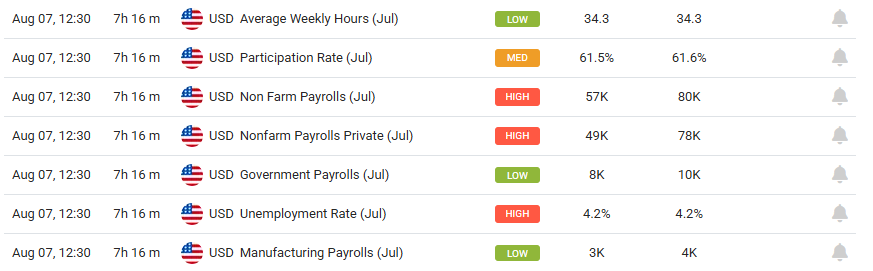
Gold (XAU/USD), trading around $4,254, is on pace for its most profitable weekly close since January after rising 5% this week. Falling oil prices, a weaker dollar, and declining Treasury yields have driven recent movement. In combination with weaker private-sector hiring, expectation for a September Fed rate hike has decreased. The key fundamental data will be today’s U.S. Non-Farm Payrolls, reported at 8:30 a.m. ET. According to the Reuters poll, private-sector payrolls are expected to add 80,000, while the unemployment rate remains unchanged at 4.2%.
Gold has shifted from consolidation to strong recovery. However, buyers will need to push the breakout further after Friday’s labor report. XAU/USD may find a floor near $4,200 in response to falling yields and soft payrolls. However, stronger payrolls and wages may predict Fed tightening and profit-taking.
As the most recent labor data sent mixed signals, the data clearly showed a decline in hiring momentum. ADP data showed that private-sector employers added 44,000 jobs in July, revised down from 95,000 in June and below expectations which were between 70,000-75,000. Limited job growth came from the services sector, while the goods-producing sector saw a decline.
The soft hiring data and falling yields and dollar support gold. Non-yielding bullion benefits from falling yields, as the opportunity cost for holding gold decreases.
Initial jobless claims slightly increased to 199,000 for the week ending August 1 and are still at low levels historically. Continuing claims increased to about 1.80 million, and layoffs decreased to a two-year low. Reuters noted the numbers point to a stable labor market with low hiring.
Traditionally, demand and supply in the labor market have created an environment of “slow-hire, slow-fire,” but no significant labor downturn has been observed.
Friday has been marked on the calendars for the official employment report, as it has become the most important short-term event. According to the latest Reuters poll, the Non-Farm Payroll numbers for the month of July should be around 80,000, up from 57,000 in June. The unemployment rate is projected to stay flat at 4.2%. Annual wage growth is expected to be around 3.5%.
The report should be out by 8:30 am EDT, so until then, any numbers are simply estimates. A significant shortfall in the payrolls (80,000) combined with lower wage growth or downward revisions to wage growth would likely push Treasury yields lower and increase support for gold, as it would give the Fed more reason to pause in September.
For a strong NFP report, the contrary would happen. Markets are indicating that the inflation outlook is unfettered and containment measures cannot yet be applied. Reuters is reporting a 55% chance of an increase in September, down from 63% the previous week. The Fed still has time to consider the data.
For the first time in months days, falling energy prices have helped drive the gold markets in the strongest direction. Gold has a inverse relation to the inflation cycle in that falling oil prices and inflation reduces the need for the Federal Reserve to raise interest rates, which have the most impact on gold in 2026.
The initial U.S.-Iran conflict created and sustained an environment of geopolitical uncertainty that did not impact gold because both oil and inflation, and yields and the dollar were high. Without the conflict, energy inflation and yields will improve for gold in 2026 as yields and inflation will trend lower.
On Friday, gold spot prices increased by 5 percent, which was an indication that gold’s strongest weekly return was about to be realized since January.
The continuous buying of gold to protect against potential geopolitical instability provides a foundation for the price of gold to increase in the long term despite downturns in the market.
The World Gold Council has shown that due to the liquidity and diversification that gold provides, gold is used by Central Banks for protection against geopolitically and financially risky investments and thus gold will retain its value for the longer term more so than other investments due to interest rates, dollar and geopolitical risk.
In 2026, the price of gold improved from the record low of $4,000 in June to $4,250. The macro status of gold and the improvement of the economy was reflected in its price, however, the jobs report from Friday was still able to negatively impact gold’s price.
Gold keeps its bullish sentiment by breaking through the descending trend line and the symmetrical triangle that lasted multiple weeks. Currently, the price stands at $4,254, just below Thursday’s seven-week high.
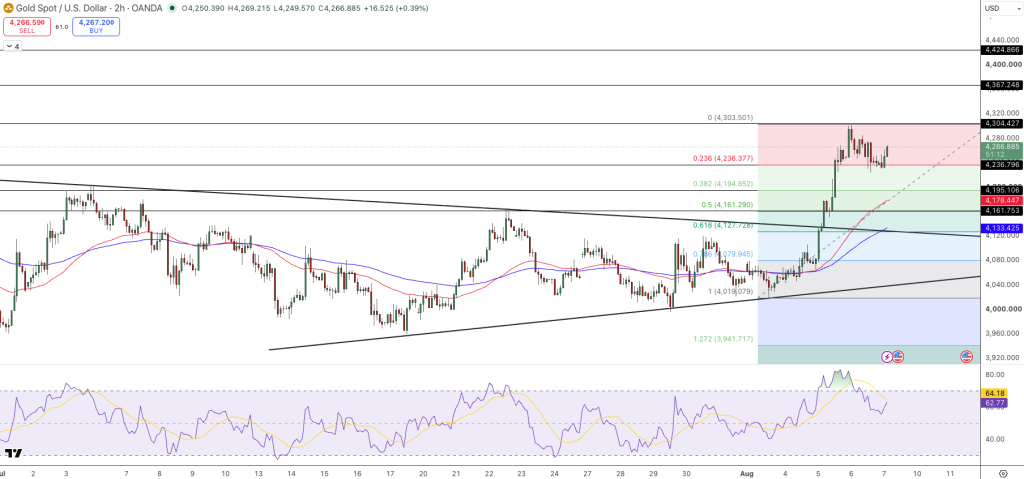
Gold remains above the 50-period EMA at $4,178 and the 100-period EMA at $4,133. After going into the overbought region, the RSI has retreated and the price has shown a lack of upward momentum.
Gold has maintained its bullish behavior as long as the price remains above the $4,236 support level. If the resistance of $4,280 is broken, price targets become $4,303 and $4,367, while a break of $4,195 would indicate the exhaustion of the post-breakout bullish momentum.
Gold is appreciating this week in conjunction with declining Oil prices, decreased U.S. hiring, diminished expectations for an additional Federal Reserve rate hike, declining Treasury yields, and a depreciating dollar.
The most recent economist projections by Reuters show an anticipated increase in employment by 80,000 with July’s Unemployment rate remaining unchanged at 4.2%.
The upcoming breakout level of XAU/USD is $4280 with a subsequent target of $4303 and $4367. Support of XAU/USD is found at $4236 and $4195.

Arslan Ali Butt
Lead Markets Analyst – Multi-Asset (FX, Commodities, Crypto)
Arslan Ali Butt serves as the Lead Commodities and Indices Analyst, bringing a wealth of expertise to the field. With an MBA in Behavioral Finance and active progress towards a Ph.D., Arslan possesses a deep understanding of market dynamics.
His professional journey includes a significant role as a senior analyst at a leading brokerage firm, complementing his extensive experience as a market analyst and day trader. Adept in educating others, Arslan has a commendable track record as an instructor and public speaker.
His incisive analyses, particularly within the realms of cryptocurrency and forex markets, are showcased across esteemed financial publications such as ForexCrunch, InsideBitcoins, and EconomyWatch, solidifying his reputation in the financial community.
The euro is extending its advance against the US dollar, with technical indicators suggesting the pair is poised to push beyond the 1.1600 level in the near term. As of the latest trading session, EUR/USD is trading near 1.1580, up 0.3% on the day, supported by a softer dollar and improving risk sentiment.
The pair has been consolidating above the 50-day moving average, and a clear break above the 1.1600 handle would open the door to further upside toward the 1.1650 region, a level not seen since early September. Momentum indicators, including the Relative Strength Index (RSI), are pointing higher but remain below overbought territory, suggesting room for additional gains.
On the downside, immediate support is seen at 1.1550, followed by the 1.1500 psychological level. A failure to hold above 1.1550 could signal a retest of the 1.1450 area, but the overall bias remains tilted to the upside as long as the pair stays above the 50-day MA.
The dollar has been under pressure amid expectations that the Federal Reserve may be nearing the end of its tightening cycle, while the European Central Bank (ECB) maintains a hawkish stance. Recent US economic data, including softer inflation figures, have reinforced the view that the Fed could pause rate hikes, undermining the dollar’s yield advantage.
In contrast, ECB officials have signaled further rate increases to combat persistent inflation in the eurozone. This policy divergence is a key factor supporting EUR/USD, as investors adjust their positions to reflect the shifting interest rate outlook.
For forex traders, a sustained break above 1.1600 could trigger a fresh wave of buying, with potential targets at 1.1650 and 1.1700. Conversely, a failure to break resistance might lead to profit-taking and a pullback toward 1.1500. Investors with exposure to European assets may also benefit from a stronger euro, as it boosts the value of euro-denominated holdings when converted to dollars.
In summary, EUR/USD’s technical setup favors further upside, with the 1.1600 level acting as a critical trigger for the next leg higher. While market sentiment and central bank policy will remain key drivers, the current momentum suggests that a break above 1.1600 is increasingly likely in the coming sessions.
Q1: What is the key resistance level for EUR/USD?
The immediate resistance is at 1.1600, and a break above that level could lead to a test of 1.1650 and beyond.
Q2: Why is the euro strengthening against the dollar?
The euro is benefiting from a weaker dollar, driven by expectations that the Fed may pause rate hikes, while the ECB remains hawkish on inflation.
Q3: What are the key support levels to watch?
Initial support is at 1.1550, followed by the 1.1500 psychological level. A drop below 1.1500 could signal a deeper correction.
Disclaimer: The information provided is not trading advice, Bitcoinworld.co.in holds no liability for any investments made based on the information provided on this page. We strongly recommend independent research and/or consultation with a qualified professional before making any investment decisions.
GBP/JPY trades in a narrow range on Thursday, with the British Pound (GBP) modestly outperforming the Japanese Yen (JPY). The Yen stays on the back foot for a third consecutive day, reversing part of the intervention-driven rally that briefly sent GBP/JPY below 210.00 at the start of the week.
At the time of writing, GBP/JPY changes hands near 212.53, finding support at the 200-day Simple Moving Average (SMA).
Rabobank’s Bas van Geffen notes that only days after the Japanese Ministry of Finance and the US Treasury intervened in FX markets to prop up the Yen, “the cabinet approved a plan to cut the sales tax on food for two years.” He adds that, “on top of that, the government is planning handouts to lower-income households.”
Rabobank highlights that “the tax cut costs JPY 4 trillion (around 0.6% of GDP) in lost revenues annually, and the government did not specify how it would fund this shortfall.” The prime minister has tried to reassure investors that the measures are temporary, while Finance Minister Katayama has “pledged to refrain from financing this tax cut through Japan’s deficit.”
Crucially for JPY, Rabobank argues that “these tax cuts do not lead to investments that could structurally improve Japan’s economic growth – which could have lent JPY some of the necessary support.” They add that, “paradoxically, the cost of effective growth-enhancing policies would probably eclipse the budgetary implications of Takaichi’s food tax cuts,” leaving the Yen without the kind of durable, growth-based backing that markets are looking for.
On the daily chart, GBP/JPY holds below the 100-day, 50-day and 21-day Simple Moving Averages (SMAs), which keeps the near-term bias bearish and the pair structurally capped.
The pair is still anchored above the longer-term 200-day SMA at 211.85, but the slide away from recent highs, together with a subdued Relative Strength Index (RSI) around 36 and a negative Moving Average Convergence Divergence (MACD) line below zero, indicate that downside momentum remains dominant.
On the topside, immediate resistance is seen at the 100-day SMA at 214.47, followed by the 50-day SMA at 215.44 and then the 21-day SMA near 216.47, which together define a dense cap on recovery rallies.
On the downside, initial support emerges at the 200-day SMA at 211.85, ahead of the horizontal floor around 210.00. A daily close below these levels would open the way for a deeper corrective phase, while holding above them would keep GBP/JPY in a broader consolidation despite the current bearish bias.
(The technical analysis of this story was written with the help of an AI tool. Know more.)
The table below shows the percentage change of Japanese Yen (JPY) against listed major currencies today. Japanese Yen was the strongest against the Swiss Franc.
| USD | EUR | GBP | JPY | CAD | AUD | NZD | CHF | |
|---|---|---|---|---|---|---|---|---|
| USD | 0.12% | 0.04% | 0.08% | -0.08% | 0.25% | 0.06% | 0.33% | |
| EUR | -0.12% | -0.08% | -0.02% | -0.20% | 0.10% | -0.03% | 0.21% | |
| GBP | -0.04% | 0.08% | 0.04% | -0.12% | 0.19% | 0.03% | 0.30% | |
| JPY | -0.08% | 0.02% | -0.04% | -0.15% | 0.16% | 0.01% | 0.28% | |
| CAD | 0.08% | 0.20% | 0.12% | 0.15% | 0.31% | 0.17% | 0.43% | |
| AUD | -0.25% | -0.10% | -0.19% | -0.16% | -0.31% | -0.14% | 0.10% | |
| NZD | -0.06% | 0.03% | -0.03% | -0.01% | -0.17% | 0.14% | 0.29% | |
| CHF | -0.33% | -0.21% | -0.30% | -0.28% | -0.43% | -0.10% | -0.29% |
The heat map shows percentage changes of major currencies against each other. The base currency is picked from the left column, while the quote currency is picked from the top row. For example, if you pick the Japanese Yen from the left column and move along the horizontal line to the US Dollar, the percentage change displayed in the box will represent JPY (base)/USD (quote).
EUR/JPY depreciates after two days of gains, trading around 182.10 during the Asian hours on Thursday. The currency cross is maintaining a bearish near-term bias as it holds beneath both the nine-day and 50-day Exponential Moving Averages (EMAs).
The EUR/JPY cross is retreating from recent highs and remains capped by these overlapping EMA barriers, while the 14-day Relative Strength Index (RSI) around 37 suggests persistent but not extreme downside momentum after the latest pullback.
The EUR/JPY cross may retest the initial support at the eight-month low of 179.37, reached on August 3. Further support lies at the nine-month low of 175.70.
On the upside, the EUR/JPY cross could rise toward the nine-day EMA at 183.16, followed by the 50-day EMA at 184.71. Further advances above these moving averages would cause a bullish emergence and support the currency cross to explore the region around the all-time high of 187.95, which was recorded on April 17.
Strategists at BNY Mellon highlight that recent data show “growth defies gloom,” with Europe’s latest PMIs generally surprising to the upside and pushing back against immediate stagflation fears. They argue that while this resilience is clearly welcome, it is “not a clean invitation for the ECB to tighten again,” warning that “another hike risks turning a nascent recovery into a policy-induced slowdown” for the Eurozone economy and regional assets.
(The technical analysis of this story was written with the help of an AI tool. Know more.)
The table below shows the percentage change of Euro (EUR) against listed major currencies today. Euro was the weakest against the US Dollar.
| USD | EUR | GBP | JPY | CAD | AUD | NZD | CHF | |
|---|---|---|---|---|---|---|---|---|
| USD | 0.05% | 0.07% | 0.00% | 0.02% | 0.16% | 0.13% | 0.03% | |
| EUR | -0.05% | 0.01% | -0.02% | -0.03% | 0.09% | 0.09% | -0.02% | |
| GBP | -0.07% | -0.01% | -0.04% | -0.02% | 0.08% | 0.06% | -0.02% | |
| JPY | 0.00% | 0.02% | 0.04% | 0.02% | 0.14% | 0.13% | 0.05% | |
| CAD | -0.02% | 0.03% | 0.02% | -0.02% | 0.13% | 0.12% | 0.03% | |
| AUD | -0.16% | -0.09% | -0.08% | -0.14% | -0.13% | -0.00% | -0.11% | |
| NZD | -0.13% | -0.09% | -0.06% | -0.13% | -0.12% | 0.00% | -0.06% | |
| CHF | -0.03% | 0.02% | 0.02% | -0.05% | -0.03% | 0.11% | 0.06% |
The heat map shows percentage changes of major currencies against each other. The base currency is picked from the left column, while the quote currency is picked from the top row. For example, if you pick the Euro from the left column and move along the horizontal line to the US Dollar, the percentage change displayed in the box will represent EUR (base)/USD (quote).
– Written by
Frank Davies
STORY LINK Pound-to-Dollar Forecast: GBP Climbs on Strait of Hormuz Deal Hopes
The Pound US Dollar (GBP/USD) exchange rate moved higher on Wednesday as a brighter market mood reduced demand for traditional safe-haven currencies.
At the time of writing, GBP/USD was trading at around $1.3478, up approximately 0.2% from Wednesday’s opening levels.
The US Dollar (USD) weakened during Wednesday’s session as investors rotated away from defensive assets amid growing confidence that tensions in the Middle East could continue to ease.
Markets were encouraged by reports that negotiations involving the US, Iran and Oman over reopening the Strait of Hormuz were progressing well, fuelling expectations that an agreement could be reached in the near future.
The ‘Greenback’ also faced headwinds from a run of underwhelming US economic releases.
The latest ADP employment survey revealed private payroll growth slowed to just 44,000 in July, while the ISM services PMI also disappointed, indicating activity in the dominant services sector lost more momentum than expected.
The Pound (GBP) found modest support on Wednesday after revised survey data pointed to a healthier performance from the UK’s services sector.
Get better rates and lower fees on your next international money transfer.
Compare TorFX with top UK banks in seconds and see how much you could save.
July’s final S&P Global services PMI was revised higher from the preliminary estimate, signalling a stronger rebound in business activity after weakness earlier in the summer.
The improved figures reinforced expectations that the Bank of England (BoE) could still retain a relatively hawkish stance later this year if domestic economic resilience persists.
Looking ahead, trading in the Pound to US Dollar (GBP/USD) exchange rate may remain cautious as investors await Friday’s US non-farm payrolls report.
The employment figures are expected to play a pivotal role in shaping expectations for the Federal Reserve’s next policy move. Another disappointing labour market update would likely weaken confidence in a September rate hike and place further pressure on the US Dollar.
Meanwhile, with the UK economic calendar relatively quiet, Sterling’s direction is likely to remain closely linked to broader market sentiment. Should optimism surrounding the Strait of Hormuz continue to improve, the Pound may remain well supported against the safe-haven US Dollar.

International Money Transfer? Ask our resident FX expert a money transfer question or try John’s new, free, no-obligation personal service! ,where he helps every step of the way,
ensuring you get the best exchange rates on your currency requirements.
TAGS: Pound Dollar Forecasts
Domestic coffee prices today
Coffee prices today in the domestic market increased compared to the previous day. According to giacaphe. com, coffee prices on August 6th averaged 98,900 VND/kg, up 600 VND/kg. The highest price in key Central Highlands regions was recorded at 99,000 VND/kg.
In Lam Dong, coffee prices today reached 98,300 VND/kg, an increase of 700 VND/kg compared to the previous day. This is the lowest level in the regions.
In Gia Lai, coffee prices were recorded at 98,800 VND/kg, an increase of 500 VND/kg compared to the previous session.
The old Dak Nong area recorded a level of 99,000 VND/kg, an increase of 700 VND/kg. This is the highest level among the surveyed areas.
After two consecutive increasing sessions, domestic coffee prices have approached the 110,000 VND/kg mark. Compared to the August 4 session, the average level has increased by about 2,400 VND/kg.
World coffee prices
In the world market, coffee prices increased in the most recent session. According to data from Barchart, the September 2026 Arabica contract closed the session up 2.80 US cents/lb, equivalent to 0.86%, to 326.90 US cents/lb.
Robusta London futures for September 2026 also increased by 37 USD/ton, equivalent to 0.96%. With this increase, Robusta futures for September 2026 contracts increased to 3,891 USD/ton.
This development shows that world coffee prices are clearly supporting the domestic market more. Robusta increasing by nearly 1% is a noteworthy sign for purchasing prices in Vietnam, as this is the main coffee group of the domestic market.
Coffee price assessment
Domestic coffee prices continued to increase as both Robusta and Arabica in the world went up. The increase of 600 VND/kg brought the average price close to 99,000 VND/kg, narrowing the gap with the region of 100,000 VND/kg.
According to Barchart, coffee prices increased in the most recent session due to global weather factors and slower Brazil harvest progress than the same period.
For the Vietnamese market, Robusta London is still a variable that needs to be closely monitored. If the September futures contract remains above the 3,800 USD/ton range, domestic coffee prices will have more support in the short term.
Regarding domestic weather, the National Center for Hydro-Meteorological Forecasting said that on the day and night of August 6, the Central Highlands area will be cloudy, with showers and thunderstorms in some places; especially in the afternoon and evening, there will be scattered showers and thunderstorms, locally heavy rain. The lowest temperature is 20-23 degrees Celsius, the highest is 26-29 degrees Celsius, in some places above 29 degrees Celsius. Rain and thunderstorms this season need to be monitored at the stages of garden care, pest and disease prevention and goods preservation.
Coffee prices today continue to increase domestically and in the same direction as the world market. In the coming sessions, the developments of Robusta London, USD/VND exchange rate, inventory and demand for export purchases will continue to dominate the domestic price level.
The US dollar dropped slightly on Wednesday, as we continue to dance around the 200 Day EMA
The US dollar has pulled back ever so slightly against the Japanese yen and some other currencies as well, as the interest rates initially fell during the trading session. But as we roll into the afternoon in New York, we are starting to see those rates pick up just a touch. That should provide a little bit of strength for the dollar, and we are seeing a return to that strength in this pair as well, just a touch. We are hanging on to a trend line that goes all the way back to the lows at the end of March.

The question now is, will the Federal Reserve, the US Treasury Department, the Bank of Japan, everybody else continue to squash this pair, or will it change things? There are a lot of pundits out there who think mixed thoughts. One particular bank that I’m thinking of right now suggested that 2 billion dollars wasn’t enough to change the trend. I tend to agree with that.
That being said, we are in an area, the 200-day EMA, that will capture a lot of attention. I suspect this is going to be more of the same. It’s just a shot across the bow trying to slow down the hot money, while the longer-term investors watching a gradual climb aren’t so much the concern. It’s not necessarily the value of the yen that is the biggest problem; it is the rate of decay. It’s all about the second derivative, if you will.
Ultimately, I’m still in a position in this market. I have again added a small position on top of when I got involved back in the middle of September. This pays me at the end of every day, and it pays me triple swap on Wednesdays, so that could be something to watch on the way out the door.
Pay attention to the 158-yen level. If that gets broken to the upside, that could signal more buying as well. As far as selling is concerned, or getting out of a position, if we broke down below the hammer, I might do that and then focus maybe more on the dollar against the Swiss franc. But as things stand right now, I think we’re going to see some sideways action and then an eventual climb. That’s what’s happened the previous 3 times we’ve seen intervention, and of course, history does tend to repeat itself.
Want to trade our USD/JPY forex analysis and predictions? Here’s a list of forex brokers in Japan to check out.
Christopher Lewis is a technical analyst and market commentator at DailyForex with more than two decades of trading experience in Forex and other leveraged markets. Based in Columbus, Ohio, he specializes in chart-based analysis of major currency pairs, stock indices, commodities, and energy markets, focusing on clear support and resistance levels, trend structure, and risk management. Christopher produces daily written and video analysis for traders who rely on technical setups to navigate volatile market conditions
As seen on: Pairs Of Aces Podcast,The Trader Guy, FXEmpire