The main tag of Cryptocurrency price Articles.
You can use the search box below to find what you need.
[wd_asp id=1]
The main tag of Cryptocurrency price Articles.
You can use the search box below to find what you need.
[wd_asp id=1]
Ripple’s XRP is currently down by more than three percent and is trading at $2.40 levels. The altcoin has shown sideways action after an impressive recovery on February 3. At present, XRP is in a sideways range, and there’s speculation it could form into a triangle or possibly a continuation pattern. The market is currently in a waiting phase, and the next few days will determine whether XRP can break above resistance or fall further.
This week, two important events are happening that could impact XRP holders: the release of the Consumer Price Index (CPI) on Wednesday, February 12th, and the Producer Price Index (PPI) on Thursday. While XRP is currently consolidating, these reports might temporarily affect its price, especially with ongoing market uncertainties and fears.
XRP could witness a massive price spike due to supply shock if nine of the largest global banks invest only 0.5% of their total assets.
Notably, discussions around the potential adoption of XRP by the banking system has gained momentum amid positive regulatory changes. For one, the U.S. SEC’s recent change in leadership has triggered speculations of an imminent settlement in the Ripple vs. SEC case.
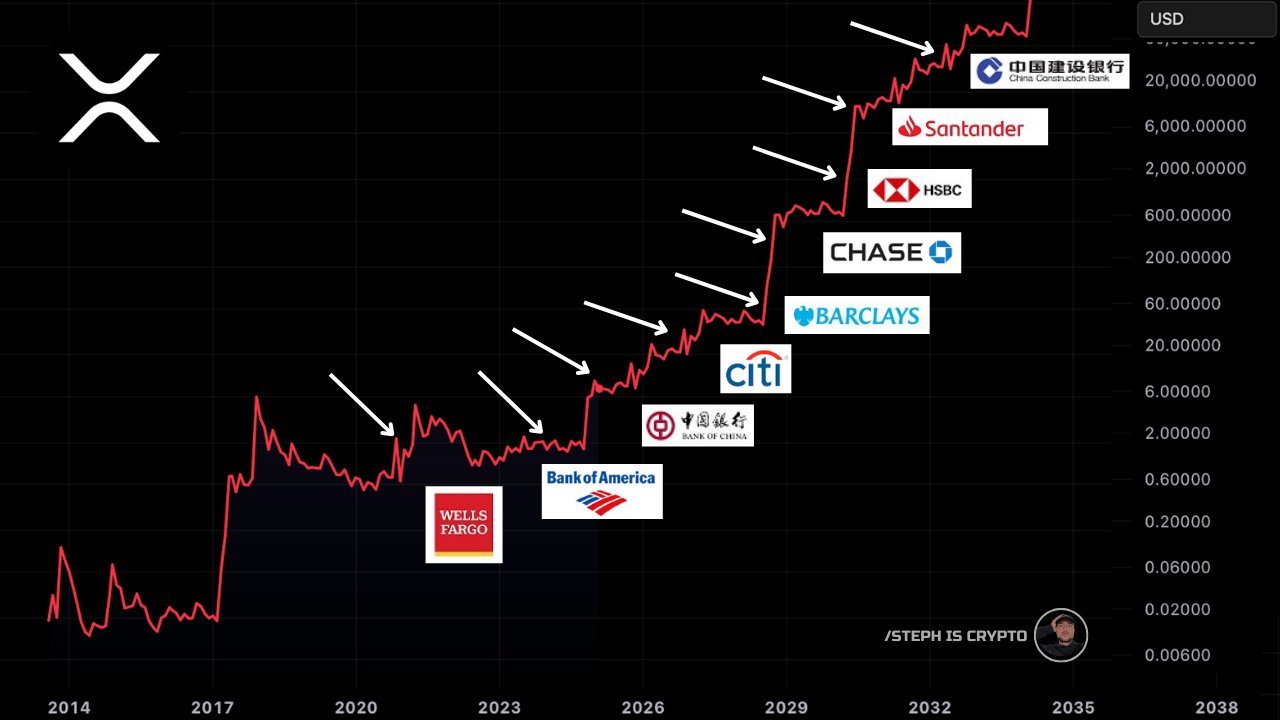
This could completely lift any regulatory cloud over XRP, leading to greater institutional adoption. Amid these discussions, market analyst Steph recently suggested that if some of the world’s largest banks adopted XRP, the impact on its price could be massive.
In an accompanying chart, he called attention to such possible adoption by nine of these banks. However, his disclosure lacked specific figures. Notably, a more streamlined analysis provides a clearer picture of how this could unfold.
Data from CompaniesMarketCap.com shows the sheer scale of assets held by these financial giants. Particularly, the China Construction Bank controls $5.837 trillion, while the Bank of China holds $4.859 trillion.
Meanwhile, JP Morgan follows with $4.210 trillion, and Bank of America has $3.324 trillion. HSBC’s total assets amount to $3.098 trillion, Wells Fargo’s to $1.922 trillion, Citigroup’s to $2.430 trillion, Banco Santander’s to $2.013 trillion, and Barclays’ to $2.049 trillion. Combined, these banks control a staggering $29.74 trillion in assets.
If each of them allocated just 0.5% of their total assets to purchasing XRP, the capital injection would surpass $148.7 billion. At XRP’s current price of $2.3, this would result in substantial acquisitions.
Specifically, China Construction Bank alone could purchase 12.69 billion XRP, while Bank of China would obtain 10.56 billion XRP. JP Morgan’s allocation would translate to 9.15 billion XRP, and Bank of America’s to 7.23 billion XRP.
Further, HSBC would secure 6.73 billion XRP, while Wells Fargo, Citigroup, Banco Santander, and Barclays would acquire 4.18 billion, 5.28 billion, 4.38 billion, and 4.45 billion XRP, respectively. In total, these banks would accumulate 64.66 billion XRP, representing nearly 65% of the liquid supply.
With XRP’s total supply at 100 billion, removing 64.66 billion XRP from the market would create an extreme supply shock. Notably, a purchase of this scale would likely drive prices higher. However, the extent of this price surge remains uncertain, so we sought insights from ChatGPT.
The AI chatbot first used a market cap formula to estimate the impact of this potential capital influx. Given that the purchase would inject $148.7 billion into XRP, its market cap would more than double.
If the price followed this increase proportionally, ChatGPT estimates XRP could rise to at least $4.6. However, this estimate assumes the market reacts in a linear fashion.

In reality, several factors could drive the price even higher. The chatbot noted that a supply squeeze, combined with surging demand, could send XRP’s value soaring well beyond $10. It also projected that XRP could climb to $20 or even $50, depending on how aggressive the market response is.
DisClamier: This content is informational and should not be considered financial advice. The views expressed in this article may include the author’s personal opinions and do not reflect The Crypto Basic opinion. Readers are encouraged to do thorough research before making any investment decisions. The Crypto Basic is not responsible for any financial losses.
Solana’s network is expanding fast, with Circle minting another 250 million USDC, bringing the total to $6 billion this year. Stablecoin supply on Solana jumped 112% in January, hitting a record $11.1 billion – and with liquidity soaring, SOL’s price could see 10x in 2025.
Meanwhile, PlutoChain ($PLUTO) is emerging as a potential solution for Bitcoin’s biggest problems. This Layer-2 solution might enable fast transactions, cut fees, and potentially boost Ethereum compatibility.
Let’s check out the details!
Solana’s network is expanding quickly, with stablecoin issuer Circle minting another 250 million USDC on the blockchain, according to Spot On Chain data. This brings the total USDC minted on Solana in 2025 to $6 billion, including 1.25 billion in the past week alone. The surge signals strong capital inflows, reinforcing Solana’s growing dominance in the entire field.
Stablecoin supply on Solana jumped 112% in January, reaching a record $11.1 billion. USDC remains the top stablecoin on the network, holding a 77% market share. Since bottoming out in November 2022, Solana has outperformed Bitcoin and Ethereum in both price gains and capital inflows, benefiting from sustained liquidity growth.
With rising adoption and increasing liquidity, SOL could be set for a huge rally. If momentum continues, a 10x move isn’t out of the question, especially if demand for Solana-based assets keeps climbing. However, market conditions and resistance levels will ultimately determine how high SOL can go.
PlutoChain ($PLUTO) might represent a significant step forward for Bitcoin. While Bitcoin remains the gold standard for security and decentralization, it’s fallen behind Ethereum and Solana in terms of speed and real-world applications.
PlutoChain’s hybrid Layer-2 blockchain could bridge this gap by potentially expanding Bitcoin’s capabilities. The platform achieves 2-second block times, compared to Bitcoin’s 10 minutes, which may make BTC more practical for everyday transactions while potentially lowering fees.

One of the biggest innovations could be the introduction of smart contracts to Bitcoin. This feature might enable developers to build decentralized applications (dApps) on Bitcoin, possibly opening doors to DeFi, NFTs, and AI integration.
The platform’s Ethereum Virtual Machine (EVM) compatibility could allow for easier migration of Ethereum projects to Bitcoin, potentially combining Ethereum’s flexibility with Bitcoin’s established security features. Community governance appears to be central to PlutoChain, as users may participate in voting on platform decisions, which could help shape its development.
Initial testnet results suggest the platform is capable of processing approximately 43,200 daily transactions. Regarding security, PlutoChain has reportedly undergone audits from firms like SolidProof, QuillAudits, and Assure DeFi, which may provide some assurance about its safety measures.

Solana’s expanding stablecoin reserves and rising liquidity signal strong momentum, with billions in fresh capital fueling speculation about SOL’s next big move. If this trend continues, sustained demand could push further its price in the coming months.
However, there’s a new project that could gain buzz in the following weeks – PlutoChain ($PLUTO). Built as a hybrid Layer-2 for Bitcoin, it could expand the network’s ecosystem while solving long-standing issues such as scalability and utility.
With innovations such as 2-second block times, smart contracts, and EVM compatibility, PlutoChain might help position Bitcoin to compete more effectively with networks like Ethereum and Solana.
———
Please remember that this article is purely informational and not financial advice. Any and all cryptocurrencies are volatile, with prices prone to rapid changes. Always do your own research and consult an expert before joining any crypto venture. We are not liable for any outcomes based on the information in this article. Statements about the future entail risks and may not reflect updates.
Disclosure: This is a sponsored press release. Please do your research before buying any cryptocurrency or investing in any projects. Read the full disclosure here.
Dogecoin ($DOGE) has recently garnered attention due to predictions of a potential 500% surge, possibly reaching $1,98 or maybe even more. There are predictions even more optimistic than this one, but the question is – which one will be the right one?
PlutoChain ($PLUTO), however, could introduce the first hybrid Layer-2 solution to Bitcoin, potentially enabling smart contracts and decentralized applications. With an average block time of just 2 seconds, PlutoChain could enhance Bitcoin’s scalability and transaction speed.
Dogecoin ($DOGE) has recently exhibited patterns reminiscent of its 2020-2021 bull run, suggesting a potential rally exceeding 500%. In that period, DOGE broke above a symmetrical triangle, leading to a staggering 31,375% surge.
As of January 2025, similar breakout signals have emerged, indicating a possible significant price increase. Analysts have observed that DOGE’s current correction mirrors previous cycles, with percentage declines closely aligning with past patterns.
Analyst Javon Marks highlights Dogecoin’s historical price trends, pointing to its recurring market cycles.
Marks’ analysis outlined three distinct phases, each involving accumulation, a breakout, a surge in price, and a subsequent correction. Based on these patterns, Marks suggested that Dogecoin remains on track for another bullish move.
While the 500% and over rally wouldn’t be instantaneous, Dogecoin’s momentum and current market conditions set a positive stage for DOGE to shine over the next few years.
Bitcoin’s biggest limitation has always been its inability to support smart contracts and decentralized applications (dApps) natively. While networks like Ethereum and Solana have built thriving ecosystems with DeFi, NFTs, and AI projects, Bitcoin has remained primarily a store of value.
PlutoChain ($PLUTO) could change that by introducing a hybrid Layer-2 solution that enables smart contracts and scalable applications directly on Bitcoin – without relying on external blockchains.

PlutoChain’s infrastructure could allow developers to build on Bitcoin while benefiting from low fees, high-speed transactions, and Ethereum Virtual Machine (EVM) compatibility.
With its own 2-second block time, PlutoChain removes Bitcoin’s slow confirmation bottleneck of 10 minutes, potentially making decentralized finance on Bitcoin a reality.
Developers would be able to migrate Ethereum-based applications seamlessly, possibly creating a bridge between the two most dominant blockchains. Security is another key factor. PlutoChain has successfully passed audits from SolidProof, QuillAudits, and Assure DeFi, reinforcing trust in its network.
Its testnet also validates its potential, processing an impressive 43,200 daily transactions and showcasing readiness for widespread adoption.

Additionally, its governance model gives platform users direct influence over protocol upgrades, ensuring decentralized decision-making. With Bitcoin DeFi still in its infancy, PlutoChain could unlock an untapped market, positioning itself as a leading force in blockchain innovation.
It may redefine Bitcoin’s role beyond a store of value and maybe bring a new wave of applications to the world’s largest digital asset.

Dogecoin’s historical trends suggest a potential rally beyond 500%, with analysts identifying patterns similar to past breakouts. If these signals hold, DOGE could surge to $1.98 or higher, making it a key token to watch.
Meanwhile, PlutoChain could transform Bitcoin by introducing smart contracts and decentralized applications through its hybrid Layer-2 solution.
With an average 2-second block time, EVM compatibility, and strong security audits, PlutoChain may finally bring Ethereum-level functionality to Bitcoin.
———
Please remember that this article is purely informational and not financial advice. Any and all cryptocurrencies are volatile, with prices prone to rapid changes. Always do your own research and consult an expert before joining any crypto venture. We are not liable for any outcomes based on the information in this article. Statements about the future entail risks and may not reflect updates.
Disclosure: This is a sponsored press release. Please do your research before buying any cryptocurrency or investing in any projects. Read the full disclosure here.
ADA, the native token of the Cardano blockchain, is gaining significant attention from crypto enthusiasts following an asset manager’s move to file for a Cardano Exchange-Traded Fund (ETF) in the United States. This development has sparked notable interest among traders and investors, resulting in impressive upside momentum.
As the market surge pushes ADA near a crucial resistance level, the asset has begun experiencing massive sell-offs, causing its price to fall—another disappointment for traders and investors today.
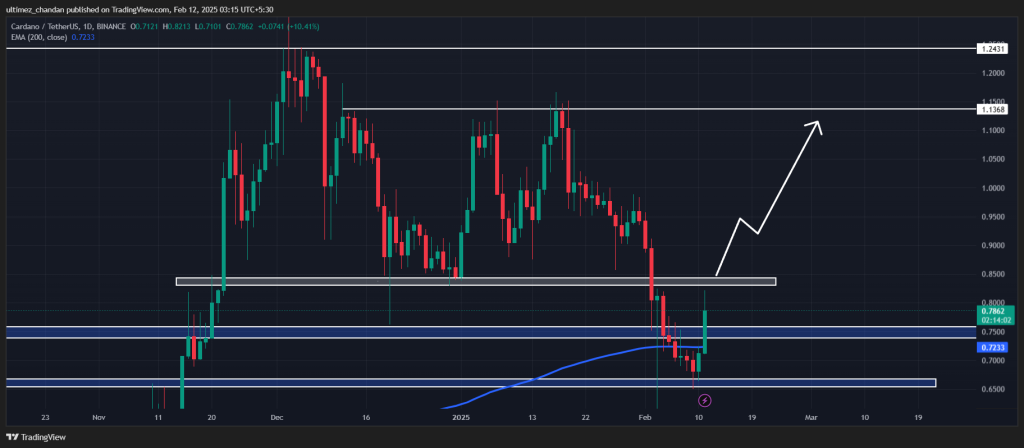
Despite the recent fall in the ADA token price, the asset has reclaimed its uptrend as it moves above the 200 Exponential Moving Average (EMA) on the daily time frame. Additionally, today’s notable selling pressure has not had any significant impact on investor sentiment, as long-term holders appear to be accumulating the token.
ADA is currently trading near $0.77 and has experienced a price surge of over 11% in the past 24 hours. However, the asset reached an intraday high of $0.815 with a 16% gain, but the market lost a significant portion of those gains, likely due to ongoing profit booking and the current market sentiment.
Nonetheless, participation from traders and investors has surged to the next level, increasing by more than 120% during the same period.
According to expert technical analysis, ADA is at a crucial resistance level of $0.85, where it faced resistance today.
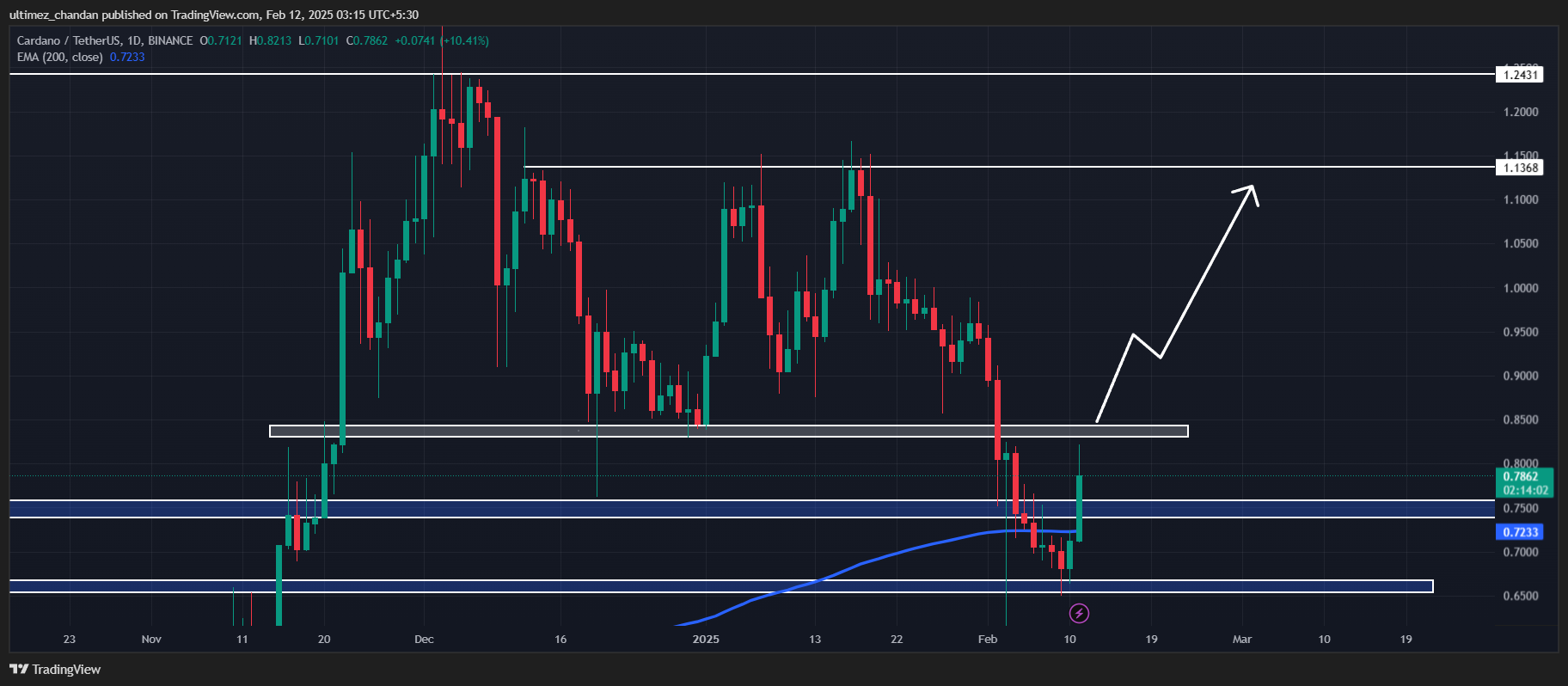
Based on the recent price action, if ADA continues to rally and breaches the $0.85 level, closing a daily candle above it, there is a strong possibility it could soar by 32% to reach the $1.13 level in the future.
Currently, traders are taking a mixed approach. At present, the major liquidation areas are near $0.734, where traders holding long positions are over-leveraged, with $18.80 million worth of long positions. Conversely, $0.826 is another liquidation level, where traders holding short positions are over-leveraged, with $18.20 million worth of short positions.
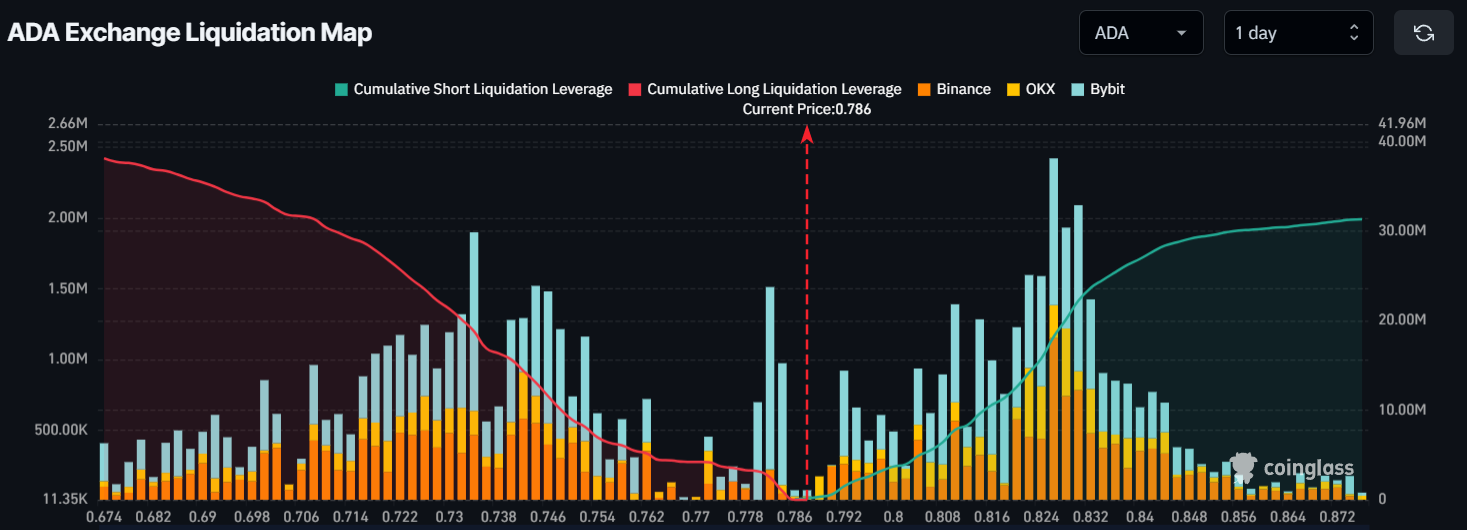
When combining these on-chain metrics with technical analysis, it appears that long-term holders are accumulating tokens, while intraday traders are taking advantage of the current market sentiment.
In the ever-evolving world of cryptocurrencies, Ripple’s XRP remains a focal point for both investors and technology enthusiasts. As innovations in artificial intelligence (AI) continue to permeate various sectors, their influence is now extending into the realm of cryptocurrency predictions. The question on everyone’s mind is: How can AI fundamentally change XRP price predictions?
Recent developments suggest that AI-driven analytics could revolutionize the way investors and analysts predict XRP price movements. AI algorithms can process vast amounts of historical data and market trends at lightning speed, offering insights that are significantly more accurate and timely than traditional methods. By identifying patterns and applying machine learning techniques, AI models can predict future price movements with improved precision.
What’s more intriguing is the emergence of AI collaboration across multiple platforms. Decentralized finance (DeFi) realms are integrating AI technologies to create more reliable and trustworthy predictive models. This technological symbiosis could herald a new age for XRP predictions, where biases and historical inaccuracies are minimized.
Additionally, the application of AI in analyzing social media sentiment, news topics, and global economic indicators could offer a more holistic view of what drives XRP price shifts. As these AI tools evolve, they might enable investors to not only predict future prices more accurately but also create new strategies for investment in XRP and other digital currencies.
In a world driven by technology, embracing AI for cryptocurrency forecasting might just be the game-changer the market needs, heralding a new era for XRP and beyond.
How is AI Transforming Ripple’s XRP Price Predictions?
The integration of artificial intelligence (AI) into cryptocurrency predictions, particularly for Ripple’s XRP, is reshaping how analysts and investors approach the market. AI algorithms, by processing extensive historical data and real-time market trends, are providing insights that are not only faster but also more accurate than traditional methods. This transformative capability allows for the identification of patterns and the application of machine learning techniques to predict future XRP price movements with enhanced precision.
What Are the Pros and Cons of Using AI for XRP Price Predictions?
Pros:
– Increased Accuracy: AI can analyze vast datasets quickly, offering predictions that are often more precise.
– Real-time Analysis: The ability to process data in real-time allows for timely insights.
– Pattern Recognition: AI models can identify unseen patterns in data, providing a deeper understanding of market dynamics.
Cons:
– Dependency on Data Quality: AI predictions are only as good as the data they are fed. Poor quality or biased data can lead to inaccurate predictions.
– Complexity and Cost: Developing and maintaining AI systems can be costly and complex.
– Lack of Human Intuition: AI lacks the intuitive understanding of human emotions and market sentiment that experienced traders might possess.
How Can AI-Driven XRP Predictions Impact Investment Strategies?
AI’s role in XRP predictions extends beyond just forecasting prices. By analyzing social media sentiment, news feeds, and global economic indicators, AI tools offer a comprehensive view of market dynamics. This allows investors to develop new strategies tailored to take advantage of predicted market shifts. As these tools continue to evolve, investors can anticipate and react to market changes more swiftly, potentially leading to lucrative investment opportunities in XRP and other cryptocurrencies.
For more information on XRP and cryptocurrency investments, domains like CoinMarketCap and CoinDesk are valuable resources.
Overall, as AI technologies advance, their impact on cryptocurrency markets could be significant, potentially ushering in a new era of intelligent investing strategies.
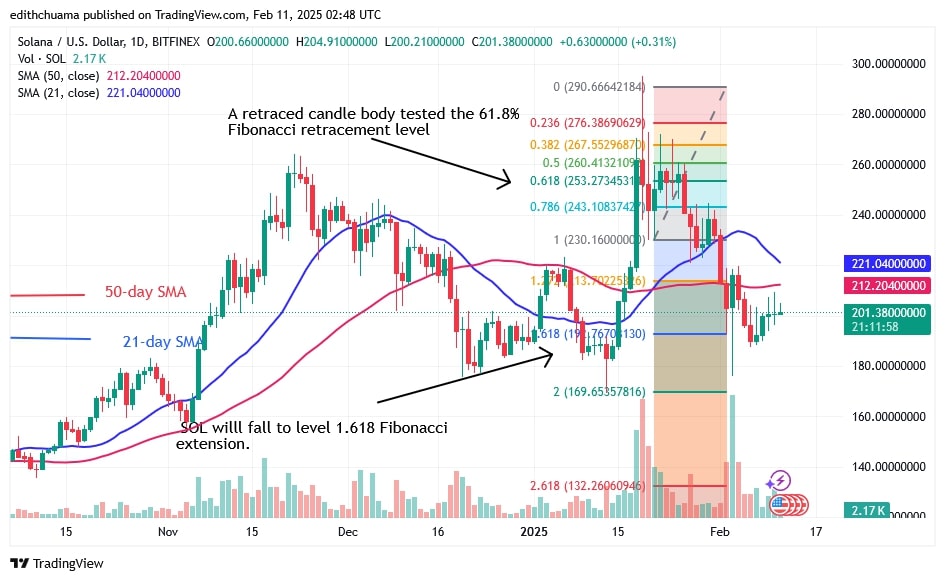
Solana (SOL) has declined since its rejection of the $260 top price.
The cryptocurrency dropped and reached the 1.618 Fibonacci extension level or $192.76, which was the price prediction. The downtrend resumed its volatility above the current support at $190 after hitting the expected price level twice.
Solana has been trading below the moving average lines and above the $190 support since February 6. The moving average lines have hindered the upward moves. The uptrend will resume when the price breaks above the moving average lines.
Similarly, Solana will return to the previous low at $176 if the bears break below $190 support. Meanwhile, Solana price is $201.
SOL price indicator analysis
The price of the cryptocurrency has fallen below the moving average lines. The selling pressure has eased above the support level of $190. The price bars on the 4-hour chart show the sideways movement since February 3 and are above and below the moving average lines.
Technical indicators
Key supply zones: $220, $240, $260
Key demand zones: $140, $120, $100
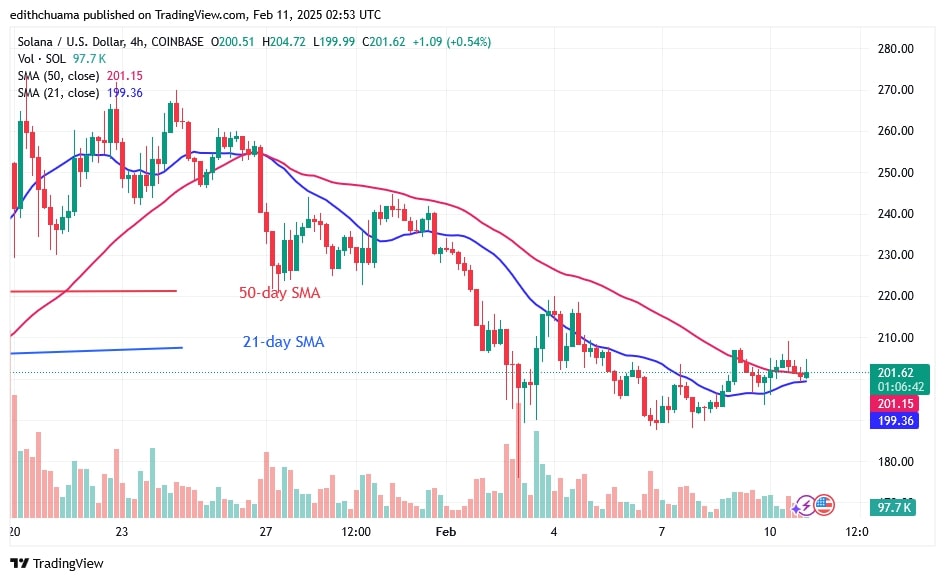
On the 4-hour chart, the price of Solana has resumed its sideways movement after the price drop on February 3. The altcoin is trading in a relatively narrow range between $190 and $210.
The presence of doji candlesticks causes the price of cryptocurrencies to move slowly. The doji candlesticks limit the price movement as the resistance of $210 stands in the way of bigger rises. The sideways movement will continue if the levels within the trading range are not broken.
Disclaimer. This analysis and forecast are the personal opinions of the author. They are not a recommendation to buy or sell cryptocurrency and should not be viewed as an endorsement by CoinIdol.com. Readers should do their research before investing in funds.
Bulls are trying to hold the gained initaitive, according to CoinStats.
The price of DOGE has risen by 3.83% since yesterday.
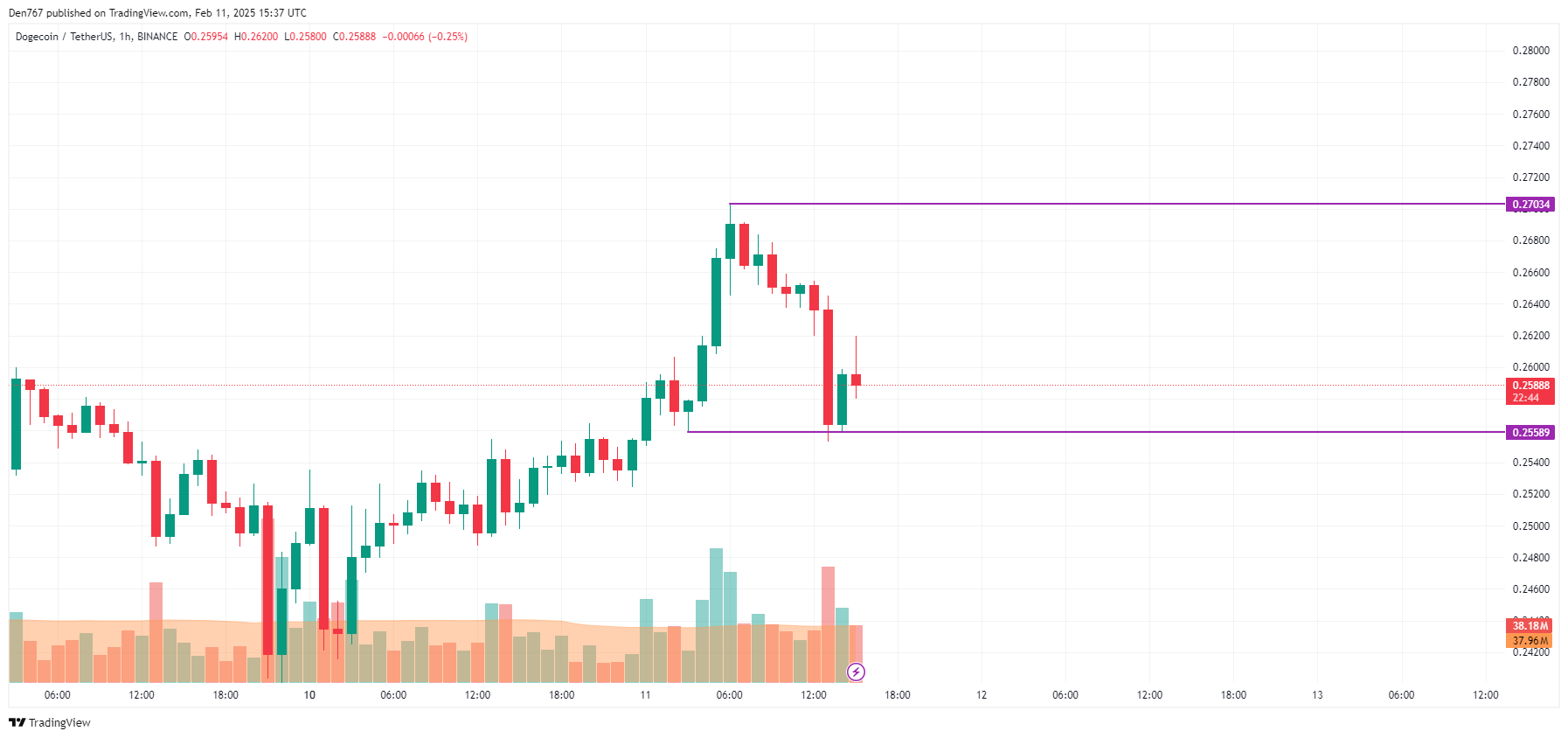
On the hourly chart, the rate of DOGE is coming back to the local support of $0.2558. If sellers’ pressure continues, traders may witness a level breakout, followed by an ongoing correction to the $0.25 zone.
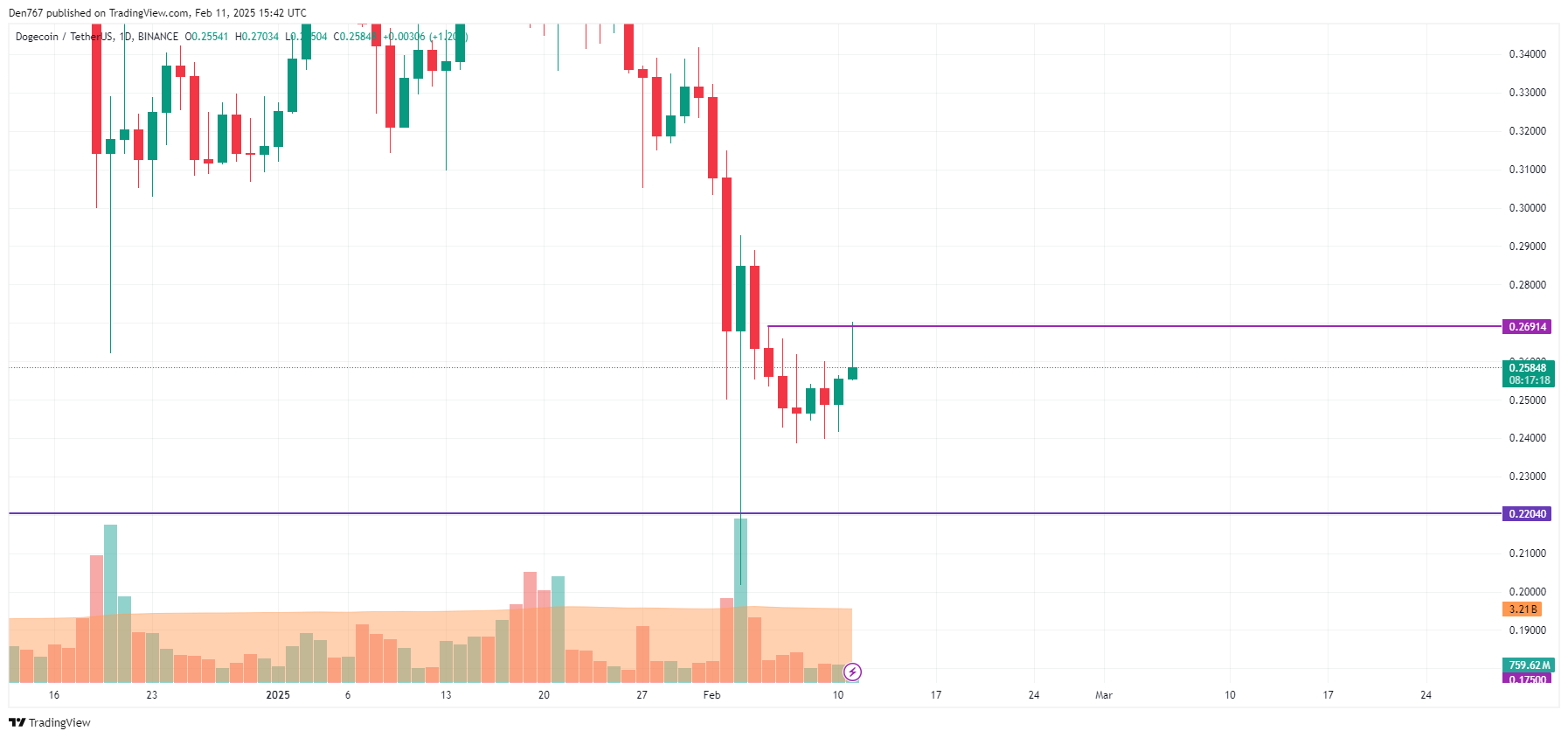
On the bigger time frame, the price of DOGE has made a false breakout of the resistance of $0.2691. If the daily bar closes far from that mark, one can expect a test of the $0.2450-$0.25 area by the end of the week.
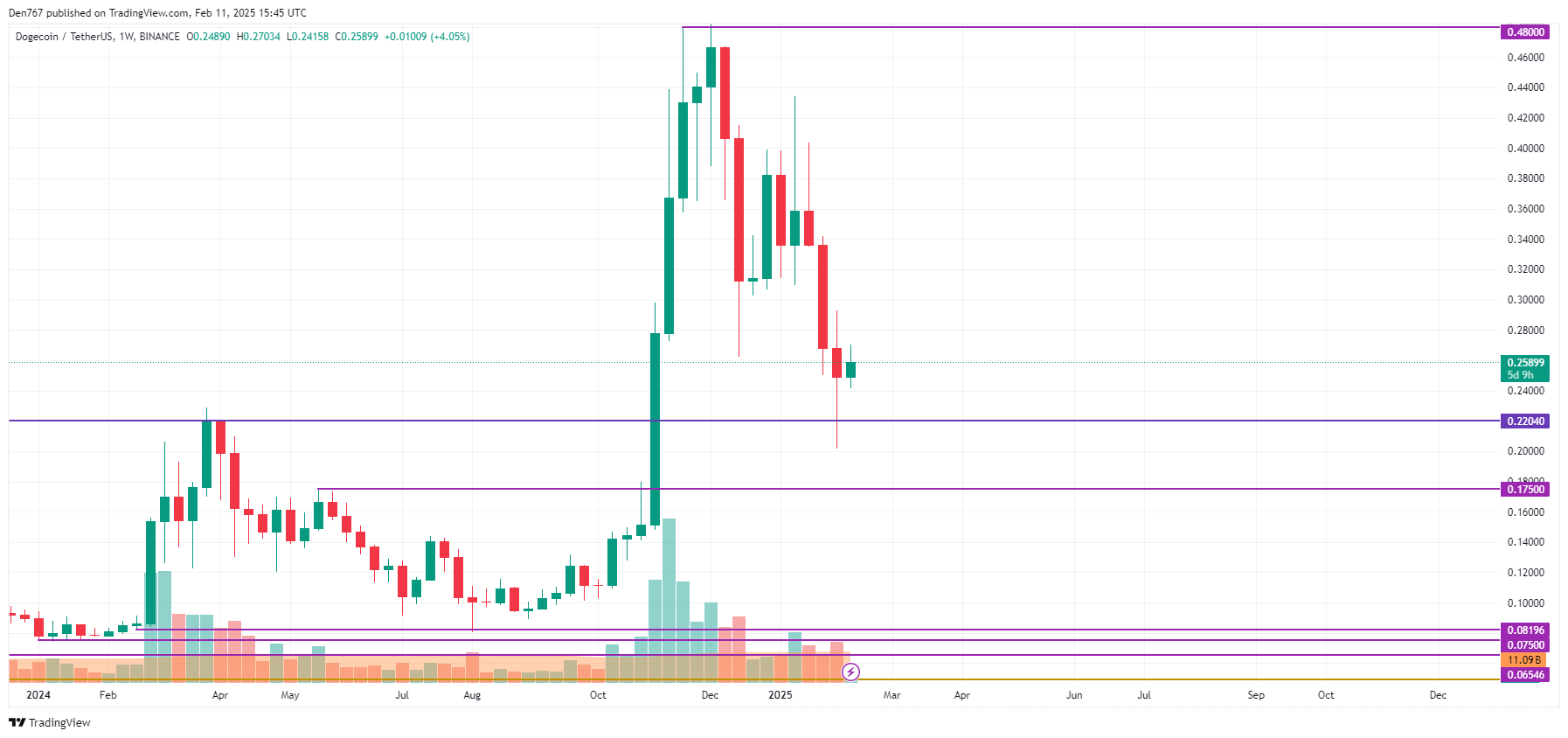
From the midterm point of view, the rate of the meme coin is trading within the previous bar.
Related

If the picture remains the same by the end of the week, there are low chances of seeing sharp moves.
DOGE is trading at $0.2593 at press time.
As market watchers monitor the latest developments surrounding Ripple’s XRP, they’re also setting their sights on a young altcoin experiencing a meteoric rise—. Since its presale launch, JetBolt has sold over 320 million tokens, a massive feat for such a new crypto coin.
But what’s behind the growing interest in this budding altcoin and the buying frenzy around it? Market observers see its groundbreaking features as the key drivers of its ascent in the Web3 space.
JetBolt offers game-changing zero-gas technology, enabling crypto users to make blockchain transactions without paying gas fees. This high-tech feature could benefit developers, too, as it empowers them to build a wide range of decentralized applications (dApps) without the hassles of gas costs.
Additionally, JetBolt revolutionizes staking by making an easy-to-use design for its crypto-staking platform. Aside from that, JetBolt’s unique Proof of Attendance and Worth protocol gives stakers a chance to earn rewards when they simultaneously stake their tokens and interact with friends on the platform.
Leveraging artificial intelligence, JetBolt’s crypto insights tool can display crypto news and stories and automatically arrange them based on bullish or bearish market sentiment.
Currently in presale, JetBolt allows early buyers to score early bird perks. They can get additional tokens when they purchase or JBOLT tokens in batches.
JetBolt’s innovative features, such as zero-gas technology and exciting presale perks, have contributed to its soaring popularity in the crypto space.
While Solana gears up to test the $500 threshold, is turning heads with its trailblazing innovations and rapidly accelerating presale. This next-gen crypto coin is capturing the attention of crypto whales and enthusiasts alike.
JetBolt redefines blockchain efficiency with zero-gas technology powered by the Skale Network. Gone are the days of unpredictable gas charges—JetBolt ensures near-instant, frictionless blockchain interactions, setting a new standard in decentralized finance.
But JetBolt isn’t stopping there. Its AI-driven Web3 content aggregator is a standout feature, seamlessly displaying third-party crypto news and blockchain developments while tagging updates with bullish or bearish sentiment. This innovative integration blends modern technology with blockchain functionality.
Adding to the buzz is JetBolt’s SocialFi staking system. Token holders who stake their JBOLT tokens can enhance their rewards through active engagement on the platform. This combination of staking and social interaction creates a more engaging, rewarding experience.
JetBolt’s presale is another key factor driving its meteoric rise. With over 320 million tokens already sold, early adopters are flocking to secure their JBOLT tokens before prices climb even higher. Alpha Boxes, offering on batch purchases, have added another layer of excitement, making JetBolt a trending presale crypto in the market today.