The main tag of cryptocurrency price today Articles.
You can use the search box below to find what you need.
[wd_asp id=1]
The main tag of cryptocurrency price today Articles.
You can use the search box below to find what you need.
[wd_asp id=1]
Ripple’s native token XRP, is posed for a price decline as whales dump millions of XRP tokens while the price retests the breakdown level of $0.545. On September 12, 2024, the transaction tracker Whale Alert made a post on X (Previously Twitter) that Ripple whales have offloaded 39.32 million XRP tokens, worth $21.13 million to Bitstamp.
This XRP dump by whales has made the overall sentiment more bearish, as it occurred when the price retested its breakdown level of $0.545.
At press time, XRP is trading near $0.535 and has experienced a price drop of over 1.12% in the last 24 hours. Meanwhile, its trading volume has increased by 25% during the same period, indicating higher participation from traders despite the price decline.
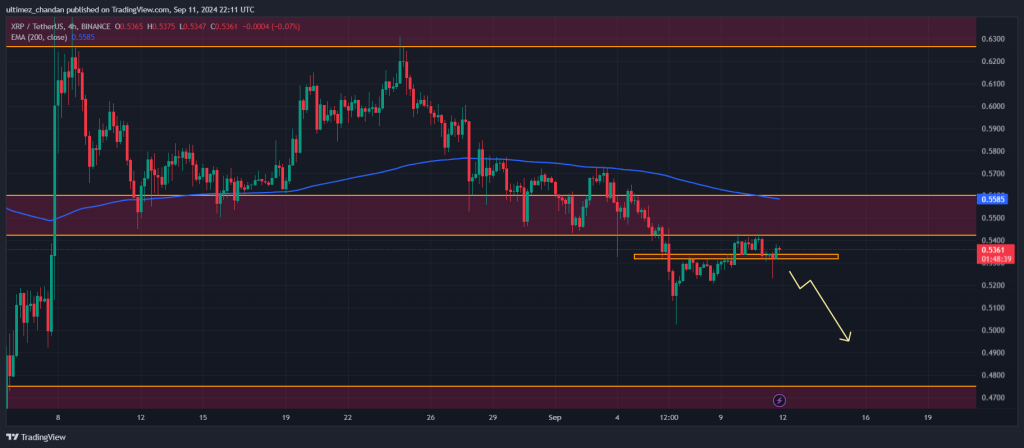
Expert technical analysis warns that XRP appears bearish, as it is trading below the 200 Exponential Moving Average (EMA) on a daily time frame. Currently, it is receiving decent support at the $0.531 level. If XRP fails to hold this support level, there is a high possibility it could plunge by 10% to the $0.475 level.
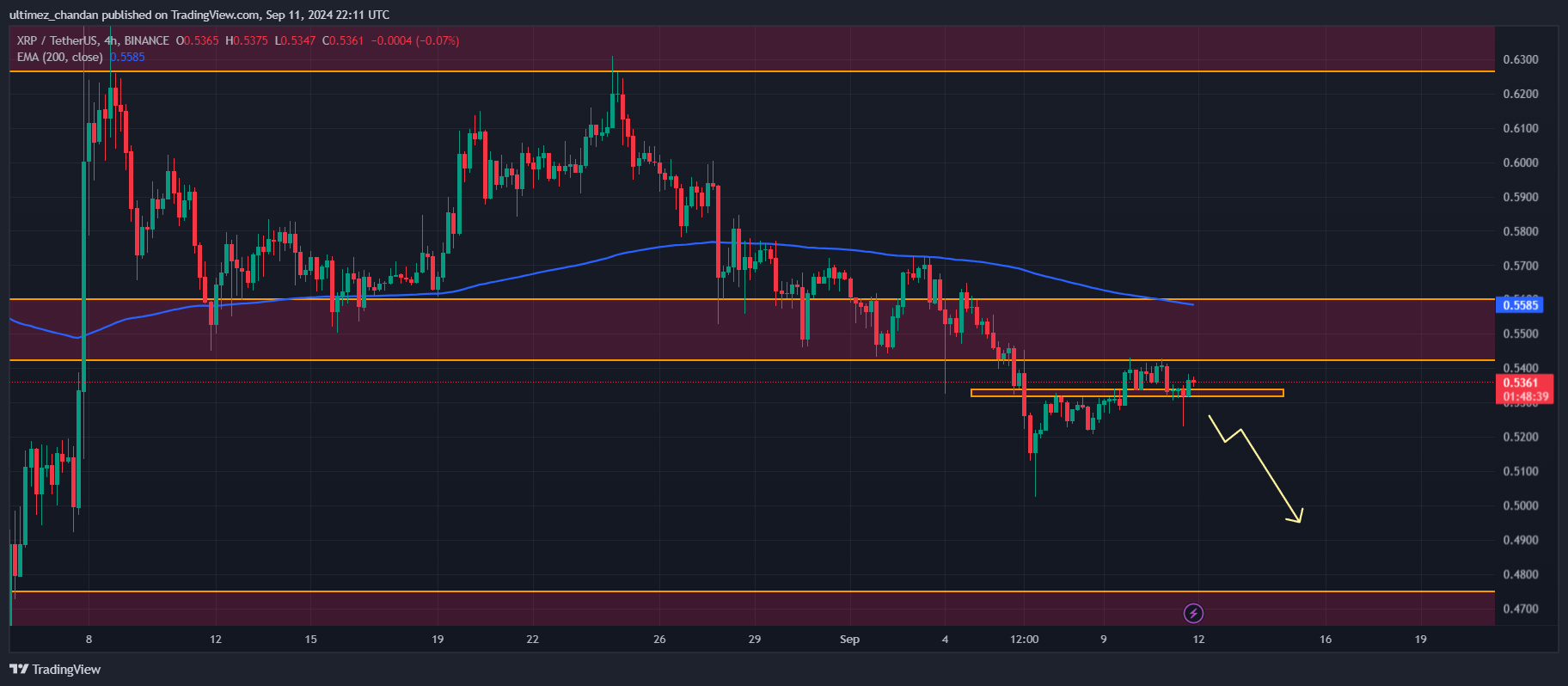
Additionally, XRP’s Relative Strength Index (RSI) is in oversold territory and is flashing a potential price reversal.
As of now, the major liquidation areas are near the $0.521 level on the lower side and $0.543 on the upper side, as traders are over-leveraged at these levels, according to Coinglass.
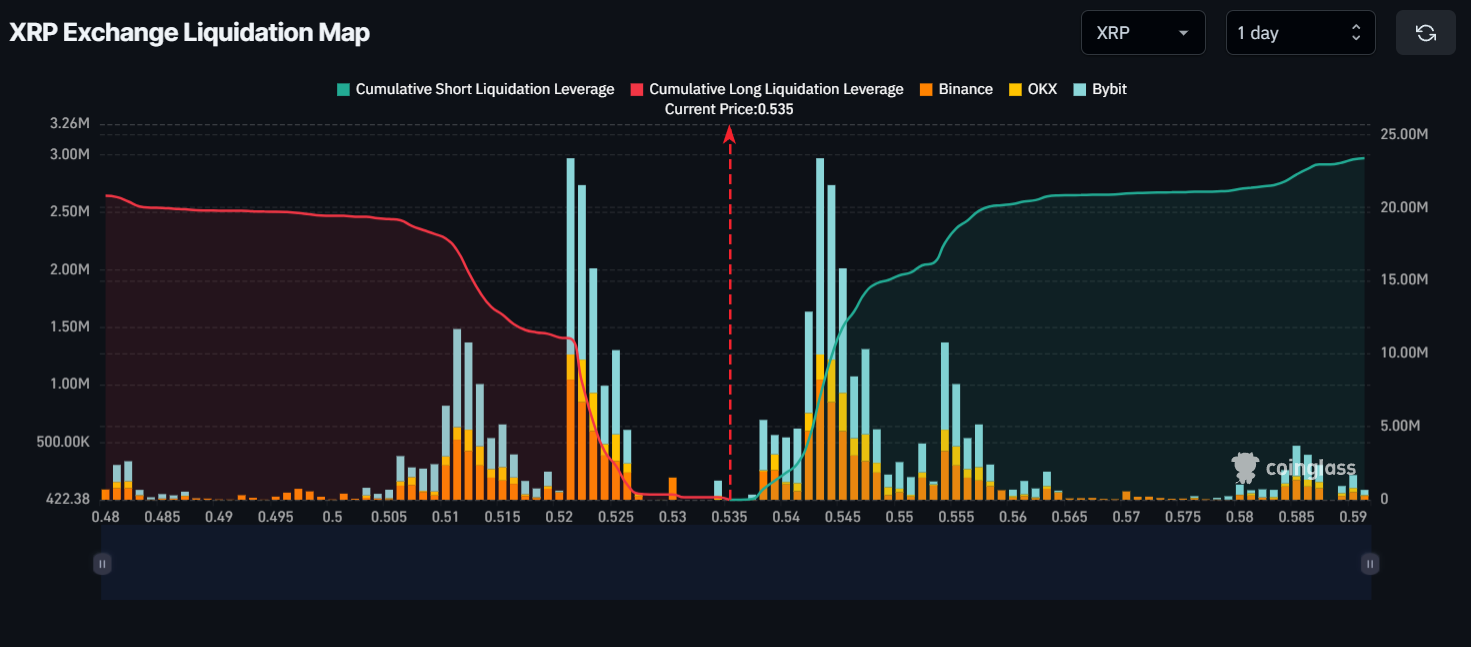
If the sentiment remains bearish and the XRP price falls to the $0.521 level, nearly $11.04 million worth of long positions will be liquidated. Conversely, if the sentiment shifts and the price rises to the $0.543, approximately $7.07 million worth of short positions will be liquidated.
Coinglass’s XRP Long/Short ratio data shows that, in the past four hours, 53.64% of top XRP traders have taken short positions, while 46.36% have taken long positions.
Combining all these data, it appears that bears are controlling the asset and have the potential to increase selling pressure.
Disclaimer: The opinions expressed by our writers are their own and do not represent the views of U.Today. The financial and market information provided on U.Today is intended for informational purposes only. U.Today is not liable for any financial losses incurred while trading cryptocurrencies. Conduct your own research by contacting financial experts before making any investment decisions. We believe that all content is accurate as of the date of publication, but certain offers mentioned may no longer be available.
Sellers are back in the game as the rates of most of the coins are in the red zone, according to CoinMarketCap.
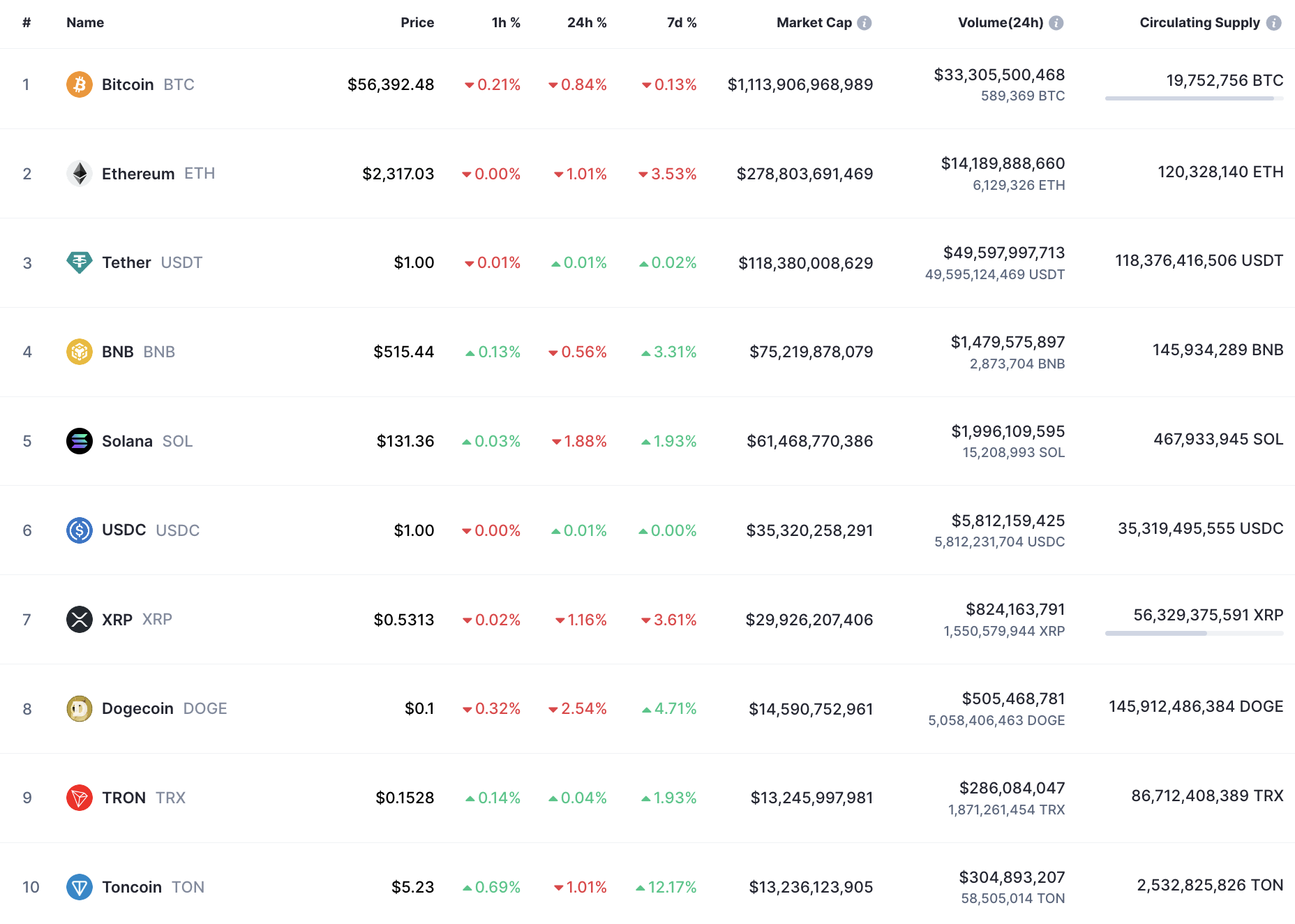
DOGE is one of the biggest losers today, falling by 2.54%.
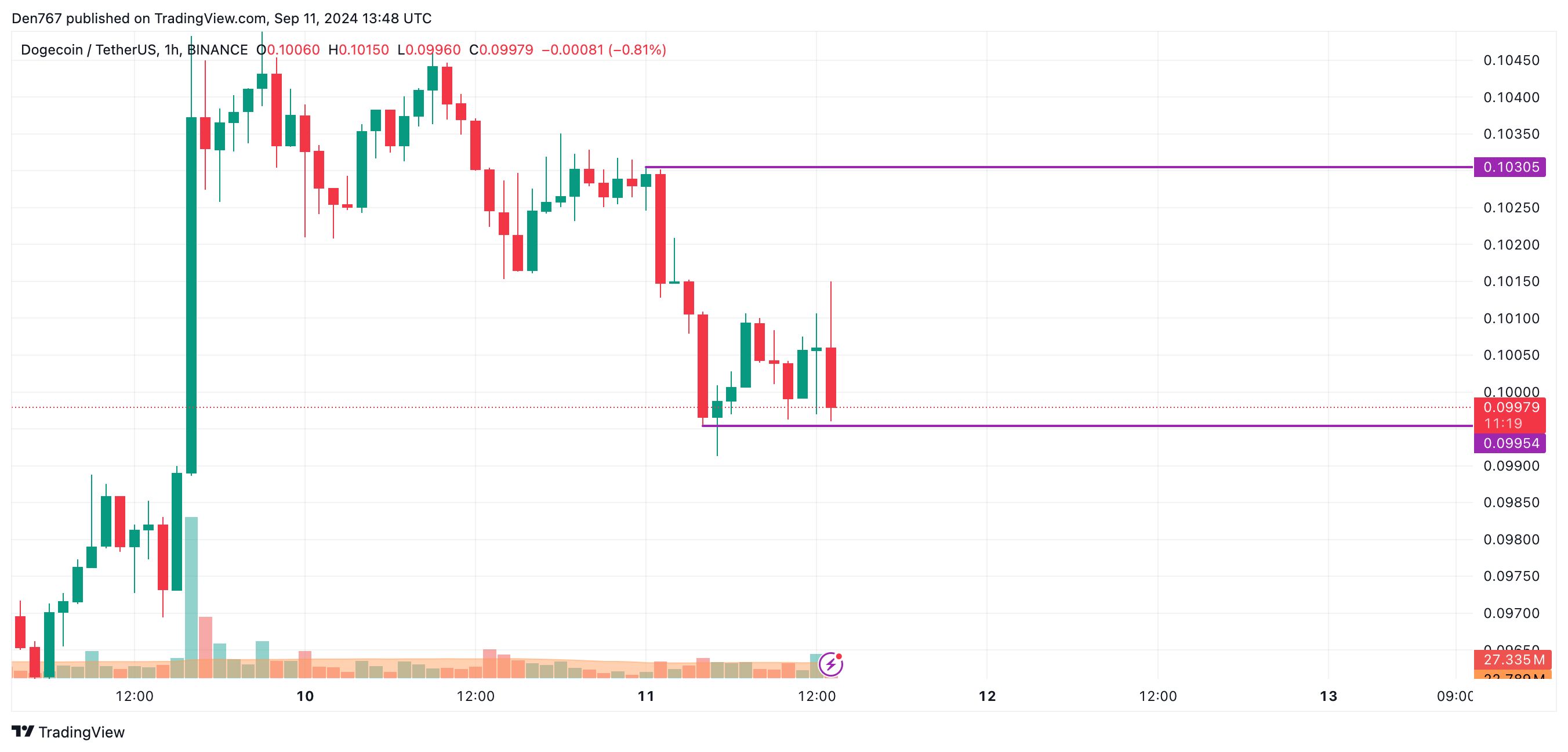
On the hourly chart, the rate of DOGE is testing the local support of $0.09954. If it breaks out, the fall may lead to a test of the $0.098 area soon.
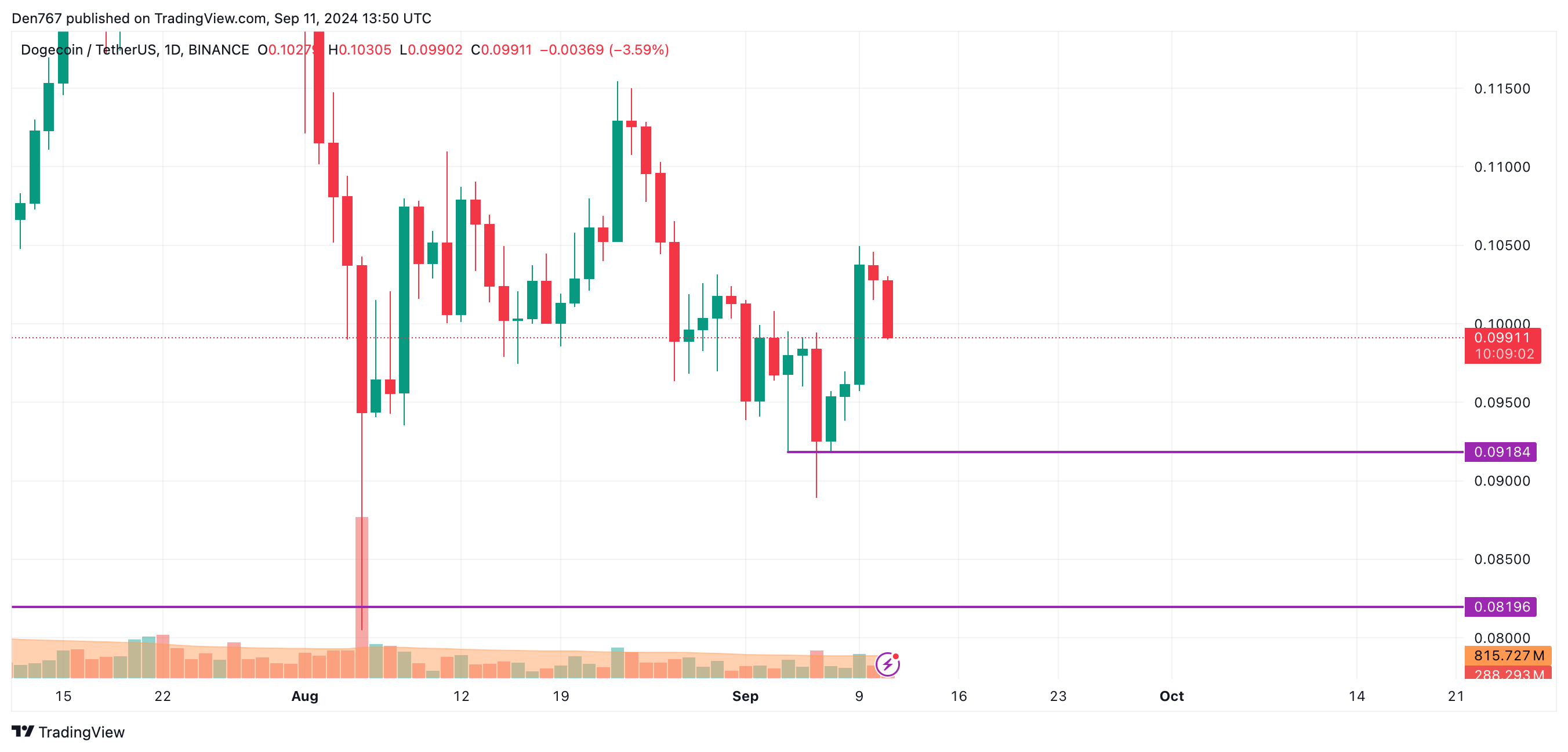
On the daily time frame, one should pay attention to the interim zone of $0.10. If buyers lose it, there is a chance to see a correction to the $0.095 mark by the end of the week.
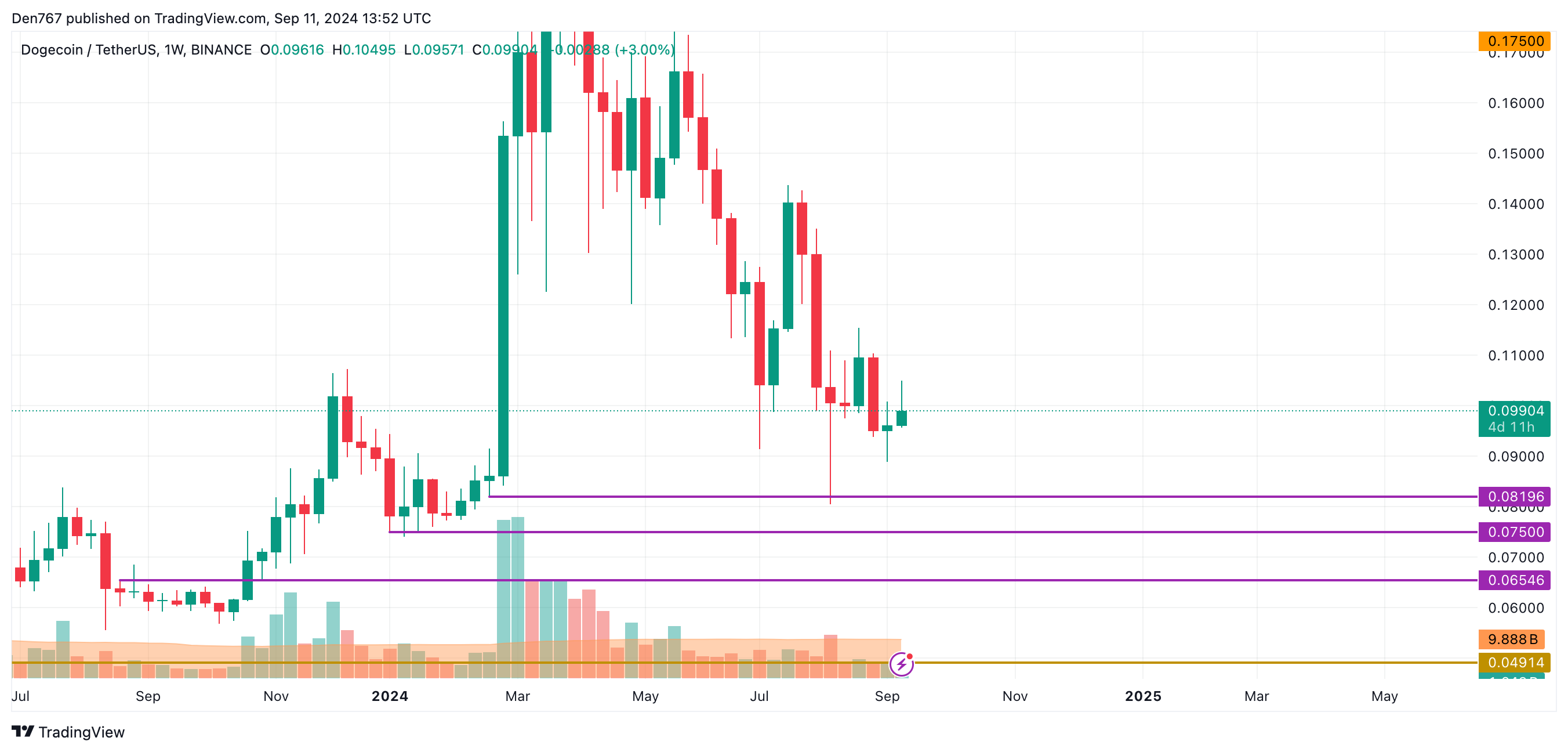
On the weekly chart, the rate of DOGE is far from the main levels.
Related

However, if the candle closes around the current prices, traders may witness a drop to the nearest area of $0.09.
DOGE is trading at $0.09885 at press time.
Steph, a widely followed market analyst, has called on market participants to load up XRP tokens before a potential price surge to $40.
In his latest analysis shared on X, the notable commentator highlighted that XRP is poised for a significant breakout, supported by bullish patterns across both short-term and monthly timeframes. According to Steph, technical indicators point to a potential rally in the coming months.
The analyst identified an inverted Head and Shoulders pattern on XRP’s daily chart. He noted that the breakout will be confirmed when the market sees a daily close above the neckline, located around $0.65.
Currently, XRP is trading at approximately $0.538, having risen by 1% in the past 24 hours. Steph believes that a successful reclaiming of the $0.65 level could signal a further upward trajectory.
Specifically, the analyst suggested that if the breakout is confirmed, the next technical target could reach $1.11. Notably, this would represent a 106.31% increase from current levels.
Meanwhile, on the monthly chart, Steph provided an even more optimistic outlook. He pointed out that XRP is consolidating within a larger symmetrical triangle. According to him, a breakout from this pattern could push XRP to as high as $40.
For context, achieving this price point would represent an extraordinary 7,334% growth from XRP’s current value. While Steph recognizes that the $40 target is ambitious, he advised caution, noting that it should be treated as a “rough guideline.”
However, he remains confident that a confirmed breakout could trigger a major rally up to that point.
While Steph is cautious about the $40 point, other analysts have even shared more audacious outlooks for XRP based on the monthly chart.
In July, analyst Heikin Ashi argued that XRP could experience a massive bull rally, potentially surging 71,061% to $305. He pointed to monthly candlestick patterns, which resemble past trends before significant price increases.
Despite recent low performances, Ashi’s analysis suggested XRP’s ongoing monthly patterns echo previous periods of explosive growth, and a peak at $305 could be reached as a result.
However, many other XRP analysts have contested the possibility of such extreme price growth, deeming it unlikely.
In addition to technical factors, Steph emphasized the role of market sentiment in driving XRP’s price.
The Crypto Fear and Greed Index currently shows a reading of 33, indicating a state of fear among retail investors. However, Steph believes this presents a buying opportunity for XRP, noting that “smart money typically buys into fear.”
Moreover, the upcoming Federal Reserve meeting on September 18 will likely introduce more volatility into the market.
With a potential interest rate cut on the horizon, many analysts, including Steph, predict a broader crypto rally similar to the one seen in 2020, when rate cuts spurred a bull run that sent Bitcoin and altcoins to all-time highs.
Disclaimer: This content is informational and should not be considered financial advice. The views expressed in this article may include the author’s personal opinions and do not reflect The Crypto Basic’s opinion. Readers are encouraged to do thorough research before making any investment decisions. The Crypto Basic is not responsible for any financial losses.
The green dots on the chart represent MicroStrategy’s Bitcoin purchases, many of which were made during price dips, effectively allowing the company to lower its dollar-cost average.
For example, after MicroStrategy’s strategic purchases in March 2021, Bitcoin surged above $60,000, cementing the company’s reputation as a major market mover.
The chart clearly shows price increases after notable purchases in early 2021, and the trend reoccurred in April 2024, when Bitcoin’s price rallied after Saylor reiterated his long-term $13 million price prediction at the Bitcoin Nashville Conference.
Hence, while Bitcoin’s recent price struggles in H2 2024 has culminated in 24% decline from the yearly peak of $73,800 price Saylor’s latest bullish comments could potentially reinforce confidence among investors leaning neutral, and prospective new entrants.
Given MicroStrategy’s historical influence and Saylor’s ambitious prediction, the market could experience another short-term rally as investors react to his latest comment.
Saylor’s foresight and the company’s strong positioning in Bitcoin make it likely that market sentiment will shift positively, as it has in the past after MicroStrategy’s recent key moves.
The Intersection of Politics and Bitcoin
In addition to his price prediction, Saylor touched on how political stances toward Bitcoin are shifting ahead of the U.S. 2024 presidential elections.
He noted that the Republican Party has become more progressive on crypto-related policies, with frontrunner Donald Trump adopting a pro-Bitcoin stance. Meanwhile, Democratic candidate Kamala Harris has yet to outline a clear position on cryptocurrencies.
As market sentiment swings sideways, two subtle but important metrics signal a potential drop in the price of Dogecoin (DOGE). Last month, DOGE hit $0.11.
However, the meme coin has been trading below this level since the beginning of September. These indicators reveal how the cryptocurrency’s current trend might impact the price.
Dogecoin’s Mean Dollar Invested Age (MDIA) is the first key metric to watch. MDIA measures the average age of every dollar invested in the coin. A rising MDIA suggests long-term holding, meaning holders are not selling. Conversely, a declining MDIA indicates that more participants are trading their coins, often signaling significant sell-offs.
As shown in the chart, MDIA has dropped sharply since September 8, implying that less capital is being invested in Dogecoin. This could make Dogecoin’s price vulnerable to a drop below its current level of $0.10.
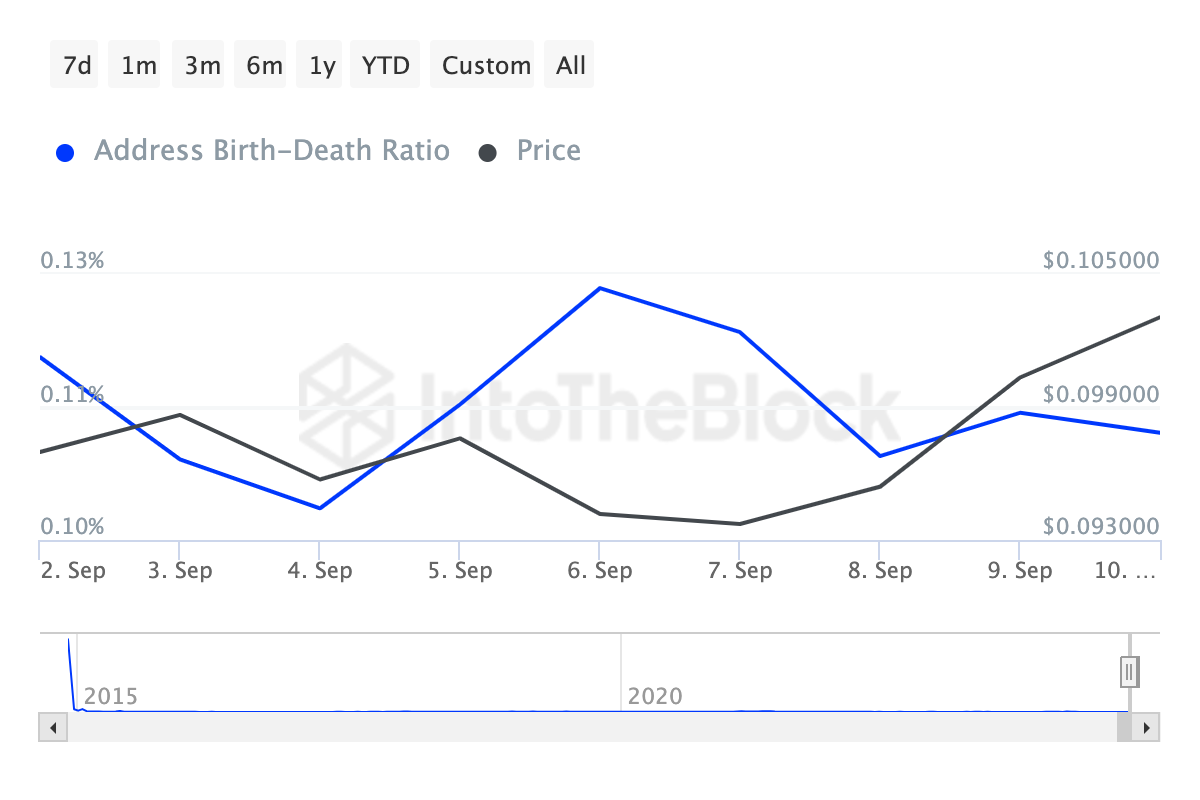
The second vital but rarely used indicator is the Address Birth-Death ratio. As the name implies, the ratio measures the rate at which new addresses are adopting a cryptocurrency compared to the rate at which other addresses are selling all of their coins.
A high Birth-Death ratio indicates that a cryptocurrency is seeing more adoption than exits. However, as of this writing, the ratio is down to 0.11%, suggesting that a higher proportion of retired DOGE wallets compared to the newly created ones.
Read more: How To Buy Dogecoin (DOGE) and Everything You Need To Know
According to the daily chart, Dogecoin broke above the descending triangle three days ago. Typically, a break above this technical pattern is a bullish sign — evident as DOGE’s price attempted to appreciate further.
However, the coin encountered rejection, as it aimed at $0.11. Based on the image below, DOGE’s price is on the brink of falling below the 61.8% Fibonacci retracement level.
Read more: Dogecoin (DOGE) vs Shiba Inu (SHIB): What’s the Difference?
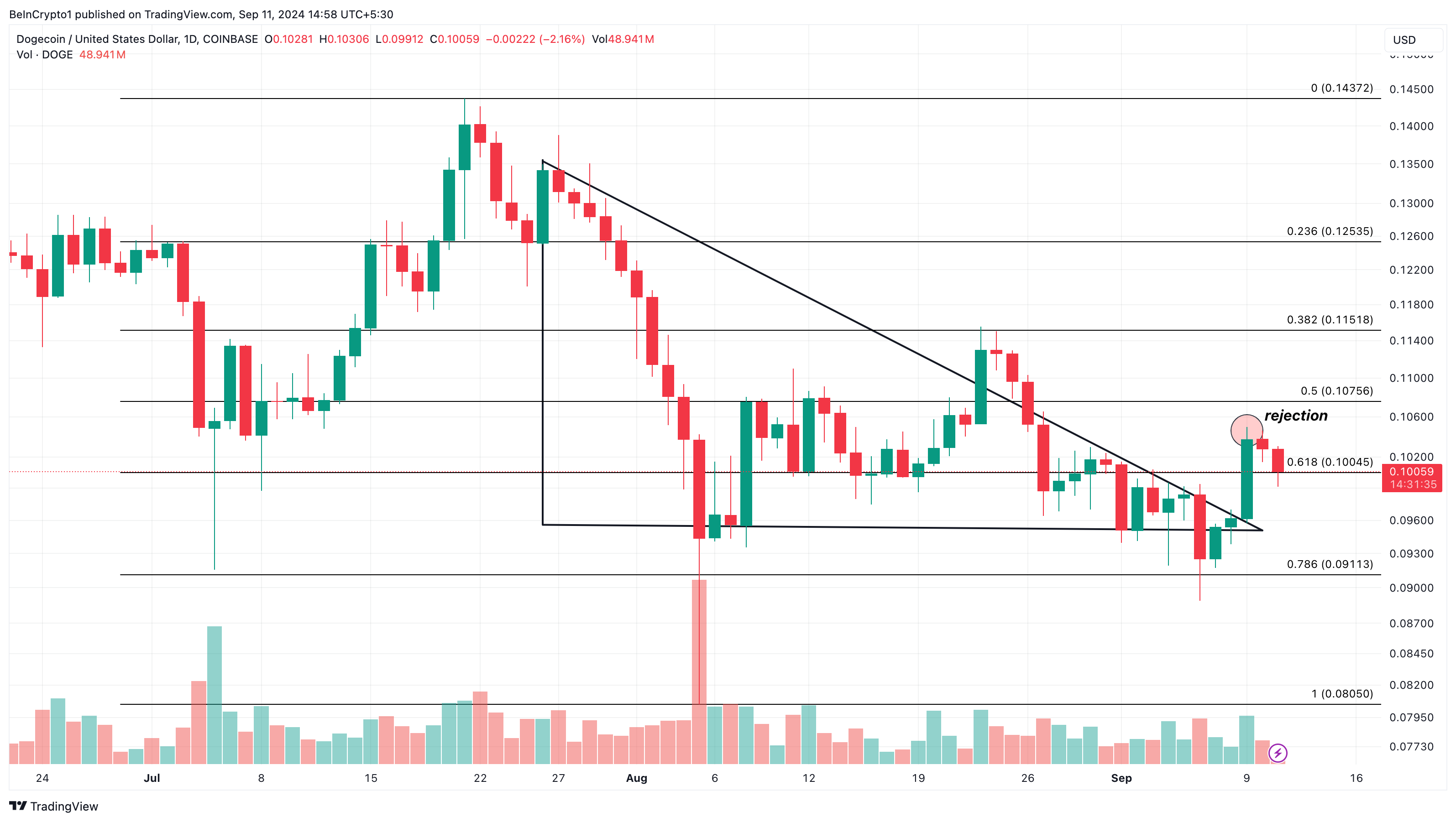
As soon as this happens, the bearish outlook could be confirmed, potentially driving the price down to $0.091. However, if bulls manage to hold the price above this level, the bearish prediction could be invalidated, and Dogecoin might rise to $0.12.
Disclaimer
In line with the Trust Project guidelines, this price analysis article is for informational purposes only and should not be considered financial or investment advice. BeInCrypto is committed to accurate, unbiased reporting, but market conditions are subject to change without notice. Always conduct your own research and consult with a professional before making any financial decisions. Please note that our Terms and Conditions, Privacy Policy, and Disclaimers have been updated.
Bitcoin (BTC) price approaches a critical support level; if it holds, it might pave the way for further recovery. However, Ethereum (ETH) and Ripple (XRP) find rejection around their resistance level and could be poised for declines, diverging from BTC’s potential rebound.
Bitcoin price retested and found support around the $54,000 level on Saturday, bouncing 6% over the next three days. It broke and closed above the $56,022 daily resistance level on Monday. At the time of writing on Wednesday, it trades slightly down by 1% at $57,038.
If the $56,022 continues to hold as support, BTC could rise 6% to retest its 50% price retracement level at $59,529 (drawn from a high in late July to a low in early August).
The Relative Strength Index (RSI) on the daily chart is hovering around its neutral level of 50, indicating indecisiveness among investors. The Awesome Oscillator (AO) still trades well below its neutral level of zero. Both indicators should trade above their respective neutral levels for any upcoming recovery rally to be sustained.
BTC/USDT daily chart
This bullish thesis will be invalidated if Bitcoin price closes below the $54,000 support level. In this scenario, BTC could decline by an additional 7% and retest the next daily support at $49,917.
Ethereum price faces rejection around the daily resistance at $2,421 after recovering 7.5% in the last four days. At the time of writing on Wednesday, it trades slightly lower by 1.6% at $2,349.
If ETH continues to face resistance from the $2,421 level, it could decline 5.5% from its current trading level to retest its September 7 low of $2,225.
The RSI and AO are trading below the neutral levels of 50 and zero on the daily chart. These momentum indicators signal a continuation of the bearish dominance and impending fall in prices on the horizon.
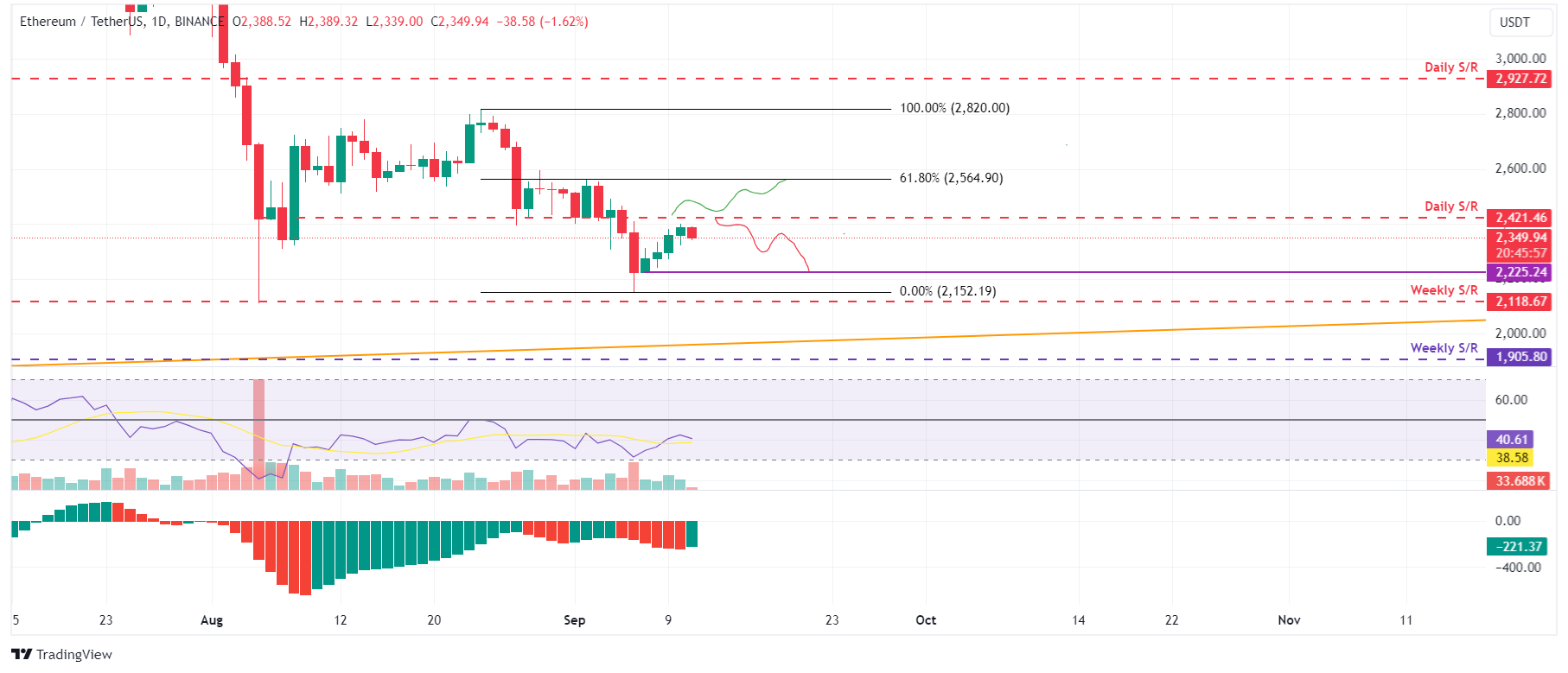
ETH/USDT daily chart
On the other hand, if ETH breaks and closes above the $2,421 level, this would invalidate the bearish thesis, and it could rally 5.8% to retest its 61.8% Fibonacci retracement level at $2,564.
Ripple price finds rejection around the 200-day Exponential Moving Average (EMA), hovering around $0.548 and the daily support level at $0.544 on Tuesday. As of Wednesday, it trades slightly down by 1.37% at $0.533.
If the 200-day EMA at $0.548 continues to hold as resistance, it could decline 6% to retest its September 6 low of $0.502.
The daily chart’s RSI and AO are trading below the neutral levels of 50 and zero. These momentum indicators strongly indicate bearish dominance.
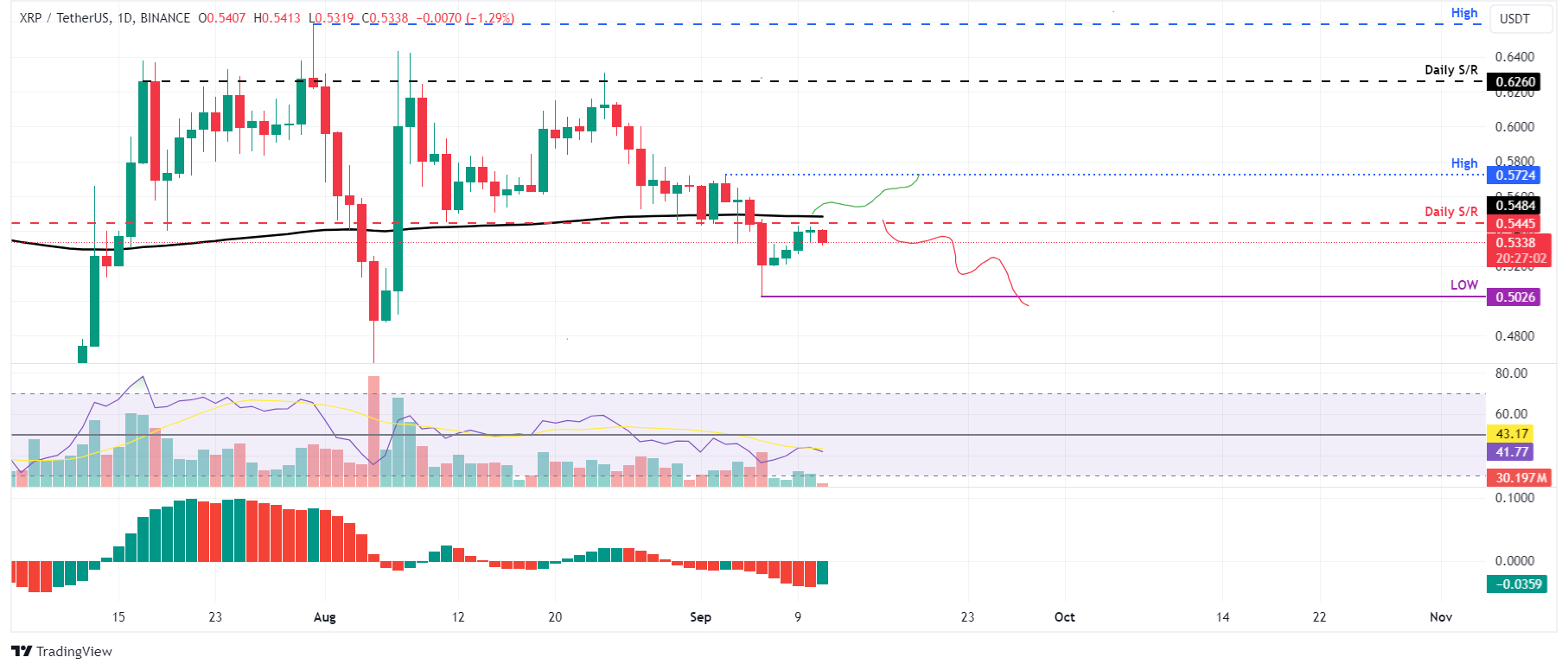
XRP/USDT daily chart
However, if the Ripple price breaks above the $0.544 daily resistance level and closes above the 200-day EMA at $0.548. This would invalidate the bearish thesis, and it could rise 4% to revisit the September 3 high of $0.572.
Even though Solana has been through major ups and downs in recent years, it is still among the largest cryptocurrencies on the market. At the time of writing, SOL commands a market cap of $61.4 billion, which makes it the 5th largest crypto asset overall. Despite its extreme volatility, Solana is still one of the most promising cryptocurrency projects and could very well remain a big player over the long term. In this article, we will be taking a look at some long-term scenarios, including a Solana price prediction for 2040 and 2050.
Solana has only been on the market for about 4 and a half years, so it’s difficult to make any kind of long-term price predictions based on SOL’s price history so far. On average, SOL has displayed a 3,038% yearly growth rate, which is obviously not going to be sustainable.
To make a more realistic Solana price prediction for 2040 and 2050, we should use more conservative benchmarks for yearly growth. Here’s a table showing what the price of 1 SOL would be assuming different average yearly growth figures.
| 2025 | 2030 | 2040 | 2050 | |
|---|---|---|---|---|
| SOL price prediction (5% yearly growth) | $138 | $176 | $286 | $467 |
| SOL price prediction (S&P 500 historical 11.13% ROI)* | $146 | $247 | $710 | $2,040 |
| SOL price prediction (BTC 3-year CAGR of 19.05%)** | $156 | $374 | $2,136 | $12,215 |
| SOL price prediction (CoinCodex algorithm) | $154 | $223 | $1,193 | $3,305 |
Based on the price of Solana of $131.20 as of September 11, 2024.
*The S&P 500 index’s average rate of return over the past 50 years.
** Bitcoin’s compounded average growth rate (CAGR) over the last 3 years has been 19.05%.
If you are looking to invest in crypto and Solana is on your shortlist, it’s important to understand how SOL got to the place where it is now. Before we take a closer look at the predictions for Solana’s future, let’s analyze Solana’s price history to get a better context.
Solana made its debut on the market in April 2020, with SOL changing hands between $0.50 and $0.80 in the first few months of trading. Towards the end of 2020, SOL surpassed the $1 mark for the first time ever and hasn’t returned below this price level since.
In 2021, Solana demonstrated one of the most impressive bullish rallies in the history of the crypto markets. SOL, which traded at about $1.6 on January 1, 2023, peaked at a whopping $259 by November of the same year. This represented a price increase of more than 160x in less than a year.
However, this massive rally also meant that there was a lot of room to fall when the cryptocurrency market as a whole turned bearish. By December 2022, SOL had crashed all the way down to $9.10 before buyers stepped in and mounted a recovery.
Since the start of 2024, the price of SOL has increased by 27.5%, with SOL currently trading at $131.
In terms of quarterly returns, we can see that SOL has posted 10 positive quarters and 7 negative quarters so far. The coin’s most successful quarter was Q1 2021, when SOL saw a +1,190% price increase.
We’ve already mentioned that using Solana’s average yearly growth so far is not very helpful when making a long-term prediction. If SOL were to grow by over 3,000% each year, we would see the coin hit truly astronomical prices by 2040.
Instead, let’s use more conservative benchmarks to estimate how high Solana can go by 2040. The S&P 500 index, which is used as a benchmark for measuring the growth of the U.S. equities market, has grown by an average of 11.13% over the past 50 years.
If we plug this rate of return into our crypto profit calculator, we can see what the price of SOL would be if it grew by 11.1% every year until 2040. We are using $131.2 as the initial investment since this is the price of SOL at the time of writing.

Under this assumption, the price of Solana in 2040 would be $710, a more than 4x increase compared to the current price.
Let’s see what happens if we assume a more ambitious rate of return. Over the last 3 years, Bitcoin has grown by compound average growth rate of 19.05%. This projection is perhaps more interesting as it is rooted in the historical price performance of the leading cryptocurrency asset, which has more in common with SOL than a stock index.

Using our crypto profit calculator, we can see that SOL would be priced at $2,136 if it grew at an average yearly rate of roughly 19% until 2040. This would be an approximately 16x price increase compared to the current Solana price.
Now, let’s use the same growth rates to project what the price of Solana could be in 2050.
If we assume Solana would follow the S&P 500 average yearly growth rate of 11.1%, SOL would have a price of $2,040 by 2050. This would be an increase of 1,455% compared to the current SOL price.

Meanwhile, if we use Bitcoin’s average yearly growth rate over the last 3 years (19.05%) as our benchmark, the price of SOL would get quite extreme in 2050. Under this assumption, the price of SOL in 2050 would be $12,215, or 91x the current price.
Given the current supply of SOL, this would imply a market capitalization of $5.6 trillion for Solana. Since not even Bitcoin has reached such a market capitalization yet, we can say that it’s pretty unlikely that SOL would reach this price level.

The CoinCodex price prediction is forecasting that SOL will be trading at $195 one year from now. However, SOL could reach as high as $330 during that time, posting a new all-time high along the way.
By 2040, Solana is predicted to climb to $1,193, which would be an 804% increase from current price levels. The prediction for 2050 is ever more bullish, as the algorithm projects a move above $3,305, which would be a 2,407% increase.
Despite the volatility in the SOL markets, the Solana community has been pushing forward with new products and developments. The platform has a flourishing ecosystem of wallets, explorers, DeFi apps, NFT marketplaces, and more.
Solana developers are making a strong push into the mobile market with the Solana Mobile Stack (SMS) software suite and the Saga, a flagship-level smartphone catering to blockchain users. The second version of the Saga phone broke records in terms of presales, so the mobile suite should continue to gain adoption in the future.
In addition, we’ve seen several interesting projects launch on Solana recently, which shows that talented developers are still interested in building on the platform thanks to its scalability and efficiency. One such example is the content monetization protocol Access Protocol. In addition, the decentralized network infrastructure project Helium migrated from its own blockchain over to Solana earlier this year.
It’s also worth noting that Solana has become the blockchain for meme coin development in recent months, highlighted by the market success of memecoins such as Dogwifhat, Bonk, Book of Meme, Daddy Tate, and many more. In fact, the Solana-based decentralized exchanges – which are primarily platforms for buying and selling these tokens – have seen a huge spike in activity, even surpassing Ethereum DeFi trading volume on some day.
On the other hand, there are also a few reasons why Solana might not see much growth in the future. The fast development of layer 2 solutions for Ethereum could make Solana redundant if the Ethereum layer 2s manage to reach similar performance. In addition, Solana doesn’t have the best reputation in some parts of the crypto community due to the several outages that made the network temporarily unavailable.
Solana could certainly be a strong performer over the long term, but we should be careful about using SOL’s growth up to this point as a benchmark for how it will perform in the future. While Solana is certainly not dead, we shouldn’t expect SOL to make the same kind of jump as it did in 2021.
If you’re interested in the future of Solana, check out our article exploring the question of whether SOL is a good investment.
For additional long-term predictions, check our following analyses:
Polygon, the second-largest Layer-2 network built on the Ethereum blockchain, is initiating a major upgrade today. The longstanding MATIC token will transition to POL tokens.
This move aims to enhance the network’s flexibility in issuing new supplies.
MATIC has a strong market presence, boasting a market capitalization of $3.6 billion. Moreover, it ranks as the 28th largest crypto asset. Hence, this migration will directly impact a large number of crypto investors.
Specifically, those holding MATIC on the Polygon Proof of Stake (PoS) chain need not take any action; their tokens will automatically convert to POL. Conversely, those on the Ethereum network and Polygon’s zkEVM layer-2 network might need to manually migrate their tokens through the Polygon Portal Interface or by bridging to Ethereum.
Currently, there is no set deadline for MATIC holders on these platforms to convert their tokens to POL. However, Polygon has hinted that it might impose a deadline in the future. This change is a key part of a broader strategy detailed in the “Polygon 2.0” roadmap, which positions POL as the core token across its main and subsidiary chains.
Read more: How To Transfer MATIC to POL
According to Polygon officials, POL will serve critical functions across the network. Initially, it will become the native gas and staking token of the Polygon PoS network.
“POL is a hyperproductive token that can be used to provide valuable services to any chain in the Polygon network, including the AggLayer itself. It feels good to know that, as the community builds towards this exciting vision, the network has a future-proof native token that can secure it and support its growth,” Polygon explained.
The AggLayer is a central element of the roadmap, aiming to unify various blockchain platforms utilizing Polygon’s technology. In the future, POL is slated to support an array of functions within the Polygon staking hub, scheduled to launch in 2025. These functions include block generation, zero-knowledge proof generation, and participation in Data Availability Committees (DACs).
The shift to POL also brings changes in tokenomics, with a new emission rate of 2% annually. This rate aims to reward validators on the Polygon PoS chain and replenish the community treasury, thus supporting the network’s sustainability and growth.
Read more: Polygon (MATIC) Price Prediction 2024/2025/2030
Despite these optimistic developments, the value of MATIC has been declining, currently trading at $0.3897 with a 5% drop over the last 24 hours.
Disclaimer
In adherence to the Trust Project guidelines, BeInCrypto is committed to unbiased, transparent reporting. This news article aims to provide accurate, timely information. However, readers are advised to verify facts independently and consult with a professional before making any decisions based on this content. Please note that our Terms and Conditions, Privacy Policy, and Disclaimers have been updated.
Dogecoin price has been displaying bullish trends lately despite the entire market struggling to get back on its feet, and many are wondering how soon Bitcoin price could resume its rally. This comes amid a high-profile social media exchange between Elon Musk and Taylor Swift has sparked renewed speculation.
Meanwhile, the much anticipated Trump-Harris debate was an anti-climatic event for the crypto community as the duo skipped crypto talks. The effect was a general market slump that also affected Dogecoin. Nevertheless, investors remain optimistic as DOGE price hints at the potential to surge by 113% over the coming days, but there’s a catch.
The recent online exchange between Elon Musk and Taylor Swift has ignited fresh interest in Dogecoin. Musk, known for his influence on market trends, responded on X (formerly Twitter) to Swift’s Instagram post endorsing Kamala Harris for U.S. President. Swift’s post, featuring her cat with the caption “childless cat lady” in a jab at J.D. Vance quickly went viral.
Fine Taylor … you win … I will give you a child and guard your cats with my life
— Elon Musk (@elonmusk) September 11, 2024
Musk, a vocal Trump supporter, has previously called for a government efficiency commission, humorously abbreviated as “DOGE.” Given his social media antics’ past impact on Dogecoin price, many investors are now wondering if this high-profile interaction could trigger significant gains for the meme coin.
DOGE price has dropped 3.2% in the last 24 hours and is trading at $0.1004.
While the long-term projection is bullish for Dogecoin, in the short term, there is a chance that the price will drop 6% to $0.092 before shooting for higher levels. On the 4-hour chart, Dogecoin price trended inside a falling channel and had an aggressive breakout on September 10. Technically, breakout confirmations are usually accompanied by retests; otherwise, they risk becoming fake-outs.

This sentiment, further echoed by the data from Coinglass, shows an imbalance between the DOGE Longs and Shorts. On the daily timeframe, there is an overwhelming amount of Shorts, which means the market is overall bearish on that timeframe, expecting the price to drop lower,

However, the weekly timeframe shows there are more Longs than Shorts, the imbalance suggesting that bullish sentiment is dominating the market since traders expect the Dogecoin price to rise in the long term.
The Dogecoin price is in a falling wedge pattern on the daily time frame, commonly known for resolving to the upside. The pattern has spanned six months, meaning the breakout could be significant, potentially larger than the anticipated 113% increase.
DOGE price will likely experience resistance around $0.115 and $0.138 on its way up. Beyond that, Dogecoin may target $0.17 and eventually $0.21 before surging to new yearly highs.

On the flip side, if bears prevail, Dogecoin price prediction shows the meme coin might lose the current support at $0.092 and drop lower to test $0.08 and $0.07 supports.
Elon Musk’s humorous response to Taylor Swift’s Kamala Harris endorsement has led to speculation that his social media influence could boost Dogecoin’s value.
Investors might want to consider the potential for a 6% drawdown as an opportunity to enter before a significant price increase. However, as always, it’s essential to carefully analyze the risks and market conditions before making any decisions.
In the long term, Dogecoin is projected to break out of its six-month-long falling wedge pattern, which typically resolves to the upside. The price could potentially face resistance at $0.115 and $0.138 before targeting higher levels such as $0.17 and $0.21, and possibly new yearly highs.
Related Articles

Evans Karanja
Evans Karanja is a crypto analyst and journalist with a deep focus on blockchain technology, cryptocurrency, and the video gaming industry. His extensive experience includes collaborating with various startups to deliver insightful and high-quality analyses that resonate with their target audiences. As an avid crypto trader and investor, Evans is passionate about the transformative potential of blockchain across diverse sectors. Outside of his professional pursuits, he enjoys playing video games and exploring scenic waterfalls.
Disclaimer: The presented content may include the personal opinion of the author and is subject to market condition. Do your market research before investing in cryptocurrencies. The author or the publication does not hold any responsibility for your personal financial loss.
Cardano [ADA] has seen renewed interest after the integration of the ASI token into its blockchain. This development, along with greater activity in decentralized finance (DeFi), has drawn attention to the network again. Despite these positive moves, however, ADA’s price did drop by 0.49% in the last 24 hours. At press time, it was valued at $0.3429.
While there are signs of potential growth, market indicators suggest caution is necessary before making long-term bullish predictions.
Cardano has been consolidating in a tight range between $0.302 and $0.395, with traders closely watching the $0.395 resistance level. The Bollinger Bands revealed a narrow trading range, typically signaling upcoming volatility. If ADA breaks through the $0.395 resistance, it could confirm a stronger bullish trend, which many traders have been waiting for.
Cardano’s technical indicators still presented a mixed picture though. For instance, the Relative Strength Index (RSI) was found at 48.37 – A sign that the market was in a neutral zone, providing room for price growth.
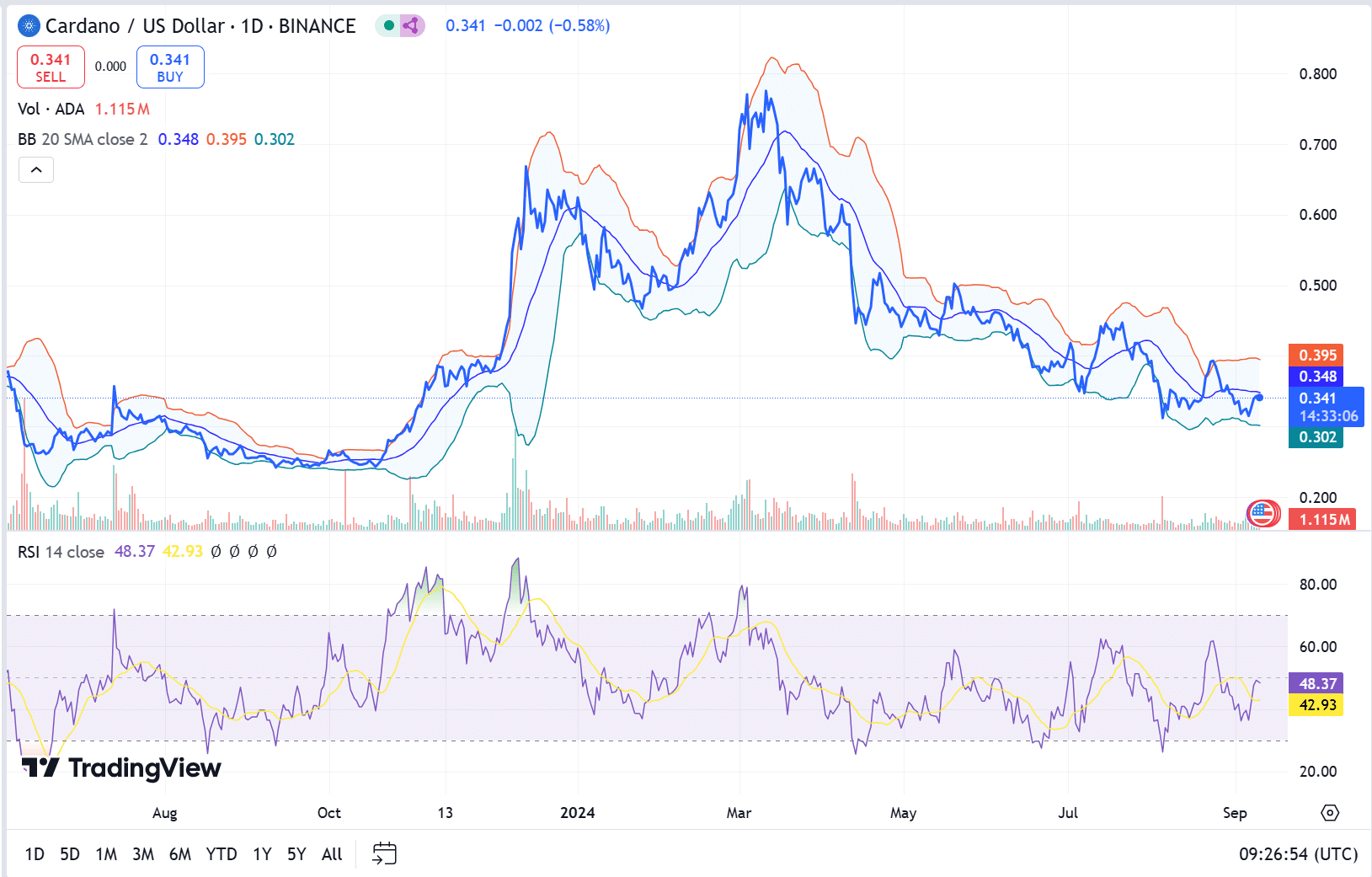
Source: TradingView
ADA’s trading volume fell by 3.16% in the past 24 hours too, bringing the total volume to $232 million. This decline in volume may hinder ADA’s ability to break through the $0.395 resistance. A stronger volume hike would be needed to confirm a bullish breakout.
On the contrary, on-chain activity did offer some positive signs for Cardano. The number of active addresses climbed to 31,678 – a 5-month high. This reflected a surge in network participation following the ASI token deployment.
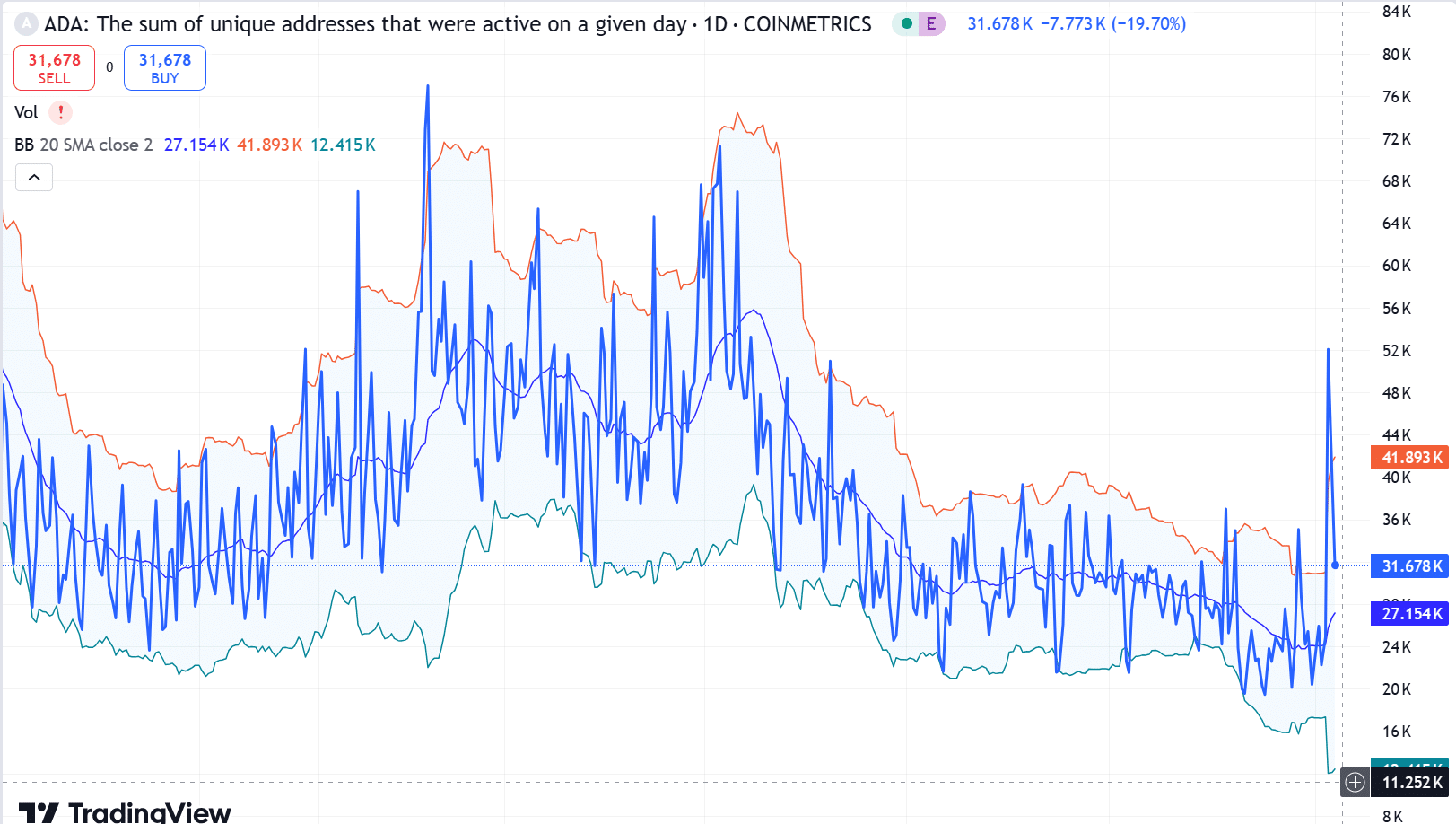
Source: TradingView
Additionally, Cardano’s transaction volume spiked to $286.81 million – A sign of heightened on-chain activity, according to Coinglass. This rise in transaction volume demonstrates robust usage of the Cardano network, which could support future price movements.
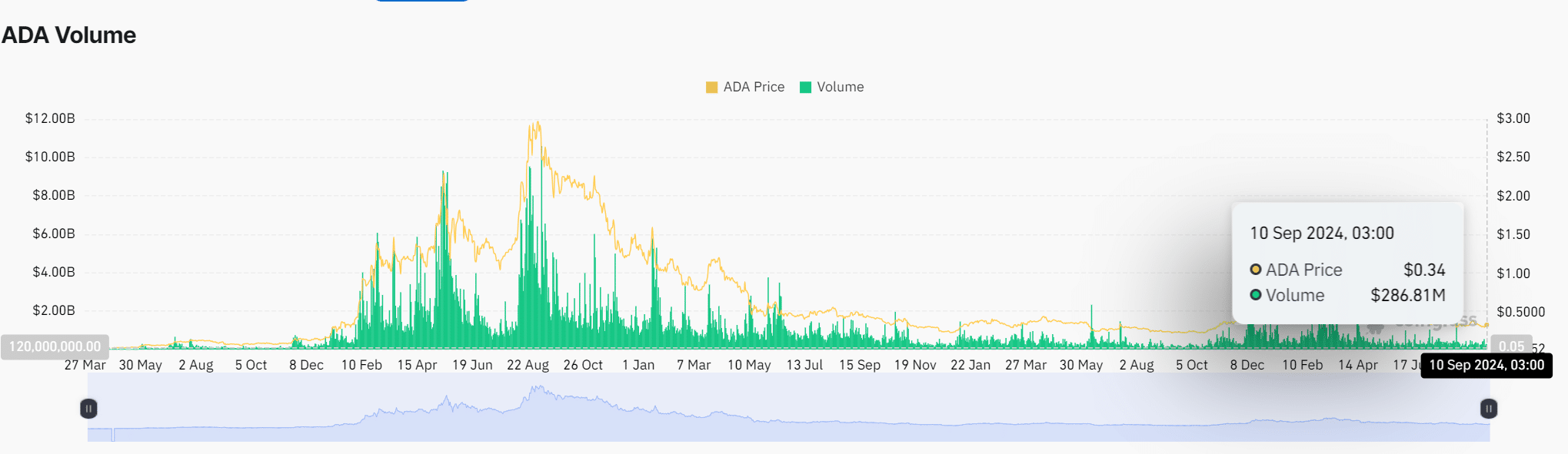
Source: Coinglass
Cardano’s ASI token integration has sparked renewed interest and a hike in active addresses. However, the decline in trading volume raises concerns about whether this enthusiasm will translate into sustained growth.
An uptick in trading and transaction volume will be critical for ADA to break out of its current consolidation. Traders should remain cautious, monitoring key levels and activity across the network before confirming a long-term bullish trend.



✓ Share: