The EURJPY repeated attempts to form bullish waves due to providing positive momentum by the main indicators in the last period, to move away from the support at 182.00 and recording some gains by reaching 183.55.
We couldn’t confirm regaining the bullish bias unless breaching the barrier at 184.40 level and holding above it, therefore, we expect forming unstable mixed trading, to keep waiting for surpassing the main levels to confirm the main trend in the upcoming period.
The expected trading range for today is between 182.55 and 184.00
Trend forecast: Fluctuating within the bearish track
The Pound to US Dollar (GBP/USD) exchange rate moved little on Wednesday, with traders opting for caution ahead of the Federal Reserve’s upcoming interest rate decision.
At the time of writing, GBP/USD hovered around $1.3358, showing minimal movement from the start of the session.
The US Dollar remained confined to a tight range during European trading hours, as investors held back from making significant moves ahead of the Federal Reserve’s latest policy announcement.
Although no changes to interest rates are expected, attention is firmly on the Fed’s guidance and remarks from Chair Jerome Powell for clues on the direction of future monetary policy.
Markets are particularly focused on how policymakers interpret the inflationary impact of the ongoing tensions in the Middle East, which have pushed global energy prices sharply higher in recent weeks.
Fears that inflation could remain elevated for longer have already led some analysts to delay their expectations for when the Federal Reserve might begin easing policy.
Should the Fed signal a later timeline for rate cuts, or even hint at further tightening, the US Dollar could jump.
Save on Your GBP/USD Transfer
Get better rates and lower fees on your next international money transfer.
Compare TorFX with top UK banks in seconds and see how much you could save.
The Pound was largely stable, as a modest decline in energy prices offered some respite to UK bond markets.
Government borrowing costs edged lower, with two-year yields slipping as falling oil prices helped ease some of the immediate inflationary pressure on the UK economy.
At the same time, investors remained cautious toward Sterling, refraining from placing strong directional bets ahead of the Bank of England’s own policy decision.
Short-Term GBP/USD Forecast: BoE Guidance in Focus
Attention will shift to the Bank of England’s interest rate announcement, which is expected to be the next major driver for the Pound to US Dollar exchange rate.
As with the Federal Reserve, policymakers are not expected to alter rates at this meeting, leaving forward guidance as the key area of interest. Any indication that rates may need to rise again to counter inflation could provide support for the Pound.
For the US Dollar, geopolitical developments will remain important, with any escalation in the Middle East likely to revive demand for safe-haven assets.
Like this piece? Please share with your friends and colleagues:
International Money Transfer? Ask our resident FX expert a money transfer question or try John’s new, free, no-obligation personal service! ,where he helps every step of the way,
ensuring you get the best exchange rates on your currency requirements.
2026.03.18 2026.03.18 Yen Gains Ground As BoJ Expected to Adopt Hawkish Tone. Forecast as of 18.03.2026
Dmitri Demidenkohttps://www.litefinance.org/blog/authors/dmitri-demidenko/
The Bank of Japan’s main advantage is timing. By the time it acts, the outcome of the Fed meeting and the markets’ reaction will already be clear, allowing it to adjust its own accompanying statement accordingly. Will the USD/JPY pair benefit from this? Let’s discuss this topic and make a trading plan.
The article covers the following subjects:
Major Takeaways
Rising oil prices and a weaker yen are spurring inflation in Japan.
The Bank of Japan’s cautious stance could continue to weigh on the yen.
Timing is on the BoJ’s side, allowing it to react after the Fed’s policy decisions.
Pullbacks toward 158.3 and 157.7 may offer opportunities to open long positions on the USD/JPY.
Weekly Fundamental Forecast for Yen
Ignoring the problem will not make it disappear. Markets are closely watching how central banks will respond to the potential combination of rising inflation and slowing economic growth amid the Middle East conflict. The challenge is particularly acute for the Bank of Japan, as Japan relies on imports for roughly 90% of its energy needs. Rising oil prices, coupled with a weak yen, could push consumer prices sharply higher. At the same time, Sanae Takaichi’s government has shown little enthusiasm for raising the overnight rate.
USD/JPY and Crude Price
Source: Bloomberg.
None of the 51 Bloomberg analysts expect the Bank of Japan to tighten monetary policy in March, but the futures market puts a 60% probability on this happening in April. The question remains: will the BoJ dash these expectations by citing caution due to the Middle East conflict, or will it provide a clear signal that it will resume monetary tightening?
The BoJ’s hesitancy could weigh heavily on the yen. The Reserve Bank of Australia has already raised rates, and the derivatives market suggests a 69% probability that the European Central Bank will follow suit by June. Hawkish signals from the Fed are likely to push USD/JPY quotes higher. Geopolitical tensions have driven the pair above 20-month highs, but ahead of a series of central bank meetings, speculators have begun taking profits on their long positions.
USD/JPY Price and Speculative Positions on Japanese Yen
Source: Bloomberg.
The Bank of Japan’s main advantage is timing. Its upcoming meeting is scheduled just a few hours after the Federal Reserve releases its results, including revised forecasts for the federal funds rate. This allows the BoJ to observe how USD/JPY quotes react to Jerome Powell’s comments and adjust its accompanying statement accordingly.
Japanese officials appear to view the current USD/JPY rally as unfavorable. Finance Minister Satsuki Katayama continues to caution investors through verbal interventions, noting that financial markets are experiencing heightened volatility. At the same time, the pair has become detached from fundamental factors, with the current deviation particularly pronounced. Under these conditions, Japanese officials remain ready to take action at any moment, maintaining close coordination with Washington.
While there is no doubt about the Japanese government’s willingness to intervene in the Forex market, success is likely to be limited when the rally is driven primarily by oil prices and the US dollar, factors largely outside the BoJ’s control. If the Fed fails to temper bulls, the BoJ is unlikely to succeed either. In such a scenario, the Ministry of Finance may have no choice but to wait for a more favorable moment to act.
Weekly USDJPY Trading Plan
Against this backdrop, a pullback in USD/JPY quotes toward support levels at 158.3 and 157.7, or a rebound above the resistance at 159.1, could present a buying opportunity. At the same time, upcoming central bank meetings may trigger increased volatility.
This forecast is based on the analysis of fundamental factors, including official statements from financial institutions and regulators, various geopolitical and economic developments, and statistical data. Historical market data are also considered.
Price chart of USDJPY in real time mode
The content of this article reflects the author’s opinion and does not necessarily reflect the official position of LiteFinance broker. The material published on this page is provided for informational purposes only and should not be considered as the provision of investment advice for the purposes of Directive 2014/65/EU.
According to copyright law, this article is considered intellectual property, which includes a prohibition on copying and distributing it without consent.
EUR/USD stays in a consolidation phase above 1.1500 after posting gains on Monday and Tuesday. The pair’s near-term technical outlook points to a loss of bearish momentum as focus shifts to the Federal Reserve’s (Fed) policy announcements.
Euro Price This week
The table below shows the percentage change of Euro (EUR) against listed major currencies this week. Euro was the strongest against the US Dollar.
USD
EUR
GBP
JPY
CAD
AUD
NZD
CHF
USD
-0.93%
-0.78%
-0.33%
-0.20%
-1.58%
-1.14%
-0.48%
EUR
0.93%
0.18%
0.53%
0.72%
-0.65%
-0.23%
0.45%
GBP
0.78%
-0.18%
0.49%
0.56%
-0.80%
-0.39%
0.35%
JPY
0.33%
-0.53%
-0.49%
0.14%
-1.24%
-0.80%
-0.16%
CAD
0.20%
-0.72%
-0.56%
-0.14%
-1.42%
-0.94%
-0.27%
AUD
1.58%
0.65%
0.80%
1.24%
1.42%
0.42%
1.12%
NZD
1.14%
0.23%
0.39%
0.80%
0.94%
-0.42%
0.65%
CHF
0.48%
-0.45%
-0.35%
0.16%
0.27%
-1.12%
-0.65%
The heat map shows percentage changes of major currencies against each other. The base currency is picked from the left column, while the quote currency is picked from the top row. For example, if you pick the Euro from the left column and move along the horizontal line to the US Dollar, the percentage change displayed in the box will represent EUR (base)/USD (quote).
The improvement seen in risk mood, as reflected by the modest recovery in Wall Street’s main indexes after the opening bell, helped EUR/USD edge higher in the American session on Tuesday.
Early Wednesday, US stock index futures stay in positive territory, limiting the USD’s gains and allowing EUR/USD to hold its ground.
In the second half of the day, market participants will take a break from the Middle East conflict and shift their attention to the Fed event.
The US central bank is widely expected to leave the policy rate unchanged after the March meeting. Alongside the policy statement, the Fed will publish the Summary of Economic Projections (SEP), which will highlight policymakers’ inflation, growth and interest rate expectations.
In December, the SEP showed that officials’ projections implied one 25 basis-points (bps) rate cut in 2026. In case the publication shows that a majority of policymakers see the interest rate remaining unchanged for the rest of the year, the immediate reaction could trigger a USD rally and weigh on EUR/USD. Conversely, the USD could have a hard time finding demand if the SEP points to at least one rate cut in 2026. According to the CME FedWatch Tool, markets are currently pricing in about a 30% probability that the policy rate will hold steady at 3.5%-3.75% by end-2026.
Investors will also pay close attention to comments from Fed Chair Jerome Powell. If Powell hints that they will have to be more attentive to inflation risks, because of rising Oil prices due to the US-Iran war, the USD could preserve its strength. On the other hand, EUR/USD could gain traction in case Powell voices growing concerns over the labor market outlook after the February employment report showed a significant 92,000 decline in Nonfarm Payrolls (NFP).
EUR/USD Technical Analysis:
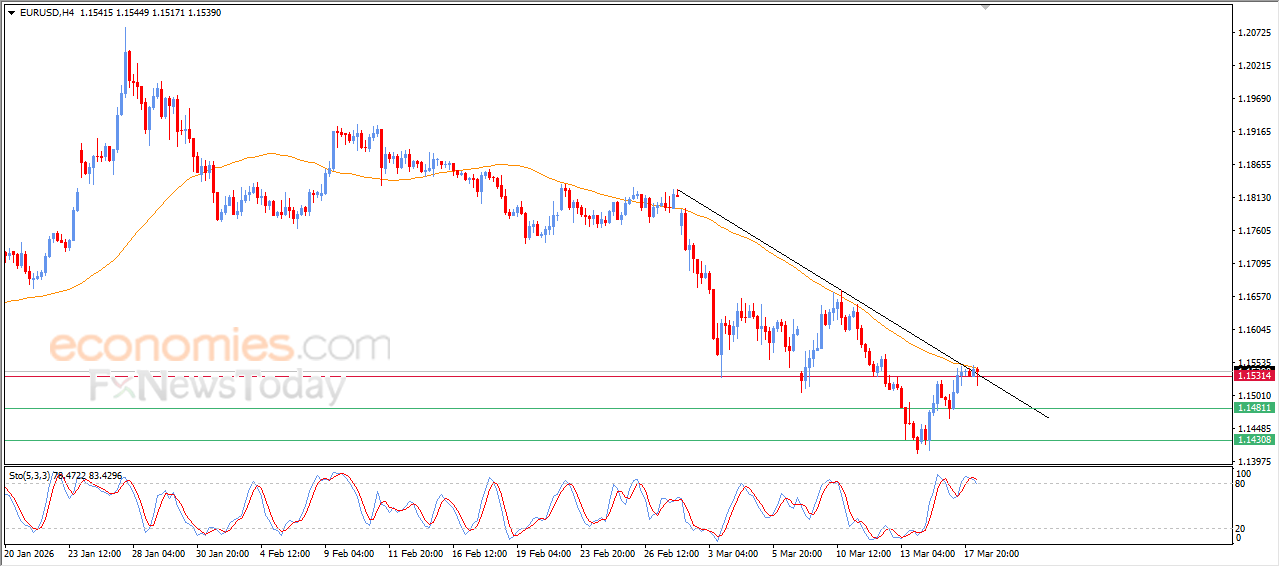
In the 4-hour chart, EUR/USD trades at 1.1523. The near-term bias is mildly bullish after the pair rebounded from the 1.1500 support area and broke above the descending resistance trend line that originated near 1.1817 and was intersecting around 1.1509. Price now holds just above the 20-period Moving Average (MA) at 1.1487 and closes in on the 50-period MA at 1.1544, while remaining capped well below the flattening 100- and 200-period MAs clustered above 1.1630, which tempers upside conviction. The Relative Strength Index (RSI) hovers around 51, reflecting balanced but recovering momentum that favors a gradual upside extension as long as the recent breakout is preserved.
Immediate support is located at 1.1500, reinforced by the nearby 20-period MA, with the next cushion at 1.1460 ahead of a stronger structural floor at 1.1410. Holding above 1.1500 would keep buyers in control and maintain the post-breakout structure. On the upside, initial resistance is seen near the 1.1600 area (static level), followed by the 100-period SMA at 1.1630 and 1.1670 (static level).
(The technical analysis of this story was written with the help of an AI tool.)
Euro FAQs
The Euro is the currency for the 20 European Union countries that belong to the Eurozone. It is the second most heavily traded currency in the world behind the US Dollar. In 2022, it accounted for 31% of all foreign exchange transactions, with an average daily turnover of over $2.2 trillion a day.
EUR/USD is the most heavily traded currency pair in the world, accounting for an estimated 30% off all transactions, followed by EUR/JPY (4%), EUR/GBP (3%) and EUR/AUD (2%).
The European Central Bank (ECB) in Frankfurt, Germany, is the reserve bank for the Eurozone. The ECB sets interest rates and manages monetary policy.
The ECB’s primary mandate is to maintain price stability, which means either controlling inflation or stimulating growth. Its primary tool is the raising or lowering of interest rates. Relatively high interest rates – or the expectation of higher rates – will usually benefit the Euro and vice versa.
The ECB Governing Council makes monetary policy decisions at meetings held eight times a year. Decisions are made by heads of the Eurozone national banks and six permanent members, including the President of the ECB, Christine Lagarde.
Eurozone inflation data, measured by the Harmonized Index of Consumer Prices (HICP), is an important econometric for the Euro. If inflation rises more than expected, especially if above the ECB’s 2% target, it obliges the ECB to raise interest rates to bring it back under control.
Relatively high interest rates compared to its counterparts will usually benefit the Euro, as it makes the region more attractive as a place for global investors to park their money.
Data releases gauge the health of the economy and can impact on the Euro. Indicators such as GDP, Manufacturing and Services PMIs, employment, and consumer sentiment surveys can all influence the direction of the single currency.
A strong economy is good for the Euro. Not only does it attract more foreign investment but it may encourage the ECB to put up interest rates, which will directly strengthen the Euro. Otherwise, if economic data is weak, the Euro is likely to fall.
Economic data for the four largest economies in the euro area (Germany, France, Italy and Spain) are especially significant, as they account for 75% of the Eurozone’s economy.
Another significant data release for the Euro is the Trade Balance. This indicator measures the difference between what a country earns from its exports and what it spends on imports over a given period.
If a country produces highly sought after exports then its currency will gain in value purely from the extra demand created from foreign buyers seeking to purchase these goods. Therefore, a positive net Trade Balance strengthens a currency and vice versa for a negative balance.
The EURJPY repeated attempts to form bullish waves due to providing positive momentum by the main indicators in the last period, to move away from the support at 182.00 and recording some gains by reaching 183.55.
We couldn’t confirm regaining the bullish bias unless breaching the barrier at 184.40 level and holding above it, therefore, we expect forming unstable mixed trading, to keep waiting for surpassing the main levels to confirm the main trend in the upcoming period.
The expected trading range for today is between 182.55 and 184.00
Trend forecast: Fluctuating within the bearish track
The EURJPY repeated attempts to form bullish waves due to providing positive momentum by the main indicators in the last period, to move away from the support at 182.00 and recording some gains by reaching 183.55.
We couldn’t confirm regaining the bullish bias unless breaching the barrier at 184.40 level and holding above it, therefore, we expect forming unstable mixed trading, to keep waiting for surpassing the main levels to confirm the main trend in the upcoming period.
The expected trading range for today is between 182.55 and 184.00
Trend forecast: Fluctuating within the bearish track
Important DisclaimersFXEmpire is owned and operated by Empire Media Network LTD., Company Registration Number 514641786, registered at 7 Jabotinsky Road, Ramat Gan 5252007, Israel. The content provided on this website includes general news and publications, our personal analysis and opinions, and materials provided by third parties. This content is intended for educational and research purposes only. It does not constitute, and should not be interpreted as, a recommendation or advice to take any action, including making any investment or purchasing any product. Before making any financial decision, you should conduct your own due diligence, exercise your own discretion, and consult with competent advisors. The content on this website is not personally directed to you, and we do not take into account your individual financial situation or needs. The information contained on this website is not necessarily provided in real time, nor is it guaranteed to be accurate. Prices displayed may be provided by market makers and not by exchanges. Any trading or other financial decision you make is entirely your own responsibility, and you must not rely solely on any information provided through the website. FXEmpire does not provide any warranty regarding the accuracy, completeness, or reliability of any information contained on the website and shall bear no responsibility for any trading losses you may incur as a result of using such information. The website may include advertisements and other promotional content. FXEmpire may receive compensation from third parties in connection with such content. FXEmpire does not endorse, recommend, or assume responsibility for the use of any third-party services or websites. Empire Media Network LTD., its employees, officers, subsidiaries, and affiliates shall not be liable for any loss or damage resulting from your use of the website or reliance on the information provided herein.Risk DisclaimersThis website contains information about cryptocurrencies, contracts for difference (CFDs), and other financial instruments, as well as about brokers, exchanges, and other entities trading in such instruments. Both cryptocurrencies and CFDs are complex instruments and involve a high risk of losing money. You should carefully consider whether you understand how these instruments work and whether you can afford to take the high risk of losing your money. FX Empire encourages you to conduct your own research before making any investment decision and to avoid investing in any financial instrument unless you fully understand how it works and the risks involved.
Important DisclaimersFXEmpire is owned and operated by Empire Media Network LTD., Company Registration Number 514641786, registered at 7 Jabotinsky Road, Ramat Gan 5252007, Israel. The content provided on this website includes general news and publications, our personal analysis and opinions, and materials provided by third parties. This content is intended for educational and research purposes only. It does not constitute, and should not be interpreted as, a recommendation or advice to take any action, including making any investment or purchasing any product. Before making any financial decision, you should conduct your own due diligence, exercise your own discretion, and consult with competent advisors. The content on this website is not personally directed to you, and we do not take into account your individual financial situation or needs. The information contained on this website is not necessarily provided in real time, nor is it guaranteed to be accurate. Prices displayed may be provided by market makers and not by exchanges. Any trading or other financial decision you make is entirely your own responsibility, and you must not rely solely on any information provided through the website. FXEmpire does not provide any warranty regarding the accuracy, completeness, or reliability of any information contained on the website and shall bear no responsibility for any trading losses you may incur as a result of using such information. The website may include advertisements and other promotional content. FXEmpire may receive compensation from third parties in connection with such content. FXEmpire does not endorse, recommend, or assume responsibility for the use of any third-party services or websites. Empire Media Network LTD., its employees, officers, subsidiaries, and affiliates shall not be liable for any loss or damage resulting from your use of the website or reliance on the information provided herein.Risk DisclaimersThis website contains information about cryptocurrencies, contracts for difference (CFDs), and other financial instruments, as well as about brokers, exchanges, and other entities trading in such instruments. Both cryptocurrencies and CFDs are complex instruments and involve a high risk of losing money. You should carefully consider whether you understand how these instruments work and whether you can afford to take the high risk of losing your money. FX Empire encourages you to conduct your own research before making any investment decision and to avoid investing in any financial instrument unless you fully understand how it works and the risks involved.
The USD/JPY pair attracts some dip-buying during the Asian session on Tuesday and stalls its modest pullback from the 159.75 area, or the highest level since July 2024, retested the previous day. Spot prices currently trade around the 159.20-159.25 region, though bulls seem hesitant amid intervention fears and ahead of the key central bank event risks.
The US Federal Reserve (Fed) is scheduled to announce its decision at the end of a two-day meeting on Wednesday, which will be followed by the Bank of Japan (BoJ) policy update on Thursday. Investors will look for fresh cues about the central bank’s rate outlook amid inflationary concerns stemming from a further escalation of conflicts in the Middle East. This, in turn, will provide some meaningful impetus to the USD/JPY pair and help in determining the next leg of a directional move.
From a technical perspective, the near-term bias is mildly bullish as the USD/JPY pair holds well above the rising 200-period Simple Moving Average (SMA) on the 4-hour chart, indicating buyers retain control despite recent hesitancy. Furthermore, the Moving Average Convergence Divergence (MACD) has turned slightly positive after recovering from negative territory, suggesting improving upward momentum.
That said, the Relative Strength Index (RSI) near 49 stays close to the neutral line, which reinforces a modest upside tone rather than a strong trending move. Hence, any further move up is more likely to confront some resistance near the 159.75 region ahead of 160.00, where psychological offers could cap gains. A clear hourly close above the latter would strengthen the bullish case and pave the way for a retest of higher highs in the coming sessions.
On the downside, initial support emerges at 159.00, with a break exposing the next downside level near the 200-period SMA around 158.40. A sustained move below that area would weaken the current bullish bias and open the door toward 158.00. On the upside, immediate resistance stands at 159.60, the recent intraday high zone, followed by the 160.00 psychological mark.
(The technical analysis of this story was written with the help of an AI tool.)
(This story was corrected on March 17 at 07:30 GMT to mention the 160.00 psychological mark as the next relevant resistance.)
USD/JPY 4-hour chart
Japanese Yen FAQs
The Japanese Yen (JPY) is one of the world’s most traded currencies. Its value is broadly determined by the performance of the Japanese economy, but more specifically by the Bank of Japan’s policy, the differential between Japanese and US bond yields, or risk sentiment among traders, among other factors.
One of the Bank of Japan’s mandates is currency control, so its moves are key for the Yen. The BoJ has directly intervened in currency markets sometimes, generally to lower the value of the Yen, although it refrains from doing it often due to political concerns of its main trading partners. The BoJ ultra-loose monetary policy between 2013 and 2024 caused the Yen to depreciate against its main currency peers due to an increasing policy divergence between the Bank of Japan and other main central banks. More recently, the gradually unwinding of this ultra-loose policy has given some support to the Yen.
Over the last decade, the BoJ’s stance of sticking to ultra-loose monetary policy has led to a widening policy divergence with other central banks, particularly with the US Federal Reserve. This supported a widening of the differential between the 10-year US and Japanese bonds, which favored the US Dollar against the Japanese Yen. The BoJ decision in 2024 to gradually abandon the ultra-loose policy, coupled with interest-rate cuts in other major central banks, is narrowing this differential.
The Japanese Yen is often seen as a safe-haven investment. This means that in times of market stress, investors are more likely to put their money in the Japanese currency due to its supposed reliability and stability. Turbulent times are likely to strengthen the Yen’s value against other currencies seen as more risky to invest in.