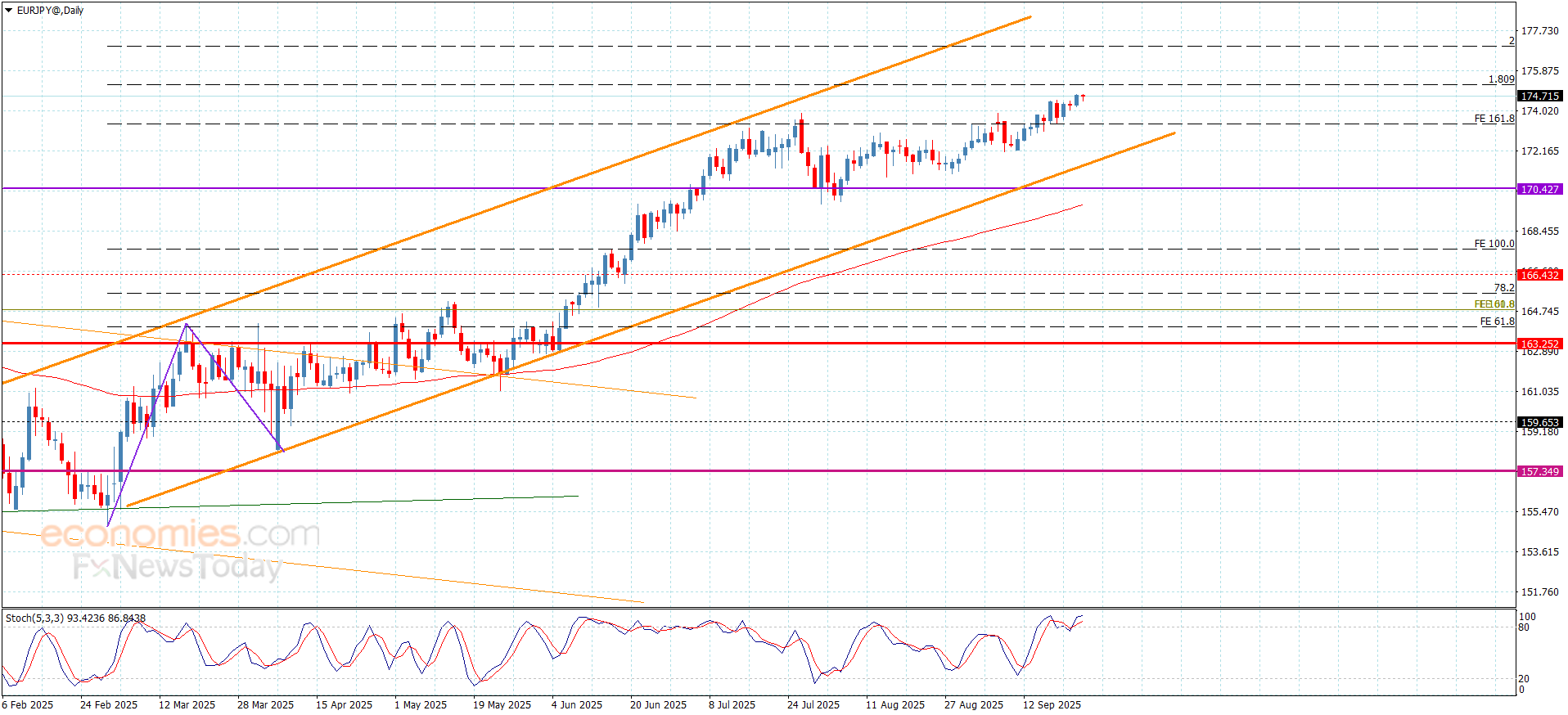
The EURJPY pair didn’t settle above 172.00 level, affected by stochastic exit from the overbought level, forming some of the bearish correctional waves and its stability near 171.65.
The continuation of the negative pressures will force it to suffer more of the losses, to expect attacking 170.45 level, to extend the losses towards 169.80 which might form a neckline for the negative double top level, therefore, we recommend monitoring the price behavior when reaching this level to detect the main trend in the upcoming trading.
The expected trading range for today is between 170.45 and 172.30
Important DisclaimersThe content provided on the website includes general news and publications, our personal analysis and opinions, and contents provided by third parties, which are intended for educational and research purposes only. It does not constitute, and should not be read as, any recommendation or advice to take any action whatsoever, including to make any investment or buy any product. When making any financial decision, you should perform your own due diligence checks, apply your own discretion and consult your competent advisors. The content of the website is not personally directed to you, and we does not take into account your financial situation or needs.The information contained in this website is not necessarily provided in real-time nor is it necessarily accurate. Prices provided herein may be provided by market makers and not by exchanges.Any trading or other financial decision you make shall be at your full responsibility, and you must not rely on any information provided through the website. FX Empire does not provide any warranty regarding any of the information contained in the website, and shall bear no responsibility for any trading losses you might incur as a result of using any information contained in the website.The website may include advertisements and other promotional contents, and FX Empire may receive compensation from third parties in connection with the content. FX Empire does not endorse any third party or recommends using any third party’s services, and does not assume responsibility for your use of any such third party’s website or services.FX Empire and its employees, officers, subsidiaries and associates, are not liable nor shall they be held liable for any loss or damage resulting from your use of the website or reliance on the information provided on this website.Risk DisclaimersThis website includes information about cryptocurrencies, contracts for difference (CFDs) and other financial instruments, and about brokers, exchanges and other entities trading in such instruments. Both cryptocurrencies and CFDs are complex instruments and come with a high risk of losing money. You should carefully consider whether you understand how these instruments work and whether you can afford to take the high risk of losing your money.FX Empire encourages you to perform your own research before making any investment decision, and to avoid investing in any financial instrument which you do not fully understand how it works and what are the risks involved.
GBP/USD trades at around 1.3500 in the European session on Wednesday.
Annual CPI inflation in the UK rose to 3.8% in July.
The technical outlook is yet to point to a buildup in recovery momentum.
After falling to a fresh eight-day low near 1.3460 in the Asian session on Wednesday, GBP/USD recovered to the 1.3500 area in the European trading hours. The pair’s technical outlook, however, doesn’t yet offer any convincing signs of an extended recovery.
British Pound PRICE This week
The table below shows the percentage change of British Pound (GBP) against listed major currencies this week. British Pound was the weakest against the US Dollar.
USD
EUR
GBP
JPY
CAD
AUD
NZD
CHF
USD
0.58%
0.50%
0.24%
0.41%
1.17%
1.67%
0.24%
EUR
-0.58%
-0.09%
-0.38%
-0.18%
0.60%
1.06%
-0.33%
GBP
-0.50%
0.09%
-0.38%
-0.08%
0.69%
1.15%
-0.29%
JPY
-0.24%
0.38%
0.38%
0.20%
0.97%
1.48%
0.02%
CAD
-0.41%
0.18%
0.08%
-0.20%
0.74%
1.27%
-0.20%
AUD
-1.17%
-0.60%
-0.69%
-0.97%
-0.74%
0.46%
-0.97%
NZD
-1.67%
-1.06%
-1.15%
-1.48%
-1.27%
-0.46%
-1.45%
CHF
-0.24%
0.33%
0.29%
-0.02%
0.20%
0.97%
1.45%
The heat map shows percentage changes of major currencies against each other. The base currency is picked from the left column, while the quote currency is picked from the top row. For example, if you pick the British Pound from the left column and move along the horizontal line to the US Dollar, the percentage change displayed in the box will represent GBP (base)/USD (quote).
The broad-based US Dollar (USD) strength amid a risk-averse market environment caused GBP/USD to stretch lower on Tuesday and early Wednesday, before Pound Sterling found support on July inflation data from the UK.
The UK’s Office for National Statistics reported that the Consumer Price Index (CPI) rose by 3.8% on a yearly basis in July. This print followed the 3.6% increase recorded in June and came in above the market expectation of 3.7%. On a monthly basis, the CPI rose by 0.1%, compared to analysts’ estimate for a decrease of 0.1%.
Meanwhile, Reuters reported on Tuesday that 50 of 62 polled economists said that they expect the Bank of England (BoE) to lower the policy rate once more this year, in the fourth quarter, by 25 basis points to 3.75%. Although GBP/USD keeps its footing after the latest inflation data, it finds it difficult to gather bullish momentum, with investors already largely anticipating the BoE to cut rates just once more in 2025.
In the late American session, the Federal Reserve (Fed) will release the minutes of the July policy meeting. Since that meeting took place before the release of the latest employment and inflation data from the US, its content might be seen as outdated. Nevertheless, market participants could react to changes in risk perception. A bearish action in Wall Street’s main indexes could cause GBP/USD to edge lower in the second half of the day.
GBP/USD Technical Analysis
The Relative Strength Index (RSI) indicator on the 4-hour chart stays below 50, reflecting a lack of buyer interest.
In case 1.3500 (static level, 50-day Simple Moving Average (SMA), round level) is confirmed as resistance, 1.3460 (Fibonacci 50% retracement of the latest downtrend, 200-period SMA) could be seen as the next support before 1.3410-1.3400 (Fibonacci 38.2% retracement, 100-period SMA) and 1.3330 (static level).
Looking north, resistance levels could be seen at 1.3540 (Fibonacci 61.8% retracement), 1.3590-1.3600 (static level, round level) and 1.3640 (Fibonacci 78.6% retracement).
Pound Sterling FAQs
The Pound Sterling (GBP) is the oldest currency in the world (886 AD) and the official currency of the United Kingdom. It is the fourth most traded unit for foreign exchange (FX) in the world, accounting for 12% of all transactions, averaging $630 billion a day, according to 2022 data.
Its key trading pairs are GBP/USD, also known as ‘Cable’, which accounts for 11% of FX, GBP/JPY, or the ‘Dragon’ as it is known by traders (3%), and EUR/GBP (2%). The Pound Sterling is issued by the Bank of England (BoE).
The single most important factor influencing the value of the Pound Sterling is monetary policy decided by the Bank of England. The BoE bases its decisions on whether it has achieved its primary goal of “price stability” – a steady inflation rate of around 2%. Its primary tool for achieving this is the adjustment of interest rates.
When inflation is too high, the BoE will try to rein it in by raising interest rates, making it more expensive for people and businesses to access credit. This is generally positive for GBP, as higher interest rates make the UK a more attractive place for global investors to park their money.
When inflation falls too low it is a sign economic growth is slowing. In this scenario, the BoE will consider lowering interest rates to cheapen credit so businesses will borrow more to invest in growth-generating projects.
Data releases gauge the health of the economy and can impact the value of the Pound Sterling. Indicators such as GDP, Manufacturing and Services PMIs, and employment can all influence the direction of the GBP.
A strong economy is good for Sterling. Not only does it attract more foreign investment but it may encourage the BoE to put up interest rates, which will directly strengthen GBP. Otherwise, if economic data is weak, the Pound Sterling is likely to fall.
Another significant data release for the Pound Sterling is the Trade Balance. This indicator measures the difference between what a country earns from its exports and what it spends on imports over a given period.
If a country produces highly sought-after exports, its currency will benefit purely from the extra demand created from foreign buyers seeking to purchase these goods. Therefore, a positive net Trade Balance strengthens a currency and vice versa for a negative balance.
The euro has been slightly positive during the early hours here on Tuesday, as we continue to see a lot of noisy behavior coming out of the Forex markets, especially as traders are trying to get an idea as to where monetary policy is going to be with the Americans.
After all, the Fed Funds Futures markets are pricing in an almost guaranteed 25 basis point rate cut coming out all the FOMC meeting on September, but I do think you also have to keep in mind that the real question will be whether or not Jerome Powell sounds dovish later this week in his Jackson Hole Symposium speech.
Technical Analysis
The technical analysis for this market is somewhat neutral at the moment, as the 1.16 level underneath is going to offer a certain amount of support, right along with the 50 Day EMA sitting there. The 50 Day EMA of course is an indicator that a lot of people will be watching closely, as it has behaved for the most part like a trendline. As long as that ends up being the case, then I think you have a certain amount of buying pressure underneath. Furthermore, we have been in an uptrend, but I would also point out that we had seen a major double top near the 1.18 level just a few weeks ago. In other words, I think it makes sense that we get a bit of consolidation in this area.
We are at the end of the summer vacation season when things culminate and typically there is a lack of volume. The end of August is pretty miserable for trading at times, just simply due to the fact that the bigger players are there. However, we have enough going on at the moment that I think we will continue to see a lot of choppiness and attention paid to this pair but given enough time it should give us an idea as to where the US dollar is going overall. If we were to break down below the 1.15 level in this market, I suspect that the US dollar will not only strengthen against the euro to reach the 1.12 level, but it will also probably break a lot of other currencies.
Christopher Lewis has been trading Forex and has over 20 years experience in financial markets. Chris has been a regular contributor to Daily Forex since the early days of the site. He writes about Forex for several online publications, including FX Empire, Investing.com, and his own site, aptly named The Trader Guy. Chris favours technical analysis methods to identify his trades and likes to trade equity indices and commodities as well as Forex. He favours a longer-term trading style, and his trades often last for days or weeks.
The (ETHUSD) price settled low in its last intraday trading, after breaking the key support at $4,150, amid the continuation of the negative pressure due to its trading below EMA50, and under the dominance of bearish correctional wave on the short-term basis and its trading alongside a bias line that reinforces the stability of this track, especially with the emergence of the negative signal on the (RSI), after it succeeded in offloading its oversold conditions in its previous trading, opening the way for recording more of the losses.
VIP Trading Signals Performance by BestTradingSignal.com (August 11–15, 2025)
BestTradingSignal.com – Professional Trading Signals with high accuracy. Subscribe now to tailored packages for the world’s leading markets and receive signals instantly via Telegram from an expert team:
Check full VIP signals performance report for the week of August 11–15, 2025: Full Report
The EURJPY pair didn’t settle above 172.00 level, affected by stochastic exit from the overbought level, forming some of the bearish correctional waves and its stability near 171.65.
The continuation of the negative pressures will force it to suffer more of the losses, to expect attacking 170.45 level, to extend the losses towards 169.80 which might form a neckline for the negative double top level, therefore, we recommend monitoring the price behavior when reaching this level to detect the main trend in the upcoming trading.
The expected trading range for today is between 170.45 and 172.30
The British pound initially trying to rally during the trading session here on Tuesday but has given back those gains pretty quickly.
Ultimately, I think you’ve got a scenario where traders are going to look at this through the prism of a potential downtrend tying to form.
And I am seeing this across the Forex world where the US dollar is supposed to be crumbling and losing its status as the world’s reserve currency is basically fighting tooth and nail with a lot of these currencies.
I’m Not Shorting, But…
Now, having said that, the British pound is not necessarily where I’m looking to short if I’m going to start trading in favor of the US dollar. But if this one gives it up, everybody else doesn’t stand a chance because the British pound has been the all-star, if you will, of currency trading recently.
After all the market is very strong for the British pound until recently. And while other currencies did fairly well, the British pound not only did well on the way up, but it did well on the way down when the U S dollar was destroying everything in its site, the British pound did okay. It fell less than others. So, I watched this chart very closely as an indicator on how the US dollar is going to do because of its show strength here. It’s going to destroy Canadian dollars, New Zealand dollar, Australian dollar, Japanese yen, the euro to a point, Swiss franc to a point. But we are seeing a bifurcation between Europe and Asia.
There are some outliers out there like the Mexican peso that might do okay just because of the interest rate differential between it and the US dollar, but the British pound is the harbinger of everything at this point. If we can break above the 1.36 level in this pair, then I think the US dollar really starts to suffer at the hands of pretty much everybody. So while we are still very much in an uptrend, it’s not lost on me that we are struggling at the same place yet again. Jackson Hole Symposium speeches at the end of the week could be the final nail in the coffin of whichever direction we pick. Right now, the dollar looks like it’s not quite ready to give up.
Christopher Lewis has been trading Forex and has over 20 years experience in financial markets. Chris has been a regular contributor to Daily Forex since the early days of the site. He writes about Forex for several online publications, including FX Empire, Investing.com, and his own site, aptly named The Trader Guy. Chris favours technical analysis methods to identify his trades and likes to trade equity indices and commodities as well as Forex. He favours a longer-term trading style, and his trades often last for days or weeks.
See today’s full USD/JPY forecast with chart setups and trade ideas.
AUD/USD: Monthly Employment Earnings to Spotlight the RBA
Turning to the AUD/USD pair, investors are bracing for crucial wage data. Wage growth trends are a key consideration for the RBA and monetary policy decisions.
Rising wages may fuel consumer spending and demand-driven inflation. A higher inflation outlook could reduce expectations of a Q4 RBA rate cut, lifting demand for the Aussie dollar.
On the other hand, softer wage growth could dampen demand-driven inflation, supporting further RBA rate cuts.
According to the ABA, total wages and salaries paid by employers rose 0.9% month-on-month in March and by 5.8% year-on-year. The Wage Price Index, a separate wage growth indicator, rose 0.8% quarter-on-quarter in the second quarter, down from 0.9% in the previous quarter.
AMP Head of Investment Strategy and Chief Economist Shane Oliver projected a November rate cut and further policy easing in H1 2026, stating:
“We continue to see the RBA cutting rates again in November, February and May taking the cash rate down to 2.85%.”
Will today’s wage data confirm Oliver’s forecast—or surprise markets?
Beyond the data, the People’s Bank of China’s loan prime rate decision could influence AUD/USD trends. Markets predict the PBoC will leave the one-year and five-year LPRs at 3% and 3.5%, respectively. A surprise cut to LPRs could boost domestic demand, potentially improving Aussie trade terms.
For context, Australia has a trade-GDP ratio of over 50%, with roughly one-third of shipments bound for China.
AUD/USD: Key Scenarios to Watch
Bearish AUD/USD Scenario: Softer wage growth or dovish RBA guidance. These factors could push AUD/USD below the $0.6450 support level, potentially exposing the crucial $0.6400 support level.
Bullish AUD/USD Scenario: Stronger wage growth or hawkish RBA rhetoric. These factors could send AUD/USD above the 200-day EMA, bringing the 50-day EMA into play.
Explore our full AUD/USD analysis, including key trends and trade data, here.
AUD/USD Daily Outlook: Fed Policy Guidance and Rate Differentials
Later today, Fed speeches will draw interest as the Jackson Hole Symposium looms. Recent US inflation-linked data have affected Fed rate cut bets and US-Aussie rate differentials.
Hawkish Fed signals, calling for a delay to interest rate cuts, would widen the rate differential in favor of the US dollar. A wider rate differential could push AUD/USD toward the $0.6400 support level. If breached, the $0.63500 mark would be the next key support level.
Conversely, increased support for a September Fed rate cut and cuts in the fourth quarter would narrow the rate differential. A narrower rate differential may send AUD/USD above the 200-day EMA, paving the way to the 50-day EMA.
Pound US Dollar Exchange Rate Muted amid Souring Trade
The Pound Sterling was trapped in a narrow range against the US Dollar on Tuesday despite a risk-off market sentiment.
While largely steady versus the Pound (GBP), the US Dollar (USD) managed to gain ground against several other major currencies on Tuesday.
Even in the absence of market-moving releases, the ‘Greenback’ drew support from a prevailing risk-off market mood.
The cautious tone bolstered the Dollar’s safe-haven appeal, particularly against its riskier rivals.
At the same time, investors remained hesitant to take aggressive positions on the Dollar ahead of key events later in the week, including the upcoming FOMC meeting minutes and the Jackson Hole Symposium.
On Tuesday, the Pound (GBP) showed little conviction, with a quiet UK economic calendar leaving Sterling largely influenced by overall market sentiment.
Amid a downbeat market mood, the currency fell back against a number of safe-haven peers, highlighting its sensitivity to shifts in risk appetite.
Equally, the risk environment allowed GBP to make small gains against more risk-sensitive currencies on Tuesday.
With no new domestic data to guide its movement, Sterling fluctuated against most of its key counterparts.
GBP/USD: UK and US Releases to Drive Movement
Looking ahead to Wednesday, the GBP/USD pair is expected to respond to key economic releases from both the UK and the US.
In the United States, investors will focus on the latest FOMC meeting minutes, which could weigh on the US Dollar if they signal a dovish stance and reinforce expectations of upcoming Federal Reserve interest rate cuts.
Meanwhile, the UK is set to publish July’s consumer price index (CPI), with forecasts pointing to a modest rise from 3.6% to 3.7%.
Should the inflation data meet expectations, Sterling may find support, potentially pushing GBP higher against the US Dollar during Wednesday’s European session.
Like this piece? Please share with your friends and colleagues:
International Money Transfer? Ask our resident FX expert a money transfer question or try John’s new, free, no-obligation personal service! ,where he helps every step of the way,
ensuring you get the best exchange rates on your currency requirements.
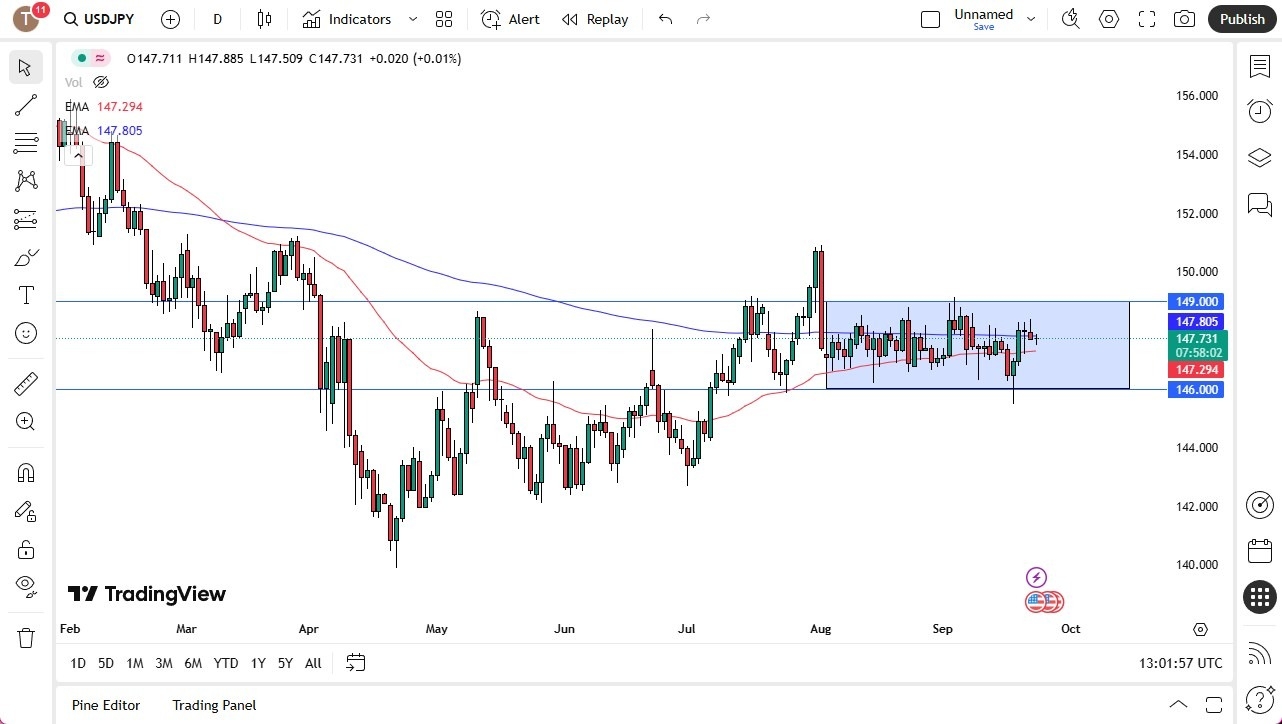
The US dollar initially rallied against the Japanese yen during trading here on Tuesday, but at this juncture, it just looks like a market that continues to see a lot of noise at the 148 yen level. If and when we can finally leave this area, the next target might be 151 yen, as that’s basically where we saw all the massive selling from a couple of weeks ago.
And keep in mind that despite the fact there is a general consensus that the Federal Reserve is going to start cutting, the interest rate differential still heavily favors the US dollar. And that’s something that eventually will come back into the picture. The 50-day EMA underneath offering support is worth paying close attention to because if we break down below there, we could find ourselves dropping to 146 yen.
AUD/USD Technical Analysis
The Australian dollar has done next to nothing in the early hours here on Tuesday, perhaps waiting for the interest rate decision out of New Zealand, as the two currencies move somewhat lockstep with each other, because there will be a sympathy related move when we get that announcement early in Wednesday trading. So, I think at this point, it makes a certain amount of sense that a pair that’s been admittedly quiet and sideways anyways, isn’t doing much. The 0.6550 level continues to be an area of resistance that I’m willing to fade at the first signs of exhaustion.
For a look at all of today’s economic events, check out our economic calendar.