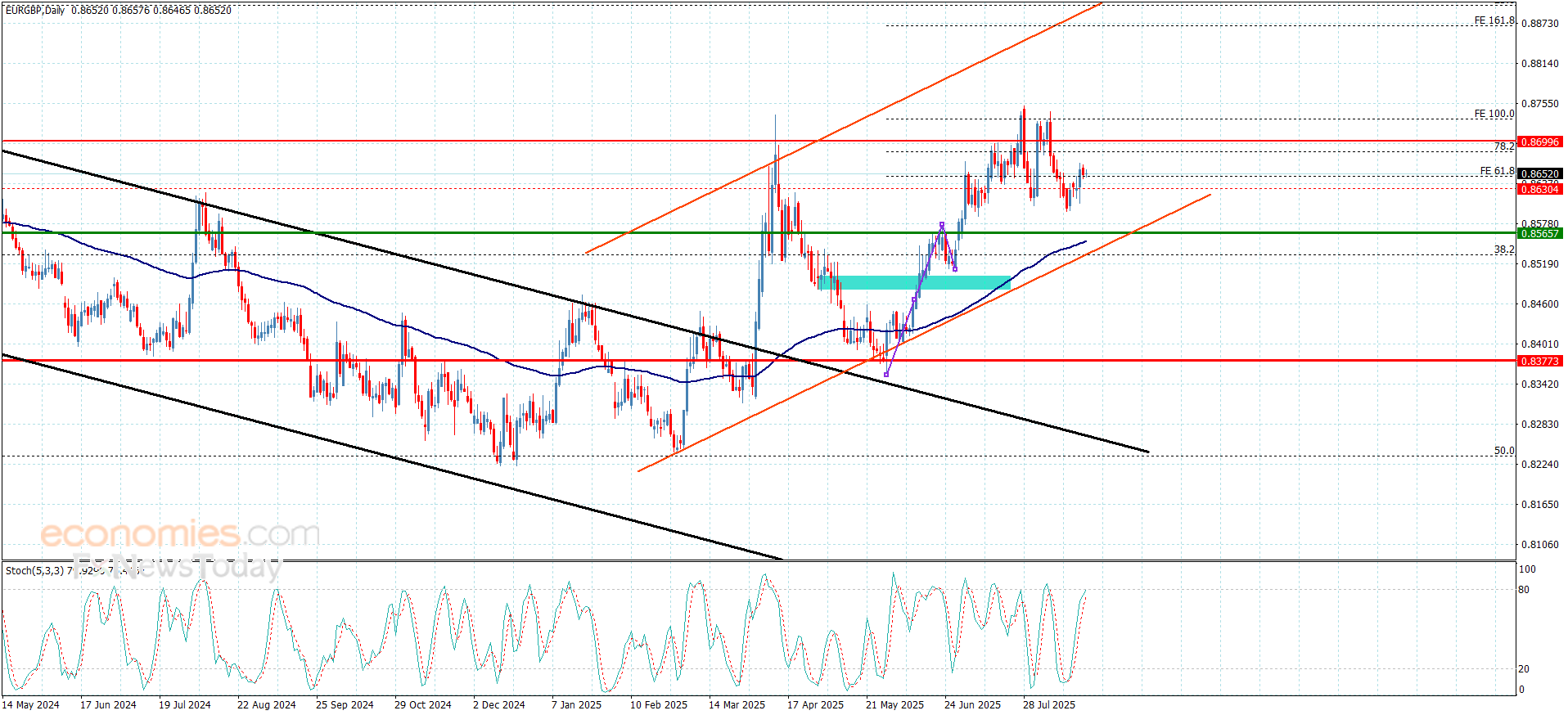
The EURGBP was affected by some negative factors, forming bearish correctional decline to 0.8595, forming extra support to allow it recover some of the losses by its rally to 0.8660.
Note that the stability of the price within the bullish channel’s levels might extend its main support level to 0.8545, besides providing positive momentum by stochastic, these factors confirm the price readiness to renew its bullish attempts, to expect targeting 0.8695 level, to press on 0.8735 resistance.
The expected trading range for today is between 00.8630 and 0.8695
GBP/USD trades near 1.3400 in the European session on Friday.
The US Dollar rallied on strong PMI data on Thursday.
Fed Chair Powell’s speech at Jackson Hole could ramp up the pair’s volatility.
GBP/USD stabilizes slightly above 1.3400 in the European session on Friday after posting losses for four consecutive days and losing about 1% since the beginning of the week. Investors refrain from taking large positions ahead of Federal Reserve (Fed) Chair Jerome Powell’s speech at the annual Jackson Hole Symposium.
Pound Sterling Price This week
The table below shows the percentage change of British Pound (GBP) against listed major currencies this week. British Pound was the weakest against the US Dollar.
USD
EUR
GBP
JPY
CAD
AUD
NZD
CHF
USD
0.98%
1.03%
0.98%
0.69%
1.31%
1.98%
0.46%
EUR
-0.98%
0.05%
-0.02%
-0.29%
0.34%
0.96%
-0.51%
GBP
-1.03%
-0.05%
-0.14%
-0.33%
0.29%
0.91%
-0.60%
JPY
-0.98%
0.02%
0.14%
-0.28%
0.34%
1.00%
-0.52%
CAD
-0.69%
0.29%
0.33%
0.28%
0.60%
1.28%
-0.26%
AUD
-1.31%
-0.34%
-0.29%
-0.34%
-0.60%
0.61%
-0.90%
NZD
-1.98%
-0.96%
-0.91%
-1.00%
-1.28%
-0.61%
-1.52%
CHF
-0.46%
0.51%
0.60%
0.52%
0.26%
0.90%
1.52%
The heat map shows percentage changes of major currencies against each other. The base currency is picked from the left column, while the quote currency is picked from the top row. For example, if you pick the British Pound from the left column and move along the horizontal line to the US Dollar, the percentage change displayed in the box will represent GBP (base)/USD (quote).
The US Dollar (USD) benefited from the upbeat Purchasing Managers Index (PMI) data from the US and caused GBP/USD to push lower on Thursday. S&P Global Manufacturing PMI improved to 53.3 in August’s preliminary estimate from 49.8 in July and the Services PMI came in at 55.4, beating the market expectation of 54.2. Reflecting the broad-based USD strength, the USD Index climbed to its highest level in over two weeks near 99.00 early Friday.
In assessment of the findings of the survey, Chris Williamson, Chief Business Economist at S&P Global Market Intelligence, explained that the increase seen in selling prices for goods and services suggests that consumer price inflation will rise further in the coming months.
“Combined with the upturn in business activity and hiring, the rise in prices signaled by the survey puts the PMI data more into rate hiking, rather than cutting, territory according to the historical relationship between these economic indicators and FOMC policy changes,” Williamson added.
The odds of a 25 basis-points (bps) Fed rate cut at the next meeting declined to 73% from about 84% before the release of the PMI data, as per CME FedWatch Tool.
Fed Chair Powell’s speech, entitled “Economic Outlook and Framework Review,” will be scrutinized by market participants in the American session on Friday.
In case Powell repeats that they need more time to analyze the impact of tariffs on inflation before entering a policy-easing cycle, the USD could preserve its strength and force GBP/USD to stay on the back foot heading into the weekend.
Conversely, the USD could come under selling pressure if Powell hints at a September rate cut by acknowledging worsening conditions in the labor market. In this scenario, GBP/USD could erase some of its weekly losses in the second half of the day.
GBP/USD Technical Analysis
The Relative Strength Index (RSI) indicator on the 4-hour chart edges higher but remains below 40, suggesting that GBP/USD’s bearish bias remains intact despite the latest recovery attempt.
On the upside, the 100-period Simple Moving Average (SMA) and the 200-period SMA form a strong resistance area at 1.3425-1.3440 before 1.3460 (Fibonacci 50% retracement of the latest downtrend) and 1.3500 (static level, round level, 50-period SMA).
Looking south, support levels could be seen at 1.3400-1.3390 (static level, Fibonacci 38.2% retracement), 1.3330 (static level) and 1.3300 (Fibonacci 23.6% retracement).
Fed FAQs
Monetary policy in the US is shaped by the Federal Reserve (Fed). The Fed has two mandates: to achieve price stability and foster full employment. Its primary tool to achieve these goals is by adjusting interest rates.
When prices are rising too quickly and inflation is above the Fed’s 2% target, it raises interest rates, increasing borrowing costs throughout the economy. This results in a stronger US Dollar (USD) as it makes the US a more attractive place for international investors to park their money.
When inflation falls below 2% or the Unemployment Rate is too high, the Fed may lower interest rates to encourage borrowing, which weighs on the Greenback.
The Federal Reserve (Fed) holds eight policy meetings a year, where the Federal Open Market Committee (FOMC) assesses economic conditions and makes monetary policy decisions.
The FOMC is attended by twelve Fed officials – the seven members of the Board of Governors, the president of the Federal Reserve Bank of New York, and four of the remaining eleven regional Reserve Bank presidents, who serve one-year terms on a rotating basis.
In extreme situations, the Federal Reserve may resort to a policy named Quantitative Easing (QE). QE is the process by which the Fed substantially increases the flow of credit in a stuck financial system.
It is a non-standard policy measure used during crises or when inflation is extremely low. It was the Fed’s weapon of choice during the Great Financial Crisis in 2008. It involves the Fed printing more Dollars and using them to buy high grade bonds from financial institutions. QE usually weakens the US Dollar.
Quantitative tightening (QT) is the reverse process of QE, whereby the Federal Reserve stops buying bonds from financial institutions and does not reinvest the principal from the bonds it holds maturing, to purchase new bonds. It is usually positive for the value of the US Dollar.
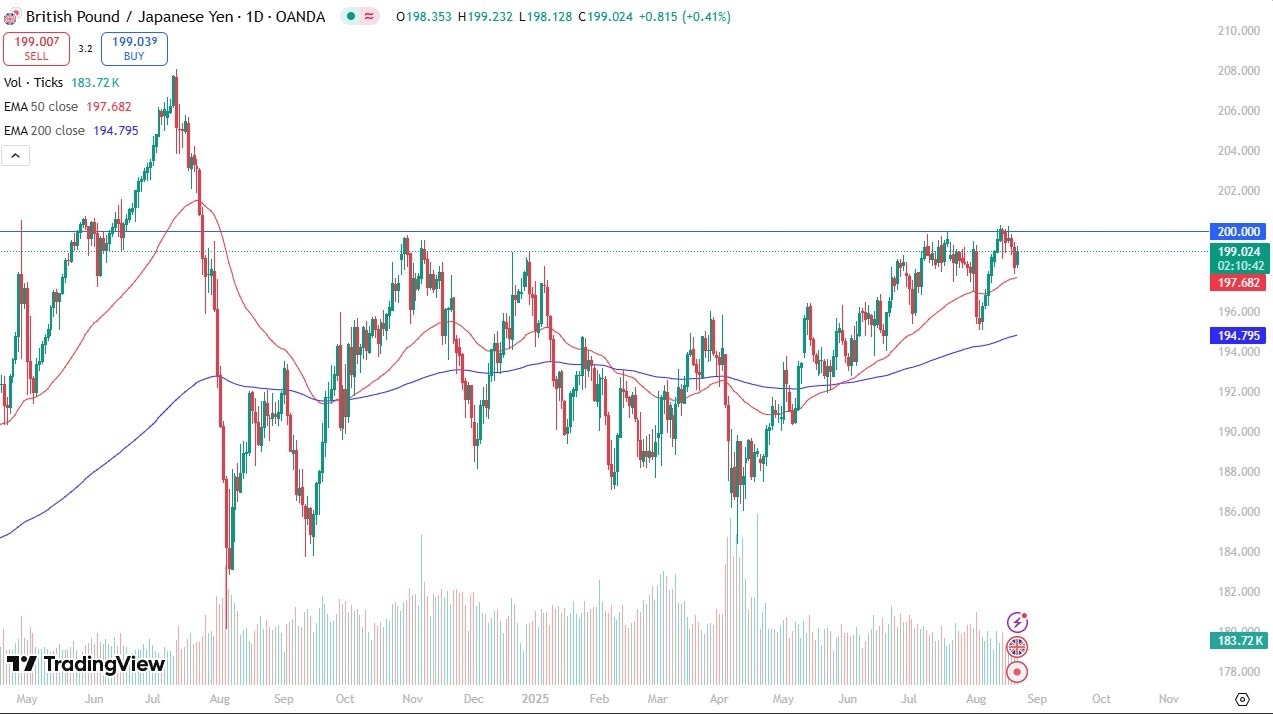
The British Pound has rallied nicely against the Japanese Yen during the trading session as the 50-day EMA looks like it is offering a bit of support.
That being said, keep in mind this is a pair that’s highly sensitive to risk appetite and therefore I think you have to watch what other markets are doing.
The most obvious level on this chart is going to be the 200 yen level, an area that has been like a brick wall, if we can break above there finally, and continue to go higher, it could lead to a massive shot to the upside.
If we were to break down below the 50 day EMA that could send the British pound down to the 196 yen level, possibly even as low as the 200 day EMA which is underneath there. So that being said, I think you’ve got a situation where we are at an inflection point. But we are also in a bullish trend that is now pressuring a major barrier.
On a Break Above 200
If we can get beyond that barrier, you will probably see the Japanese yen get eviscerated by almost everything else around the world as well. It probably won’t be just a British pound thing. That being said, Friday has the speech by Jerome Powell and that of course will make a certain amount of sense that it could cause some noise.
And with this, I think you have to understand that traders are looking for some type of clarity on what the Federal Reserve will do and therefore what risk appetite might be due to monetary policy.
Ultimately, this is a market that I think will be very volatile, but that’s typically the case here with this pair anyways. I still favor the upside, but we obviously have a huge mountain to climb just above at this big figure.
Christopher Lewis has been trading Forex and has over 20 years experience in financial markets. Chris has been a regular contributor to Daily Forex since the early days of the site. He writes about Forex for several online publications, including FX Empire, Investing.com, and his own site, aptly named The Trader Guy. Chris favours technical analysis methods to identify his trades and likes to trade equity indices and commodities as well as Forex. He favours a longer-term trading style, and his trades often last for days or weeks.
See today’s full USD/JPY forecast with chart setups and trade ideas.
AUD/USD: Wage Growth, Consumer Sentiment, and RBA Rate Cut Bets
Turning to the AUD/USD pair, expectations of an additional RBA rate cut in November have weighed on Aussie dollar demand. However, recent economic indicators sent mixed signals. Total wages and salaries paid by employers increased 1.5% month-on-month in June, up from an increase of 0.9% in March. Year-on-year, wages and salaries rose 5.9% (March: +5.8%).
Higher wages and lower interest rates may fuel spending and inflation, complicating Q4 rate cut bets. Private sector PMIs also signaled an improving macroeconomic backdrop, potentially delaying further policy easing.
The S&P Global Australia Composite PMI rose from 53.8 in June to 54.9 in July as private sector output expanded at the sharpest pace since April 2022. New export business expanded across the private sector, leading to higher staffing levels. Notably, wage costs contributed to higher inflation. However, the rates of cost inflation softened across the manufacturing and services sectors.
Why do new export order trends matter?
Australia has a trade-GDP ratio of over 50%, with roughly 20% of its workforce in trade-related jobs.
AMP Head of Investment Strategy and Chief Economist Shane Oliver projected a November rate cut and further policy easing in H1 2026, stating:
“We continue to see the RBA cutting rates again in November, February and May taking the cash rate down to 2.85%.”
However, not all economists share this view, with some cautioning that rising wages could delay further easing.
AUD/USD: Key Scenarios to Watch
Bearish AUD/USD Scenario: Dovish RBA guidance and cooling inflation. These factors could push AUD/USD below the $0.64 support level, potentially exposing the $0.63623 support level.
Bullish AUD/USD Scenario: Hawkish RBA signals and sticky inflation. These factors could drive AUD/USD toward the 200-day EMA, bringing the 50-day EMA into sight.
Explore our full AUD/USD analysis, including key trends and trade data, here.
AUD/USD Daily Outlook: Will Fed Chair Powell Trigger an AUD/USD Decline?
While economists are betting on a November RBA rate cut, uncertainty lingers about the Fed’s policy outlook. Fed Chair Powell’s support for a September Fed rate cut and further policy easing would narrow the US-Aussie interest rate differential. A narrower rate differential could send AUD/USD toward $0.6450, bringing the 200-day EMA into view.
On the other hand, the pair could drop below $0.64, exposing the $0.63623 support level if Powell raises concerns about upside risks to inflation.
The global financial landscape is undergoing a seismic shift, driven by macroeconomic realignment and the erosion of U.S. dollar dominance. Bank of America’s latest EUR/USD forecast—projecting the pair to reach 1.20 by year-end 2025 and 1.25 by 2026—signals a pivotal moment in currency dynamics. This bold outlook is not merely a technical prediction but a reflection of deep structural forces reshaping risk allocation and capital flows. For investors, understanding these drivers and adapting strategies accordingly is no longer optional—it is imperative.
Macroeconomic Realignment: The Case for the Euro’s Rebound
Bank of America’s forecast hinges on three interlocking factors: stagflation risks, Fed policy uncertainty, and institutional erosion.
Stagflation and the Fed’s Dilemma The U.S. economy is teetering on the edge of stagflation—a toxic mix of weak growth and stubborn inflation. Softening labor market data, coupled with inflation stubbornly above 4%, has forced the Federal Reserve into a precarious balancing act. While the Fed’s independence is under political siege, its potential dovish pivot to ease a slowing economy could accelerate dollar depreciation. Historically, stagflation erodes the dollar’s appeal, as seen in the 1970s, when the euro’s predecessor, the ECU, gained traction.
Institutional Erosion and Data Skepticism Trust in U.S. economic institutions is crumbling. The recent overhaul of the Bureau of Labor Statistics and the politicization of inflation data have sown doubt among global investors. If inflation metrics are perceived as manipulated, the Fed’s credibility—and with it, the dollar’s—will suffer. This skepticism is already fueling a shift in capital toward the euro, which benefits from Europe’s more transparent governance and fiscal stimulus in Germany.
Trump’s Protectionist Tailwinds President Donald Trump’s aggressive tariff policies are exacerbating inflationary pressures while simultaneously weakening the dollar. By design, these tariffs aim to boost U.S. exports, but they also signal a retreat from global cooperation. The resulting trade tensions and higher input costs are pushing investors toward the euro, which is now seen as a safer bet in a fragmented world.
Post-Dollar Dynamics: De-Dollarization and the Rise of Alternatives
The U.S. dollar’s share of global reserves has fallen to a two-decade low of 58%, while gold and the yuan are gaining ground. This de-dollarization trend is most visible in commodity markets, where energy contracts are increasingly priced in non-dollar currencies. Russian oil exports to China and India, for instance, are now settled in yuan and rubles, reducing reliance on the dollar.
Emerging markets are also rethinking their dollar exposure. Latin America’s 19.1% deposit dollarization rate remains high, but countries like China are actively de-dollarizing domestic transactions. Meanwhile, central banks in Turkey, Russia, and India are stockpiling gold, with its share in EM reserves doubling since 2015 to 9%.
Actionable Trading Strategies for a Multipolar World
Investors must adapt to a post-dollar era by diversifying portfolios, hedging risks, and capitalizing on non-dollar opportunities.
Diversify Reserves and Portfolios Reduce overexposure to U.S. Treasuries and dollar-denominated assets. Allocate to eurozone bonds, gold, and emerging market equities. The euro’s appreciation against the dollar is supported by Europe’s fiscal stimulus and Germany’s economic rebound.
Hedge Against Dollar Volatility With the dollar’s “safe-haven” status in question, institutional investors are raising currency hedge ratios. Use forwards and options to lock in favorable EUR/USD rates, especially as the euro’s technical indicators suggest a sustained upward trend.
Tap into Non-Dollar Commodities Invest in gold and commodities priced in yuan or euros. As energy and raw materials shift away from dollar pricing, these assets offer both diversification and inflation protection.
Monitor Dollar Smile Flattening The Dollar Smile framework—where the dollar strengthens during U.S. growth or global risk aversion—is flattening. Larger macroeconomic shocks, such as a U.S. fiscal crisis or geopolitical conflict, will now be required to drive significant dollar movements. Position for both scenarios.
The Strategic Imperative: Rebalancing Risk Allocation
The euro’s rebound is not a short-term anomaly but a symptom of a broader realignment. Investors must recognize that the dollar’s dominance is waning, not collapsing. While no credible alternative has yet emerged to replace it, the euro’s structural advantages—transparency, fiscal coordination, and a growing role in global trade—make it a compelling long-term bet.
For now, the dollar remains a core strategic asset, but its role as the sole anchor of global finance is diminishing. A diversified portfolio that includes the euro, gold, and non-dollar commodities will be better positioned to navigate the uncertainties of a multipolar world.
Conclusion: Embracing the New Normal
Bank of America’s EUR/USD forecast is a clarion call for investors to rethink their assumptions about currency dynamics. The euro’s strategic rebound is not just a technical play—it is a macroeconomic inevitability driven by stagflation, institutional erosion, and de-dollarization. By adopting proactive strategies that hedge against dollar volatility and capitalize on non-dollar opportunities, investors can thrive in this new era.
The future of global finance is no longer unipolar. It is multipolar—and those who adapt will lead the way.
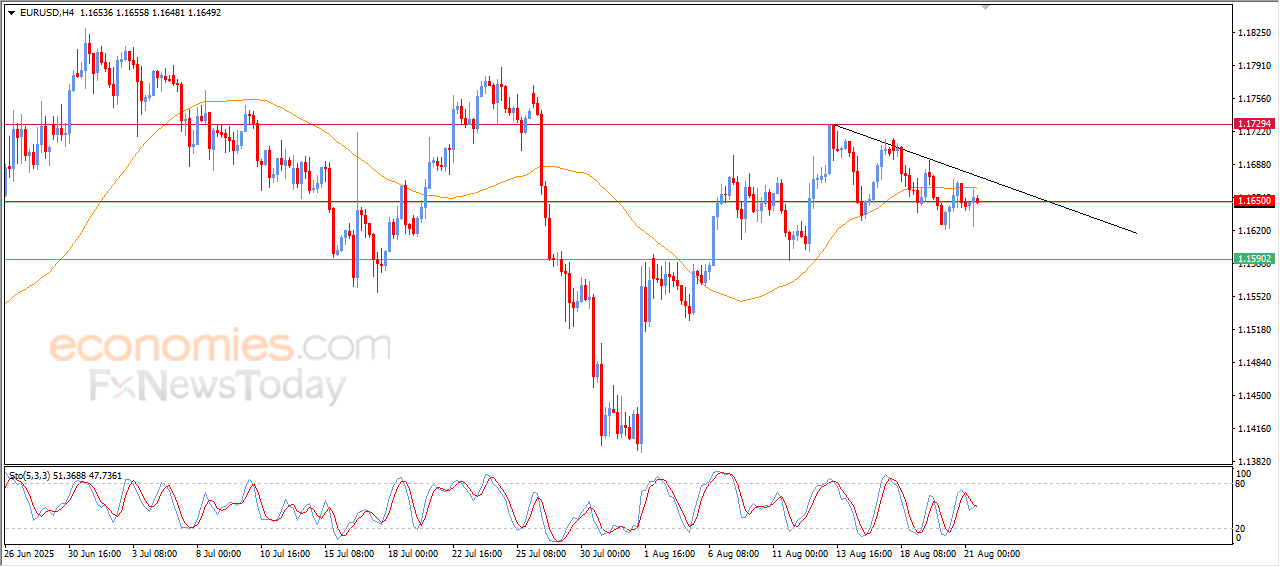
The Euro to Dollar exchange rate (EUR/USD) has consolidated just below the 1.1650 level as narrow ranges have prevailed with the latest Fed chatter not causing sustained dollar damage.
UoB commented; “Momentum indicators are turning flat, and EUR is likely to trade within a range today, probably between 1.1630 and 1.1680.”
ING added; “We may see another tight 1.1620-1.1670 trading range in EUR/USD today, with the biggest chance of a breakout remaining Powell’s speech tomorrow.”
According to Scotiabank; “The two-week range has been roughly bound between 1.1600 support and 1.1720 resistance, offering little in terms of near-term direction.”
ING is forecasting that EUR/USD will strengthen to 1.20 by the end of 2025.
There was little impact from Federal Reserve minutes from the July policy meeting with committee comments on economic risks seen to be outdated given the subsequent weak Jobs report.
Traders were still engaged in a waiting game ahead of Fed Chair Powell’s speech to the Jackson Hole symposium on Friday.
Markets are pricing in just below an 80% chance of a rate cut at the September meeting.
Funds will continue to monitor Administration efforts to influence the Federal Reserve Board and interest rates.
The latest spark of concern centred on Trump’s calls for Governor Cook to resign. The calls came after reports that she was being investigated for possible financial fraud.
According to Scotiabank; “Now, President Trump would apparently like to say “you’re fired” to Governor Cook, a centrist/dovish voice on the Board, amid accusations of mortgage fraud.”
It added; “If anything, these sorts of manoeuvres may make the Fed even less inclined to adjust policy in the short run. In the longer run, the perception of an erosion in the Fed’s independence may result in investors demanding a higher risk premium for holding USD-denominated assets.”
MUFG commented; “If she was forced to step down it would further increase President Trump’s influence on setting Fed policy. His influence on policy setting is already set to increase in the year ahead when Jerome Powell’s term as Fed Chair comes to an end in May.”
Commonwealth Bank of Australia senior economist Kristina Clifton also noted market concerns; “Perceived political interference in the Federal Reserve can undermine its independence, steepening the yield curve and denting the USD’s safe haven status.”
Administration rhetoric will continue to be watched very closely.
Earlier, the Euro-Zone recorded slightly stronger than expected PMI business confidence data.
ING commented; “The small increase in the composite PMI from 50.9 to 51.1 indicates that the eurozone economy continues to weather global storms quite well. Improvements in new orders and increased hiring add to a picture of accelerating growth, but a muted pace seems likely given significant downside risks to the outlook.”
Like this piece? Please share with your friends and colleagues:
International Money Transfer? Ask our resident FX expert a money transfer question or try John’s new, free, no-obligation personal service! ,where he helps every step of the way,
ensuring you get the best exchange rates on your currency requirements.
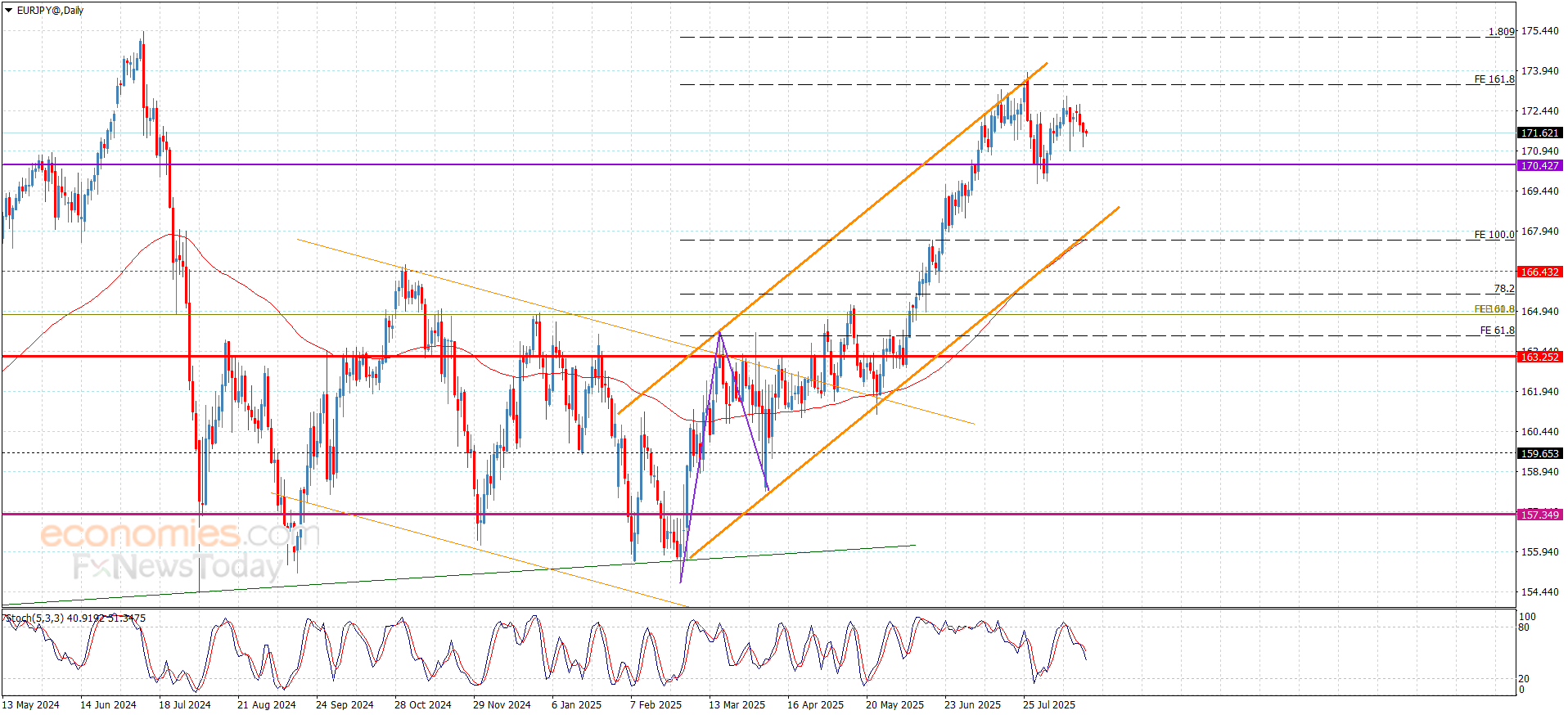
The EURJPY pair reached 171.10 level, then formed some mixed trading, to keep its negative stability below 172.00 level, forming extra barrier against the bearish correctional attempts.
The continuation of providing negative momentum by stochastic confirms the price readiness to form more of the bearish correctional trading, to keep waiting for attacking 170.40 level, then attempts to break the barrier at 169.80 to resume the attempts of gathering the gains in the near and medium period.
The expected trading range for today is between 170.45 and 172.10
The US dollar has rallied against the Japanese yen to reach the 148 yen level. If we can break above there and possibly the 148.50 yen, then it could open up a move to the 151 yen level. Short-term pullback should continue to see significant support at the 50-day EMA just below. And until I think we get through that speech at Jackson Hole, this might be a sideways market.
AUD/USD Technical Analysis
In the Australian dollar, we have dipped a bit but then turned around to show signs of life at 0.64. If we can break here, then I think we will go much lower. Ultimately, I think in the short term, we will probably bounce, and we look for a reason to start selling again at the first signs of exhaustion.
The Australian dollar has underperformed the other currencies against the US dollar for quite some time. And if we are starting to see US dollar strength, that most certainly will play out against the Aussie pretty aggressively in my estimation. I have no interest in buying this currency at the moment. That being said, we are sitting on support. So, I don’t necessarily want to be starting a short position here either.
For a look at all of today’s economic events, check out our economic calendar.
Platinum price surpassed some of the negative pressures by stochastic rally to 80 level, keeping its stability above the support of the sideways track that is represented by $1302.00, to rally to the moving average 55, which reinforces the stability of the barrier at $1342.00.
We will remain neutral, to keep waiting for surpassing one of the main levels to confirm the expected trend in the near and medium period, breaching the barrier will open the way for achieving more of the gains by the price rally to $1365.00 and $1382.00, while breaking the support and holding below it will activate bearish correctional track, and $1281.00 level represents the initial negative target for the bearish track.
The expected trading range for today is between $1302.00 and $1342.00
GBP/USD Forecast: Pound Sterling recovery could remain shallow
After dropping to its lowest level in over a week below 1.3450 in the Asian session on Thursday, GBP/USD regained its traction and advanced to the 1.3470 region. Despite this recent recovery, the pair’s technical outlook doesn’t point to an increasing buyer interest.
The risk-averse market environment caused GBP/USD to continue to stretch lower early Thursday. In the European session, Pound Sterling benefited from the preliminary August Purchasing Managers’ Index (PMI) data from the UK and erased its daily losses. Read more…
GBP/USD outlook: Continues to pressure daily cloud base following limited positive impact
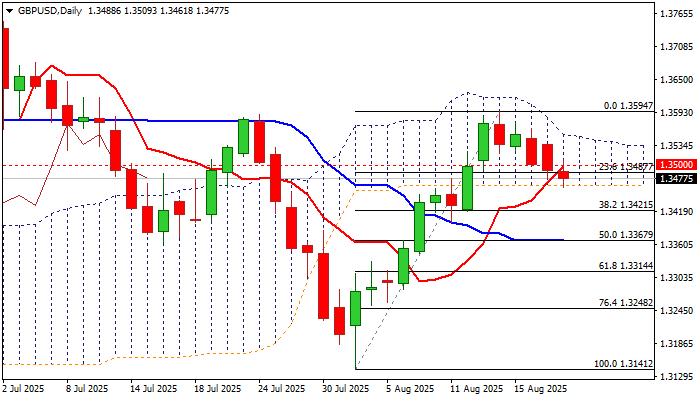
Cable edged higher on Wednesday after testing next key support provided by daily cloud base (1.3464), following break below psychological 1.3500 level (reinforced by daily Tenkan-sen) previous day.
Pound was lifted by disappointing UK July inflation data which further darkened outlook as Britain’s inflation is the highest and fastest growing among G7 economies. In addition, economic growth remains weak that makes the position of UK policymakers more difficult, with bets about rate cut by the end of the year, fading after today’s data. Read more…