The GBPCHF price formed some bullish correctional trading, to approach from the moving average of 55 near 1.0765, taking advantage of providing positive momentum by stochastic, to retest an important barrier again.
The main stability within the bearish channel’s levels, which forms an extension for the main resistance at 1.0810 level besides forming an extra barrier at 1.0775 level, these factors make us wait for gathering the negative momentum, which allows it to renew the negative attempts that might target 1.0710 and 1.0660.
The expected trading range for today is between 1.0770 and 1.0710
GBP/USD moves sideways below 1.3300 in the European session.
Improving risk mood helps Pound Sterling hold its ground.
July ISM Services PMI data from the US will be scrutinized by investors later.
After failing to make a decisive move in either direction on Monday, GBP/USD extends its sideways grind on Tuesday and trades in a narrow band below 1.3300.
British Pound PRICE Last 7 days
The table below shows the percentage change of British Pound (GBP) against listed major currencies last 7 days. British Pound was the weakest against the Japanese Yen.
USD
EUR
GBP
JPY
CAD
AUD
NZD
CHF
USD
0.43%
0.51%
-0.53%
0.51%
0.98%
1.45%
0.93%
EUR
-0.43%
0.07%
-0.99%
0.07%
0.57%
0.90%
0.51%
GBP
-0.51%
-0.07%
-1.06%
0.00%
0.50%
0.84%
0.43%
JPY
0.53%
0.99%
1.06%
1.02%
1.51%
1.91%
1.57%
CAD
-0.51%
-0.07%
-0.00%
-1.02%
0.42%
0.95%
0.42%
AUD
-0.98%
-0.57%
-0.50%
-1.51%
-0.42%
0.35%
-0.07%
NZD
-1.45%
-0.90%
-0.84%
-1.91%
-0.95%
-0.35%
-0.41%
CHF
-0.93%
-0.51%
-0.43%
-1.57%
-0.42%
0.07%
0.41%
The heat map shows percentage changes of major currencies against each other. The base currency is picked from the left column, while the quote currency is picked from the top row. For example, if you pick the British Pound from the left column and move along the horizontal line to the US Dollar, the percentage change displayed in the box will represent GBP (base)/USD (quote).
The US Dollar (USD) Index, which tracks the USD’s performance against a basket of six major currencies, registered marginal gains on Monday and made it difficult for GBP/USD to build on Friday’s rebound.
Early Tuesday, US stock index futures rise about 0.2% on the day and the UK’s FTSE 100 Index is up more than 0.3%, reflecting a risk-positive market atmosphere. In case the market mood remains upbeat in the second half of the day, GBP/USD is likely to hold its ground.
The US economic calendar will offer the Institute for Supply Management’s (ISM) Services Purchasing Managers Index (PMI) data for July in the American session. Markets expect the headline PMI to improve to 51.5 from 50.8 in June. A print below 50 could weigh on the USD with the immediate reaction, while a reading above analysts’ estimate could support the USD and drag GBP/USD lower.
Nevertheless, investors could refrain from taking large positions and allow GBP/USD to remain in a consolidation phase ahead of the Bank of England’s (BoE) monetary policy announcements on Thursday.
GBP/USD Technical Analysis
The Relative Strength Index (RSI) indicator on the 4-hour chart moves sideways near 50 and GBP/USD fluctuates between the 20-period and the 50-period Simple Moving Average (SMA), highlighting a neutral bias in the near term.
On the downside, the 20-period Simple Moving Average (SMA) aligns as interim support at 1.3250 ahead of 1.3200 (static level, round level) and 1.3130 (lower limit of the descending channel).
Looking north, resistance levels could be spotted at 1.3300 (static level, round level), 1.3330 (former support level, 50-period SMA) and 1.3400 (100-period SMA, upper limit of the ascending channel).
Pound Sterling FAQs
The Pound Sterling (GBP) is the oldest currency in the world (886 AD) and the official currency of the United Kingdom. It is the fourth most traded unit for foreign exchange (FX) in the world, accounting for 12% of all transactions, averaging $630 billion a day, according to 2022 data.
Its key trading pairs are GBP/USD, also known as ‘Cable’, which accounts for 11% of FX, GBP/JPY, or the ‘Dragon’ as it is known by traders (3%), and EUR/GBP (2%). The Pound Sterling is issued by the Bank of England (BoE).
The single most important factor influencing the value of the Pound Sterling is monetary policy decided by the Bank of England. The BoE bases its decisions on whether it has achieved its primary goal of “price stability” – a steady inflation rate of around 2%. Its primary tool for achieving this is the adjustment of interest rates.
When inflation is too high, the BoE will try to rein it in by raising interest rates, making it more expensive for people and businesses to access credit. This is generally positive for GBP, as higher interest rates make the UK a more attractive place for global investors to park their money.
When inflation falls too low it is a sign economic growth is slowing. In this scenario, the BoE will consider lowering interest rates to cheapen credit so businesses will borrow more to invest in growth-generating projects.
Data releases gauge the health of the economy and can impact the value of the Pound Sterling. Indicators such as GDP, Manufacturing and Services PMIs, and employment can all influence the direction of the GBP.
A strong economy is good for Sterling. Not only does it attract more foreign investment but it may encourage the BoE to put up interest rates, which will directly strengthen GBP. Otherwise, if economic data is weak, the Pound Sterling is likely to fall.
Another significant data release for the Pound Sterling is the Trade Balance. This indicator measures the difference between what a country earns from its exports and what it spends on imports over a given period.
If a country produces highly sought-after exports, its currency will benefit purely from the extra demand created from foreign buyers seeking to purchase these goods. Therefore, a positive net Trade Balance strengthens a currency and vice versa for a negative balance.
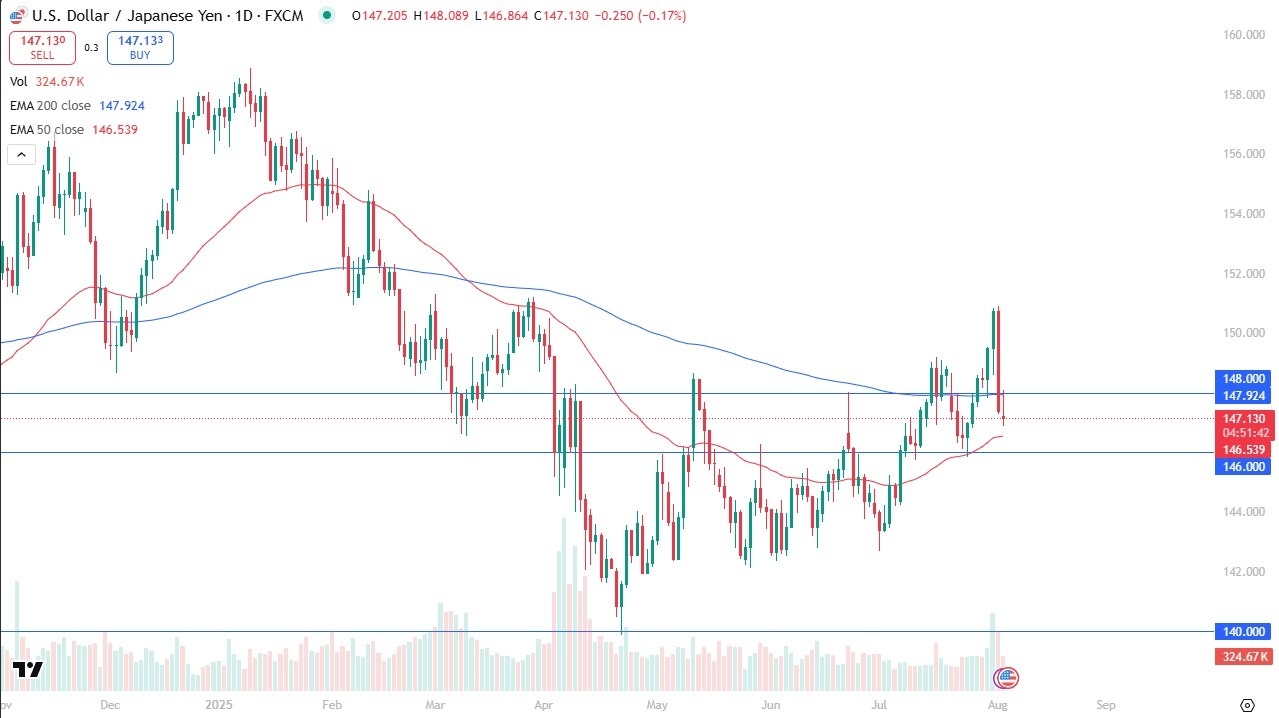
The US dollar has been all over the place during the trading session here on Monday against the Japanese yen, as we are sitting just below the 200 day EMA.
The 200 day EMA, currently sitting basically at the 148 yen level, is something that I will be watching closely, mainly due to the fact that we have quite a bit of previous noise in that same area.
And of course, Friday was a horrific candlestick. Nonetheless, if we can break above the 200 day EMA on a close on the daily chart, then I think we could go looking at the 151 yen level again.
This was a move towards safety, but quite frankly, the Federal Reserve is not going to suddenly be collapsing rates.
US Dollar Fighting Back Against Others
While the Japanese yen may put up a fight, it’s interesting that several of the other stronger currencies actually couldn’t hang on to the gains for the day against the yen. And with that being the case, the market could very well bounce from here, but I think it’s got a lot of effort that it’s going to need to do in order to truly send markets to the upside.
If we fall from here, then we could be looking at a move down to the 50 day EMA. Anything below the 50 day EMA then could send the S dollar down to the 146 yen level. That of course is an area that’s been important a couple of times and anything below there could open up a move down to the 143 yen level.
Ultimately, I think we’re in an area of somewhat balance. So, I think we probably see a little bit of back and forth, but ultimately, I still think the US dollar has a fair shot of rallying here, but we need a day or two of stabilization.
Christopher Lewis has been trading Forex and has over 20 years experience in financial markets. Chris has been a regular contributor to Daily Forex since the early days of the site. He writes about Forex for several online publications, including FX Empire, Investing.com, and his own site, aptly named The Trader Guy. Chris favours technical analysis methods to identify his trades and likes to trade equity indices and commodities as well as Forex. He favours a longer-term trading style, and his trades often last for days or weeks.
Platinum price formed some bullish waves, to hit $1355.00 level, to bounce quickly to settle below the barrier at $1342.00 level, affected by stochastic negativity, which approaches from 50 level as appears in the above image.
The stability of this barrier will force the price to delay the bullish attempts, to increase the chances for forming new bearish correctional waves to target $1290.00 level reaching 38.2%Fibonacci correction level at $1255.00, while breaching it will open the way for activating the bullish attack to target $1366.00 level initially reaching the resistance at $1400.00.
The expected trading range for today is between $1290.00 and $1342.00
Platinum price formed some bullish waves, to hit $1355.00 level, to bounce quickly to settle below the barrier at $1342.00 level, affected by stochastic negativity, which approaches from 50 level as appears in the above image.
The stability of this barrier will force the price to delay the bullish attempts, to increase the chances for forming new bearish correctional waves to target $1290.00 level reaching 38.2%Fibonacci correction level at $1255.00, while breaching it will open the way for activating the bullish attack to target $1366.00 level initially reaching the resistance at $1400.00.
The expected trading range for today is between $1290.00 and $1342.00
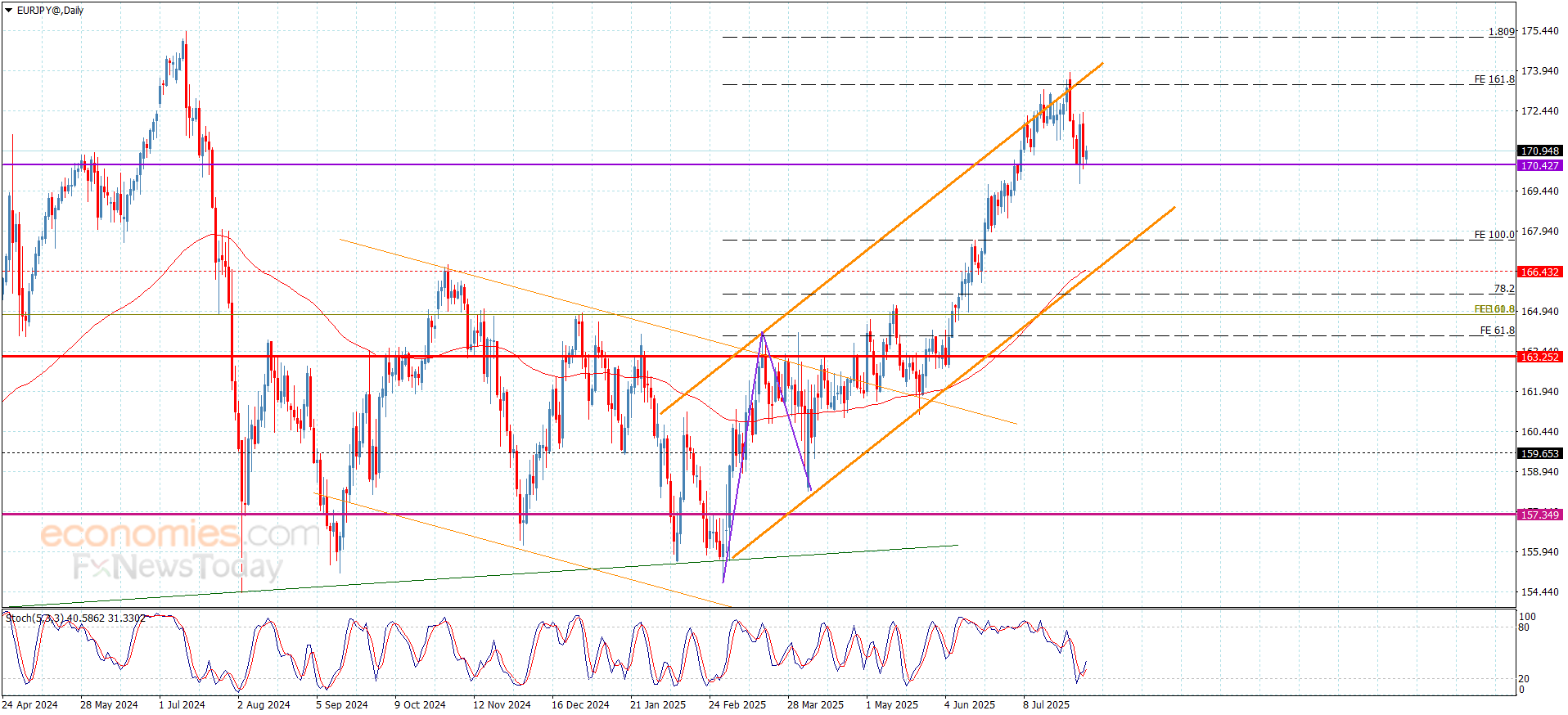
Despite facing strong bearish pressures and forming sharp decline by targeting 106.70, the main bullish track of the CADJPY remains valid by its stability above 50%Fibonacci correction level, which represents an important support at 106.40.
Note that the possibility of forming sideways trading due to the contradiction between the main indicators, but the stability above the mentioned support will reinforce the chances for gathering the positive momentum, to ease the mission of its rally to 108.10, surpassing this obstacle might extend the trading to the next main target at 109.30.
The expected trading range for today is between 106.50 and 107.90
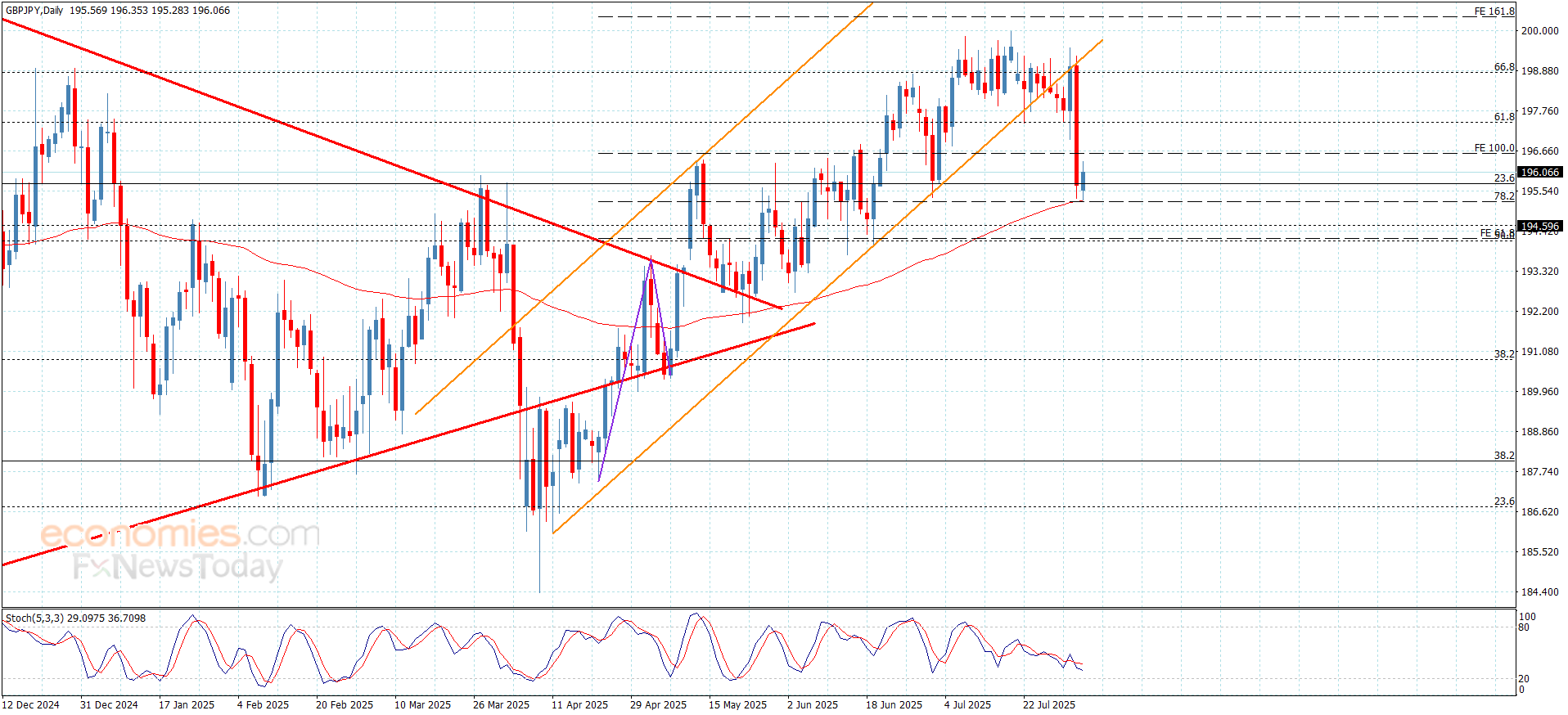
The GBPJPY pair didn’t settle above the support of the minor bullish channel at 198.70, forcing it to suffer deep losses by its decline to 195.35, facing the moving average 55 that supports the stability of 78.2%Fibonacci correction level as appears in the above image.
Noticing the beginning of forming bullish waves since this morning, but it couldn’t regain the bullish bias until surpassing the obstacle at 196.60, which allows it to resume the rise and achieve extra gains that might extend to 197.05 and 197.40, while the decline below 195.35 and holding below it will confirm its surrender to the bearish bias domination, which forces it to suffer extra losses by reaching 194.55.
The expected trading range for today is between 195.70 and 196.90
The GBPJPY pair didn’t settle above the support of the minor bullish channel at 198.70, forcing it to suffer deep losses by its decline to 195.35, facing the moving average 55 that supports the stability of 78.2%Fibonacci correction level as appears in the above image.
Noticing the beginning of forming bullish waves since this morning, but it couldn’t regain the bullish bias until surpassing the obstacle at 196.60, which allows it to resume the rise and achieve extra gains that might extend to 197.05 and 197.40, while the decline below 195.35 and holding below it will confirm its surrender to the bearish bias domination, which forces it to suffer extra losses by reaching 194.55.
The expected trading range for today is between 195.70 and 196.90
GBP/USD trades in a narrow band above 1.3250 on Monday.
GBP/USD snapped a six-day losing streak after weak US jobs data on Friday.
The technical outlook doesn’t yet hint at a bullish reversal.
GBP/USD finds it difficult to attract bulls in the European session on Monday and fluctuates below 1.3300. The pair’s near-term technical outlook doesn’t yet offer any convincing signs of a bullish reversal.
British Pound PRICE Last 7 days
The table below shows the percentage change of British Pound (GBP) against listed major currencies last 7 days. British Pound was the weakest against the Japanese Yen.
USD
EUR
GBP
JPY
CAD
AUD
NZD
CHF
USD
1.71%
1.13%
0.07%
0.53%
1.50%
1.75%
1.49%
EUR
-1.71%
-0.60%
-1.57%
-1.16%
-0.20%
0.04%
-0.22%
GBP
-1.13%
0.60%
-1.16%
-0.56%
0.40%
0.65%
0.38%
JPY
-0.07%
1.57%
1.16%
0.46%
1.37%
1.65%
1.54%
CAD
-0.53%
1.16%
0.56%
-0.46%
0.93%
1.22%
0.95%
AUD
-1.50%
0.20%
-0.40%
-1.37%
-0.93%
0.24%
-0.02%
NZD
-1.75%
-0.04%
-0.65%
-1.65%
-1.22%
-0.24%
-0.26%
CHF
-1.49%
0.22%
-0.38%
-1.54%
-0.95%
0.02%
0.26%
The heat map shows percentage changes of major currencies against each other. The base currency is picked from the left column, while the quote currency is picked from the top row. For example, if you pick the British Pound from the left column and move along the horizontal line to the US Dollar, the percentage change displayed in the box will represent GBP (base)/USD (quote).
The broad-based selling pressure surrounding the US Dollar (USD) helped GBP/USD gain traction and allowed the pair to snap a six-day losing streak.
The monthly data published by the US Bureau of Labor Statistics (BLS) showed that Nonfarm Payrolls (NFP) rose by 73,000 in July, missing analysts’ estimate of 110,000, while the Unemployment Rate edged higher to 4.2% from 4.1%, as expected. More importantly, the BLS announced that it revised down May and June NFP increases, noting that NFP growth in this two-month period combined was 258,000 lower than previously reported.
The probability of a 25 basis points Federal Reserve (Fed) rate cut in September jumped above 70% from about 30% before the data, as per CME FedWatch Tool. In turn, the USD weakened sharply against its peers.
The economic calendar will not feature any high-tier macroeconomic data releases on Monday. Later in the week, the Bank of England (BoE) will announce monetary policy decisions.
In the meantime, market participants will keep a close eye on US politics. Following the dismal employment report, US President Donald Trump fired BLS Chief Erika McEntarfer, accusing her of manipulating the numbers for political purposes. Additionally, Fed Governor Adriana Kugler, whose term was scheduled to end on January 31, 2026, announced her resignation.
Investors could opt to stay away from the USD in case political developments feed into concerns over the Fed or the BLS losing independence.
GBP/USD Technical Analysis
The Relative Strength Index (RSI) indicator on the 4-hour chart stays below 50 and GBP/USD remains within the one-month-old descending regression channel, suggesting that the bearish bias remains intact following Friday’s rebound.
On the downside, the 20-period Simple Moving Average (SMA) aligns as interim support at 1.3250 ahead of 1.3200 (static level, round level) and 1.3140 (lower limit of the descending channel).
Looking north, resistance levels could be spotted at 1.3300 (static level, round level), 1.3330 (former support level) and 1.3370 (50-period SMA).
Pound Sterling FAQs
The Pound Sterling (GBP) is the oldest currency in the world (886 AD) and the official currency of the United Kingdom. It is the fourth most traded unit for foreign exchange (FX) in the world, accounting for 12% of all transactions, averaging $630 billion a day, according to 2022 data.
Its key trading pairs are GBP/USD, also known as ‘Cable’, which accounts for 11% of FX, GBP/JPY, or the ‘Dragon’ as it is known by traders (3%), and EUR/GBP (2%). The Pound Sterling is issued by the Bank of England (BoE).
The single most important factor influencing the value of the Pound Sterling is monetary policy decided by the Bank of England. The BoE bases its decisions on whether it has achieved its primary goal of “price stability” – a steady inflation rate of around 2%. Its primary tool for achieving this is the adjustment of interest rates.
When inflation is too high, the BoE will try to rein it in by raising interest rates, making it more expensive for people and businesses to access credit. This is generally positive for GBP, as higher interest rates make the UK a more attractive place for global investors to park their money.
When inflation falls too low it is a sign economic growth is slowing. In this scenario, the BoE will consider lowering interest rates to cheapen credit so businesses will borrow more to invest in growth-generating projects.
Data releases gauge the health of the economy and can impact the value of the Pound Sterling. Indicators such as GDP, Manufacturing and Services PMIs, and employment can all influence the direction of the GBP.
A strong economy is good for Sterling. Not only does it attract more foreign investment but it may encourage the BoE to put up interest rates, which will directly strengthen GBP. Otherwise, if economic data is weak, the Pound Sterling is likely to fall.
Another significant data release for the Pound Sterling is the Trade Balance. This indicator measures the difference between what a country earns from its exports and what it spends on imports over a given period.
If a country produces highly sought-after exports, its currency will benefit purely from the extra demand created from foreign buyers seeking to purchase these goods. Therefore, a positive net Trade Balance strengthens a currency and vice versa for a negative balance.
The USD/JPY forecast indicates a slight recovery in the dollar.
The economy added only 73,000 jobs in July.
The BoJ has been more confident in talks of resuming rate hikes.
The USD/JPY forecast indicates a slight recovery in the dollar after a steep decline in the previous session due to downbeat employment numbers. Meanwhile, the yen found support in talks of the BoJ continuing its monetary tightening.
The dollar had a bad end to the week after the US released a downbeat monthly employment report. The economy added only 73,000 jobs in July, missing the forecast of 106,000. At the same time, the unemployment rate increased to 4.2%. Meanwhile, figures for the previous two months were revised sharply lower. Consequently, market and expert expectations for a September rate cut jumped.
“We pull forward our baseline call for a 25 bps cut from the FOMC to September,” said David Doyle, head of economics at Macquarie Group.
“While we don’t see significant further weakness in the labour market, the results of this report are likely to shift the FOMC’s assessment of the balance of risks to the outlook.”
Meanwhile, since the US-Japan trade deal, the BoJ has been more confident in talks of resuming rate hikes. This has supported the yen. However, the timing for hikes remains a mystery.
USD/JPY key events today
Market participants do not expect high-impact releases from Japan or the US. Therefore, the pair might have a slow start to the week.
USD/JPY technical forecast: Bears take a break after SMA break
USD/JPY 4-hour chart
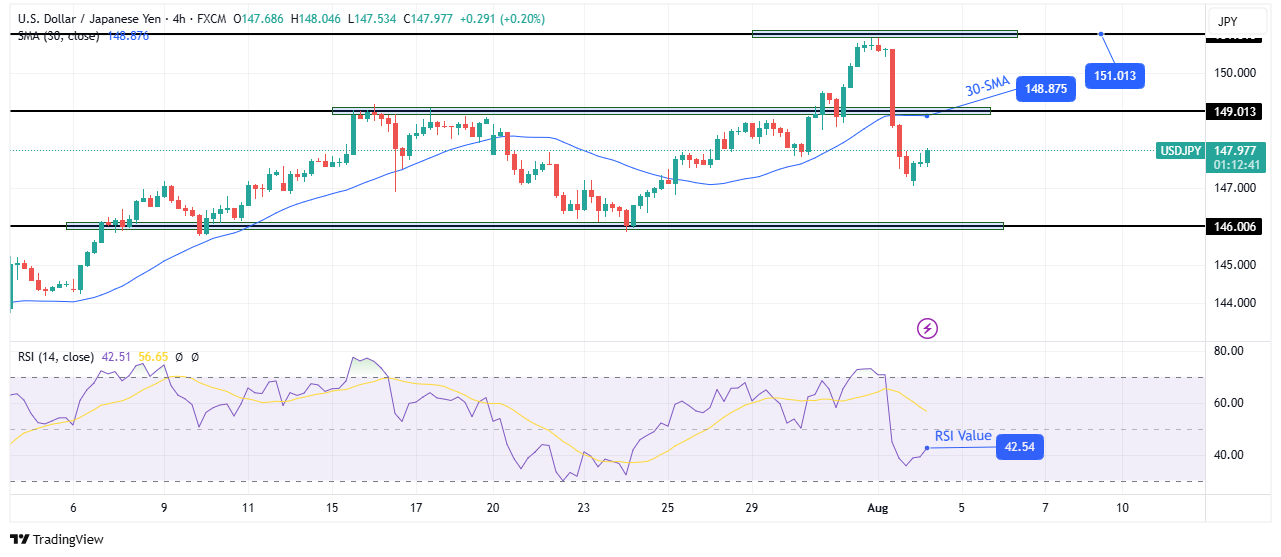
On the technical side, the USD/JPY price is recovering after a steep collapse on Friday. However, the price still trades far below the 30-SMA, showing bears are in the lead. At the same time, the RSI trades below 50, indicating solid bearish momentum.
–Are you interested in learning more about forex basics? Check our detailed guide-
Initially, bulls were in the lead, and the price had broken above the 149.01 key resistance level. However, bears appeared suddenly as the rally neared the 151.01 key level. The price made a solid bearish candle that broke back below the 149.01 level and the 30-SMA. This signaled a shift in sentiment. Since then, the price has made fresh lows below the SMA.
A pullback might retest the SMA and the 149.01 level before the new downtrend continues. In this case, USD/JPY might soon retest the 146.00 support level.
Looking to trade forex now? Invest at eToro!
68% of retail investor accounts lose money when trading CFDs with this provider. You should consider whether you can afford to take the high risk of losing your money.