The main tag of Forex News Today Articles.
You can use the search box below to find what you need.
[wd_asp id=1]

1 12, 2025
At a Major Crossroads (Chart)

By |2025-12-01T16:46:01+02:00December 1, 2025|Forex News, News|0 Comments

  • The British pound traded quietly amid thin post-Thanksgiving conditions, with major technical levels clustering near 1.32.
  • A decisive break on either side of this inflection zone could determine the broader trend in the weeks ahead.

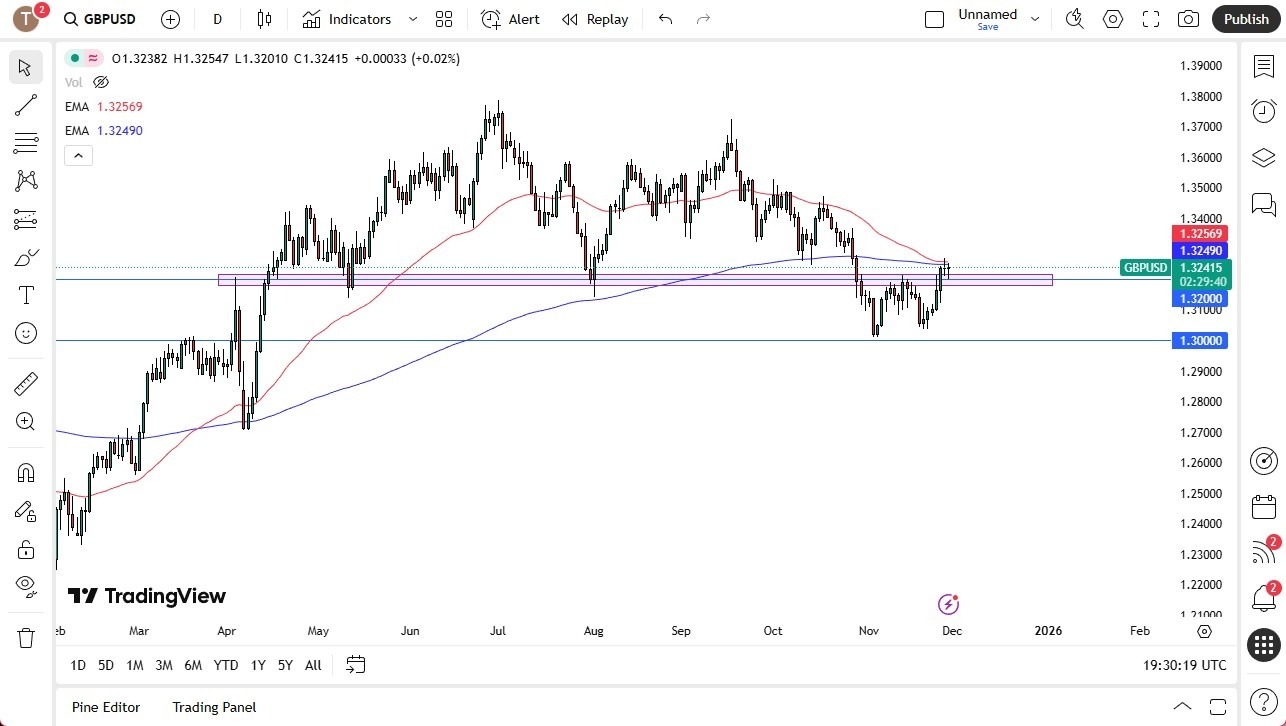
The British pound has been somewhat noisy during the trading session on Friday as we continue to see a lot of technical factors come into the picture. Friday, of course, was a fairly quiet trading session due to the fact that although the Thanksgiving holiday was over, it’s generally accepted that most Americans don’t go back to work until Monday. So, because of this, you have an entire part of the world that isn’t even involved in the markets.

That being said, it’s worth noting that the technical confluence is worth paying close attention to because it could matter. The 200-day EMA, the 50-day EMA, and the 1.32 level all come into play in this general vicinity. And if we break down below the 1.32 level, then I think we’ve got a situation where the market just simply rejected breaking above these crucial moving averages and broke above the idea of changing trends.

Critical Inflection Levels

If we drop from here, we could go to the 1.30 level given enough time. On the other hand, if we turn around and break above the 1.33 level, then we could go looking to the 1.35 level. But in that environment, I would expect not only the British pound to do fairly well against the US dollar, but multiple other currencies well, including the euro and the Canadian dollar.

In general, the British pound has made a massive topping pattern for most of the year. And now we are at a major point of inflection that will probably determine where we go for the next several weeks. Federal Reserve interest rate cut expectations continue to be very noisy. And it’s worth noting that the market keeps fluctuating between an almost guaranteed rate cut to a lot of questions asked about that.

And it has a major influence on the US dollar.

Keep in mind that the Bank of England almost cut interest rates last time, and the vote count only reinforced the idea that perhaps the rate cuts are coming fairly soon. Now the question is how many times will they cut? I think this is a market that probably continues to be very noisy as both central banks are in play at the moment.

Ready to trade our daily Forex GBP/USD analysis? We’ve made this UK forex brokers list for you to check out.

Source link

1 12, 2025

USD/JPY Forecast 01/12: Drifts Slightly Lower (Video)

By |2025-12-01T14:45:07+02:00December 1, 2025|Forex News, News|0 Comments

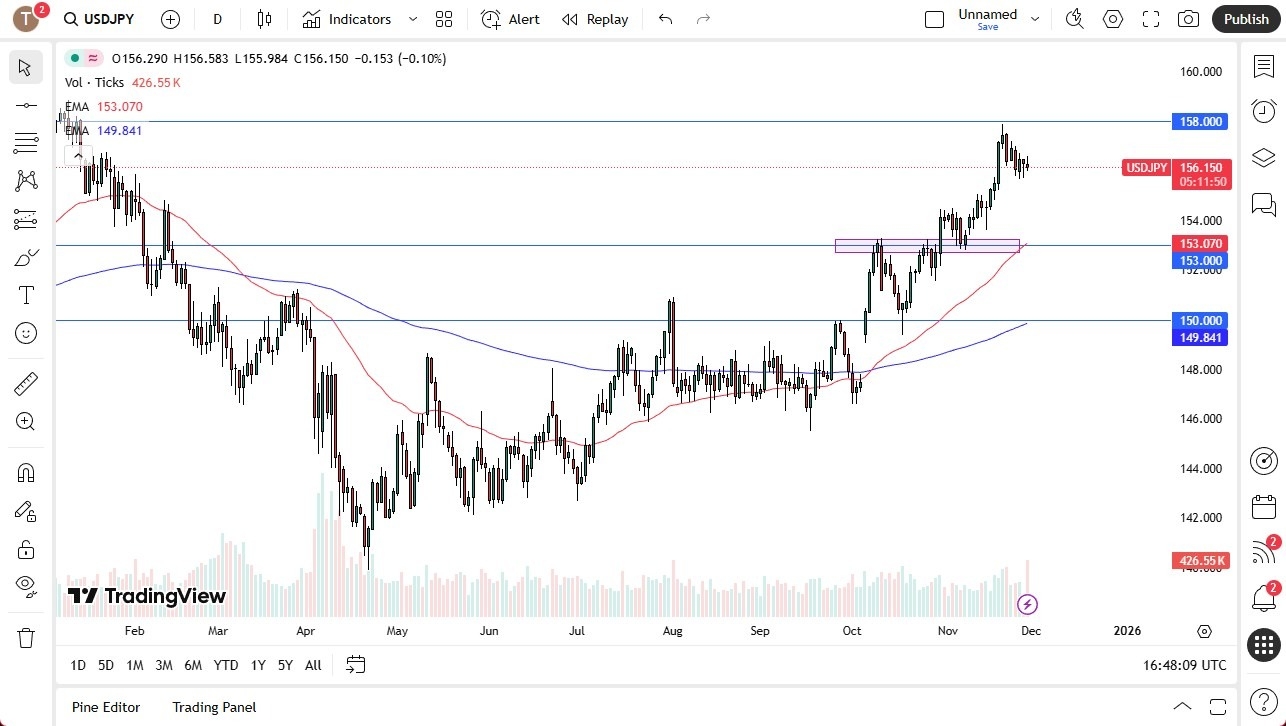
  • USD/JPY pulled back slightly in thin post-Thanksgiving trading, but broader fundamentals still favor the upside.
  • With Japan unable to tighten meaningfully and U.S. policy still supportive, the pair remains a buy-the-dip market above key support zones.

The US dollar initially rallied on Friday against the Japanese yen only to turn around and show signs of hesitation. That’s not really anything that I care about because Friday was a very thin trading session with the Americans basically stepping away from the markets as they tend to take four-day holidays for Thanksgiving. Nonetheless,

We have seen a short-term pullback as of late, and I think that is something that you need to keep in the back of your mind, recognizing that maybe the market got a little bit ahead of itself. And of course, there’s the usual machine-driven nonsense and panic about a Federal Reserve official saying one thing and then another one saying a different thing. And now we’re back to the Federal Reserve, which is going to cut rates to oblivion again.

Fundamental Divergence and Pullback Opportunities

These wild swings have become the norm in sentiment because it’s not human sentiment; it’s quantified mathematical sentiment. With that being the case, it’s a different world, but at the end of the day, you do get paid to hang on to this trade. And I still am bullish because the Federal Reserve may cut rates once or even twice, but the Bank of Japan is not going to get ultra-tight with its monetary policy anymore. Math and reality just don’t allow them to do this. With that being the case, I look at significant pullbacks as wonderful buying opportunities in a market that I have been long of for months. I have no interest in shorting this market, and every time it dips and bounces, I add to an already sizable position at this point. If we can break above the 158 yen level, then I think we start to think about 160 yen and so on.

Right now, for me at least, the floor in the market is at the 153 yen level with the 50-day EMA sitting there. If we were to break down below there, then maybe I could collect all of my profit and then rethink the situation. But until then, this is a buy on the dip scenario.

Want to trade our USD/JPY forex analysis and predictions? Here’s a list of forex brokers in Japan to check out.

Christopher Lewis has been trading Forex and has over 20 years experience in financial markets. Chris has been a regular contributor to Daily Forex since the early days of the site. He writes about Forex for several online publications, including FX Empire, Investing.com, and his own site, aptly named The Trader Guy. Chris favours technical analysis methods to identify his trades and likes to trade equity indices and commodities as well as Forex. He favours a longer-term trading style, and his trades often last for days or weeks.

Source link

1 12, 2025

Euro struggles to preserve bullish momentum

By |2025-12-01T12:44:32+02:00December 1, 2025|Forex News, News|0 Comments

EUR/USD seems to have entered a consolidation slightly below 1.1600 after rising more than 0.7% in the previous week. While the technical picture suggests that the bullish bias remain intact, the risk-averse market atmosphere could make it difficult for the pair to continue to push higher in the near term.

Euro Price Last 7 Days

The table below shows the percentage change of Euro (EUR) against listed major currencies last 7 days. Euro was the strongest against the US Dollar.

USD EUR GBP JPY CAD AUD NZD CHF
USD -0.67% -0.83% -0.59% -0.80% -1.27% -1.99% -0.48%
EUR 0.67% -0.16% 0.07% -0.13% -0.62% -1.33% 0.19%
GBP 0.83% 0.16% 0.25% 0.03% -0.45% -1.17% 0.35%
JPY 0.59% -0.07% -0.25% -0.21% -0.74% -1.54% 0.11%
CAD 0.80% 0.13% -0.03% 0.21% -0.48% -1.20% 0.32%
AUD 1.27% 0.62% 0.45% 0.74% 0.48% -0.71% 0.83%
NZD 1.99% 1.33% 1.17% 1.54% 1.20% 0.71% 1.54%
CHF 0.48% -0.19% -0.35% -0.11% -0.32% -0.83% -1.54%

The heat map shows percentage changes of major currencies against each other. The base currency is picked from the left column, while the quote currency is picked from the top row. For example, if you pick the Euro from the left column and move along the horizontal line to the US Dollar, the percentage change displayed in the box will represent EUR (base)/USD (quote).

The US Dollar (USD) weakened against its rivals last week as dovish comments from Federal Reserve (Fed) officials revived expectations of a 25 basis points (bps) rate cut at the December meeting. According to the CME FedWatch Tool, markets are pricing in about a 90% chance of a rate cut next week.

Nevertheless, the negative shift seen in risk mood helps the USD hold its ground early Monday and limits EUR/USD’s upside. At the time of press, US stock index futures were down between 0.6% and 0.9%. A bearish opening in Wall Street could help the USD find demand as a safe haven and cause EUR/USD to correct lower in the second half of the day.

The US economic calendar will feature the Institute for Supply Management’s (ISM) Manufacturing Purchasing Managers’ Index (PMI) report for November.

Markets expect the headline PMI to edge slightly lower to 48.6 in November from 48.7 in October. In case this data comes in above 50 and highlights an expansion in the manufacturing sector’s business activity, the USD could gather strength with the immediate market reaction. Conversely, a disappointing print, especially if combined with a decline in the Employment Index of the PMI survey, could trigger another USD selloff and allow EUR/USD to turn north.

EUR/USD Technical Analysis:

The 20-period Simple Moving Average (SMA) climbs above the 100- and 200-period SMAs, with price holding above all key averages. The RSI (14) prints 54, neutral, reflecting a loss of bullish momentum in the near term.

Measured from the 1.1885 high to the 1.1472 low, the 38.2% retracement at 1.1630 acts as the next resistance level before 1.1680 (Fibonacci 50% retracement). On the downside, immediate support is seen at 1.1590 (200-period SMA) ahead of 1.1570 (Fibonacci 23.6% retracement, 100-period SMA) and 1.1500 (static level, round level).

(The technical analysis of this story was written with the help of an AI tool)

Euro FAQs

The Euro is the currency for the 20 European Union countries that belong to the Eurozone. It is the second most heavily traded currency in the world behind the US Dollar. In 2022, it accounted for 31% of all foreign exchange transactions, with an average daily turnover of over $2.2 trillion a day.
EUR/USD is the most heavily traded currency pair in the world, accounting for an estimated 30% off all transactions, followed by EUR/JPY (4%), EUR/GBP (3%) and EUR/AUD (2%).

The European Central Bank (ECB) in Frankfurt, Germany, is the reserve bank for the Eurozone. The ECB sets interest rates and manages monetary policy.
The ECB’s primary mandate is to maintain price stability, which means either controlling inflation or stimulating growth. Its primary tool is the raising or lowering of interest rates. Relatively high interest rates – or the expectation of higher rates – will usually benefit the Euro and vice versa.
The ECB Governing Council makes monetary policy decisions at meetings held eight times a year. Decisions are made by heads of the Eurozone national banks and six permanent members, including the President of the ECB, Christine Lagarde.

Eurozone inflation data, measured by the Harmonized Index of Consumer Prices (HICP), is an important econometric for the Euro. If inflation rises more than expected, especially if above the ECB’s 2% target, it obliges the ECB to raise interest rates to bring it back under control.
Relatively high interest rates compared to its counterparts will usually benefit the Euro, as it makes the region more attractive as a place for global investors to park their money.

Data releases gauge the health of the economy and can impact on the Euro. Indicators such as GDP, Manufacturing and Services PMIs, employment, and consumer sentiment surveys can all influence the direction of the single currency.
A strong economy is good for the Euro. Not only does it attract more foreign investment but it may encourage the ECB to put up interest rates, which will directly strengthen the Euro. Otherwise, if economic data is weak, the Euro is likely to fall.
Economic data for the four largest economies in the euro area (Germany, France, Italy and Spain) are especially significant, as they account for 75% of the Eurozone’s economy.

Another significant data release for the Euro is the Trade Balance. This indicator measures the difference between what a country earns from its exports and what it spends on imports over a given period.
If a country produces highly sought after exports then its currency will gain in value purely from the extra demand created from foreign buyers seeking to purchase these goods. Therefore, a positive net Trade Balance strengthens a currency and vice versa for a negative balance.

Source link

1 12, 2025

The GBPJPY fails to settle above the barrier– Forecast today – 1-12-2025

By |2025-12-01T10:44:00+02:00December 1, 2025|Forex News, News|0 Comments

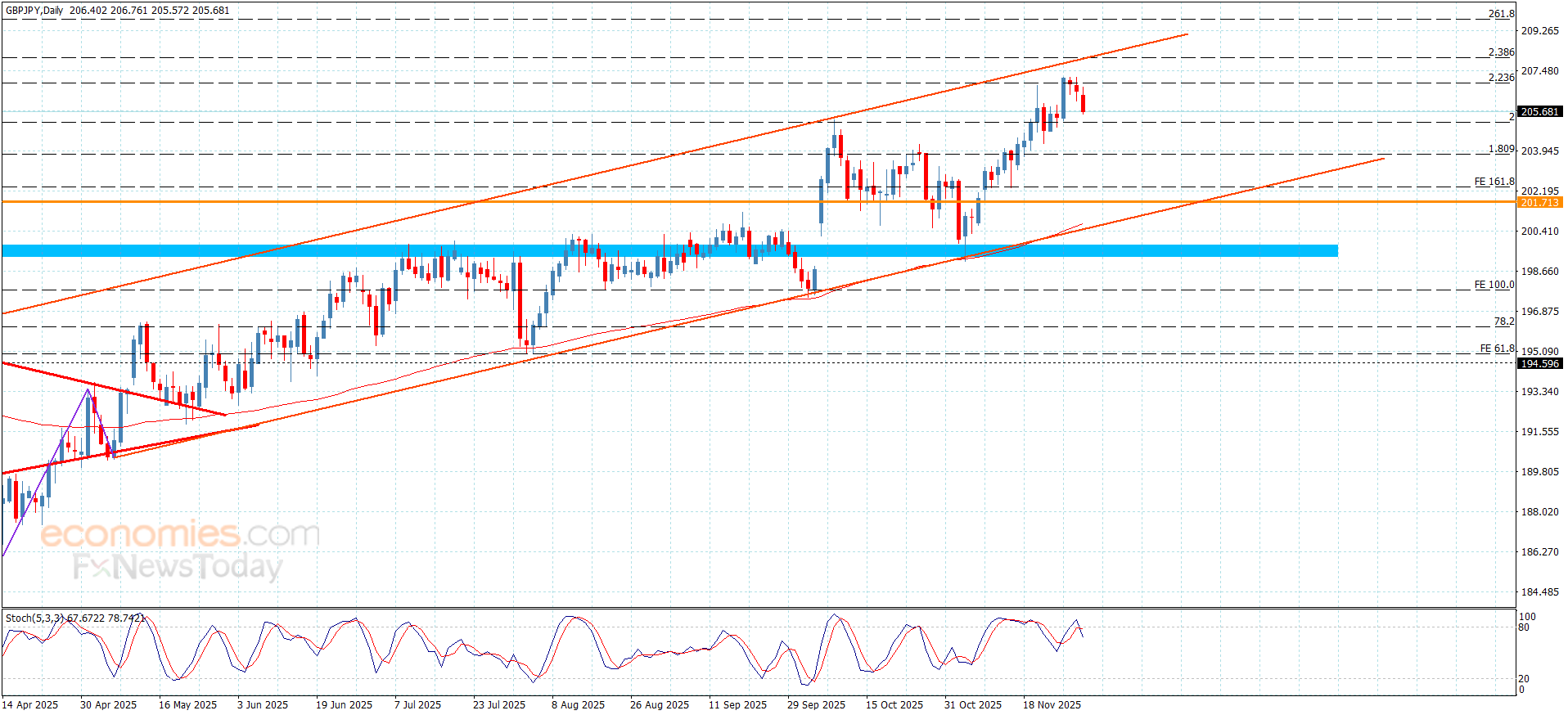
The GBPJPY pair failed to settle above the barrier at 206.95 level, forcing it to form corrective waves to settle near 205.75 as appears in above image.


Stochastic attempt to exit the oversold level, to increase the intraday negative pressures on the trading, to increase the chances of testing extra support at 205.20, where breaking it will force it to suffer extra losses by reaching 204.60 and 204.10, while renewing the bullish attempts require providing new positive close above 206.90, to ease the mission of recording the main positive targets that extend to 207.70 and 208.25.


The expected trading range for today is between 205.20 and 206.60


Trend forecast: Bearish 


Source link

1 12, 2025

The EURJPY fails to breach– Forecast today – 1-12-2025

By |2025-12-01T08:43:07+02:00December 1, 2025|Forex News, News|0 Comments

The GBPJPY pair failed to settle above the barrier at 206.95 level, forcing it to form corrective waves to settle near 205.75 as appears in above image.


Stochastic attempt to exit the oversold level, to increase the intraday negative pressures on the trading, to increase the chances of testing extra support at 205.20, where breaking it will force it to suffer extra losses by reaching 204.60 and 204.10, while renewing the bullish attempts require providing new positive close above 206.90, to ease the mission of recording the main positive targets that extend to 207.70 and 208.25.


The expected trading range for today is between 205.20 and 206.60


Trend forecast: Bearish 


Source link

1 12, 2025

Euro bulls hesitate on last trading day of November

By |2025-12-01T06:42:09+02:00December 1, 2025|Forex News, News|0 Comments

Following the bullish action seen in the first half of the week, EUR/USD corrects lower on Friday and declines toward 1.1550. The pair’s technical outlook points to a loss of bullish momentum. Financial markets in the US will close early on Black Friday.

Euro Price This week

The table below shows the percentage change of Euro (EUR) against listed major currencies this week. Euro was the strongest against the US Dollar.

USD EUR GBP JPY CAD AUD NZD CHF
USD -0.55% -0.86% -0.17% -0.46% -1.02% -1.67% -0.32%
EUR 0.55% -0.29% 0.38% 0.09% -0.49% -1.13% 0.22%
GBP 0.86% 0.29% 0.68% 0.39% -0.19% -0.85% 0.52%
JPY 0.17% -0.38% -0.68% -0.28% -0.90% -1.64% -0.15%
CAD 0.46% -0.09% -0.39% 0.28% -0.58% -1.24% 0.14%
AUD 1.02% 0.49% 0.19% 0.90% 0.58% -0.66% 0.74%
NZD 1.67% 1.13% 0.85% 1.64% 1.24% 0.66% 1.39%
CHF 0.32% -0.22% -0.52% 0.15% -0.14% -0.74% -1.39%

The heat map shows percentage changes of major currencies against each other. The base currency is picked from the left column, while the quote currency is picked from the top row. For example, if you pick the Euro from the left column and move along the horizontal line to the US Dollar, the percentage change displayed in the box will represent EUR (base)/USD (quote).

After struggling to make a decisive move in either direction on the Thanksgiving Day on Thursday, EUR/USD stays on the back foot as markets adopt a cautious stance.

Earlier in the day, the data from Germany showed that Retail Sales declined by 0.3% on a monthly basis in October. This print followed the 0.3% increase recorded in September and came in weaker than the market expectation for an increase of 0.2%, making it difficult for the Euro to find demand.

In the second half of the day, November Consumer Price Index (CPI) data from Germany will be featured in the European economic calendar. Analysts expect the monthly CPI to decline by 0.3%. A positive print could support the Euro with the immediate reaction. Nevertheless, investors could refrain from taking large positions based on this data.

It’s worth noting that month-end flows, combined with thin trading conditions, could ramp up the market volatility and cause some irregular movements in financial markets heading into the weekend.

EUR/USD Technical Analysis:

The 20-period Simple Moving Average (SMA) rises above the 50- and 100-period SMAs, suggesting an improving short-term bias, while the 200-period SMA flattens at 1.1585 and caps the recovery. RSI (14) holds at 51, neutral and consistent with a range-bound tone. Measured from the 1.1885 high to the 1.1472 low, the 23.6% retracement at 1.1569 has been reclaimed, with the 38.2% retracement at 1.1630 acting as the next resistance above 1.1585.

On the downside, immediate support is seen at 1.1569. This level is also reinforced by the 100-period SMA. A daily close below this level could open the door for an extended decline toward 1.1500 (static level, round level) and 1.1470 (static level).

(The technical analysis of this story was written with the help of an AI tool)

Euro FAQs

The Euro is the currency for the 20 European Union countries that belong to the Eurozone. It is the second most heavily traded currency in the world behind the US Dollar. In 2022, it accounted for 31% of all foreign exchange transactions, with an average daily turnover of over $2.2 trillion a day.
EUR/USD is the most heavily traded currency pair in the world, accounting for an estimated 30% off all transactions, followed by EUR/JPY (4%), EUR/GBP (3%) and EUR/AUD (2%).

The European Central Bank (ECB) in Frankfurt, Germany, is the reserve bank for the Eurozone. The ECB sets interest rates and manages monetary policy.
The ECB’s primary mandate is to maintain price stability, which means either controlling inflation or stimulating growth. Its primary tool is the raising or lowering of interest rates. Relatively high interest rates – or the expectation of higher rates – will usually benefit the Euro and vice versa.
The ECB Governing Council makes monetary policy decisions at meetings held eight times a year. Decisions are made by heads of the Eurozone national banks and six permanent members, including the President of the ECB, Christine Lagarde.

Eurozone inflation data, measured by the Harmonized Index of Consumer Prices (HICP), is an important econometric for the Euro. If inflation rises more than expected, especially if above the ECB’s 2% target, it obliges the ECB to raise interest rates to bring it back under control.
Relatively high interest rates compared to its counterparts will usually benefit the Euro, as it makes the region more attractive as a place for global investors to park their money.

Data releases gauge the health of the economy and can impact on the Euro. Indicators such as GDP, Manufacturing and Services PMIs, employment, and consumer sentiment surveys can all influence the direction of the single currency.
A strong economy is good for the Euro. Not only does it attract more foreign investment but it may encourage the ECB to put up interest rates, which will directly strengthen the Euro. Otherwise, if economic data is weak, the Euro is likely to fall.
Economic data for the four largest economies in the euro area (Germany, France, Italy and Spain) are especially significant, as they account for 75% of the Eurozone’s economy.

Another significant data release for the Euro is the Trade Balance. This indicator measures the difference between what a country earns from its exports and what it spends on imports over a given period.
If a country produces highly sought after exports then its currency will gain in value purely from the extra demand created from foreign buyers seeking to purchase these goods. Therefore, a positive net Trade Balance strengthens a currency and vice versa for a negative balance.

Source link

1 12, 2025

Japanese Yen Forecast: Pair Weakens Ahead of Powell and BoJ Updates

By |2025-12-01T04:41:09+02:00December 1, 2025|Forex News, News|0 Comments

USDJPY – 5 Minute Chart – 011225

Will BoJ Governor Ueda Greenlight a Hike?

Later this morning, BoJ Governor Kazuo Ueda could greenlight a December hike, potentially kick-starting a USD/JPY bearish-trend reversal.

USD/JPY has soared 5.63% in the fourth quarter, fueled by Prime Minister Sanae Takaichi’s support for ultra-loose monetary policy and fiscal stimulus policies. Previously fading bets on a December rate cut contributed to the fourth quarter rally.

However, growing concerns about the weaker yen pushing import prices higher and eroding Japanese households’ purchasing power have added to the chances of a BoJ hike.

I expect USD/JPY to drop sharply if Governor Ueda focuses on elevated import prices while talking optimistically about wage growth. Markets would likely view such comments as a green light for a rate hike at the December meeting.

Economists continue to flag the weaker yen as a BoJ focal point, aligning with my bearish stance on USD/JPY.

East Asia Econ commented on October’s national inflation figures, stating:

“Headline SPPI inflation was stable in October, but weak for high labor-intensive sectors, while part-time wages were strong, likely on the back of the minimum wage hike. That’s an unclear picture. But right now, with JPY so weak, the BoJ will focus more on headline CPI than these messy details.”

US PMI Data and Fed Speakers to Impact US Dollar Demand

While BoJ Governor Ueda will take center stage in the Asian session, US data and Fed speakers are in focus later on Monday.

Economists forecast the ISM Manufacturing PMI to fall from 48.7 in October to 48.6 in November. A more marked contraction across the manufacturing sector and softer prices would raise expectations of a December Fed rate cut.

November’s data will come ahead of a Fed Chair Powell speech after the market close on Monday, December 1.

Powell’s support for a December rate cut, coupled with a hawkish BoJ Governor, would likely send USD/JPY toward 150, setting up a sharper fall to 140 later in the month.

According to the CME FedWatch Tool, the probability of a December cut jumped from 39.1% on November 20 to 86.4% on November 28. Meanwhile, November’s Reuters poll showed a majority of economists predicting a December BoJ rate hike. All panelists expecting a policy adjustment by March 2026.

Technical Outlook: USD/JPY Faces Three-Day Losing Streak

Looking at the daily chart, USD/JPY remained above the 50-day and 200-day Exponential Moving Averages (EMAs), affirming a bullish bias. However, fundamentals have started to shift from the technical trend, supporting a bearish outlook.

A break below the 155 support level would pave the way to the 50-day EMA and the 153 support level. If breached, the 200-day EMA and 150 would be the next key support levels. Crucially, a break below the 50-day EMA would indicate a bearish trend reversal, signaling a drop toward 140.

Source link

1 12, 2025

Recovers After Initial Dip (Chart)

By |2025-12-01T00:39:04+02:00December 1, 2025|Forex News, News|0 Comments

  • The British pound extended its broader bullish tone against the yen, with recent sessions confirming strong upward momentum.
  • Support and resistance levels remain well-defined, while interest rate differentials and risk appetite continue to underpin longer-term upside bias.

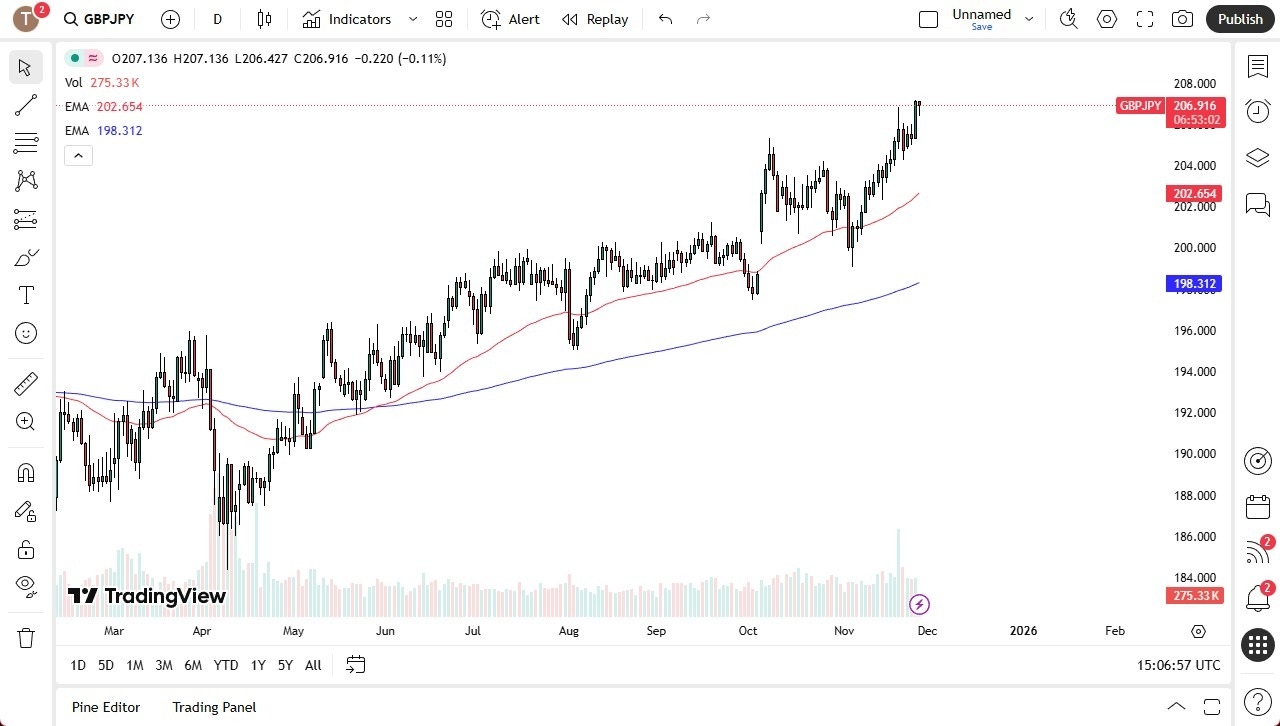
The British pound initially fell against the Japanese yen during the trading session here on Thursday but at this point it looks as if it is a market that continues to see a lot of upward trajectory and of course we need to keep in mind that the Wednesday session was a big huge victory for the British pound and it looks like we tried to roll that back but then turned around to show a confirmation of the strength.

If we can break above the high of both Wednesday and Thursday, then we have the British pound reaching towards the 210 yen level over the longer term. If we break it down, I think the 205 yen level will end up being a significant support level, as it was previous resistance. All things being equal, you do get paid at the end of every day to hang on to this pair. So, I think the interest rate differential continues to be a major factor.

Interest Rate Dynamics and Long-Term Bias

Especially as the Bank of Japan has almost no real serious possibility of tightening monetary policy of any significant note, while the British pound, despite the fact that the Bank of England came very close to cutting rates, still has a larger interest rate behind it. And therefore, I think you’ve got a situation where over the longer term, we should continue to just levitate here. Furthermore, you also have to keep in mind that there is a risk appetite factor here, and traders typically will buy this pair when they feel more risk on than risk-averse, and of course vice versa. I like buying dips here. I think we go higher.

Begin trading our daily forecasts and analysis. Here is a list of Forex brokers in Japan to work with.

Christopher Lewis has been trading Forex and has over 20 years experience in financial markets. Chris has been a regular contributor to Daily Forex since the early days of the site. He writes about Forex for several online publications, including FX Empire, Investing.com, and his own site, aptly named The Trader Guy. Chris favours technical analysis methods to identify his trades and likes to trade equity indices and commodities as well as Forex. He favours a longer-term trading style, and his trades often last for days or weeks.

Source link

30 11, 2025

Bullish outlook prevails above 181.00

By |2025-11-30T18:36:18+02:00November 30, 2025|Forex News, News|0 Comments

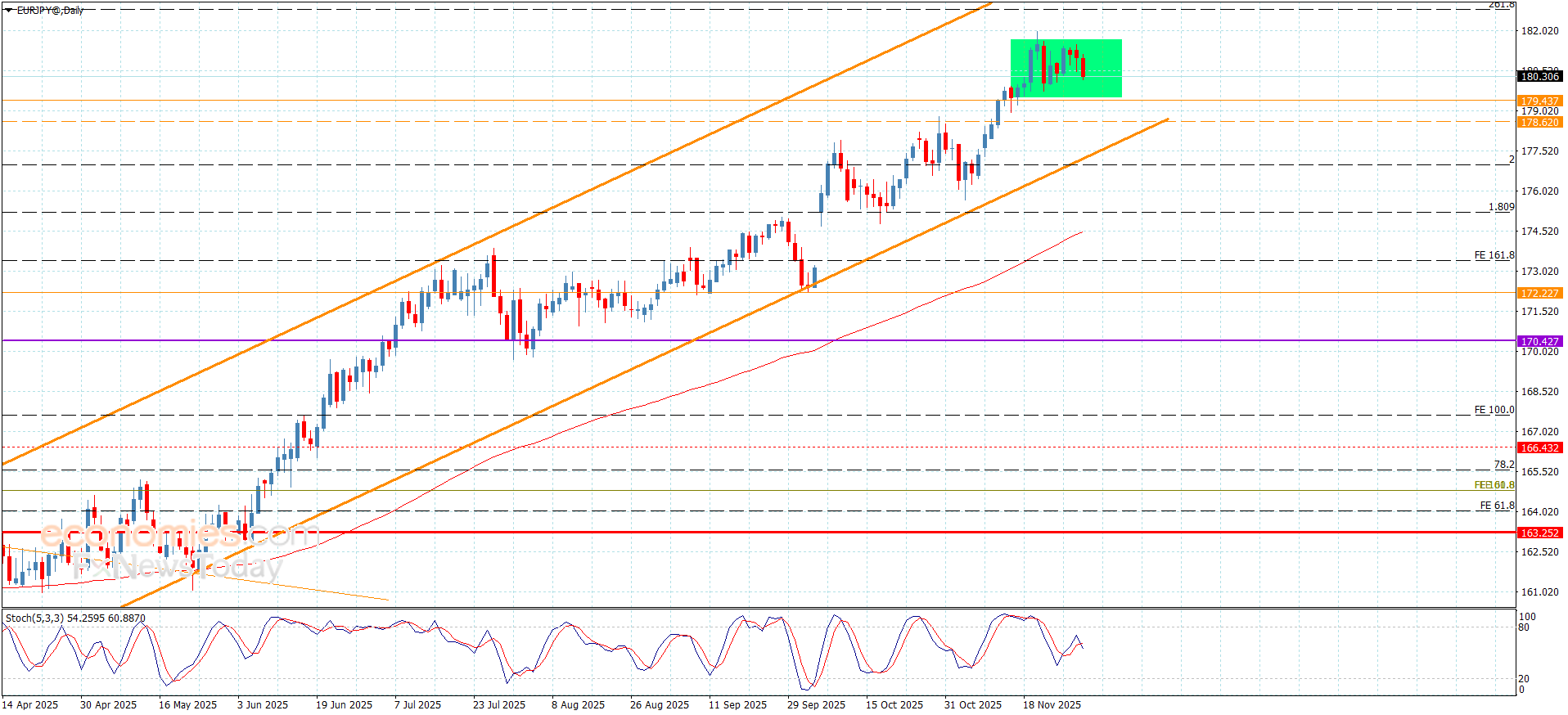
The EUR/JPY cross trades in negative territory near 181.05 during the early European session in Friday. The Japanese Yen (JPY) edges higher against the Euro (EUR) amid some verbal intervention from Japanese authorities. Traders brace for the release of Germany’s Retail Sales and Consumer Price Index (CPI) inflation data, which will be released later on Friday.

In the daily chart, EUR/JPY trades at 181.04. Price holds well above the rising 100-EMA at 174.71, sustaining the medium-term uptrend. The slope of the average has steepened in recent weeks, reinforcing bullish control. RSI at 63.77 is firm but not overbought, easing from 65.56 and indicating momentum has cooled slightly.

Price trades above the middle Bollinger Band and leans toward the upper band at 182.67, while the bands widen, signaling persistent bullish pressure and elevated volatility. A daily close through the upper band could extend the advance, whereas a pullback under 179.41 would expose a support range at 176.15–174.71.

(The technical analysis of this story was written with the help of an AI tool)

Japanese Yen FAQs

The Japanese Yen (JPY) is one of the world’s most traded currencies. Its value is broadly determined by the performance of the Japanese economy, but more specifically by the Bank of Japan’s policy, the differential between Japanese and US bond yields, or risk sentiment among traders, among other factors.

One of the Bank of Japan’s mandates is currency control, so its moves are key for the Yen. The BoJ has directly intervened in currency markets sometimes, generally to lower the value of the Yen, although it refrains from doing it often due to political concerns of its main trading partners. The BoJ ultra-loose monetary policy between 2013 and 2024 caused the Yen to depreciate against its main currency peers due to an increasing policy divergence between the Bank of Japan and other main central banks. More recently, the gradually unwinding of this ultra-loose policy has given some support to the Yen.

Over the last decade, the BoJ’s stance of sticking to ultra-loose monetary policy has led to a widening policy divergence with other central banks, particularly with the US Federal Reserve. This supported a widening of the differential between the 10-year US and Japanese bonds, which favored the US Dollar against the Japanese Yen. The BoJ decision in 2024 to gradually abandon the ultra-loose policy, coupled with interest-rate cuts in other major central banks, is narrowing this differential.

The Japanese Yen is often seen as a safe-haven investment. This means that in times of market stress, investors are more likely to put their money in the Japanese currency due to its supposed reliability and stability. Turbulent times are likely to strengthen the Yen’s value against other currencies seen as more risky to invest in.

Source link

30 11, 2025

Steady as Thanksgiving curbs trading activity

By |2025-11-30T00:26:05+02:00November 30, 2025|Forex News, News|0 Comments

EUR/USD trades without clear direction around 1.1590 on Thursday, virtually unchanged on the day, as liquidity drops sharply with US markets closed for Thanksgiving. The pair retains a modest bullish bias after facing resistance just above 1.1600 earlier in the European session.

Price action remains limited by the lack of fresh macroeconomic catalysts. The United States (US) is not releasing any major data on Thursday, while US Bond and Equity markets are shut, preventing any directional momentum.

On Wednesday, US figures had briefly supported the US Dollar (USD), with Initial Jobless Claims declining to 216,000 and Durable Goods Orders rising 0.5%, both beating expectations. However, that support faded into the late US session amid risk-positive flows, allowing the Euro (EUR) to close marginally higher.

Monetary policy expectations remain a key driver for EUR/USD. Markets continue to anticipate further rate cuts from the Federal Reserve (Fed) in the coming month, limiting the USD’s ability to extend technical rebounds. Investors consider that the gradual cooling of the labor market and the risks surrounding US growth make it difficult for the Fed to adopt a genuinely hawkish tone.

In the Eurozone, the Accounts of the October meeting of the European Central Bank (ECB) showed that Governing Council members broadly view current rates as appropriate. The document highlights an inflation outlook that is “broadly unchanged”, with uncertainty still elevated, reinforcing the idea that the easing cycle has ended. This cautious stance provides some stability to the Euro, though it does not generate strong upside in the absence of new data.

With US markets partially frozen and a very light macro agenda, EUR/USD is likely to remain confined to a narrow range. Traders will wait for liquidity to return before reassessing monetary policy divergence and the US Dollar’s ability to regain traction, or resume its broader bearish trend.

EUR/USD Technical Analysis

In the 4-hour chart, EUR/USD trades at 1.1594, little changed on a daily basis and below the day opening by 8 pips. The 100-period Simple Moving Average (SMA) edges higher, suggesting a modestly improving bias. Price holds above the SMA, with the average at 1.1564 offering nearby dynamic support. The Relative Strength Index (RSI) stands at 59, endorsing mild bullish momentum. Immediate support is seen at 1.1540, then at 1.1500, while initial resistance emerges around 1.1650.

A descending trend line from 1.1920 has limited gains, with a break area located near 1.1607. A decisive topside extension could target resistances at 1.1729 and 1.1779, while failure to clear trend resistance would leave the pair vulnerable to supports at 1.1500 and 1.1470. With momentum improving but capped by the line, subsequent direction would hinge on acceptance above the break area.

(The technical analysis of this story was written with the help of an AI tool)

Source link

Go to Top