The EURJPY pair formed strong bullish rally yesterday, confirming its surrender to the domination of the bullish bias, to notice its fluctuation near the second target at 161.65, taking advantage of its stability above the MA55.
We expect to form additional support at 160.10, beside stochastic additional positive momentum, to continue forming the bullish waves and attempt to press on 162.40 resistance line, followed by monitoring its behavior due to the importance of this level to detect the next trend.
The expected trading range for today is between 160.80 and 162.40
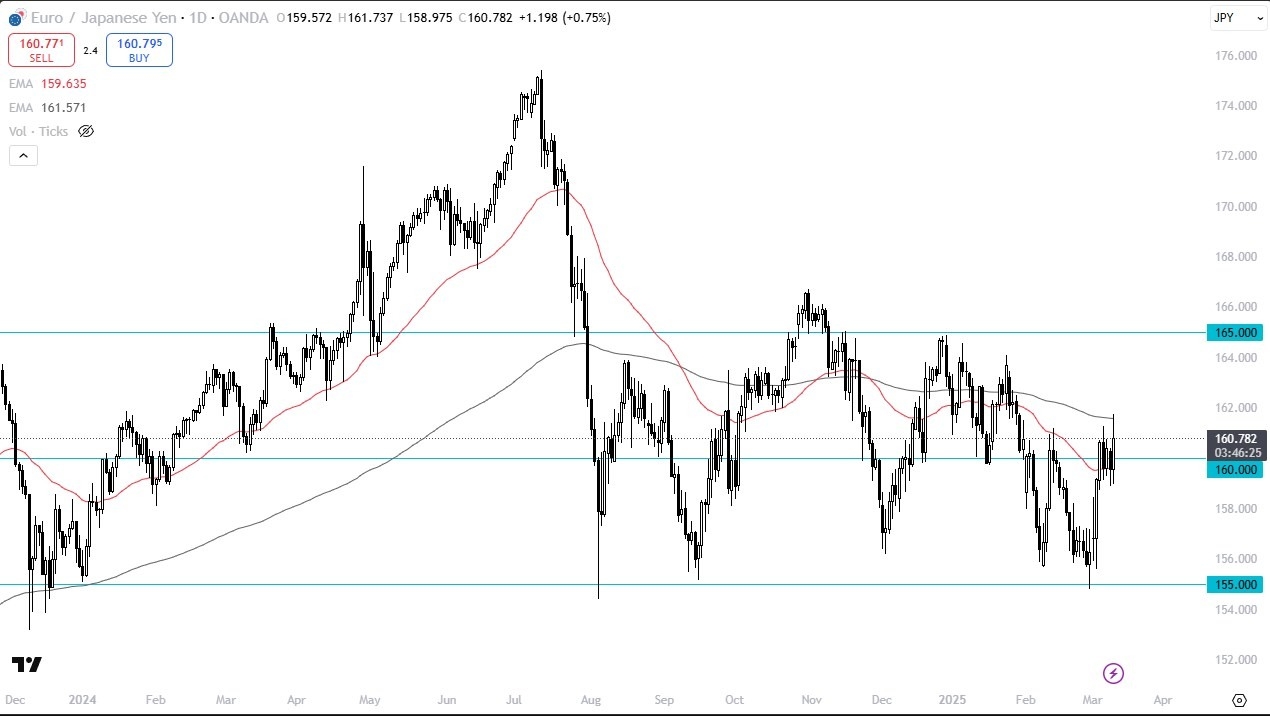
The euro has initially pulled back just a bit against the Japanese yen on Tuesday, only to skyrocket toward the 200-day EMA.
This is a pair that I think, given enough time, will probably try to break above the ¥162 level.
If it does, that opens up the possibility of moving all the way to the ¥165 level.
This is an area that I think would be somewhat resistant to further pressure to the upside, as it has been important multiple times in the past.
Short-term pullbacks, I think, continue to find buyers because of the interest rate differential and the fact that interest rates in Europe are rising via the bond market. That has a major influence on what happens with the euro itself. The Japanese yen, by contrast, has the Bank of Japan and its ultra-loose monetary policy, despite the fact that it’s probably going to raise interest rates one more time.
It’s also worth noting that the market has been banging around between the 50-day EMA and the 200-day EMA indicators, so there are a certain number of questions about whether or not we’re going to break out of this area. If we do break out, typically, that means you’re going to get some momentum. As things stand right now and also taking into account the size and strength of the candlesticks for the trading session on Tuesday, I do favor the upside.
Swap Matters in JPY Pairs Over Time
I don’t like paying for a swap at the end of the day anyway, and generally, over the long term, that’s a loser. Short-term traders may continue to kick this thing back around these moving averages, but ultimately, I think you have a scenario where short-term dips probably bring in more buyers. I don’t have any interest in shorting. I don’t want to own the Japanese yen at this point.
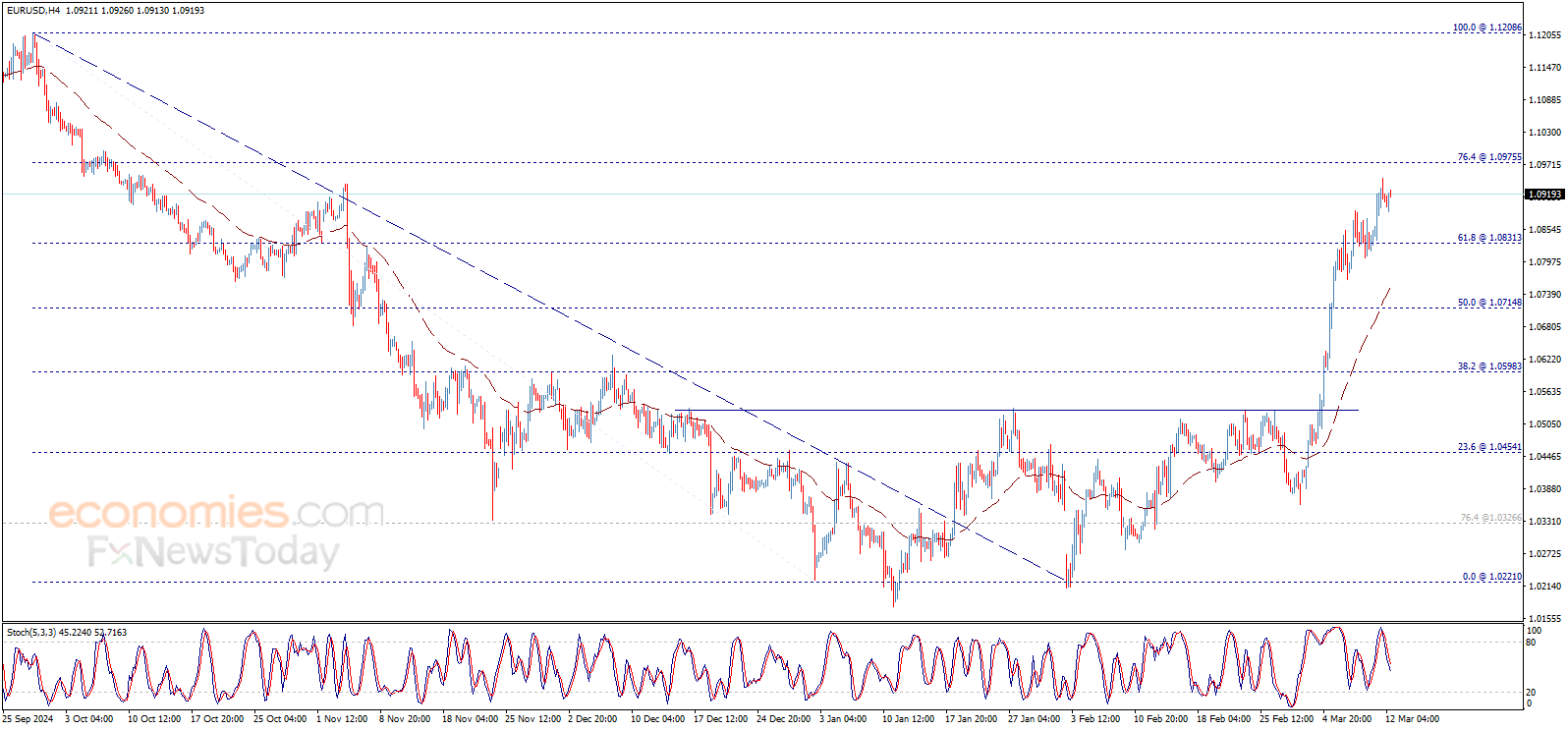
EUR/USD trades in a relatively tight channel at around 1.0900 on Wednesday.
The US’ 25% tariffs on global steel and aluminum imports went into effect, triggering a response from the EU.
The US economic calendar will feature Consumer Price Index (CPI) data for February.
EUR/USD seems to have entered a consolidation phase near 1.0900 after rising to its strongest level since mid-October near 1.0950. The pair’s technical outlook suggests that the bullish bias remains intact but investors could refrain from committing to another leg higher in the near term.
Euro PRICE This week
The table below shows the percentage change of Euro (EUR) against listed major currencies this week. Euro was the strongest against the Canadian Dollar.
USD
EUR
GBP
JPY
CAD
AUD
NZD
CHF
USD
-0.80%
-0.15%
0.40%
0.48%
0.13%
0.00%
0.32%
EUR
0.80%
0.61%
1.18%
1.29%
1.02%
0.78%
1.01%
GBP
0.15%
-0.61%
0.52%
0.65%
0.41%
0.12%
0.46%
JPY
-0.40%
-1.18%
-0.52%
0.08%
-0.20%
-0.46%
0.00%
CAD
-0.48%
-1.29%
-0.65%
-0.08%
-0.39%
-0.47%
-0.18%
AUD
-0.13%
-1.02%
-0.41%
0.20%
0.39%
-0.23%
0.05%
NZD
-0.01%
-0.78%
-0.12%
0.46%
0.47%
0.23%
0.39%
CHF
-0.32%
-1.01%
-0.46%
-0.00%
0.18%
-0.05%
-0.39%
The heat map shows percentage changes of major currencies against each other. The base currency is picked from the left column, while the quote currency is picked from the top row. For example, if you pick the Euro from the left column and move along the horizontal line to the US Dollar, the percentage change displayed in the box will represent EUR (base)/USD (quote).
The White House announced that 25% tariffs on steel and aluminum products from Canada and all other countries went into effect, with no exceptions or exemptions. In response, European Commission President Ursula von der Leyen said on Wednesday that the European Union (EU) has launched “swift and proportionate” countermeasures worth 26 billion Euros.
Meanwhile, European Central Bank (ECB) President Christine Lagarde said on Wednesday that trade fragmentation could lead to “larger, more disruptive relative price changes.”
In the second half of the day, the US Bureau of Labor Statistics will release the Consumer Price Index (CPI) data for February.
On a monthly basis, the core CPI is forecast to rise 0.3% following the 0.4% increase recorded in January. According to the CME FedWatch Tool, markets currently see virtually no chance of the Federal Reserve (Fed) cutting its policy rate after next week’s meeting. A soft monthly core CPI print, however, could feed into expectations of a rate reduction in May and weigh on the US Dollar (USD) with the immediate reaction. On the flip side, a stronger-than-forecast reading could support the USD. Nevertheless, a hot inflation report is likely to revive concerns over an economic downturn in the US and make it difficult for the USD to stage a decisive rebound.
EUR/USD Technical Analysis
EUR/USD remains within the ascending regression channel and the Relative Strength Index (RSI) indicator on the 4-hour chart stays near 70, reflecting the bullish stance. On the upside, 1.0940 (static level) aligns as interim resistance before 1.1000 (static level, round level, mid-point of the ascending channel).
In case EUR/USD drops below 1.0870 (lower limit of the ascending channel) and starts using this level as resistance, technical buyers could be discouraged. In this scenario, 1.0800 (static level, round level) could be seen as next support before 1.0730, where the 200-day Simple Moving Average is located.
Tariffs FAQs
Tariffs are customs duties levied on certain merchandise imports or a category of products. Tariffs are designed to help local producers and manufacturers be more competitive in the market by providing a price advantage over similar goods that can be imported. Tariffs are widely used as tools of protectionism, along with trade barriers and import quotas.
Although tariffs and taxes both generate government revenue to fund public goods and services, they have several distinctions. Tariffs are prepaid at the port of entry, while taxes are paid at the time of purchase. Taxes are imposed on individual taxpayers and businesses, while tariffs are paid by importers.
There are two schools of thought among economists regarding the usage of tariffs. While some argue that tariffs are necessary to protect domestic industries and address trade imbalances, others see them as a harmful tool that could potentially drive prices higher over the long term and lead to a damaging trade war by encouraging tit-for-tat tariffs.
During the run-up to the presidential election in November 2024, Donald Trump made it clear that he intends to use tariffs to support the US economy and American producers. In 2024, Mexico, China and Canada accounted for 42% of total US imports. In this period, Mexico stood out as the top exporter with $466.6 billion, according to the US Census Bureau. Hence, Trump wants to focus on these three nations when imposing tariffs. He also plans to use the revenue generated through tariffs to lower personal income taxes.
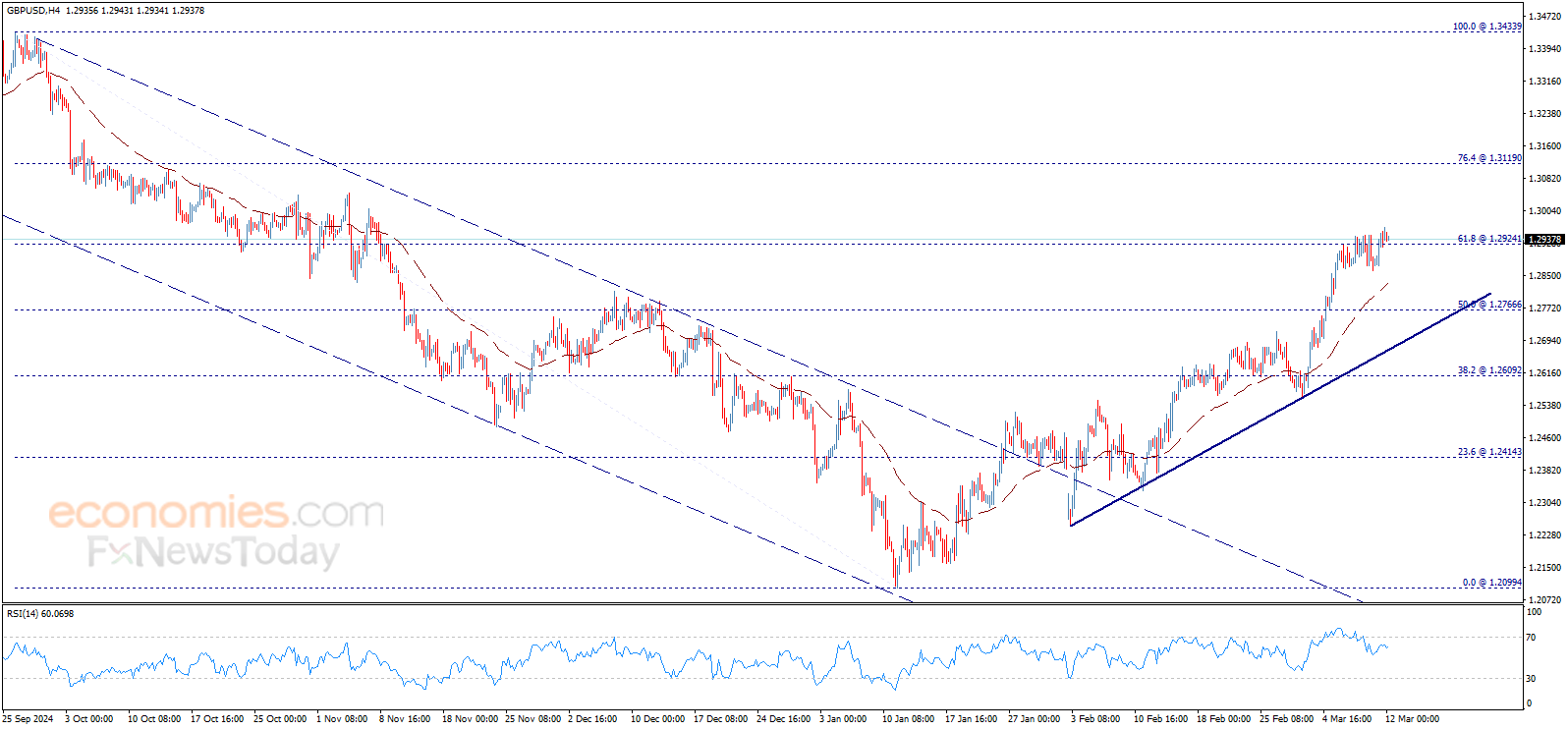
The GBPJPY pair took advantage of the stability of 188.50 support line to activate the bullish track and start achieving many gains by rallying towards 191.70, to approach the target mentioned in our previous report.
We notice stochastic attempt to provide the additional positive momentum to increase the efficiency of the bullish track, to expect attacking 192.10 obstacle, while surpassing it might extend trades towards 50% Fibonacci correction level at 193.25.
The expected trading range for today is between 190.80 and 193.25
The EURJPY pair formed strong bullish rally yesterday, confirming its surrender to the domination of the bullish bias, to notice its fluctuation near the second target at 161.65, taking advantage of its stability above the MA55.
We expect to form additional support at 160.10, beside stochastic additional positive momentum, to continue forming the bullish waves and attempt to press on 162.40 resistance line, followed by monitoring its behavior due to the importance of this level to detect the next trend.
The expected trading range for today is between 160.80 and 162.40
The EURJPY pair formed strong bullish rally yesterday, confirming its surrender to the domination of the bullish bias, to notice its fluctuation near the second target at 161.65, taking advantage of its stability above the MA55.
We expect to form additional support at 160.10, beside stochastic additional positive momentum, to continue forming the bullish waves and attempt to press on 162.40 resistance line, followed by monitoring its behavior due to the importance of this level to detect the next trend.
The expected trading range for today is between 160.80 and 162.40
Binance Coin’s currency price (BNBUSD) rose in the intraday after the current support of $534.7 held on, with the price trying to recoup some recent losses, amid the dominance of the downward correctional trend in the short term, with negative pressure due to trading below the 50-day SMA, coupled with negative signals from the RSI.
Therefore we expect the price to return lower, provided the aforementioned support of $534.7 was breached, thus targeting the pivotal support of $471.5.
Tweezers bottom’ pattern formed at 146.54 signals potential short-term trend reversal.
RSI flattens, suggesting bearish momentum is losing steam.
Key upside resistance seen at 148.00; clearance opens the door toward Senkou Span A at 149.79.
The USD/JPY rises as trade tensions loom due to back-and-forth tariff rhetoric between Canada and the United States (US), which initially weighed on the US Dollar. Nevertheless, as both countries agreed to lift tariffs, the pair advanced and traded at 147.77, up 0.34%.
USD/JPY Price Forecast: Technical outlook
USD/JPY formed a ‘tweezers bottom’ two candle chart pattern near the year-to-date (YTD) low of 146.54, hinting that the downtrend seems overextended after dropping from around 158.00 toward the current exchange rates. Despite being bearish, the Relative Strength Index (RSI) is flat, indicating that selling pressure is fading.
For a bearish continuation, USD/JPY needs to clear the YTD low of 146.54. If surpassed the next stop would be the September 30 swing low of 141.64, followed by the September 16 low of 139.58.
Conversely, if USD/JPY climbs above 148.00 a rally towards testing the Senkou Span A at 149.79 is on the cards.
USD/JPY Price Chart – Daily
Japanese Yen PRICE Today
The table below shows the percentage change of Japanese Yen (JPY) against listed major currencies today. Japanese Yen was the strongest against the Euro.
USD
EUR
GBP
JPY
CAD
AUD
NZD
CHF
USD
0.02%
0.01%
0.00%
-0.05%
0.03%
0.00%
-0.02%
EUR
-0.02%
-0.01%
-0.06%
-0.06%
0.00%
-0.02%
-0.04%
GBP
-0.01%
0.01%
-0.02%
-0.05%
0.02%
-0.01%
-0.02%
JPY
0.00%
0.06%
0.02%
-0.03%
0.05%
0.00%
0.01%
CAD
0.05%
0.06%
0.05%
0.03%
0.08%
0.04%
0.03%
AUD
-0.03%
-0.01%
-0.02%
-0.05%
-0.08%
-0.03%
-0.04%
NZD
0.00%
0.02%
0.00%
-0.01%
-0.04%
0.03%
-0.01%
CHF
0.02%
0.04%
0.02%
-0.01%
-0.03%
0.04%
0.00%
The heat map shows percentage changes of major currencies against each other. The base currency is picked from the left column, while the quote currency is picked from the top row. For example, if you pick the Japanese Yen from the left column and move along the horizontal line to the US Dollar, the percentage change displayed in the box will represent JPY (base)/USD (quote).
The GBP/USD price analysis shows solid bullish momentum.
The dollar has remained fragile amid worries about a likely US recession.
Traders expect at least three Fed rate cuts this year.
The GBP/USD price analysis shows solid bullish momentum as the pound holds near recent peaks due to dollar weakness. The sterling has maintained a bullish rally since the start of March as the dollar collapsed due to US economic worries. At the same time, market participants expect the Bank of England to keep rates unchanged next week.
–Are you interested to learn more about forex options trading? Check our detailed guide-
The dollar has remained fragile amid worries about a likely US recession due to Trump’s tariffs. The US president caused market turmoil last week by implementing new tariffs and suspending some. Traders are worried that his aggressive approach will spark trade wars that will cause an economic slowdown in the US. Decreased trade between the US and its partners means local companies suffer. If this happens, other parts of the economy will decline like the labor sector and consumer spending.
At the same time, recent US data has revealed slower demand, raising expectations for Fed rate cuts this year. On Friday, data showed slower job growth and higher unemployment in February. As a result, traders expect at least three Fed rate cuts this year. The upcoming inflation report will keep shaping this outlook.
On the other hand, market participants expect the Bank of England to keep rates unchanged next week amid the recent economic recovery.
GBP/USD key events today
GBP/USD technical price analysis: Bullish momentum pauses after a steep climb
GBP/USD 4-hour chart
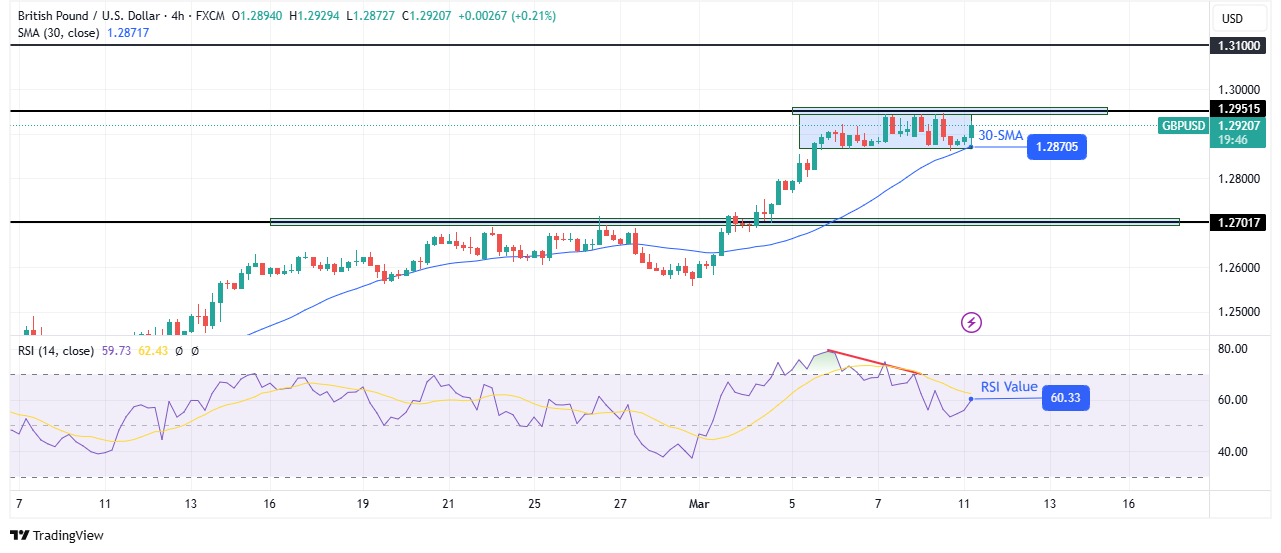
On the technical side, the GBP/USD price has met a solid hurdle at the 1.2951 level. However, the price still trades above the 30-SMA, with the RSI above 50, indicating a bullish bias. The price rose steeply after breaking above the pivotal 1.2701 resistance level.
–Are you interested to learn more about Thailand forex brokers? Check our detailed guide-
However, the rally has slowed down, and bullish momentum is fading. Price action is confined to a tight range. At the same time, the RSI has made a bearish divergence, suggesting a likely reversal. If bears are ready to take control, the price will break below the 30-SMA and fall to retest the 1.2701 support.
On the other hand, if bullish momentum remains strong, the price will soon break above the 1.2951 resistance. Such a move would clear the path to the 1.3100 key psychological level and a new high in the bullish trend.
Looking to trade forex now? Invest at eToro!
67% of retail investor accounts lose money when trading CFDs with this provider. You should consider whether you can afford to take the high risk of losing your money.
Important DisclaimersThe content provided on the website includes general news and publications, our personal analysis and opinions, and contents provided by third parties, which are intended for educational and research purposes only. It does not constitute, and should not be read as, any recommendation or advice to take any action whatsoever, including to make any investment or buy any product. When making any financial decision, you should perform your own due diligence checks, apply your own discretion and consult your competent advisors. The content of the website is not personally directed to you, and we does not take into account your financial situation or needs.The information contained in this website is not necessarily provided in real-time nor is it necessarily accurate. Prices provided herein may be provided by market makers and not by exchanges.Any trading or other financial decision you make shall be at your full responsibility, and you must not rely on any information provided through the website. FX Empire does not provide any warranty regarding any of the information contained in the website, and shall bear no responsibility for any trading losses you might incur as a result of using any information contained in the website.The website may include advertisements and other promotional contents, and FX Empire may receive compensation from third parties in connection with the content. FX Empire does not endorse any third party or recommends using any third party’s services, and does not assume responsibility for your use of any such third party’s website or services.FX Empire and its employees, officers, subsidiaries and associates, are not liable nor shall they be held liable for any loss or damage resulting from your use of the website or reliance on the information provided on this website.Risk DisclaimersThis website includes information about cryptocurrencies, contracts for difference (CFDs) and other financial instruments, and about brokers, exchanges and other entities trading in such instruments. Both cryptocurrencies and CFDs are complex instruments and come with a high risk of losing money. You should carefully consider whether you understand how these instruments work and whether you can afford to take the high risk of losing your money.FX Empire encourages you to perform your own research before making any investment decision, and to avoid investing in any financial instrument which you do not fully understand how it works and what are the risks involved.