The main tag of Forex News Today Articles.
You can use the search box below to find what you need.
[wd_asp id=1]

10 03, 2025

Euro stabilizes near multi-month highs

By |2025-03-10T12:29:15+02:00March 10, 2025|Forex News, News|0 Comments

  • EUR/USD trades in a narrow range above 1.0800 to start the week.
  • The pair could stay in a consolidation phase in the near term.
  • The US economic calendar will feature February inflation data later in the week.

EUR/USD gained more than 4% in the previous week and touched its highest level since early November near 1.0890 on Friday. The pair stays relatively quiet and fluctuates in a tight channel above 1.0800 in the early European session on Monday.

Euro PRICE Last 7 days

The table below shows the percentage change of Euro (EUR) against listed major currencies last 7 days. Euro was the strongest against the US Dollar.

  USD EUR GBP JPY CAD AUD NZD CHF
USD   -4.11% -2.46% -1.99% -0.62% -1.82% -2.30% -2.55%
EUR 4.11%   1.60% 2.00% 3.45% 2.29% 1.70% 1.45%
GBP 2.46% -1.60%   0.51% 1.82% 0.68% 0.09% -0.15%
JPY 1.99% -2.00% -0.51%   1.61% 0.21% -0.28% -0.59%
CAD 0.62% -3.45% -1.82% -1.61%   -1.06% -1.69% -1.94%
AUD 1.82% -2.29% -0.68% -0.21% 1.06%   -0.58% -0.82%
NZD 2.30% -1.70% -0.09% 0.28% 1.69% 0.58%   -0.25%
CHF 2.55% -1.45% 0.15% 0.59% 1.94% 0.82% 0.25%  

The heat map shows percentage changes of major currencies against each other. The base currency is picked from the left column, while the quote currency is picked from the top row. For example, if you pick the Euro from the left column and move along the horizontal line to the US Dollar, the percentage change displayed in the box will represent EUR (base)/USD (quote).

The US Dollar (USD) remained under heavy selling pressure last week as the disappointing macroeconomic data releases, in addition to US President Donald Trump’s tariff decisions, fed into fears over an economic downturn in the US.

The data published by the US Bureau of Labor Statistics showed on Friday that Nonfarm Payrolls rose by 151,000 in February. This reading missed the market expectation for an increase of 160,000. Other details of the employment report showed that the Unemployment Rate edged higher to 4.1% from 4% in January, while the annual wage inflation rose to 4% from 3.9% in the same period. Later in the day, Federal Reserve (Fed) Chairman Jerome Powell said that the uncertainty around the Trump administration’s policies are high. Powell reiterated that they can maintain policy restraint for longer if inflation progress stalls, or that they can ease the policy if the labor market unexpectedly weakens. These comments failed to trigger a market reaction and allowed EUR/USD to stabilize in the upper half of its weekly range.

The Fed will be in the blackout period this week. On Wednesday, February Consumer Price Index (CPI) will be featured in the US economic calendar. 

Meanwhile, US stock index futures were last seen losing between 0.4% and 0.6%. Although a bearish action in Wall Street could help the USD find demand, investors could refrain from betting on a steady recovery in the currency.

EUR/USD Technical Analysis

The Relative Strength Index (RSI) indicator on the four-hour chart retreated slightly below 70, suggesting that the bullish bias remains intact following a technical correction. On the downside, 1.0800 (static level, 20-period Simple Moving Average (SMA), round level) aligns as first support before 1.0760 (static level) and 1.0730 (200-day SMA).

Looking north, first resistance could be spotted at 1.0870 (200-week SMA) ahead of 1.0900 (round level, static level) and 1.0940 (static level).

Euro FAQs

The Euro is the currency for the 19 European Union countries that belong to the Eurozone. It is the second most heavily traded currency in the world behind the US Dollar. In 2022, it accounted for 31% of all foreign exchange transactions, with an average daily turnover of over $2.2 trillion a day. EUR/USD is the most heavily traded currency pair in the world, accounting for an estimated 30% off all transactions, followed by EUR/JPY (4%), EUR/GBP (3%) and EUR/AUD (2%).

The European Central Bank (ECB) in Frankfurt, Germany, is the reserve bank for the Eurozone. The ECB sets interest rates and manages monetary policy. The ECB’s primary mandate is to maintain price stability, which means either controlling inflation or stimulating growth. Its primary tool is the raising or lowering of interest rates. Relatively high interest rates – or the expectation of higher rates – will usually benefit the Euro and vice versa. The ECB Governing Council makes monetary policy decisions at meetings held eight times a year. Decisions are made by heads of the Eurozone national banks and six permanent members, including the President of the ECB, Christine Lagarde.

Eurozone inflation data, measured by the Harmonized Index of Consumer Prices (HICP), is an important econometric for the Euro. If inflation rises more than expected, especially if above the ECB’s 2% target, it obliges the ECB to raise interest rates to bring it back under control. Relatively high interest rates compared to its counterparts will usually benefit the Euro, as it makes the region more attractive as a place for global investors to park their money.

Data releases gauge the health of the economy and can impact on the Euro. Indicators such as GDP, Manufacturing and Services PMIs, employment, and consumer sentiment surveys can all influence the direction of the single currency. A strong economy is good for the Euro. Not only does it attract more foreign investment but it may encourage the ECB to put up interest rates, which will directly strengthen the Euro. Otherwise, if economic data is weak, the Euro is likely to fall. Economic data for the four largest economies in the euro area (Germany, France, Italy and Spain) are especially significant, as they account for 75% of the Eurozone’s economy.

Another significant data release for the Euro is the Trade Balance. This indicator measures the difference between what a country earns from its exports and what it spends on imports over a given period. If a country produces highly sought after exports then its currency will gain in value purely from the extra demand created from foreign buyers seeking to purchase these goods. Therefore, a positive net Trade Balance strengthens a currency and vice versa for a negative balance.

(This story was corrected on March 10 at 09:48 GMT to say that the annual wage inflation in the US rose to 4% from 3.9%, not 4.9%.)
Source link

10 03, 2025

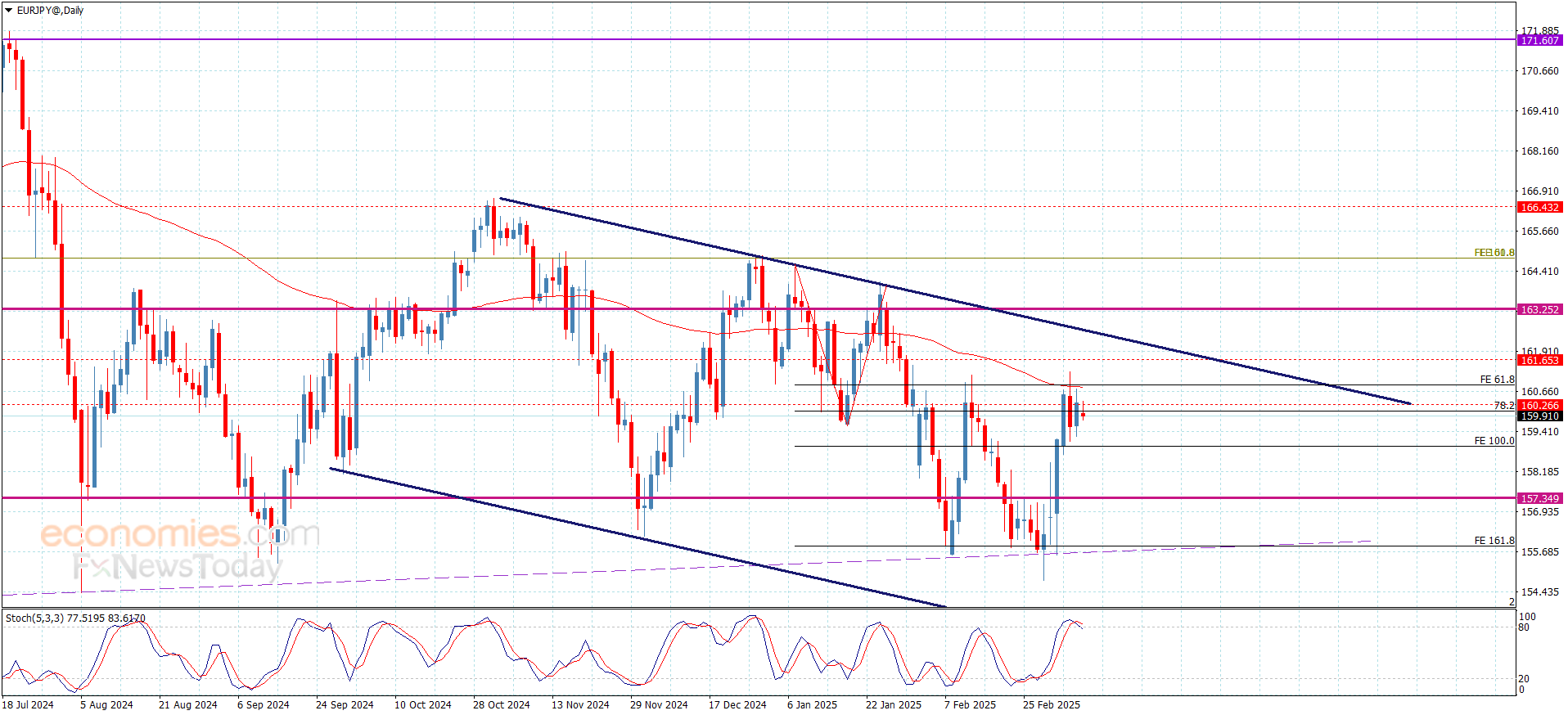
The EURJPY faces difficulty to rise – Forecast today – 10-3-2025

By |2025-03-10T10:27:56+02:00March 10, 2025|Forex News, News|0 Comments

Despite copper price consolidation within the bullish channel, the stability of 4.8100$ barrier continues to hinder the attempts to resume the bullish attack, to notice providing negative rebound towards 4.6200$ now.


We expect to get more mixed trades now, noting that it is important to hold above the additional support 4.5400$ to manage to gather the positive momentum and attack the mentioned barrier first, while surpassing it will push the price to achieve new gains that might extend towards 4.8800$ and 5.000$.


The expected trading range for today is between 4.5500$ and 4.7700$


Trend forecast: Bullish


Source link

10 03, 2025

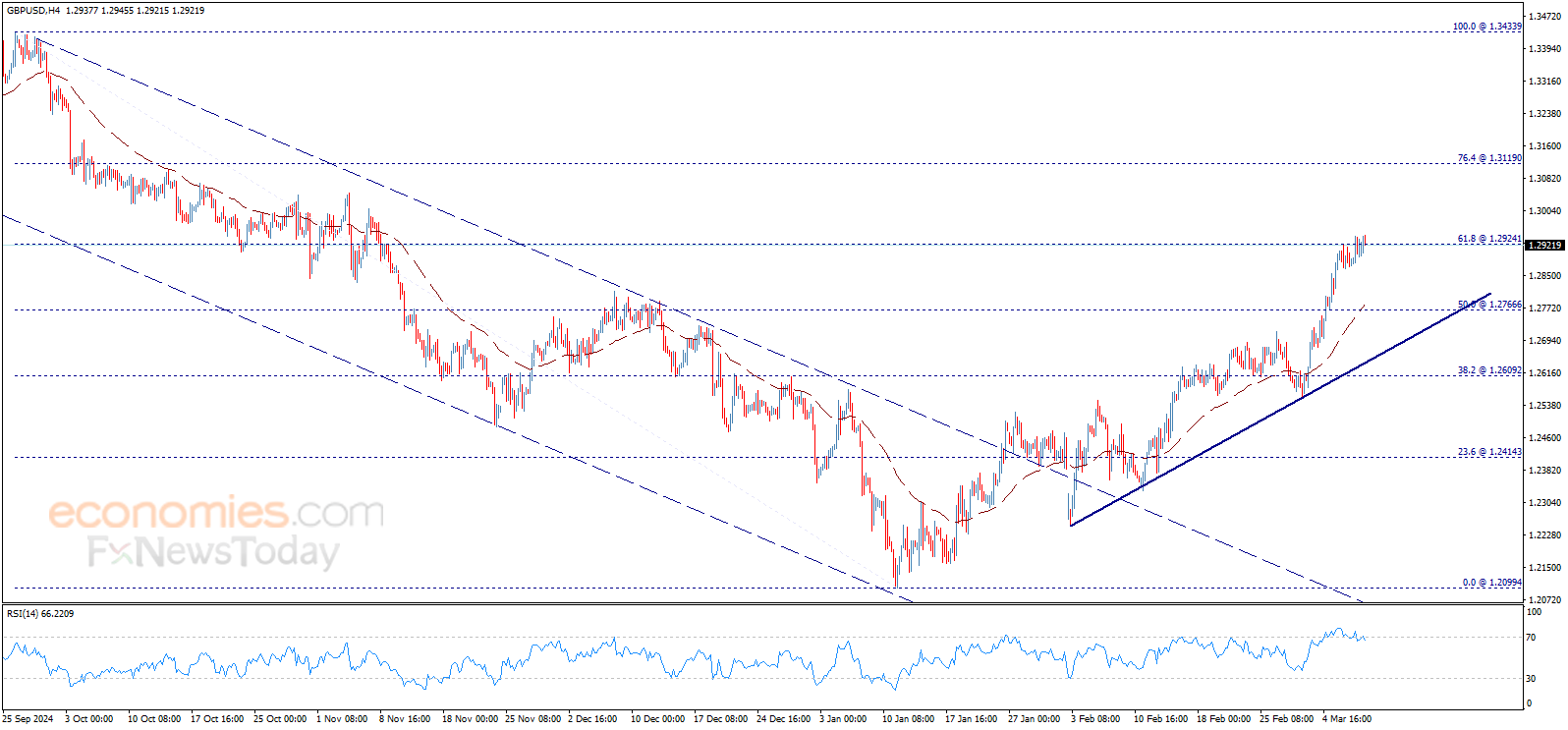
The GBPUSD price attempts to breach – Forecast today

By |2025-03-10T08:27:01+02:00March 10, 2025|Forex News, News|0 Comments

Brent oil price rallies upwards now to breach 70.40$ and attempts to hold above it, and by taking a deeper look at the chart, we find that the price completed forming double bottom pattern that we expect to push the price to recover in the upcoming sessions and achieve intraday gains.


To review the full report, and to get our more detailed analysis and 100% accurate signals provided by Best Trading Signal, subscribe to Economies.com VIP Club through the link below!


Source link

10 03, 2025

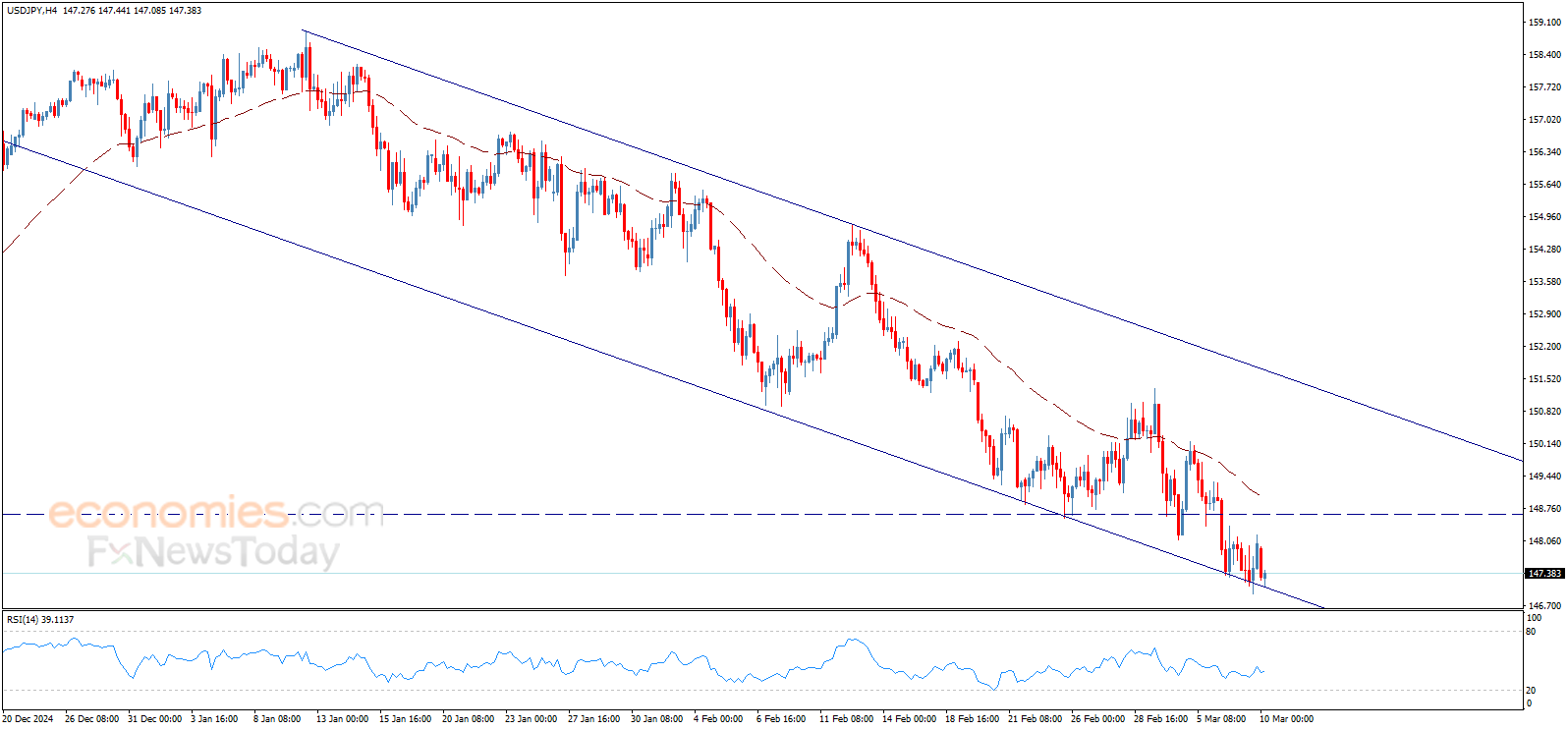
The USDJPY price attempts negatively – Forecast today

By |2025-03-10T06:26:16+02:00March 10, 2025|Forex News, News|0 Comments

The USDJPY price shows sideways trades in the previous sessions, starting today with bearish bias in attempt to resume the expected bearish trend for the upcoming period, which targets 146.50 areas as a next negative station.


To review the full report, and to get our more detailed analysis and 100% accurate signals provided by Best Trading Signal, subscribe to Economies.com VIP Club through the link below!


Source link

10 03, 2025

Here’s a EUR/USD forecast to 1.20 after the German fiscal bazooka lst week — TradingView News

By |2025-03-10T04:25:11+02:00March 10, 2025|Forex News, News|0 Comments

Catching up on some of the revised forecasts after Germany ditched its debt brake, ICYMI:

  • Germany will set up €500 billion infrastructure fund and a special defense fund
  • German bond yields surge higher after deal to loosen debt brake

Bank of America revised up their forecasts for the euro:

  • now see EUR/USD reaching $1.15 by the end of 2025
  • and to around $1.20 by the end of 2026

Source link

10 03, 2025

Pound to Dollar Weekly Forecast: Target Extended to 1.33-1.34 say Analysts

By |2025-03-10T00:23:11+02:00March 10, 2025|Forex News, News|0 Comments

March 9, 2025 – Written by David Woodsmith

Foreign exchange strategists at Morgan Stanley have extended their Pound to Dollar exchange rate (GBP/USD) target to $1.33.

Bank of America analysts consider that the GBPUSD break higher this week is potentially very important and could pave the way for a test of 2024 highs above $1.34.

It has been a week of chaotic US drama amid with sharp dollar index losses (DXY) as the Euro surged and GBP/USD hit 4-month highs near 1.2950 before a correction.

ING commented; “This week’s tectonic shifts in the Transatlantic divide come with significant caveats and major unknowns. And it’s these question marks that really matter for what happens next in financial markets.”

The bank no longer expects GBP/USD will slide below 1.20.

According to Morgan Stanley; “The combination of USD-negative forces and improved optimism around EUR as a ‘credible alternative’ to the greenback should propel capital into Europe, benefiting not just EUR but other European currencies as well.”

Ukraine developments remained very important, especially given the European reaction.

Advertisement


On the trade front, President Trump imposed 25% tariffs on Canada and Mexico from February 4th.

Trump then announced that autos would be exempted for one month and this was then extended to all goods covered by the free-trade agreement.

There are still plans to introduce global tariffs at the beginning of April and tariffs on China have been increased.

MUFG commented; “What is clear is that the back-and-forth on trade tariff policy announcements can’t be good for the US economy and it is surely creating an incentive amongst businesses to retrench from decisions around hiring and business investments.”

US data was mixed with the jobs report close to expectations.

Federal government employment, however, declined and sharper falls are expected over the next few months.

Expectations of a first-quarter GDP decline for the first quarter increased recession fears.

Equity markets declined, but it was notable that the dollar failed to gain defensive support.

This failure helped open a wider currency debate.

According to Deutsche Bank’s global head of FX strategy George Saravelos there is an increased risk that the US dollar will lose its reserve currency status; “we are starting to become more open-minded to the prospects of a broader weaker trend unfolding for the dollar. Two pillars of America’s role in the world are being fundamentally challenged: the US’s security backstop for Europe and the respect of rules-based free trade.”

It added; “We do not write this lightly. But the speed and scale of global shifts is so rapid that this needs to be acknowledged as a possibility. It is hard to over-estimate the scale of change taking place in global economic and geopolitical relations in a matter of days.”

Kit Juckes at SocGen also expressed dollar reservations; “My biggest underlying concern with the dollar is that even after so many years of exceptionalism that have taken it to levels it hasn’t seen since 1985 in real effective terms, it only takes a few chinks in the armour for it to look weaker.”

ING commented on the 2025 outlook; “Given this week’s events and the fact that DXY is heavily weighted towards European currencies, it seems fair to say that DXY has now topped for the year.”

According to Lloyds Bank; “We’re witnessing regular acts of US economic self-harm, which will cause short-term disruptions at the very least. On top of that, we’ve seen an indiscriminate tearing at the rules and bureaucracy, which will invariably have unforeseen consequences.”

The bank noted the risk of capital outflows; “that flow could become a torrent as policy implications begin to galvanise, or we see a more sustained pick up in market volatility. We had shaded our longer-term core bullish USD view over the past couple of weeks, but we now abandon that viewpoint entirely.”

Doubts over the US outlook were compounded by the German proposals for a huge EUR500bn boost to infrastructure spending as well as a sharp increase in defence spending.

A re-rating of the Euro-area outlook and jump in yields triggered a Euro surge and further gains would be a tailwind for GBP/USD.

JP Morgan commented; “We are now approaching that inflection point prompting us to turn bearish on the dollar and constructive on the Euro for the first time since 2024. This represents a substantial change in view for us. It sees a potential EUR/USD move to 1.12-1.14.

Bank of America considers that the 1.20 area could be in reach late this year.

UBS is still wary over Pound fundamentals; “Risks regarding the UK’s fiscal and current account situation remain and pose a downside risk to GBP—in case of “the wrong kind of carry” whereby FX and rates can decouple as we saw in January.”

Like this piece? Please share with your friends and colleagues:


International Money Transfer? Ask our resident FX expert a money transfer question or try John’s new, free, no-obligation personal service! ,where he helps every step of the way,
ensuring you get the best exchange rates on your currency requirements.

TAGS: Currency Predictions Pound Dollar Forecasts

Source link

9 03, 2025

Japanese Yen Weekly Forecast: Will Japan’s Wage Growth Signal a BoJ Rate Hike?

By |2025-03-09T22:21:09+02:00March 9, 2025|Forex News, News|0 Comments

FX Empire – US Producer Prices

Shifting to the US labor market and consumer sentiment, initial jobless claims and the Michigan Consumer Sentiment Index also need consideration.

A spike in jobless claims and a fall in consumer sentiment could indicate weaker wage growth and spending. A pullback in consumer spending may soften demand-driven inflationary pressures. However, another drop in claims and improving sentiment may delay Fed rate cuts.

A more hawkish Fed may push USD/JPY toward 150, while dovish signals could trigger a drop toward 145.

Short-term Forecast:

In the coming week, USD/JPY trends will hinge on:

  • Japan’s Economic Data: Wage growth and inflation remain crucial for the BoJ rate path.
  • US Reports: Inflation, labor market, and consumer sentiment to affect Fed rate cut bets
  • Geopolitical risks: US tariff developments could impact market sentiment.

USD/JPY Price Action

Daily Chart

After last week’s declines, the USD/JPY sits well below the 50-day and the 200-day EMAs, sending bearish price signals.

A USD/JPY break above the 149.358 resistance level would support a return to 150. A breakout from 150 could enable the bulls to target the 200-day and 50-day EMAs.

Conversely, a break below last week’s low of 146.935 could signal a drop toward 145. A fall through 145 would bring the 140.309 support level into sight.

The 14-day Relative Strength Index (RSI) at 33.86 indicates a USD/JPY fall below 147 before entering oversold territory (RSI below 30).

Source link

9 03, 2025

Euro to Dollar Forecast: 2 Factors Could Drive Additional Gains Over Next 1-3 Months

By |2025-03-09T20:19:33+02:00March 9, 2025|Forex News, News|0 Comments

March 9, 2025 – Written by Frank Davies

The US Dollar (USD) has remained firmly on the defensive versus the Pound Sterling (GBP) in global markets while the Euro (EUR) has made further net gains following German plans to unlock a huge fiscal stimulus.

The Pound to Dollar exchange rate (GBP/USD) has posted fresh 4-month highs just above 1.2930.

The US jobs data is likely to be pivotal in determining whether GBP/USD can test the 1.30 level today.

The Pound to Euro (GBP/EUR) exchange rate is close to 5-week lows just above the 1.1900 level amid a Euro surge.

According to Kirstine Kundby-Nielsen, FX analyst at Danske Bank, “It’s all to do with the broad-based euro optimism that we’ve seen with this shift in fiscal policy in Germany.”

ING added on the Euro, “A major re-rating is underway.”

Economic data and the equity market performance is likely to be crucial for the dollar.

Advertisement


President Trump made further concessions to Canada and Mexico on Thursday, but there are increased fears that the uncertainty and frequent policy changes will undermine confidence in the economy.

The US will release the latest employment data on Friday.

Consensus forecasts are for an increase in non-farm payrolls around 160,000 for February with the unemployment rate holding at 4.0%.

Markets are, however, expecting a soft set of data even though the rash of government firings will not yet show up in the data.

ING commented, “Some fear that weather plus changes in government education funding will be a drag on the headline number. However, the impact of the DOGE government job cuts may not emerge for another couple of months.”

According to MUFG, “Given the depreciation of the dollar is down to a shift in relative macro expectations in part due to weak economic data from the US, a weak payrolls report today would certainly further extend dollar losses and harden the view that the FOMC will cut sooner than expected.”

The ECB cut interest rates on Thursday but added an extra element with comments that policy is now much less restrictive.

In this context, there were doubts whether there would be a further cut in April.

ING commented, “A pause at the next meeting to come to terms with the new macro reality now looks like a possibility.”

EUR/USD has hit 4-month highs around 1.0870 amid the Euro surge. Further gains would provide a tailwind for GBP/USD.

According to Danske Bank, “While EUR optimism from increased fiscal spending may now be largely priced in, potential catalysts such as a ceasefire deal in Ukraine or a further deterioration in the US cyclical macro outlook – especially the latter – could drive additional gains in the pair over the next 1-3M.”

Like this piece? Please share with your friends and colleagues:


International Money Transfer? Ask our resident FX expert a money transfer question or try John’s new, free, no-obligation personal service! ,where he helps every step of the way,
ensuring you get the best exchange rates on your currency requirements.

TAGS: Euro Dollar Forecasts

Source link

9 03, 2025

Weekly Forex Forecast – March 09

By |2025-03-09T16:17:21+02:00March 9, 2025|Forex News, News|0 Comments

I wrote on 2nd March that the GBP/NZD currency pair would likely fall in value. Unfortunately, it rose in value by 0.71%.

Last week saw several data releases affecting the Forex market:

  1. US Average Hourly Earnings – a month-on-month increase of 0.3% as expected.
  2. ECB Main Refinancing Rate & Monetary Policy Statement – the rate cut of 0.25% was widely expected, but the ECB cut its growth forecast which could be seen as a small dovish surprise.
  3. US Non-Farm Employment Change – this was just a little less than expected.
  4. US ISM Services PMI – slightly better than expected.
  5. US ISM Manufacturing PMI – almost exactly as expected.
  6. Australian GDP – as expected.
  7. Swiss CPI (Inflation) – the month-on-month increase was 0.6%, slightly higher than the widely expected 0.5%.
  8. US Unemployment Claims – just a little less than expected.
  9. US Unemployment Rate – this unexpectedly increase from 4.0% to 4.1%.
  10. Canadian Unemployment Rate – this was expected to tick higher, but it stayed at 6.6%.

Last week’s key takeaways were:

  1. The data outlined above was inconsequential for the markets, which are much more concerned with the US-centered trade war which seems to be underway without a clear end.
  2. The ongoing trade war between the USA on one side and Canada, Mexico, China and potentially the European Union on the other is what has really been driving market movements over the past week. There is no deal in sight and the new tariffs remain in place, causing economic harm to all three countries.
  3. It was a bad week for stock markets, especially in the USA, where major indices dropped sharply enough to shake out more trend followers from long positions, with many institutions either reducing or eliminating their exposure. Friday saw some gains, however.
  4. Market sentiment is basically in risk-off mode, with commodities and commodity currencies taking a serious beating. Even Gold, which had been holding up relatively well, has not been able to reach a new high.
  5. In the Forex market, the Euro made very strong gains, while the US Dollar was weak.
  6. There are concerns that the USA may be starting to tip into recession after the Atlanta Fed data suggested GDP could be running at an annualized decline of 2.4%.
  7. President Trump announced the creation of a strategic crypto reserve for the USA, also stating he wanted to see stablecoin legislation passed by the end of this summer. This gave crypto a temporary boost, but major cryptocurrencies quickly gave up all gains as it was realized the US government would still not be purchasing crypto.

The coming week has a lighter schedule of important releases, so we are likely to see less volatility in the Forex market over the coming week.

This week’s important data points, in order of likely importance, are:

  1. US CPI (inflation)
  2. US PPI
  3. US Preliminary UoM Inflation Expectations
  4. Bank of Canada Overnight Rate & Rate Statement
  5. US Preliminary UoM Consumer Sentiment
  6. US JOLTS Job Openings
  7. UK GDP

For March 2025, I made no forecast, as there were no clear trends at the start of this month.

Last week, I forecasted that the following currency cross would fall in value over the week:

  • GBP/NZD – rose by 0.71%

This was not a profitable call.

This week, I forecast that the following currency crosses will fall in value:

The Euro was the strongest major currency last week, while the US Dollar was the weakest, putting the EUR/USD currency pair in focus. Volatility increased last week, with 70% of the most important Forex currency pairs and crosses changing in value by more than 1%. It is likely to remain at a similar level over the coming week, despite the lighter agenda, due to US inflation data due, and the ongoing trade war.

You can trade these forecasts in a real or demo Forex brokerage account.

Weekly Forex Forecast – March 09

Last week, the US Dollar Index printed the largest weekly bearish candlestick in almost 2.5 years. The Dollar was the worst performing major currency last week and suffered a big loss, closing back within its dominant recent range and well below its level from 3 months ago, invalidating its former long-term bullish trend. At one point, the price reached a new 4-month low.

These are bearish signs, although there is some lower wick suggesting a little buying at the low.

Global markets have entered a strongly risk-off mode, but the greenback does not benefit because of the uncertain trade war the US is now engaged in against Canada, Mexico, and China, with no end in sight.

Trades taken over the coming week will probably be best positioned against the US Dollar, at least until a deal is announced replacing reciprocal import tariffs involving the USA.

Weekly Forex Forecast – March 09

The EUR/USD currency pair made a huge gain over the week, rising by more than 4%, which is unusual. The key driver is certainly the US-centered trade war, which has sent the greenback flying lower, while the Euro has gained as a store of value.

Although the European Central Bank met last week and gave a slightly dovish report, as well as cutting rates by 0.25%, that was not enough to weaken the Euro at all.

Despite the strong bullish move, the daily price chart below shows that the bulls may have run out of steam towards the end of last week, with the final two daily candlesticks close to looking like bearish pin bars. Another factor is the tight cluster of resistance levels overhead which are confluent with a major bearish inflection point near the major round number at $1.1000.

Another bearish factor is that the moving averages are misaligned: although the price has made a bullish breakdown to new multi-month highs, the 50-day moving average is still below the 100-day moving average, and this is often used as a filter by successful trend traders, suggesting we are most likely to see a bearish reversal.

I caution traders positioned long here to think about exiting and suggest that other traders consider a short trade, if and when we get a reversal from a key resistance level.

Weekly Forex Forecast – March 09

The USD/JPY currency pair fell last week to trade at a new 5-month low. Trend traders would have got signals to go short here last week but this was stopped by one key filter still saying no short trade: the 50-day moving average remains above the 100-day moving average.

Note how the price rejected the low of the week Friday and the support level at ¥147.84 with a bullish pin bar. This is certainly not decisive, but until the price makes a stronger fall and erases that low with a strongly bearish close, it will be unwise to go short. Also, the moving averages need to cross.

The US Dollar is very weak due to the US-centered trade war, and the Japanese Yen typically benefits in this kind of risk-off situation where the greenback cannot. The Yen also has a tailwind as Japanese wage inflation is clearly rising and the Bank of Japan seems set to implement meaningful rate hikes for the first time since 2008.

Weekly Forex Forecast – March 09

The S&P 500 Index fell strongly last week and reached a level nearly 8% below its record high which was made barely more than 2 weeks ago. The main reason for the strong drop in most global stock markets, and the major US indices in particular, is of course the large tariffs President Trump has imposed on US imports from Canada and Mexico, and the fact that neither country seems close to capitulating or to make the kind of deal President Trump would want to call off the tariffs. The US tariffs are just negotiation by another means.

Technically, what is most interesting here is that the price on Thursday and Friday traded below the 200-day moving average, which is drawn within the daily price chart below. This indicator is used to establish a technical bear market, and it is interesting we have not yet had a daily close below it. This suggests that this moving average may be acting as a mobile pivotal point. If the price keeps refusing to close below it, we may see the start of another bullish rally, and if a tariff deal were then concluded, that would give a big tailwind to any bullish push.

Personally, as a trend trader, I will not be entering any new long trades until we see the price make a new record high, and that might not happen for quite a long time.

Weekly Forex Forecast – March 09

It was a poor week for commodities generally, with the possible exception of Gold, which mostly traded not far away from its recent all-time high just above $2,950.

One of the very few exceptions is Natural Gas. The nearest futures contract of Henry Hub natural gas rose during last week to make a new 2-year high and ended the week not far from that.

So, what is driving Natural Gas higher? Most analysts see it as a combination of extreme cold weather, seasonality, and strong demand plus weak supply.

March can be a pretty cold month in the Northern Hemisphere, and the cold can even stretch into April, so there is reason to believe this long-term bullish trend might continue for a while longer yet.

If you are worried about the generally poor environment for commodities and start of the spring season later this month, you could pass on this long trade or take an unusually small position.

Weekly Forex Forecast – March 09

I see the best trades this week as:

  1. Long of Natural Gas futures.
  2. Short of the EUR/JPY and EUR/NZD currency crosses.

Ready to trade our Forex weekly forecast? Check out our list of the top 10 Forex brokers in the world .

Source link

8 03, 2025

GBP/USD Weekly Forecast: Dollar Slips on Economic Uncertainty

By |2025-03-08T20:07:05+02:00March 8, 2025|Forex News, News|0 Comments

  • The GBP/USD weekly forecast shows a rebound in the pound.
  • US Job growth slowed down slightly in February.
  • The US unemployment rate increased from 4.0% to 4.1%. 

The GBP/USD weekly forecast shows a rebound in the pound as the dollar drops amid soft NFP and tariff uncertainty.

Ups and downs of GBP/USD 

The GBP/USD price had a bullish week as the pound soared against a weak dollar. The greenback collapsed as market participants grew fearful of a US economic slowdown. On Tuesday, Trump implemented tariffs on Canada, Mexico and China. Although he suspended some of these tariffs, traders worried that trade wars would hurt the US economy. 

Are you interested to learn more about forex options trading? Check our detailed guide-

Meanwhile, Fed rate cut expectations increased after US nonfarm payrolls came in lower than expected. Job growth slowed down slightly. At the same time, the unemployment rate increased from 4.0% to 4.1%. More downbeat data next week could push traders to start pricing three rate cuts this year.

Next week’s key events for GBP/USD

GBP/USD Weekly Forecast: Dollar Slips on Economic Uncertainty

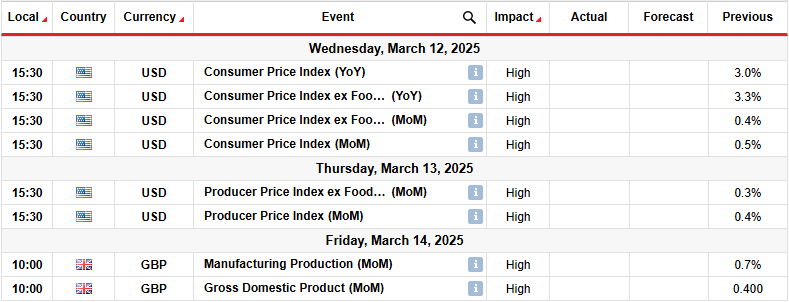
Next week, the US will release its CPI and PPI reports, showing the state of inflation. Meanwhile, the UK will release data on manufacturing production and gross domestic product. The inflation data will shape the outlook for Fed rate cuts. Economists expect inflation to ease from the previous month. Such an outcome would align with recent data showing a slowdown in the US economy. Therefore, it would increase Fed rate cut expectations, boosting GBP/USD. 

Meanwhile, UK data will show the health of the UK economy and shape the outlook for Bank of England monetary policy. 

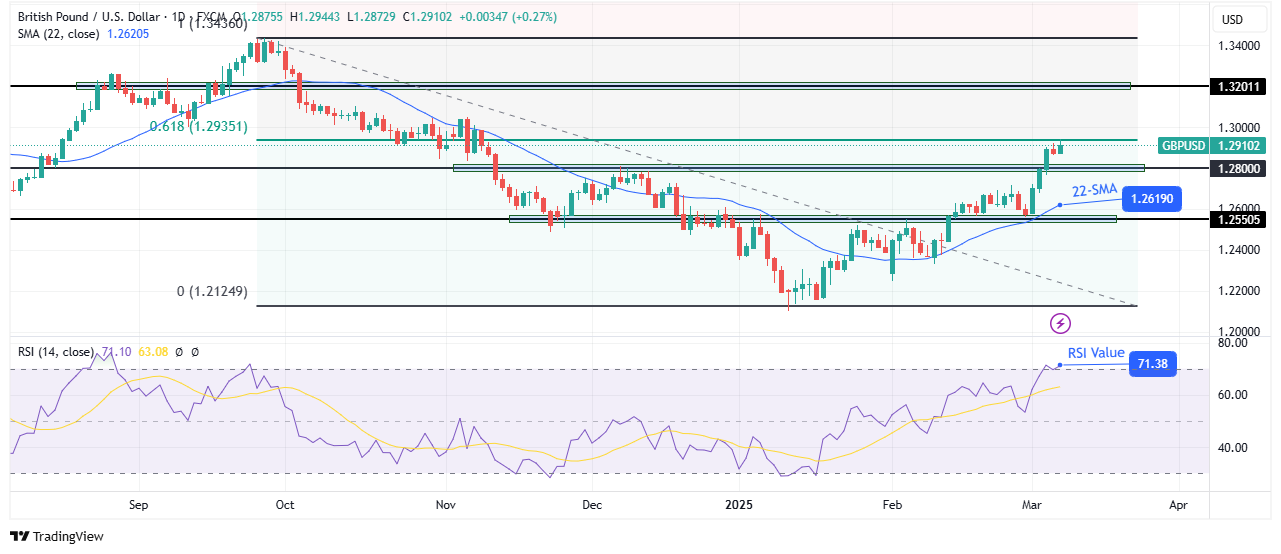
GBP/USD weekly technical forecast: Bulls meet the 0.618 Fib hurdle

GBP/USD weekly technical forecastGBP/USD weekly technical forecast
GBP/USD daily chart

On the technical side, the GBP/USD price has broken above the 1.2800 key resistance level. This move has pushed the price far above the 22-SMA, with the RSI in the overbought region, indicating solid bullish momentum. 

Are you interested to learn more about Thailand forex brokers? Check our detailed guide-

The price recently reversed after a strong downtrend. Since the reversal, bulls have maintained their position above the 22-SMA, constantly reaching new highs. However, the current high has fallen near the 0.618 Fib retracement level. This might act as a solid resistance. Therefore, GBP/USD might pull back to retest the recently broken 1.2800 key level. A deeper pullback would retest the 22-SMA.

However, as long as the price stays above the SMA and the RSI above 50, the bullish trend will continue. Therefore, GBP/USD might reach the 1.3201 resistance level.

Looking to trade forex now? Invest at eToro!

67% of retail investor accounts lose money when trading CFDs with this provider. You should consider whether you can afford to take the high risk of losing your money.

Source link

Go to Top