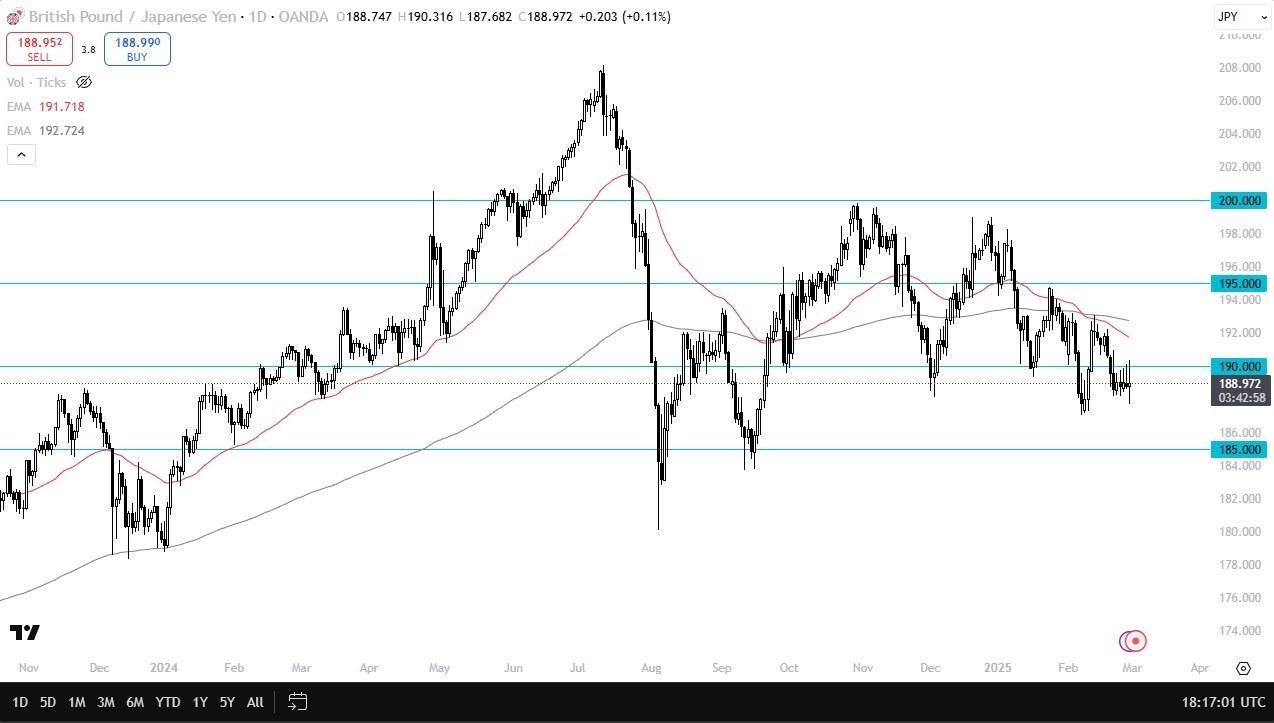
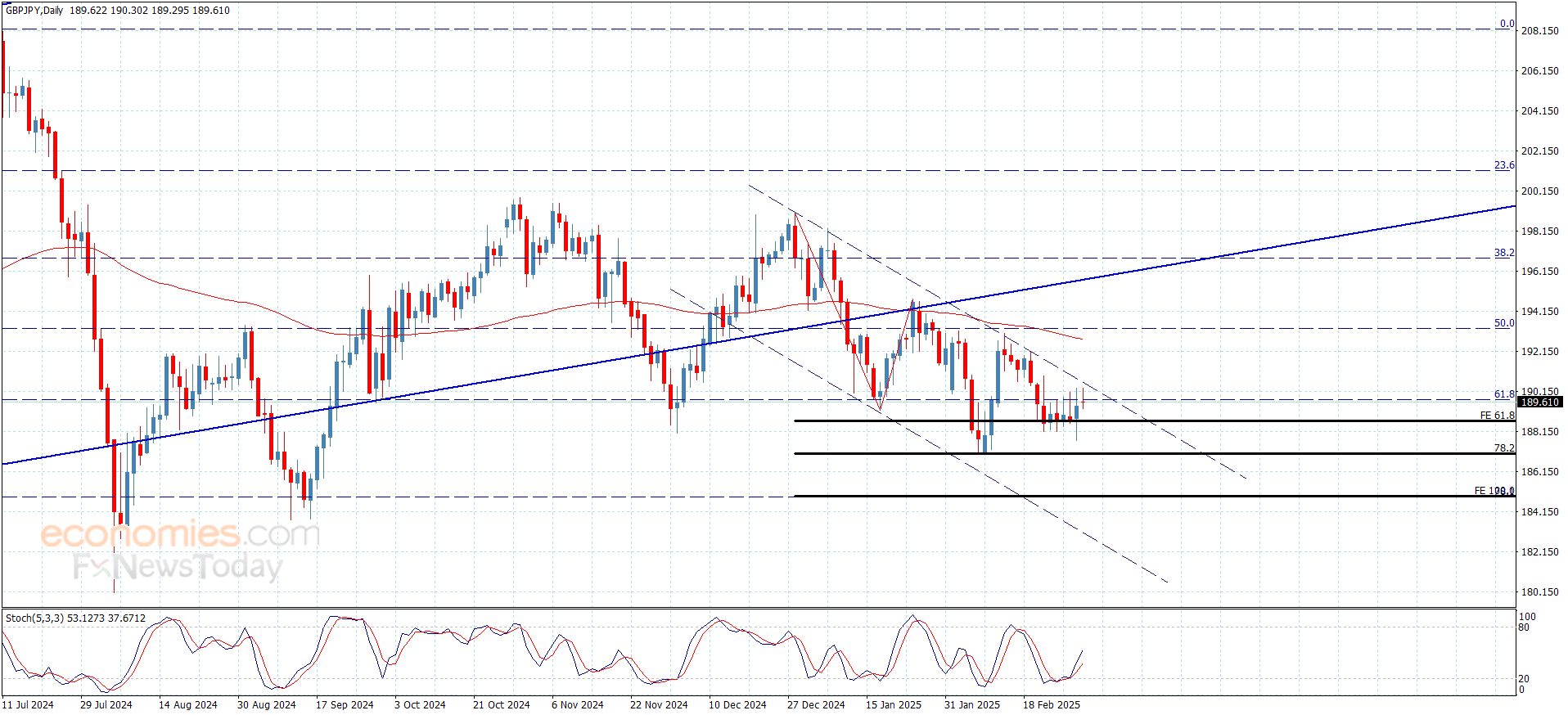
During the trading session on Friday, we have seen the British pound all over the place against the Japanese yen.
Ultimately, the market did test the ¥190 level, which is a large, round, psychologically significant figure, but it’s also an area that has been important more than once.
Because of this, and the fact that we pull back from there so quickly, the market is likely to continue to look at this area as crucial.
If we break down from here, and perhaps below the low of the trading session, then we could see the British pound Paul significantly, perhaps down to the crucial ¥185 level. The ¥185 level of course is an area that’s been important a couple of times in the past as well, and this is something that a lot of people will be paying close attention to. Anything below there could get really ugly in a very short amount of time.
Risk Appetite
The risk appetite component of this pair shouldn’t be ignored, as the British pound does favor the upside in this pair when traders are feeling better about the overall economic prospects. Ultimately, this is a market that will continue to look very much like a market that is trying to determine whether or not we have found the bottom, but I think it’s a little early to say that. The size of the candlestick for the day of course is fairly important as it shows just how volatile and dangerous this pair could be. That being said, the market will have to make a bigger decision, and once it does, I think that we could see a very big move.
I favor the upside, mainly due to the interest rate differential, and the fact that the Bank of Japan can only raise interest rates so far, I suspect that we will eventually see this market take off. If and when it does, it could be a very brutal move to the upside.
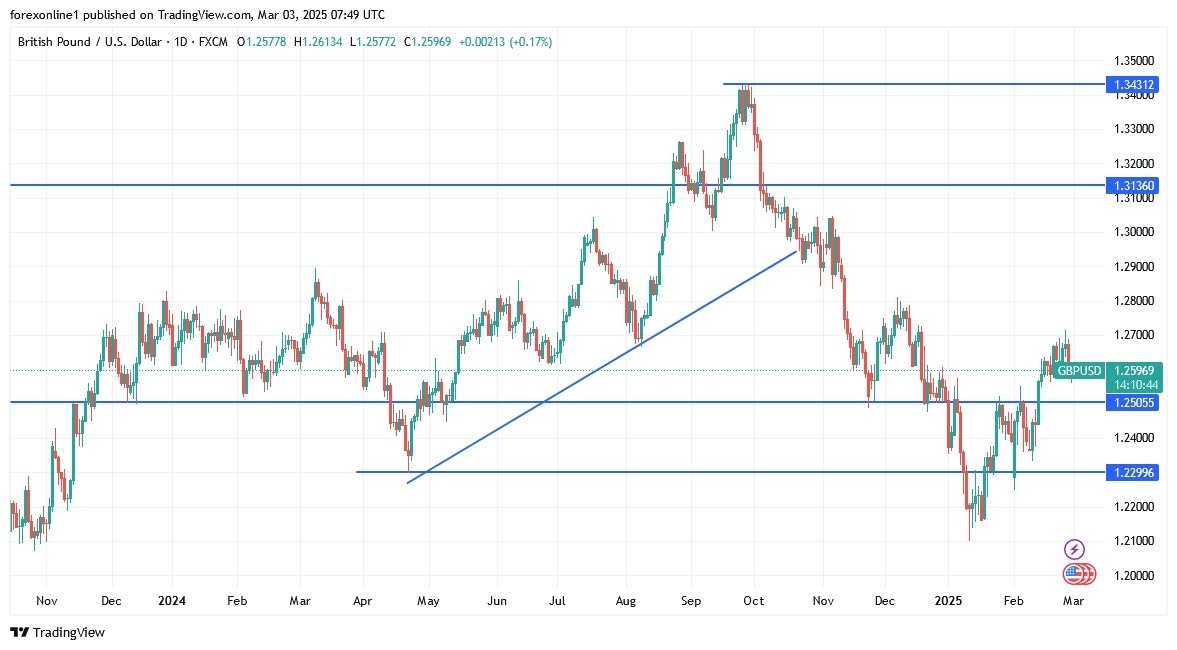
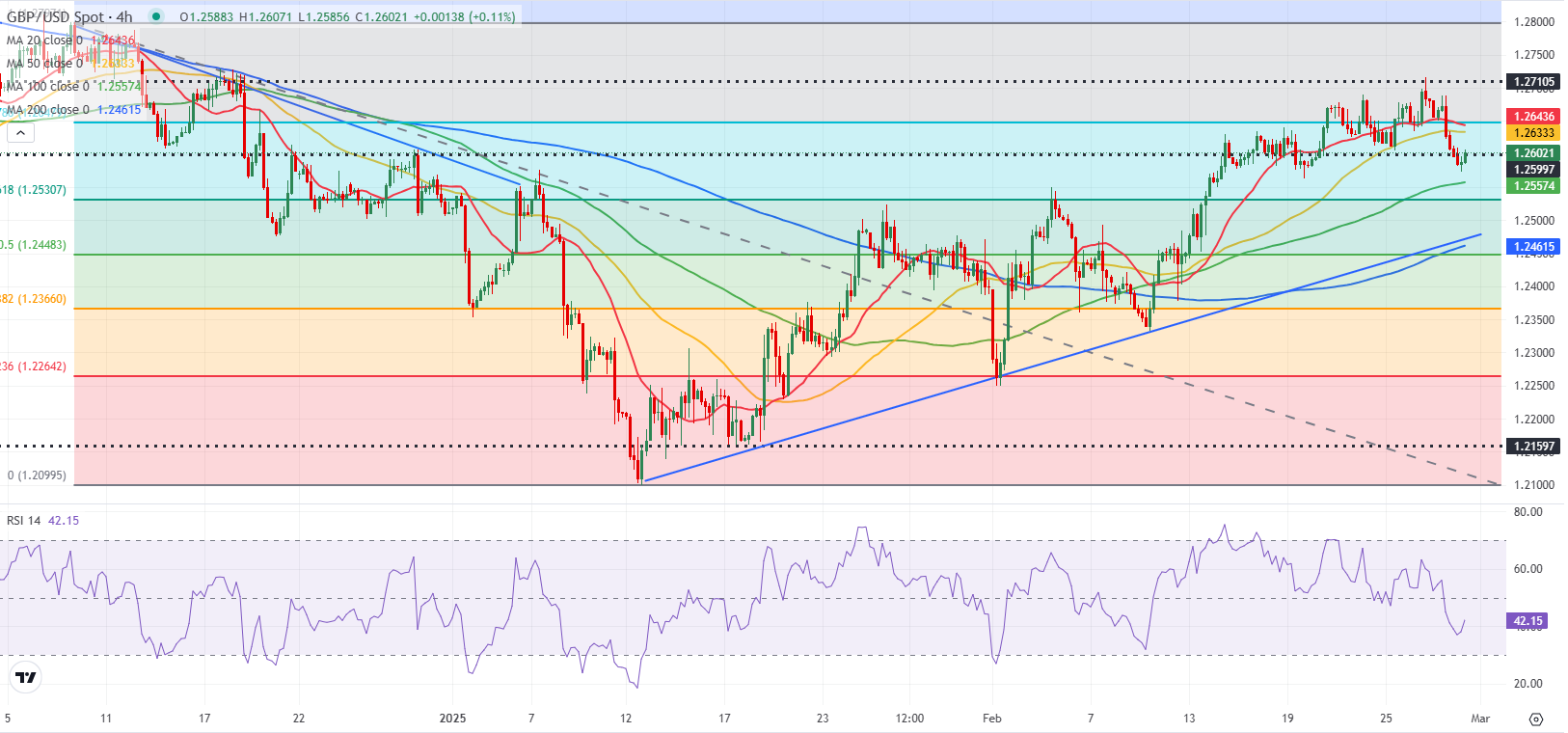
The US dollar’s decline during last week’s trading allowed bulls to quickly push the GBP/USD currency pair towards the resistance level of 1.2715, the pair’s highest in 2025.
This was before experiencing profit-taking sell-offs at the end of the week, which moved it towards the support level of 1.2559 and stabilized around 1.2580 at the start of this important week.
This includes the announcement of key US job numbers.
Will Britain Be Affected by US Trade Wars?
For Britain, “tariffs will not be necessary”; for everyone else, they will be necessary. This is the scene after British Prime Minister Keir Starmer’s visit to President Donald Trump in Washington. Trump said that Britain and the United States of America will work towards a “new economic deal” that could happen “very quickly.” “I think we have a good chance of making a deal that could be great, really great for both countries,” Trump added, “We could end up with a real trade deal where tariffs won’t be necessary.”
Trump made his comments hours after the president said the US would soon move forward with 25% tariffs on Canada and Mexico and would add an additional 10% on Chinese imports. Also, he confirmed that another round of tariffs was due in April.
Meanwhile, the developments underscored market suspicions that Britain is relatively insulated from Trump’s new world of tariffs.
According to forex trading, the pound outperformed all of its G10 peers on the day – except the US dollar – confirming that the pound is increasingly seen as a relative safe haven in the tariff trade. “The special relationship has helped sterling limit losses within the G10,” commented experts at Societe Generale.
According to licensed trading companies’ platforms, the GBP/EUR exchange rate rose to its highest level since December 19 at 1.2131. The GBP/USD exchange rate fell to 1.2585 amid a broad-based US dollar recovery related to Trump’s confirmation of broader tariffs. Generally, analysts see the Pound as a safe haven for tariffs, believing that Britain is less vulnerable to tariffs than major exporters like the EU. This supports the recent rise in the Pound against all its G10 currency peers.
Trading Tips:
Britain’s avoidance of US tariffs means that the pound will be more resilient to the gains of the US dollar against other currencies, as it is sought as a safe haven from the consequences of Trump’s policies.
The Future of US-UK Trade
In this regard, according to the Times, the US President offered Sir Keir Starmer a trade deal that could exempt Britain from being subject to US tariffs, as he praised the “wonderful” relationship between the two countries. Trump said that Starmer was “working hard” to convince him to exempt Britain from the 25 percent tariffs that he imposes on other countries, adding that he earned “whatever they pay him there.”
For his part, British Prime Minister Starmer said that the deal will focus on artificial intelligence and other advanced technologies, placing Britain on the side of the US against what he criticized as an overly cautious approach in the EU. Starmer added, “We are taking a similar approach to this issue – instead of over-regulating these new technologies, we are seizing the opportunities they provide.” “We have decided today to move forward to start working on a new economic deal based on advanced technology.” Starmer echoed Trump’s optimistic tone, saying, “AI could cure more. This could be a great achievement of our time.”
Technical Analysis for the GBP/USD pair today:
According to recent trading on the daily chart and despite the recent selling, the GBP/USD pair is holding on to the recent bullish momentum as long as it is stable around and above the 1.2600 resistance. Furthermore, the bulls’ success in moving towards the 1.2685 and 1.2760 resistance levels will enhance the move towards the psychological resistance of 1.3000 respectively, which confirms the strength of the upward shift, while at the same time the technical indicators may move towards strong overbought levels. On the other hand, and for the same time frame, the support at 1.2420 will remain important for bears to be able to move again. Finally, we expect movements in narrow ranges until the reaction to the announcement of the US jobs numbers.
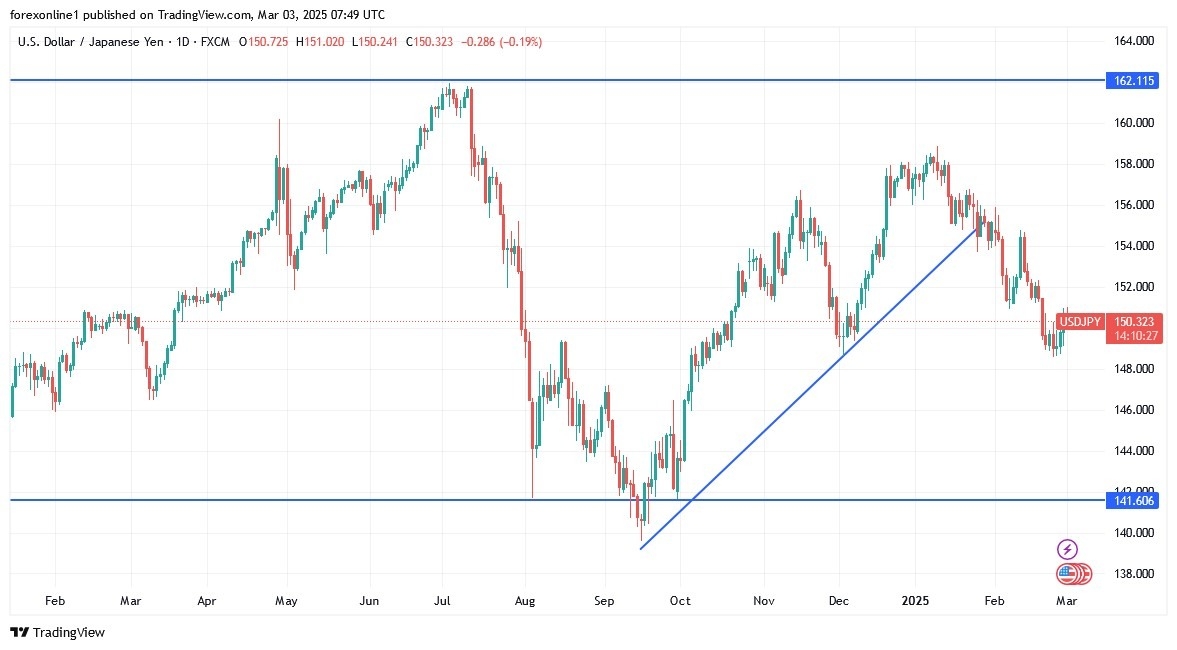
For four consecutive trading sessions, bulls have been attempting to push the USD/JPY currency pair above the 150.00 level.
According to the daily chart performance, this level separates bear and bull control.
Recently, bears have prevailed, with the USD/JPY pair falling to the support level of 148.56, its lowest in four months.
According to licensed trading companies’ platforms, the USD/JPY price is stabilizing around 150.50 at the time of writing the analysis, awaiting reactions to the US jobs numbers this week, as well as the future of Trump’s trade policies, which are unsettling markets.
US Dollar Temporarily Halts Gains
According to Forex market trading, the US dollar has halted its recent gains, largely driven by the Euro’s strength, supported by renewed optimism about a potential resolution to the Ukraine war. The US dollar also retreated after US Commerce Secretary Howard Lutnick recently indicated that tariffs on Mexico and Canada are still “variable,” suggesting they may be less than the proposed 25%. However, the US minister confirmed that the additional 10% tariff on China is “fixed.”
Trading Tips:
We still recommend buying the US dollar against the Japanese yen from every downward level, but without risk and activating profit and stop loss orders to ensure the safety of the trading account from any sudden price reversals.
Japanese Stock Indices Rise Following US Stocks
During today’s trading session and across stock trading companies’ platforms, the Nikkei 225 index of Japanese stocks rose by 1.7% to close at 37,785 points, while the broader Topix index rose by 1.77% to 2,730 points, recovering from last week’s losses, and the Japanese market’s gains increased after the gains of US stock indices at the end of last week’s trading. Investors, however, remained cautious ahead of a March 4 deadline for US President Donald Trump’s proposed 25% tariffs on Mexico and Canada, along with an additional 10% on Chinese goods. Geopolitical concerns also remained, with Trump and Ukrainian President Volodymyr Zelenskyy failing to reach a deal on Friday that would end the war in Ukraine.
On the domestic front, the Japanese manufacturing PMI for February was revised slightly higher but still indicates contraction for the sixth consecutive month. Among the best-performing companies were Disco shares (up 2.2%), Mitsubishi Heavy Industries shares (up 6.7%), Mitsubishi UFJ shares (up 2.4%), IHI Corp shares (up 7.8%), and Toyota Motor shares (up 3.9%).
USD/JPY Technical analysis and Expectations Today:
According to recent trading, the USD/JPY pair has now risen to trade at levels slightly above the 100-hour moving average line. As a result, the currency pair is about to enter the overbought levels of the 14-hour Relative Strength Index. In the short term, bulls will seek to extend the current gains towards the resistance levels of 150.85 or higher to the resistance of 151.60. In contrast, the bears’ closest targets will be a correction down towards the support levels of 149.90 and then to the support of 149.00, respectively.
In the long term, according to the performance on the daily chart, the USD/JPY pair is trading within a descending channel formation. However, the 14-day Relative Strength Index has recently rebounded to avoid moving to oversold levels. Therefore, bulls will seek to extend the recent bounce gains to move towards the resistance levels of 152.30 and then to the resistance of 156.00 respectively. On the other hand, and in the same time frame, bears will have targets in case of selling operations to take profits to move towards the support levels of 148.00 and then to the support of 145.00 respectively.
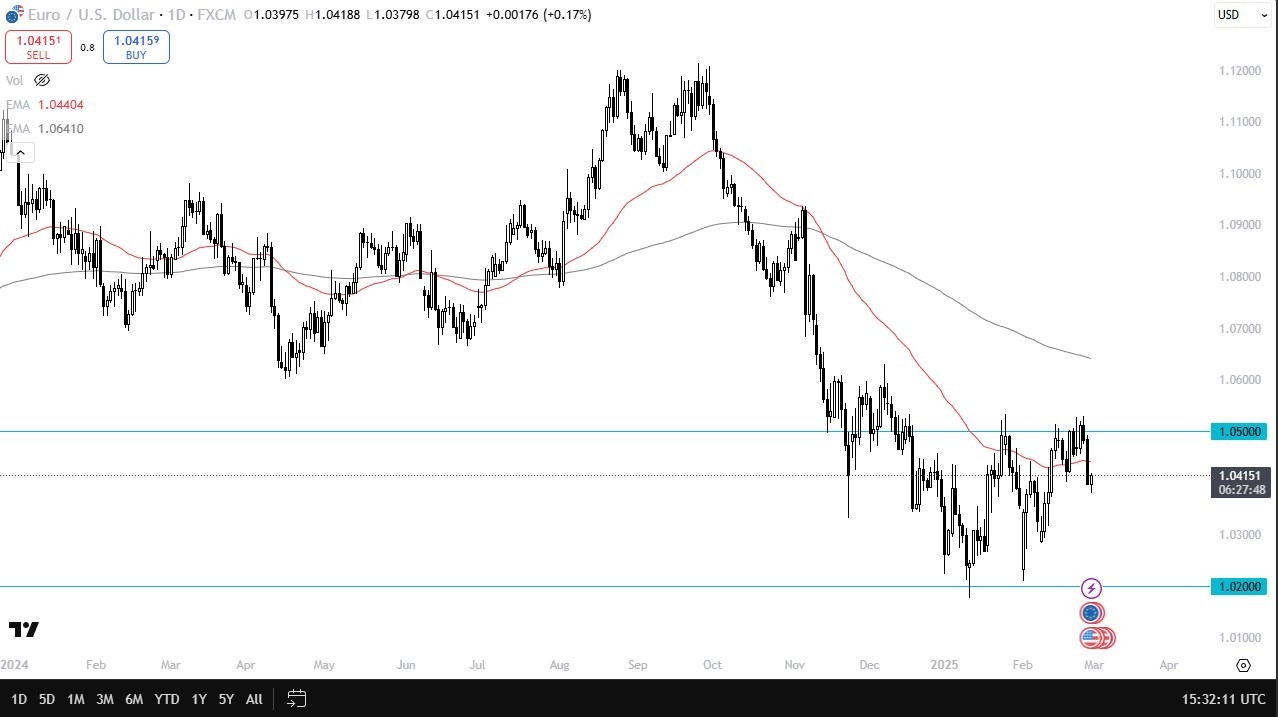
You can see that the Euro has stabilized a bit during the trading session on Friday as we continue to pay close attention to the 1.04 level.
Donald Trump’s announcement of tariffs on the European Union has had a greater impact on traders than I initially expected.
Given that he had previously mentioned the possibility of such tariffs, I’m somewhat surprised by the market’s reaction.
Nonetheless, the market is now below the 50-day EMA, and that will attract a certain amount of attention in and of itself, and I think really what matters here is that we now find ourselves somewhat affirming the previous consolidation area, at least in theory we are of 1.05 above being a major barrier and 1.02 underneath being a major floor. As long as we stay in this area, I think we will continue to see a lot of noisy and erratic trading. That’s typical for the Euro. All one has to do is zoom out, look at the chart, and you can see a lot of it’s just chopping back and forth.
Rangebound Still
This range that we find ourselves in now is just below the one before it. And that is common for the euro as well. It finds a range, it stays there for a certain amount of time, and then it moves to the next block. With that being the case, I think you have to assume that there is still a lot of selling pressure above the 1.05 level. Just as there’s a lot of support at the 1.02 level, a lot of pundits had the euro go into parity before it’s all said and done. It wouldn’t really surprise me if that happened.
As far as getting bullish, I would need to see this market actually break above the 1.06 level because it would take out a cluster from December that could cause a bit of headaches for buyers. And of course, take out the crucial 200 day EMA. Ultimately though, I think we’ve got a lot more sideways action in front of us than anything else.
The GBPJPY pair reacted to stochastic positivity by forming correctional bullish rebound and approach the minor bearish channel’s resistance line at 190.45, while the upcoming scenario depends on the strength of this resistance, as its stability allows us to expect renewing the negative attempts by crawling towards 188.75 followed by reaching 187.90.
On the other hand, facing strong positive pressures and rallying above the current resistance will cancel the bearish overview to start forming bullish waves, expecting to target 190.80 as a first station, followed by reaching the MA55 at 192.60.
The expected trading range for today is between 188.75 and 190.50
The GBPJPY pair reacted to stochastic positivity by forming correctional bullish rebound and approach the minor bearish channel’s resistance line at 190.45, while the upcoming scenario depends on the strength of this resistance, as its stability allows us to expect renewing the negative attempts by crawling towards 188.75 followed by reaching 187.90.
On the other hand, facing strong positive pressures and rallying above the current resistance will cancel the bearish overview to start forming bullish waves, expecting to target 190.80 as a first station, followed by reaching the MA55 at 192.60.
The expected trading range for today is between 188.75 and 190.50
The AUDCAD price started to activate the previously waited negative track by crawling below 50% Fibonacci correction level at 0.9030 yesterday, surpassing the EMA50 to start targeting the negative stations by reaching 0.8970.
We notice stochastic attempt to crawl towards the oversold areas to increase the chances of gathering the negative momentum to ease the mission of targeting the target at 0.8940, while surpassing it will extend trades towards 0.8900 direct, to form the next main target for the current trades.
The expected trading range for today is between 0.8940 and 0.9010
The AUDCAD price started to activate the previously waited negative track by crawling below 50% Fibonacci correction level at 0.9030 yesterday, surpassing the EMA50 to start targeting the negative stations by reaching 0.8970.
We notice stochastic attempt to crawl towards the oversold areas to increase the chances of gathering the negative momentum to ease the mission of targeting the target at 0.8940, while surpassing it will extend trades towards 0.8900 direct, to form the next main target for the current trades.
The expected trading range for today is between 0.8940 and 0.9010
Pound Sterling underperforms US Dollar as Trump’s fresh tariffs dampen market mood
The Pound Sterling (GBP) extends its downside move to near 1.2570 against the US Dollar (USD) in Friday’s European session. The GBP/USD pair faces pressure as the US Dollar gains further amid a risk-off market mood. The US Dollar Index (DXY), which tracks the Greenback’s value against six major currencies, moves higher to 107.45.
Market participants are cautious as President Donald Trump has announced more levies on China and provided more clarification on the timeline for 25% import duties on Canada and Mexico and reciprocal tariffs. Read more…
GBP/USD Forecast: Pound Sterling could struggle to gather bullish momentum
GBP/USD seems to have entered a consolidation phase near 1.2600 after losing more than 0.5% on Thursday as investors move to the sidelines while waiting for January inflation data from the US.
The US Dollar (USD) benefited from safe-haven flows in the American session on Thursday and gathered strength against its major rivals. Read more…
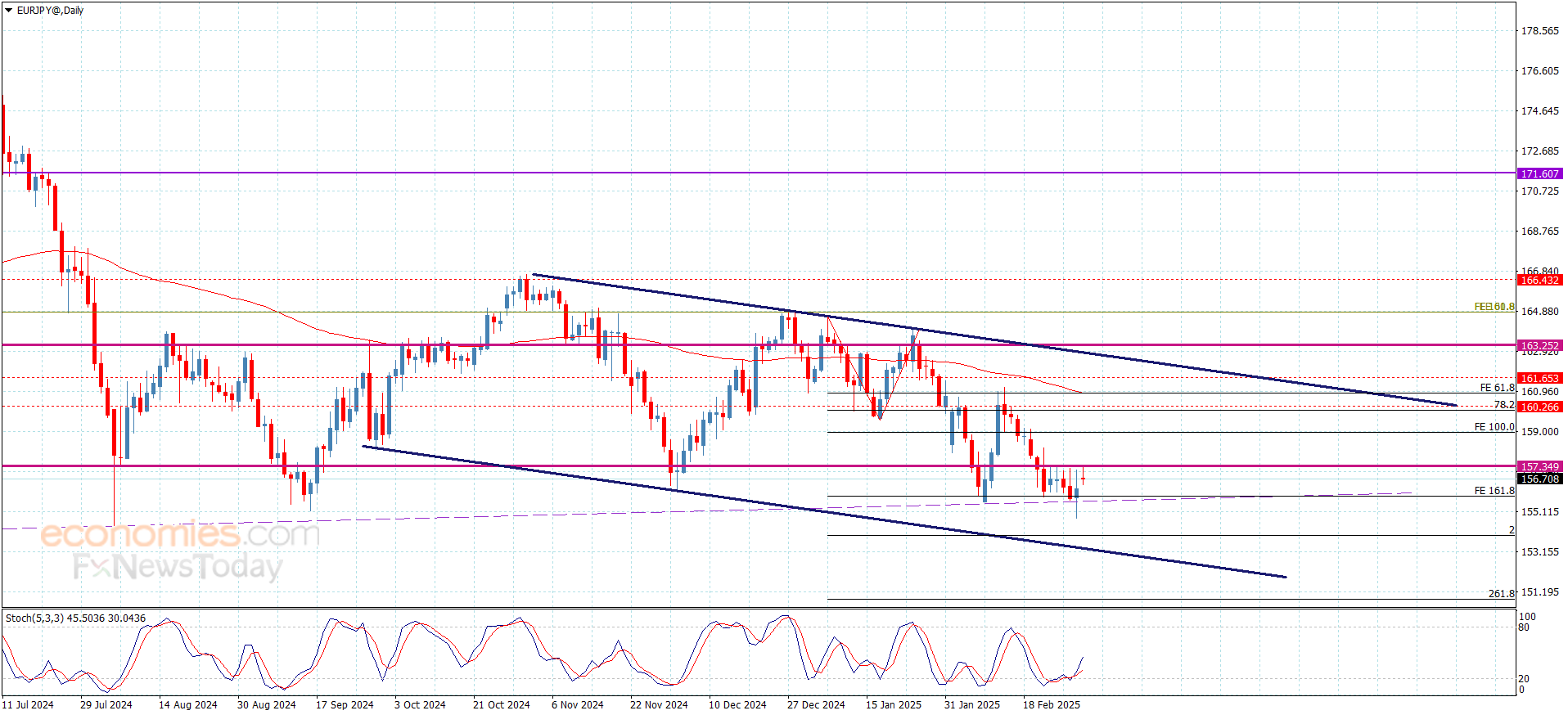
EUR/JPY surges to near 157.00 as soft Tokyo CPI data sends the Yen on the backfoot.
Moderate Tokyo CPI growth is expected to weigh on BoJ hawkish bets.
Steady German HICP growth is unlikely to restrict the ECB from easing monetary policy further.
The EUR/JPY pair rallies to near 157.00 in the North American session on Friday. The pair strengthens as the Japanese Yen (JPY) is underperforming across the board after the release of the soft Tokyo Consumer Price Index (CPI) data for February.
Japanese Yen PRICE Today
The table below shows the percentage change of Japanese Yen (JPY) against listed major currencies today. Japanese Yen was the strongest against the New Zealand Dollar.
USD
EUR
GBP
JPY
CAD
AUD
NZD
CHF
USD
-0.08%
0.06%
0.66%
-0.16%
0.31%
0.52%
0.31%
EUR
0.08%
0.15%
0.75%
-0.06%
0.40%
0.62%
0.40%
GBP
-0.06%
-0.15%
0.59%
-0.22%
0.25%
0.46%
0.24%
JPY
-0.66%
-0.75%
-0.59%
-0.80%
-0.35%
-0.14%
-0.35%
CAD
0.16%
0.06%
0.22%
0.80%
0.46%
0.68%
0.46%
AUD
-0.31%
-0.40%
-0.25%
0.35%
-0.46%
0.21%
-0.00%
NZD
-0.52%
-0.62%
-0.46%
0.14%
-0.68%
-0.21%
-0.22%
CHF
-0.31%
-0.40%
-0.24%
0.35%
-0.46%
0.00%
0.22%
The heat map shows percentage changes of major currencies against each other. The base currency is picked from the left column, while the quote currency is picked from the top row. For example, if you pick the Japanese Yen from the left column and move along the horizontal line to the US Dollar, the percentage change displayed in the box will represent JPY (base)/USD (quote).
Statistics Bureau of Japan reported that the Tokyo headline CPI decelerated significantly to 2.9% from 3.4% in January. In the same period, the Tokyo CPI ex. Fresh Food rose by 2.2%, slower than estimates of 2.3% and the former release of 2.5%. Soft Tokyo CPI data is likely to weigh on market expectations that the Bank of Japan (BoJ) will raise interest rates again this year.
Meanwhile, the Euro (EUR) outperforms its major peers despite fears that United States (US) President Donald Trump’s tariff agenda will be unfavorable for the Eurozone economy. On Wednesday, Trump threatened to impose 25% tariffs on cars and other things imported from the Eurozone sooner.
On the domestic front, hotter-than-expected flash German Harmonized Index of Consumer Prices (HICP) data for February is unlikely to ease market expectations that the European Central Bank (ECB) will reduce its Deposit Facility rate by 25 basis points (bps) to 2.5% in the policy meeting on Thursday.
German HICP rose steadily by 2.8%, faster than estimates of 2.7% on year. Month-on-month HICP grew at a faster pace of 0.6% than expectations of 0.5%. In January, the underlying inflation data deflated by 0.2%.
EUR/JPY recovers strongly after revisiting an almost seven-month low of 155.15 on Friday. However, the near-term outlook of the cross is still bearish as the 20-day Exponential Moving Average (EMA) is sloping downwards to near 158.00.
The 14-day Relative Strength Index (RSI) bounced back to the 40.00-60.00 range, which indicates that bearish momentum has ended. However, the negative bias remains intact.
More recovery in the EUR/JPY pair above the February 25 high of 157.30 would allow it to gain further towards the 20-day EMA around 158.00, followed by the February 19 high of 159.14.
On the flip side, a downside move by the pair below the intraday low of 154.80 would expose it to the August 5 low of 154.40 and the 19-month low of 153.17.
EUR/JPY daily chart
Japanese Yen FAQs
The Japanese Yen (JPY) is one of the world’s most traded currencies. Its value is broadly determined by the performance of the Japanese economy, but more specifically by the Bank of Japan’s policy, the differential between Japanese and US bond yields, or risk sentiment among traders, among other factors.
One of the Bank of Japan’s mandates is currency control, so its moves are key for the Yen. The BoJ has directly intervened in currency markets sometimes, generally to lower the value of the Yen, although it refrains from doing it often due to political concerns of its main trading partners. The BoJ ultra-loose monetary policy between 2013 and 2024 caused the Yen to depreciate against its main currency peers due to an increasing policy divergence between the Bank of Japan and other main central banks. More recently, the gradually unwinding of this ultra-loose policy has given some support to the Yen.
Over the last decade, the BoJ’s stance of sticking to ultra-loose monetary policy has led to a widening policy divergence with other central banks, particularly with the US Federal Reserve. This supported a widening of the differential between the 10-year US and Japanese bonds, which favored the US Dollar against the Japanese Yen. The BoJ decision in 2024 to gradually abandon the ultra-loose policy, coupled with interest-rate cuts in other major central banks, is narrowing this differential.
The Japanese Yen is often seen as a safe-haven investment. This means that in times of market stress, investors are more likely to put their money in the Japanese currency due to its supposed reliability and stability. Turbulent times are likely to strengthen the Yen’s value against other currencies seen as more risky to invest in.