The main tag of Forex News Today Articles.
You can use the search box below to find what you need.
[wd_asp id=1]

13 02, 2025

GBP/USD Forecast Today 13/02: Consolidates (Video+Chart)

By |2025-02-13T13:07:19+02:00February 13, 2025|Forex News, News|0 Comments

  • The British Pound has gone back and forth during the trading session. On Wednesday, as the core CPI numbers out of the United States came in at 0.4% instead of the expected 0.3%.
  • Because of this, the market is likely to continue to see a lot of choppy and uncertain behavior, because it puts the entirety of the Federal Reserve’s interest rate situation at risk.
  • Traders started to think that perhaps the Federal Reserve might loosen monetary policy later this year, but with inflationary numbers being as sticky as they are, it’s very difficult to imagine that happening.

Technical Analysis

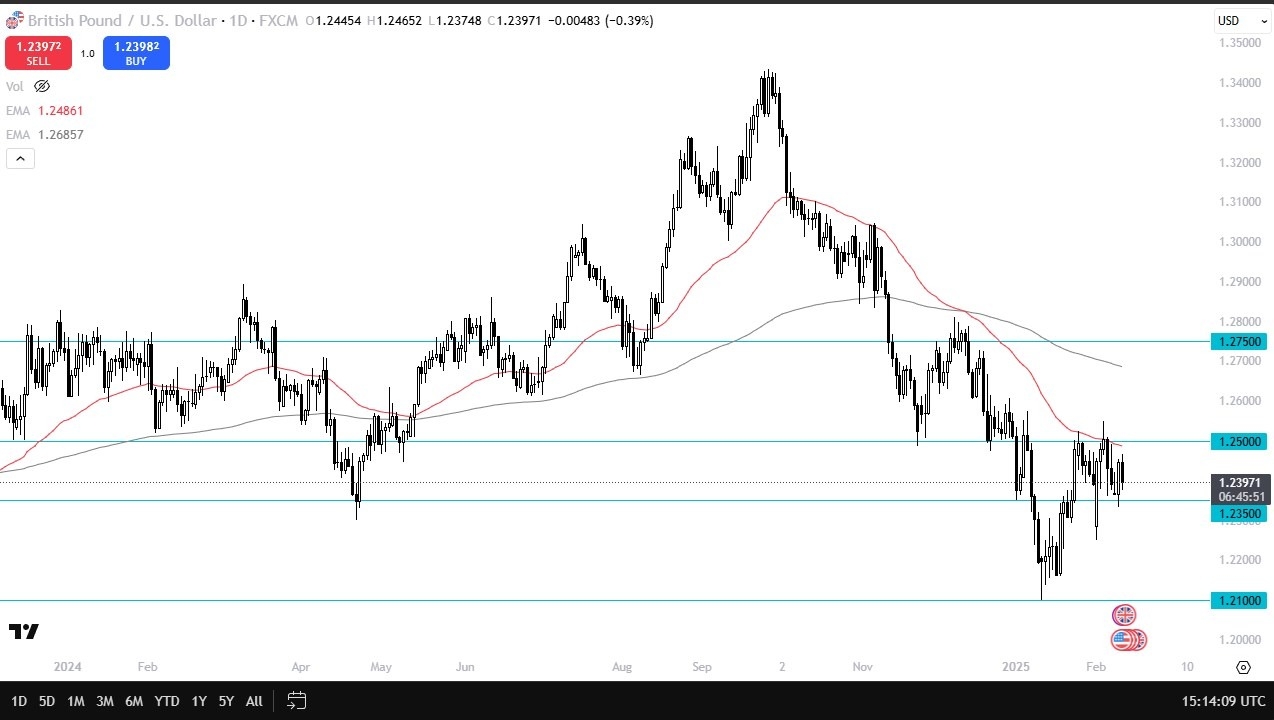
Ultimately, when you look at the technical analysis, we are still very much in a downtrend, and the 50-day EMA sits just above and near the 1.25 level. The level of 1.25 has been both support and resistance multiple times in the past, so I don’t think it’s very surprising that it could be an area of interest right now.

If we were to break above 1.26, then you can start to talk about a potential trend change. But right now, I think we’re just stuck in the same pattern that we’ve been in for a while with 1.25, a bump being a bit of a ceiling and 1.2350 level underneath being a bit of a floor. We have a little bit of sideways action, maybe some short-term range-bound opportunities present themselves for those who are a little bit more short-term inclined.

Overall, though, I still think you have a scenario where the US dollar remains fairly stout and rallies at this point in time I just don’t trust. Things can and will change, but keep in mind the Bank of England just cut interest rates and even had a couple of members on the Monetary Policy Committee suggest that they were ready to cut 50 basis points instead of 25.

Ready to trade our daily Forex GBP/USD analysis? We’ve made this UK forex brokers list for you to check out

Source link

13 02, 2025

The USDJPY price breaches the resistance – Forecast today

By |2025-02-13T11:05:16+02:00February 13, 2025|Forex News, News|0 Comments

At the beginning of 2025, expectations are rising that silver could become one of the most dazzling assets in global markets this year, driven by intertwined economic and geopolitical factors 

Amid the search by retail traders for financial assets to hedge against inflation or capitalize on potential bullish trends, individual investors’ appetite for the white metal is increasing 

At the same time, escalating global trade tensions and growing economic uncertainty are bolstering demand for safe-haven assets, with silver remaining a favored choice alongside gold to protect wealth during volatile times 

On the monetary side, major economies continue to implement a cycle of monetary easing, with central banks persistently cutting interest rates, which makes non-yielding assets such as silver more attractive compared to traditional investments like bonds 

With real yields falling, the investment demand for the white metal is on the rise, potentially driving its prices to new levels throughout the year 

On the industrial front, silver continues to play a vital role in multiple sectors, most notably in technology and renewable energy; the growing demand for solar panels—which rely on silver in their production—along with its widespread use in electronics and medical applications, contributes to a strong and sustainable demand for the metal 

As emerging economies expand and investments in infrastructure and green technology increase, industrial demand is expected to remain a key driver for silver’s market growth, placing it at a crossroads between being an exceptional investment opportunity or merely a temporary bullish surge. Are you ready to seize the opportunity and benefit from these supporting trends? 

Retail Traders 

In their quest for financial assets to hedge against the risks associated with changing monetary policies of global central banks, silver has proven to be the most cost-effective and optimal choice at present, making it the focus of investors’ attention 

The current surge in silver prices has caught the attention of retail traders as the white metal diverges significantly from its true value compared to gold, which continues to set new record highs, nearing the $3,000 per ounce mark for the first time in history 

Silver Institute Forecasts 

According to the Silver Institute, the supply shortage in the silver market is expected to continue throughout 2025, which could support price increases to levels not seen since 2011. Moreover, supportive government policies for green energy and infrastructure are anticipated to boost silver demand due to its use in renewable energy technologies 

The institute, an international non-profit organization comprising members from various sectors of the silver industry, explained that stronger industrial activity will be a major catalyst for increased global demand for the white metal, potentially leading to a new high annual level this year 

Global Trade Tensions 

Global trade tensions have escalated with the return of U.S. President Donald Trump to the political arena and the adoption of stringent trade policies aimed at protecting the American economy, as he vowed to impose high tariffs on a wide range of imports, particularly from China and Europe 

These measures have prompted strong reactions from major trading partners, who have threatened retaliatory actions, further stoking fears of a new trade war that could impact global economic growth and boost demand for safe-haven assets such as gold and silver 

Additionally, silver benefits from concerns over supply chain disruptions, especially with potential restrictions on industrial metals, maintaining its investment appeal amid uncertainty over U.S. trade policies 

Global Monetary Easing Cycle 

Major central banks in the United States, Europe, the United Kingdom, Canada, Switzerland, and Mexico continue their cycle of monetary easing and interest rate cuts, resulting in new liquidity injections into the markets and bolstering medium-term investor optimism for stocks, real estate, gold, silver, and even cryptocurrencies 

Strong Industrial Demand for Silver 

Forecasts indicate that industrial demand for silver will remain robust throughout 2025, driven by its increasing use in technology, renewable energy, and electronics. This is especially true as investments in solar energy, which relies on silver for photovoltaic cells, continue to expand 

Moreover, demand from the electronics and medical sectors is expected to further support the sustainable growth of silver’s market, enhancing long-term price prospects 

Key Applications of Silver 

Silver is primarily used for industrial purposes, playing a crucial role in the manufacturing of automobiles, solar panels, jewelry, and electronics, in addition to its use in coinage and as a safe haven for investors 

Top Silver Price Forecasts for 2025 

  • Citibank Group forecasts silver prices to rise to $35 per ounce this year.
  • Goldman Sachs Group forecasts silver prices to reach $37 per ounce by the end of this year.
  • Deutsche Bank forecasts that silver could reach $38 per ounce by the end of 2025.
  • Morgan Stanley forecasts silver prices to hit $35 per ounce by the end of 2025.
  • UBS Bank expects silver prices to range between $36 and $38 per ounce in 2025.
  • J.P. Morgan expects silver to reach $38 per ounce in 2025.

Types of Demand for Silver 

Industrial Demand 

  • Electronics: Silver is used in electronic components such as printed circuit boards and motherboards in smartphones, computers, and other devices.
  • Renewable Energy: Silver is employed in the manufacturing of solar panels and lithium-ion batteries, making it a key element in clean energy technologies.
  • Medical Devices: Silver is used in medical instruments due to its antibacterial properties.
  • Automotive and Household Products: It helps enhance the performance and efficiency of vehicles and household appliances.

Investment Demand 

  • Jewelry: Silver is a precious metal used in the production of jewelry and artistic pieces.
  • Coins: Silver is used in minting coins for its value and stability.
  • Safe Haven: Silver bars and coins are considered safe havens for investors during times of economic and geopolitical uncertainty.
  • ETFs: Exchange-Traded Funds allow investors to buy and sell silver without the need to physically own it.

Factors Affecting Silver Demand Levels 

  • Global Economic Growth: Drives increased demand for silver in both industrial and consumer sectors.
  • Global Interest Rates: Lower interest rates make silver a more attractive alternative investment.
  • Economic and Geopolitical Uncertainty: Boosts demand for silver as a safe-haven asset.
  • Technological Developments: Lead to higher requirements for silver in advanced industries.

Key Silver Price Milestones 

  • October 2008: Silver hit a low of $8.42 per ounce.
  • April 2011: Silver reached an all-time high of $49.76 per ounce.
  • May 2020: Silver recorded its lowest level in 12 years at $11.64 per ounce.
  • April 2024: Silver reached its highest level in three years at $29.80 per ounce.
  • 2010: Achieved the best annual gain with an increase of 83%.
  • 2013: Suffered the worst annual loss with a decline of over 36%.

Best Historical Performance of Gold Prices 

  • 2007: Best annual performance with an increase of nearly 31%.
  • Q1 2016: Best quarterly performance with an increase of over 16%.
  • September 1999: Best monthly performance with an increase of approximately 17%.

Top FAQs About Silver 

Is Silver Price Suitable for Investment? 

Silver is currently trading at around $32 per ounce, and given forecasts that indicate a bullish market in 2025, we believe that levels between $31 and $30 per ounce are suitable for investment, with a long-term target above $35 per ounce 

How to Invest in Silver? 

There are several ways to invest in silver:

  1. Purchasing physical silver such as coins or bars.
  2. Investing through silver Exchange-Traded Funds (ETFs) on global exchanges.
  3. Buying shares in silver mining and refining companies.
  4. Trading silver futures, options, and other derivative contracts.

Will Silver Reach $100 per Ounce? 

In light of recent developments in global markets and the economic, trade, and geopolitical risks, it is entirely possible for silver prices to climb above $50 per ounce over the coming years, eventually paving the way to reach $100 for the first time in history if strong industrial and investment demand factors materialize 

Is Silver Expected to Rise in 2025? 

Yes, most major institutions and banks forecast that silver prices will continue to rise this year, with the metal nearing the breakthrough of the $35 per ounce barrier 


Technical Analysis of Silver Prices 

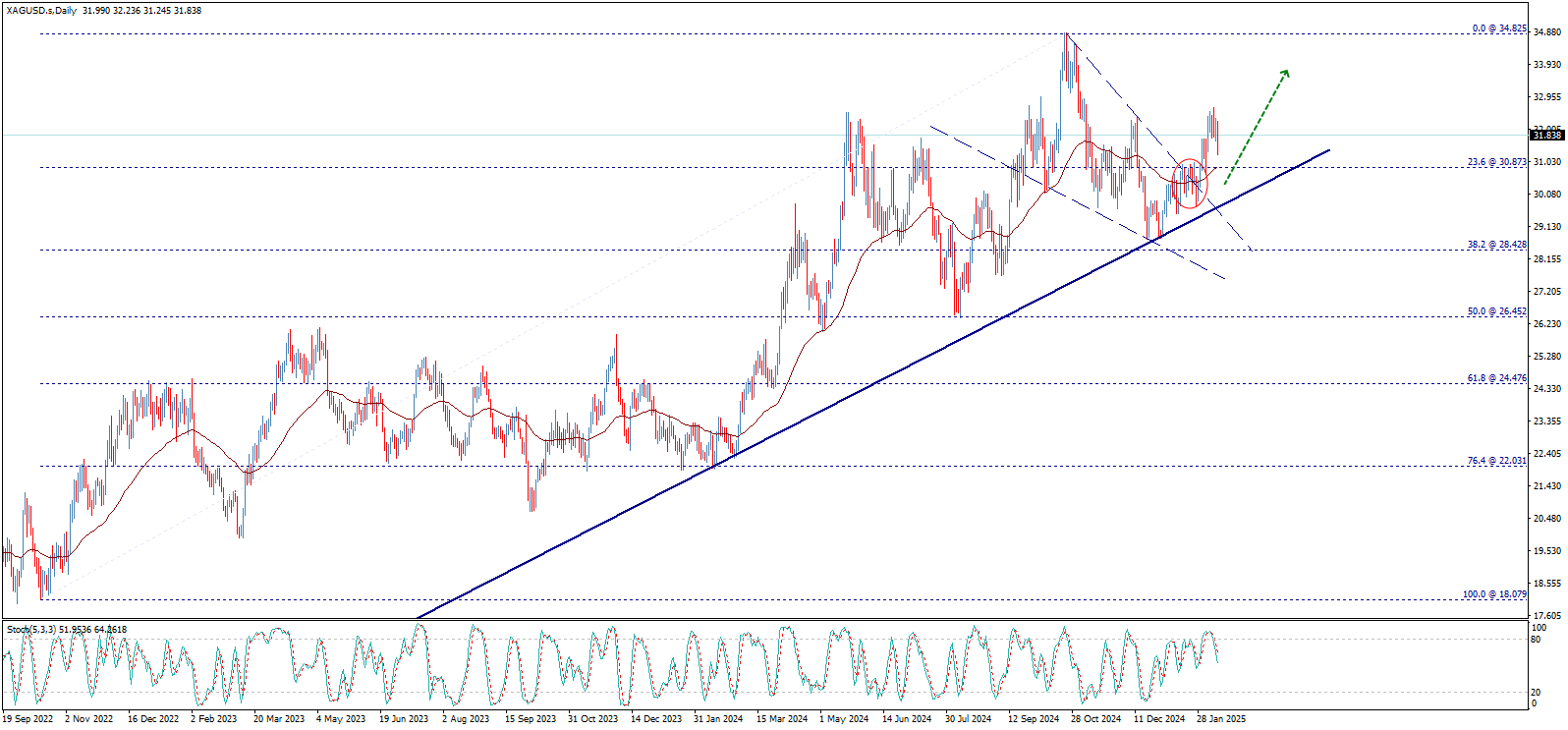
The weekly chart of silver prices shows how the downward correction that began from the all-time high recorded at $49.74 was halted at the 76.4% Fibonacci level, which formed strong support around $15.34. From there, the price began its new upward journey, attempting to resume the long-term bullish trend. 


Current positive attempts are facing a key resistance level formed by the previously broken 38.2% Fibonacci level, now acting as strong resistance at $32.55. Therefore, the price needs to break through this barrier and secure a weekly close above it to confirm the continuation of the upward trend and move toward new gains starting with a target of $35.30 and then the next pivotal resistance at $39.10. 

On the daily timeframe, we notice that the price underwent a minor downward correction before resuming its upward movement. Additionally, the price recently formed and broke through a descending wedge pattern, triggering a positive catalyst that is expected to drive the price further upward and achieve the targets mentioned above. 


silver


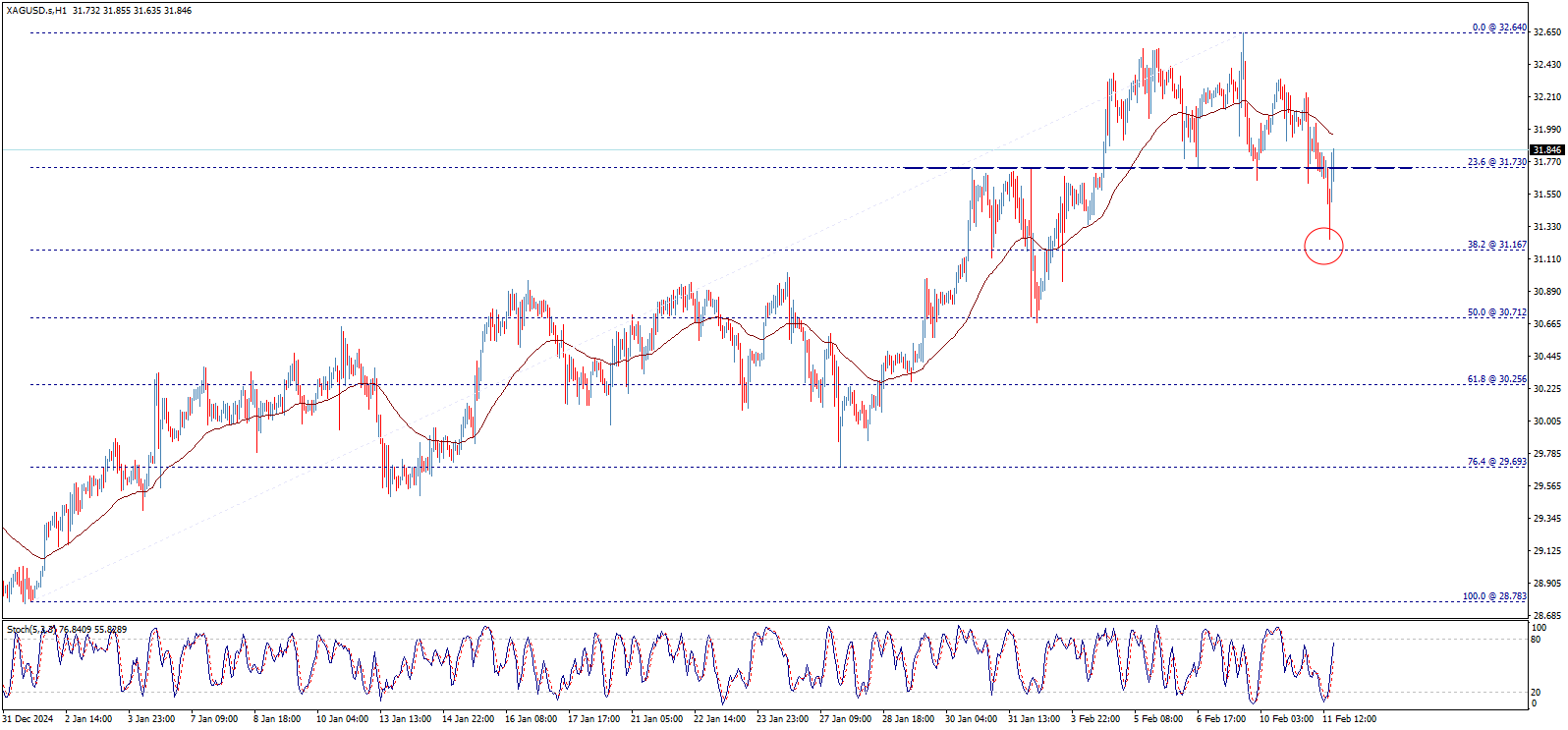
The current negative momentum across various timeframes may cause some temporary bearish fluctuations before a return to positive trading, as evidenced by the 1-hour chart. This chart shows the price forming a double top pattern, which triggered a quick downward correction before rebounding. The price needs to hold above $31.75 to avoid further negative pressure and to build a new upward wave with targets first breaking $32.64, then paving the way toward levels of $35.30 and finally $39.10, which are the next major milestones. 


silver


In summary, the aforementioned technical factors suggest that the price is on track to continue rising in the coming period, provided it overcomes certain barriers starting with the $32.55 – $32.64 range, and then moves towards the targets mentioned above. The 50-day moving average continues to offer positive support for the anticipated bullish wave. 

Conversely, it is crucial to note that a reversal below $29.70 would derail the upward momentum, forcing a new downward correction with targets initially testing the $28.40 level and potentially extending losses to $24.50 before any new attempt at a recovery. 


Source link

13 02, 2025

Euro bulls take over as risk flows return

By |2025-02-13T09:03:02+02:00February 13, 2025|Forex News, News|0 Comments

  • EUR/USD trades in positive territory, well above 1.0400 early Thursday.
  • The US Dollar (USD) struggles to find demand as risk mood improves.
  • The pair could reverse its direction in case Trump announces reciprocal tariffs.

EUR/USD gathers bullish momentum and rises toward 1.0450 in the European morning on Thursday. The broad-based selling pressure surrounding the US Dollar (USD) fuels the pair’s leg higher as risk flows dominate the action in financial markets.

Euro PRICE Today

The table below shows the percentage change of Euro (EUR) against listed major currencies today. Euro was the strongest against the US Dollar.

  USD EUR GBP JPY CAD AUD NZD CHF
USD   -0.42% -0.40% -0.23% -0.19% -0.16% -0.19% -0.20%
EUR 0.42%   0.02% 0.21% 0.24% 0.24% 0.23% 0.22%
GBP 0.40% -0.02%   0.15% 0.22% 0.27% 0.21% 0.20%
JPY 0.23% -0.21% -0.15%   0.03% 0.08% 0.00% 0.03%
CAD 0.19% -0.24% -0.22% -0.03%   0.04% -0.02% -0.01%
AUD 0.16% -0.24% -0.27% -0.08% -0.04%   -0.03% -0.04%
NZD 0.19% -0.23% -0.21% 0.00% 0.02% 0.03%   -0.01%
CHF 0.20% -0.22% -0.20% -0.03% 0.01% 0.04% 0.01%  

The heat map shows percentage changes of major currencies against each other. The base currency is picked from the left column, while the quote currency is picked from the top row. For example, if you pick the Euro from the left column and move along the horizontal line to the US Dollar, the percentage change displayed in the box will represent EUR (base)/USD (quote).

In the early trading hours of the American session on Wednesday, EUR/USD declined toward 1.0300 as the USD gathered strength on January inflation data. The US Bureau of Labor Statistics reported that the annual Consumer Price Index (CPI) rose by 3%, coming in above the market expectation and December’s increase of 2.9%. Additionally, the core CPI, which excludes volatile food and energy prices, rose by 0.4% on a monthly basis, following the 0.2% rise recorded in the previous month.

Later in the day, the improving risk mood made it difficult for the USD to preserve its strength and opened the door for a decisive rebound in EUR/USD. US President Donald Trump said that he had a “lengthy and highly productive” phone call with Russian President Vladimir Putin to begin negotiations to end the war in Ukraine. In the meantime, Trump refrained from announcing reciprocal tariffs.

In the second half of the day, the risk perception could continue to drive the pair’s action amid a lack of high-tier data releases. At the time of press, US stock index futures were rising between 0.2% and 0.5%. 

According to CNBC, Trump could still unveil his reciprocal tariff plan before he meets with Indian Prime Minister Narendra Modi on Thursday. In case Trump does so, the USD could regain its traction and cause EUR/USD to turn south. On the other hand, the pair could build on its daily gains if markets don’t get any new headlines on Trump’s reciprocal tariffs.

EUR/USD Technical Analysis

The Relative Strength Index (RSI) indicator on the 4-hour chart climbed above 70, suggesting that EUR/USD could correct lower before extending its uptrend. On the upside, 1.0440 (Fibonacci 61.8% retracement of the latest downtrend) aligns as immediate resistance. If the pair rises above this level and starts using it as support, it could target 1.0500-1.0510 (round level, Fibonacci 78.6% retracement) and 1.0550 (static level) next.

Looking south, the first support level could be spotted at 1.0400 (100-period Simple Moving Average (SMA), Fibonacci 50% retracement) ahead of 1.0355-1.0350 (Fibonacci 38.2% retracement, 200-period SMA).

Tariffs FAQs

Tariffs are customs duties levied on certain merchandise imports or a category of products. Tariffs are designed to help local producers and manufacturers be more competitive in the market by providing a price advantage over similar goods that can be imported. Tariffs are widely used as tools of protectionism, along with trade barriers and import quotas.

Although tariffs and taxes both generate government revenue to fund public goods and services, they have several distinctions. Tariffs are prepaid at the port of entry, while taxes are paid at the time of purchase. Taxes are imposed on individual taxpayers and businesses, while tariffs are paid by importers.

There are two schools of thought among economists regarding the usage of tariffs. While some argue that tariffs are necessary to protect domestic industries and address trade imbalances, others see them as a harmful tool that could potentially drive prices higher over the long term and lead to a damaging trade war by encouraging tit-for-tat tariffs.

During the run-up to the presidential election in November 2024, Donald Trump made it clear that he intends to use tariffs to support the US economy and American producers. In 2024, Mexico, China and Canada accounted for 42% of total US imports. In this period, Mexico stood out as the top exporter with $466.6 billion, according to the US Census Bureau. Hence, Trump wants to focus on these three nations when imposing tariffs. He also plans to use the revenue generated through tariffs to lower personal income taxes.


Source link

13 02, 2025

GBP/JPY Forecast Today 12/02: Tests Key Resistance (Video)

By |2025-02-13T07:01:54+02:00February 13, 2025|Forex News, News|0 Comments

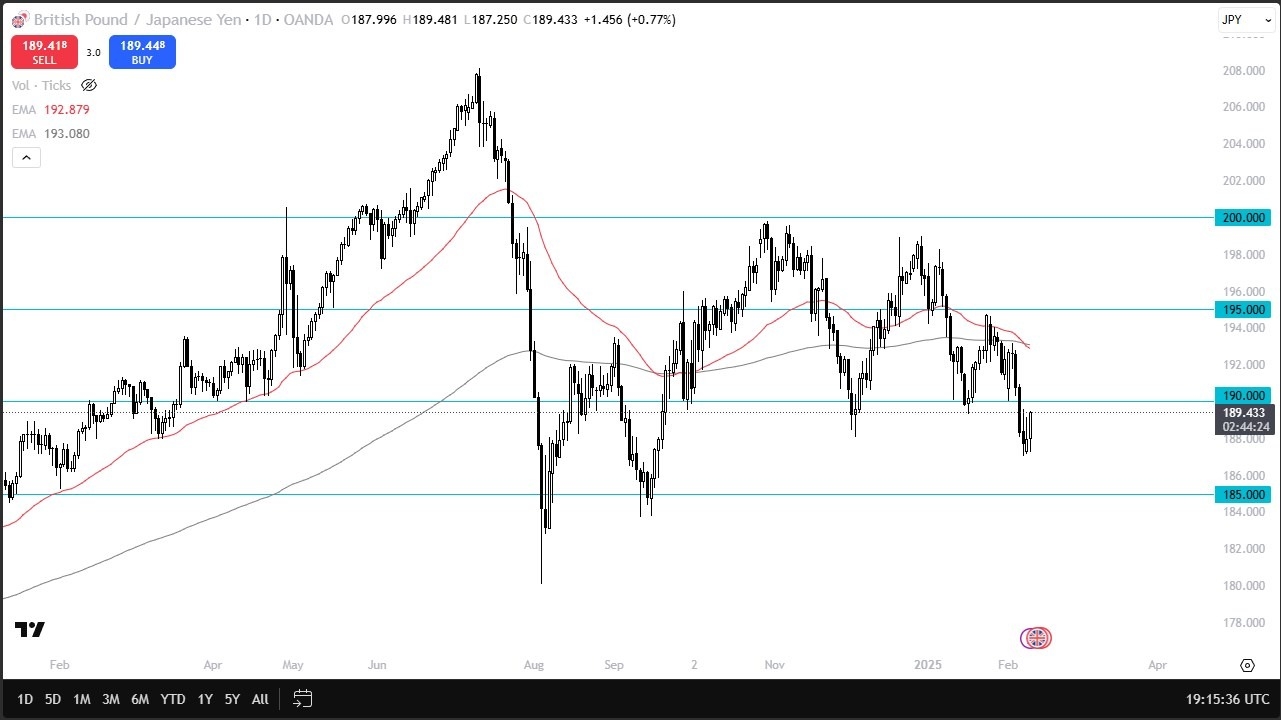
  • Taking a look at the British pound against the Japanese yen the British pound has initially pulled back just a bit only to turn around and show signs of strength.
  • At this point in time the market is likely to look at the 190 yen level as a major barrier to overcome and if we can then it would be an extraordinarily bullish sign.
  • After all, we formed a couple of inverted hammers, so breaking the top of an inverted hammer obviously captures a lot of attention.

A Potential Melt Higher?

In that environment, I think you have to look at the market through a potential melt up. I don’t have any interest in trying to get too cute here. I think it’s a simple matter of waiting to see if we can break above that 190 yen level on a daily close if we can then I think that’s a very positive sign if we can’t, then it shows that we are going to pull back and go looking at the 188 yen level again. In general, I don’t necessarily like jumping into the market right here, I want to see what the reaction is to this major inflection point.

I think ultimately, you’ve got a scenario where a lot of traders will be looking at this through the idea of whether or not we can continue to go higher or if the exhaustion comes back into the picture, because the interest rate differential does favor the British pound, but it also is a scenario where the Bank of England just cut rates and they look like they’re going to continue to cut rates while the Japanese central bank of course is now starting to worry about fighting inflation. So definitely at this point in time we are at a major inflection point, but you need to watch this 190 yen level for clues.

Ready to trade our daily Forex analysis? We’ve made a list of the best forex demo accounts worth trading with.

Source link

13 02, 2025

EUR/GBP Forecast Today 12/02: Downward Pressure (Video)

By |2025-02-13T05:00:45+02:00February 13, 2025|Forex News, News|0 Comments

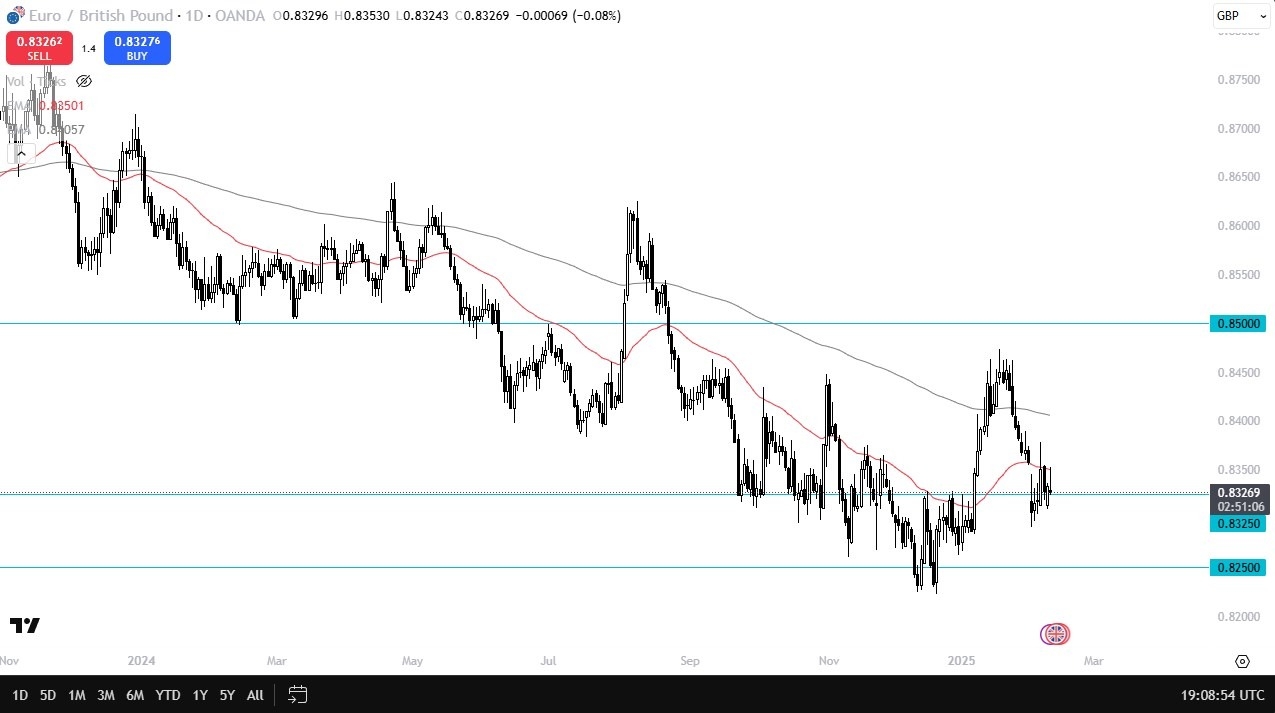
  • You can see that the Euro initially rallied against the British pound during trading on Tuesday but has given back gains and the crucial 50 day EMA.
  • This is a pair that’s been in a downtrend for some time.
  • Despite the fact that the Bank of England has recently cut rates, there is still a huge problem in Europe when it comes to lack of growth.
  • The question now is, will the UK follow suit?

Relative Game Here

Well, I don’t know if they will, but I do know that when you look at two currencies, it is a relative game. The question now is which one is going to end up being the victor of the two? Well, when you look at this pair, you can see we’ve been in a downtrend for some time. But it’s also worth noting that the 0.8250 level is an area of significant support. So, I think this remains more or less a choppy market, but I do favor fading short term rallies that show signs of exhaustion as the market is most decidedly heavy.

The 50 day EMA has attracted some attention. And I think at this point in time, if we do break down from here, we could revisit that 0.8 to five zero level. On the other hand, if we can turn around and break above the 0.8375 level, we could challenge the 200 day EMA, followed by the 0.8460 level. This is a market that tends to be very choppy and noisy, so you have to pay attention to your trades on a short-term basis because it doesn’t move very much most of the time. However, keep in mind that the PIP value is much higher than most currency pairs, so it doesn’t need to. At this point, I still favor shorting, at least for now, but I do believe that we are getting close to some type of bottoming pattern. Expect a lot of choppiness going forward.

Ready to trade our daily forecast and analysis? Here’s a list of some of the top forex brokers UK to check out

Source link

13 02, 2025

Surges past 154.50 post hot CPI

By |2025-02-13T02:59:54+02:00February 13, 2025|Forex News, News|0 Comments

  • USD/JPY jumps over 1%, breaking 153.00 and 154.00 resistance levels.
  • Hot US inflation fuels Treasury yield surge, boosting dollar strength.
  • Technical outlook: Bulls eye 155.26, but key support lies at 153.00.

The USD/JPY rallied sharply on Wednesday after a hot US inflation report spurred a jump in the US 10-year Treasury yield, closely correlated with the major. Hence, the pair aimed higher, clearing the 153.00 and 154.00 figures on their way toward current spot prices, near 154.50.

USD/JPY Price Forecast: Technical outlook

The USD/JPY enjoyed an over 1% rally on Wednesday after clearing the 200-day Simple Moving Average (SMA) at 152.76, opening the door for further upside. Despite this, the pair found stir resistance at the Kijun-sen at 154.90 before consolidating near the 154.50 area,

Despite this, the pair is neutral to downward biased after registering a successive series of lower highs and lower lows. If bulls want to regain control, the USD/JPY must clear the 50-day SMA at 155.26, followed by the latest cycle high of 155.89.

On the other hand, a drop below 154.00 would expose the Senkou Span B at 153.76, followed by the 153.00 figure and the 200-day SMA at 152.76.

USD/JPY Price Chart – Daily

Japanese Yen PRICE Today

The table below shows the percentage change of Japanese Yen (JPY) against listed major currencies today. Japanese Yen was the strongest against the Australian Dollar.

  USD EUR GBP JPY CAD AUD NZD CHF
USD   0.05% 0.03% 0.00% 0.03% 0.06% 0.05% 0.03%
EUR -0.05%   -0.02% -0.05% -0.02% -0.01% 0.00% -0.02%
GBP -0.03% 0.02%   -0.04% 0.00% 0.03% 0.02% -0.00%
JPY 0.00% 0.05% 0.04%   0.03% 0.06% 0.05% 0.03%
CAD -0.03% 0.02% -0.00% -0.03%   0.02% 0.02% -0.00%
AUD -0.06% 0.01% -0.03% -0.06% -0.02%   -0.01% -0.03%
NZD -0.05% -0.01% -0.02% -0.05% -0.02% 0.00%   -0.02%
CHF -0.03% 0.02% 0.00% -0.03% 0.00% 0.03% 0.02%  

The heat map shows percentage changes of major currencies against each other. The base currency is picked from the left column, while the quote currency is picked from the top row. For example, if you pick the Japanese Yen from the left column and move along the horizontal line to the US Dollar, the percentage change displayed in the box will represent JPY (base)/USD (quote).


Source link

12 02, 2025

EUR/USD Forecast Today 12/02: Rallies Again (Chart)

By |2025-02-12T22:58:04+02:00February 12, 2025|Forex News, News|0 Comments

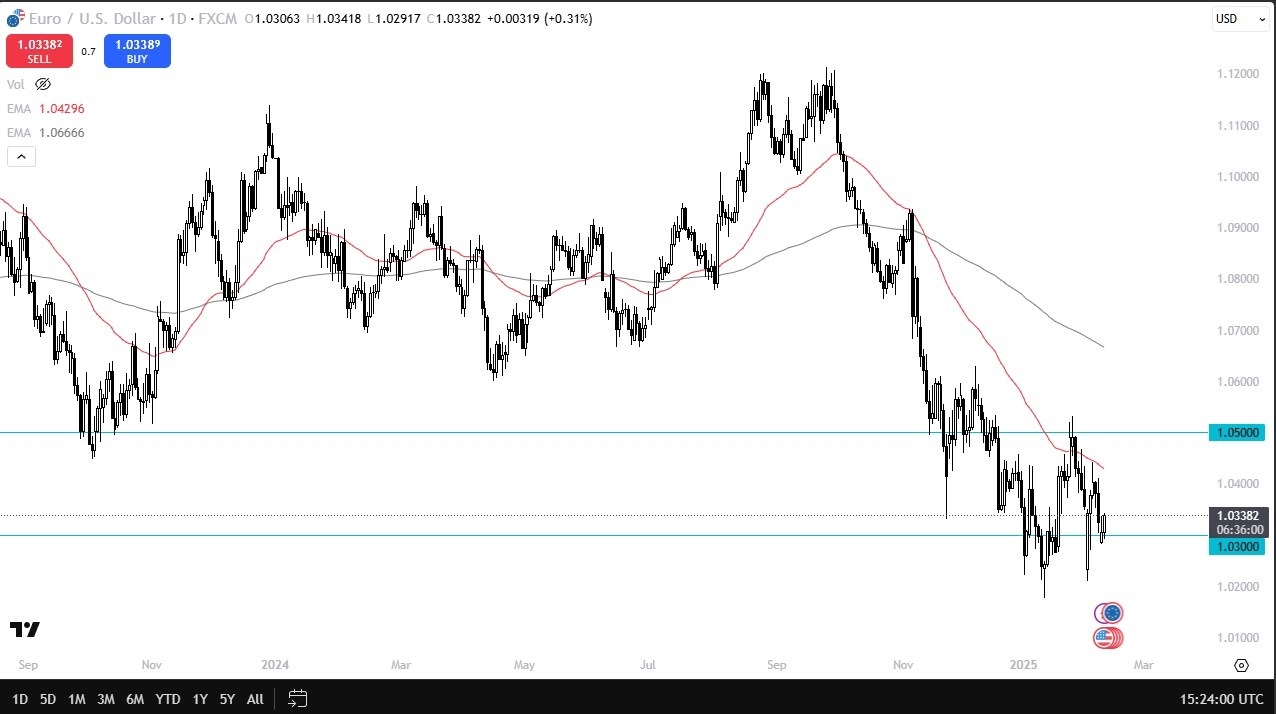
  • In my daily analysis of the EUR/USD pair, I continue to focus on the 1.03 level below.
  • This is an area that has acted as support on both Monday and Tuesday, and it’s also an area that’s been important multiple times in the past.
  • As things stand right now, think you got a situation where rally still have to be looked at with suspicion, as the European Union is most certainly lagging the United States.

Side note, it’s worth noting that the European Union has roughly the same size economy that it had 20 years ago, while the United States has doubled its economy. This is a thing that tells you everything you need to know.

Technical Analysis

I believe that the technical analysis for this market is still very negative, but that doesn’t necessarily mean that you want to short market at extremely low levels. In fact, I would like to see a bit of a bounce so that I can start fading again. This is how I traded in this EUR/USD market for about 2 months now, and so far, it’s worked out quite nicely. The 50 Day EMA is near the 1.0425 level and is dropping. I think that more likely than not will end up being an area that a lot of sellers will enter.

What I need to see is a higher and a long wick to the upside showing signs of exhaustion. As far as buying is concerned, I have no interest in doing so, at least not until we break above the 1.06 level. The level of 1.06 is roughly where the 200 Day EMA is currently sitting at. It’s not until we break above all of that that I think you have a situation where the euro starts to take off to the upside for a sustainable move. Anything between now and then is probably just going to be in the vein of an opportunity to “pick up cheap US dollars.”

Ready to trade our EUR/USD analysis and predictions? Here are the best European brokers to choose from.

Source link

12 02, 2025

The GBPJPY achieves big gains – Forecast today – 12-2-2025

By |2025-02-12T20:57:07+02:00February 12, 2025|Forex News, News|0 Comments

The GBPJPY pair succeeded to activate the bullish track, taking advantage of the stability of the major support at 187.00 to form many bullish waves by reaching the previously targeted barrier at 189.50.


Also, resuming the bullish attack this morning and recording additional gains by reaching 191.25 confirm its regain to the bullish bias, to expect getting positive momentum by stochastic to reach 192.30 level soon, followed by attempting to test the MA55 at 193.55.


The expected trading range for today is between 189.70 and 192.30


Trend forecast: Bullish


Source link

12 02, 2025

Surges to near 159.60 as Japanese Yen languishes across the board

By |2025-02-12T18:56:18+02:00February 12, 2025|Forex News, News|0 Comments

  • EUR/JPY soars to near 159.60 amid a notable weakness in the Japanese Yen.
  • BoJ Ueda warned that food prices could rise and impact inflation expectations.
  • ECB Galhau cautioned that Trump’s tariffs would have negative impacts on the Eurozone.

The EUR/JPY pair extends its winning spell for the third trading day on Wednesday. The pair strengthens as the Japanese Yen (JPY) weakens across the board despite firm market speculation that the Bank of Japan (BoJ) will continue raising interest rates.

Japanese Yen PRICE Today

The table below shows the percentage change of Japanese Yen (JPY) against listed major currencies today. Japanese Yen was the strongest against the Australian Dollar.

  USD EUR GBP JPY CAD AUD NZD CHF
USD   0.37% 0.43% 1.16% 0.32% 0.77% 0.73% 0.20%
EUR -0.37%   0.06% 0.78% -0.05% 0.38% 0.34% -0.18%
GBP -0.43% -0.06%   0.71% -0.12% 0.32% 0.29% -0.24%
JPY -1.16% -0.78% -0.71%   -0.80% -0.36% -0.41% -0.93%
CAD -0.32% 0.05% 0.12% 0.80%   0.45% 0.40% -0.12%
AUD -0.77% -0.38% -0.32% 0.36% -0.45%   -0.04% -0.57%
NZD -0.73% -0.34% -0.29% 0.41% -0.40% 0.04%   -0.53%
CHF -0.20% 0.18% 0.24% 0.93% 0.12% 0.57% 0.53%  

The heat map shows percentage changes of major currencies against each other. The base currency is picked from the left column, while the quote currency is picked from the top row. For example, if you pick the Japanese Yen from the left column and move along the horizontal line to the US Dollar, the percentage change displayed in the box will represent JPY (base)/USD (quote).

The BoJ raised its key borrowing rates by 25 basis points (bps) to 0.5% in the January policy meeting as inflationary pressures remain well above the 2% target for longer. BoJ officials have also guided a hawkish monetary policy outlook on the assumption that wages would continue to grow.

Earlier in the day, BoJ Governor Kazuo Ueda warned that “food prices may continue to remain high” and will impact “people’s mindsets and price expectations”, Reuters report.

Meanwhile, the Euro (EUR) outperforms its peers despite deepening fears of potential tariffs by United States (US) President Donald Trump on the Eurozone. Donald Trump is poised to announce reciprocal tariffs sooner and market participants expect that Eurozone will face higher levies on auto. The European Union (EU) charges 10% tariffs on imports of automobiles from the US and pays 2.5% import duty for domestic autos supplied to them.

In European trading hours, European Central Bank (ECB) policymaker and Bank of France head Francois Villeroy de Galhau warned that Trump’s trade policies would most likely have a “negative impact on the economy.” 

EUR/JPY bounces back strongly after revisiting the four-month low around 156.00. The asset retraces to near the 20-day Exponential Moving Average (EMA), which trades around 159.80. The 14-day Relative Strength Index (RSI) returns into the 40.00-60.00 range, which indicates that the bearish momentum has ended for now.

Going forward, a decisive move by the pair above the February 5 high of 160.30 would open doors for the February 3 high of 160.84, followed by the January 30 high of 161.80.

On the flip side, a downside move by the cross below the February 10 low of 155.67 would expose it to the August 5 low of 154.40 and 7 December 2023 low of 153.17.

EUR/JPY daily chart

Euro FAQs

The Euro is the currency for the 19 European Union countries that belong to the Eurozone. It is the second most heavily traded currency in the world behind the US Dollar. In 2022, it accounted for 31% of all foreign exchange transactions, with an average daily turnover of over $2.2 trillion a day. EUR/USD is the most heavily traded currency pair in the world, accounting for an estimated 30% off all transactions, followed by EUR/JPY (4%), EUR/GBP (3%) and EUR/AUD (2%).

The European Central Bank (ECB) in Frankfurt, Germany, is the reserve bank for the Eurozone. The ECB sets interest rates and manages monetary policy. The ECB’s primary mandate is to maintain price stability, which means either controlling inflation or stimulating growth. Its primary tool is the raising or lowering of interest rates. Relatively high interest rates – or the expectation of higher rates – will usually benefit the Euro and vice versa. The ECB Governing Council makes monetary policy decisions at meetings held eight times a year. Decisions are made by heads of the Eurozone national banks and six permanent members, including the President of the ECB, Christine Lagarde.

Eurozone inflation data, measured by the Harmonized Index of Consumer Prices (HICP), is an important econometric for the Euro. If inflation rises more than expected, especially if above the ECB’s 2% target, it obliges the ECB to raise interest rates to bring it back under control. Relatively high interest rates compared to its counterparts will usually benefit the Euro, as it makes the region more attractive as a place for global investors to park their money.

Data releases gauge the health of the economy and can impact on the Euro. Indicators such as GDP, Manufacturing and Services PMIs, employment, and consumer sentiment surveys can all influence the direction of the single currency. A strong economy is good for the Euro. Not only does it attract more foreign investment but it may encourage the ECB to put up interest rates, which will directly strengthen the Euro. Otherwise, if economic data is weak, the Euro is likely to fall. Economic data for the four largest economies in the euro area (Germany, France, Italy and Spain) are especially significant, as they account for 75% of the Eurozone’s economy.

Another significant data release for the Euro is the Trade Balance. This indicator measures the difference between what a country earns from its exports and what it spends on imports over a given period. If a country produces highly sought after exports then its currency will gain in value purely from the extra demand created from foreign buyers seeking to purchase these goods. Therefore, a positive net Trade Balance strengthens a currency and vice versa for a negative balance.


Source link

12 02, 2025

Pound Sterling bulls retain control after reclaiming technical hurdle

By |2025-02-12T16:55:15+02:00February 12, 2025|Forex News, News|0 Comments

  • GBP/USD holds near 1.2450 after posting strong gains on Tuesday.
  • The technical picture highlights sellers’ hesitancy in the near term.
  • The US economic calendar will feature January inflation data.

Following the bearish action seen at the beginning of the week, GBP/USD reversed its direction on Tuesday and gained more than 0.6%. Ahead of the key January inflation data from the US, the pair holds above key technical area.

British Pound PRICE This week

The table below shows the percentage change of British Pound (GBP) against listed major currencies this week. British Pound was the strongest against the Japanese Yen.

  USD EUR GBP JPY CAD AUD NZD CHF
USD   -0.41% -0.37% 1.46% 0.16% -0.06% 0.37% 0.14%
EUR 0.41%   0.11% 1.99% 0.69% 0.35% 0.87% 0.64%
GBP 0.37% -0.11%   1.72% 0.55% 0.24% 0.76% 0.52%
JPY -1.46% -1.99% -1.72%   -1.32% -1.43% -1.07% -1.28%
CAD -0.16% -0.69% -0.55% 1.32%   -0.19% 0.18% -0.04%
AUD 0.06% -0.35% -0.24% 1.43% 0.19%   0.52% 0.28%
NZD -0.37% -0.87% -0.76% 1.07% -0.18% -0.52%   -0.24%
CHF -0.14% -0.64% -0.52% 1.28% 0.04% -0.28% 0.24%  

The heat map shows percentage changes of major currencies against each other. The base currency is picked from the left column, while the quote currency is picked from the top row. For example, if you pick the British Pound from the left column and move along the horizontal line to the US Dollar, the percentage change displayed in the box will represent GBP (base)/USD (quote).

The US Dollar (USD) came under selling pressure on Tuesday, allowing GBP/USD gain traction. The lack of fresh headlines surrounding US President Donald Trump’s trade policy and Federal Reserve (Fed) Chairman Jerome Powell’s hesitancy to offer fresh insight into the policy outlook helped market mood improve in the American session.

On the first day of his congressional testimony on the semi-annual Monetary Policy Report, Powell repeated that they do not need to be in a hurry to adjust the monetary policy. He added that it’s not for the Fed to comment on tariffs and explained that they will follow incoming data to assess the effects of the trade policy.

In the second half of the day, January Consumer Price Index (CPI) data from the US will be watched closely by market participants. On a monthly basis, the core CPI, which excludes volatile food and energy prices, is forecast to rise 0.3%. A stronger increase than expected could support the USD with the initial reaction and cause GBP/USD to turn south. Conversely, a soft monthly core inflation reading of 0.2% or lower could have the opposite impact on the pair’s action.

Early Thursday, the UK’s Office for National Statistics (ONS) will publish the Gross Domestic Product (GDP) data for the fourth quarter.

GBP/USD Technical Analysis

GBP/USD holds comfortably above the ascending trend line and the 200-period and the 100-period Simple Moving Averages (SMA), reflecting the bullish bias. Additionally, the Relative Strength Index (RSI) indicator on the 4-hour chart stays above 50.

In case GBP/USD confirms 1.2450 (Fibonacci 50% retracement of the latest downtrend) as support, it could target 1.2500 (round level, static level) and 1.2530 (Fibonacci 61.8% retracement) next. On the downside, supports could be seen at 1.2415 (100-period SMA) and 1.2380-1.2370 (200-period SMA, Fibonacci 38.2% retracement, ascending trend line).

Pound Sterling FAQs

The Pound Sterling (GBP) is the oldest currency in the world (886 AD) and the official currency of the United Kingdom. It is the fourth most traded unit for foreign exchange (FX) in the world, accounting for 12% of all transactions, averaging $630 billion a day, according to 2022 data. Its key trading pairs are GBP/USD, also known as ‘Cable’, which accounts for 11% of FX, GBP/JPY, or the ‘Dragon’ as it is known by traders (3%), and EUR/GBP (2%). The Pound Sterling is issued by the Bank of England (BoE).

The single most important factor influencing the value of the Pound Sterling is monetary policy decided by the Bank of England. The BoE bases its decisions on whether it has achieved its primary goal of “price stability” – a steady inflation rate of around 2%. Its primary tool for achieving this is the adjustment of interest rates. When inflation is too high, the BoE will try to rein it in by raising interest rates, making it more expensive for people and businesses to access credit. This is generally positive for GBP, as higher interest rates make the UK a more attractive place for global investors to park their money. When inflation falls too low it is a sign economic growth is slowing. In this scenario, the BoE will consider lowering interest rates to cheapen credit so businesses will borrow more to invest in growth-generating projects.

Data releases gauge the health of the economy and can impact the value of the Pound Sterling. Indicators such as GDP, Manufacturing and Services PMIs, and employment can all influence the direction of the GBP. A strong economy is good for Sterling. Not only does it attract more foreign investment but it may encourage the BoE to put up interest rates, which will directly strengthen GBP. Otherwise, if economic data is weak, the Pound Sterling is likely to fall.

Another significant data release for the Pound Sterling is the Trade Balance. This indicator measures the difference between what a country earns from its exports and what it spends on imports over a given period. If a country produces highly sought-after exports, its currency will benefit purely from the extra demand created from foreign buyers seeking to purchase these goods. Therefore, a positive net Trade Balance strengthens a currency and vice versa for a negative balance.


Source link

Go to Top